Showing posts with label Chaparral Institute. Show all posts

Thursday, May 16, 2013

Establishing a Forest where the Experts said it would Fail

Please don't be offended by this "Tunnel Vision Science" meme. I'm not really an anti-science Luddite, but I've been considered one by many sciencey types who insisted I didn't know what I was talking about. Especially where it comes to rejecting what is supposed to be progressive mjodern science which knows better than Nature, because well, Nature is after all imperfect and flawed. You see there is this little religious dogma called "Argument from Poor Design" which was fabricated decades ago to help evolutionists argue with right-wing Fundies in those asinine time wasting origins debates. But I love it when amazing things out in nature overturn strongly entrenched conventional Paradigms. This argument from poor design has done more to hold back good science and our correct understanding of the natural world more than anything else. You know, when I write a post about habitat restoration or Urban Landscaping & making practical application of things learned and observed in Nature, my personal interest for the most part is not to try and impress the prevailing conventional scientific orthodoxy which often times I find ideologically driven. It's to help others. Let's take the U.S. Forest Service officials who informed me by letter back in the early 1980s, that any forest establishment in Anza Valley would never work after I requested their advice on Forest practices. After all, who would know better than those US Forest Custodians with those much coveted titles before their names and alphabet soup initials after their names on a business card, right ? I've been at odds with many of the local Forest officials in the San Jacinto Mountains for almost 2+ decades and many were actually friends. But changing their policy (worldview), methods and land maintenance applications, that's just way too much red tape ribbon cutting for me. Mostly I've enjoyed simply helping out the average home owner or land holder who actually cares about their little slice of paradise and are looking for real natural world viable alternatives that the conventional wisdom rejects because it doesn't fit their worldview of a conventional paradigm. I think influencing the average property owner who cares makes more sense, because collectively they can actually outnumber most Government landholdings. A Home owner has no political agendas or baggage which motivate what they do, other than beautifying their own place and if done properly make a true success to be replicated by fellow neighbours. Although these folks have to be taught this along proper guidelines. Unfortunately while many rural folks are sincere and well meaning and believe what they are doing is the right thing, they haven't had the best of examples when it comes to reforestation of the native landscape. Perhaps collectively, with the correct education, they can embarrass the largest landowner into submission, or at least get them to take notice. I seriously want the average person to succeed at their own pet projects on their land. I also want the Forestry to succeed, but under the correct methods. I've also seen what private people can do to land when they don't care and  pursue improper land stewardship which comes from ignorance. No one is at fault for being ignorant, but it is your fault if you choose to stay that way. But everyone can learn something new if they are humble, open minded and have the passion and willingness to take a complete turn around view of how nature actually works and develop practical applications from the things observed. This past weekend I revisited some of my own older pet projects up in Anza California from about three decades ago.

One of the first projects was back at the end of 1983, I got an privilege to be caretaker of a property for former Terwilliger (ANZA) residents Ken and Linda Dawson (now long since gone to Arizona last I heard). They gave me free rent and I in exchange watched and helped maintain their property. I had already experienced doing things the conventional way I learned in School with regards Forestry and Agriculture and I failed whenever I made practical application from the official version of habitat restoration techniques. Some things learned were good, but I also found ways to improve upon them. As I've previously written here on this and my other blog, I used already existing Nurse Plants or Mother Trees to establish and facilitate native tree or other plant restoration. The official Forestry tree planting programs and policies almost always even to the present day call for stripping the land of what they mistakenly believe are  competing chaparral brush and other plants deemed unworthy of existence in favour of trees. So most reforestation projects call for techniques which mimic a home gardener or large scale industrial Farmer. But Nature doesn't work like that. To interest the Dawson's and 4 other Terwilliger & Anza residents to go for improving their landscape with native forest trees, I revealed to them a program where the California Department of Forestry through a Nursery called L.A. Moran in Davis California would sell them bare root trees suited to their area climate and elevation for mere pennies a piece. This also offered some Tax advantages which sweetened the pot. Of course there was a catch. There was a minimum 250 trees per species they had to purchase. The project also couldn't be done for nursery resale profit. Their motive was to improve their wildland and to make the idea extra tasty, I gave each of them official tax documentation where they could write off for seven years many benefits for doing so. I guess Charles Rasmussen [now deceased] benefited the most on the tax benefits. There were of course criteria for what were considered acceptable tree planting projects such as Christmas Tree Farm, Lumber Operation and/or things like growing trees for eventual firewood sales, even wildlife habitat improvement, but the transplanting of these trees into Nursery containers for any retail profiteering was absolutely forbidden. Now here's what happened next.

After holding a meeting back in November of 1983 with all five property owners, I explained just how we should proceed once the trees arrived. First you don't wait until the trees arrive to prepare your land. You do all of this well ahead of time because once they arrived there is an extremely tiny window of opportunity to transplant these bare root packaged trees from their airtight sealed containers which retain moisture out into their permanent location. If delicate tree roots even remotely dry out, the root hairs are destroyed and your project will never establish. If the trees are left too long in their packaging they will rot or mold. As far as land preparation, the main message I wanted to get across was NOT to totally strip and  remove chaparral shrub vegetation from their properties. But rather selectively weeding out less vigorous shrubs was okay, but the majority should stay. Only ONE resident (Dawsons) did what I recommended. Ken Dawson had a really kool small scale tractor with tiny backhoe for which he was very skillful at using with meticulous precision. The other residents totally stripped their land down to bare exposed soil and installed irrigation lines. One of them listed instructional info from the U.S. Forestry & L.A. Moran Nursery as reasons for going ahead and doing what the US Forest Service recommended. Whatever! ALL properties eventually lost most all of their tree plantings, with ONLY the Dawson family being successful. They also used irrigation for a few years but mostly as an establishment measure which would replicate an area's wet rainy period (El NiƱo) which cycles back and forth in Nature. What Ken, Linda and I did was to be selective in removing older diseased looking chaparral, but left all healthy looking Scrub Oaks, Manzanitas, Sugarbush, Largest Redshanks or Ribbonwoods, old growth Mountain Mahogany & Chamise (Greasewood). It was until a decade later when I found Chamise & Redshank to be the best Nurse shrubs for Pine & Oaks. It would be a further two decades before somebody with credentials confirmed this in a study on how Ecto-Mycorrhizae (Pioslithus Tinctorius) would colonize both chaparral shrubs in wet periods allowing pine and oak seedlings to form a bond for better survival. Yet still to this day it's rarely spoken of. 

[On an interesting note here, after the partial clearing the land and transplanting the bare root trees, we also noticed Sugarbush and Manzanita seedlings began making an appearance that summer, but no fire necessary for germination. Hmmmm, I feel a paradigm shift coming] 

Image: Ryan R600

The photo above is illustrative to understanding the actually scale of the small backhoe Ken used in the selective removal of shrubs without damaging the entire underground mycorrhizal network. The rule I've always followed is leaving between 40% - 60% of the native chaparral. We planted all 500+ trees which included Coulter Pine, Jeffrey Pine and Incense Cedar. The Anza Chiropractor, Eugene Abbott,  retired Bell Telephone guy Charles Rasmussen (deceased now) and one other nearby resident's trees all failed. Two years ago I stopped by Rasmussen's old place at the far west side of Lightning Road and one single short stunted pine tree was left. The log cabin Washburn's place on the north side of the property next to Lightning Rd was stripped bare and plowed with a tractor and trees planted in very even concentrated rows. Take a look below at what is left of the 500+ trees they planted as we drove by on Tuesday. The Dawson's place was planted mostly by Ken and Linda and myself when they came up from their main place in Vista CA on the weekends. Seeing this has been a huge reward even though it belongs to other folks.
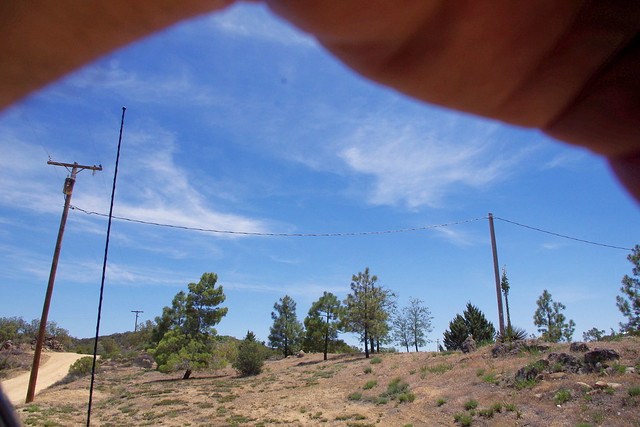
This photo on the right is the Poverty Hill Ranch owned by Elgie Washburn. Although Elgie and his wife Lucille lovingly watered by hand and cared for their trees, this is what they have left of all those Jeffrey and Coulter Pines from the front view on Lightning Road. They really did work hard though on watering those trees by hand in the beginning. I almost wished now I had thought to bring over some of my mycorrhizal mix to inoculate their trees as well. This photo was taken from Mary Ann Kiger's truck passenger side. It does look like they thinned them out pretty good. Actually it wouldn't hurt to give them all a shot of inoculation dose of MycoApply and see what the results would be next year. More trees are out of view to the right of the photograph here. Dawson's place is just ahead as you turn left onto Thunder Road  and down to the last house at the dead end.

Photo Credit: Mine

Lessons Learned from the Bajadas (Alluvial Fans)

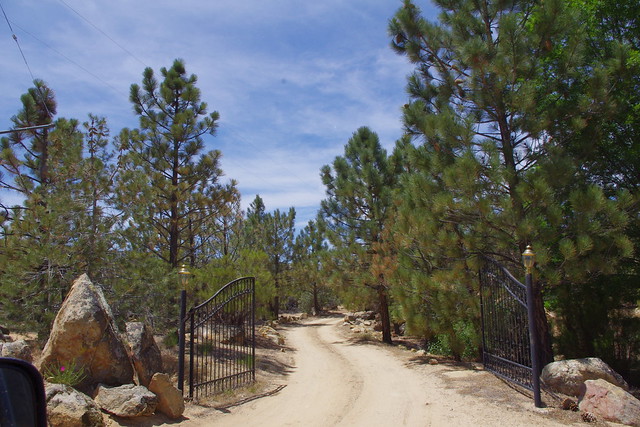
This is the entrance to Ken and Linda Dawson's old place which I was caretaker for a couple of years. We left 60% of the Chaparral species of healthy plants in place and 40% at other locations depending on the geology. Even after clearing some areas by hand, we left the underground biological grid intact and actually newer seedlings of Sugarbush and Holly Leaf Cherry germinated among the pine seedlings we transplanted. In fact so did a couple Manzanitas, no fire required as insisted upon by the scientific literature. At the beginning, I inoculated with Pisolithus tinctorius collected in Burnt Valley area and some years later with a Mycorrhizal mix from PHC.  Ken installed an extensive above ground drip system to run for the first few years to replicate a good wet season. Thereafter the system was slowly shut way  down until it wasn't a necessity any longer. The present state of that irrigation is dismantled now anyway. I have no irrigation issues in the beginning for establishment of plants. This replicates a period of good winter rainy season followed by good monsoonal moisture where many systems (especially alluvial plain Riparian ecosystems) get their natural foothold established. There is a natural precedent for following this rule in a post I wrote on "Lessons from a Bajada (Alluvial Fan)".

Photo Credit: Mine
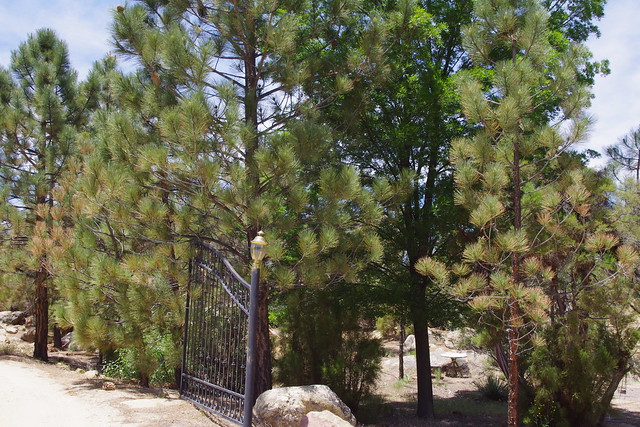
This shot to the right of the gated entrance shows also a Black Locust and other trees in the back ground like Incense Cedar. The Cedars did not fare as well, but there are some further up the drive as well as larger Jeffrey & Coulter Pines. HOWEVER - there is a vicious Pit Bull at the newer owner's house and other Dogs. DO NOT go to this house and inquire of anything. I have no idea who the present owner's are, but I drove up there to introduce myself and explain some of the history background of the place, but my VW Bug was attacked by this almost demonic expression looking Pitbull and it scratched the Driver door and tore off the rocker panel to where it dragged the road and I had to stop and repair it with some wire someone gave me. Seriously, DO NOT drive onto this property and get out of your car if you visit this place.
Photo Credit: Mine
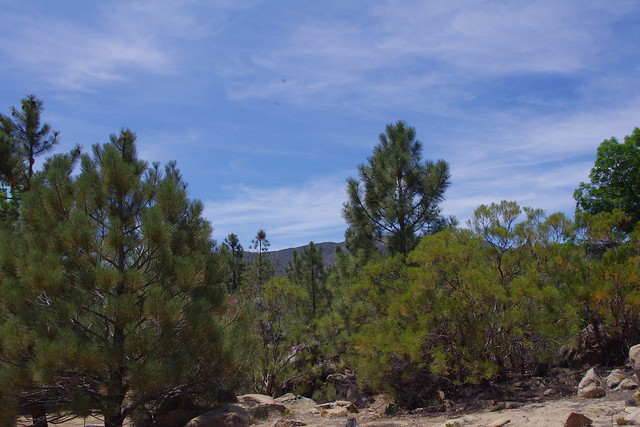
This view at the dead end part of the road shows the still intact Redshanks and Manzanitas. These were old growth chaparral which were left intact because of their deep rooted infrastructure and their beautiful appearance. The pine tree establishment success however reveals that the chaparral's presence meant much more. The beauty is that unlike the other property owners, Ken & Linda left the ground intact which saved the already existing underground fungal network which benefited the Pines who merely tapped into the system.
Photo Credit: Mine
This shot allows you to see closer up some of the Incense Cedar which made it. There are also chaparral plants in the background here. I believe the Dawson's and Washburn's also shared some Knobcone Pines, but not many of them made the transplant. I think Washburn's Knobcone pines may have done even better than the Dawson's Knobcones.
Photo Credit: Mine
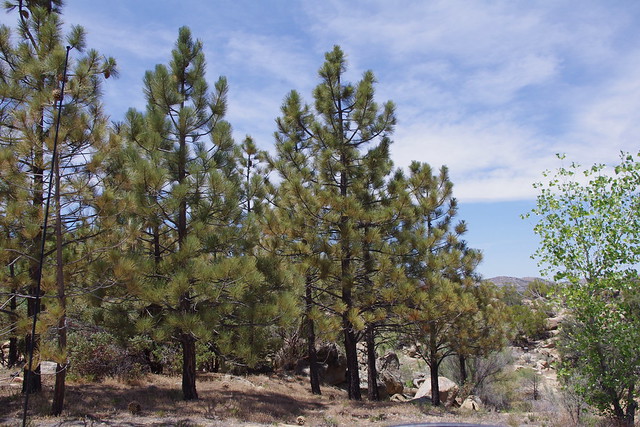
Finally this is the tail end of the Thunder Road dead end cul du sac. Notice the Manzanita and Greasewood still existing among the Jeffrey and Coulter Pines ? I have to admit I wasn't expecting much as with everything else that has gone wrong in So-Cal, but like the weed infested hill in El Cajon where I attempted to re-establish a completely ruined ecosystem, this trip back was truly an encouragement to all Nature loving folks who wish to reclaim land as well as saving prized wild landscapes. Here was that earlier article:
Note to All Eco-Activists: Why not challenge yourself to restore the Land that was Lost ? 
Just a quick note to all those Eco-Activism folks who may get their knickers in a twist over the above title. It was meant as a teaching point and not a slam on your favourite 1960s styled activism protest cause. If you didn't read it through then you missed the main import of the post which was not a slam against your saving something some where out in Nature, but rather to point out some most often overlooked areas within city limits for which to rehabilitate. These overgrown non-native weed annuals on ruined lands closer to cities are so easy to dismiss and/or write off, but they were at one time as pristine as areas you want to save further out in any wilderness. Also, they are closer to home and so access is generally easier for busy people trying to make a living. Hands on work with plants is most educational, more so than mere reading of books or internet sites and the outdoor experience tends to burn important instructional teaching points into your memory banks, even when you make mistakes, you can learn from these as well.
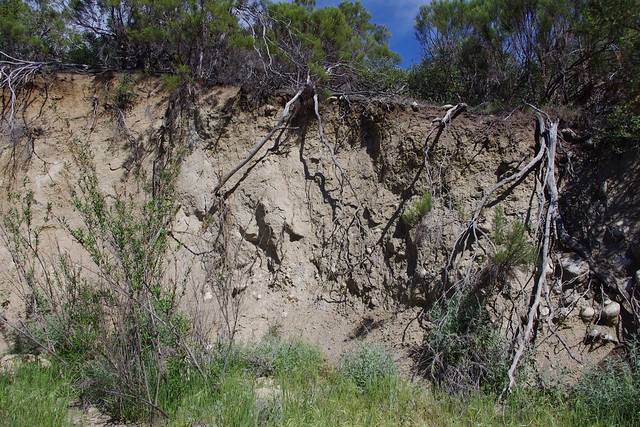
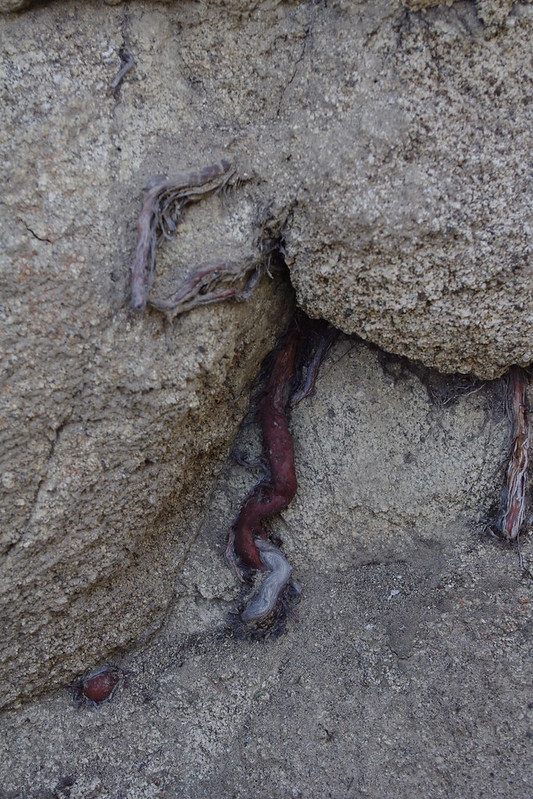
These next series of photos are merely illustrative of the natural mechanics of how an early developing Forest system survives within the Chaparral Plant Community. That Dawson property above has some of the lousiest rocky hard adobe soil and what most average folks would consider terrible Landscape or Gardening canvas. The land referenced above is a giant boulder strewn, rocky fractured underground with decomposed sterile looking granite with a lot of red hard adobe-like clay which is hard as a rock when dry, but slick as snot when wet. Most people in their conventional right mind would never think of attempting what we did here. Ken Dawson said that the real estate people informed him that they couldn't sell this last piece at the end of the road just because of that bad condition of the land. But he loved the rocks as his family was into crystal mining down over in the mountains above the Pala Indian Reservation in San Diego County. Even the well water here has seriously nasty high iron content which is hardly suitable for drinking and also quite often screwed up irrigation lines and indoor plumbing without a major filtration system attached to the Well itself. These first three photos below are of the hike I took with two friends on Tuesday where we documented the unnatural erosion cut above Hwy 74 which was to allow the road department the luxury of not having to build a bridge which would have upped the construction costs. In so doing they gouged a gully in the higher ground of the wild landscape which severely has eroded sharp steep cuts into this part of the Earth. There is clearly nothing natural about this newer stream bed here which normally takes hundreds or even thousands of years to create and settle to conform with the surrounding landscape and eventually to establish itself with riparian species which for the most part are completely missing here, unlike the former stream course which is still performing wonderfully with rich diversity of streamside habitat plant life by underground moisture. Take a look at the next three photos and see what has happened. Keep in mind I am merely illustrating what chaparral plants do underground and how they allow trees to encroach on their habitat and actually help them to succeed.
All Three Photos: Mine
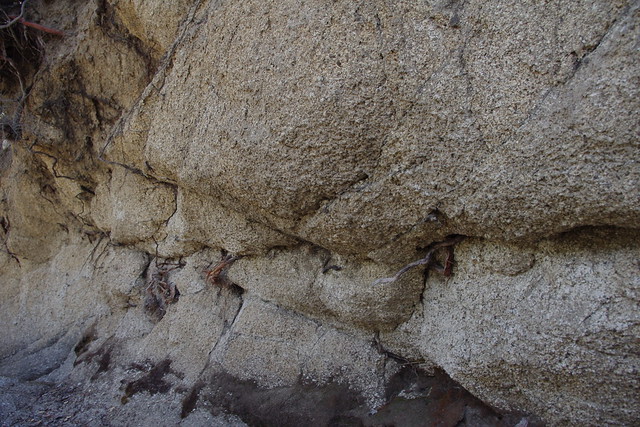
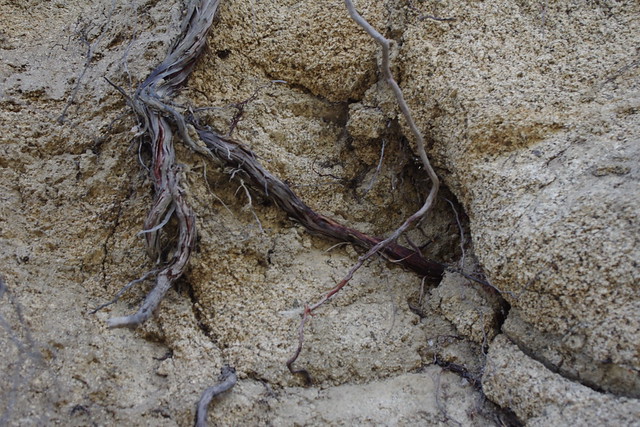
The top two were actually shots taken side by side. The last one is the rocky side where the granite boulders have slid down in the erosion cuts as a result of being undermined by a torrent of winter water flows. While this action which took place decades ago is sad, they are however illustrative of the obvious unnaturalness of this creek which is no more than an eroded wash or desert dry gully. But there is a learning experience here from the exposure of the deep underground chaparral plant networks which should not go unnoticed.


All Three Photos: Mine
I've taken these photos to illustrate the 12 to 15 foot depth of what can clearly be identified as Greasewood or Chamise, Manzanita and Redshank or Ribbonwood. Think of these constructs as living biological mechanical plumbing infrastructure for supporting a larger system we call a forest. There are never any good reasons for making a slam against Chaparral plants, but rather a praise for the major positive contribution they make as to their importance within any ecosystem. People need to also keep in mind how most chaparral facilitates water movement deep underground even when they are dormant in winter months. Rain water when it falls, by nature will run off and will not soak deep on it's own, but certain plants will inject the soils within it's deeper layers with generous amounts of moisture to fill water deeper table aquifers and for later use in the topsoil system during dry periods for all vegetation's benefit.

Two Important Phenomena in Nature Illustrated Below which Explain Water Movement in Soils 

Hydraulic Lift & Redistribution

Both phenomena, hydraulic lift & hydraulic descent, are imperative for healthy plant ecosystems. Removal of deep rooted shrubs and trees from off the surface of the land destroys this natural biological hydrological system. The Hydraulic Lift and Redistribution of deep subsoi moisture by deeply rooted plants pulls water up from deeper layers of the ground and redistributes this life saving moisture to more shallow rooted plants. The mycorrhizal grid network will further enhance this process as all plants are interconnected.

The other opposite phenomena known as hydraulic descent is a process of when plants (shrubs & trees) are dormant during winter or rainy season months and not actively growing, but have the ability to take abundant surface water from upper rain soaked layers and pump it down deep into the earth to be later used during summer months and or facilitate water table and aquifer levels. Most people have no idea this goes on and how purchasing rural land acreage and hiring the local Joe Six-Pack to bulldoze and clear your land is working against your own interests. Yet this is exactly what the US Forest Service for decades has recommended for planting and estaaablishing of plantation trees for reforestation. Strip land and lightly till prior t tree planting. The myth is that chaparral is an evil competitor for water and nutrients and this is completely false. Redshank or Ribbonwood (Adenostoma sparsifolium) & Chamise or Greasewood (Adenostoma fasiculatum) are some of the deepest rooted shrubs and therefore make perfect facilitatirs of Hydraulic Lift & Descent. Add to that PT Mycorrhizal associations and you will more than double the growth of Pine & Oak than the methods espoused by the US Forest Service science-based recommendations.

Hydraulic Descent
Below here is a great animation by Bert Wilson on his Las Pilitas Nursery website which illustrates the value and potential of transforming what looks otherwise like a worthless rocky piece of land like that of Ken Dawson's property. Native trees and shrubs in this area will always find a way to break through the hard-pan or bedrock subsurface regions of a tough soil profile and find a way to tap into moister layer which are indeed down there, whether or not it appears that way to you on a first impression basis.

Bert Wilson: Las Pilitas Nursery
I can't preach and sermonize enough about the importance of leaving most existing chaparral plants within your landscape alone and injecting the soil when transplanting trees with a good healthy diverse species blend of Mycorrhizal and beneficial Bacteria mix. Replicating initially a period of wet rainy season for the first few years through extensive drip irrigation and then tapering off to hands off watering after a few years are essential for allowing your forest system to develop an incredible infrastructure underground which will sustain the system thereafter, even enough to weather some drought years with little attention. Most Land Barons or Home owners make the terrible mistake of leaving their drip irrigation on for life and that makes plants dependent. It creates a type of flawed system on artificial life support. It doesn't work. It's a lot like Welfare. Welfare, while it may have had an original noble motivational beginning has never worked in the USA or Europe for that matter in the making of productive citizens since they are never  truly encouraged to be weaned off the support system. It makes people lazy or unable to care for themselves and dependent on the entitlement meal ticket they were never weaned off from. Care for plants will actually work the same identical way, and if you don't believe this, take a tour of most people's properties who have never taken their landscape off the drip system. Maybe the video by Northwestern Forest Soils Biologist Suzanne Simard is again appropriate here on how a forest works.


Here are some great recent Studies which have been told time and again, but more proof of how Nature works under the ground: 
ScienceShot: Shhh, the Plants Are Talking
Plants Talk: Seedlings Thrive with Encouraging 'Words'
Fungus network 'plays role in plant communication'
PHYSORG: Plants use underground networks to warn of enemy attack
~~~~~~~~~~~~~~~~~~~~~~~~~~~~~~~
Here are the best info standbys for local So-Cal Plant information and education:
The California Chaparral Institute
Mycorrhizal Applications Inc & MycoApply
~~~~~~~~~~~~~~~~~~~~~~~~~~~~~~~
Native Plant Purchase & Educational Resources:
http://www.laspilitas.com/
Tree of Life California Native Plant Nursery


Wednesday, October 31, 2012

Rebuilding Ecosystems After a Man Made or Natural Disaster

Now that Hurricane Sandy has passed and the News Reporter's  Cameras can reveal to us the destruction aftermath in living colour, people now must strategize and calculate the costs of rebuilding. Not just there homes, but also their landscapes and private wildland acreages, if they are so lucky to own them. Even now plans are being made to harvest any downed trees in what are called Salvage Forestry Operations. Whether State or Private Landowners, the opportunity to make some quick CA$H especially in times of shaky economy would seem to make Dollar $ense. But is this the best way to rebuild the wild woodlands across these regions ? How do such policies really effect the future forest resources economy ? Are the conventional methods of U.S. Forest Service restoration techniques going to truly be the best for all concerned when it comes to the complete picture ? What exactly is the best strategy for rehabilitating and restoring a devastated ecosystem ? Would you believe DO NOTHING at all ??????
(Edwin Torres - Yahoo Contributor Network)
Hurricane Sandy countless giant trees such as these in this New Jersey Neighbourhood. It's called, rebuild Nature's Way or hitting the Highway!

photo by Richard Halsey
 California Chaparral Institute

http://www.californiachaparral.com/
Incredible as these natural or un-natural disasters are which seem to occur on a regular basis in the News Reports these days, it's clear that attempts at working against Nature as opposed to working with Nature can actually have long lasting damaging consequences. I can understand wanting to put back something once beautiful back the way it was. I can understand and relate personally to the feeling of impatience that an imperfect human being has in wanting results NOW as opposed to actually being patient and waiting for natural processes engineered into every ecosystem to do it's work. Especially since there is this nagging feeling that I may feel I'll never see nor experience such pristine old growth scenery again. Let's face it, we all have short life spans and are driven to less than ideal behavior as a result. Cuyamaca State Park in San Diego County is a prime example. I always considered it to be the wild pristine Old Growth Yosemite of Southern California.  In that one fatal decision of a single irresponsible individual Hunter, thousands of years of building and development of a breath taking natural resource are gone in less than a week. Of course logic only dictates that there should be a measure of clean up and rebuilding.  No one argues that. Yet patience, thinking and pondering a restoration project with a clear level head beforehand and not allowing desperate emotional hurried or rushed responses which cloud judgement are really what is necessary here. 
Previously I've written about many of the holistic approaches to building or rebuilding various ecosystems and pointed the readers here to much of the very logical research work done by Richard Halsey of the California Chaparral Institute and other publications and studies which made similar conclusions that after fire disasters, it should be a HANDS-OFF approach which is far more effective than rushing to remedy what is considered a bad situation. In fact it has been found that the long practiced land restoration techniques hinder natural rebuilding or actually create newer problems. Take for example these logical conclusions found at the Western Fire Ecology Center website where common sense approaches of HANDS-OFF have been found sufficient for ecosystem recovery. 
~~~~~~~~~~~~~~~~~~~~~~~~~~~~~~~~
There is no ecological need for immediate intervention on the post-fire landscape:
"With respect to the need for management treatments after fires, there is generally no need for urgency, nor is there a universal, ecologically-based need to act at all.  By acting quickly,. we run the risk of creating new problems before we solve the old ones. Ecologically speaking, fires do not require a rapid human response.  We should not talk about a "fire crisis" but rather of managing the landscape with the anticipation that fire will eventually occur.  Given the high degree of variability and high uncertainty about the impacts of post-fire responses, a conservative approach is warranted, particularly on sites susceptible to on-site erosion." 
And this is a logical conclusion in applying a restraint on the emotional tendency to interfere or force what is believed to be a faster recovery of a once pristine forested ecosystem. Too much interference has been proven to be a hindrance to recovery than of facilitating it. Allow natural recovery and recognize the temporal scales involved with ecosystem development.  Human intervention should not be permitted unless and until it is determined that natural recovery processes are not occurring.
"Human intervention on the post-fire landscape may substantially or completely delay recovery, remove the elements of recovery, or accentuate the damage.  Many such adverse consequences are difficult or impossible to predict or foresee in specific situations.  In this light there is little reason to believe that post-,fire salvage logging has any positive ecological benefits, particularly for aquatic ecosystems.  There is considerable evidence that persistent, significant adverse environmental impacts are likely to result from salvage logging, based on many past cases of salvage projects, plus our growing knowledge of ecosystem functions and land-aquatic linkages.  These impacts include soil compaction and erosion, loss of habitat for cavity nesting species, loss of structurally and functionally important large woody debris."
Well there you have it. Clearly land clearing of debris hinders growth and development. Removal of various components also creates a void in wildlife habitat by the absence of cavity nesting sites and early recovery vegetation which provides not only cover, but valuable food sources for both trees and animals. Often times this obsession with what are considered valuable tree species to the biased human eye are nothing more than "eye appeal" in the emotional minds of misguided researchers. There is more to the life and health of any ecosystem than mere vegetation. Richard Halsey recently pointed this out on his review of the present ongoing failed recovery policies of the Rancho Cuyamaca State Park in San Diego County. Here is a look at his Google+ Account Photo Gallery and I'll reference just three of his photos for reference on the flawed mindset of those in charge of land management who should know better. Click on each photo and read the accompanying text for the explanation.
Damaging Rancho Cuyamaca State Park

Image: Richard Halsey
This is a photograph of the cut fire line which attempts to eliminate unwanted species which are considered an "eye sore" and save what are considered valuable species for no other logical reason than they look prettier than CeanothusRedshank, or other chaparral which in reality make later succession of the desired species possible. This method above actually can set things back decades. On another observational note: Who in the world believes Manzanitas to be undesirable ???? =  Nonsense !!!

Notice the warning sign ? Plant Rehabilitation ?  

Richard Halsey's Response below:
"Piles of cut snags (dead trees) that would have provided important habitat, ceanothus, and manzanita. In an attempt to alter the natural post-fire recovery occurring after the 2003 Cedar Fire, park managers (influenced by the same folks at San Diego County's Department of Planning and Land Use who wanted to clear-cut thousands of acres of chaparral in the backcountry) are currently using heavy machinery to remove ceanothus, manzanita, and habitat rich snags (dead trees) from large areas of the park. This will be followed up by a questionable tree planting effort funded mostly by private corporations to acquire carbon credits."

photo credit by Richard Halsey
"Despite being warned by a park field botanist to not disturb this fragile riparian area, this stream bed was heavily impacted by equipment and cut debris."
Okay, so that is Richard Halsey's ongoing research at the California Chaparral Institute and studies which confirm his understanding of how the natural world's ecosystems really work (actually every type of ecosystem globally operates the same identical way). It should be noted that even the Western Fire Recovery Center's findings referenced above were from as far back as March 1995.  But oddly enough nothing seems to have changed as far as policies and management techniques. One has to wonder why such valuable information is shelved in a secret library somewhere and filed away under "Items Of Interesting Note", as opposed to being implemented in practical application and general practice. Are the findings by these people a mere philosophically driven some minority group ???  Not according to recent published findings in the National Science Foundation who published a study called - "In-Blown Forests: A Study of Survival" on October 16, 2012. This was an incredible study and understandable as to why it is only coming to light now. It took over a decade to unfold. In fact this study is what real science is all about. It employed simple common sense techniques involving the true definition of what the "Scientific Method" truly is and which in simple terms is to simply Ask a Question! - Do background research! - Construct a Hypothesis! - Test Your Hypothesis by Doing an Experiment! - Analyze Your Data and Draw a Conclusion! & finally Communicate Your Results! This experiment was so simple and easy that even a child could have done it in his/her School's Science Fair Projects. Here's what they found: - (SOURCE)
 http://www.nsf.gov/news/news_summ.jsp?cntn_id=125744
In newscasts after intense wind and ice storms, damaged trees stand out: snapped limbs, uprooted trunks, entire forests blown nearly flat. 
In a storm's wake, landowners, municipalities and state agencies are faced with important financial and environmental decisions. 
A study by Harvard University researchers, supported by the National Science Foundation (NSF) and published in the journalEcology, yields a surprising result: when it comes to the health of forests, native plants and wildlife, the best management decision may be to do nothing.
Salvage logging is a common response to modern storm events in large woodlands. Acres of downed, leaning and broken trees are cut and hauled away. 
Landowners and towns financially recoup with a sale of the damaged timber. But in a salvaged woodland landscape, the forest's original growth and biodiversity, on which many animals and ecological processes depend, is stripped away. 
A thickly growing, early-successional forest made up of a few light-loving tree species develops in its place. 
But what happens when wind-blown forests are left to their own devices? 
The Ecology paper reports results of a 20-year study at NSF's Harvard Forest Long-Term Ecological Research (LTER) site in Massachusetts. Harvard Forest is one of 26 such NSF LTER sites around the world in ecosystems from coral reefs to deserts, grasslands to the polar regions. 
"To manage sustainable ecosystems, we must understand how they recover from extreme, natural events, such as hurricanes, fires and floods," says Matt Kane, a program director at NSF for LTER. "This process can take decades. The NSF LTER program is uniquely able to support important experiments at the time scales needed." 
At Harvard Forest in 1990, a team of scientists recreated a major hurricane in a two-acre patch of mature oak forest 
Eighty percent of the trees were flattened with a large winch and cable. Half the trees died within three years, and the scientists left the dead and damaged wood on the ground. 
In the 20 years since, the researchers have monitored everything from soil chemistry to the density of leaves on the trees. What they found is a remarkable story of recovery. 
Initially, the site was a nearly impassable jumble of downed trees. But surviving, sprouting trees, along with many new seedlings of black birch and red maple--species original to the forest--thrived amid the dead wood. Although weedy invasive plants initially tried to colonize the area, few persisted for long. 
"Leaving a damaged forest intact means the original conditions recover more readily," says David Foster, co-author of the paper and director of the NSF Harvard Forest LTER site. 
"Forests have been recovering from natural processes like windstorms, fire and ice for millions of years. What appears to us as devastation is actually, to a forest, a natural and important state of affairs." 
After severe tornadoes in Massachusetts in June 2011, the Commonwealth of Massachusetts' Division of Fisheries and Wildlife pursued a watch-and-wait policy at a site in Southbridge, Mass. There, salvage work is limited to providing access routes for public safety. 
The area is quickly regaining lush, native vegetation. It supports everything from invertebrates to salamanders, and black bears that winter in thick brush piles and forage for insects in rotting logs. 
While a range of economic, public safety and aesthetic reasons seems to compel landowners to salvage storm-damaged trees, paper co-author Audrey Barker-Plotkin of the Harvard Forest site suggests that improving forest health should not be one of them.
"Although a blown-down forest appears chaotic," she says, "it is functioning as a forest and doesn't need us to clean it up." 
-NSF-
Now here's an illustrated view of what they did and the results and conclusions from observations. Once again, even a child gets this!

NSF photo by Marcheterre Fluet
In 1990, this was part of the National Science Foundation's Harvard Forest Long Term Ecological Research (LTER)  site was a jumble of downed trees.  Here at Harvard Forest in 1990, a team of  real Scientists (could have even been done by Mayfield Elementary School kids with Theodore  Cleaver [The Beav] led by Miss Landers) recreated a major Hurricane aftermath scenario in a two acre patch of oak forest.  Eighty percent of the trees were flattened with a large winch and cable. Half the trees died within three years, and the scientists left the dead wood and damaged trees on the ground.
NSF photo by Bill Byrne
Initially the site was impassable jumble of downed trees. But later Sassafras comes to life after significant storm damage. Other surviving and sprouting trees, along with many new seedlings of Black Birch and Red Maple which were original species of the forest  thrived amid the dead wood.

NSF photo by John Hirsch
In the 20 years since researchers have monitored everything from soil chemistry to the density of leaves on the trees. Here above are Harvard Forest ecologists monitoring downed wood in the Hurricane Recreation experiment.

NSF photo by David Foster

Look at this photograph and it's same exact location as the one at the top. Notice that even nine years into the Harvard Forest Hurricane Re-Creation Experiment, trees were everywhere. The area quickly regain it's natural vegetative state quite quickly. Aside from the return of the forest, the other important components of a living ecosystem like Salamanders to black bears were benefited from the left debris which offered over wintering brush piles and foraging opportunities of insects in fallen rotting logs. No doubt even cavity nesting birds found left over snags prime habitat for nest locations.

NSF file photo by Bill Byrne
An actual example of broken and snapped off trees in a Tornado impact area in SouthbridgeMasschusettes, in 2011. So the Hurricane Re-Creation Experiment was an exact prime example of the reality so common after such catastrophic events such as severe weather damage or fire storm damage.
The questions here by readers should be - "Why with all this research and understanding do failed restoration policies and techniques which result in mismanagement and land abuses and other degradation still persist to this day ?"  or how about  "What valuable habitat restoration concepts based on how Nature really works do I personally come away with and how can such techniques be incorporated into my Home Gardening, Urban Landscape or Large Agricultural Project ?" I'll say it once again, this is not Rocket Science. Even a Child gets it!!!