This is just one of many island-like Hills which are located within the El Cajon city limits. But you'll also find many in other parts of San Diego and Riverside Counties. Most of the native chaparral has long since been gone, replaced by non-native invasive weeds from the European Mediterranean or Northern Africa regions. This particular hill was stripped many years ago of native coastal sage scrub and planted with the common Red River Eucalyptus gum trees from Australia which was common practice almost 100 years ago. You can see the living and dead remnants of Eucalypts on the top of this hill and the numerous cut stumps of those which were harvested. Still, the native chaparral plant community never did really come back, but there are a few surprising hold overs.
 |
| Photo - Mine |
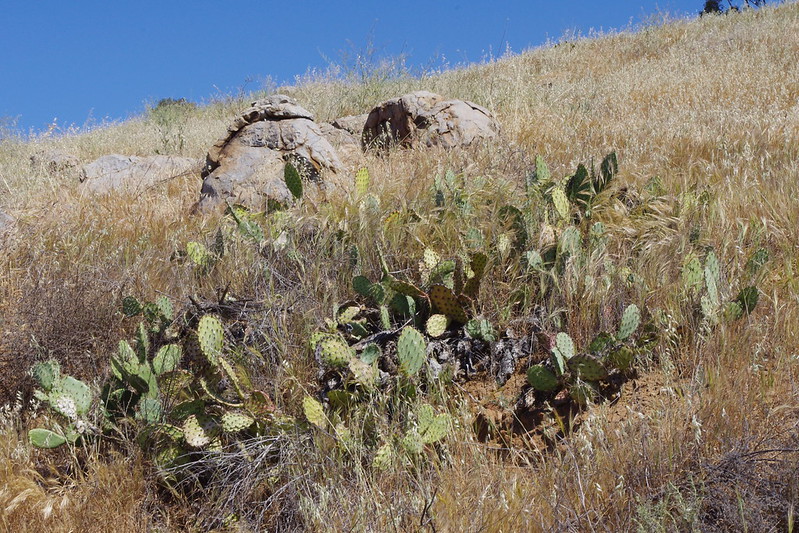
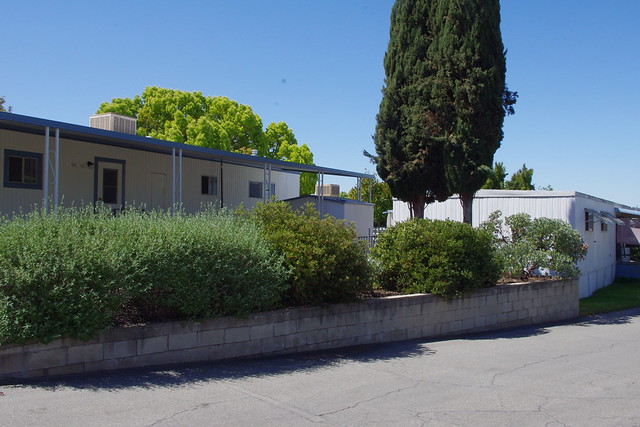
On this Hill east of Gillespie Air Field is a hold over of times past. This is a native Prickly Pear Cactus which surprisingly has gotten much bigger since I first encountered it in 2002. Still, you can see the overwhelming smothering of the non-native invasive weeds. However further down below near the Mobile Home Park, there is a rather large healthy colony near some large granite boulders and smooth flat granite bedrock where Metate Grinding Holes are located. No doubt the natives may have planted these some centuries back when their village was present. I've also noticed most native metate locations will also contain one, two or three Mexican Elderberry. This area is also next to a natural spring within the trailer park which has been capped. Want to find a former native encampment or village site ??? Then keep a keen eye out for these specific plants.
 |
| Photo - Mine |
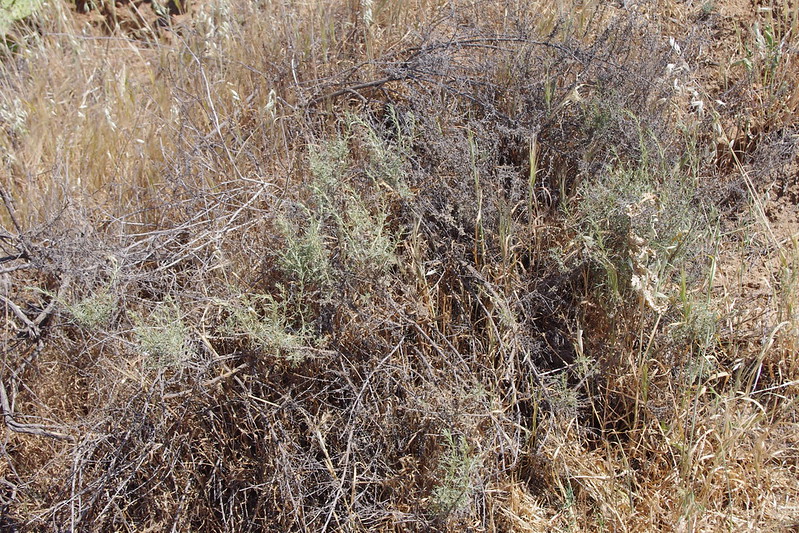
This California Sagebrush (Artemisia californica) is being overwhelmed and smothered by the heavy weedy intrusion of the non-native grasses like this cheat grass and non-native wild Black Mustard from the Mediterranean. This particular plant is the ONLY specimen on this entire hill. I know because I have thoroughly searched this entire hill for others. It is a main target featured plant when saving and setting aside habitat for the California Gnatcatcher, such as the conservation area on Rattlesnake Mountain to the north of this location which the rules demanded that open space be set aside during the construction of the Sky Ranch Housing Development. We always wondered if one day some developer would come along and turn those mountains into another Mount Helix rich folks paradise to the south, but the mandated open space totally prevented that from happening.
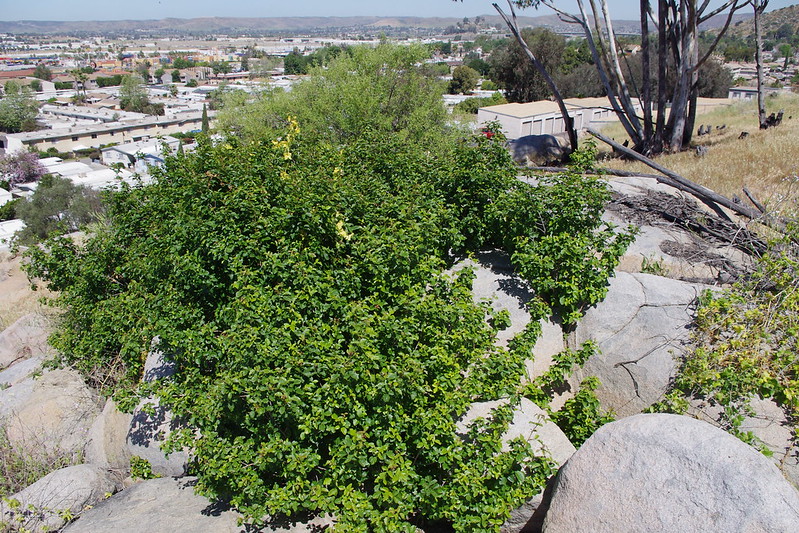 |
Toxicodendron diversilobum, Western poison oak or
Pacific poison oak (syn. Rhus diversiloba) |
Finding this plant for the first time back in 2002 was a wonderful surprise and an unexpected shock at the same time. But interesting none the less because it further intrigued me as to what the orignal historic vegetation content of this hill was really like a century ago. Such a plant as this one (Poison Oak) I've only associated with areas of high moisture content and usually on on the north side of a mountain. The Rattlesnake Mountain chain to the north of this Starlight Hill location and would have been an ideal location for this plant because of it's many springs, seep and cienegas. And yet, from all my decades of hiking all around up there on Rattlesnake Mountain, I have never once stumbled across this native Poison Oak species high up there.
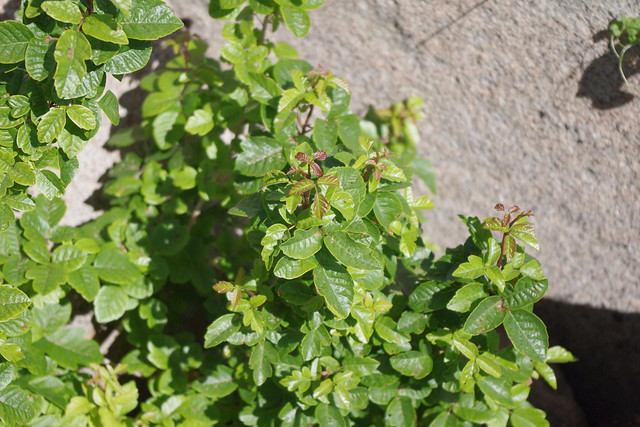 |
| Close up view of the Poison Oak foliage |
Just a few further comments on this plant which I consider a strange anomaly of sorts because there is none of this that I have ever found along all of the mountain ridges of the Rattlesnake Mountain chain. In almost every instance where I have ever encountered it when out hiking on So-Cal, I have never found it in such a dry hot south facing slope location before. It has always appeared to be in areas of higher moisture content. One clue as to why it survives and does so well here is the fact that there are several granite boulders outcroppings all over this small hill in El Cajon as is also the case with other such hills to the east and south of here. It's these geological rock features which fascinated me years ago and inspired the use of many rock or other similar hardscape features which can act as a sort of mulch to prevent moisture loss and they also tend to concentrate rainfall allowing for such unique areas to have a higher water content than any of the surrounding soils. So in drought years there is no problem. Even in drought years you get a little rainfall, but in this geological feature it becomes concentrated. An illustrative comparison would be noticing the lusher higher growth of vegetation along desert highways as opposed to plants out away from the pavement. Runoff does concentrate and benefit those plants near by closer to the road. Such natural features can actually create a micro-climate effect of sorts which will allow plants to grow where they normally would not succeed. I hope to document and photo some areas in Riverside Co as prime dry hot locations where plants which normally require a heavier moisture content not only exist, but actually thrive in these locations. Still, this Poison Oak plant was unexpected by me when I first encountered it and my pondering or meditation kicked in as to where this plant's ancestral heritage came from, much like the Rattlesnake Mountain single Lemonade Berry tree colony I've written about previous at one single location on all that big mountain chain. Such pondering triggers other questions, like, "What was the climate like way back when ?" or "What was the entire complete plant community like at one time ?" Another kool feature to keep in mind when it comes to seed collection or gathering cuttings, this could have unique genetic qualities useful in some habitat restoration projects as this plant's internal system may have engineered some important drought tolerant qualities into it's DNA that others may not have. Other clues as to past wetness are given the fact that, at the very foot of this small hill there are some exposed flat granite smooth bedrock with Metate grinding holes and these near a once well known Artesian Spring at the bottom of this rock platform, it's probably safe to assume that native Coastal Live Oak were also present in abundance as well as they once were on the alluvial fans emerging from cnayons at the foot of Rattlesnake Mountain which were stripped and planted with citrus orchards. Take a close look at the area of the once Native American encampment or village site of times long past.
 |
| Photo - Mine |
This is the granite bedrock site of the native American Metate grinding holes. Notice the Prickly Pear Cactus which no doubt was part of the native's pantry and out of this picture frame to the left are some abundant examples of Mexican Elderberry, also a common plant near these village food preparation sites. The weedy invasive plants have a tougher go of it here, although they are still present.
 |
| Mexican Elderberry (Sambucus mexicana) |
Just above the historic Native village site. Actually this small chaparral tree is very common in and around the rocks here on this hill. I find it ncredible how Europe is so crazy about their Native Elderberry Trees and local Californians pay them no mind nor give them a second thought as a cultivated found source like the Natives did. Not even the majority of so-called Native Plant enthusiasts.
Now maybe I should get to the point of my post here. I have always found that most Save Nature Activism Groups never give many of the city locations a second look. Mostly these are written off and ignored by the majority in favour of more eye candy appealing locations which still contain native flora. Not everyone has this worldview, but certainly the majority view these locations as worthless and beyond hope and yet, these are right there in their own neighbourhood backyards. I look at such weedy locations as a challenging blank canvas to be restored to what it once was. Of course doing so means you must dump the conventional modern day enlightenment wisdom in plant healthcare (which generally comes with a price tag on it) and actually replicate what nature actually does. I'm happy that there are many who are nature lovers, love hiking and suchlike, but there is more to loving nature than mere surface knowledge. I often find that many greatly lack deeper practical application of what they see or observe on their short or long hikes. By practical application, I'm referring to their own personal garden and landscape projects. There are many who don't understand the basic fundamentals of plant growth in nature and that there is clearly more to buying a plant at your local Native Plant Nursery and plugging it into the ground. Conventional Care as espoused by the Commercial Garden Products (like Drip Irrigation, etc) industry will kill the natives and often shorten the life of other non-native Nursery Grown plants. I also find that while many are willing to support a cause, even if it's merely clicking the "LIKE" button on an Eco-Activist Facebook page or being hooked into giving a donation, most never consider personal commitment by investing personal time and energy with involvement on restoration work projects. This is too bad, because even if you fail at something in terms of a project commitment, you also learn from that valuable experience. Weeding out the conventional bad old school science-based wisdom is a tough thing to over come. It's a complete turn around from things you've been taught & raised to believe and indoctrinated to place your faith in without questioning. Maybe we should call the hands on workshop a deprogramming experience. You know, things like dumping chemical fertilizers and installing a permanent irrigation infrastructure, believing all the while you are doing something for the plant's own good ? But gain understanding of how the natural world actually works and you'll never go back to that failed conventional modern day wisdom which is presently killing our planet Earth.
 |
Image from Google Earth
Actual Area is east of Gillespie Field airport in El Cajon CA |
A healthy chaparral or coastal sage scrub plant community is a mycorrhizal one. On the other hand, the weedy type annual plants (wild radish, black mustard, cheatgrass, yellow star thistle, etc) generally come from a flood plain with it's bacterial system where most of the nutrients wash down from the higher locations and collect and settle on the valley floors. In the old days, weeds never really got a foothold on mountainous areas or foothills, but times have changed as these areas have become richer in nutrient content, no doubt as a result of various pollution components by mankind which have gradually accumulated over the decades to allow for this unnatural succession of invasive non-native annual plant community to take over. Not to mention the complete disappearance of the healthy mycorrhizal community which outcompetes weedy ruderals for nutrients that keeps the weeds in check. This is where I took it upon myself while working there to experiment with a portion of that Starlight Hill that I have revealed to you in any of the photos. First thing that has to be dealt with on such a location is what I consider a radical extreme measure of dealing with any heavy weedy system in a swift kick blow to the weedy plants themselves. First step would be to use a weed eater or Fishing line power trimmer to cut down as far to the ground as possible any and all weeds. dead or alive. Next, while I don't like chemicals, in some extreme cases where used properly and not over done, products like Roundup can be used after the next rainy season growth appears. After this initial extreme KILL, heavily mulch these areas to suppress the newer weeds from appearing on the area to be re-established with chaparral or any other native plants from any area of the globe being restored. In the old days, most southern facing slopes had a sterile decomposed granite soil base spaced between the individual plants with the plant's own dander or mulch underneath it's own vegetative drip line. This is not the case now. In fact you cannot allow any bare spaces between plants for a few decades, given the changes which have taken place on our once pristine natural world. Allow these spaces and weeds will fill in these spaces. So keep these areas between plants mulched until they grow large enough to merge with each other. What I did on this hill project was plant both native Chaparral and native tree species, with the exception of a few non-native Mediterranean trees which can take drier conditions. Also remember, this hill site was to never have an irrigation system, so proper healthy natural establishment done the right way in the beginning was a must. The native chaparral plants I used were Lemonade Berry, Californian Holly (Toyon), Cleveland Sage, etc.
Importance of understanding the Mycorrhizal Grid
 |
| Image from updated Google Earth (2018) |
 |
| Image- Ryan Cummings (2011) |
The photo above has been updated from Google Earth street view at the end of Marlinda Way in El cajon, California at the foot of Rattlesnake Mountain. When I was a child in the late 50s & early 60s, the flowers here to the right were the main players. There were loads of TidyTips, California Poppies, Lupines, Blue Bells, etc. All of them have been replaced by Black Mustard, Yellow Star Thistle, Wild Radish, Cheatgrass, etc. All non-mycorrhizal non-native invasive plants which have change the soil microbiology from a mycorrhal one to a bacterial one. These plants do this when they invade and through their root exudates release chemicals which disrupt the chemical signally for symbyosis to take place between host plants and the mycorrhizal fungi. Decades ago industrial commercial agriculture planted Black Mustard between rows of grape vines and trees in orchards. Believe it or not Mustard are one of the best fumigants for soil, not only removing both good and bad fungi, but also root nematodes which would attack both orchard trees and grapevines in the vineyard for which farmers would have to employ otherwise toxic chemical fumigants to accomplish the same thing. But the farmers never really dealt with the mustard before it goes to seed and therefore Mustard escaped into the surrounding wild hillsides much like the photo below of a Northern California Vineyard.
 |
| Image - Naomi's Garden Blog |
 |
| Image - Jade Meadow Farms |
The photo of course is beautiful and picturesque, but it has also brought ecological consequences with the practice. Such invasive plant escapees have replaced the native California wildflowers and coastal sage scrub shrubs. Many modern biodynamic organic farmers are practicing the use of sheep to graze the mustard, not only in vineyards, but also in massive Solar Farm fields. This provides an alternative to other damaging science-based practices requiring synthetic pesticides. In so doing, farmers have the vines higher up on the trellis and using stubby legged Babydoll Southdown Sheep for this purpose. When I was in vocational agriculture and studying sheep, the larger taller breeds like Suffolk along with the stockiness of Hampshire were the focus because of meat production. Certain other breeds were dying out only saved through people who were champions of such breeds. How wonderful some people helped save those breeds and new purpose has been discovered for their use. This is where you also need to correct the soil's microbiology back to a mycorrhizal one in a restoration project. Decades of neglect ensure almost no beneficial mycorrhizal fungi existed to maintain healthy plantings. First, you need to understand and realize that out there in the untouched Natural world where plant communities are very healthy, there is an underground network grid on all mycorrhizal sites which interlinks all the plants that are coupled to it. This grid or network can range from the smallest lichens to the largest trees in any forest ranging from 100s of miles on out to 100s of miles of prairie. So it is imperative that a good fungal species blend of mycorrhizal mix be added at the very moment of planting for a good healthy start and to change the underground soil infrastructural makeup to something which will allow the plants to succeed. IMPORTANT: DO NOT listen to those who criticize inoculating the soil at planting. Actually you only need to inoculate the plant, not all the soil. The fungi will move throughout the soil. Often their biased view is that it's not necessary to inoculate because the fungal spores are just out there everywhere in the air. Forget it. If it were really there, the invasives would not have been so successful. The native trees I planted, believe it or not were Tecate Cypress and Coastal Live Oak, both of which thrived immediately. Non native trees were mostly volunteers of Aleppo & Canary Pine which were already around the properties below in the housing that was maintained by the company I worked for. What can I say is this, they were free and after all, it was only an experiment anyway. Even if failure were to happen, this was a major learning expreience. The first couple years the plants were babied with once a week watering the first several months down to once a month the second year. After that no more water. Such a watering strategy replicates what I learned here:
 |
| Photo - Mine |
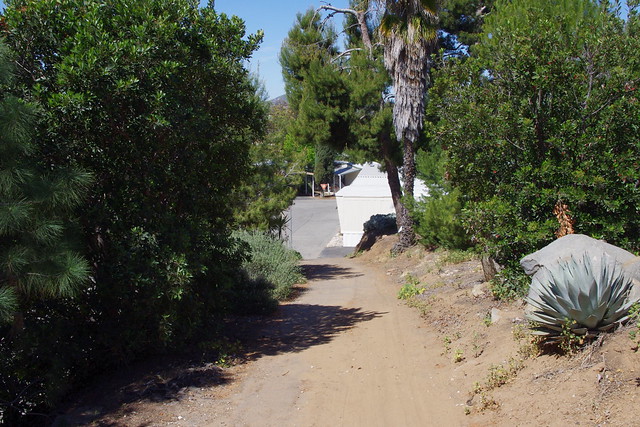
This is looking up the Landscape and Maintenance Service road for which plants were established on both sides of the road to provide privacy screening for the work of chipping and gravel and soil dumping which was necessary for the normal Park maintenance. Often times such areas are unsightly branches and trimmings piles and it detracts from the tidy cleanness of the Park Community. At the top where the road turns left, you'll notice the Tecate Cypress which actually provide a good green screening, Aleppo Pine is easy to identify and many of the small trees are actually Toyon and Lemonade Berry. Cleveland Sage is to the right.
 |
| Photo - Mine |
This is looking back down the maintenance road. Notice the Silver Agave on the right. I collected that back in the 1990s from the Huachuca Mountains above Sierra Vista Arizona and brought it down we me when I left Anza CA. This Agave was actually growing on the forest floor up there under trees when I first discovered it. It originally was the size of my fist when I collected it. It was one of the pups around a bigger one.
 |
| Cleveland Sage (Salvia clevelandii) |
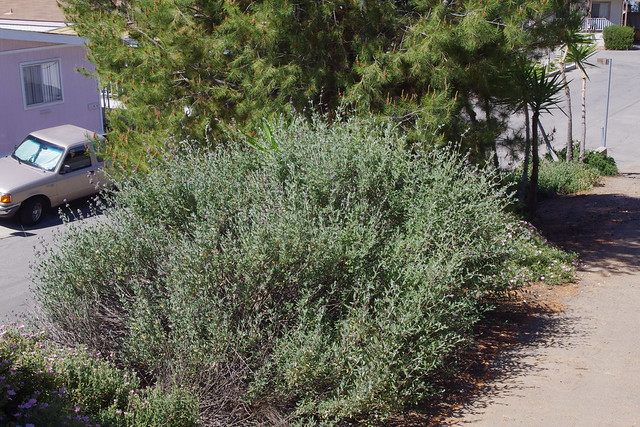
This is on the south side of the maintenance road
 |
| Aleppo Pine (Pinus halapensis) |
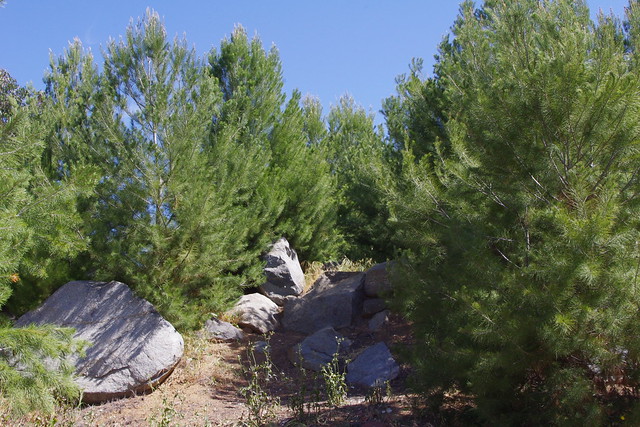
This is on the north side of the maintenance road opposite from the previous picture of the Cleveland Sage. Only weeds appear to be some Sow Thistle, but not much more. Continued use of mulch keeps them in check. These Aleppo Pine Trees here are 8 years old. There is absolutely no irrigation. My previous experiments in Anza California in dealing with the interconnections of a strong mycorrhizal grid network underground between a large group of pine trees are clearly present here as you can see these trees are exceptionally healthy with little or no irregation. This underground interconnected network between all the tree root systems can shunt water from lower reaches where some irrigation from the Park may be transported uphill to the trees at the higher elevations above. The front Office and pool are of the Park has some extremely large Canary Island Pines for which somehow became colonized with Pisolithus tinctorius truffles. Every Spring the truffles appears and I'd collect them. Most of the Pisolithus tinctorius inoculent used on this hill came from those truffles I collected. Now the only water is the little rain from winter's rainy season which has been mainly drought. When planting trees and shrubs, remember to mulch heavily. It suppresses weeds and breaks down slowly by the fungi which feed the nutrients back to your plants.
 |
| Tecate Cypress ( Cupressus forbesii ) |
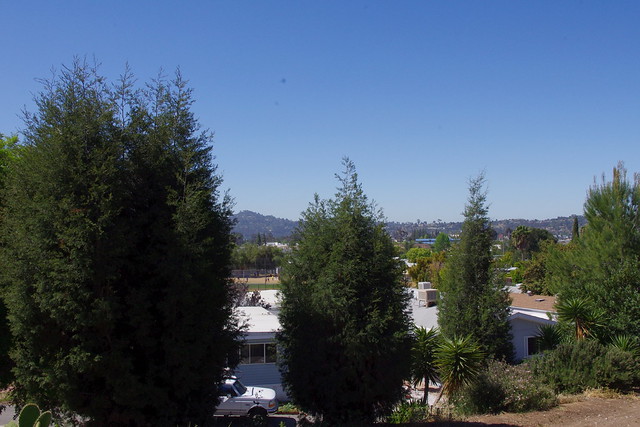
These trees are actually larger than they appear here in the photo. I had to stand back quite a ways to include all of them. The lower tall slender one is almost 20 foot in height as it is much much lower at the bottom of the bank. All of them show no signs of slowing down to a comfortable growth. None, with the exception of the lower one receives any watering. The lowest one may have roots near some irrigated plants nearby.
 |
| Photo - Mine |
Same Tecate Cypress, but now viewed from below the bank. All of the Tecate Cypress were also colonized with mycorrhizae. The soil is decomposed granite with some adobe red clay and very little organic material. Only organics are the mulches place around the rooted areas.
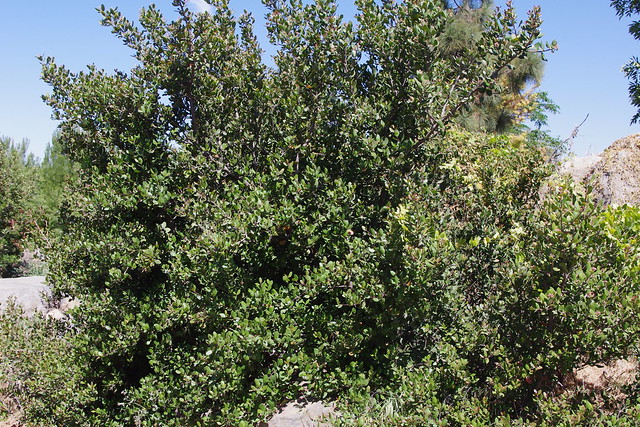 |
| Lemonade Berry (Rhus integrifolia) |
This is a large chaparral shrub and was given to me by the Company's owner to plant where I wished. This specimen came from Scripps Ranch area. I really was unsure if it would take as it had been in a one gallon pot for a long while after being transplanted from the wild. It looked stunted and could easily been written off, but fortunately, a good mycorrhizal mix is mostly all that was needed. To the right and on the back of the bush is wild cucumber vine growing up into the branches. How fortunate for the wild cucumber to fiend an old friend where most others are lacking.
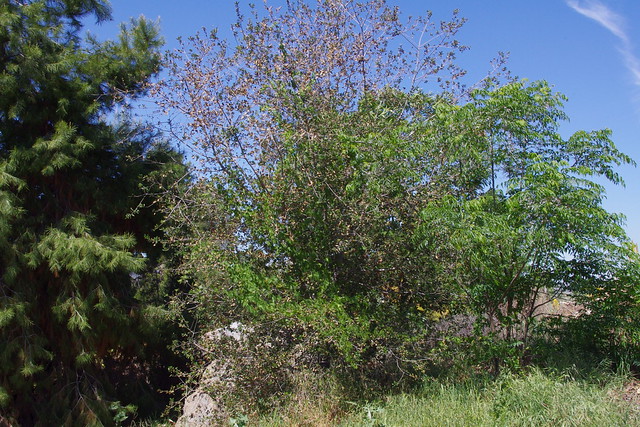 |
| Coast Live Oak (Quercus agrifolia) |
Of all things that would disappoint me, is the sorry condition of the Coastal Live Oak as upsetting, but it's still alive. When I last visited here in July of 2011, the vegetation was healthy, thick and dense. Now the leaves are half green and half brown, almost as if poisoned with Roundup. Not sure how sensitive it's roots are, the new maintenance person may have sprayed to heavily dose of roundup around it to maintain the rid the area of weeds around it. Still it has been a success otherwise as I heavily inoculated it with various Ectomycorrhizae , in particular Pisolithus tinctorius. There is a volunteer Texas Umbrella or China Berry Tree growing to the right of the tree and it has wild Cucumber Vine growing up into it. I'll have to work on this area with permission of course.
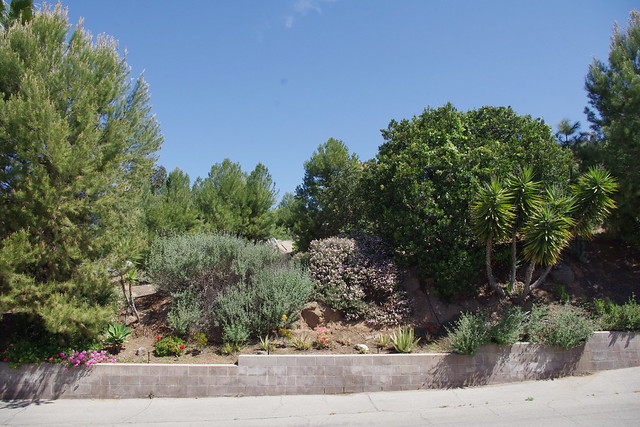 |
| Photo - Mine |
Looking up at at the once weed infested hill from across the street below. I actually have a photo back in Sweden of this hill before anything was done, but I'll have to scan it at a later date and post it. The transformation is remarkable and possible for any location. I have actually got some conventional camera photos of this area before much was done, but I'll have to scan them and upload here later.
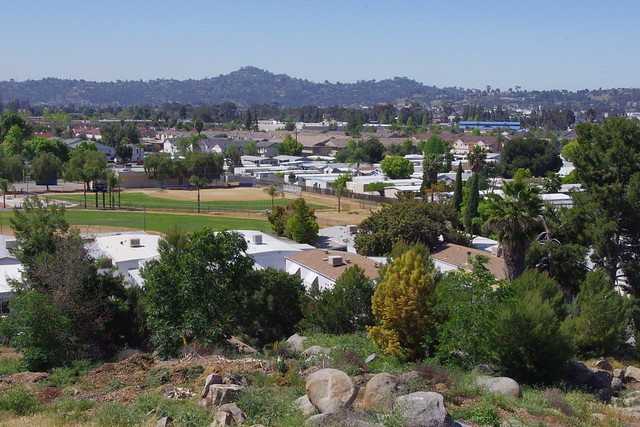 |
| Photo - Mine |
| Looking down from the hill at the restoration project below. This is looking directly south towards Mount Helix in the southern end of El Cajon Valley. |
 |
Cleveland Sage (Salvia clevelandii) - Howard McMinn Manzanita
(Arctostaphylos densiflora) - Big Berry Manzanita (Arctostaphylos glauca) |
These were planted on along the top of a wall to replaced the conventional dying Retail Nursery plants which had outlived their usefulness. They were inoculated with mycorrhizae mix from Dr Mike of Mycorrhizal Applications Inc and no supplementary water is necessary with the exception of some periodic deep slow watering once or twice in the summer.
 |
| Howard McMinn Manzanita and Bigberry Manzanita |
Well to mostly sum things up, anyone can create a small project like these and go far farther that what I did if they get up. The experience is a fun learning thing. I'll have to photograph and post some of the plants I installed on my mum's property which is a third of an acre. The Cleveland Sage and Manzanita, which by the way is "Canyon Sparkle" ( Arctostaphylos insularis) does exceptionally well here in interior valley HOT El Cajon CA. Yet is is advertised as a coastal cooler climate plant. Of course the soil is a very deep sandy loam and roots are deep. A mulch is always kept around the roots and of course it was heavily inoculated with mycorrhizae at time of planting. No summer watering has ever been necessary after the first couple of years. Most watering is rainy season ground storage and maybe some slow soak winter soaking for later usage throughout the year. It resides next to a Cleveland Sage and both look so natural. Incredibly, I now understand why this "Canyon Sparkle" or Island Manzanita got it's name. The newer foliage is exceptionally glossy bright green and does reflect an awesome amount of sunlight on a bright sunny day. Of course the older foliage is a bright beautiful green anyway. Still! I've noticed more and more that the Freeway planting projects are going mostly native now around here locally. Good for them and us. Here's the post on my mum's place:
"Canyon Sparkle" Manzanita
One of the best non-profit organizations, which actually does do a hands on restoration and education program is the, Back to Natives Restoration, group out of Orange County in Southern Califonia. You won't find the long time traditional in your face activism tactics like civil disbedience, foul language, threats etc comon among many of today's groups. Mainly they education young people and to be honest, I've never seen an organization like this that attracts so many volunteers as this group. This is refreshing, because environmentalism has gotten a black eye where most causes are based and identify with something they hate as opposed to something they are for or love.
https://www.backtonatives.org
 |
| image - PBS |
Still Interested in Environmental Activism ???
Then stop being distracted by the plethora of environmental non-profits who promise if you donate to them, join in their monkey wrenching covert schemes or trust their "Occupy" worldview of overthrowing an ideology they hate which will make the world a better place and challenge yourself to restoring a local urban area landscape they have written off as unsalvageable decades ago. Nature has always had the tools for turning things around again. You may find it will require some outdoor time which must be purchased away from your time wasting routine of lurking on many worthless Facebook sites, but that will be a healthy thing. You remember, like the old days pre-internet ??? Start with your own backyard or local habitat beautification project. It's local and it's not that far to go from a time and expense-wise point of view as far as fuel is concerned. Areas of local restoration could include the entire restoration of the San Diego River riparian corridor from Mission Trails Regional Park all the way to El Monte Valley in Lakeside California. Or anywhere else on the planet where the misuse and abuse of Science by profit obsessed corporate entities has caused environmental ruin. Here's an example of what hard working volunteers are doing within the urban areas of San Diego County.
 |
Artist picture of Walker Preserve entrance
(Walker Preserve Trail Santee) |
Earth's Internet: "Santee's River Walks: Mast Park & Walker Preserve"
Lakeside River Park Conservancy
Time Out Post: Guerrila Habitat Improvement


 Common annual variety of annual Wheat here are contrasted next to perennial Wheatgrass. Notice perennials, which come back year after year have a root system which will grow to a depth of few meters, while the annual varieties perhaps a mere foot. This is also illustrative of all ruderals versus perennials in the wild setting. A farmer or rancher with a pasture of abundant diversity of perennials is going to weather the dry season or even drought much better than say those common western states pastures where short lived ruderals such as cheatgrass and other annuals [runderals] reign supreme. This is why many western rangelands and pasture can only have a limited use early in the year. What is most important to a pasture is having a large biodiversity of perennial plants dominating the vast area which encourages an underground microbiological community of beneficial mycorrhizal fungi and healthy nitrogen fixing bacteria to allow the soils to breathe. Any rainwater falling on such a landscape will fully percolate into the earth as opposed to running off. This is important to underground storage of water to be tapped into later in the dry season. In times of heavier rainy seasons, several meter deep root infrastructures may also facilitate a process called hydraulic descent which may also help restore underground aquifers and replenish natural springs. The other being hydraulic lift & redistribution, but more on that below. Again, these are also things which even many farmers who do practice biodiverse perennial cover crops may be completely ignorant themselves of the full line of services being accomplished by perennial plant root systems other than mere water percolation through healthy aggregated soil alone. More on that phenomena below. But here is a link to the root system galley:


 New technological advances by mankind's Elites have seemingly made life easier for the rest of us when we only look at them from an on the surface viewpoint. These bio-innovations created in some high security lab however have put mankind and the natural world at risk. The fate of the world is being placed into the hands of unaccountable elites in bed with powerful political interests who speak from one side of their mouths of their products being the result of ethical responsibility while at the same time being obsessed with the pursuit of fame and personal enrichment out of the other side of their mouths. The problem is our messed up world is the result of a gross lack of Bioethics. These people know full well what their products are doing, but their strategy is to play the dumb card. When a newer consequence strikes, they simply create another synthetic solution to treat the symptoms while totally turning a blind eye to the cause. The pharmaceutical industry works the same way, but hey, are the also not related ? So from a short term monetary, fame, glitter and glory standpoint there are certainly those who appear to come of the winners. Farmers are also the real losers, not the agro-chemical corporations. If any farmer actually becomes truly informed, educated and understands that most of their success is in changing practices as opposed to spending vast amounts of money on synthetic inputs along with magic seeds, these giant corporate entities would fold. Can you now understand the reasons for vast amount of financial resources being funneled into these damage control public relations lobbying by corporate business interests ? The vast majority of other lifeforms including humans will also lose out in the end. I know of no real solution as far as implementing or reversing the damage done on a massive global scale. You all read the News lately, so you tell me. That doesn't mean the information and understanding on how to use the clean viable information doesn't exist. It does. But there always seems to be something powerfully negative out there to throw the proverbial wrench in the works. The best that can be done is for those few individuals who actually get it to make practical application of what they know to use out on the farm, ranch, landscape or garden and allow the light of success to do the talking for you.


