Showing posts with label ideology. Show all posts

Friday, May 11, 2018

Science-Based Herbicides vs Holistic Grazing in Weed Management of National Forests

Forest Service to cut hundreds of ponderosa pine trees near Sisters killed by the herbicide "Perspective."
(Ryan Brennecke/Bulletin photo)

photo by Jim Anderson
Recently back on May 4th in the News, there was a sad report of a tragic event which took place along many of Oregon's Highway right-of-ways where conventional science-based weed abatement practices of spraying dangerous herbicides, like Bayer's toxic weed product known as "Perspective" which was supposed to target broadleafed weeds and other fire flamable vegetation, some unintended consequences took place. Apparently, this has been the practice by Oregon Transportation Department for some time as it is also around the country. While the target may have been the broadleaf weeds and other flammable weeds through a seemingly easy no break a sweat approach management version provided by science-based toxic chemicals and hopefully acquiring immediate results, the chemical apparently made it's systemic way underground, perhaps further facilitated through the mycorrhizal grid network to the Ponderosa pine rootsystems which eventually later led to the Ponderosa Pine's succumbing to the toxic effects a few years later. Interestingly it does seem that there were warning labels on this side effect on non-target trees and shrubs which were totally ignored. Without further explanation, here are the two links. First is from August 2016 and the second from May 2018 a few days back.
The Nugget Newspaper (Sisters, Oregon) "The warning bell is ringing!"
The Bend Bulletin: "Forest Service to cut hundreds of ponderosa pines near Sisters killed by herbicide"
===============================================
A more viable & responsible Solution and one that Perfectly Biomimics Nature
Photo: Washington State DOT Flickr Photostream

(Photograph courtesy Texas DOT.)
This photo above is of goats clearing grass and weeds near Olympia area highway interchange. Something seriously needs to change for the better. Herbicides need to be shelved and never used again. Of all the grazing & browsing animals, goats are basically biological mowers/browsers and can perform a similar function as mechanical mowing but without burning fossil fuels and generating carbon emissions. Another advantage is that some weed seeds are sterilized as they pass through a goat’s digestive system, allowing for more effective weed control than mechanical mowing or chemical herbicide spraying. Goats can also easily access steep and uneven terrain along highway shoulders and cutouts. Of course there are the usual concerns over the use of grazing in highway applications which may include higher costs associated with fencing, watering and supervising the animals; liability; and potential distractions to drivers, but I think much of these costs could be a non-factor if the Highway Departments did not try and manage this themselves and awarded grazing rights to responsible herdsmen who could provide a better professional hands on project of oversight. We're not talk just throwing the animals out there and seeing what happens. They do have to be responsibly managed and not left on their own. Clearly areas like this region in Oregon where 1000s of large Ponderosa Pines must now be removed could have benefitted by this holistic approach as opposed to the conventional science-based practices which have been used for decades. Most all roadside landscape plants should be natives to the areas the roads are located which eliminates watering and benefits wildlife, especially the native pollinators. Below are some links to sites which further explain the benefits.
Roadside vegetation management in the Netherlands
https://environment.transportation.org/"Invasive Species/Vegetation Management"
Roadside Best Management Practices that Benefit Pollinators Handbook for Supporting Pollinators through Roadside Maintenance and Landscape Design
US ARMY: Unconventional Sustainability Method using Sheep & Goats in Hawaii Nabs Award
https://www.wsdot.wa.gov/THE USE OF GRAZING ANIMALS IN ROADSIDE VEGETATION MANAGEMENT
===============================================
Grazing to Reduce Wildfire Risks also Biomimics Nature
Photo by johndeerefurrow.com

Another interesting article in John Deere's online journal, "The Furrow," provided interesting feedback on experimental practices of Fall grazing of invasive annuals like cheatgrass to reduce wildfire risk and helping to provide nutrients to the soils. Here is that link:
https://www.johndeerefurrow.com/2017/09/01/forage-not-fuel
Also, remember my last post on the environmental effects of the presence of megafauna (large herbivores) and the roles they all played in forest and prairie health and almost total absence of wildfires ??? 😲 Yes, studies showed that fire while being naturally present was not the major destroyer and killer it is now. Well, here it is again:
Megafauna were the "Ecosystem Engineers" not Wildfire

National Park Service / Neal Herbert

Now, one would think that the environmentalists and government agencies would all be for such a holistically sustainable approach to weed management which actually replicates Nature through Biomimicry, right ??? Wrong! The modern day environmental movement has a murderous hatred of ranchers and as many of the leadership in this movement have admitted, they want this industry to go extinct. This is a really sad video.
The Eco-Activist Movement's rejection of utiling grazing and browsing animals for any Vegetation Management

In this video posted by journalists from the Wall Street Journal on March 30th 2018, "The Last Cowboy at Pine Creek Ranch," they discuss one ranching family, who, after a 40-year battle, was wrecked by government agency rules designed to make ranching unprofitable and impractical. Wayne Hage won his case in court numerous times, proving his grazing and water rights were his legally, not publicly owned and controlled as the government insisted. Yet each victory was appealed by the heavy hand of government, moving the case to the next court and the next judge in the system, forcing Wayne to spend more and more on legal fees. The government plan was simple and obvious. Destroy him financially until he was forced to give up. Now the the government and environmentalist's viscous tactics have finally forced this family to give up the fight as they prepare to move off the ranch and let the ecoactivists and government have their spoils in the war over the rangelands. The Federal land managers were aided in this travesty by the environmental group known as Western Watershed Project (WWP); the program’s director, activist Mike "Buffalo Man" Mease, who was interviewed in the video had this to say.

A cow is a non-native species to America and when we set them free on the wildlands of the west, they don't know what they're doing out there. As they will walk and eat every blade of grass in front of them, as they walk Cattle hoofs are not cleft. They are one single pallet which compacts the soil, unlike native animals which have cloven hoofs which aerate soil.”
Amazingly, most all the Government agencies and environmentalist groups including Mike Mease's Western Watershed Project & Buffalo Field Campaign, etc generally know full well that grasslands developed under intensive grazing from large herds of bison (pre-1800s saw 60+ million Bison according to stats) and other wild animals (millions of Elk, Deer, Antelope, etc), which through co-dependency became necessary for both soil and plant health. Yet in practice however, most of these militant groups have become more and more hostile to the presence of cattle or other domestic grazing/browsing animals presence on the land, which they variously blame for native species loss, range degradation and forest destruction, erosion, pollution, global climate change and even labeling ranching operations as public theft. In justification of this warped thinking, WWP’s spokesman, Mike "Buffalo Man" Mease, claims cattle harm grasslands because they are not “native.” He provides a nonsense explanation about cattle hooves compacting land by calling them "single pallet" as opposed to the native animals like Antelope, Elk, Deer, etc which have cloven hoofs which aerate soil. If any animal could be labeled as single pallet, then would that not better describe such animals as Horses which have a uni-hoove (or single toe). Cows have cloven hooves with dewclaws. Interestingly, both horses and buros were present in larger numbers centuries ago and had positive effects on the land. But take a look at the differences below.

Images - Mother Nature's Tillers


Mike "Buffalo Man" Mease's knowledge here is confusing as you listen to the very words leaving his mouth given the fact that he labels himself with the knickname, "Buffalo Man" which should leaves folks puzzled. Bison (Buffalo) and Cattle have the same identical hooves. Once again, there were once over 60,000,000,000+ Bison in pre-1800s in North America. So by his definition when using the hoove design argument, was Nature in trouble when such vast numbers existed just a century ot two ago ??? And if so, then why does he champion more and more buffalo on the landscape ??? Surely from his outdoor experience and credentials he must know what is right ??? Oh wait, he doesn't have any biology or conservation credentials. Mike Mease has a B.A. in Radio/Television and Psychology from the University of Montana. This is almost the same identical credentials of another infamous eco-activist, Kieran Suckling of militant Earth First fame and co-founder/director of the Center for Biological Diversity out of Tucson, Arizona. Neither of them are biologists. Like Mease, Suckling wants ranching to go extinct:
“Ranching is one of the most nihilistic lifestyles this planet has ever seen. Ranching should end. Good riddance.”
CBD director Kierán Suckling to the Washington Post.
In the interview with the journal High Country News, when he was asked if his lack of any science degrees were a hindrance to his work. He responsed:
"I think the professionalization of the environmental movement has injured it greatly. These kids get degrees in environmental conservation and wildlife management and come looking for jobs in the environmental movement. They've bought into resource management values and multiple use by the time they graduate. I'm more interested in hiring philosophers, linguists and poets. The core talent of a successful environmental activist is not science and law. It's campaigning instinct. That's not only not taught in the universities, it's discouraged."
Well that's wonderful. Learning how nature really works and pursuing degrees in environmental conservation and wildlife management are totally worthless. Civil disobedience, eco-terrorism and psychological warfare thru sue and settle are something to be admired. Kieran Suckling once boasted that he himself engages in a kind of psychological warfare (which for a fact he is credentialed with his degree in Philosophy) by causing stress to already stressed public servants when he bragged, "They feel like their careers are being mocked and destroyed -- and they are. So they become much more willing to play by our rules." 
(Source: High Country News)
I'll never understand the murderous hatred eco-activists openly display towards ranchers on the part of the environmental movement which is in fact killing nature, not preserving it. So much about ecology movement these days has become like a fanatical version of a religious Jihad or kind of animist holy war. While there were clearly practices within traditional ranching that were irresponsible in the past, that is not the case with many ranchers today who see great worthwhile value in helping to preserve wildlife and restoring the land's vegetative ecosystems. It's not just a matter of their livelihood for profit, but also their love and passion for conservation which has also become their hobby. Rather than demonizing all ranchers and lumping them onto the Bundy Bandwagon, they should embrace and ally themselves with the more responsible ranching land stewards. But thus far they have refused to do so.


Image - Cow Hooves

Take a close look at both photos above and below here of both cattle and Bison (Buffalo Hooves). Both cattle and bison hooves are split. The two animals are so closely related (same 'kind' of animal) that they can actually interbreed. They are roughly the same size and weight. Whether on a forest floor or on grasslands, when cattle herds are hands on managed and grazed in a way that mimics bison herds in large numbers, timing and behavior, their physiological effects on the landscape are similar to the bison. Under these conditions cattle can stimulate plant growth like grass and the native weeds (which cattle won't necessarily eat), but which in turn benefit creatures which like the weeds like the pronghorn and deer and the native insects necessary to sustain grassland birds like quail and grouse. In so doing cattle and bison sequester carbon and add organic humus to soil, which increases its fertility and water-retention, thus improving watersheds. But given Mike "Buffalo Man" Mease's lack of understanding that there really are no physical differences of cattle to buffalo, are we to assume ancient historical buffalo herds of 60+ million were a bad thing within the pre-1800s environment ??? 😕 Hardly!

Image - Bison Hooves

When you look at the various hooves and their imprints, you should be able to notice that they closely resemble chisels. They have the ability to cut into the soil, churn it up, break up crusts and clumps, create pockets to hold moisture, trample old vegetation into the ground. Humans have terminology for this action. We call it tilling and cultivation. Of course animal disturbance on the land done the right way only disturbs the top few inches, not feet like science-based mechanized innovation. But grasslands, forests and wildlife have steadily declined since the massive bison herds were wiped out over 150 years ago. So to offset this horrible ecosystem decline, these so-called defenders of Nature, which apparently also includes many in government, academic and the general conservation bureaucracy seek to banish cattle completely off the landscape. And yet Cattle properly managed through a hands on holistic approach are the only true substitute for those missing keystone grazers, the (Bison herds). What's worse, environmentalists have no idea of how, why or what other animals to replace the Bison with out on the landscape. They never offer any real world viable solutions other than promoting the need of reducing mankind through science-based abortion, eugenics and hospital oversight over euthanasia programs. After that, they want to turn everything into their version of wilderness and Nature will just fix the problem all by itself.


Interestingly, regarding these chisel design patterns of hooves: the  Rodale Institute has developed a crimper-roller that’s designed to trample green manures and old stalks into the ground. The tines work like chisels. Vineyards have available to them a smaller, even more chisel-like adjustable “eco-roll.” And Ames Lab at Iowa State University have also produced an imprinter-roller that tries to imitate the hoofprints of passing buffalo, to be used in Colorado prairie restoration. All of this is about bomimicry when it comes to the ecological management of the landscape that went on for thousands of years with 60+ million forest and prairie Bison. Keep in mind, such innovation is necessary in the absence of herbivore animals. Animals are the original ecosystem management component [tool] and that's by design.

In conclusion, this information and news items are for people who do own land and who want to manage that land in a holistic manner which will enhance ecosystems and wildlife. There are numerous services that grazing and browsing animals can perform if properly managed which would negate the using of more science-based toxins. As for all these enviromental groups which lay claim to being the only solution for representing Nature, run the other way folks. There is a Proverb 24:21 which states the danger in associating with these types of groups, it says, 
" . . and do not associate with those who are calling for change [or allegiance with, and are dissenters, rebels, revolutionaries]." 
Our world today is characterized by militant activism against anything and new ways of being offended, angry and outraged seem to be invented or fabricated now on a daily basis. Save your money folks and pursue rescuing and rehabilitating nature under far more peaceful responsible circumstances. My wife and I just recently visited my hometown from Sweden which is San Diego California this past April 2018. Everything there seems to have taken a turn for the worse. California is literally riddled with misdirected people who are looking for any reasons to become activists for whatever cause. People now days seem to be at war with whatever is popular on social media that outrages them and considered trendy to participate in. Very few seem to have a normal life anymore, whatever normal life once was. In the mean time, being credentialed with regards to environment issues are ultimately meaningless when these so-called credentials conflict with common sense and reality on the ground.


Sustainable Dish with Joel Salatin


Tuesday, July 23, 2013

Historical Observations on Fire Ecology both Past through the Present

Controlled burns are essential to promoting healthy  pine growth and to prevent unwanted wildfires.


Wikipedia

Grave of California Governor
Jose Joaquin de Arrillaga
Well that's not only a Theory, it's also the prevailing conventional industrial  science-based practice which has the power over and ability to trump the Science of discovery and wonder. In these modern times with so much research and information gathered on the actual way Nature really operates  and maintains itself, you'd think that this newer understanding would replace the old outdated thinking and archaic land management practices based on the Historical past's ignorance. But it hasn't. Incredibly though, not all historical figures of the past were so ignorant. Some had the ability to observe and see first hand the fallacy of just such a practice and during a time when most of us would have called such a time in California as Nature in it's perfect pristine state. The man's name was, José Joaquín de Herrera, and he was once the Spanish Governor of California and only one to my knowledge who is buried here. He listened to complaints of many who were upset by the practice by both Spanish Settlers and the Natives who were burning the landscape for no doubt the commercial ventures of the time. No doubt with any lack of controls, or as Richard Minnich calls it, "Shepherding" of the fire, these fires most likely got out of control, though maybe not in the megafire way we experience them in our modern times. It's really hard to understand fully what this Spanish Governor saw, but clearly he saw the use of fire in both domesticated land management and out in the wild as reckless and childish as he put it.
“With attention to the widespread damage which results to the public from the burning of the fields, customary up to now among both Christian and Gentile Indians in this country, whose childishness has been unduly tolerated, and as a consequence of various complaints that I have had of such abuse, I see myself required to have the foresight to prohibit for the future …. all kinds of burning, not only in the vicinity of the towns but even at the most remote distances.
Therefore I order and command all commandantes of the presidios in my charge to do their duty and watch with the greatest earnestness to take whatever measures they may consider requisite and necessary to uproot this very harmful practice of setting fire to pasture .: I order that this decision of mine be published by proclamation in the presidios as well as the missions and towns of this province which is in my charge …. with the full understanding that whatever lack of observance may be noticed in this matter [which is] of such great interest will be worthy of the most severe punishment.”
May 31, 1793 -  Jose Joaquin de Arrillaga
( Source )
The above source has some fascinating reading and observations from those early exploring pioneers who wrote about life in the past. Though in some places, it's really hard to interpret everything they observed and their take on the actual observation. Wonder what a person in modern times would think if transported back in time to that era and unshackled by the ignorance of those times[not to mention the biased assumptions of these times], and what questions do you suppose he/she would ask the Natives ?What would be the actual TRUTH of what actually happened and why back then ? Hmmmm!

What triggered my thoughts again on this subject was a post by the Chaparral Institute on Natural Fire return interval (meaning normal effect prior to Human influence) in which it was mentioned about interval time frame of fire effects as being between 30 to 130 years. He referred to the available study data in which oldest Manzanita found have averaged 130+ years. Incredibly though, I have found Manzanitas which appeared 100+ year old growth on numerous hiking and other exploration outings which had died, but without fire. [logically it's easy to tell if fire was at fault] Actually I've found not one, but several, one of which were on my property and died for no visible reasons in what appeared to be healthy pristine surroundings in wild settings. Rick Halsey calls such long held beliefs about reasons for Fire Management in which Prescribed or Control Burns are based on "conventional wisdom". There others like Jon Keeley who have also bucked a lot of conventional wisdom when it comes to outdated understanding still found in many modern day textbooks which influence policy in land management practices.

Image - Springer - "Obligate Seeders"

But I've spent a lifetime bucking the conventional wisdom of this world's leadership, especially where it is glaringly wrong. I admit, I do question things quite a bit, but only because many times I have observed things behaving contrary to the supposed wisdom Conventional Authority[who as a general rule, resents having such authority questioned] when I've spent hours in the field over a period of 30+ years. For example, take the image from 
'Springer Images' on the right. It is an example of plants said to ONLY germinate as a result of Fire and these plants are called "
Obligate Seeders". Upper image: (left) serotinous cone of Pinus halepensis; (right) Pinus halepensis seedling. Lower image: Cistus creticus seedlings massively appearing on the burned ground. Yes, and as the story goes when the justification of Prescribed Burns is promoted, many plants cannot survive and/or propagate without fire and because there has been historical fire suppression, these ecosystems are in danger of going extinct otherwise. This has also been said about Tecate Cypress in a research papers and other Cypress are also "Obligate Seeders"
[PDF] A framework for assessing adaptation strategies for plants ... 
"Tecate Cypress (Cupressus forbesii) Threatened by altered fire regime ▪ Obligate seeder – time for seed bank" 
"Longer average fire return intervals better than shorter Fire Return Intervals, with 60 – 80 year average fire return intervals being optimal"
Again with Tecate Cypress, as I've written about before [see link above] and given directions where to view Tecate Cypress seedling Germination in old growth Chaparral/Tecate Cypress settings on Guatay Mountain between Pine Valley and Descanso CA right on Old U.S. Route Hwy 80. Then there was always my easiest example where I used to collect Tecate Cypress cone at Wildcat Spring on Boulder Creek Road below the western face of Cuyamaca Peak

See link to WildcatSpring

Image - San Diego Trails

Tecate Cypress seedlings were always common every year when I came to collect cones off those large trees. They were not only under the canopy of the Mother Cypress Trees, but pioneering out into the Chaparral as well. Sadly, I'm afraid the 2003 Cedar Fire put an abrupt halt to all of that. I'd be curious if any reader would go there and report back to us with any photos. You can identify the spot which has a rock build square shaped reservoir for storage. Fire just is not necessary in many cases. But the strategy of explosive seed germination are necessary 'IF' a fire does plow through an area eliminating entire woodlands, but certainly not a requirement as the conventional wisdom would have you all believe.  Another study [and there are countless others like it], which I reference at the bottom of this post because it deals with research on the age of Manzanitas, also refers to Manzanitas as one of these "Obligate Seeders", which by the definition given by this paper means this:
"These species have been well-studied in CA, and their seeds have been found to require fire for germination – this germination type is called ‘obligate seeder’.  In CA and in other Mediterranean climates, shrubs with obligate seeder germination are generally unable to successfully recruit in the absence of fire."  (uuuun-believable)
*see link below @ bottom of this post)
Here is something interesting about my experience with Big Berry Manzanita. I had many on my former Anza California property. On the south side of my house I had 5 Manzanita seedlings which all sprouted during or about the same time period of the year 1986 & year after 1987. They were all down slope of two very large old growth Manzanitas which were  along side the dirt road Table Mountain Trail. These five or six seedlings didn't require any fire whatsoever. In fact they all germinated in between some other shrubs what are commonly viewed as competitor chaparral, Chamise or Greasewood and in some of the most impossible soil you would never want to garden in. When I visited my old place this past year, three of the Manzanita shrubs were missing becayse the new owner bulldozed a pad and placed a small singlewide mobile home in it's place, but the rest were still there. This area also always had multiple Coyote scat loaded with seeds as there was always a small narrow game trail running through this location. And that is where I am glad I took these next photos on the South Fork San Jacinto River Canyon trail in early May 2013.

image - Mine

Somehow I knew this would come in handy. This Coyote scat (droppings) are representative of what is part of a predators diet, though most folks would never associate Manzanita berries as part of a coyote's diet. This is a common sight on hiking trails. At different times of year you may also find Holly Leaf Cherry seeds in Coyote scat. In any case, the stomach acid effects can have the similar chemical trigger that may result in prepping the seed for germination. But this proves that fire isn't always necessary as advertised by so-called experts who may have a vested interest in such mythology with great commercial potential. 

Photo: Mine
This young Manzanita was emerging from a Chamise or Greasewood as the Prescribe Burn proponents love to call it. This plant also was along the South Fork San Jacinto River Canyon Trail and about ten yards further up the trail from the Coyote scat. Now I can't say for sure that this small shrub resulted from the Coyote scat, perhaps it could have been even microbial breakdown of the hard seed shell which allowed germination. In any event, what I do know is that it wasn't the result fire as there was no recent evidence of such anywhere.
For those local to the Anza/Aguanga area and interested in seeing for themselves, as opposed to taking my word for it, here is an easier drive to take and you may not even have to get out of your Car. Between Bautista Road and all the way west to the very foothills of Cahuilla Mountain, there are whole acreage patches of pure Manzanita chaparral stands where this fire prescription hasn't been necessary. To make things specific and easy, take Cary Road north from Highway 371 towards the area called Tripp Flatts. In fact I believe somewhere in twists and turns, Cary Rd becomes Tripp Flats Road. At a certain point you will come to a Y in the road where pavement continues to the left, but straight on to the right becomes Woodview Rd which loops around and eventually comes back to Tripp Flats Rd by means of Saddleback Road. There are other loops, but that is a main one. Keep in mind that traditionally this road has been a rough one with rocks, wash board and ruts everywhere depending on recent rains. But that's rural life in Anza. What you will notice in many of the cuts the road takes through hills is that the sloping berms created by the road cuts will have numerous small Manzanitas of varying ages and Fire was NOT a reason they germinated. Anyway, here is a map link to make it easier to find. (Map Loop link) . Even off Baustista Rd, you'll find many roads heading west towards other land development which will offer similar observations. The "Obligate Seed" anomaly may simply be viewed as  a document or file of a genetic programming to be used where immediate recovery on a grander scale is necessary to counteract the effects of a catastrophic event. If these fire events however happen to frequently, even this file or program is made worthless. 

The recent events of the major wildfire tragedies have brought out the Ideologue boys in pimping Control or Prescribed Burn philosophies which are nothing more than Government looking like they are doing something good in the eyes of their citizens, despite the evidence that Nature doesn't work this way. Hence, justification for prescribed burns are said to be necessary because the Native Americans did it. Or the flawed argument that chaparral needs a regular healthy burn because it can't germinate without it. Both these flawed reasonings are parroted by countless ignorant citizens on all manner of discussion boards because they are conditioned to letting the Authorities do their Natural World thinking and research for them as opposed to actually getting off backsides out and out into the field and finding out for themselves. Such strategy by Authorities is nothing new. When Christendom ruled europe for Centuries with an iron fist this was done very effectively for Centuries by indoctrinating parishioners not to question their Authority. So it should not come as a surprise when today's Secular Authorities employ the same information control tactic. You've heard the expression, "If it's not broken why fix it" ? Rulership never changes, just the change of garb. Especially with this latest "Mountain fire" in the San Jacinto Mountains above Palm Springs California have many well known ignorant statements been made by people promoting themselves as the infallible authority. Two main ones come to mind. Recent comments by supposed Fire Ecologist Richard Minnich who says old growth vegetation is a bad thing and Politician Harry Reed who had this to say below:
"Reid said the government should be spending “a lot more” on fire prevention, echoing elected officials who say the Forest Service should move more aggressively to remove brush and undergrowth that turn small fires into huge ones."
(Source)
Image - Mine

Cuyamaca Cypress & it's
Chamise Nurse Plant
The sad thing is, the average person will parrot such men or woman in charge of fire policy. Chaparral and old growth Forests are not the problem. Human error however is the issue. The challenge for these Politicians and others in authority, is how do you control human behavior ? Answer- you can't. Aside from creating some newer extremist type of Laws hindering more freedom and strict enforcement of penalties by means of a Scientific Socialism type of Gestapo police state action, quite simply you still won't control people's actions, whether deliberate or the flaws of their own stupid decision making. Education certainly would be beneficial, but let's be honest here, this freedom mentality is a tough nut to crack and rein in. Teaching people that Freedom has limits is not what the majority wants to hear, even though they know this to be true. You all know what I'm talking about, just flick on the Nightly News. For some people like the Minnichs, Bonnicksens or the Reids of our world, they will always cite that often misused and abused term "peer-review". Ever notice that some intellectuals [at least the ones that promote themselves as such] seem to be incapable of believing in something unless it's been "peer-reviewed". It's like a truth of a matter cannot be correctly established unless it has been 'peer-reviewed'. But is there really any guarantee that 'peer-review' translates as 'Truth' ? While peer-review is a wonderful concept and should be used for the purpose intended, it is no guarantee of truth of a matter. Some people use it in discussions and debates as a kind of 'magic pixie dust' for settling an argument on Public Forums.The bottom line here is, you should always test things out for yourself. If you believe you cannot trust something unless it has been peer-reviewed, then you seriously need deprogramming. The obsession with "peer-review" often champions another term called "political correctness, when what is really needed is "common sense." If "peer-review" was actually the silver bullet for success,
"The gullible believe anything they’re told; the prudent sift and weigh every word. Foolish dreamers live in a world of illusion; wise realists plant their feet on the ground."

Proverbs 14:15-16 

Don't be gullible and taken in by the Expert's bluff. When you hear the News Reports and the Politicking going on, take everything with a grain of Salt. If you are a private citizen property owner, don't wait and count on the leadership to say and do the right thing before you act on your own land. Historical precedents tell us it'll be a long ride before that happens and the Earth and Natural World under the present system doesn't have the luxury of time.
Interesting Reading References:
http://people.oregonstate.edu/~muirp/FuelsReductionSWOregon/ResearchReports/Research_ChaparralEcology/Research_ChaparralEcologynew.html


Thursday, July 4, 2013

Dances With Myths: Indigenous Native Peoples and Fire Ecology

Fire Ecology: Hopeless Evironmental Romantics  say the darndest things!
Artist: Frederic Remington (1861-1909) - Amon Carter Museum of American Art
Can anyone tell me what's wrong with this picture ? Really ? Is something really wrong here ? Well, maybe or maybe not, but I'll deal with this further below.
These are just some of my own personal thoughts and observations that I have made over the years on Fire Ecology and benefits to Nature. Or could there be other means of Natural Ecosystem maintenance that has been ignored. I've pondered some of the justification for the present world policies of Prescribed or Controlled Burning Policies as a means of Mega-Fire prevention under the guise of modern Science and saying things like,  "It's healthy for Nature because Indians did it for centuries" and it just doesn't make any eco-sense to not do it. Also any quotes or references I make in this post are not reflective of the people or sites I am referencing, but I simply want everyone to sit and digest or mediate (not talking mind emptying Eastern religious stuff here), but on some of the common sense things I'll bring or point out below.

It has been popular and indeed romanticized for some years now as to the instinctive natural ecological-intuitiveness of the North American Natives (or other indigenous peoples in remote parts of the Earth) and their supposed uncanny understanding of caring for the Land. Certainly for myself, I have always been intrigued and curious as to just how Native Americans lived off the land ever since I was a kid in the early 1960s and found my first evidence of a couple of villages or settlements behind my house. This curiosity and/or obsession of mine has led not only towards my originally narrowed interest in plants, but well beyond with regards other environmental elements in Nature with regards the Natural World's entire mechanisms as a whole. A big part of my learning has always been replication and practical application of what I observe. I would have to imagine that life for the Natives must have involved quite a bit of success and failure or hit and miss when it came to survival. One advantage they would have had back then is none of the distractions we have today. They had plenty of time on their hands for observation which would have been necessary to properly develop which techniques would be key to survival. As the title above suggests, there have been a number of stories about the natives which continue to this day. And the title is also the name of a Book published with the same name (Dances with Myths) which offers several quotes like the ones below which often influence land management policy makers who are bent on a certain specific artificial conservation application for no other logical reason than because, "Well, this is what the Indians did"
Herb Hammond from Sierra Club book, "Clearcut"
"For many thousands of years, most of the indigenous nations on this continent practiced a philosophy of protection first and use second of the forest. In scientific terms, we recognize that their use of forest was ecologically responsible - meaning that it kept all the parts"
According to former Secretary of the Interior Stewart Udall, 
"The Indians were, in truth, the pioneer ecologists of this country." 
From the Chaparral Institute's article: The Politics of Fire
"Historically, most of California's forests were open because Native Americans and lightning-casued fires burned regularly."  
Dr Thomas M. Bonnicksen,  2004. Restore Forests Before Memory Fades. California Forests 8: 14-15.
It's this last subject which I want to specifically address where fire ecology and plant life are concerned. The rest of it having to do with animals, etc is for another subject another day. Most global government land management programs are based on many of these legendary myths. When Scientists and other Researchers look at Nature, they see a precise organized balance in the natural world when left to it's own. Everything observed is harmonious and is only disrupted when humans come into the picture. However, often times the Natives are viewed as primitives with certain specific animal instincts when it comes to conserving and living off the land. Now, I understand some of the ideological, philosophical and even religious reasons for this view, but the reality is, those people back then & today, are just as equal a people like any folks today. Some researchers often seem to forget that they were human, a part of all mankind with the same frailties, faults, imperfections as well as ingenuity and smarts as folks today. They were not some lower animal providing an ecological niche in the ecosystems they occupied. So what I want to do is run by a couple of possible real world explanations for fire produced by Native Americans and the various reasons they were used and how possibly, some of these may have gotten out of control by accident, ignorance, stupidity, ambition, etc just like people today. See if some of these examples make sense.

The single biggest reason (myth) promoted by the experts today for Native American use of fires was for ecology and conservation. Creating food sources for game and increasing the health of the forest or grassland ecosystems. The funny thing is however, that when supposedly modern day superior intelligent humans with all their intellectual educational capacity have made practice of their presupposition about Natives for Fire Ecology programs, Nature has actually gone down hill. Gee, why is that ? Did they not perform it properly the way the Indians did ? Things really haven't improved all that much for wildlife or their vegetative environments either. That would lead us to believe then that perhaps these modern Fire Ecology experts have gotten it all wrong or perhaps they haven't quite got their technique perfected yet ? Still these myths will persist despite the failures and unproven historical control burn precedents. It is said that the plant world has evolved or adapted to these Lightning and Native fires and that is what kept forest floor under-stories clean. Really ?????  

Let's go back up to that Artist conception of American Plains Indians starting grassland fires to apparently improve Bison and/or Elk grazing range. It's the perfect vision for today's myths. I don't doubt that early pioneers of the late 1700s , but especially throughout the 1800s saw such reality of Native burning scenarios for real. But can anybody tell me when the Indians first got horses ? You do remember they were not in north America before the Spanish arrived ? Several research sites dealing with this show that the Indians didn't get horses until the Spanish brought them to the southwest where Apache and Navajo were the first to learn to utilize them. Apparently, most village sites of old, which were more like permanent civilized settlements showed that the Natives were more of a permanent resident to their localities and Nomadic habits were not fully developed until the arrival of the horse. But that's not to say there were no nomads. So prior to the Spanish, it is safe to say that all hunting was done on foot. Now the story goes that fires were started to make more grassland open country to promote animal population explosions for easier hunting. Does it seem reasonable that people on foot would want more open country to chase down creatures far superior in speed than themselves ? Yes, I'm aware of the pictures of Indians disguising themselves in wolf skins and doing that sneaking up on animal thingy, but even today in the wild, wolves and cougars miss more than they hit. I would imagine human chances would probably fare worse if it came to numbers of successes game. Recently, reading once again the diary of Juan Bautista de Anza and that of Padre Pedro Font, the Indians they mostly encountered were barely making a living and in many cases in pathetic shape. Many have no bows and arrows and were armed only with clubs. Yes there were successful villages and tribes back then who were more organized, but many were not, most likely outcasts at some historical point. It was a tough life. Horses just made it somewhat easier.
http://www.redoaktree.org/indianhorse/history2.htm
"Horses brought about a dramatic change in the Indian Culture, but horses did not materially change the Indian lifestyle. Indians still did the same things in pretty much the same ways except now they used horses. It was the Spanish horse that made it possible for the American Indians to move onto the Plains and become truly nomadic."
Artist - E. Irvine Couse

So according to the above quote, it would appear that the illustrated picture at the top of this post of Plains Indians using fire was perhaps at best only a couple of hundred years, not the imagined thousands upon thousands of years these myths demand. Incredibly, from my own experience in the San Jacinto Mountains, animals like Deer are mostly found in heavily vegetated areas of chaparral, although sometimes in open prairie, they seem to prefer cover. My bushwhacking treks have always proven that as well, as I have stumbled upon many a Deer game trail in dense cover and regularly used. I'm almost certain that Natives would have also known this and found that laying in ambush for just the most opportune moment to strike in dense cover was better than the open country which would have made element of surprise much tougher. Of course that isn't to say or rule out that some did open range hunt. But let's talk about other incidents of fire back then and compare them to today's reason that fires get started and accidentally get out of hand. (which would negate many of their purposed arguments)

Image - youralaskalink.com

Do you suppose that some camp fires were left unattended or not properly put out when moving on, especially by hunting parties ? If embers were blown to life again by stiff breezes, could that not have created a wildfire scenario, even back then ? What about villages ? Is it reasonable to believe that the Native Housewife back then in starting supper, lit a fire at an inappropriate weather moment and a wildfire resulted ?  Could one possible explanation for a wildfire be when two young boys [White Cloud Jr & Red Cloud Jr] got hold of daddy's flint stones and took off behind the hill to see if they could make fire ? What about the use of fire for war as a weapon to burn out a rival tribe or clan ? Take note of what one journal commented on when it came to reasons Native Americans used fire:
"Additionally, Native Americans could use fire as a weapon in war, to drive away their enemies. Conversely, if they were worried about an attack, they might intentionally burn the sur- rounding prairies and woodlands in a controlled fashion rather than giving their enemies the opportunity to burn it for them. Once burned and free of fuel, the blackened area became a safe zone where they could set up camp without worrying about being burned out. This also eliminated many hiding places for an approaching war party and improved visibility so they could better watch for danger. In this sense, Native Americans were practicing what we might today call “fuel load reduction."
http://www.restoringnaturewithfire.com/yahoo_site_admin/assets/docs/Reborn_From_the_Ashes.179113121.pdf
Growing up much of my appreciation was initiated by how Native americans lived off of the land. But one of the most disappointing things I remember learning later about the Native Americans when I was growing up was discovering that often times they displayed hatred and jealousy towards one another. I realized that in so many ways, they were actually no different than the conquering Europeans who are so often vilified today. And certainly burning grasses on the plains for concentrating and chasing Bison over a cliff would have been an easy human on foot ONLY way of providing both abundance and waste. See, no difference. Doing whatever it takes for a strategic economic advantage, which ultimately had zero to do with conservation. They were no different than the Europeans when you put it into such perspective.

But let's go back to the excuse used today as to fires being used to burn off chaparral and trees to encourage grasses to grow to attract and raise more Deer, Bison or Elk, etc. (I'll get to Bison later) Can anyone tell me what the biggest complaint is by gardeners and landscapers when it comes to Deer ? Is it, "Oh I have this problem with Deer eating my grass or lawn" ? Is that really what they say ? NO! It's always about Bushes and Flowers, Tree Seedlings or Saplings etc. I don't think or could imagine that any person would mind if all they ate was grass. And yet I personally have seen more Deer feeding on shrubs and tree saplings over grasses in meadows, although they do feed on meadows and in fields of grass. But, these very large numbers of grazing animals are the one component missing today as opposed to the notion it was just about the Native Americans. The abundance of large game. There is evidence that large game like Elk and Bison roamed forests and kept the forest floor under story cleaned regularly. Over here in Europe, there was a documentary from Germany which explained how meadows and fields of former east Germany were kept manicured and clean by large herds of Elk which feed regularly on the abundant European Oak (Quercus robur) saplings from encroachment into these fields and meadows. No fire is necessary. This again is the main animal component which is missing from California and other areas of the southwest or east. Previously, I wrote about the heavy numbers of  California Tule Elk in the San Joaquin & Central Valleys of California. Estimates are just over 500,000+ Tule Elk for which any numbers today are a mere fraction of what once was. Can you imagine the impact in tree understory for house cleaning they had and maintenance of grasslands and smaller meadows ? Then there is the issue of 10s of 1000s of native variety of Pronghorn Antelope. What impact did they have on grassland management ? Not to mention the Deer, California Grizzley Bears etc that would have impacted both chaparral and forested understories. In most cases we'll never know, but knowing something about the impacts they do have today in isolated locations where still abundant, helps us learn about the past. The loss of the abundant mega-fauna (Ground Sloths, Mastadons, etc) is almost never factored in, but clearly they must have made a major impact on the ecology of any ecosystem. But that's another subject and one we'll almost never completely understand. But there have been lately some studies showing that such animals were killed off by humans. And who would that have been ??? No one wants to touch this with a 10' pole.

Yellowstone Elk - (Associated Press - 2011)

As an example, we have the account of the Elk's impact on riparian woodlands in Yellowstone where to many Elk hindered Alders and Aspens from creating woodlands. Never under estimate the cleaning power of large abundant animal herds. The reintroduction of wolves into Yellowstone National Park added a balance back into Nature. But Fire was not a necessary component for keeping understories clean, even though fire may have been present at times. The animals were so completely effective as vegetation eaters that without the wolves to keep the animals moving, whole riparian woodland ecosystems were disappearing or having a rough go at coming back. Again, it was NOT any fires that were accomplishing this. It was the abundance of large grazing animal herbivores. 
"Many scientists believe that the reintroduction of wolves into Yellowstone National Park in 1995, after they had been eradicated from the park for decades through hunting, has caused a trophic cascade with results that are generally positive for the ecosystem. Wolves have sharply reduced the population of elk, allowing willows to grow back in many riparian areas where the elk had grazed the willows heavily. Healthier willows are attracting birds and small mammals in large numbers. "Species, like riparian songbirds, insects, and in particular, rodents, have come back into these preferred habitat types, and other species are starting to respond," says biologist Robert Crabtree of the Yellowstone Ecological Research Center. "For example, fox and coyotes are moving into these areas because there's more prey for them. There's been an erupting trophic cascade in some of these lush riparian habitat sites."
(Source)
This would also explain the fire ecology studies like the article from Southern Methodist University which posted the study called: 
Ancient tree-ring records from southwest U.S. suggest today’s megafires are truly unusual
Image - SMU
What is truly fascinating about these findings is that during the changes in climate cycling of drought and wetter periods, the behavior of fires were the same. It was NOT a common occurrence for fires to reach the forest canopy and Megafires were not necessarily known back then. The main difference in modern times is climate shift or change and much greater human impact, something missing previously, even though the Native American eco-myths wish to tell us otherwise. In reality, those tree ring studies actually paint an opposite picture from the Indian Eco-Myths. See Sage Journals: 
A 1416-year reconstruction of annual, multidecadal, and centennial variability in area burned for ponderosa pine forests of the southern Colorado Plateau region, Southwest USA
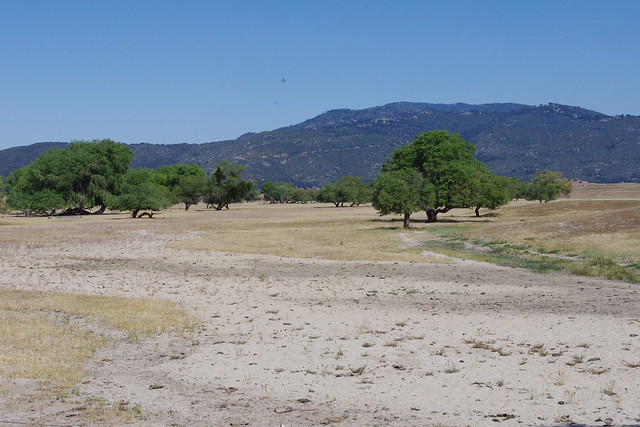
This actually brings me to some photos I took in and around San Diego County this past April/May in 2013 to illustrate just how effective animals could be used today as a means of practical applications. These photos were taken in and around the Lake Henshaw area which is owned by Vista Irrigation District and leased to Cattle Ranchers. Take a look at the effectiveness of keeping tree understories cleaned, especially with riparian systems

Photo: Mine

Photo: Mine
Both these photos are illustrative of how large animals can be utilized to clean and maintain an understory of an overhead tree canopy. The top photo is the creek bed that comes out of Camp Mataguay Scout Camp south of Warner Springs CA. Many of these trees were actually established during that same heavy seasonal rainfall period I wrote about back in 1987 to 1983. Same with that ribbon of green life coming from Warner Springs to just south of the Glider Airport all the way west to Lake Henshaw. Mostly Cottonwoods there, but now very large and mature. Previously there was only grassland there with a handful of trees. Now there are hundreds stretching for several miles. The lower photo above of the Cottonwoods are a group of woods which have existed as far back as I can remember in the early 1960s when my family went for country drives. These are half way in between the Hwy junctions of 79 6 76 which is south and either a County or Cal-Trans Station to the north on Hwy 79. Turkeys were also out in these wide open spaces when I took this shot.

The idea of utilizing animals for forest health maintenance is also nothing new, as Joel Salatin actually works his pigs this way. He fences off an area of forest, allows the pigs to root around and feed exactly one month, then allows eleven months of forest understory regrowth. He calls the method, one month of ground disturbance and 11 months of healing. In this first video below, Joel talks about his Silviculture practices which replicate the disturbance caused by Buffalo and elk which would move through and disturb the understory every year. If there was a disruption in this natural animal disturbance for whatever reason, then fire would provide the physical removal of the understory build up, but never a crown fire. The main point is here, is this man is successful at replicating nature and has turned a farm that had no top soil originally into a lush environment working the system with animals. 
~~~~~~~~~~~~~~~~~~~~~~~~~~~~~~~~~~~~~~
(As a caution, Joel momentarily for 30 seconds talks about his personal beliefs - hold off on the sarcasm & insults within your thoughts and focus on the main message & practices he expresses, which is basically replicating Nature. I don't believe everything he does or says either, but if you allow that stupid mode of ideological pride to take over, you'll miss the valuable lessons)
Forest Silviculture practices - Polyface Farms
Pastured Pigs - Part one
Pastured Pigs - Part two
Dr. Mercola Discusses Pigs with Joel Salatin at Polyface Farm
So what about the Native Americans ? Well, we've seen they are a lot like everyone else. There is no difference now or even back then. Humans excel at disturbing their surroundings. Many ancient civilizations did similar stupid things to their environment. The Aztecs in today's Mexico deforested their land for agricultural economics, then came drought and ruined the climate and any economy they once enjoyed. It's called greed and selfishness, just like today. Same in some other places in South America, Easter Island, the Maoris of New Zealand, the Colorado Plateau where ancient Natives called Anazasi which were very sophisticated with regards to building some incredible cities and an advanced form of agriculture went way to far, became greedy by removing too much forests for more farmland and no doubt deliberately burning the slash to grow more crops. When such historical disturbance was localized back then, only that area suffered as a result. However, today there is hardly a corner of the Earth that is not effected by dumb irresponsible behavior when is comes to land custodianship. Now the entire planet mechanisms are being effected and ecosystems which once took much abuse cannot take this any longer. The wild landscapes simply are not functioning normally. I saw this on my last visit where areas of Chaparral are not recovering fully or normally any longer. Some of this is due to lack of rainfall, but also there is more and more evidence of the underground disruption of the mycorrhizal grid which is effected by high concentrations of aluminum and other contaminants found in simple rainwater. I know, it's a long story, but I've got a post on this as well. Hope this at least puts to rest some of the Fables that have no doubt been exaggerated and embellished upon for some of the irresponsible land management programs which have done more harm than good.

Update - February 7, 2017: 
The Problem With The Ecological Indian Stereotype
~~~~~~~~~~~~~~~~~~~~~~~~~~~~~~~~~~~~~~~~~~~
Further reading: 
http://timeless-environments.blogspot.se/2012/06/fire-adaptated-ecosystems-ideology-that.html 
http://reason.com/archives/1997/02/01/dances-with-myths
http://www.redoaktree.org/indianhorse/history2.htm
~~~~~~~~~~~~~~~~~~~~~~~~~~~~~~~~~~~~~~~~~~~~
Update: Also of note is an article from June 7th 2013 which explains the Proper uses of livestock to correct and heal the soil and Earth. Raising cattle and other livestock might prove key to combating the ongoing transformation of fertile fields into deserts. This actually replicates what Joel Salatin practices, which in itself is nothing more than replication of what is found and observed in Nature if one is intelligent & intuitive enough to recognize it.
How Livestock Might Revitalize Degraded Agricultural Lands