Showing posts with label parasites. Show all posts

Monday, March 24, 2014

Parasites, Ecology & the Goldilocks Principle

Would you have ever in your life considered parasites as “tiny, hidden architects” of biodiversity that run a service business for a sustainable global ecology ? The biggest problem for the Earth's natural world is that ever since human beings arrived on the earthly scene, as caretakers of the natural world, they've mucked things up so horribly by introducing parasites where they can & will cause not only the most harm to other living organisms within any and all ecosystems, but where they will cause pain and suffering to other human beings. Let's be totally honest here, as environmental stewards Humans stink at it. There are a number of fascinating studies which have been published recently over the past couple of years which shed light on the positive as opposed to the usual negative aspects of various parasites and their healthy function in the natural world when that world is in a stable balance. I'll simply list a few and you can follow the articles. A parasitologist name Tommy Leung, suggests that parasites don’t just rob and steal; they usually do good as functional players in an ecosystem.
“Parasites are thought of as free-loaders, but many contribute as much as they take,” “They service the ecosystem. From an ecological perspective, they are more like tiny, hidden architects that are overlooked by most people.”  - “Some parasites do have a negative impact on an ecosystem, especially when they are introduced to a new and unfamiliar environment.” (source)  
Credit: haquintero

The parasite a cricket’s nightmares are made of
"But the very act of forcing crickets to their watery grave actually functions as a kind of fast food delivery service for the fish living in those streams. Cricket do not normally jump into streams and a drowning cricket is usually a rare treat for any fish. But thanks to the hairworm, these fish get to feast regularly on these large insects and it has been calculated that this straight-to-your-stream food delivery service accounts for more than half of the trout population’s energy intake in some watersheds."
Watch this creepy but very kool video below here of what happens when the cricket is forced by it's parasitic hitchhiker to jump into water and drown itself.
~~~~~~~~~~~~~~~~~~~~~~~~~~~~~~~~

Credit: Tommy Leung

(source) When microbes cause ants to become zombies
"Usually the enemy of an enemy is a friend, but that is of no consequence for a zombified ant. To these fungi the ant is but a stage upon which they play out their lives and conflicts, as they have been doing for millions of years."
Can you imagine the possibilities in dealing a blow to the out of control Argentine Ant Super Colony over-population of California and other areas of the west ? BTW, Mycologist Paul Stamets has brought this up before.
~~~~~~~~~~~~~~~~~~~~~~~~~~~~~~ 
Photo: Andrew DunnEuropean Mistletoe (Viscum album) attached to a
silver birch (
Betula pendula)
"Plant parasites can also affect ecosystem processes. While most people associate mistletoe with Christmas, it is actually a parasitic plant that has special root-like structures called haustoria that burrow into the host tree to suck out water and other nutrients. But for all that it draws from the host, this parasite returns it to the ecosystem in the form of enriched leaf litter."
"A study published in the Proceeding of the Royal Society B shows that when mistletoes are removed from a forest, more than a quarter of the birds species also disappear. The enriched leaf litter allows the forest to support a richer community of insects, which in turn bring in more birds." 
(source)
I previously wrote about Mistletoe on January 3, 2013, but so did many other people. It was the same link above, but it was worth bringing up the subject again as a great reminder.
Mistletoe: Former Demonized Plant Turns Out to be a Great Helper 
~~~~~~~~~~~~~~~~~~~~~~~~~~~~~~~

Image: SeaFoods.com

New Zealand Cockle (Austrovenus stutchburyi)

Credit: Tommy Leung
There was a story of a parasitic fluke that infects shellfish helps deposit them on seashores where birds can eat them, and barnacles and limpets and live in the shells – increasing the biodiversity of a shore that would normally have only sand. To the right here in the photo image you can see the Cysts of Curtuteria australis (tagged with fluorescent dye) in the foot of a New Zealand cockle. As more and more parasites accumulate, the presence of those cysts causes the cockle’s foot muscle to degenerate. With a mangled foot, the clam loses its ability to dig and is left stranded on the surface of the mudflat, exposed to hungry shorebirds – just what the parasite Curtuteria australis wanted. The nature of the seashore changes from one covered mostly with mud and sand, to one paved with hard shells. This actually increases the overall level of biodiversity in the area since the shells of the stranded clams provide habitats for other animals like limpets and barncles.
Parasitism as a determinant of community structure on intertidal flats
~~~~~~~~~~~~~~~~~~~~~~~~~~~~~~

Credit: Alvesgaspar/Wikipedia

Grassopper of Acrididae family: Anacridium aegyptium
"Scientists have known for some time that P. locustae infections in individual locusts leads to less swarming in locusts around them. What was not known was how it happened."
"The researchers are still puzzled as to why P. locustae would "want" to cause less swarming, as doing so would seem to lead to more difficulty in spreading from one of the insects to another." (No Kidding, why ????)
Team uncovers how microsporidian parasites prevent locust swarm behavior
~~~~~~~~~~~~~~~~~~~~~~~~~~~~~~
Credit: Vittorio Baglione

A carrion Crow brood parasitized by a great spotted Cuckoo
"Most everyone knows that cuckoo birds are the ultimate free-loaders. Mothers lay their eggs in the nests of birds of different species, leaving them to raise their young for them. What many may not realize however, is that different kinds of cuckoo birds behave differently when they hatch. Some famously push all the other eggs out of the nest, leaving themselves as the sole survivor and beneficiary. Other's however, don't do that, instead, they leave the other chicks alone and share in food the mother brings, acting as an adopted sibling, of sorts. At first glance it would appear that the host birds gain no benefit from this arrangement, but upon closer inspection, that assumption has been proved wrong."
"The researchers in Spain were studying the relationship between cuckoos and host carrion crows. In so doing, they were surprised to find that survival rates for crow chicks in nests shared by a cuckoo, were actually higher than for cuckoo-less nests. Looking even closer they discovered that the cuckoos had a survival mechanism that crows did not—they gave off a stink when threatened that caused predators such as feral cats to stay away. The stink, the researchers found, was caused by a chemical mix of repulsive compounds that included indoles, acids, sulfur and phenols. Taken together it proved too much for cats and birds of prey which typically find chicks in a nest easy pickings when the mother is away gathering food."
Study shows some cuckoo birds may actually help their hosts 
The major sad thing here is that in most of the television documentaries (where the majority of people get their science education) which reference the Cuckoo or Cow Bird as a parasite that robs and steals from others, we almost never see this side of the story. 
~~~~~~~~~~~~~~~~~~~~~~~~~~~~~~
Wasp parasitizing Gypsy Moth
Carepiller
So once again, how does it go ? Parasitism is bad. Parasitism is evil. Parasites wage war against innocent hosts. This is normal human  mindset. But what if parasites can actually do good ? If they are only suppose to be doing harm to the host, why do some biologists find that there are “positive benefits” which seem to be maintaining their hosts ? Ignorance has caused us to create an imbalance in nature by means of our horrible science-based agricultural practices which destroys both beneficial parasitic insects along with the bad. Our mind's naturally have a tendency to classify what we consider bizarre phenomena out in nature into moral categories: good kitty, bad doggie, so forth & so on. We do that with parasites all the time because we know how often some of them annoy, harm or kill us. I certainly don't want to suggest from these above articles that there is anything good about Mosquitos, Ticks, Fleas, Leeches, Roundworms or Malaria. But who knows how even these things behave when in a balanced system ? The majority of us have no clue as to what such a system would be like. I have found over the years that many things considered by humans to be plagues, cause famines and/or Pestilences are most often times the results of human ignorance, environmental sloppiness, lack of hygiene, etc. 

"Survival of the Fittest"
What’s instructive about many of these stories is that many of these research teams start with an assumption that parasites are bad. They are at war with the host, using the host’s resources for their own good. The evidence gathered above suggests the opposite; they might really be beneficial after all. Another organism we often demonize & insert into the “bad” category are Viruses. After all,  they do invade a host cell, hijack and use its replication machinery to make copies of themselves. Why, then, do only a small fraction of viruses cause disease ? What are the others out there doing ? Interestingly, many of them kill bacteria; that could be a good thing, couldn't it ?  Maybe we should take a fresh look at what we consider the creepy icky things of our natural World. In biology there are many pushes and pulls. But these pushes and pulls are not necessarily good or bad; they are simply opposite forces that maintain any ecosystem's homeostasis. Maybe by learning how nature really operates in a complete context, we can come to some conclusions of how to better deal with what has come to be termed invasive. These so-called invasive plants, insects, animals, birds, fish, etc are only a problem of ecosystem imbalance which resulted from some historical stupid decision made by humans which  created the problem in the first place. Nature had zero to do with it. Such findings by these researchers, do lend themselves to new ways of thinking about our natural world's parasites as designed mechanisms originally intended for health of the entire global ecosystem, a few of which have subsequently gone bad. For readers who cannot accept that, the story is a lesson about not trusting metaphors as reliable guides to understanding our natural world. You know many of these metaphors, some good and instructive, but some of these are horrible like "Survival of the Fittest". Okay, everybody for the most part completely understands how the best & healthiest seeds out perform sickly seeds and so forth. But people like Prof Suzanne Simard have revealed how bad and outdated that metaphor is from her research about "Mother Trees" in a forested Ecosystem where all the biological components have been observed working together to help each other survive as opposed to selfish competing individuals. This goes a long way in explaining the inept reforestation practices where the chaparral plant community is viewed as an enemy as opposed to an ally which actually insures a forest's natural rebuilding program. The reality is, this terrible religious metaphor has actually hindered our understanding as opposed to educating mankind by instilling respect for the natural world. A little over a decade ago, there was a great article I have never forgotten which puts things into perspective. It was called, Natural Enemies: Metaphor or Misconception ? ( in other words, is that a reality, or just another  metaphor ?), by Matthew K. Chew and Manfred D. Laubichler in the July 4, 2003 issue of Sciencemag.org , an online journal which discussed the usefulness and dangers of metaphors in the language of science. You know, like, "Survival of the Fittest" ? Please click and read the link below, but here are the two concluding paragraphs which I'll post here:
"What troubles us is that biology's metaphorical abstractions all too easily become concrete objects and substitute for specific, describable processes. Maximal diversity becomes evolution's telos instead of its tendency. Biogeographical frontiers become prescriptive and enforceable, rather than descriptive and conceptual. Seasonal “disturbances” such as floods interrupt normal ecological processes, instead of exemplifying them. Biological “productivity” and “diversity” become not only measurable, but virtuous."
Matt Chew's & Manfred Laubichler's essay provides many excellent metaphor examples like; ecology speaks of predator and prey, but these suggest one is good and the other evil. Hence we have Wolf versus Elk, Mountain Lion versus Big Horn Sheep, etc. You may also remember that metaphors have been used for describing the signalling and machinery that are used in cell biology, as well as being used to explain what goes on within DNA such as “coding” and "development". But for me personally, I find that bad metaphors associated with parasites have hindered us from viewing them in a way that helps us to better understand their roles in the Natural World. In conclusion, Chew & Laubichler warned: 
"Perhaps we cannot avoid metaphors altogether in scientific language. But scientists must be aware of the potential problems inherent in invoking the familiar as a convenient way for describing their ideas. At the very least, we should be concerned about what the frequent use of “natural enemies” (and the notable absence of “natural allies,” describing an equally familiar set of ecological interactions) reveals about the ways in which we interpret nature through metaphorical lenses, especially in the current historical situation."
(source: "Natural Enemies--Metaphor or Misconception ?")
BTW, Matthew Chew has an updated version from 2011 called, The Rise and Fall of Biotic Nativeness: a Historical Perspective 
~~~~~~~~~~~~~~~~~~~~~~~~~~~~~~
So what really is this Goldilocks Principle ?
Well, we've all heard of the classic fairytale 'Goldilocks and the Three Bears' which tells us the story of a young fair golden haired Girl who wanders into a strange house in the woods. She finds one bowl of porridge too hot, another too cold and the third just right. Many Scientists sometimes apply the tale to a planet's ability to sustain life as we know it. In our own star system for example, Venus is too hot and Mars is too cold, but Earth is just right. But there's far more  here on the Earth itself which is loaded with the Goldilocks Principles. Hence even the subject of parasites. These ideas  haven't always been very popular, because it smacks of fine-tuning and the Earth being special and unique among other known planets and so forth. Broadly speaking, the Goldilocks Principle applies to any situation where only a particular range of conditions is acceptable or agreeable for a healthy ecosystem. The Earth's ability to perfectly recycle and maintain itself is now seriously being called into question. Here was an interesting read from just last week on this very subject: 
Goldilocks principle: Earth's continued habitability due to geologic cycles that act as climate control 
~~~~~~~~~~~~~~~~~~~~~~~~~~~~~~
 So Parasites, Ecology & the Goldilocks Principle ?
File under: "Religion & other Metaphysics"

Thursday, January 3, 2013

Mistletoe: Former Demonized Plant Turns Out to be a Great Helper

Photo Credit: Duke University
Mistletoe is more easily identifiable in the Fall and Winter when deciduous trees have lost their leaves. Yet there are numerous other species of Mistletoe which exist on other evergreens, cactus, Chaparral, Eucalyptus, etc. Often demonized and used as an excuse for  timber harvesting and Control Burns, now it appears to be an actual Keystone species necessary for a health Vegetative system and it's occupants.


Wow, who knew it had other uses ? Well, Scientists should have known this all along. At least the ones who are in charge and trust of protecting the natural world and the authoritative control over official policies for responsible the land management. But as with other areas of Science back in the 20th Century, this hasn't always worked out well for the natural world. Government agencies with official oversight of Natural Resources have always managed the landscape from an exploitative money making venture perspective. Now that our natural world is so badly degraded at the start of the 21 Century, it is only now we see the real true value of things that have been either completely lost and not ONLY on the verge of  extinction, but now Science is actually taking a harder look at things assigned negative labels such as a disease, infectious, invasive, ugly, worthless, parasite and so forth. Ultimately, they now have to try to view various components of Earth's Ecosystems from a purposed perspective (something often considered by some as heretical in the past), just what benefits are derived from organisms like Mistletoe deemed worthless, evil or invasive.


Credit: US Forest Service
Words/Terms like these ones here  'invasive' - 'parasite' - 'infection' etc, have often in ignorance done more to hurt our understanding of some organism than to further it. To be honest, Mistletoe in my book isn't any of these and I'll conclude further on down as to why that is so. For more than a century, Mistletoe has been long thought to be a destructive trees murdering organism for which this great harm to human resources must be eradicated. I wanted to comment earlier when the research paper came out by David Watson, a researcher at Charles Sturt University in Albury of New South Wales in Australia, but I was delayed. I really wanted to document & reference for you some of the usual bad forest policies used in the past to eradicate or control what were considered infestations of Mistletoe in regards to Control or Prescribed Burns. But first, here is the latest article came out in the around December 17th 2012. Here is the link and Abstract and my comment after that. (by all means read the entire paper)
The Royal Society: "Mistletoe as a keystone resource: an experimental test"
Abstract:
"Various entities have been designated keystone resources, but few tests have been attempted and we are unaware of any experimental manipulations of purported keystone resources. Mistletoes (Loranthaceae) provide structural and nutritional resources within canopies, and their pervasive influence on diversity led to their designation as keystone resources. We quantified  the effect of Mistletoe on diversity with a woodland-scale experiment, comparing bird diversities before and after all Mistletoe plants were removed from 17 treatment sites, with those of 11 control sites and 12 sites in which Mistletoe was naturally absent. Three years after Mistletoe removal, treatment woodlands lost , on average, 20.9 percent of their total species richness, 26.5 percent of woodland-dependent bird species and 34.8 percent of their woodland-dependent residents, compared with moderate increases in controlled sites and no significant changes in Mistletoe-free sites. Treatment sites lost greater proportions of birds recorded nesting in Mistletoe, but changes in species recorded feeding on Mistletoe did not differ from control sites. Having confirmed the status of Mistletoe as a keystone resource, we suggest that nutrient enrichment via litter-fall is the main mechanism promoting species richness, driving small-scale heterogeneity in productivity and food availability for woodland animals. This explanation applies to other parasitic plants with high turnover of enriched leaves, and the community-scale influence of these plants is most apparent in low productivity systems."
~~~~~~~~~~~~~~~~~~~~~~~~~~~~~~~~~~~~~~~~~~~~
Wikipedia

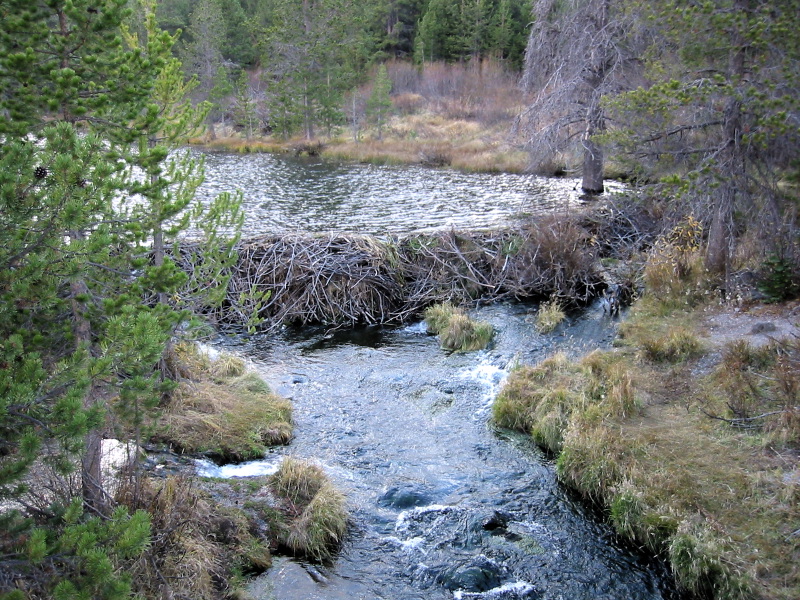
What impact does the Dam
of a Keystone Species like a
Beaver play in an ecosystem ?
Mistletoe = Ecological Keystone Species ? This would be a living organism that has the biggest impact on life around it within an ecosystem. But who would have thought that of Mistletoe ? I mean it is often ugly, rangy looking, certainly poisonous. So what possible worth or value  is it ? It's funny, I was reflecting on this negative attitude on this plant and similar attitudes towards other species plants, animals, birds, etc (like various Chaparral Plant Community Species) from a Human perspective and realized that humans treat and judge other humans the very same way. Or is it the other way around ? Could it be that mankind's often inhuman treatment of other cultures, races, class distinctions etc has been transferred over from their abuse of the natural world's resources and that explains the sad state of affairs in our societies as well ? I do believe it's both that reflect the mirror image of each other. But let's get back to examples of other kinds of Foundation Species which will illustrate the importance of the role a Keystone species plays in any habitat and get a better than average understanding of what and how Mistletoe fits just such an important niche in nature. How about a Beaver's Dam ? A Beaver moves into a completely new area and then by his dam building, physically and dramatically changes an entire wide area even well beyond it's immediate shorelines. 

Wikipedia
This impact of a Beaver's Dam building in create a lake or even small pond are huge indeed. Clearly as illustrated above, there are the obvious reasons. But even still, more so even far away from beyond the immediate vicinity of the pond or lake. Underground water tables are raised. Riparian woodlands which will be extensive around the banks will not only provide shelter and other habitat and food resources, but also the fact that their specific nature with regards their root systems in being both Endo & Ecto Mycorrhizal make them perfect water shunts or hydraulic transporters to other species of forest trees and chaparral far away from the water source. That in turn creates further life opportunities elsewhere.

I truly enjoyed reading from the study here, about some of the benefits that Mistletoe actually provides in the plant communities. I've always known about the benefits to birds as far as food and nesting, but the intriguing benefits of Mistletoe leaves to the forest floor was very interesting. Again, who knew ? Who would have thought Mistletoe leaf litter contained further richness for which to effect other life on the forest floor ? So the Mistletoe actually provides more richness in nutrient drop debris, than simply it's own leaf litter. And as far as that label "Parasite", I hate it !!! Why ?  Because the reason is, it's inaccurate of what I would consider a true parasite, you know, one that sucks almost all the life from it's host and gives nothing back ? But Mistletoe is different. scroll back up and look at the colour of that Mistletoe at the top of the page. Notice all the green ? That is Chlorophyll and for what purpose is Chlorophyll used for ? The manufacturing of food. So it's doesn't exactly draw from the tree's carbon stores what it needs, it manufactures it's own.  What it does do is create roots within the tree's branches and trunk and draw water and nutrients. Mycorrhizae however does draw from the plant carbon sugar stores and yet we don't consider it a parasite. Why ? Because it actually increases nutrient and water uptake by the plant by 200% and you can actually see improvement. It actually makes the plant work harder, but more efficiently. So one has to wonder what other things Mistletoe may be giving back to the tree in the way of beneficial Chemical exchanges. We do know that through the mycorrhizal network that plants can make chemical exchange between all sorts of trees and shrubs. So mycorrhizae gets a much nicer word of association through Symbiosis

Credit: ForestryImages.org
Dwarf mistletoe on black spruce in
northern Minnesota, USA
There is no doubt that under specific circumstances, the over abundance of Mistletoe in a tree which may be in a weakened state,  can overwhelm and even kill the tree. Some like the Dwarf Mistletoe which are perhaps not of the Greener variety and colonize pines, maybe have more of a parasitizing nature when out of control caused by imbalances. However, if there is one thing we all do know NOW, the natural world when it's left in a pristine healthy state with all it's various living components for which we NOW know all cooperate and help one another as opposed to the mistaken dogma or doctrine of "Survival of the Fittest", doesn't normally work against itself, UNLESS something gets out of balance. Mostly, if it does, it has a human stain of ignorance shackled by greed and selfishness as a motivational factor. The same could be true, and there is evidence that it is, with much of the mistletoe degradation of forested ecosystems around some places on Earth. At times however, out of control mistletoe can leave clues behind as to why conditions were so favourable for it's excessive spread which has been a result of human mismanagement of the land.  Take for example this photo below. 


Credit: ForestryImages.org
Large clearcut in mistletoe infected jack pine stand in Manitoba. Cut boundaries located well beyond extent of infection. Site chained afterward to eliminate infected understory trees.
http://www.forestry.uga.edu/outreach/pubs/pdf/forestry/mistletoe%20monograph%20pub%2008-25.pdf
 When I hear of certain specific reasons (excuses) made for why trees needed to be harvested to eradicate something or even plans for a prescribed or control burn to eradicate something, I know that as a general rule, some other motive is behind it. While there may be real circumstances where there could be a real need, how or why did such an overwhelming outbreak occur in the first place ? Take a clue from the photo above of the clearcut forest. They said on the forestry link that it had to be done because of the invasive Mistletoe. Really ? See anything odd or unnatural about that photo ? Yes, of course, it's a dead give away. It's not a normal occurrence for Jack Pine or any other species of tree to grow in a monoculture setting which looks more like row crops of a corn field somewhere in Iowa. Clearly, the unnatural circumstance of the Industrial Forestry created in the first place by humans is to blame, but that is not what gets the blame. Mistletoe is the evil villain. The above circumstance also justified taking out non-infected areas also. Open this link below here from the Warnell School of Forestry in Georgia and scroll on down to page 20 view the survey chart which shows the results of three Surveys taken in the U.S. states of Kentucky/Tennessee hardwood forests. The percentages shown for the majority of Mistletoe colonization are mostly tiny to none per species and yet the four highest percentage species listed certainly are not life threatening to the woodlands either. This is because the forest is extremely biodiverse and not monocropped like the Industrial Tree Farm of Jack Pine in the above photo. 
~~~~~~~~~~~~~~~~~~~~~~~~~~~~~~~~~~
Juglans nigra 35%Ulmus americana 21%Ulmus rubra 16%Robinia pseudoacacia 11%Prunus serotina   9%Fraxinus americana   7%Acer saccharinum   4%Celtis laevigata   4%Gleditsia triacanthos   4%Ulmus serotina   3%Ulmus thomasi   3%Acer rubrum   2%Carya ovata   2%Celtis occidentalis   2%Maclura pomifera   2%Fraxinus pennsylvanica   1%Liriodendron tulipifera   1%Nyssa sylvatica   1%Quercus alba   1%Castanea dentata   0.6%Platanus occidentalis   0.6%Acer saccharum   0.3%Fagus grandifolia   0.3%Liquidambar styraciflua   0.3%Ostrya virginiana   0.3%Quercus prinus   0.3%Sassafrass albidum   0.3%Ulmus alata   0.3%Quercus muhlenbergii   0.1%
There are numerous Mistletoe species and many of them host specific, which means they prefer one or two kinds of tree. The more biodiverse, the far less problem of an entire wipe out of an ecosystem. BTW, read that entire link. There are some fascinating educational information on Mistletoe life cycle and construct on that paper. Below is a photo of the use of prescribed burns for control. 
Credit: ForestryImages.org

Cut, felled and 'prescribe burn' of supposedly Mistletoe 
infested Lodgepole pine in the United States.
Recently I wrote about the Santa Rosa Mountains which are above overlooking Palm Springs. Sometime back in the 1930s, a switched back trail called the Sawmill Trail was constructed to allow Logging companies back in the 1930s to harvest Jeffrey Pine trees. Talking with the man who built the road, Jay Dee McGaugh, he said the excuse the Forestry gave them for clear cutting the Jeffrey Pines  was that they were all "Bug Trees", which I took to mean they were all infested with some species of Pine Beetle. Knowing the way politics was and has been, one has to wonder if the real truth of the matter was more of a money making venture as opposed to any ecology. Guess we'll never know for sure, but no replanting effort was made and the forest tree line no longer extends lower down Santa Rosa as it once did. Recently another similar Science report has come out and exposed the cause for the global increase of an explosion of Jellyfish populations everywhere around the entire earth. Of course the report doesn't blame the Jellyfish, but does expose the human cause of pollution throughout our planet's oceans for the favourable conditions which facilitate & trigger their rapid increase. My point here is this. There are all sorts of living organism on this planet that are out of balance. Some of the out of balance circumstances even in your own yard's landscape like insect pests, weeds or whatever may be a fault of your own, but unknown to you. Before applying some irresponsible damage control measure by use of other science based innovations like chemicals, should be avoided to see if there is a more ecological solution which would be more viable.
EurekAlert
Common scene of Japanese Fishermen fighting to keep Jellyfish from their nets. These creatures are also consuming the fish they may catch. But will the Fishermen blame government and big business for the off balanced abnormal conditions created by industrial pollution and demand something be done about it ? Or will yet apply another negative label to be attached to a creature who simply responds to genetic instructional instincts as triggered by it's environment for which humans are responsible ?

These two links here are of some of the negative uninformed mentality which rules. Further below are some more interesting links. You can actually Google more info and obtain 100s of other informative links with the same bad science viewpoint towards Mistletoe. In the mean time, when you next go walking on a nature hike, give consideration to those darker green lush patches high up in the tree's branches and give some thought to all the other biodiverse richness of life they provide to the entire system
http://www.fs.fed.us/outernet/r3/publications/documents/dm-fire.pdf
http://www.landandwater.com/features/vol49no6/vol49no6_1.html
~~~~~~~~~~~~~~~~~~~~~~~~~~~~~~~~~~~~~~~~~~~
Further Reading References on the importance of Mistletoe
University of Adelaide: "Could mistletoe give the kiss of death to cancer?"
"Beyond pills: Cardiologists examine alternatives to halt high blood pressure" (Mistletoe Extract Used in Chinese Medicine)
Charles Sturt University: "Passions meet in mistletoe book" (2011)
http://www.hiltonpond.org - "MISTLETOE: FRIEND OR FOE?"
http://www.arhomeandgarden.org/plantoftheweek/articles/mistletoe.htm
http://www.floridata.com/ref/p/phor_leu.cfm