Showing posts with label GMOs. Show all posts

Tuesday, March 29, 2016

How the microbiome mines the soil for nutrients & how their demise will domino effect all other lifeforms

Scientists observe the step-by-step process by which a fungus attacks a mineral to extract vital nutrients
Image credit - Henry Teng
The researchers found the fungus Talaromyces flavus in a
Chinese mine, eating up minerals and extracting iron and magnesium


"All over the world, microbes destroy rocks to access precious nutrients like the iron locked inside. In a lab in Washington, D. C., researchers zoomed in on one particular microbe, the fungus Talaromyces flavus, to see just how this is done."
In a paper published this month in Geology, the researchers document their observations of the fungus as it obliterates its rocky environment using a mix of acid and mechanical force. Although it’s known that microbes like bacteria and fungi can wear away rocks, previous researchers estimated that fungi only contribute 1% to total bioweathering, said Henry Teng, a geochemist at George Washington University and coauthor of the paper. After watching T. flavus burrow into the mineral to extract essential nutrients, Teng and his team suggest that fungal weathering could actually be 40%–50% of all bioweathering. 
I really do not want to repost the entire article, but there were so many gems in this one which offer pause, pondering and meditation. For example, maybe I should have titled my blog,  Earth's Interface".  Definition: "Interface":
Noun 1. a point where two systems, subjects, organizations, etc. meet and interact. "the interface between accountancy and the law" 
2. COMPUTING a device or program enabling a user to communicate with a computer. "a graphical user interface" 
Verb 1. interact with (another system, person, etc.). "you will interface with counterparts from sister companies" 
2. COMPUTING connect with (another computer or piece of equipment) by an interface. "the hotel's computer system can interface automatically with the booking system"
“Compared to bacteria, fungi are overlooked, understudied, and very few studies [looked] at these interfaces between fungi and mineral,” said Steeve Bonneville , a biogeochemist at the Free University of Brussels in Belgium who was not involved in the paper, which he called “a very solid study.” The new research provides evidence that “fungi can be a major player in mineral alteration and more generally in biogeochemical cycles,” Bonneville said. 
EOS: Using Acid and Physical Force, Fungi Burrow Through Rock
Also, please see my other post which deals with the same identical subject matter: 
Mycorrhizal Fungi run the Largest Mining Operation in the World 
~~~~~~~~~~~~~~~~~~~~~~~~~~~~~~~~~~~~~~~~~~
Credit: University of Adelaide

Panning for platinum grains in Brazil: Frank Reith, University
of Adelaide, and Barbara Etschmann, Monash University.
Another fascinating question was recently explored, "Why do we see flakes of palladium, platinum and other heavy elements on the surface of the Earth?" It’s been presumed that geological processes dredge them up from the interiior. Yup, sure enough, that's what I always thought. Volcanoes, Tectonic uplift etc brought to the surface all those traces elements. But in an Australian study, the scientists found that bacteria play a major role in this. The article in PhysOrg quotes Frank Reith from the University of Adelaide:
“Traditionally it was thought that these platinum group metals only formed under high pressure and temperature systems deep underground, and that when they were brought to the surface through weathering and uplift, they just sat there and nothing further happened to them,” says Dr Reith.
“We’ve shown that that is far from the case. We’ve linked specialised bacterial communities, found in biofilms on the grains of platinum group minerals at three separate locations around the world, with the dispersion and re-concentration of these elements in surface environments.
So to make a long story short, these “nuggets of platinum and related metals can be reformed at the surface through bacterial processes.”
“We’ve shown the biofilms occur across a range of platinum-group-metal grains and in different locations,” says Dr Reith. “And we’ve shown, that at the Brazil site at least, the entire process of formation of platinum and palladium was mediated by microbes.”
(Source - PhysOrg) 
There is so much tonage of understanding that scientists still do not know, but by nature are often reluctant to admit. This is why bioethics within industrial science are so important and it behooves those scientists to learn humility. How often lately are we reading expressions in science studies and journals like, "We were shocked to find," totally unexpected," "now we know," etc etc etc. So much for other terms like, "Settled Science" or "Scientific Consensus" which is what Biotechs and Agro-Chemical companies and their researchers hide behind to justifiy their technology. As Henry Teng said:
“Most of the nutrients in rock and soil are in geological form. Roots cannot directly use that. Plants depend on the fungi to colonize their roots.”
~~~~~~~~~~~~~~~~~~~~~~~~~~~~~~~~
Image: Max Planck Institute

Fluorescent microscopy image of a root of Arabidopsis thaliana (violet)
 surrounded by a fungal mesh of Colletotrichum tofieldiae (green).
The mesh also grows within the root cells.
"Plants take on fungal tenants on demand"
The above title is from an article on March 17th 2016 from the Max Planck Institute which reveals how plants send signals to potential fungal partners when vital nutrients like phosphorus are scarce and the plant is incapable of acquiring these abundant, but unavailable nutrients on their own. This also sheds light on why heavy application of synthetic fertilizers in agriculture will trigger an epigentic off switch and shut down a crop plant's chemical signaling system which alerts potential fungal partners to please colonize this host. In fact, the biotechs have shut the system down altogether in many of their cultivators either by accident or deliberately. This creates a dependency in GMO Seeds on the Agro-Chemical industries synthetic wares. For me personal, a major clue on this came from watching the interviews of India and Mexican peasant farmers who failed with GMO seeds said their earlier traditional hierloom seed varieties didn't require all the fertilizer applications with the new biotech engineered seeds. Monsanto as much as admitted this when they said the reasons Indian farmers failed was because they didn't use the chemicals the seeds were designed to work with for higher yield. See folks, they've known about this all along and sheds light on why the industrial Ag business model spends millions on disinformation public relations campaigns. Below is the forward abstarct and link to the whole article. 
For a long time, it was thought that the sole role of the immune system was to distinguish between friend and foe and to fend off pathogens. In fact, it is more like a microbial management system that is also involved in accommodating beneficial microorganisms in the plant when required. Researchers from the Max Planck Institute for Plant Breeding Research in Cologne in collaboration with an international consortium of other laboratories discovered this relationship between the model plant Arabidopsis thaliana, or thale cress, and the fungus Colletotrichum tofieldiae. The plant tolerates the fungus when it needs help in obtaining soluble phosphate from the soil and rejects the microbe if it can accomplish this task on its own.
https://www.mpg.de/10390194/plants-symbiosis-phosphate
There was an interesting piece in Science Daily which admitted that there was an urgent need to collect wild ancestor plants of today's crop plants because the vast volumes of genetic information for fighting diseases, climate change etc could be lost if they are not found and locked away in that precious seed vault. These genes will contain the vital information for plant/fungal symbiosis which has been complete lost or shut down by genetic engineering. Fungi are vital for plant drought resistance for which messing arond with genomes for a Drought Guard patent is worthless. But even this may not be enough.
Over 70% of essential crop wild relative species in urgent need of collection
Why people should be very afraid of what the actual consequences of the Industrial Agricultural practices are doing to the Earth
Scary news comes from researchers showing that not only plants, but also microbes may not be able to adapt to climate change as once imagined.


(Kevin Griffin/Lamont-Doherty Earth Observatory)
"Cotton grass flowers on the tundra of northern Alaska. These and other cold-region plants do not respond as steadily to increasing heat as previously thought, according to a new study. 
Scientists Say Many Plants Don’t Respond to Warming as Thought

Courtesy of Alice Dohnalkova/PNNL
Microbes in soil — organisms that exert enormous influence over our planet's carbon cycle — may not be as adaptable to climate change as most scientists have presumed, according to a paper published March 2 in PLOS One.  
The scientists found less adaptability than they expected, even after 17 years. While the microbial make-up of the samples did not change much at all, the microbes in both sets of transplanted soils retained many of the traits they had in their "native" climate, including to a large degree their original rate of respiration.
Microbes may not be so adaptable to climate change


UCI graduate student Caitlin Looby is exploring the effects of
global warming on the soil fungi communities of a mountain
cloud forest in Monteverde, Costa Rica. UCI 
Soil fungi and plants have developed a mutually beneficial arrangement. Some fungi help plants by growing into their root cells and increasing the root surface area available to absorb water and nutrients. In turn, plants give the fungi the sugars they crave. Other fungi facilitate the breakdown of plant material, which releases carbon dioxide.  
“These mountains provide a unique opportunity to predict how soil fungi will change in response to climate,” Looby said. “The properties of these mountain soils are sensitive to the rising cloud layer. Our work demonstrates that fungal community composition shifts with elevation and with climatic factors that co-vary with belowground responses to elevation, such as temperature and moisture.”
UC Irvine: Even plant-supporting soil fungi affected by global warming, UCI study finds

Image Mine
I can attest to the fact that both plants and soil organisms work best when the soil temps are much cooler. This photo at right here of my old place in the San Jacinto Mountains is a prime example. In the beginning when I planted trees in the open ground, temps were not uncommon at 90+ Fahrenheit [32 Celsius]. Although I inoculated them with fungal spores, the pine seedlings stayed stuck in neutral until I placed a thick layer of bark and pine straw mulch around the tree at a four foot diameter. You could almost instantly see a difference in the needles which change position to a more upright one as opposed to drooping downwards. And this dispite the fact that the ground was damp and wet from watering. Root systems operate at maximum efficiency when they are cool. Hence the reasons in nature why seedlings grow better with nurse plants or mother trees. Aside from the obvious underground interfacing within the mycorrhizal grid. While above ground foliage grow may be slowed or even stopped altogether when temps are cold or frigid, I've always noticed root growth often continues. This was obvious when I did wild outplanted pine nut experiments where even the warmer climate pine seedling emergence would even push up through the snow in Spring. Once germinated and above ground, the seedling would stay in park until further warmer weather arrived. But you can bet there was still underground infrastructure activity going on. Climate Change will definitely impact all ecosystems irrespective of where they are located around the globe. The Industrial Ag business model is not the answer and in fact it's a major part of the problem despite the propaganda to the contrary (See - Climate Change & Industrial Agriculture's "Get-Out-of-Jail-Free" card) . A biomimetic approach is the only answer, but only if all humans around the globe are on the same page with how Nature actually works. Given the insaneness around the globe in all the News reports, this is probably the last thing on most people's minds. Especially today's youth who are taking over running the planet and with little or no understanding of how old growth plant ecosystems actually work. This includes young College Science students. I mean, what's left of the natural world for them to actually study ??? How about the "World According to Monsanto" ???
I usually post more references, but I think you've got more than enough above!

Monday, February 2, 2015

Using Nature's Mycorrhizal Tool-Kit to compete with Weeds vrs killing them with Glyphosate

Get'em, he's not one of us!!!
This post will be my last post on the subject of GMOs. This volatile subject just seems to spark so much vicious ideological hatred by those claimer to be defenders of Science.  My last post dealt with the recent flood of articles in journals across the internet which championed all the common Biotech definition shell games on what GMOs really are. I of heat at the Google+ Science community where a dozen rabid Sci-Fi defenders whose main arguments for GMOs had nothing so much  to do with science, but rather personal attacks on me. Most were the typical "animal house" type of university student with no outdoors experience in the real world other than what they've been fed inside some Lab or what they've been indoctrinated into believing inside some University lecture halls by professors shackled to the interests of Industrial Agriculture whom they depend on for funding. In fact on that very point, their entire understanding came from the talking points they've parroted straight out of the Corporate Biotech playbook. I kid you not, every retort was scripted from Biotech website talking points. They had no originality of their own. I bore the brunt of every derogatory insult and personal attack you could imagine. This final incredible  comment was thrown at me just before I was banned by the Science Moderator who emphatically insisted that my being banned  was the result my making Anti-Science statements. And yet there  this *cough-cough* scientifically inaccurate statement below. Actually this was the only clean one I can repeat:
  "Also Kevin, developing GMO's is not "against nature". Anything that occurs in the natural observable world is natural. Skyscrapers and bridges are as naturally occurring as bee hives."
Unbelievable !! So apparently if I'm reading this correctly, we're to believe that all those Industrial Solar Farms and Wind Farms installed within pristine wild environments are officially natural and anybody against those projects would be labeled anti-science ?  I was totally surrounded and outnumbered by intellectuals, but not a genius among them. Only one older commenter knew what I was talking about and apologized for all the vicious hatred I bore the brunt of. Actually I was trying to explain the benefits of how and why mycorrhizal fungi are a superior mechanism choice over BOTH  conventional breeding [as championed by the Organics gang] and Genetic Engineering [as championed by the Industrial Science Crowd], of which both techniques were mentioned in the December Intelligence Squared debate in which the audience was informed it would take 10 years to develop for drought resistant plants. But with the mycorrhizal fungi, you will actually get instantaneous results that very first season. No matter, this will be my last post on the subject of GMOs. But first, a bit on natural weed control which would negate using chemical pesticides.
~~~~~~~~~~~~~~~~~~~~~~~~~~~~~~~~~
Of course the subject of Roundup or Glyphosate was only a small part of what I wanted to talk about. Actually I didn't really want to discuss it at all. However it is anyway a major component of the conventional science-based industrial agricultural program that most Farmers and Home Gardeners practice for ridding themselves of those evil weeds. I am NOT totally against chemicals, they all can have a place when used modestly. For example, I mostly find  them useful in ONLY the extreme cases where drastic measures can reverse what human land mismanagement caused in the first place. In an extremely dense weedy situation after weed whacking, you need only use Roundup one or two times and that's it. But then you also need to rebuild plant community system back to a more naturally biologically balanced situation which would be mycorrhizal. Years ago, I too fell for the Roundup is "Biodegradable" label like you see above, believing the text which stated that when the Glyphosate comes into contact with soil it becomes inert or neutralized. Well, low and behold that was a lie and the government forced them to change their label. So without chemicals, how does one go about accomplishing this ?

image: Rick Halsey
Take a look at this photograph at left. This was taken by the California Chaparral Institute's lead Biologist, Richard Halsey, who along with friends were exploring and photo documenting a clean pristine Manzanita environment at Fort Ord in California recently. Now those numbers and names are unimportant for what I want you to closely observe here. Look at that clean hygienic foreground in the shot. Do you understand here that there are incredible tiny little biological mechanisms at work which are the reasons behind why there are no weeds ? No of course not, because they are microscopic in size and not visible to the naked eye. And maybe that's the problem for most people, out of sight out of mind. I admit it, I'm a bit tweaked. I tend to look for hidden subtle clues when out in the wild that others bypass or overlook because there are more sexy eye catching objects to document, like the hunt for different species of Manzanita to share with the public to instill deeper appreciation for the natural world. I agree with all that of course, people by nature need life size visuals or illustrations from familiar situations which allow them to actually see, touch, and smell to effect and inspire the senses. But if you only look for the big things, the smaller things which make all of those bigger life size things possible will not get the credit and protection they deserve. Take all those microscopic things away and entire systems collapse.   

Image: Kevin Franck - Julian California
This past summer as an example, had I not looked for clues as a result of my obsession with mycorrhizal fungi, I would have passed up this mycorrhizal truffle which looks like nothing more than a stone along the trail at Inspiration Desert Viewpoint south of Julian California off Hwy 79. Most people would discount it's appearence or importance to the environment, but eliminate it completely and that important  chaparral or forested plant community collapses. If that happens, then the noxious invasive weeds rule as King. And that is really what I wanted to talk about here, because the same exact program within all healthy ecosystems which allows different lifeforms to mutually cooperate and help each other to survive can be replicated and used efficiently on an Agricultural scale and replace the industrial one we are forced to accept presently. It's always been about the money, not the science.
~~~~~~~~~~~~~~~~~~~~~~~~~~~~~~~~~~~~
Mycorrhizal Applications Inc
Monsanto

In a previous post about the Intelligence Square Debates on GMOs between Team Monsanto & Organic, I reference the above photo from Mycorrhizal Applications Inc. The subject in that December debate had both sides talking of the need to either breed different Corn varieties for drought resistance to grow in the hotter climates of Africa or Genetically Engineer Corn [Droughtgard Hybrids] for drought resistance. Both sides were dead wrong. The drought resistant tools have always been there since the beginning of time with regards life on Earth and it was poor preparation on the part of the Organic team not to reference this and to no surprise a deliberate silence on Team Monsanto's part not to reference it since there is no real money in such a proposal. What was fascinating about the University of Florida study of MycoApply [which I do use] in the above photograph is that there is a clear distinction between corn grown conventionally without MycoApply and those Corn roots which were inoculated with it. Something else is interesting about that photo. Notice in the control square patch on the right where mycorrhizae has moved and spread underground from the Mycorrhizal inoculated side on the left and the healthy looking stalks along the border are also reaping the healthy benefits of the fungi moving underground into their root zone. I mean isn't that kool or what ? Well, Okay, so now what about the weeds ?

Photo Credit: Oregon State
Mike Amaranthus in a teaching seminar referenced this photograph here to the left which shows Douglas Fir seedlings with and without mycorrhzal fungi colonizing their roots. Mike stated that when they examined these poorly growing seedlings, they were phosphorus deficient. So the next obvious thing was to check the phosphorus levels in the soil, but the odd thing about that was that when they tested the soil, it was high in phosphorus levels. But yet again, those trees were phosphorus deficient. What they found is that the Methyl Bromide which is a broad spectrum fumigant to kill diseases in the soil, also killed any beneficial organisms which would have helped these Doug Fir seedlings extract the phosphorus from the soils more efficiently. In my early days of schooling and my ornamental hort  agricultural courses we used this chemical as a fumigant for sterilizing soil for nursery seed germination application. My Ag instructor told is that this stuff is extremely deadly and could kill humans even if breathed even briefly. It was developed in the 1930s and also found to deplete the Ozone and in many countries is supposed to be phased out by 2015. This really spooked me back in the early 1970s and it is what got me into looking at alternatives for finding safer more biological solutions for preparing potting soil media and eventually brought me to mycorrhizae. As much as I was interested in entering the Nursery business, I did not want that to be part of my regularly performed weekly duties.

Now getting back to Phosphorus. This necessary plant nutrient is key to understanding what all plants need and how they acquire it, including weeds. Take note of what this photograph is illustrating for us here. Imagine for a moment if we could digitally remove the  fungi mycelial threads from the picture. There would be only one main single tap root and two or three slender branch roots. Now imagine those stunted Douglas Fir trees without the mycorrhizal colonization in that high phosphorus content in that soil. The seedlings do not have the performance enhancing tool-kit to allow them to excel in growth as the other taller seedling did who did have the mycorrhizae. As Mike Amaranthus stated, we're talking maybe ten miles worth of threads in a single handful of soil. The stunted trees were not capable on their own to access available phosphorus. Interestingly however, weeds excel under non-mycorrhizal conditions unlike trees and shrubs. They thrive in a more bacterial soil system. The interesting thing about phosphorus is that it doesn't move very well in the soil, so if trees or shrubs don't have a mycorrhizal soil system in place, they cannot access the phosphorus. The mycorrhizae also produce a chemical which dissolves the phosphorus and readily feeding it to their hosts, again something plants alone don't have the ability to procure by themselves alone. 

Bert Wilson - Las Pilitas Nursery
This was also yet another feedback Mike Amaranthus has received from many his commercial organic farm customers. The purchase of MycoApply of course was mainly for drought resistance and improved nutrient uptake, however they reported a side effect provided by the mycorrhizae they did not expect. They had reported less weeds. An interesting thing about weeds the majority of which are ruderals, is that they are mostly non-mycorrhizal and therefore have competitive edge in non-mycorrhizal soils over crops planted within disturbed soils sites like those environments created by industrial agriculture. Weeds thrive in a bacterial soil environment and therefore have no problem accessing the phosphorus without any competition for it. However, weeds do get outcompeted and starved for phosphorus in a heavily healthy mycorrhizal system. This was something Bert Wilson of Las Pilitas Nursery wrote about on their website quite regularly. He preached and preached about  mycorrhizal systems versus a bacterial systems. He wrote of how bacterial systems favour weeds [ruderals] and mycorrhizal systems favour trees and shrubs. The man had a wealth of knowledge and more importantly it came from hands on practical application from getting off his back side by experiencing the outdoors and any  knowledge he gained had zero to do with any controlled indoor Lab experiments. Although Bert did have a degree in chemistry, he was not a well known celebrity type or  ruling Scientific Orthodoxy. However, Bert Wilson was much appreciated and loved by the 1000s who benefitted from his knowledge and the California Native Plants he and his family grew at the Las Pilitas Nursery. I'll post some of Bert Wilson's links on weed control at the bottom in the references. 

So both Mike Amaranthus and Bert Wilson spoke of weeds not being able to compete within a mycorrhizal system. So why is this  ? It's a thing called phosphorus. Weeds excel in a bacterial environment which industrial agriculture and conventional chemical gardening and landscaping create by killing the mycorrhizal biological controls within the soils. They rob the soils of phosphorus. More and more literature is proving that in these mycorrhizal landscape beds and organic run farm fields where mycorrhizae is used to enhance performance in crops, the weeds are starved for phosphorus. In the disturbed soil environment created by industrial agriculture, the weeds are very aggressive at capturing the soil phosphorus far better than mycorrhizal crop plants who lack mycorrhizae on their root systems under conventional farming practices. This is where the industrial agricultural model benefits Corporate profiteering interests. Not only can they sell their expensive patent protected GMO seeds, but all the other chemical fertilizers, herbicides and some insecticides where the precious GMOs fail. It's a win win for all those former WWII chemical companies and an expensive proposition for the farmers that feel shackled to the system. Were it not for U.S. Government Subsidies, the conventional Farmers would never earn a living. That's why Organic wheat growers and other organic farmers don't qualify for the Government teat life support entitlements, because they make profit. Because they plant into their crops a good healthy mycorrhizal blend within their soils and those same weeds cannot compete in a mycorrhizal environment with it's massive rooting network grid infrastructure. So it's a P related factor and this is what Mike Amaranthus' customers have been experiencing and why they are noticing fewer weeds. Now does anyone here reading this have any idea of potential for ruin of some powerful wealthy Biotech Industry's business model ? Do you think they are just going to lay down and accept defeat ? Not on your life.

There are also some other important points to consider regarding farm cost savings and higher production yields with mycorrhizae. The University of Wisconsin made a study of the effects of Mycorrhizal Applications Inc's product called MycoApply on potato yields, profit and another extremely interesting thing about the application of phosphorus in the field. It was found that where conventional grown potatoes needed 120 lbs of phosphorus added per acre, under the mycorhizal applications to the potato fields, only 30 lbs was needed. Hence less phosphorus and more efficient mycorrhizal nutrient competition and uptake means less fertilizers. There was also an added bonus of more yield of potatoes per acre and profit by the usage of mycorrhizae into the soils. So drought tolerance, superior nutrient uptake which negated tons of fertilizers on industrial site, 200% increase in water hydration which made plants drought resistant and the added plus of less weeds or stunted weeds which could not compete. So it was win win all way round.
 
Illustration by Michael Rothman
University of Wisconsin Potato trail with MycoApply
Summary of 2011 results
• MycoApply® treated plots averaged higher yields at all input levels of phosphorus. 
• Yield increases were greatest @ 25% of conventional phosphorus inputs (30 lbs /acre vs 120 lbs / acre.) 
• Yields from MycoApply® treated plots shifted significantly to higher grade potatoes (which bring higher prices) 
• Net savings on phosphorus alone = at least $81.00 / acre with MycoApply® vs standard conventional P inputs. 
• Net revenue increases ranged from $319 to $1,095 per acre on MycoApply® treated plots, depending on phosphorus inputs. 
Influence of MycoApply® on yield response to phosphorus fertilizer in Russet Burbank potato 
~~~~~~~~~~~~~~~~~~~~~~~~~~~~~~~~~~~~~~
Mycorrhizal Applications Inc. - MycoApply gave higher yields in potatoes with only a fraction of the fertilizer

2013 Maine Potato Trials with “MycoApply®” Summary
• 6 trails on 6 farms with MycoApply® 
•  Average yield with MycoApply® was 366 cwt/Acre. Potatoes over 10 oz was 24% 
• Average yield withNO MycoApply® was 319 cwt/Acre. Potatoes over 10 oz was 21% 
• Average MycoApply® Advantage was 47 cwt/Acre. 
• We estimate potato prices $8.50/cwt 
http://mycorrhizae.com/wp-content/uploads/2013-Maine-Potato-Trials.pdf
~~~~~~~~~~~~~~~~~~~~~~~~~~~~~~~~~~~~~
Mycorrhizal Applications Inc
Most all conventional farm grown crop plants routinely face a challenge of absorbing enough of certain key elements, such as phosphorus, nitrogen, potassium and iron. What choice is there ? The Biotech Industrial Business Model doesn't allow for the formation of a healthy fungal grid underneath the soil. The synthetic fertilizers will prevent that from happening. However, the field crops which are colonized by the Mycorrhizal fungi don’t face that same obstacle. The fungi produce specialized acids and enzymes that break the bonds that bind those nutrients like rock phosphates which are generally unavailable to non-mycorrhizal roots even if they are abundantly high in the soil. Many Landscapers and Gardeners who have learned a more organic approach out of necessity recognize this huge advantage of having plants with roots tied into an extensive fungal network. Compost and other organic fertilizers alone are not enough. It’s no surprise that a plant with hundreds, if not thousands, of miles of fungal hyphae working on the plant’s behalf to mine key nutrients and freight them back to through the roots to the plant structure above ground is far better able to grow faster, stay healthier, and ultimately yield more than it would without the fungi’s partnership.
 
This is something industrial agriculture is far behind and lacking because there is no money in such a business model. The Biotech model engineer it's patented seeds to quite literally be drenched in more chemicals and not less as advertised. This makes them outrageously expensive and unattainable by many of the small farmers in the poorer developing countries. When India Farmers failed with those GMO seeds which were heavily promoted as a simply a "Just Add Water" recipe by India's celebrity Bollywood culture as part of the Biotech public relations media blitz, the poor farmers bought into their sales pitch. When things went wrong, Monsanto blamed them for not purchasing and using their chemical fertilizers and pesticides which they were engineered to work in conjunction with. Seriously, dirt poor third world people do not have the money to buy that chemical junk and India Farmer customers who make one to three dollars a day cannot afford to buy more expensive food which makes the "We just want to feed the world" slogan a joke. Now take a look below here at this extreme weed infested maize field. This is actually the results of years of abuse in this field with chemicals and other bad land management practices. 

Image Credits: USDA/Public Domain - Arkansas Cornfield

In Southern California this super weedy infestation phenomena is common on hillsides and illustrates years of abuse. This field is one in Arkansas and probably represents years of spraying and drenching crops with their chemical junk. The soil is lifeless for the most part and synthetic fertilizers must be heavily added in hopes that the crop gets at least some kind of nutrition even if artificial. It's a numbers game. The weeds thrive in a bacterial soil environment where a mycorrhizal presence is totally absent. When the situation is turned around into a mycorrhizal one, the fungi out competes the weeds for that phosphorus. But the situation above is an example of one of those drastic circumstances I mentioned earlier where a weed killer like that evil Roundup may be needed to remove the bulk of weed density. But you have to stop that chemical application soon, along with the implementing of planting good cover crops which are mycorrhizal to get the problem corrected underground, and then plant a food crop. After planting and harvesting, it will be imperative to have a rotation scheme. Never, never leave soil without mycorrhizal roots in it. If you don't soon plant a cover crop, the fungi may die out and you'll have to start over. Good cover crops are fava, vetch, barley, rye, sorghum, velvet bean, sudangrass, sunnhemp, daikon radish, agricultural mustard, amaranth, safflower, lupin, etc. This will also prevent nitrogen leaching, enhance the soil biology, fixate nitrogen, increases soil mineralization, and prevent erosion. Neglect the cover crops and you'll have to inoculate all over again. Be prepared, that once mycorrhizae is established, weeds may not totally disappear as their seeds will always blow in from somewhere else, but if they do germinate, they will always be stunted in growth because they cannot compete with the mycorrhizae for that precious phosphorus. 

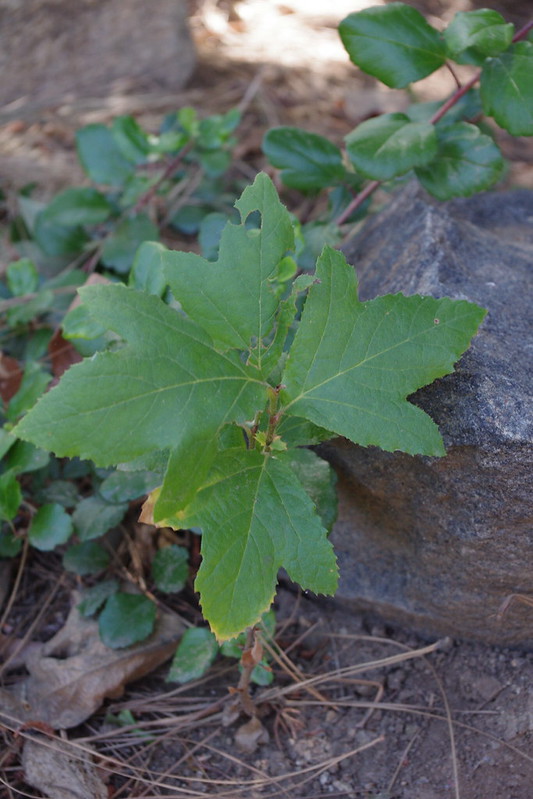
This is really something I should have written about previously with regards Farming because it has always been my experience and method for preparing planting sites prior to urban landscape installation and maintenance for years. This is also true in the wild with any habitat restoration where hands on presence at remote location sites to insure success is impossible. For example the various landscape beds around my mother's place as the picture to the right is a perfect example. Now a couple of weeds will grow now and again and if they do they are extremely stunted in growth and only an inch or so high. The funny thing however about a healthy landscaped condition which is mostly mycorrhizal in nature, you will get weeds [unwanted Plants], but not the quite the type you are most likely thinking of. I get loads of tree and shrub seedlings. Take for example this California Sycamore seedling below. It was this Sycamore that I removed and planted at my sister's place over in Lakeside California. I planted it along the wash of the old San Vicente Creek through the Moreno Valley north of Lakeside.

This tree volunteered in a dry raised planter bed I built which really no longer gets much water with the exception of the rainy season which only comes once a year. The first few years back in 2003-05, I did inoculate the Tecate Cypress, Pines Saplings and smaller shrubs like Spicebush [Calycanthus] and the spreading Catalina Currant you see in the background which when grown inland has to be grown under shade of trees. So the germination of this little Sycamore seedling in 2013 came as a pleasant surprise. But not a total shock as I always understood that after two and three years the weeds all but disappeared as a result of a health fungal network. One of the worst weeds was stinging nettles which were always an issue, but under the healthy mycorrhizal control they haven't been a pest at all. You should also know that they always were a problem since the late 1960s here when they first appeared in our garden. In some places where there are no mycorrhizal plants on that property, they still persist in spring. Many chaparral species off Rattlesnake Mountain above this location like Laurel Sumac are appearing every year and they were never an original part of the plantings. Now I have no problem with such unwanted shrub or tree seedlings. It's easy enough once a year to pluck them out of the ground. I may have a healthy nature replicated system, but I have none of the plant control components like Deer, squirrels, rabbits etc which would have kept excessive seedling presence in check. In the front yard all shrubs in the pea family are sprouting up everywhere. Again, it's easy enough to pluck them out. But I've always taken it as a compliment when they appear because it means something positive happened under the soil. No weed issues, no insect pest problems, but there are lots of beneficial insects as I've written about previously. 

This all translates as biomimetic application as far as caring for and maintaining all plants under any and all circumstances, even on a smaller controlled industrial scale. But don't count on the industry ever latching hold of it. It doesn't make as much profit for the Industrial Ag business model and they will fight and/or manipulate media and use the neanderthal type of blind faith defenders who will question nothing they do or say, nor get off their back sides into the outdoors and explore a world beyond their electronic devices or Labs to find out how nature really works. So this is for individuals who actually give a rats backside. Until the end of the present system anyway, this is the direction this world will always be heading. It's not enough to read this stuff or the links I'll provide below. You have to go beyond head knowledge and make practical application in real life and that is what will provide the wisdom on how to properly use this information and be successful. 

Once again, this is my last piece on Biotechs and GMOs. The topic is too much of a waste of time for those who are warm and fuzzy in their own comfort zone ideology where beating up imagined anti science Fundies is the perverted intellectual sport of choice in our modern times. Personally I think they all deserve each other. This world doesn't exactly have many genius' who can prevent problem, but there are a plethora of intellectuals who will gladly claim that they solve any problem, but this usually comes with a high price. In any event, below is one more little tidbit which should illustrate how corporate industrial agricultural ventures will not be going down without a fight any time soon. 
Update February 16, 2015: "Fertilizer Use to Surpass 200 Million Tonnes in 2018"

Fertilizer Use to Surpass 200 Million Tonnes in 2018


Food and Agriculture Organization of the United Nations
 Any math folks out there ? Remember those University studies Mike Amaranthus mentioned on MycoApply and Potatoes ? Remember how those organically grown potatoes colonized with Mycorrhizal fungi how they only had to apply 30 lbs of Phosphorus per acre as opposed to 130 lbs per acre as required by the conventional Agricultural farming methods ? So what are we talking about as far as percentages when it comes to drastically reducing this outrageous number referenced above by the United Nations of an increase 200 Million tonnes. Even without doing the numbers, can you see what kind of a fight lies ahead for any group promoting far more responsible farming methods as recommended by companies like what Mycorrhizal Applications Inc is doing ? Can anyone see the handwriting on the wall of just how these Agricultural chemical giants will not stand for their obscene wealth generating business model being dismantled bit by bit ? Seriously people, think about this!
~~~~~~~~~~~~~~~~~~~~~~~~~~~~~~~~~~~~~
Good Resources for Studies on Mycorrhizas and Weed Control
Australia: "Weed Control - A new discovered benefit of mycorrhizal fungi"
Biological weed control with soil fungi? Antagonistic effects of arbuscular mycorrhizal fungi on the growth of weeds
Mycorrhizal fungi suppress aggressive agricultural weeds
Mycorrhizal fungi for weed control
Glyphosate herbicide affects belowground interactions between earthworms and symbiotic mycorrhizal fungi in a model ecosystem
Further Update February 11th, 2015 (Trinity College Dublin, Ireland)
Friendly Fungi Could Help Barley Growers Feed the World Without Chemicals 
Bert Wilson's mycorrhizal recommendations
Weeds and their effect on the Ecosystem 
California Native Oaks and Mycorrhiza: The Growth and Ecology of California Native Oak Trees
Native plant roots: what goes on below the surface
California Soils and native plants 
This reference link below has a page of numerous sub-links, so please click on them and read them. Bert deals mainly with California Native Plants, but the basic fundamentals as far as mechanisms are the same globally. Only the finite details and local applications depending on ecosystems will be unique, but that is where you need to explore personally.
http://www.laspilitas.com/nature-of-california/plant-articles
Introduction to California's Ecosystem


Sunday, December 14, 2014

Industrial Agriculture: Rejecting Nature's Tool-Kit

"As we work to save the vital whitebark pine from disappearing from the landscape, it is essential to use all available tools. Ectomycorrhizal fungi are an integral part of forest integrity, ecology and health; showing respect for these mighty microbes might just mean the difference between the restoration and death of a forest."
Dr. Cathy L. Cripps is an associate professor at Montana State University
 Somewhere a Monsanto Research & Development Chief  just fell off a chair
Ghost forest of whitebark pine “skeletons.” Credit: Dr. Cathy L. Cripps
In his book Diversity of Life, E.O. Wilson states that “Most life on land depends ultimately on one relationship: the mycorrhiza, the intimate and mutually dependent coexistence of fungi and the roots systems of plants.” His point is that the importance of these beneficial fungi should not be underestimated. This is especially true for forest ecosystems, and those of Whitebark Pine are no exception.
WHITEBARK PINE FORESTS IN PERIL
"Whitebark pine (Pinus albicaulis) is North America’s only stone pine — pines with seeds that are not dispersed by wind — and it is primarily limited to the Pacific Northwest and the north-central Rocky Mountains. This five-needle pine is considered a keystone species at treeline elevations where other conifers have difficulty surviving. At these high elevations, it forms magnificent forests of gnarled old growth trees or low-tangled krummholz forms. However, whitebark pine populations are diminishing at an alarming rate because of record infestations of mountain pine beetles coupled with the devastating effects of the invasive white pine blister rust. The results are ghost forests of whitebark pine skeletons. The species has been granted endangered status in Canada and awaits this designation in the United States. Enormous efforts are underway to restore lost forests with large plantings of disease-resistant nursery-grown whitebark pine seedlings. But, can we also retrieve all the complex parts of this unique ecosystem? And what about the mycorrhizal fungi — how crucial are they to the survival of these forests?"
A COMPLEX ECOLOGY
"Above ground, the ecology of whitebark pine forests is a fascinating story of the interaction of trees, birds, squirrels and bears. In fall, when the round purple cones mature, the forests erupt in a riot of sound and a flurry of activity. Clark’s nutcrackers, large gray corvid birds with long bills, attract each other to the ripening food source with their raucous calls. Landing precariously in tree tops, they incise seeds out of cones like surgeons and gulp them into their crops. They fly off to bury their treasure as a food stash. Meanwhile, red squirrels chatter high above trying to beat the birds to the cones by clipping and dropping whole branches — an efficient way to gather a winter’s cone supply. Later, as winter approaches, grizzly and black bears raid the squirrel stashes for the fatty seeds. In spring, seedlings germinate in clusters from the un-retrieved seeds and, remarkably, this is the main dispersal mechanism for whitebark pine as a species; it depends on the forgetfulness of the birds."
UNDERGROUND CONNECTIONS
"What goes on below ground is more of a mystery. Here, a major portion of the trees exist as extensive and massive roots systems that push through hard soil in harsh high-elevation habitats just below treeline. This is the interface between the living and non-living world. It is a dark place where pale, living roots come into contact with minerals in the soil — or do they?"
Credit: Dr. Cathy L. Cripps.

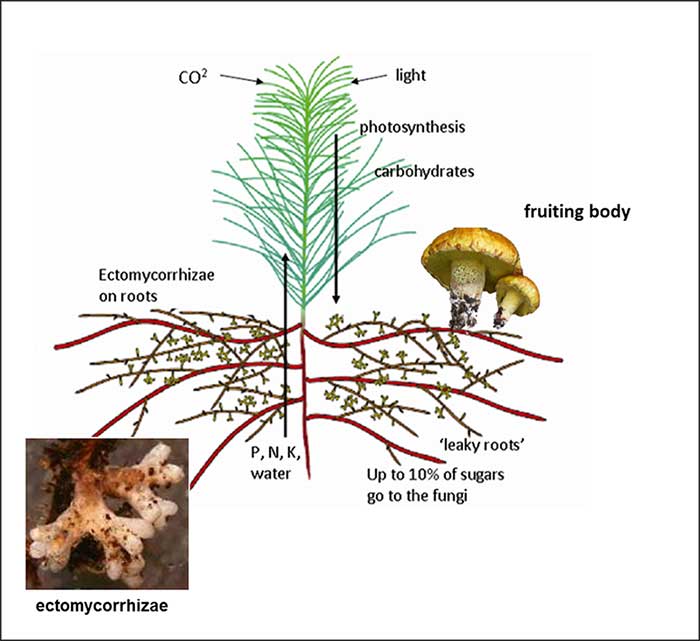
How ectomycorrhizal fungi works (Click to Enlarge)
"In a twist of nature, certain mycorrhizal fungi insert themselves between tree roots and soil to form a protective barrier around each root tip. In addition, the fungi boost the uptake of nitrogen into roots by extending their long thin bodies into the soil where they forage for scarce nutrients. The microscopic threads that comprise their bodies are called hyphae — or, when in mass, mycelium — and they act as conduits, moving nutrients and water from soil into roots. These fungi can also protect tree roots from heavy metals, tiny invertebrate grazers, and root pathogens hiding in the soil. The fungi themselves are able to eke out a living on photosynthetic scraps, sugars that leak from fine roots."
"‘Mycorr-’ means fungus and ‘-rhizal’ means root and the unions of these two entities, called mycorrhizae, are found on the roots of more than 80 percent of the plant species on Earth. This mutualism is not the exception, but the rule in nature, and all forests — except perhaps those of mangroves — depend on mycorrhizal fungi. This has been true for thousands of years."
"The group of fungi that attach themselves to woody plants, mostly trees, wrap themselves around the outside of roots to form what are called ectomycorrhizae. These tiny sock-like structures are found on each of the thousands of root tips throughout a forest. Although miniscule, ectomycorrhizae have a huge impact on the survival of trees, many of which could not maintain themselves in nature, especially in harsh climates, without these fungi. They are only visible when they reproduce and their fruiting bodies (i.e. mushrooms) push up though the soil to produce the spores that fly off in the wind to land, mate and continue the species’ life cycle."
NO TWO FUNGI ARE ALIKE
Credit: Dr. Cathy L. Cripps

Siberian slippery Jack (Suillus sibiricus)
ectomycorrhizal with whitebark pine
 "Just as each tree species is not interchangeable with another, so too one fungal species cannot be substituted for another without altering the biology of an ecosystem. There are thousands of species of ectomycorrhizal fungi in the world, each with its own unique ecology, physiology, and preference for certain tree hosts."
"As an example, Cenococcum is a tough hardy fungus with dense black mycelium that is found everywhere, often at low levels just below the radar. But it comes into its own during periods of drought, when it thrives while other fungi die, all the while passing the benefits of drought tolerance on to its tree partner. Another example is Piloderma, a promiscuous fungus that attaches itself to many different tree species; it not only gains sugars from tree roots but also has the ability to decompose dead organic material and pass the nutrients along to living trees. Its bright yellow mycelium can be observed in rotting wood or organically rich soils as well as on roots. Douglas-fir alone associates with more than 2,000 different species of ectomycorrhizal fungi, and some are only found with this species. A single tree in a forest can host any number of ectomycorrhizal fungi simultaneously, with each providing its own unique set of benefits. Often, there is a succession of fungi found on a tree over its lifetime. Certain ectomycorrhizal fungi are important in a tree’s establishment as a seedling, and other fungi come in later to provide benefits in mature forest situations."
FUNGAL ALLIES OF WHITEBARK PINE
Credit: Dr. Cathy L. Cripps

Slippery jacks are also part of the forest food
 chain. These were nibbled by a small animal
"Until recently, we knew very little about ectomycorrhizal fungi in whitebark pine forests. Our mycology lab at Montana State University (MSU) has discovered that from the Greater Yellowstone Area (GYA) north into Alberta, these forests appear to host only a limited number of ectomycorrhizal species in great contrast to Douglas-fir forests. Some of these fungi are specialists and are only found with five-needle pines; some only occur with stone pines. There are several species of stone pines scattered throughout Europe and Asia, in addition to the whitebark pines of North America."
"A well-known fungal inhabitant of stone pine forests in Europe (P. cembra forests) and Asia (P. pumila forests) is the so-called Siberian slippery jack (Suillus sibiricus). Remarkably, this fungus also occurs with five-needle pines in western North America, and we now report it from most of the whitebark pine forests studied in the GYA. These records show that the Siberian Suillus has a long evolutionary history with stone pines in the northern hemisphere that may be an indication of its importance to these pines; it does not occur with other conifers or on two/three-needle pines. Other examples of specialists with whitebark pine include S. tomentosus variety discolor and S. subalpinus; the latter is only known from the Yellowstone region. A variety of mammals, large and small, devour the mushrooms produced by these fungi as a natural part of the forest food chain."


"Other special ectomycorrhizal fungi found in whitebark pine forests include Rhizopogon, commonly called “pogies.” These interesting fungi spend their whole life underground. Instead of mushrooms, they produce subterranean tuber-like fruiting bodies often called false truffles. These marble- to golf-ball-sized tubers have unique odors that attract squirrels, voles, deer and bears — including grizzlies — which sniff them out and dig them up as a food source. When ripe, these pogies can smell intriguingly musky, fermented fruity or sour — even like blue cheese. The spores located inside the pogies are capable of traveling through the digestive tract of a mammal unharmed and are eventually deposited in pellets and piles. In a sense, these fungi have co-opted mammals as their spore dispersal mechanism just as whitebark pines have co-opted birds to disperse their seeds. Ultimately, the spores germinate and reunite with a root to form an ectomycorrhizal bond after passing through the gut of a mammal. When greasy scat samples of grizzly bears were brought into the MSU lab, examination with a microscope revealed a mass of one kind of spore. The bears had feasted exclusively on one particular kind of pogie, no doubt with a very attractive odor!"
"Coming full circle, while we see whitebark pines providing habitat for the animals that eat or spread its seeds and rest or nest in boughs and shade for the understory plants that proliferate at their base, there are even more intricate ecological relationships among these organisms, including the ectomycorrhizal fungi that help maintain the forests."
MISSING PIECE IN RESTORATION HARDWARE
Credit: Dr. Cathy L. Cripps

Roots of an inoculated seedling covered
with ectomycorrhizae
"Are these fungi a missing piece of the puzzle in whitebark pine restoration? Can they be used to jumpstart the whitebark pine seedlings being planted in such huge numbers to help a greater number survive?   
In Austria, forests on steep slopes were clear-cut to extend pastureland many years ago. Subsequent efforts were made to restore these forests which included the planting of European stone pine seedlings, a practice that continues today. Fifty years ago, a wise mycologist named Meinhard Moser discovered that adding the spores or mycelium of Suillus sibiricus (and related species) to nursery seedlings could significantly boost the survival of these nursery seedlings when they were out-planted. Today, mature forests are flourishing on the alpine slopes of Austria and the Siberian Suillus is still used on the stone pine seedlings in the Austrian Federal Nursery. Inoculation of nursery trees with ectomycorrhizal fungi is now status quo in Europe."
Credit: Dr. Cathy L. Cripps

Lonergan monitoring whitebark pine
 seedlings in the field.
"At MSU, graduate student Erin Lonergan and postdoc Dr. Eva Grimme examined how this practice might be applied to nurseries in the western United States. From their research, we now know that S. sibiricus can form ectomycorrhizae efficiently on whitebark pine seedlings in the greenhouse and that colonization will occur if given enough time (a few months) and if a low nitrogen fertilizer is used. High nitrogen fertilizers and fungicides prevent mycorrhizal colonization. The age of the whitebark pine seedlings at inoculation is also important since prolific side roots need to develop before colonization can take place. When successful, hundreds of tiny, white sock-like ectomycorrhizae can be observed on the roots of containerized seedlings."
(Article Source: American forests)
MSU study: Native fungus could be another tool for helping restore ghostly forests 
~~~~~~~~~~~~~~~~~~~~~~~~~~~~~~~~
Credit: Don Bachman

Cripps inoculating whitebark pine seedlings
The information and understanding of how our natural world really operates and functions has been known for quite a few decades now. Unfortunately such highly vauluable knowledge has been deliberately suppressed until now because of something called worldview. There is a time wasting strategy when it comes life's origins called "Argument from Poor Design." This has done more to hold back good valuable sustainable scientific practice far more than anything else. The reason is that this lame argumentation insists that nature is flawed, inept, inefficient and badly designed and all of this is proof that there is no intelligent designer. They argue that if there were an intelligent designer, he would have designed such and such in such and such a fashion because the design in their opinion is flawed. But how could anyone know this ? What experiment did they create using the scientific method to arrive at such a conclusion ? I couldn't do that, so how could they do that ?
Below is a glaring example of how the Industrial Science industry has attempted to indoctrinate the average person into adopting the flawed worldview of how vicious and cursed the planet was and in desperate need of Industrial Science's various services. Remember these mind dumbing commericals from the 1970s which trashed Nature ???


"Argument from Poor Design" (Exposing Nature's Flaws ???)
Believe it or not this is why biotechs refuse to actually replicate what nature does. They take their cue from some off topic lousy lame false religious concept such as the poor design arguments. They believe nature is flawed and poorly designed and only they can fix it. How well has that worked out for Mankind and Nature thus far ??? Do we live in a better world because of this dogma ??? The culture of science types are loathed to criticize industrial science (even the giant Environmental Organizations) because they fear the aweful backlash of being labeled as anti-science, which is a Biotech's cowardly way of justifying their business model. Incredibly all of this points back to Darwin and his writings. He actually started the bad design arguments. Here's an examples below given to us by none other than Richard Dawkins.


The above photo of a Tomato Hornworm caterpillar being victimized by the eggs of the wasp larvae, overlaid with Charles Darwin's famous 1860 "wasp feeding quote", which worked to teeter him away from a belief in a creator. Such examples of the supposedly bad designs which exist in nature have been utilized by people like Richard Dawkins, who admixtured in "selfish genes" + "Hamilton rule" + "blind forces", and used these Nature flaws as his main atheism movement to promote a purposeless universe ideology. But this has actually back fired on nature. How much good viable science and sustainable ecological technological innovation has been stifled because a handful of ideologues have a hard on towards Christensom ? Look, I get the argument against many of the religious institutions, but these people like Dawkins have stolen their playbook and made it their own with a plethora of failed their own version of blind faith Teleological arguments that have back fired on our natural world. The main problem has been when scientists and other researchers cannot explain something, the problem must lay with the flaws of natural design and not their own university cultivated intellectual ignorance. This is why they came up with Junk DNA as a label for the non-coding DNA. They didn't know what it did, could not find a useful function for it's presence and therefore concluded it must be a vestigial evolutionary hold over from the distant mythical past. It was touted as proof of evolution and no intelligent designer. But lo & behold geneticists are finding a wealth of instructions when all this imaginary *cough-cough* Junk apparently does have function when used within a context of other genes. This has become more and more to do with epigenetics or different gene expression triggered by various environmental cues. Now there is this big movement towards promoting biomimetics or biomimicry. Suddenly people who've for years dismissed this practice are now on board. However, to be taken seriously, they must first apologize to mankind for holding back good science and running our planet into the ground with their own unsustainable inept technological innovation based on nature being inept at designing anything. As yet they have refused to do this. Janine Benyus is one example. She won't touch this subject of bad design with a ten foot pole. 
Biomimicry: Streamlining Innovation for Environmentally Sustainable Products
The reason designs found in Nature are seriously being more considered now is that Scientists are now realizing too late that they have no choice but to consider these remarkable designs found throughout all of the Earth's ecosystems because their own degenerate past ideologically driven science has been wrong all along. This is not to say there have not been dedicated Scientists  out there over the last few decades who have been working hard all along to discover and create practical application of what they have observed and learned out in the field. I know because I've been following many of them for decades. What has always influenced the direction Science takes in research for decades has always been it's being shackled to their sources of funding that comes from big industrial agri-business interests. It is even worse now because Scientists who desire major funding for their pet projects must tow the corporate line or risk having their funding removed. 

This has actually happened to my former Agricultural Instructor who retired early from Cal Poly San Luis Obispo. He had a course on Sustainable Agriculture and apparently it was this class which he was teaching with regards to ecological and more sustainable farming practices which were found to be offensive to an Executive of an Industrial scale Feedlot business (Harris Ranch Beef) interest over in the San Joaquin Valley who threatened Cal Poly San Luis Obispo by withholding a certain promise of $500,000 in Grant Funding towards a new Butchering facility if he wasn't fired and his Sustainable Agriculture course dismantled. Also, at this same time period, they were peeved by a Campus visit of Michael Pollan who they also viewed as a radical or agricultural heretic.


Robert Rutherford
My wife and I went to Cal Poly San Luis Obispo this past June 2014 and saw the new state of the art butchering facility. Oddly enough I thought he would still be working there, but when I saw that the large new beautiful building had been built after all, I guess I knew then that he was gone. So I wrote an email to him when I got back to San Diego. He said he got fed up with the administration at Cal Poly and with this issue hanging over him, he realized he could no longer make a significant difference as he wanted, so agreements were made and he retired early. He said University Professors are rewarded for the status quo. They & their Industrial Ag partners are a sort of Band of Brothers. I really admire and respect him for not caving into their demands, sticking to his core principles and following what knows to be the truth. He now has his own business [Whole Options LLC] where he travels and lectures about sustainable Agriculture. In particular, pasture and grazing practices which are best for the environment.

Unlike my Ag Instructor, the man I quoted at the beginning of this post below the photograph with the dead whitewashed skeletons of Whitebark Pines was Edward O. Wilson a Harvard Biologist who wrote the book, "Diversity of Life" from which the quote was taken Unfortunately, Mr E.O. Wilson has gone down a much different road than my Ag Instructor. Here is that quote once more:
“Most life on land depends ultimately on one relationship: the mycorrhiza, the intimate and mutually dependent coexistence of fungi and the roots systems of plants.”
He is also an environmentalist of sorts and has many radical ideas such as giving back half of the Earth to Nature again. He just seems  so committed to Nature in that quote doesn't he ? Unfortunately it would seem that Mr E.O. Wilson has other commitments as well. I can almost agree with that sentiment of giving back much of the land to Nature, since I despise most cities and prefer the quiet solitude of Natural surroundings anyway. Unfortunately, I also read an interview he had done in "EarthSky Journal" in December 2011, where he was asked his views on what scientific advances in biology he sees advancing into the 21st Century. Unbelievably, this is what this same man said who wrote that environmental book and the quote about about how we should use Nature's Tool-Kit for maintaining living systems. 
"And within science, this is going to be a century of biology. We are entering an age of synthesis. So many discoveries have been made in biology in the cell, at the molecular level, and on up to the development of organisms."
"And we need all the biology and all the advances we can find in agriculture, especially. We’re going to have to switch worldwide to dry land agriculture. We don’t have enough water in enough countries to feed all those people and to restore soil to arable condition. So this means that we have to have genetically modified organisms. I’d take that as a given. Some people don’t like the idea. But that’s one of those necessities brought about by the human condition."

Image credit: Jim Harrison
Unlike my former Ag Instructor who stuck to his principles and standards on what he knows to be right by rejecting a good ole boys club, E.O. Wilson is a disappointment of sorts in that he sides with the billionaire  boys club. How can you make the same observation of pristine Nature and the various mechanisms and components within it's Tool-Fit for maintaining all ecosystem for eternity by championing this from one side of your mouth in an environmental book on Biodiversity and then turn directly around in an about face and from the other side of your mouth praise Industrial Science which continually takes a cheap shots at Nature through genetic manipulation and creating synthetic organisms and the dangerous chemicals that they are engineered to work with ? And why does Industrial Science do this ? Well, aside from the major lure of obscene profit demanded by share holders, it's because Industrial Science is influenced by those same ideologically driven philosophers that teach modern Mankind that Nature is a bad designer with major flaws and that they can fix it, for a price of course. Suddenly the praise for mycorrhiza, as Wilson called it, flies out the window and no longer has any meaning. Of course in that debate between Team Monsanto & Team Organic at that infamous Intelligence Squared Debates, it was said that Biotechs have consensus and peer-review on their side. You know, the #1 biggest problem with College Professors and Research Scientists who are shackled and committed to the funding by Industrial Agriculture is that when they do write their research papers, they are then peer reviewed by other committed industrial scientists, which are then consumed by yet other Industrial Corporate Scientist and you suddenly then realize there really is no such thing as honest scientific scrutiny. You finally have to come to the realization that an individual like E.O. Wilson is committed first and foremost to his own status as a celebrity icon. The trouble with the world of science is this potential for fame, glitter and glory which allows personal ambition and bias to hinder real science in pursuit of that goal.

Fortunately, researchers like Dr Cathy Cripps are looking at a more natural holistic approach in replicating Nature as it really works. In the decades past I was always told by government experts that it  was not necessary to inoculate the nursery stock before out planting. Why they said, "those mycorrhizal spores were everywhere in nature. Why those spores are floating around us in the very air we breathe." Fortunately I never listened to and bought into their theory and have proof to show for it. When you look at the above ground surface and see that many plants within almost every ecosystem around the globe are failing now days, don't you think that what lives underground may also itself be failing as well ? Nothing anymore is indestructible. Every living thing today is at risk. So maybe the microbiological activity under the ground needs a boost to. When humans destroy Earth's ecosystems as rapidly as they have during the past 100+ years of enlightenment, we don't have thousands of years to wait and see if it can heal itself or not. Clearly things need a push and helping hand. For the moment, California is getting what is considered a rescue of another El Nino  rainy season of sorts. In my own experience, it has always been these small windows of exceptional wet periods of when Nature can spring back the best and humans can help it to further heal if they know the exact tools and how to use them. But we are finding that these system mechanisms are now breaking down and need help and a jump start. Mycorrhizal Fungi and Beneficial Bacteria can performance enhance that recovery if those in charge are humble enough to admit they have been making mistakes for the past 100+ years and will make a 360 degree turn around and start working with Nature instead of against it. Now go back and read Dr Cathy Cripps' research again, and then go seek out advice on a reputable Mycorrhizal promoting website and order the right blend of material for inoculation of your own trees and shrubs. Maybe your own restoration project. And dump the we don't have to inoculate dogma, because yes you do.


There is no mysticism here. You want successful landscaping, farming or gardening then you have to inoculate. The only mystic fantasy here is that the human leadership that people have allowed to be put in charge of land management has been a miserable failure. Using Nature's Tool-Kit by learning to identify and use the right mechanisms will lead to many many success stories.
~~~~~~~~~~~~~~~~~~~~~~~~~~~~~~~~~
Further Reading references
Mycorrhizal Applications Inc
http://holisticmanagement.org
Using Nature's Mycorrhizal Tool-Kit to compete with Weeds vrs killing them with Glyphosate
The Agricultural Controversy
http://www.sanluisobispo.com/2009/10/14/885164/criticism-from-harris-ranch-beef.html 
http://californiawatch.org/dailyreport/beef-company-pressured-cal-poly-remove-agriculture-professor-819 
http://www.newtimesslo.com/news/3411/controversy-erupts-over-michael-pollans-poly-lecture