Showing posts with label Monsanto. Show all posts

Tuesday, November 24, 2015

Soil Microbes use Rocket Science to Maintain the Earth's Atmosphere

One could also say that we could use the incredible Rocket Science of these Microbes to save our planet and reverse the negative effects brought about by the misuse and abuse of scientific discovery
Photo Credit: Nicholas A. Tonelli

So why is the Science of Soil Ecology & Microbes rejected in favour of the Industrial version for Commercial Agriculture ???


There's an old Sci-Fi classic from 1956 called "Forbidden Planet" where the film’s setting is of a bleak landscape on some far away planet and the concept of space travel that was inspired by many of the inventions which came out of world War II and intrigued people about the future possibilities of where mankind's ever expanding knowledge could take them. The film starts out with a spaceship from Earth (which looked more like a flying saucer aliens would have invented and used) which carries a small rescue mission that lands on a planet called, Altair IV, where a radio message from Dr. Edward Morbius warns them away from landing on the planet because of some unknown mysterious danger. This Dr Morbius and his daughter Altaira are the only people left alive from the original scientific expedition. An ancient alien race called the Krell have been gone for thousands of years, but they've left behind an incredible infrastructure and library of their existence among which there is one device Morbius calls the “plastic educator.” The device can greatly expand human intelligence, but there is a price to pay for that increased knowledge. As the film continues, these new arrivals from Earth are about to find out just how costly that knowledge really is. That machine in the film more than anything was intriguing to me as a kid watching that flick in the early 1960s. What if they could really invent such a device ? I mean just  suppose for a moment that you could be hooked up to such an intelligence machine and all the collective information of the various scientific disciplines could be uploaded into your mind. You could get employment almost anywhere right ? But the knowledge is nothing if you don't really understand how to properly apply it. If you have a great lack of communication and social skills (even common sense), like most of our world's intellects, you'd be greatly handicapped in the understanding of how to properly apply that knowledge to the benefit of yourself and others around you. Interestingly this would require cooperation with others and how many intellects have the patience to deal with those they view as their inferiors ? The world's soil microbial community are different and operate with an incredible amount of programmed instinctive knowledge and accomplish important tasks with incredible efficiency. In fact it appears that the microbial community is nothing more than life self-perpetuating information strings running remarkably sophisticated complex nano-machines and science hasn't a clue as to how they do what they do for us. 


illustration:  Mattias Adolfsson
When left alone and unmolested from  irresponsible human activities, all of the microbial soil communities underneath the  Earth's various ecosystems operate in a sophisticated complex united Social Network of cooperation that humans could only dream of. And yet we are supposed to be superior to them as the top organism on the planet. We've been force fed that these things are the most primitive living organisms on Earth, at least that's what the official scientific narrative has told us in School and the textbooks. As time pants on to the end, we find that is not really true. In fact all of the Earth's supposedly higher lifeforms would all perish without them. Frankly, I don't know if I really want humans to gain much more understanding and knowledge of the natural world under the present system based on their past historical activity of abuses of further knowledge. Take the latest research on a certain specific microbe which is brilliant at operating the Earth's biochemical nitrogen cycling. Here is an opening brief description of the soil microbe as given by Microbe Wiki  
"Anaerobic ammonium oxidation (Anammox) is a significant component of the biogeochemical nitrogen cycle. The process was discovered when it was noticed that ammonium was being converted to dinitrogen in a fluidized-bed reactor system at a yeast factory nearly 20 years ago. An unusual characteristic of anammox metabolism is the production of the metabolic intermediate hydrazine, which is one of the strongest reducing agents known in biological systems. "It is used as rocket fuel and in the manufacture of explosives and pesticides."
(Source - Microbe Wiki)
The last line in red of the quote in that description really expresses how much I hope that Scientists never crack the code of how these microbes do what they do. Even if they at some future point in time exclaim that they have solved the puzzle, you can bet that it will  somehow always be incomplete and imperfect. The very idea that such knowledge would be acquired and put to use by the present  irresponsible world leadership is a frightening scenario to ponder. And yet despite this, a team of European scientists in the Netherlands found something very interesting about this Anammox  bacteria. Published earlier this year in Nature, the researchers tell how they have ascertained the structure of a molecular machine that performs chemical wizardry using rocket science. Here is a reprinted quote from Nature and Discovery [keep in mind some of this may be boring for many]:
"Anaerobic ammonium oxidation (anammox) has a major role in the Earth's nitrogen cycle and is used in energy-efficient wastewater treatment. This bacterial process combines nitrite and ammonium to form dinitrogen (N2) gas, and has been estimated to synthesize up to 50% of the dinitrogen gas emitted into our atmosphere from the oceans. Strikingly, the anammox process relies on the highly unusual, extremely reactive intermediate hydrazine, a compound also used as a rocket fuel because of its high reducing power. So far, the enzymatic mechanism by which hydrazine is synthesized is unknown. Here we report the 2.7 Å resolution crystal structure, as well as biophysical and spectroscopic studies, of a hydrazine synthase multiprotein complex isolated from the anammox organism Kuenenia stuttgartiensis. The structure shows an elongated dimer of heterotrimers, each of which has two unique c-type haem-containing active sites, as well as an interaction point for a redox partner. Furthermore, a system of tunnels connects these active sites. The crystal structure implies a two-step mechanism for hydrazine synthesis: a three-electron reduction of nitric oxide to hydroxylamine at the active site of the γ-subunit and its subsequent condensation with ammonia, yielding hydrazine in the active centre of the α-subunit. Our results provide the first, to our knowledge, detailed structural insight into the mechanism of biological hydrazine synthesis, which is of major significance for our understanding of the conversion of nitrogenous compounds in nature."
Dinitrogen gas (N2) is a tough nut to crack. The atoms pair up with a triple bond, very difficult for humans to break without a lot of heat and pressure. Fortunately, this makes it very inert for the atmosphere, but life needs to get at it to make amino acids, muscles, organs, and more. Nitrogenase enzymes in some microbes, such as soil bacteria, are able break apart the atoms at ambient temperatures (a secret agricultural chemists would love to learn). They then "fix" nitrogen into compounds such as ammonia (NH3) that can be utilized by plants and the animals that eat them. To have a nitrogen cycle, though, something has to return the N2 gas back to the atmosphere. That's the job of anammox bacteria.
"Most nitrogen on earth occurs as gaseous N2 (nitrogen oxidation number 0). To make nitrogen available for biochemical reactions, the inert N2 has to be converted to ammonia (oxidation number −III), which can then be assimilated to produce organic nitrogen compounds, or be oxidized to nitrite (oxidation number +III) or nitrate (+V). The reduction of nitrite in turn results in the regeneration of N2, thus closing the biological nitrogen cycle."
Let's take a look at the enzyme that does this, the "hydrazine synthase multiprotein complex." Rocket fuel; imagine! No wonder the scientific community was surprised. The formula for hydrazine is N2H4. It's commonly used to power thrusters on spacecraft, such as the Cassini Saturn orbiter and the New Horizons probe that went by Pluto recently. Obviously, the anammox bacteria must handle this highly reactive compound with great care. Here's their overview of the reaction sequence. Notice how the bacterium gets some added benefit from its chemistry lab:
"Our current understanding of the anammox reaction (equation (1)) is based on genomic, physiological and biochemical studies on the anammox bacterium K. stuttgartiensis. First, nitrite is reduced to nitric oxide (NO, equation (2)), which is then condensed with ammonium-derived ammonia (NH3) to yield hydrazine (N2H4, equation (3)). Hydrazine itself is a highly unusual metabolic intermediate, as it is extremely reactive and therefore toxic, and has a very low redox potential (E0′ = −750 mV). In the final step in the anammox process, it is oxidized to N2, yielding four electrons (equation (4)) that replenish those needed for nitrite reduction and hydrazine synthesis and are used to establish a proton-motive force across the membrane of the anammox organelle, the anammoxosome, driving ATP synthesis."
We've discussed ATP synthase before. It's that rotary engine in all life that runs on proton motive force. Here, we see that some of the protons needed for ATP synthesis come from the hydrazine reaction machine. Watch the cool video below which is 3:21 minutes in length.


What does the anammox enzyme look like? They say it has tunnels between the active sites. The "hydrazine synthase" module is "biochemically unique." Don't look for a common ancestor, in other words. It's part of a "tightly coupled multicomponent system" they determined when they lysed a cell and watched its reactivity plummet. Sounds like an irreducibly complex system.


The paper's diagrams of hydrazine synthase (HZS) show multiple protein domains joined in a "crescent-shaped dimer of heterotrimers" labeled alpha, beta, and gamma, constituted in pairs. The machine also contains multiple haem units (like those in hemoglobin, but unique) and "one zinc ion, as well as several calcium ions." Good thing those atoms are available in Earth's crust.

Part of the machine looks like a six-bladed propeller. Another part has seven blades. How does it work? Everything is coordinated to carefully transfer electrons around. This means that charge distributions are highly controlled for redox (reduction-oxidation) reactions (i.e., those that receive or donate electrons). The choice of adverbs shows that their eyes were lighting up at their first view of this amazing machine. Note how emotion seasons the jargon:
"Intriguingly, our crystal structure revealed a tunnel connecting the haem αI and γI sites (Fig. 3a). This tunnel branches off towards the surface of the protein approximately halfway between the haem sites, making them accessible to substrates from the solvent. Indeed, binding studies show that haem αI is accessible to xenon (Extended Data Fig. 4c). Interestingly, in-between the α- and γ-subunits, the tunnel is approached by a 15-amino-acid-long loop of the β-subunit (β245-260), placing the conserved βGlu253, which binds a magnesium ion, into the tunnel."
We would need to make another animation to show the machine in action, but here's a brief description of how it works. The two active sites, connected by a tunnel, appear to work in sequence. HZS gets electrons from cytochrome c, a well-known enzyme. The electrons enter the machine through one of the haem units, where a specifically-placed gamma unit adds protons. A "cluster of buried polar residues" transfers protons to the active center of the gamma subunit. A molecule named hydroxylamine (H3NO) diffuses into the active site, assisted by the beta subunit. It binds to another haem, which carefully positions it so that it is "bound in a tight, very hydrophobic pocket, so that there is little electrostatic shielding of the partial positive charge on the nitrogen." Ammonia then comes in to do a "nucleophilic attack" on the nitrogen of the molecule, yielding hydrazine. The hydrazine is then in position to escape via the tunnel branch leading to the surface. Once they determined this sequence, a light went on:
"Interestingly, the proposed scheme is analogous to the Raschig process used in industrial hydrazine synthesis. There, ammonia is oxidized to chloramine (NH2Cl, nitrogen oxidation number −I, like in hydroxylamine), which then undergoes comproportionation with another molecule of ammonia to yield hydrazine."
So here's something you can meditate on when you take in another breath. The nitrogen gas that comes into your lungs is a byproduct of an exquisitely designed, precision nanomachine that knows a lot about organic redox chemistry and safe handling of rocket fuel. This little machine, which also knows how to recycle and reuse all its parts in a sustainable "green" way, keeps the nitrogen in balance for the whole planet. Intriguing. Interesting. As Mr. Spock might say, fascinating.

The above post is reprinted from materials provided by Radboud University, Discovery Institute and Nature. Note: Some materials were edited for content and length.
(Source) - (Source) - (Source)
~~~~~~~~~~~~~~~~~~~~~~~~~~~~~~~~~~

So where does Mankind go from here ?


Image: EocWatch
For the past few decades the focus has always seemed to be on the big oil companies like Exxon, Chevron, BP, and Shell who have been perceived as the main climate change culprits. It's understandable because they are such big exposed targets and we are all shackled to them in what they provide for us as what we consider today as a normal life. And yet people for the most part have totally ignored the same dirty irresponsible behaviour of industrial corporate agricultural giants such as Monsanto, DuPont, Dow Agro-Chemical, Bayer, Syngenta, and BASF. Funny, we don't hardly here from BASF because they mostly deal with other large corporate business interests, but they are huge. All of them came out of World War II making munitions and other explosives for both the Allies and Axis powers, so they have a history of being in the death business. We know that between 20-30 percent of all man-made green house gases in the atmosphere comes from the overuse and abuse of chemicals manufactured by industrial agriculture. These very chemicals should be restricted for manufacturing purposes and transportation, not for the Earth's soil. By dumping agricultural chemicals [synthetic fertilizers, insecticides, fungicides, herbicides] onto our soils, we disrupt nature’s delicate balance of water, soil and air cycling. As we've seen in the above research, soil organisms have been perpetually monitoring Earth's carbon cycling components for countless 1000s of years, now suddenly we have 150 years of supposed scientific enlightenment under our belt and the function of these sophisticated cycling mechanisms are in jeopardy.

But what really are the true solutions for turning things around ? This just question begs once again, why is a scientific microbiological approach to farming practices considered, "anti-science" or "pseudo-science" by the Elite powerful and why are the people who advocate and practice such disciplines considered Voodoo Science practicing Luddites ??? You can thank the WSU Garden Professors for that one. Then on the other hand there are innumerable clever memes out there on the Organics sites floating around the Internet which promise a brighter future if everyone would just become an activist and practice what their favourite organization's philosophy recommends as a viable sustainable practice. While I am all for doing things by means of a holistic responsible approach through the practice of Biomimicry [replicating what Nature does], I am also aware that the world's problems won't be fixed through another materialistic scientific innovation approach as a cure all for what ails the world. I read the headlines daily promising that if humans would only just support such and such ideology regarding building healthy soils, we could turn around this present climate change crisis. It will never happen. First it assumes that everyone around the planet will get on board with the idea and they won't. Secondly, everyone reading knows the world we all live in, the all too common daily terrorizing News headlines lately and the failure of any government to provide viable solutions for any lasting piece and security. The best I can offer from a personal practice perspective is pay attention individually to your own garden, urban landscape or commercial farm and share your experiences with neighbours and friends. 
To conclude, here is a video of Dr. Kristine Nichols of the Rodale Institute talks about soil health and soil biology in regenerative organic systems. She hasn't always worked with Rodale, in fact she has worked as a Soil Microbiologist with the USDA, Agricultural Research Service (ARS) Northern Great Plains Research Laboratory (NGPRL) in Mandan, ND for over seven years. Since 1993, Dr. Nichols has studied arbuscular mycorrhizal (AM) fungi – a plant-root symbiont. Her most recent work involves the investigation of glomalin – a substance produced by AM fungi. Glomalin contributes to nutrient cycling by protecting AM hyphae transporting nutrients from the soil to the plant and to soil structure and plant health by helping to form and stabilize soil aggregates. Dr. Nichols has been examining the impacts of management such as crop rotation, tillage practices, organic production, cover crops, and livestock grazing on soil aggregation, water relationships, and glomalin. This comes from her Bio there. One of the main things I loved about her presentation here to farmers is the fact that she humbly acknowledges is how she and others as Scientists learn from the feedback from Farmers as to what works and what won't work or needs improving upon. That isn't normally done in today's world.


No references as I don't believe most are read anyways

Sunday, December 14, 2014

Industrial Agriculture: Rejecting Nature's Tool-Kit

"As we work to save the vital whitebark pine from disappearing from the landscape, it is essential to use all available tools. Ectomycorrhizal fungi are an integral part of forest integrity, ecology and health; showing respect for these mighty microbes might just mean the difference between the restoration and death of a forest."
Dr. Cathy L. Cripps is an associate professor at Montana State University
 Somewhere a Monsanto Research & Development Chief  just fell off a chair
Ghost forest of whitebark pine “skeletons.” Credit: Dr. Cathy L. Cripps
In his book Diversity of Life, E.O. Wilson states that “Most life on land depends ultimately on one relationship: the mycorrhiza, the intimate and mutually dependent coexistence of fungi and the roots systems of plants.” His point is that the importance of these beneficial fungi should not be underestimated. This is especially true for forest ecosystems, and those of Whitebark Pine are no exception.
WHITEBARK PINE FORESTS IN PERIL
"Whitebark pine (Pinus albicaulis) is North America’s only stone pine — pines with seeds that are not dispersed by wind — and it is primarily limited to the Pacific Northwest and the north-central Rocky Mountains. This five-needle pine is considered a keystone species at treeline elevations where other conifers have difficulty surviving. At these high elevations, it forms magnificent forests of gnarled old growth trees or low-tangled krummholz forms. However, whitebark pine populations are diminishing at an alarming rate because of record infestations of mountain pine beetles coupled with the devastating effects of the invasive white pine blister rust. The results are ghost forests of whitebark pine skeletons. The species has been granted endangered status in Canada and awaits this designation in the United States. Enormous efforts are underway to restore lost forests with large plantings of disease-resistant nursery-grown whitebark pine seedlings. But, can we also retrieve all the complex parts of this unique ecosystem? And what about the mycorrhizal fungi — how crucial are they to the survival of these forests?"
A COMPLEX ECOLOGY
"Above ground, the ecology of whitebark pine forests is a fascinating story of the interaction of trees, birds, squirrels and bears. In fall, when the round purple cones mature, the forests erupt in a riot of sound and a flurry of activity. Clark’s nutcrackers, large gray corvid birds with long bills, attract each other to the ripening food source with their raucous calls. Landing precariously in tree tops, they incise seeds out of cones like surgeons and gulp them into their crops. They fly off to bury their treasure as a food stash. Meanwhile, red squirrels chatter high above trying to beat the birds to the cones by clipping and dropping whole branches — an efficient way to gather a winter’s cone supply. Later, as winter approaches, grizzly and black bears raid the squirrel stashes for the fatty seeds. In spring, seedlings germinate in clusters from the un-retrieved seeds and, remarkably, this is the main dispersal mechanism for whitebark pine as a species; it depends on the forgetfulness of the birds."
UNDERGROUND CONNECTIONS
"What goes on below ground is more of a mystery. Here, a major portion of the trees exist as extensive and massive roots systems that push through hard soil in harsh high-elevation habitats just below treeline. This is the interface between the living and non-living world. It is a dark place where pale, living roots come into contact with minerals in the soil — or do they?"
Credit: Dr. Cathy L. Cripps.

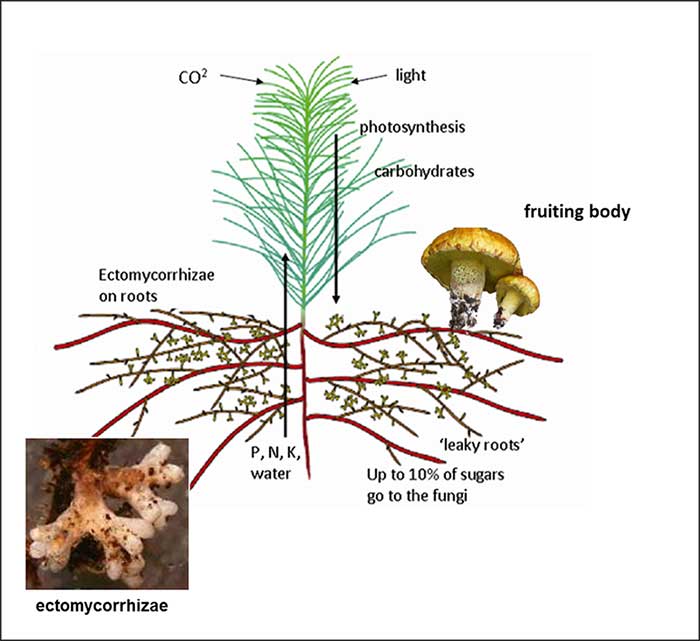
How ectomycorrhizal fungi works (Click to Enlarge)
"In a twist of nature, certain mycorrhizal fungi insert themselves between tree roots and soil to form a protective barrier around each root tip. In addition, the fungi boost the uptake of nitrogen into roots by extending their long thin bodies into the soil where they forage for scarce nutrients. The microscopic threads that comprise their bodies are called hyphae — or, when in mass, mycelium — and they act as conduits, moving nutrients and water from soil into roots. These fungi can also protect tree roots from heavy metals, tiny invertebrate grazers, and root pathogens hiding in the soil. The fungi themselves are able to eke out a living on photosynthetic scraps, sugars that leak from fine roots."
"‘Mycorr-’ means fungus and ‘-rhizal’ means root and the unions of these two entities, called mycorrhizae, are found on the roots of more than 80 percent of the plant species on Earth. This mutualism is not the exception, but the rule in nature, and all forests — except perhaps those of mangroves — depend on mycorrhizal fungi. This has been true for thousands of years."
"The group of fungi that attach themselves to woody plants, mostly trees, wrap themselves around the outside of roots to form what are called ectomycorrhizae. These tiny sock-like structures are found on each of the thousands of root tips throughout a forest. Although miniscule, ectomycorrhizae have a huge impact on the survival of trees, many of which could not maintain themselves in nature, especially in harsh climates, without these fungi. They are only visible when they reproduce and their fruiting bodies (i.e. mushrooms) push up though the soil to produce the spores that fly off in the wind to land, mate and continue the species’ life cycle."
NO TWO FUNGI ARE ALIKE
Credit: Dr. Cathy L. Cripps

Siberian slippery Jack (Suillus sibiricus)
ectomycorrhizal with whitebark pine
 "Just as each tree species is not interchangeable with another, so too one fungal species cannot be substituted for another without altering the biology of an ecosystem. There are thousands of species of ectomycorrhizal fungi in the world, each with its own unique ecology, physiology, and preference for certain tree hosts."
"As an example, Cenococcum is a tough hardy fungus with dense black mycelium that is found everywhere, often at low levels just below the radar. But it comes into its own during periods of drought, when it thrives while other fungi die, all the while passing the benefits of drought tolerance on to its tree partner. Another example is Piloderma, a promiscuous fungus that attaches itself to many different tree species; it not only gains sugars from tree roots but also has the ability to decompose dead organic material and pass the nutrients along to living trees. Its bright yellow mycelium can be observed in rotting wood or organically rich soils as well as on roots. Douglas-fir alone associates with more than 2,000 different species of ectomycorrhizal fungi, and some are only found with this species. A single tree in a forest can host any number of ectomycorrhizal fungi simultaneously, with each providing its own unique set of benefits. Often, there is a succession of fungi found on a tree over its lifetime. Certain ectomycorrhizal fungi are important in a tree’s establishment as a seedling, and other fungi come in later to provide benefits in mature forest situations."
FUNGAL ALLIES OF WHITEBARK PINE
Credit: Dr. Cathy L. Cripps

Slippery jacks are also part of the forest food
 chain. These were nibbled by a small animal
"Until recently, we knew very little about ectomycorrhizal fungi in whitebark pine forests. Our mycology lab at Montana State University (MSU) has discovered that from the Greater Yellowstone Area (GYA) north into Alberta, these forests appear to host only a limited number of ectomycorrhizal species in great contrast to Douglas-fir forests. Some of these fungi are specialists and are only found with five-needle pines; some only occur with stone pines. There are several species of stone pines scattered throughout Europe and Asia, in addition to the whitebark pines of North America."
"A well-known fungal inhabitant of stone pine forests in Europe (P. cembra forests) and Asia (P. pumila forests) is the so-called Siberian slippery jack (Suillus sibiricus). Remarkably, this fungus also occurs with five-needle pines in western North America, and we now report it from most of the whitebark pine forests studied in the GYA. These records show that the Siberian Suillus has a long evolutionary history with stone pines in the northern hemisphere that may be an indication of its importance to these pines; it does not occur with other conifers or on two/three-needle pines. Other examples of specialists with whitebark pine include S. tomentosus variety discolor and S. subalpinus; the latter is only known from the Yellowstone region. A variety of mammals, large and small, devour the mushrooms produced by these fungi as a natural part of the forest food chain."


"Other special ectomycorrhizal fungi found in whitebark pine forests include Rhizopogon, commonly called “pogies.” These interesting fungi spend their whole life underground. Instead of mushrooms, they produce subterranean tuber-like fruiting bodies often called false truffles. These marble- to golf-ball-sized tubers have unique odors that attract squirrels, voles, deer and bears — including grizzlies — which sniff them out and dig them up as a food source. When ripe, these pogies can smell intriguingly musky, fermented fruity or sour — even like blue cheese. The spores located inside the pogies are capable of traveling through the digestive tract of a mammal unharmed and are eventually deposited in pellets and piles. In a sense, these fungi have co-opted mammals as their spore dispersal mechanism just as whitebark pines have co-opted birds to disperse their seeds. Ultimately, the spores germinate and reunite with a root to form an ectomycorrhizal bond after passing through the gut of a mammal. When greasy scat samples of grizzly bears were brought into the MSU lab, examination with a microscope revealed a mass of one kind of spore. The bears had feasted exclusively on one particular kind of pogie, no doubt with a very attractive odor!"
"Coming full circle, while we see whitebark pines providing habitat for the animals that eat or spread its seeds and rest or nest in boughs and shade for the understory plants that proliferate at their base, there are even more intricate ecological relationships among these organisms, including the ectomycorrhizal fungi that help maintain the forests."
MISSING PIECE IN RESTORATION HARDWARE
Credit: Dr. Cathy L. Cripps

Roots of an inoculated seedling covered
with ectomycorrhizae
"Are these fungi a missing piece of the puzzle in whitebark pine restoration? Can they be used to jumpstart the whitebark pine seedlings being planted in such huge numbers to help a greater number survive?   
In Austria, forests on steep slopes were clear-cut to extend pastureland many years ago. Subsequent efforts were made to restore these forests which included the planting of European stone pine seedlings, a practice that continues today. Fifty years ago, a wise mycologist named Meinhard Moser discovered that adding the spores or mycelium of Suillus sibiricus (and related species) to nursery seedlings could significantly boost the survival of these nursery seedlings when they were out-planted. Today, mature forests are flourishing on the alpine slopes of Austria and the Siberian Suillus is still used on the stone pine seedlings in the Austrian Federal Nursery. Inoculation of nursery trees with ectomycorrhizal fungi is now status quo in Europe."
Credit: Dr. Cathy L. Cripps

Lonergan monitoring whitebark pine
 seedlings in the field.
"At MSU, graduate student Erin Lonergan and postdoc Dr. Eva Grimme examined how this practice might be applied to nurseries in the western United States. From their research, we now know that S. sibiricus can form ectomycorrhizae efficiently on whitebark pine seedlings in the greenhouse and that colonization will occur if given enough time (a few months) and if a low nitrogen fertilizer is used. High nitrogen fertilizers and fungicides prevent mycorrhizal colonization. The age of the whitebark pine seedlings at inoculation is also important since prolific side roots need to develop before colonization can take place. When successful, hundreds of tiny, white sock-like ectomycorrhizae can be observed on the roots of containerized seedlings."
(Article Source: American forests)
MSU study: Native fungus could be another tool for helping restore ghostly forests 
~~~~~~~~~~~~~~~~~~~~~~~~~~~~~~~~
Credit: Don Bachman

Cripps inoculating whitebark pine seedlings
The information and understanding of how our natural world really operates and functions has been known for quite a few decades now. Unfortunately such highly vauluable knowledge has been deliberately suppressed until now because of something called worldview. There is a time wasting strategy when it comes life's origins called "Argument from Poor Design." This has done more to hold back good valuable sustainable scientific practice far more than anything else. The reason is that this lame argumentation insists that nature is flawed, inept, inefficient and badly designed and all of this is proof that there is no intelligent designer. They argue that if there were an intelligent designer, he would have designed such and such in such and such a fashion because the design in their opinion is flawed. But how could anyone know this ? What experiment did they create using the scientific method to arrive at such a conclusion ? I couldn't do that, so how could they do that ?
Below is a glaring example of how the Industrial Science industry has attempted to indoctrinate the average person into adopting the flawed worldview of how vicious and cursed the planet was and in desperate need of Industrial Science's various services. Remember these mind dumbing commericals from the 1970s which trashed Nature ???


"Argument from Poor Design" (Exposing Nature's Flaws ???)
Believe it or not this is why biotechs refuse to actually replicate what nature does. They take their cue from some off topic lousy lame false religious concept such as the poor design arguments. They believe nature is flawed and poorly designed and only they can fix it. How well has that worked out for Mankind and Nature thus far ??? Do we live in a better world because of this dogma ??? The culture of science types are loathed to criticize industrial science (even the giant Environmental Organizations) because they fear the aweful backlash of being labeled as anti-science, which is a Biotech's cowardly way of justifying their business model. Incredibly all of this points back to Darwin and his writings. He actually started the bad design arguments. Here's an examples below given to us by none other than Richard Dawkins.


The above photo of a Tomato Hornworm caterpillar being victimized by the eggs of the wasp larvae, overlaid with Charles Darwin's famous 1860 "wasp feeding quote", which worked to teeter him away from a belief in a creator. Such examples of the supposedly bad designs which exist in nature have been utilized by people like Richard Dawkins, who admixtured in "selfish genes" + "Hamilton rule" + "blind forces", and used these Nature flaws as his main atheism movement to promote a purposeless universe ideology. But this has actually back fired on nature. How much good viable science and sustainable ecological technological innovation has been stifled because a handful of ideologues have a hard on towards Christensom ? Look, I get the argument against many of the religious institutions, but these people like Dawkins have stolen their playbook and made it their own with a plethora of failed their own version of blind faith Teleological arguments that have back fired on our natural world. The main problem has been when scientists and other researchers cannot explain something, the problem must lay with the flaws of natural design and not their own university cultivated intellectual ignorance. This is why they came up with Junk DNA as a label for the non-coding DNA. They didn't know what it did, could not find a useful function for it's presence and therefore concluded it must be a vestigial evolutionary hold over from the distant mythical past. It was touted as proof of evolution and no intelligent designer. But lo & behold geneticists are finding a wealth of instructions when all this imaginary *cough-cough* Junk apparently does have function when used within a context of other genes. This has become more and more to do with epigenetics or different gene expression triggered by various environmental cues. Now there is this big movement towards promoting biomimetics or biomimicry. Suddenly people who've for years dismissed this practice are now on board. However, to be taken seriously, they must first apologize to mankind for holding back good science and running our planet into the ground with their own unsustainable inept technological innovation based on nature being inept at designing anything. As yet they have refused to do this. Janine Benyus is one example. She won't touch this subject of bad design with a ten foot pole. 
Biomimicry: Streamlining Innovation for Environmentally Sustainable Products
The reason designs found in Nature are seriously being more considered now is that Scientists are now realizing too late that they have no choice but to consider these remarkable designs found throughout all of the Earth's ecosystems because their own degenerate past ideologically driven science has been wrong all along. This is not to say there have not been dedicated Scientists  out there over the last few decades who have been working hard all along to discover and create practical application of what they have observed and learned out in the field. I know because I've been following many of them for decades. What has always influenced the direction Science takes in research for decades has always been it's being shackled to their sources of funding that comes from big industrial agri-business interests. It is even worse now because Scientists who desire major funding for their pet projects must tow the corporate line or risk having their funding removed. 

This has actually happened to my former Agricultural Instructor who retired early from Cal Poly San Luis Obispo. He had a course on Sustainable Agriculture and apparently it was this class which he was teaching with regards to ecological and more sustainable farming practices which were found to be offensive to an Executive of an Industrial scale Feedlot business (Harris Ranch Beef) interest over in the San Joaquin Valley who threatened Cal Poly San Luis Obispo by withholding a certain promise of $500,000 in Grant Funding towards a new Butchering facility if he wasn't fired and his Sustainable Agriculture course dismantled. Also, at this same time period, they were peeved by a Campus visit of Michael Pollan who they also viewed as a radical or agricultural heretic.


Robert Rutherford
My wife and I went to Cal Poly San Luis Obispo this past June 2014 and saw the new state of the art butchering facility. Oddly enough I thought he would still be working there, but when I saw that the large new beautiful building had been built after all, I guess I knew then that he was gone. So I wrote an email to him when I got back to San Diego. He said he got fed up with the administration at Cal Poly and with this issue hanging over him, he realized he could no longer make a significant difference as he wanted, so agreements were made and he retired early. He said University Professors are rewarded for the status quo. They & their Industrial Ag partners are a sort of Band of Brothers. I really admire and respect him for not caving into their demands, sticking to his core principles and following what knows to be the truth. He now has his own business [Whole Options LLC] where he travels and lectures about sustainable Agriculture. In particular, pasture and grazing practices which are best for the environment.

Unlike my Ag Instructor, the man I quoted at the beginning of this post below the photograph with the dead whitewashed skeletons of Whitebark Pines was Edward O. Wilson a Harvard Biologist who wrote the book, "Diversity of Life" from which the quote was taken Unfortunately, Mr E.O. Wilson has gone down a much different road than my Ag Instructor. Here is that quote once more:
“Most life on land depends ultimately on one relationship: the mycorrhiza, the intimate and mutually dependent coexistence of fungi and the roots systems of plants.”
He is also an environmentalist of sorts and has many radical ideas such as giving back half of the Earth to Nature again. He just seems  so committed to Nature in that quote doesn't he ? Unfortunately it would seem that Mr E.O. Wilson has other commitments as well. I can almost agree with that sentiment of giving back much of the land to Nature, since I despise most cities and prefer the quiet solitude of Natural surroundings anyway. Unfortunately, I also read an interview he had done in "EarthSky Journal" in December 2011, where he was asked his views on what scientific advances in biology he sees advancing into the 21st Century. Unbelievably, this is what this same man said who wrote that environmental book and the quote about about how we should use Nature's Tool-Kit for maintaining living systems. 
"And within science, this is going to be a century of biology. We are entering an age of synthesis. So many discoveries have been made in biology in the cell, at the molecular level, and on up to the development of organisms."
"And we need all the biology and all the advances we can find in agriculture, especially. We’re going to have to switch worldwide to dry land agriculture. We don’t have enough water in enough countries to feed all those people and to restore soil to arable condition. So this means that we have to have genetically modified organisms. I’d take that as a given. Some people don’t like the idea. But that’s one of those necessities brought about by the human condition."

Image credit: Jim Harrison
Unlike my former Ag Instructor who stuck to his principles and standards on what he knows to be right by rejecting a good ole boys club, E.O. Wilson is a disappointment of sorts in that he sides with the billionaire  boys club. How can you make the same observation of pristine Nature and the various mechanisms and components within it's Tool-Fit for maintaining all ecosystem for eternity by championing this from one side of your mouth in an environmental book on Biodiversity and then turn directly around in an about face and from the other side of your mouth praise Industrial Science which continually takes a cheap shots at Nature through genetic manipulation and creating synthetic organisms and the dangerous chemicals that they are engineered to work with ? And why does Industrial Science do this ? Well, aside from the major lure of obscene profit demanded by share holders, it's because Industrial Science is influenced by those same ideologically driven philosophers that teach modern Mankind that Nature is a bad designer with major flaws and that they can fix it, for a price of course. Suddenly the praise for mycorrhiza, as Wilson called it, flies out the window and no longer has any meaning. Of course in that debate between Team Monsanto & Team Organic at that infamous Intelligence Squared Debates, it was said that Biotechs have consensus and peer-review on their side. You know, the #1 biggest problem with College Professors and Research Scientists who are shackled and committed to the funding by Industrial Agriculture is that when they do write their research papers, they are then peer reviewed by other committed industrial scientists, which are then consumed by yet other Industrial Corporate Scientist and you suddenly then realize there really is no such thing as honest scientific scrutiny. You finally have to come to the realization that an individual like E.O. Wilson is committed first and foremost to his own status as a celebrity icon. The trouble with the world of science is this potential for fame, glitter and glory which allows personal ambition and bias to hinder real science in pursuit of that goal.

Fortunately, researchers like Dr Cathy Cripps are looking at a more natural holistic approach in replicating Nature as it really works. In the decades past I was always told by government experts that it  was not necessary to inoculate the nursery stock before out planting. Why they said, "those mycorrhizal spores were everywhere in nature. Why those spores are floating around us in the very air we breathe." Fortunately I never listened to and bought into their theory and have proof to show for it. When you look at the above ground surface and see that many plants within almost every ecosystem around the globe are failing now days, don't you think that what lives underground may also itself be failing as well ? Nothing anymore is indestructible. Every living thing today is at risk. So maybe the microbiological activity under the ground needs a boost to. When humans destroy Earth's ecosystems as rapidly as they have during the past 100+ years of enlightenment, we don't have thousands of years to wait and see if it can heal itself or not. Clearly things need a push and helping hand. For the moment, California is getting what is considered a rescue of another El Nino  rainy season of sorts. In my own experience, it has always been these small windows of exceptional wet periods of when Nature can spring back the best and humans can help it to further heal if they know the exact tools and how to use them. But we are finding that these system mechanisms are now breaking down and need help and a jump start. Mycorrhizal Fungi and Beneficial Bacteria can performance enhance that recovery if those in charge are humble enough to admit they have been making mistakes for the past 100+ years and will make a 360 degree turn around and start working with Nature instead of against it. Now go back and read Dr Cathy Cripps' research again, and then go seek out advice on a reputable Mycorrhizal promoting website and order the right blend of material for inoculation of your own trees and shrubs. Maybe your own restoration project. And dump the we don't have to inoculate dogma, because yes you do.


There is no mysticism here. You want successful landscaping, farming or gardening then you have to inoculate. The only mystic fantasy here is that the human leadership that people have allowed to be put in charge of land management has been a miserable failure. Using Nature's Tool-Kit by learning to identify and use the right mechanisms will lead to many many success stories.
~~~~~~~~~~~~~~~~~~~~~~~~~~~~~~~~~
Further Reading references
Mycorrhizal Applications Inc
http://holisticmanagement.org
Using Nature's Mycorrhizal Tool-Kit to compete with Weeds vrs killing them with Glyphosate
The Agricultural Controversy
http://www.sanluisobispo.com/2009/10/14/885164/criticism-from-harris-ranch-beef.html 
http://californiawatch.org/dailyreport/beef-company-pressured-cal-poly-remove-agriculture-professor-819 
http://www.newtimesslo.com/news/3411/controversy-erupts-over-michael-pollans-poly-lecture