Showing posts with label bacteria. Show all posts

Saturday, April 9, 2016

Synthetic Nitrogen's effects on the symbiosis between Legumes and their microbial partners

"Soil microbes known as rhizobia supply much-needed nitrogen to legumes such as clover (Trifolium species). In return, legumes shelter the rhizobia in nodules on their roots and provide them with carbon." - University of Illinois
 (Graphic by Julie McMahon)
Another excellent article by some researchers from the University of Illinois on the negative effects Synthetic [science-based] Fertilizers are actually found to hinder the epigenetic mechanisms for which instructions for signaling symbyosis are being switched off by the overwhelming concentration of synthetic nutrients. This has been going on for some time however, because there are now many cultivators of crop plants which are no longer mycorrhizal. Now you know why Monsanto blames failure of productivity for their seed if the farmer doesn't purchase the synthetics they were engineered to work with. They have either deliberately engineered this shutdown knowingly or it's happened by accident as a result of industrial practices influencing epigenetic changes within the DNA of the plant itself. So here below are the findings in the article published by the University of Illinois.

Plant biologists at the University of Illinois have pinpointed the area of genomes within nitrogen-fixing bacteria in roots, called rhizobia, that’s being altered when the plant they serve is exposed to nitrogen fertilizer.
The study, published in the Royal Society journal Proceedings of the Royal Society B, deepens the understanding of an Illinois study last year that indicated rhizobia—which are particularly beneficial to legumes such as clover, beans, peas, soybeans, lentils, and others—are less beneficial for plants when they are exposed to nitrogen fertilizer.
“This is one of the first times we’ve found at the genetic level the basis of an evolutionary change in mutualism,” said Katy Heath, professor of plant biology and one of the study’s authors, referring to the mutually beneficial relationship between rhizobia and plants that has evolved over millions of years. Rhizobia receive sugar from the plant and in turn provide the plant with nitrogen.
Again, I loved this article and the shedding of light on a subject close to my own heart, but there is a need here to clarify something stated in the above paragraph. Here it is below with one slight, but very important alteration or correction:
“This is one of the first times we’ve found at the genetic level the basis of an evolutionary change "epigenetic change" in mutualism”
Of course for some of you folks reading here, you might consider this to be an unacceptable major alteration of the text on my part. Hardly, it has more relevance than you realize. But there is a huge reason why I insist on this. Because it offers nothing in the way of value in actually trying to understand this incredible natural phenomena from an actual mechanisms viewpoint which the authors are describing to us here and I'll explain the why below in the footnote. Just follow the red single star (*) at the bottom of this page. Now back to the article's text.
Heath conducted the study with Christie Klinger, a researcher at the Beckman Institute for Advanced Science and Technology who was a graduate student in Heath’s laboratory for this work, and Jennifer Lau, a plant biologist at Michigan State University. The researchers also conducted last years’ study revealing that human-made nitrogen fertilizer altered the relationship between rhizobia and plants.

Images: Edalat Sowda Trading Company, Iran


Images: Edalat Sowda Trading Company, Iran

Whether applied using industrial technology or simply spreading it by field hand workers as traditional peasant farmers do in the world's poorer countries, both techniques and practices will kill the soil's microbiobome and shut down the symbiosis between host plants and micro-organisms. Why is this ? Epigenetic shut down of the switches for symbiosis signaling. The plant will stop signaling for cooperation and the fungi will detatch. Amazing how the natural plant world thrived long before the Green Revolution in what was nitrogen poor wild soils. This is because the micro-organisms were the work horses of acquiring nitrogen from the atmosphere and feeding it to their host plants. Back then soil was very aggregated, porus and breathing capability was at it's highest in allowing the atmosphere to infiltrate soils. But over time from the 1950s onward these epigentic switches for the instructions within crop plant DNA regarding symbiotic cooperation have been turned off. This has created a perpetual dependencey on crop plants for all Agro-Chemical company's manufactured synthetic inputs as a life-support system. So with modern GMO seeds, they fail unless otherwise fed a synthetic junk food diet.
“Humans are dumping fertilizer everywhere,” Heath said. “And so one thing we were interested in asking is whether long-term nitrogen additions would disrupt this long, many tens of millions years old symbiosis that is pretty important to the ability of legumes to compete in natural ecosystems.”
By studying legumes at the W.K. Kellogg Biological Station in Michigan, site of a long-term ecological research site created by the National Science Foundation in part to study the effects of nitrogen fertilizer on plants, the researchers determined last year that in fact fertilizer caused rhizobia to become less beneficial to the plants they served. The new study was launched to determine why that was so.
“This new study is extending that work with whole genome sequencing of the bacteria,” Heath said. “We sequenced our samples from our control group and from the nitrogen-fertilized group, and we located this key region on the genome that appears to be differentiated between those two groups.”
They found the difference in an area called the symbiosis plasmid, which is an area of extra chromosones in rhibozia that enables them to be mutually beneficial with the plants—it’s where the gene is located that actually breaks the bond between nitrogen molecules and the air to “fix” it into ammonium that the plant can use.
“We see that at that region of the genome there’s differentiation suggesting that the effects of the nitrogen fertilizer were to make these less beneficial rhizobia different than the controlled rhizobia at that location,” Heath said. “In the rest of the genome they’re interchangeable. But when you look at that one region they all start separating. That basically means that selection has changed something in that region.”
Heath said that they are continuing to study the topic. She believes that the findings have significant implications as societies deal with a changing environment. 

(Photo by L. Brian Stauffer.)

University of Illinois plant biology professor Katy Heath and her colleagues pinpointed the area of genomes within nitrogen-fixing bacteria in plant roots that’s being altered when the plant is exposed to nitrogen fertilizer. 
“Why does it matter if we can synthesize nitrogen and dump it on fields anyhow?” Heath said. “It matters because we’re looking for more sustainable solutions. I think we’re looking to not add tons of human-fixed nitrogen, which is a super energy-intensive process. Rhizobia are really special because they can do it themselves.”
(Source)
~~~~~~~~~~~~~~~~~~~~~~~~~~~~~~~~
Similar article from South Dakota State University on mycorrhizae's effect on plants and the potential for dumping all synthetic inputs (April 8, 2016)
South Dakota State University: "Microbiologists unravel relationship among plants, mycorrhizal fungi" 

If you've got the time, take a look at what the Food and Ariculture Organization of the United Nation (FAO) says about the need for increased synthetic inputs for feeding the world. They insist that synthetic fertilizer use will surpass 200 million tonnes in 2018. And yet this manufacture process for nitrogen is extremely energy intensive to produce. Phosphates are mined which also means intensive energy usage through strip mining which also destroys the landscape. Both of these together require major transportation for distribution points, then trucked to the farm and later heavy agricultural machiney is required for field application which requires even more fossil fuels. This all contributes to climate change, but the industry helped smoke screen all of this months before the last climate convention in Paris. (See "Get-Out-of-Jail-Free-Card")  Take note of some thought meditations that Darwin expressed to a minister named Asa Gray which I actually find to be a legitimate question by any intelligent human being, but it's just not a scientific one: 


(Darwin to Asa Gray, [a minister] May 22, 1860)
But again, such metaphysical reasonings question beg, where do these industrial scientists get their warped view of nature being flawed, inefficient and so badly designed that they feel they are in a better position to use all their collective intelligence and make shortcuts towards biological  perfection by means of biotechnology & synthetic chemicals ? This ongoing need to reference evolution in research papers and journals is key here to understanding what motivates and influences industrial scientists to push their view of the world into their less than ecologically responsible innovations. Because they are influenced by many of theory's well known proponents and ideologically driven philosophers who are constantly writing about some imagined proofs out there which reveal flaws in design everywhere in Nature and how some intelligent designer wouldn't have done it that way. Such metaphysical reasoning cannot be scientifically tested or experimented for and therefore should have nothing to do with science. But theoretical dogma are however used by profit driven industrial business models in rejecting other specific scientific findings on how nature actually works and mutualistic symbiotic functions within all ecosystems for balance and stability. Therefore these intelligent men and women reason and rationalize that they know better than Nature on how to improve upon Nature's flaws. You know the reality is, Nature has never been so flawed and out of balance since the past 100+ years of enlightenment took over running things.  

For me, it still just boggles the mind how these folks arrived at such conclusions and as I've stated previously, what science experiment did they use to conclude this ? Truthfully, None! We never hear of a single one, hence the need for promoting their own version of religious metaphysics which actually requires unquestioned blind faith. Take for example, this religiously driven ideologue below. Here is what evolutionary biologist Jerry Coyne thinks. It's illustrative of why Nature and then mankind take a hit when it comes to quality of life.

"Evolution is the greatest killer of belief that has ever happened on this planet because it showed that some of the best evidence for God, which was the design of animals and plants that so wonderfully matched their environment could be the result of this naturalistic, blind materialistic process of natural selection."
Okay, so all plants, animals, birds, fish, reptiles, amphibians, microbes etc and the ecosystems they create are basically flawed, badly designed and that is proof positive Jerry's worldview is true  ??? Problem is many agricultural researchers have either knowingly or unconsciously bought into this pathetic religious  dogma which has resulted in a globally ruined landscape all across our once beautiful planet which is now a mirror image of their degenerate worldview of things. But there is further evidence of their flawed thinking and it's effect on biotechnology today.    
" . . the universe and life are pointless....Pointless in the sense that there is no externally imposed purpose or point in the universe."
 Does anyone remember when the Biotechs came out with those stupid scientific studies about anti-gmo people being religious nutcases who took their anti-gmo stance because they believed the Earth actually had purpose ? Seriously, that's what they insisted and they told us the research was science-based. Remember the science paper that was published and reported on by Science Daily and other science journals ? Psychology of the appeal of being anti-GMO Not only did the researchers poke fun and accuse all anti-gmo people for believing in what they viewed as a stupid idea of the Earth having a purpose, but with their mocking and insults they also exposed the opposite view that pro-gmo, pro-biotech & pro-agro-chemical people mostly likely believe as Jerry Coyne does, that Earth doesn't have any purpose and that life is basically pointless. You'd think this would strike a nerve in many pro-gmo people, many of whom are heavily committed environmental activists. But guess what folks, you never hear a peep out of any them because they fear the peer-pressure from colleagues who may label them as being, *cough-cough*, " Anti-Science " and what an embarrassing shameful heretical thing that would be. Pathetic really. But wait, there is even more gems. Jerry says he and his kind are their own gods and make up their own rules on moral question of what is right and what is wrong.
"As atheists this is something that is manifestly true to us. We make our own meaning and purpose."
(Source)
Jerry Coyne actually believes that his modern day enlightened worldview and philosophical takes on life are based on modern day rational free thinking, but they are in fact nothing more than an old tired recycled belief system stated way back many many centuries ago recorded in some ancient manuscripts. Genesis 3:5 - Douay-Rheims 1899 American Edition  and there is this rendition from another version Genesis 3:5 - Amplified Bible   Okay let's move along here. Take a long look below at the infamous legacy that the more enlightened version of industrial science has thus far provided for mankind and our planet's natural environment with their version of how agriculture should be practiced. Now remember folks, this is science-based stuff here and if you dare criticize what you see below, you run the risk of being labeled an anti-science Luddite. Okay, I'll admit it. If this is really "THE" Science, than yeah sure, I am a Luddite.


Lynn Betts - U.S. Department of Agriculture, Natural Resources Conservation Service
View of runoff, also called nonpoint source pollution, from a farm field in Iowa during a rain storm. Topsoil as well as farm fertilizers and other potential pollutants run off unprotected farm fields when heavy rains occur. Synthetic fertilizers close up and tighten soil pores and kill most of it's microbiology which creates an aggregated sponge which would otherwsie soak up all rains. Even many flooding downpours vertically, instead of horizontal runoff
Image: F. lamiot (own work) - Own work
Eutrophication is caused by the enrichment of an ecosystem with chemical nutrients, typically compounds containing nitrogen or phosphorus, here in a pond, with many dead leaves., under tree, in Lille (North of France). This sort of eutrophication is not abnormal if just for some days or weeks. But this also is the end result of runoff and explains the deaths in lakes, lagoons, sloughs and oceans by means of mainly agricultural pollution. You will find massive algal bloom photos everywhere in the news now all across the planet.
Now look at something Nature actually inspires some scientists and responsible companies through the practical application of biomimetics. No imaginary improvement is require, just plain ol'replication from observation of how Nature does really work. This was actually posted this morning by Mycorrhizal Application Inc's Facebook page. They are one of the companies at the forefront of valuing the Natural World and showing people how to profit off biomimicry by saving 10s of 1000s of $$$ not having to purchase Synthetic Inputs and keeping nature hygenically healthy at the same time around their farms. Apparently there are other companies and their scientists who believe the Earth does have a purpose, irrespective of what they believe about the origins debates which are mostly time wasting anyway.

Image: Mycorrhizal Applications Inc.
Mycorrhizal Applications Inc just recently completed a trial on the effects of their MycoApply Ultrafine Endo inoculant on potato yields in India. With a population of 1.2 billion to feed, this OMRI-listed bio-rational solution can feed the masses using nature's ancient programmed software of storage mechanisms of knowledge and the age-old symbiotic relationships that industrial scientists say are flawed, inept, inefficient, and badly designed. Now I have no problem or issues with companies wanting to make money. But at least when technologies based on biomimetics like that of Mycorrhizal Applications Inc make money, they don't screw up the planet for everyone else.
~~~~~~~~~~~~~~~~~~~~~~~~~~~~~~~~
In a future article on Epigenetics which is really starting to explode now and revealing how change in all organisms actually takes place by means of genetic information control by sensors which trigger on and off switches in how such specific information is expressed. Understanding it is really not overly complicated and that is the beauty of this over the tired old fogma of random mutations being tinkered by natural selection, ot otherwise known as Stuff Happens. Now below here is my footnote explanation.
~~~~~~~~~~~~~~~~~~~~~~~~~~~~~~~~ 
Footnotes Explained & My Own Conclusions


From the Footnote*, the online journal, "The - Scientist" in August 2005, Philip S. Skell (1918 – 2010), an American chemist, emeritus Evan Pugh Professor at Pennsylvania State University, and from 1977 a member of the United States National Academy of Sciences wrote an article called, "Why do we invoke Darwin." Here are three great paragraphs from Philip Skell's article which sum up micely why Darwinian evolution is not helpful in experimental biology. Professor Skell explains the deep seated reasons that the name Darwin and/or words & terms natural selection evolution, etc are used in peer-reviewed papers and journals:

"In the peer-reviewed literature, the word "evolution" often occurs as a sort of coda to academic papers in experimental biology. Is the term integral or superfluous to the substance of these papers? To find out, I substituted for "evolution" some other word – "Buddhism," "Aztec cosmology," or even "creationism." I found that the substitution never touched the paper's core. This did not surprise me. From my conversations with leading researchers it had became clear that modern experimental biology gains its strength from the availability of new instruments and methodologies, not from an immersion in historical biology."

"In reality, however, this passage illustrates my point. The efforts mentioned there are not experimental biology; they are attempts to explain already authenticated phenomena in Darwinian terms, things like human nature. Further, Darwinian explanations for such things are often too supple: Natural selection makes humans self-centered and aggressive – except when it makes them altruistic and peaceable. Or natural selection produces virile men who eagerly spread their seed – except when it prefers men who are faithful protectors and providers. When an explanation is so supple that it can explain any behavior, it is difficult to test it experimentally, much less use it as a catalyst for scientific discovery."

"Darwinian evolution – whatever its other virtues – does not provide a fruitful heuristic in experimental biology. This becomes especially clear when we compare it with a heuristic framework such as the atomic model, which opens up structural chemistry and leads to advances in the synthesis of a multitude of new molecules of practical benefit. None of this demonstrates that Darwinism is false. It does, however, mean that the claim that it is the cornerstone of modern experimental biology will be met with quiet skepticism from a growing number of scientists in fields where theories actually do serve as cornerstones for tangible breakthroughs."
This is a very logical explanation for why no value is offered in understanding what is observed in experimental biology when faith-based terminology is inserted into any science paper or journalist's article on a subject matter. In fact, Katy Heath's and her team of colleagues conclusions on effects of nitrogen fertilizer on the symbiosis between plants and micro-organisms could be summed up in Philip Skell's last paragraph he wrote to a colleague who criticized his article.

"Evolution is not an observable characteristic of living organisms. What modern experimental biologists study are the mechanisms by which living organisms maintain their stability, without evolving. Organisms oscillate about a median state; and if they deviate significantly from that state, they die. It has been research on these mechanisms of stability, not research guided by Darwin's theory, which has produced the major fruits of modern biology and medicine. And so I ask again: Why do we invoke Darwin?"
This is why I inserted in above in the paragraph the term, "Epigentic Change" which is going to be so important in the future in explaining mechanisms with which influence the natural world into adaptive change to environment, as oppose to religious speculations demanded by the Scientific Orthodoxy which run Science and determines whose career receives life or figuratively burned at the stake. And if you think this dogma doesn't harm or influence industrial science, go back up and read my observations on the industrial agro-science industry.  Oddly enough, the same Evolutionary Biologist, Jerry Coyne, I referenced above admitted this in an article published in "Nature": 

"if truth be told, evolution hasn't yielded many practical or commercial benefits. Yes, bacteria evolve drug resistance, and yes, we must take countermeasures, but beyond that there is not much to say."
(Source)

You know what's really annoying for me when I read any scientific research paper or science journal article which inserts these blind faith metaphysical terminologies into their script ? Ever try and watch a Youtube video where someone has uploaded a video which contains those annoying Advertisement interruptions they try and force you to watch ? But then you get that button on the lower right side of the video with a message tells you that in 7 seconds you can click the Skip button and proceed with the viewing. So you wait through the longest 6 or 7 seconds of your life to click Skip Ad. That's what it's like when you have to skim over the gloss and fluff to get past the religiosity to appreciate the actual import of the information given on the article's subject. If there is too much insertion in the text, then like the Youtube videos, you just have to turn them off completely and move along elsewhere. So when I see science papers like the one in the recent Science Daily with the title, "The genetic evolution of Zika virus" , you find if you read the article, there was zero to do with evolution and everything to do with epigenetic change within DNA depending on which host the Zika virus was present. There was nothing that the word 'evolution' in the title that offered any value to help you understand the subject's main body of of information found in the text. It would be equally disappointing as Philip Skell explained, if other terms like God, Christ, Allah, Buddha, created, etc were inserted instead. They simply wouldn't help you to understand what was actually going on from a scientific observational mechanism standpoint. Sometimes folks, depending on who is doing the research, it's not advisable to follow the science where it leads based on the bias and motivation of the reseacher. In a worldview that claims to champion skepticism, amazing that so few actually practice skepicism. To summarize again, inoculate instead of fertilize with industrial science-based products.


Tuesday, March 29, 2016

How the microbiome mines the soil for nutrients & how their demise will domino effect all other lifeforms

Scientists observe the step-by-step process by which a fungus attacks a mineral to extract vital nutrients
Image credit - Henry Teng
The researchers found the fungus Talaromyces flavus in a
Chinese mine, eating up minerals and extracting iron and magnesium


"All over the world, microbes destroy rocks to access precious nutrients like the iron locked inside. In a lab in Washington, D. C., researchers zoomed in on one particular microbe, the fungus Talaromyces flavus, to see just how this is done."
In a paper published this month in Geology, the researchers document their observations of the fungus as it obliterates its rocky environment using a mix of acid and mechanical force. Although it’s known that microbes like bacteria and fungi can wear away rocks, previous researchers estimated that fungi only contribute 1% to total bioweathering, said Henry Teng, a geochemist at George Washington University and coauthor of the paper. After watching T. flavus burrow into the mineral to extract essential nutrients, Teng and his team suggest that fungal weathering could actually be 40%–50% of all bioweathering. 
I really do not want to repost the entire article, but there were so many gems in this one which offer pause, pondering and meditation. For example, maybe I should have titled my blog,  Earth's Interface".  Definition: "Interface":
Noun 1. a point where two systems, subjects, organizations, etc. meet and interact. "the interface between accountancy and the law" 
2. COMPUTING a device or program enabling a user to communicate with a computer. "a graphical user interface" 
Verb 1. interact with (another system, person, etc.). "you will interface with counterparts from sister companies" 
2. COMPUTING connect with (another computer or piece of equipment) by an interface. "the hotel's computer system can interface automatically with the booking system"
“Compared to bacteria, fungi are overlooked, understudied, and very few studies [looked] at these interfaces between fungi and mineral,” said Steeve Bonneville , a biogeochemist at the Free University of Brussels in Belgium who was not involved in the paper, which he called “a very solid study.” The new research provides evidence that “fungi can be a major player in mineral alteration and more generally in biogeochemical cycles,” Bonneville said. 
EOS: Using Acid and Physical Force, Fungi Burrow Through Rock
Also, please see my other post which deals with the same identical subject matter: 
Mycorrhizal Fungi run the Largest Mining Operation in the World 
~~~~~~~~~~~~~~~~~~~~~~~~~~~~~~~~~~~~~~~~~~
Credit: University of Adelaide

Panning for platinum grains in Brazil: Frank Reith, University
of Adelaide, and Barbara Etschmann, Monash University.
Another fascinating question was recently explored, "Why do we see flakes of palladium, platinum and other heavy elements on the surface of the Earth?" It’s been presumed that geological processes dredge them up from the interiior. Yup, sure enough, that's what I always thought. Volcanoes, Tectonic uplift etc brought to the surface all those traces elements. But in an Australian study, the scientists found that bacteria play a major role in this. The article in PhysOrg quotes Frank Reith from the University of Adelaide:
“Traditionally it was thought that these platinum group metals only formed under high pressure and temperature systems deep underground, and that when they were brought to the surface through weathering and uplift, they just sat there and nothing further happened to them,” says Dr Reith.
“We’ve shown that that is far from the case. We’ve linked specialised bacterial communities, found in biofilms on the grains of platinum group minerals at three separate locations around the world, with the dispersion and re-concentration of these elements in surface environments.
So to make a long story short, these “nuggets of platinum and related metals can be reformed at the surface through bacterial processes.”
“We’ve shown the biofilms occur across a range of platinum-group-metal grains and in different locations,” says Dr Reith. “And we’ve shown, that at the Brazil site at least, the entire process of formation of platinum and palladium was mediated by microbes.”
(Source - PhysOrg) 
There is so much tonage of understanding that scientists still do not know, but by nature are often reluctant to admit. This is why bioethics within industrial science are so important and it behooves those scientists to learn humility. How often lately are we reading expressions in science studies and journals like, "We were shocked to find," totally unexpected," "now we know," etc etc etc. So much for other terms like, "Settled Science" or "Scientific Consensus" which is what Biotechs and Agro-Chemical companies and their researchers hide behind to justifiy their technology. As Henry Teng said:
“Most of the nutrients in rock and soil are in geological form. Roots cannot directly use that. Plants depend on the fungi to colonize their roots.”
~~~~~~~~~~~~~~~~~~~~~~~~~~~~~~~~
Image: Max Planck Institute

Fluorescent microscopy image of a root of Arabidopsis thaliana (violet)
 surrounded by a fungal mesh of Colletotrichum tofieldiae (green).
The mesh also grows within the root cells.
"Plants take on fungal tenants on demand"
The above title is from an article on March 17th 2016 from the Max Planck Institute which reveals how plants send signals to potential fungal partners when vital nutrients like phosphorus are scarce and the plant is incapable of acquiring these abundant, but unavailable nutrients on their own. This also sheds light on why heavy application of synthetic fertilizers in agriculture will trigger an epigentic off switch and shut down a crop plant's chemical signaling system which alerts potential fungal partners to please colonize this host. In fact, the biotechs have shut the system down altogether in many of their cultivators either by accident or deliberately. This creates a dependency in GMO Seeds on the Agro-Chemical industries synthetic wares. For me personal, a major clue on this came from watching the interviews of India and Mexican peasant farmers who failed with GMO seeds said their earlier traditional hierloom seed varieties didn't require all the fertilizer applications with the new biotech engineered seeds. Monsanto as much as admitted this when they said the reasons Indian farmers failed was because they didn't use the chemicals the seeds were designed to work with for higher yield. See folks, they've known about this all along and sheds light on why the industrial Ag business model spends millions on disinformation public relations campaigns. Below is the forward abstarct and link to the whole article. 
For a long time, it was thought that the sole role of the immune system was to distinguish between friend and foe and to fend off pathogens. In fact, it is more like a microbial management system that is also involved in accommodating beneficial microorganisms in the plant when required. Researchers from the Max Planck Institute for Plant Breeding Research in Cologne in collaboration with an international consortium of other laboratories discovered this relationship between the model plant Arabidopsis thaliana, or thale cress, and the fungus Colletotrichum tofieldiae. The plant tolerates the fungus when it needs help in obtaining soluble phosphate from the soil and rejects the microbe if it can accomplish this task on its own.
https://www.mpg.de/10390194/plants-symbiosis-phosphate
There was an interesting piece in Science Daily which admitted that there was an urgent need to collect wild ancestor plants of today's crop plants because the vast volumes of genetic information for fighting diseases, climate change etc could be lost if they are not found and locked away in that precious seed vault. These genes will contain the vital information for plant/fungal symbiosis which has been complete lost or shut down by genetic engineering. Fungi are vital for plant drought resistance for which messing arond with genomes for a Drought Guard patent is worthless. But even this may not be enough.
Over 70% of essential crop wild relative species in urgent need of collection
Why people should be very afraid of what the actual consequences of the Industrial Agricultural practices are doing to the Earth
Scary news comes from researchers showing that not only plants, but also microbes may not be able to adapt to climate change as once imagined.


(Kevin Griffin/Lamont-Doherty Earth Observatory)
"Cotton grass flowers on the tundra of northern Alaska. These and other cold-region plants do not respond as steadily to increasing heat as previously thought, according to a new study. 
Scientists Say Many Plants Don’t Respond to Warming as Thought

Courtesy of Alice Dohnalkova/PNNL
Microbes in soil — organisms that exert enormous influence over our planet's carbon cycle — may not be as adaptable to climate change as most scientists have presumed, according to a paper published March 2 in PLOS One.  
The scientists found less adaptability than they expected, even after 17 years. While the microbial make-up of the samples did not change much at all, the microbes in both sets of transplanted soils retained many of the traits they had in their "native" climate, including to a large degree their original rate of respiration.
Microbes may not be so adaptable to climate change


UCI graduate student Caitlin Looby is exploring the effects of
global warming on the soil fungi communities of a mountain
cloud forest in Monteverde, Costa Rica. UCI 
Soil fungi and plants have developed a mutually beneficial arrangement. Some fungi help plants by growing into their root cells and increasing the root surface area available to absorb water and nutrients. In turn, plants give the fungi the sugars they crave. Other fungi facilitate the breakdown of plant material, which releases carbon dioxide.  
“These mountains provide a unique opportunity to predict how soil fungi will change in response to climate,” Looby said. “The properties of these mountain soils are sensitive to the rising cloud layer. Our work demonstrates that fungal community composition shifts with elevation and with climatic factors that co-vary with belowground responses to elevation, such as temperature and moisture.”
UC Irvine: Even plant-supporting soil fungi affected by global warming, UCI study finds

Image Mine
I can attest to the fact that both plants and soil organisms work best when the soil temps are much cooler. This photo at right here of my old place in the San Jacinto Mountains is a prime example. In the beginning when I planted trees in the open ground, temps were not uncommon at 90+ Fahrenheit [32 Celsius]. Although I inoculated them with fungal spores, the pine seedlings stayed stuck in neutral until I placed a thick layer of bark and pine straw mulch around the tree at a four foot diameter. You could almost instantly see a difference in the needles which change position to a more upright one as opposed to drooping downwards. And this dispite the fact that the ground was damp and wet from watering. Root systems operate at maximum efficiency when they are cool. Hence the reasons in nature why seedlings grow better with nurse plants or mother trees. Aside from the obvious underground interfacing within the mycorrhizal grid. While above ground foliage grow may be slowed or even stopped altogether when temps are cold or frigid, I've always noticed root growth often continues. This was obvious when I did wild outplanted pine nut experiments where even the warmer climate pine seedling emergence would even push up through the snow in Spring. Once germinated and above ground, the seedling would stay in park until further warmer weather arrived. But you can bet there was still underground infrastructure activity going on. Climate Change will definitely impact all ecosystems irrespective of where they are located around the globe. The Industrial Ag business model is not the answer and in fact it's a major part of the problem despite the propaganda to the contrary (See - Climate Change & Industrial Agriculture's "Get-Out-of-Jail-Free" card) . A biomimetic approach is the only answer, but only if all humans around the globe are on the same page with how Nature actually works. Given the insaneness around the globe in all the News reports, this is probably the last thing on most people's minds. Especially today's youth who are taking over running the planet and with little or no understanding of how old growth plant ecosystems actually work. This includes young College Science students. I mean, what's left of the natural world for them to actually study ??? How about the "World According to Monsanto" ???
I usually post more references, but I think you've got more than enough above!

Tuesday, November 24, 2015

Soil Microbes use Rocket Science to Maintain the Earth's Atmosphere

One could also say that we could use the incredible Rocket Science of these Microbes to save our planet and reverse the negative effects brought about by the misuse and abuse of scientific discovery
Photo Credit: Nicholas A. Tonelli

So why is the Science of Soil Ecology & Microbes rejected in favour of the Industrial version for Commercial Agriculture ???


There's an old Sci-Fi classic from 1956 called "Forbidden Planet" where the film’s setting is of a bleak landscape on some far away planet and the concept of space travel that was inspired by many of the inventions which came out of world War II and intrigued people about the future possibilities of where mankind's ever expanding knowledge could take them. The film starts out with a spaceship from Earth (which looked more like a flying saucer aliens would have invented and used) which carries a small rescue mission that lands on a planet called, Altair IV, where a radio message from Dr. Edward Morbius warns them away from landing on the planet because of some unknown mysterious danger. This Dr Morbius and his daughter Altaira are the only people left alive from the original scientific expedition. An ancient alien race called the Krell have been gone for thousands of years, but they've left behind an incredible infrastructure and library of their existence among which there is one device Morbius calls the “plastic educator.” The device can greatly expand human intelligence, but there is a price to pay for that increased knowledge. As the film continues, these new arrivals from Earth are about to find out just how costly that knowledge really is. That machine in the film more than anything was intriguing to me as a kid watching that flick in the early 1960s. What if they could really invent such a device ? I mean just  suppose for a moment that you could be hooked up to such an intelligence machine and all the collective information of the various scientific disciplines could be uploaded into your mind. You could get employment almost anywhere right ? But the knowledge is nothing if you don't really understand how to properly apply it. If you have a great lack of communication and social skills (even common sense), like most of our world's intellects, you'd be greatly handicapped in the understanding of how to properly apply that knowledge to the benefit of yourself and others around you. Interestingly this would require cooperation with others and how many intellects have the patience to deal with those they view as their inferiors ? The world's soil microbial community are different and operate with an incredible amount of programmed instinctive knowledge and accomplish important tasks with incredible efficiency. In fact it appears that the microbial community is nothing more than life self-perpetuating information strings running remarkably sophisticated complex nano-machines and science hasn't a clue as to how they do what they do for us. 


illustration:  Mattias Adolfsson
When left alone and unmolested from  irresponsible human activities, all of the microbial soil communities underneath the  Earth's various ecosystems operate in a sophisticated complex united Social Network of cooperation that humans could only dream of. And yet we are supposed to be superior to them as the top organism on the planet. We've been force fed that these things are the most primitive living organisms on Earth, at least that's what the official scientific narrative has told us in School and the textbooks. As time pants on to the end, we find that is not really true. In fact all of the Earth's supposedly higher lifeforms would all perish without them. Frankly, I don't know if I really want humans to gain much more understanding and knowledge of the natural world under the present system based on their past historical activity of abuses of further knowledge. Take the latest research on a certain specific microbe which is brilliant at operating the Earth's biochemical nitrogen cycling. Here is an opening brief description of the soil microbe as given by Microbe Wiki  
"Anaerobic ammonium oxidation (Anammox) is a significant component of the biogeochemical nitrogen cycle. The process was discovered when it was noticed that ammonium was being converted to dinitrogen in a fluidized-bed reactor system at a yeast factory nearly 20 years ago. An unusual characteristic of anammox metabolism is the production of the metabolic intermediate hydrazine, which is one of the strongest reducing agents known in biological systems. "It is used as rocket fuel and in the manufacture of explosives and pesticides."
(Source - Microbe Wiki)
The last line in red of the quote in that description really expresses how much I hope that Scientists never crack the code of how these microbes do what they do. Even if they at some future point in time exclaim that they have solved the puzzle, you can bet that it will  somehow always be incomplete and imperfect. The very idea that such knowledge would be acquired and put to use by the present  irresponsible world leadership is a frightening scenario to ponder. And yet despite this, a team of European scientists in the Netherlands found something very interesting about this Anammox  bacteria. Published earlier this year in Nature, the researchers tell how they have ascertained the structure of a molecular machine that performs chemical wizardry using rocket science. Here is a reprinted quote from Nature and Discovery [keep in mind some of this may be boring for many]:
"Anaerobic ammonium oxidation (anammox) has a major role in the Earth's nitrogen cycle and is used in energy-efficient wastewater treatment. This bacterial process combines nitrite and ammonium to form dinitrogen (N2) gas, and has been estimated to synthesize up to 50% of the dinitrogen gas emitted into our atmosphere from the oceans. Strikingly, the anammox process relies on the highly unusual, extremely reactive intermediate hydrazine, a compound also used as a rocket fuel because of its high reducing power. So far, the enzymatic mechanism by which hydrazine is synthesized is unknown. Here we report the 2.7 Å resolution crystal structure, as well as biophysical and spectroscopic studies, of a hydrazine synthase multiprotein complex isolated from the anammox organism Kuenenia stuttgartiensis. The structure shows an elongated dimer of heterotrimers, each of which has two unique c-type haem-containing active sites, as well as an interaction point for a redox partner. Furthermore, a system of tunnels connects these active sites. The crystal structure implies a two-step mechanism for hydrazine synthesis: a three-electron reduction of nitric oxide to hydroxylamine at the active site of the γ-subunit and its subsequent condensation with ammonia, yielding hydrazine in the active centre of the α-subunit. Our results provide the first, to our knowledge, detailed structural insight into the mechanism of biological hydrazine synthesis, which is of major significance for our understanding of the conversion of nitrogenous compounds in nature."
Dinitrogen gas (N2) is a tough nut to crack. The atoms pair up with a triple bond, very difficult for humans to break without a lot of heat and pressure. Fortunately, this makes it very inert for the atmosphere, but life needs to get at it to make amino acids, muscles, organs, and more. Nitrogenase enzymes in some microbes, such as soil bacteria, are able break apart the atoms at ambient temperatures (a secret agricultural chemists would love to learn). They then "fix" nitrogen into compounds such as ammonia (NH3) that can be utilized by plants and the animals that eat them. To have a nitrogen cycle, though, something has to return the N2 gas back to the atmosphere. That's the job of anammox bacteria.
"Most nitrogen on earth occurs as gaseous N2 (nitrogen oxidation number 0). To make nitrogen available for biochemical reactions, the inert N2 has to be converted to ammonia (oxidation number −III), which can then be assimilated to produce organic nitrogen compounds, or be oxidized to nitrite (oxidation number +III) or nitrate (+V). The reduction of nitrite in turn results in the regeneration of N2, thus closing the biological nitrogen cycle."
Let's take a look at the enzyme that does this, the "hydrazine synthase multiprotein complex." Rocket fuel; imagine! No wonder the scientific community was surprised. The formula for hydrazine is N2H4. It's commonly used to power thrusters on spacecraft, such as the Cassini Saturn orbiter and the New Horizons probe that went by Pluto recently. Obviously, the anammox bacteria must handle this highly reactive compound with great care. Here's their overview of the reaction sequence. Notice how the bacterium gets some added benefit from its chemistry lab:
"Our current understanding of the anammox reaction (equation (1)) is based on genomic, physiological and biochemical studies on the anammox bacterium K. stuttgartiensis. First, nitrite is reduced to nitric oxide (NO, equation (2)), which is then condensed with ammonium-derived ammonia (NH3) to yield hydrazine (N2H4, equation (3)). Hydrazine itself is a highly unusual metabolic intermediate, as it is extremely reactive and therefore toxic, and has a very low redox potential (E0′ = −750 mV). In the final step in the anammox process, it is oxidized to N2, yielding four electrons (equation (4)) that replenish those needed for nitrite reduction and hydrazine synthesis and are used to establish a proton-motive force across the membrane of the anammox organelle, the anammoxosome, driving ATP synthesis."
We've discussed ATP synthase before. It's that rotary engine in all life that runs on proton motive force. Here, we see that some of the protons needed for ATP synthesis come from the hydrazine reaction machine. Watch the cool video below which is 3:21 minutes in length.


What does the anammox enzyme look like? They say it has tunnels between the active sites. The "hydrazine synthase" module is "biochemically unique." Don't look for a common ancestor, in other words. It's part of a "tightly coupled multicomponent system" they determined when they lysed a cell and watched its reactivity plummet. Sounds like an irreducibly complex system.


The paper's diagrams of hydrazine synthase (HZS) show multiple protein domains joined in a "crescent-shaped dimer of heterotrimers" labeled alpha, beta, and gamma, constituted in pairs. The machine also contains multiple haem units (like those in hemoglobin, but unique) and "one zinc ion, as well as several calcium ions." Good thing those atoms are available in Earth's crust.

Part of the machine looks like a six-bladed propeller. Another part has seven blades. How does it work? Everything is coordinated to carefully transfer electrons around. This means that charge distributions are highly controlled for redox (reduction-oxidation) reactions (i.e., those that receive or donate electrons). The choice of adverbs shows that their eyes were lighting up at their first view of this amazing machine. Note how emotion seasons the jargon:
"Intriguingly, our crystal structure revealed a tunnel connecting the haem αI and γI sites (Fig. 3a). This tunnel branches off towards the surface of the protein approximately halfway between the haem sites, making them accessible to substrates from the solvent. Indeed, binding studies show that haem αI is accessible to xenon (Extended Data Fig. 4c). Interestingly, in-between the α- and γ-subunits, the tunnel is approached by a 15-amino-acid-long loop of the β-subunit (β245-260), placing the conserved βGlu253, which binds a magnesium ion, into the tunnel."
We would need to make another animation to show the machine in action, but here's a brief description of how it works. The two active sites, connected by a tunnel, appear to work in sequence. HZS gets electrons from cytochrome c, a well-known enzyme. The electrons enter the machine through one of the haem units, where a specifically-placed gamma unit adds protons. A "cluster of buried polar residues" transfers protons to the active center of the gamma subunit. A molecule named hydroxylamine (H3NO) diffuses into the active site, assisted by the beta subunit. It binds to another haem, which carefully positions it so that it is "bound in a tight, very hydrophobic pocket, so that there is little electrostatic shielding of the partial positive charge on the nitrogen." Ammonia then comes in to do a "nucleophilic attack" on the nitrogen of the molecule, yielding hydrazine. The hydrazine is then in position to escape via the tunnel branch leading to the surface. Once they determined this sequence, a light went on:
"Interestingly, the proposed scheme is analogous to the Raschig process used in industrial hydrazine synthesis. There, ammonia is oxidized to chloramine (NH2Cl, nitrogen oxidation number −I, like in hydroxylamine), which then undergoes comproportionation with another molecule of ammonia to yield hydrazine."
So here's something you can meditate on when you take in another breath. The nitrogen gas that comes into your lungs is a byproduct of an exquisitely designed, precision nanomachine that knows a lot about organic redox chemistry and safe handling of rocket fuel. This little machine, which also knows how to recycle and reuse all its parts in a sustainable "green" way, keeps the nitrogen in balance for the whole planet. Intriguing. Interesting. As Mr. Spock might say, fascinating.

The above post is reprinted from materials provided by Radboud University, Discovery Institute and Nature. Note: Some materials were edited for content and length.
(Source) - (Source) - (Source)
~~~~~~~~~~~~~~~~~~~~~~~~~~~~~~~~~~

So where does Mankind go from here ?


Image: EocWatch
For the past few decades the focus has always seemed to be on the big oil companies like Exxon, Chevron, BP, and Shell who have been perceived as the main climate change culprits. It's understandable because they are such big exposed targets and we are all shackled to them in what they provide for us as what we consider today as a normal life. And yet people for the most part have totally ignored the same dirty irresponsible behaviour of industrial corporate agricultural giants such as Monsanto, DuPont, Dow Agro-Chemical, Bayer, Syngenta, and BASF. Funny, we don't hardly here from BASF because they mostly deal with other large corporate business interests, but they are huge. All of them came out of World War II making munitions and other explosives for both the Allies and Axis powers, so they have a history of being in the death business. We know that between 20-30 percent of all man-made green house gases in the atmosphere comes from the overuse and abuse of chemicals manufactured by industrial agriculture. These very chemicals should be restricted for manufacturing purposes and transportation, not for the Earth's soil. By dumping agricultural chemicals [synthetic fertilizers, insecticides, fungicides, herbicides] onto our soils, we disrupt nature’s delicate balance of water, soil and air cycling. As we've seen in the above research, soil organisms have been perpetually monitoring Earth's carbon cycling components for countless 1000s of years, now suddenly we have 150 years of supposed scientific enlightenment under our belt and the function of these sophisticated cycling mechanisms are in jeopardy.

But what really are the true solutions for turning things around ? This just question begs once again, why is a scientific microbiological approach to farming practices considered, "anti-science" or "pseudo-science" by the Elite powerful and why are the people who advocate and practice such disciplines considered Voodoo Science practicing Luddites ??? You can thank the WSU Garden Professors for that one. Then on the other hand there are innumerable clever memes out there on the Organics sites floating around the Internet which promise a brighter future if everyone would just become an activist and practice what their favourite organization's philosophy recommends as a viable sustainable practice. While I am all for doing things by means of a holistic responsible approach through the practice of Biomimicry [replicating what Nature does], I am also aware that the world's problems won't be fixed through another materialistic scientific innovation approach as a cure all for what ails the world. I read the headlines daily promising that if humans would only just support such and such ideology regarding building healthy soils, we could turn around this present climate change crisis. It will never happen. First it assumes that everyone around the planet will get on board with the idea and they won't. Secondly, everyone reading knows the world we all live in, the all too common daily terrorizing News headlines lately and the failure of any government to provide viable solutions for any lasting piece and security. The best I can offer from a personal practice perspective is pay attention individually to your own garden, urban landscape or commercial farm and share your experiences with neighbours and friends. 
To conclude, here is a video of Dr. Kristine Nichols of the Rodale Institute talks about soil health and soil biology in regenerative organic systems. She hasn't always worked with Rodale, in fact she has worked as a Soil Microbiologist with the USDA, Agricultural Research Service (ARS) Northern Great Plains Research Laboratory (NGPRL) in Mandan, ND for over seven years. Since 1993, Dr. Nichols has studied arbuscular mycorrhizal (AM) fungi – a plant-root symbiont. Her most recent work involves the investigation of glomalin – a substance produced by AM fungi. Glomalin contributes to nutrient cycling by protecting AM hyphae transporting nutrients from the soil to the plant and to soil structure and plant health by helping to form and stabilize soil aggregates. Dr. Nichols has been examining the impacts of management such as crop rotation, tillage practices, organic production, cover crops, and livestock grazing on soil aggregation, water relationships, and glomalin. This comes from her Bio there. One of the main things I loved about her presentation here to farmers is the fact that she humbly acknowledges is how she and others as Scientists learn from the feedback from Farmers as to what works and what won't work or needs improving upon. That isn't normally done in today's world.


No references as I don't believe most are read anyways

Thursday, March 15, 2012

Understanding the Proper Soil Make Up in Landscaping or Habitat Restoration

The best way to answer this question is to relate some of my personal experience with just this question. Sometime you cannot learn except the hard way. Hopefully the readers here won't have to go through such disappointments, but like many kids, there may be no other way for some folks to learn a lesson any other way but "The Hard Way" - The right plant in the right soil? Other question also appear, like how can you change a poor soil into a fine one where plants will thrive ???

The question of course is no doubt dealing with soil requirements for which almost every plant may have specific requirements for successful living. My one experience dealing with a small-Medium tree called Tecate Cypress (Cupressus forbesii) which has some important and unique soil requirements if you plan on using them in your urban garden soil. This should be a great illustrative example of what we're talking about with reference to this question with regards what is right as well as wrong. 

One of the best ways I've ever found in successfully learning about various plant requirements is to actually go out and visit where they grow in the wild. The make up of the soil where Tecate Cypress grows in the wild is what most home gardeners would consider some of the nastiest soil for gardens in the world. Sure enough, their native habitat's soil is rugged, rocky, decomposed granite and even a fair amount of Adobe characterisitics in this soil which is sticky when wet, but hard as a rock when dry. Yet, Tecate Cypress actually succeeds in this nasty looking soil environment. Actually it thrives there. One of the reasons it does thrive in these type of soils are the mycorrhizal symbiotic relationships for which the subject matter of this particular blog deals with. Yes, even in these soils an underground  "Earth's Internet" plays a major role or they wouldn't exist there in the first place. However, there is yet another important reason these plants benefit and indeed actually thrive from this type of soil. It's called foundational structure.

Tecate Cypress for the average gardener in Southern California is a bit of a mystery tree. Very few people have ever seen it and for those who have it is a bit difficult to find at your average Nursery unless that Nursery is specifically a California Native Plant Nursery. One reason most people have never seen it in the wild is because for the most part it is fairly inaccessible in it's native habitat. The terrain is steep and often there are very few trails or roads for which to visit. And if there are roads leading to them, most of these are in closed off wilderness areas and if you do find a way of getting there you must do so through private land and the owner's permission. Yet for me it is one of the most beautiful of Cypress trees. The younger trees have a bright green foliage and the bark is a cinnamon red, much like that of a Manzanita shrub. If I get a good link pic for the bark I'll post it in the future, but you may be able to google image it. 
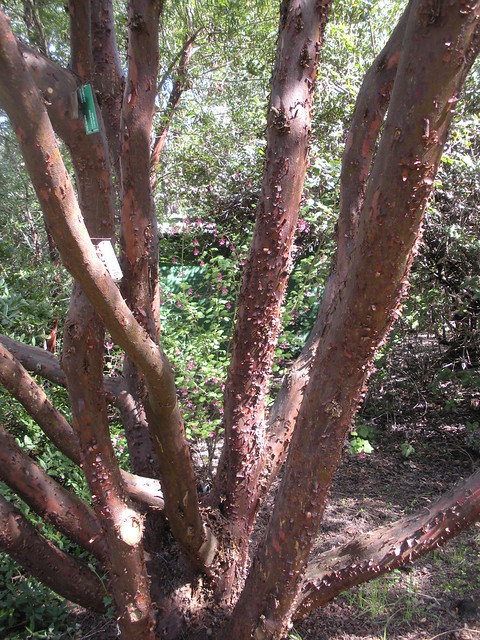
red bark of Tecate Cypress
It was one of my hopes to establish a unique Tecate Cypress woodland garden theme in my mother's landscape. However the tree has one flaw and that can be fatal. As a seedling and indeed, young tree, it is exceptionally fast growing. So much so that it's above ground branching structure will out perform it's own root system and become very top heavy. In my mother's backyard I built up a rather large retaining wall planter to construct my woodland garden. My mother's property and surrounding hectares of land around this were created from alluvial floodplain soils of sandy loam deposited over 1000s of years from the canyons above an area called Rattlesnake Mountain in El Cajon CA. Perfect soil for gardening, in fact this particular beautiful sandy loam soil is several meters deep. However it was my experience the second year when we received a heavy rainstorm and the winds blew some of the trees over or at least bent them over to the extreme. It should be noted however that in their native habitat the high winds are far worse, but the tough soil structure keeps the root system sturdy and also the accompanying chaparral act as a sort of plant staking support component. Take a look at how this works from the picture below of Cuyamaca Cypress with same soil requirements.

Cuyamaca Cypress with Chaparral Support System
~~~~~~~~~~~~~~~~~~~~~~~~~~~~~~~~
Tecate Cypress with Chaparral Support System
This past year my wife and I flew back to San Diego from here in Sweden and I had to cut all of them down but one. I felt horrible for doing it but it was necessary. Here's a picture below of this very planter location back in the year 2003 and you can see in the picture how some of the trees were already starting to lean over a bit. This is because the soil was very loose and sandy in it's structural make up. This may have been okay if the natural support system of a chaparral environment was in place, but it wasn't. Often times in a garden urban landscape setting we have to artificially stake up trees which would have been no problem in a wild setting.

Sadly in 2006, just before I moved over to Sweden, we had a very windy and rainy springtime storm in April 2006 which knocked over most of those trees. It was necessary to pull them back up and stake them with large posts to keep them upright, but it was difficult and the multiple stakes were aesthetically unsightly. Unfortunately this was necessary if I wanted to save them. There were further storms the following years and sadly that soft sandy loam perfect garden soil just wasn't strong enough to support all that top weight. With the "Earth Internet" planting strategy establishment game, I never use ANY chemical fertilizers what-so-ever. I did inoculate all of the plantings with a mix of both endo-mycorrhizae and ecto-mycorrhizae blended fungal spores along with beneficial symbiotic bacteria in the mix from a company called Plant Health Care Inc (PHC). I also heavily mulch around all of the plants. This not only adds a natural carbon feed to be downloaded by the complex sophisticated  mycorrizal network grid which exists underground, but it then is uploaded by the plants which transfer these beneficial nutrients which were made available to them from this grid. Yes you could use fertilizers to accomplish the same thing, but the health content wouldn't be the same and any mycorrhizae will actually disconnect and disassemble the healthy grid in the presence of heavy chemical usage. On an interesting note, it was in 2005 and the mulch I used came from the tree trimmings of some Canary Island pine trees from my work place and for which numerous volunteer seedlings popped up before I moved to Europe. I left them to grow naturally and had to thin the ones I didn't want. The result is that these trees which eventually replaced the Cypresses are now close to 30' high since I left in May of 2006. It's their nature to grow fast as well, but I'll have more on this in a future post. 

Here are some helpful ideas and very easy to understand tips on the benefits of an "Earth Internet" mycorrhizal based system by Linda Chalker-Scott an associate professor in the department of Horticulture and Landscape Architecture at Washington State University

"Why does the myth of phosphorus-induced root stimulation persist? The answer probably lies in theeffect phosphorus fertilizers have on mycorrhizal relationships. When plant roots are in low phosphorusenvironments, they exude organic acids from their root tips. These acids allow mycorrhizal fungi topenetrate the roots and form the networks that assist plant roots in taking up water and nutrients.Mycorrhizae are particularly adept at extracting phosphorus from the soil.""If phosphorus levels are too high, however, the roots do not exude the organic acids and mycorrhizalconnections do not form. This forces the plant to put more resources into root growth to compensate forthe lack of mycorrhizae. So in a sense phosphorus will increase root growth – but at an added cost to theplant. The resources expended by the plant in growing additional roots to take the place of mycorrhizaeare not available for other plant needs.""Shrub and tree species that are mycorrhizae-dependent have a difficult time surviving in soils wheremycorrhizae cannot develop. In particular, seedlings and newly transplanted materials are less efficient inabsorbing water and minerals from the soil and are more likely to suffer transplant shock than plantswhere mycorrhizae are present. Adding mycorrhizal spores to soils where phosphorus is too high isineffective – the spores will remain dormant."

On this same question and subject of soil structure, I had another unique experience in working with the soil on my sister's property in a brand new housing tract built in the year 2000 in Lakeside California. Like most newer housing tract developments in Southern California, most of the good agricultural land like my mother's property which use to be an Orange Grove are just about used up, but these newer tracts are built on steeply sloped hills or mountains. The building plots have certain specific compaction requirements which are necessary in order for the house to have a stable foundation. This of course is only logical given the sad experience by many folks who have homes in older developments which have been lost in well known southern California landslides as a result of poor clay soil accounting or consideration of the soil's structural make-up which no doubt was ignored in favour of making a quick profit in a desirable location, usually somewhere on the sea coasts where there is often a lack of solid bedrock for stability. My sister's property was prepared by the contractors who scraped off all top soil, used dynamite to blast through the granite bedrock and crushed this rock into various sizes only to be formed into the future housing pads and then compacted with heavy machinery for stable building foundations.

Image - Nic Lahoux
After the houses were built, they proceeded to apply a layer of brown Adobe looking earth and actually called this topsoil. Not only is this a major obstacle for the establishment of the usual horticultural selections you buy at your local retail nursery, but it is also a huge challenge for native plants from the same area. The soil structure is almost like that of Rammed Earth Construction  which is a new form of eco-designing house construction which has lately become popular for some. So your soil is almost like a solid concrete block wall. Water percolation is almost nill.
I found this out when constructing the hardscape which consisted of irrigation layout, retaining wall, pathway and step construction. I also found it necessary to create and build up raised planting beds and retaining walls around the perimeter and corners of her property. In the area where the lawn was I had to dig out countless large stones in between very little decomposed granite soil which was beneath the 6 to 8 inch phony labeled top soil added for nothing more than what I'd call "Eye Candy". I'm not at all a promoter of adding soil amendment to any tree or shrub plantings. However with the lawn it was a must. We had 5 deliveries of large bins of soil amendment from the local Home Depot. The work was tough and took a huge amount of extra time. The rock chunks I threw behind the retaining walls and mixed in with the soil there as it wouldn't have mattered to the trees and shrubs I would install there later. As always, I innoculated the ground where I wanted to establish the lawn, trees and shrubs. Interestingly, a healthy and thriving "Earth Internet" mycorrhizal web network will actually over time break down some of this compacted soils, but again, it will take some time 

 The bottom line when it comes to soils, you need first to familiarize yourself with you own property and the ground that lays underneath. Clay soils likewise have their own challenges , but there are plants that will work well in these, but you have to know which ones. If the nursery you do business at actually knows it's local business and has done their homework on what works in that area, then you should be able to get some sound advice from them. Also I have found from personal experience that it actually helps to get in your car and drive around the various local neighbourhoods in your area and take notice of the successful gardens/landscapes and ask questions of those homeowners. Again, knowing your soil and what plants will work is the first route to success and by all means DO NOT forget the benefits of establishing your own underground "Earth Internet"

Stay tuned for more articles and don't hesitate to ask specific questions on this.