"Earth's Internet" attempts to document, reference as much of the natural world networking abilities and strategies as possible. Such Scientific findings are at odds with industrial scientific approaches maintaining our planet. Be warned. If your learning approach it based on Memes with short clever quips, you may be disappointed here.
Showing posts with label Mycorrhizal Fungi. Show all posts
Showing posts with label Mycorrhizal Fungi. Show all posts
"Soil microbes known as rhizobia supply much-needed nitrogen to legumes such as clover (Trifolium species). In return, legumes shelter the rhizobia in nodules on their roots and provide them with carbon." - University of Illinois
(Graphic by Julie McMahon)
Another excellent article by some researchers from the University of Illinois on the negative effects Synthetic [science-based] Fertilizers are actually found to hinder the epigenetic mechanisms for which instructions for signaling symbyosis are being switched off by the overwhelming concentration of synthetic nutrients. This has been going on for some time however, because there are now many cultivators of crop plants which are no longer mycorrhizal. Now you know why Monsanto blames failure of productivity for their seed if the farmer doesn't purchase the synthetics they were engineered to work with. They have either deliberately engineered this shutdown knowingly or it's happened by accident as a result of industrial practices influencing epigenetic changes within the DNA of the plant itself. So here below are the findings in the article published by the University of Illinois.
Plant biologists at the University of Illinois have pinpointed the area of genomes within nitrogen-fixing bacteria in roots, called rhizobia, that’s being altered when the plant they serve is exposed to nitrogen fertilizer.
The study, published in the Royal Society journal Proceedings of the Royal Society B, deepens the understanding of an Illinois study last year that indicated rhizobia—which are particularly beneficial to legumes such as clover, beans, peas, soybeans, lentils, and others—are less beneficial for plants when they are exposed to nitrogen fertilizer.
“This is one of the first times we’ve found at the genetic level the basis of an evolutionary change in mutualism,” said Katy Heath, professor of plant biology and one of the study’s authors, referring to the mutually beneficial relationship between rhizobia and plants that has evolved over millions of years. Rhizobia receive sugar from the plant and in turn provide the plant with nitrogen.
Again, I loved this article and the shedding of light on a subject close to my own heart, but there is a need here to clarify something stated in the above paragraph. Here it is below with one slight, but very important alteration or correction:
“This is one of the first times we’ve found at the genetic level the basis of an evolutionary change"epigenetic change" in mutualism”
Of course for some of you folks reading here, you might consider this to be an unacceptable major alteration of the text on my part. Hardly, it has more relevance than you realize. But there is a huge reason why I insist on this. Because it offers nothing in the way of value in actually trying to understand this incredible natural phenomena from an actual mechanisms viewpoint which the authors are describing to us here and I'll explain the why below in the footnote. Just follow the red single star (*) at the bottom of this page. Now back to the article's text.
Heath conducted the study with Christie Klinger, a researcher at the Beckman Institute for Advanced Science and Technology who was a graduate student in Heath’s laboratory for this work, and Jennifer Lau, a plant biologist at Michigan State University. The researchers also conducted last years’ study revealing that human-made nitrogen fertilizer altered the relationship between rhizobia and plants.
Images: Edalat Sowda Trading Company, Iran
Images: Edalat Sowda Trading Company, Iran
Whether applied using industrial technology or simply spreading it by field hand workers as traditional peasant farmers do in the world's poorer countries, both techniques and practices will kill the soil's microbiobome and shut down the symbiosis between host plants and micro-organisms. Why is this ? Epigenetic shut down of the switches for symbiosis signaling. The plant will stop signaling for cooperation and the fungi will detatch. Amazing how the natural plant world thrived long before the Green Revolution in what was nitrogen poor wild soils. This is because the micro-organisms were the work horses of acquiring nitrogen from the atmosphere and feeding it to their host plants. Back then soil was very aggregated, porus and breathing capability was at it's highest in allowing the atmosphere to infiltrate soils. But over time from the 1950s onward these epigentic switches for the instructions within crop plant DNA regarding symbiotic cooperation have been turned off. This has created a perpetual dependencey on crop plants for all Agro-Chemical company's manufactured synthetic inputs as a life-support system. So with modern GMO seeds, they fail unless otherwise fed a synthetic junk food diet.
“Humans are dumping fertilizer everywhere,” Heath said. “And so one thing we were interested in asking is whether long-term nitrogen additions would disrupt this long, many tens of millions years old symbiosis that is pretty important to the ability of legumes to compete in natural ecosystems.”
By studying legumes at the W.K. Kellogg Biological Station in Michigan, site of a long-term ecological research site created by the National Science Foundation in part to study the effects of nitrogen fertilizer on plants, the researchers determined last year that in fact fertilizer caused rhizobia to become less beneficial to the plants they served. The new study was launched to determine why that was so.
“This new study is extending that work with whole genome sequencing of the bacteria,” Heath said. “We sequenced our samples from our control group and from the nitrogen-fertilized group, and we located this key region on the genome that appears to be differentiated between those two groups.”
They found the difference in an area called the symbiosis plasmid, which is an area of extra chromosones in rhibozia that enables them to be mutually beneficial with the plants—it’s where the gene is located that actually breaks the bond between nitrogen molecules and the air to “fix” it into ammonium that the plant can use.
“We see that at that region of the genome there’s differentiation suggesting that the effects of the nitrogen fertilizer were to make these less beneficial rhizobia different than the controlled rhizobia at that location,” Heath said. “In the rest of the genome they’re interchangeable. But when you look at that one region they all start separating. That basically means that selection has changed something in that region.”
Heath said that they are continuing to study the topic. She believes that the findings have significant implications as societies deal with a changing environment.
(Photo by L. Brian Stauffer.)
University of Illinois plant biology professor Katy Heath and her colleagues pinpointed the area of genomes within nitrogen-fixing bacteria in plant roots that’s being altered when the plant is exposed to nitrogen fertilizer.
“Why does it matter if we can synthesize nitrogen and dump it on fields anyhow?” Heath said. “It matters because we’re looking for more sustainable solutions. I think we’re looking to not add tons of human-fixed nitrogen, which is a super energy-intensive process. Rhizobia are really special because they can do it themselves.”
Similar article from South Dakota State University on mycorrhizae's effect on plants and the potential for dumping all synthetic inputs (April 8, 2016)
If you've got the time, take a look at what the Food and Ariculture Organization of the United Nation (FAO) says about the need for increased synthetic inputs for feeding the world. They insist that synthetic fertilizer use will surpass 200 million tonnes in 2018. And yet this manufacture process for nitrogen is extremely energy intensive to produce. Phosphates are mined which also means intensive energy usage through strip mining which also destroys the landscape. Both of these together require major transportation for distribution points, then trucked to the farm and later heavy agricultural machiney is required for field application which requires even more fossil fuels. This all contributes to climate change, but the industry helped smoke screen all of this months before the last climate convention in Paris. (See "Get-Out-of-Jail-Free-Card") Take note of some thought meditations that Darwin expressed to a minister named Asa Gray which I actually find to be a legitimate question by any intelligent human being, but it's just not a scientific one:
(Darwin to Asa Gray, [a minister] May 22, 1860)
But again, such metaphysical reasonings question beg, where do these industrial scientists get their warped view of nature being flawed, inefficient and so badly designed that they feel they are in a better position to use all their collective intelligence and make shortcuts towards biological perfection by means of biotechnology & synthetic chemicals ? This ongoing need to reference evolution in research papers and journals is key here to understanding what motivates and influences industrial scientists to push their view of the world into their less than ecologically responsible innovations. Because they are influenced by many of theory's well known proponents and ideologically driven philosophers who are constantly writing about some imagined proofs out there which reveal flaws in design everywhere in Nature and how some intelligent designer wouldn't have done it that way. Such metaphysical reasoning cannot be scientifically tested or experimented for and therefore should have nothing to do with science. But theoretical dogma are however used by profit driven industrial business models in rejecting other specific scientific findings on how nature actually works and mutualistic symbiotic functions within all ecosystems for balance and stability. Therefore these intelligent men and women reason and rationalize that they know better than Nature on how to improve upon Nature's flaws. You know the reality is, Nature has never been so flawed and out of balance since the past 100+ years of enlightenment took over running things.
For me, it still just boggles the mind how these folks arrived at such conclusions and as I've stated previously, what science experiment did they use to conclude this ? Truthfully, None! We never hear of a single one, hence the need for promoting their own version of religious metaphysics which actually requires unquestioned blind faith. Take for example, this religiously driven ideologue below. Here is what evolutionary biologist Jerry Coyne thinks. It's illustrative of why Nature and then mankind take a hit when it comes to quality of life.
"Evolution is the greatest killer of belief that has ever happened on this planet because it showed that some of the best evidence for God, which was the design of animals and plants that so wonderfully matched their environment could be the result of this naturalistic, blind materialistic process of natural selection."
Okay, so all plants, animals, birds, fish, reptiles, amphibians, microbes etc and the ecosystems they create are basically flawed, badly designed and that is proof positive Jerry's worldview is true ??? Problem is many agricultural researchers have either knowingly or unconsciously bought into this pathetic religious dogma which has resulted in a globally ruined landscape all across our once beautiful planet which is now a mirror image of their degenerate worldview of things. But there is further evidence of their flawed thinking and it's effect on biotechnology today.
" . . the universe and life are pointless....Pointless in the sense that there is no externally imposed purpose or point in the universe."
Does anyone remember when the Biotechs came out with those stupid scientific studies about anti-gmo people being religious nutcases who took their anti-gmo stance because they believed the Earth actually had purpose ? Seriously, that's what they insisted and they told us the research was science-based. Remember the science paper that was published and reported on by Science Daily and other science journals ? Psychology of the appeal of being anti-GMONot only did the researchers poke fun and accuse all anti-gmo people for believing in what they viewed as a stupid idea of the Earth having a purpose, but with their mocking and insults they also exposed the opposite view that pro-gmo, pro-biotech & pro-agro-chemical people mostly likely believe as Jerry Coyne does, that Earth doesn't have any purpose and that life is basically pointless. You'd think this would strike a nerve in many pro-gmo people, many of whom are heavily committed environmental activists. But guess what folks, you never hear a peep out of any them because they fear the peer-pressure from colleagues who may label them as being, *cough-cough*, " Anti-Science " and what an embarrassing shameful heretical thing that would be. Pathetic really. But wait, there is even more gems. Jerry says he and his kind are their own gods and make up their own rules on moral question of what is right and what is wrong.
"As atheists this is something that is manifestly true to us. We make our own meaning and purpose."
Jerry Coyne actually believes that his modern day enlightened worldview and philosophical takes on life are based on modern day rational free thinking, but they are in fact nothing more than an old tired recycled belief system stated way back many many centuries ago recorded in some ancient manuscripts. Genesis 3:5 - Douay-Rheims 1899 American Editionand there is this rendition from another version Genesis 3:5 - Amplified BibleOkay let's move along here. Take a long look below at the infamous legacy that the more enlightened version of industrial science has thus far provided for mankind and our planet's natural environment with their version of how agriculture should be practiced. Now remember folks, this is science-based stuff here and if you dare criticize what you see below, you run the risk of being labeled an anti-science Luddite. Okay, I'll admit it. If this is really "THE" Science, than yeah sure, I am a Luddite.
Lynn Betts - U.S. Department of Agriculture, Natural Resources Conservation Service
View of runoff, also called nonpoint source pollution, from a farm field in Iowa during a rain storm. Topsoil as well as farm fertilizers and other potential pollutants run off unprotected farm fields when heavy rains occur. Synthetic fertilizers close up and tighten soil pores and kill most of it's microbiology which creates an aggregated sponge which would otherwsie soak up all rains. Even many flooding downpours vertically, instead of horizontal runoff
Image: F. lamiot (own work) - Own work
Eutrophication is caused by the enrichment of an ecosystem with chemical nutrients, typically compounds containing nitrogen or phosphorus, here in a pond, with many dead leaves., under tree, in Lille (North of France). This sort of eutrophication is not abnormal if just for some days or weeks. But this also is the end result of runoff and explains the deaths in lakes, lagoons, sloughs and oceans by means of mainly agricultural pollution. You will find massive algal bloom photos everywhere in the news now all across the planet.
Now look at something Nature actually inspires some scientists and responsible companies through the practical application of biomimetics. No imaginary improvement is require, just plain ol'replication from observation of how Nature does really work. This was actually posted this morning by Mycorrhizal Application Inc'sFacebook page. They are one of the companies at the forefront of valuing the Natural World and showing people how to profit off biomimicry by saving 10s of 1000s of $$$ not having to purchase Synthetic Inputs and keeping nature hygenically healthy at the same time around their farms. Apparently there are other companies and their scientists who believe the Earth does have a purpose, irrespective of what they believe about the origins debates which are mostly time wasting anyway.
Image: Mycorrhizal Applications Inc.
Mycorrhizal Applications Inc just recently completed a trial on the effects of their MycoApply Ultrafine Endo inoculant on potato yields in India. With a population of 1.2 billion to feed, this OMRI-listed bio-rational solution can feed the masses using nature's ancient programmed software of storage mechanisms of knowledge and the age-old symbiotic relationships that industrial scientists say are flawed, inept, inefficient, and badly designed. Now I have no problem or issues with companies wanting to make money. But at least when technologies based on biomimetics like that of Mycorrhizal Applications Inc make money, they don't screw up the planet for everyone else.
~~~~~~~~~~~~~~~~~~~~~~~~~~~~~~~~
In a future article on Epigenetics which is really starting to explode now and revealing how change in all organisms actually takes place by means of genetic information control by sensors which trigger on and off switches in how such specific information is expressed. Understanding it is really not overly complicated and that is the beauty of this over the tired old fogma of random mutations being tinkered by natural selection, ot otherwise known as Stuff Happens. Now below here is my footnote explanation.
~~~~~~~~~~~~~~~~~~~~~~~~~~~~~~~~
Footnotes Explained & My Own Conclusions
From the Footnote*, the online journal, "The - Scientist" in August 2005, Philip S. Skell (1918 – 2010), an American chemist, emeritus Evan Pugh Professor at Pennsylvania State University, and from 1977 a member of the United States National Academy of Sciences wrote an article called, "Why do we invoke Darwin." Here are three great paragraphs from Philip Skell's article which sum up micely why Darwinian evolution is not helpful in experimental biology. Professor Skell explains the deep seated reasons that the name Darwin and/or words & terms natural selection evolution, etc are used in peer-reviewed papers and journals:
"In the peer-reviewed literature, the word "evolution" often occurs as a sort of coda to academic papers in experimental biology. Is the term integral or superfluous to the substance of these papers? To find out, I substituted for "evolution" some other word – "Buddhism," "Aztec cosmology," or even "creationism." I found that the substitution never touched the paper's core. This did not surprise me. From my conversations with leading researchers it had became clear that modern experimental biology gains its strength from the availability of new instruments and methodologies, not from an immersion in historical biology."
"In reality, however, this passage illustrates my point. The efforts mentioned there are not experimental biology; they are attempts to explain already authenticated phenomena in Darwinian terms, things like human nature. Further, Darwinian explanations for such things are often too supple: Natural selection makes humans self-centered and aggressive – except when it makes them altruistic and peaceable. Or natural selection produces virile men who eagerly spread their seed – except when it prefers men who are faithful protectors and providers. When an explanation is so supple that it can explain any behavior, it is difficult to test it experimentally, much less use it as a catalyst for scientific discovery."
"Darwinian evolution – whatever its other virtues – does not provide a fruitful heuristic in experimental biology. This becomes especially clear when we compare it with a heuristic framework such as the atomic model, which opens up structural chemistry and leads to advances in the synthesis of a multitude of new molecules of practical benefit. None of this demonstrates that Darwinism is false. It does, however, mean that the claim that it is the cornerstone of modern experimental biology will be met with quiet skepticism from a growing number of scientists in fields where theories actually do serve as cornerstones for tangible breakthroughs."
This is a very logical explanation for why no value is offered in understanding what is observed in experimental biology when faith-based terminology is inserted into any science paper or journalist's article on a subject matter. In fact, Katy Heath's and her team of colleagues conclusions on effects of nitrogen fertilizer on the symbiosis between plants and micro-organisms could be summed up in Philip Skell's last paragraph he wrote to a colleague who criticized his article.
"Evolution is not an observable characteristic of living organisms. What modern experimental biologists study are the mechanisms by which living organisms maintain their stability, without evolving. Organisms oscillate about a median state; and if they deviate significantly from that state, they die. It has been research on these mechanisms of stability, not research guided by Darwin's theory, which has produced the major fruits of modern biology and medicine. And so I ask again: Why do we invoke Darwin?"
This is why I inserted in above in the paragraph the term, "Epigentic Change" which is going to be so important in the future in explaining mechanisms with which influence the natural world into adaptive change to environment, as oppose to religious speculations demanded by the Scientific Orthodoxy which run Science and determines whose career receives life or figuratively burned at the stake. And if you think this dogma doesn't harm or influence industrial science, go back up and read my observations on the industrial agro-science industry. Oddly enough, the same Evolutionary Biologist, Jerry Coyne, I referenced above admitted this in an article published in "Nature":
"if truth be told, evolution hasn't yielded many practical or commercial benefits. Yes, bacteria evolve drug resistance, and yes, we must take countermeasures, but beyond that there is not much to say."
You know what's really annoying for me when I read any scientific research paper or science journal article which inserts these blind faith metaphysical terminologies into their script ? Ever try and watch a Youtube video where someone has uploaded a video which contains those annoying Advertisement interruptions they try and force you to watch ? But then you get that button on the lower right side of the video with a message tells you that in 7 seconds you can click the Skip button and proceed with the viewing. So you wait through the longest 6 or 7 seconds of your life to click Skip Ad. That's what it's like when you have to skim over the gloss and fluff to get past the religiosity to appreciate the actual import of the information given on the article's subject. If there is too much insertion in the text, then like the Youtube videos, you just have to turn them off completely and move along elsewhere. So when I see science papers like the one in the recent Science Daily with the title, "The genetic evolution of Zika virus" , you find if you read the article, there was zero to do with evolution and everything to do with epigenetic change within DNA depending on which host the Zika virus was present. There was nothing that the word 'evolution' in the title that offered any value to help you understand the subject's main body of of information found in the text. It would be equally disappointing as Philip Skell explained, if other terms like God, Christ, Allah, Buddha, created, etc were inserted instead. They simply wouldn't help you to understand what was actually going on from a scientific observational mechanism standpoint. Sometimes folks, depending on who is doing the research, it's not advisable to follow the science where it leads based on the bias and motivation of the reseacher. In a worldview that claims to champion skepticism, amazing that so few actually practice skepicism. To summarize again, inoculate instead of fertilize with industrial science-based products.
A California Fan Palm planted into a front yard landscape from a one gallon container out performs 3 five gallon Mexican Fan Palms which not only had a more massive root system, but also three times the height. So what happened ??? - "Mycorrhizal Fungi"
(image: Mine July 2014)
Image taken on July 2014
It all began last year at the start of July 2014, I purchased four more Palms for my mothers front yard to create the appearance of an Oasis among plants of the Pea family like Red Mexican Bird of Paradise (Caesalpinia pulcherrima), Baja Fairyduster (Calliandra californica) & Screwbean Mesquite (Prosopis pubescens). There was already an existing Mexican Fan Palm which had volunteered on my mother's property and my brother had moved it back in 2005 to where you see it in the photograph above. I'm still blown away by the fact that since 2006, that palm has grown very slowly from from a foot tall plant to what you see here above in last year's photograph. You may want to take special note of the size of not only the one gallon Washingtonia filifera, but also the height of the Washingtonia mexicana in the background which you'll seed more than doubled in height in the September 2015 photograph. But what blew me away on this year's (2015) return is to see what has happened with the one gallon California Fan Palm I purchased from Las Pilitas Native Plant Nursery in relation to 3 other purchased five gallon Mexican Fan Palms I purchased from Lowes on the last week of July 2014 when I planted them. This native Southern California palm is just normally slower growth than it's cousin the Mexican Fan Palm.
The major difference maker was inoculating the California Fan Palm heavily within the soil at planting time with the as opposed to simply planting the Mexican Fan Palms without the beneficial fungi. The reason is I thought the Mexican Fan Palms would explode with fast growth on their own because as a natural rule they are much faster growing than Washingtonia filifera. Wow was I ever wrong. The California Fan Palm grew another three feet, while 2 of the five gallon Mexican Fan Palms put on only a foot of growth. The third Mexican Fan Palm actually died. I seriously should have inoculated everything. But after all these years of successes and positives which have greatly exceeded all expectations, I'm still excited by amazing changes almost before my very eyes. We're talking just exactly a year and two months. This is why documenting such things is so important, because those who are behind the Industrial Agriculture business model are not at all in favour of such practices and their successes. But take a look at last year's (2014) W. filifera to this year's (2015) results below.
Over four foot of growth between the period of July 2014 to August 2015. So why is it again that home owners and professional landscapers have preferred using the faster growing Washingtonia robusta over the so-called slower growing native Southern California - Washingtonia filifera ???
(image: Mine Sept 2015)
(image: Mine July 3, 2014)
The photograph above of the California Fan Palm is little over four foot tall as I did measure it at the frond tips. At the time of planting, this one gallon tree was barely one foot tall at the tips of it's small fronds. The big difference maker was inoculation with Mycorrhizal Applications Inc's product called MycoApply. I should also note however that I also bored holes in the ground around the base of the large 11 year old Mexican Fan Palm (why I don't know) and again with the Engelmann Oak (Quercus engelmannii) on the opposite side of that largest and oldest Mexican Fan Palm as well. In any event, you can also notice the drastic difference in growth with that 11 year old Mexican Fan Palm in the same landscape Oasis photo at the very bottom of this post if you scroll on down. But also take a look at the 2013 one gallon Engelmann Oak (again purchased from Las Pilitas) which was planted in the front yard Oasis on April 2013 and the contrast of where it is today 2015.
(image: Mine September 2015)
(image: Mine June 2013)
This one gallon Engelmann Oak was purchased and planted in late May of 2013. The first photo on the right side here was actually taken on June 30th 2013 where you can see how that year's Spring branch buds which sprouted after planting grew another few more inches. So technically this small tree was less than a foot of growth from the Nursery. The top photograph above shows the tree actually well over six foot tall. I'm 6.3 foot tall, so it was a nice surprise also to see the growth of this tree slightly towering over me. I also imagine that the mycorrhizal fungi from the Oak has moved underground towards that largest Mexican Fan Palm you see to the left in the Oak photograph above. Once again, compare the height of that Palm today (2015) compared to last year (2014). Big difference. Still the slow growth of the five gallon planted Mexican Fan Palms was a surprise to me, but I'll inoculate them this year before I go back to Sweden. During yesterday's monsoonal rainstorm, the curb on the opposite side of my mother's street rain had flood water reaching 5 foot out from the curb towards the center of the street. I grabbed a five gallon orange Home Depot bucket and placing it in the deepest part of the runoff against the curb, the bucket filled up in a matter of seconds. I then proceeded to walk back to my Mother's front yard and dump the contents under various shrubs. It just kills me to see such as waste of city storm runoff which ends up downstream into the ocean. This runoff develops from all the concrete and asphalt surfaces of a housing development called Sky Ranch built on top of Rattlesnake Mountain above Pepper Drive Elementary School. I made more than 50+ trips right about the time School let out at 3:00 pm. I got soaking wet, but it felt wonderful. The kids parents were parked up and down the street. Some snickered, others complimented me. Some day these municipal flood control infrastructures within city limits are going to be designed or redesigned to be better at rainwater harvesting and infusing such water into the city park landscapes and road medians. It just makes logical sense. Anyway, the rainfall totals over my mother's landscape artificially increased by a couple more inches, especially around the Manzanitas.
(image: Mine September 2015) Basically 4 years old landscape from 2011
(image: Mine Sept 2015)
Mexican Red Bird of Paradise seeds germinatinng after one rainstorm
This is a contrasting view of the same photo at the top of this post which was taken last year. Notice in this year's photo above how much growth and taller the largest 11 year old Mexican Fan Palm has gotten when you look at it's height as seen behind the Baja Fairyduster ? And to me there is not a whole lot of noticeable difference in the smaller Mexican Fan Palm here than the photo at top. The California Fan Palm is hidden behind this largest Palm and out of view. Also take special note of the photo here at the right. We had a wonderful long soaking monsoonal rain on our visit in September which lasted most of the day and tapering off during the night with mist through this morning. These seeds on the concrete driveway are from the Mexican Red Bird of Paradise and they are some of the easiest things I have ever germinated and grown. We have no weeds, but the seedlings would almost qualify as they are very prolific in germinating. Seriously, I don't know why anyone would ever purchase one of these plants at a retail nursery. One of the greatest compliments I've gotten over the last few days working out in the yard and trimming is people walking past the house wondering what I feed the landscape to make everything so lush and intense as far as flowering. My response of course is nothing. I have never once used either synthetic nor organic fertilizers to accomplish anything. All plants are inoculated generally at time of planting and the only other addition is mulch. As a side point here before I continue, take note of the photo from four years ago in 2011. Take note how tall the largest Mexican Fan Palm was back then and it was already 4 years old and barely hanging on, before I started inoculating with MycoApply.
Same exact location, but photo is from 2011
(image: Mine 2015) Can you find the Spider ?
Sometimes in the beginning after the original installation and inoculation, I'll inoculate further the next year and perhaps a couple years after that to build up soil microbial community and build up the soil carbon. My only yearly addition into the landscape is a thin layer of decorative pine or cedar mulch which will break down slowly by the mycorrhizae and other beneficial bacteria which will release nutrients back into the system ever so slowly. Under the the synthetic industrial science-based method, most of the fertilizer is lost to percolation and runoff. The point is once you create a natural healthy ecosystem within your own urban landscape, the health of the entire plant community increases negating the need for all the other industrial science-based synthetic chemicals such as insecticides and herbicides. The use of insecticides destroys every single beneficial predator insects such as the Spider shown above left. She was a surprise to find. I only noticed her because of the long trail of dired flower petals caught or woven into her foot long nest. Interesting I wondered what exactly she was catching, possibly bees. However my mother has a motion censor nightlight on the corner of the garage and when walking out the front door at night it is triggered to come on. Several nights I walked out and notice in the Red Bird of Paradise bush the blooms were being visited by numerous little white Moths with black speckles on their wings. That was interesting since many types of garden and farm pest moths fly at night in desert agricultural areas. Hence such checks & balances critters are imperative. But the synthetic chemicals target them as well as pests and in their absence, the pest populations rise despite the chemicals. Once this type of industrial scenario is created, then you become shackled and prisoner into following the industrial maintenance program. And the sad fact is you cannot win. The only winner is the industrial agro-chemical company. Much of the synthetic fertilizers cause excessive growth which attracts insect pests and many pathogenic diseases in the form of powdery mildew etc. This is the same program or system used to grow your food found at the local grocery store produce aisles. The need for synthetic chemical herbicides also radically decreases as the mycorrhizal networks outcompete the weeds (ruderals) for available soil phosphorus. Weeds thrive in a bacterial soil system, not a mycorrhizal one. Any weeds that do make the occasional appearance are greatly stunted. Generally my mother's landscape has 4 or 5 anual weeds within the mycorrhizal soils in her landscape's sphere of influence and generally stunted with no effect on the trees, shrubs and other plants.
(image: Mine 2014)
BTW, last year when planting the other palms, this palm root from the largest tree was 14 foot away from the Mexican Fan Palm. It reveals just how far palms will go in search of water. It's extremely imperative that people reading here do not simply take my word for all this, but make practical application within their own landscape or gardening projects. By all means challenge my methods, please. This is what burns knowledge of such methods into your mind's personal experience. The majority of people have been indoctrinated into the industrial conventional business model through millions of dollars of annual advertising and also the infusing of massive amounts of funding within this world's Academia to maintain the industrial status quo. The earth simply cannot afford this type of irresponsible behaviour any longer. This isn't about pseudoscience or anti-science, this is about horrible irresponsible science versus good healthy holistic biomimetic science.
(Caesalpinia pulcherrima and caesalpinia mexicana)
The plant above on the right in the photo is Mexican Yellow Bird of Paradise (Caesalpinia mexicana). It would make a nice contrast in the landscape. While I love the Red Bird of Paradise, it can be overwhelming with too much of the same colour. I already have several of the native South American native Yellow Bird of Paradise (Caesalpinia gilliesii - native to Argentina & Bolivia) planted throughout, but they flower very early in Spring season where the others are mainly in full summer blooming. These of course naturalize very easily and we also have to pull up seedlings as they appear, but not hard to keep a handle on. Below I'll post some links of previous articles on planting members of the Pea family (Legume) and I'll also provide the post of where the Oasis landscape was planted in the dead heat of summer during 100+ Fahrenheit (40 celsius) intense heat. It really can be done and while mycorrhizal fungi inoculum is a must, the timing of the day is everything. I'm not sure how many will read this post or take it seriously, but at the very least I've been further able to document something I should have recorded years ago. People are going to have to start viewing nature as a sophisticated biological machines with various fascinating complex components. By far the most amazing thing about this subject was something that I didn't expect from the California Fan Palm and that was extremely rapid growth. Even with the mycorrhizae colonized on the root system, I fully expected little change from when I planted that little one gallon Fan Palm. I never cease to be amazed by these successes.
~~~~~~~~~~~~~~~~~~~~~~~~
Next Year's (2016) Experiment Watch: Mexican Blue Fan Palm (Brahea armata)
Image: My Sister Aimee (November 2015) Two Mexican Blue Fan Palms from 5 Gallon Containers
Next year in in Spring I hope I am able to come back over and check on the progress of to entirely different palms which are even more challenging when it comes to slow growth. These are the two Mexican Blue Fan Palms (Brahea armata) that I planted just the last week of my visit in El Cajon. The growth on these are extremely slow compared to most and they are extremely root sensitive, so what difference with the MycoApply Soluble Maxx have on their growth is anyone's guess. I'd love to see a dramatic change because these are so rarely messed with by most landscapers and homeowners for the simple reason people want instant landscape and for the fact that many still are not all that attracted to plants with a gray/blue green foliage. One thing that helps in decision making in my personal experience is being capable of visualizing what any tree or shrub will look like in the landscape. It is imperative to understand the plant's height, width, it's silhouette especially for a background tree as both of these. In my mind, I picture the example in the photo at right. In my opinion they are one of the more handsome palms when in flower as you can see in the photo. On the wait and see challenge side of things when it comes to root sensitivity, ever see those large semi tractor trailer flatbed trucks hauling large several meters high palms being transported from Tree Farms to landscape location in the desert resort areas ? It is almost impossible to do that with a Mexican Blue Fan Palm. When the machinery in the orchard cuts the roots and pulls the tree from the ground, most palms are fine, but not the Blue Fan Palm. They require the movers to first use a propane blow torch and burn the root system. This cauterizes the wounded root cuts, because otherwise being normally planted in the ground like other palms, it would bleed to death. Now growth will emerge from the burned area, but this method is imperative. This is why when search for these specific palms I looked for a one gallon container. Impossible to find, mostly because the palms are slow growing and most people wouldn't have the patience to wait for larger landscape specimen to develop. So the MycoApply's ability to prevent transplant shock and stimulate faster than normal growth will be extremely important, not only for these palm's health, but also possibly prove to the industry what can be accomplished for future successes.
=====================================
Some of my recent posts on Mexican and California Fan Palms, this year and last year in 2014. The first follows the incredible lengths Washingtonia filifera roots will go to in search of water. The second is about the invasive nature of Washingtonia robusta in the coastal canyons around urban areas of San Diego California and the further wildfire spreading threat potential they create
When I think of Todd Dawson's work, I think of my own obsession of wondering what is going on under the ground as opposed to walking through the woods and looking at all the beautiful scenery. Yes of course the scenery is beautiful and exciting. However, my metamorphosis and obsession with underground biological life networking came about over a long period of time. While I always had interest in 'Botany'&'Plants', I gradually came to realize through my own study and research that a healthy above ground paradisaic scenario is made only possible and a success by a properly installed under ground networked system. Nature, when not interfered with, takes care of itself. However, human's on the other hand are wowed by the Ooooooo-facter of various Large Corporate Marketing Schemes when it comes gardening and landscaping. Billions of Dollars in advertising over almost a century has indoctrinated people on Earth that Chemicals are the answer for your every need in the garden and landscape and without them you are bound to fail. Careful consideration should always be given to just exactly how things work in nature and then simply replicate these processes by developing practical application concepts into your own project. The mistake comes when mankind believes they can out perform and improve upon nature. No need to list the failures of this thinking. Anyone can read and listen to the News today and see that human's are rapidly destroying our planet. That aside, let's get back to what work Todd Dawsonand his team have pioneered. There are terms and phrases they research called 'Hydraulic Lift' - 'Hydraulic Redistribution' - 'Hydraulic Descent'and all of this has to do with a root phenomena where by roots of key species of any type of ecosystem facilitate the redistribution of water and nutrients through yet another complex and sophisticated piece of "Earth Internet" hardware called a mycorrhizal network or grid. These mycorrhizal organisms are nothing more than beneficial fungus which uses mycelial network fibers to inter-connect with various species of plants in an underground mutualistic association. In a nut shell the fungi provide an increased rate of absorbtion by 200% of water and nutrients and gives these to the trees or shrubs and in turn, the fungi who can't manufacture their own food through photosynthesis are rewarded from the plant carbons and other sugars by which the fungi survives.
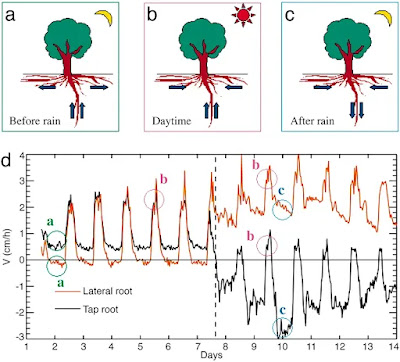
Below is an animated illustration off Todd Dawson's Lab sitewhich beautifully illustrates just what happens during daylight hours, nighttime and even during the rainy season when trees and shrubs are in dormancy state.
Animated imgage - Dawson's Lab
Sap velocity in the taproot and lateral root of P. robustum during the transition from the dry to wet season in the Floresta Nacional do Tapajós.(a–c) Schematics for water movement at nighttime before the rain (a), daytime before and after the rain (b), and nighttime after the rain (c). Arrows shown the dominant flow direction determined by sapflow. (d) Graph showing sap velocity. Positive values mean that water flows to the plant, and negative values means away from the plant into the surrounding soil. The dashed line represents a rain event (36 mm). See the text for a complete explanation.
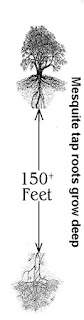
One of the first articles I ever read was a piece done above Todd Dawson'sresearch work on the role Sugar Maple (Acer saccharum)play in it's temperate forested ecosystem. It was exactly similar to something I had read about desert tree called Honey Mesquite (Prosopis juliflora) grows to a height of up to 12 metres (39 ft) and has a trunk with a diameter of up to 1.2 meters (3.9 ft).
Its roots are able to grow to a great depths in search of water: in
1960, they were discovered at a depth of 53 meters (175 feet) at an
open-pit mine near Tucson, Arizona putting them among the deepest known rootsystems.
"Mother Nature's Irrigators" by Todd Dawson
Of course I already had an interest on the theories and research work by an Austrian Forester and self taught Physicist Viktor Schauberger. This Schauberger spoke of healthy electrically charged water as only coming from deep within the Earth and moving upwards through the soil bringing with it along vital nutrients (or Salts as he put it) which nourished plants and other life on the surface in the process. The invaluable research work and physical naturalistic explanations provided by Todd Dawson, his team and a plethora of other modern day researchers was sadly something unavailable to Viktor Schauberger who was privileged to live at a time when most old growth forests were still intact and in their pristine state and he could observe first hand natural phenomena that we can only dream of now. With that early research in the back of my mind, this paragraph from the above linked article that caught my eye. It suddenly made sense of some of the things that seemed so mysterious. Take a look at what Todd Dawson and his team discovered with regards streamsidetrees. One would think that all that lush growth draws it's water hydration from off the surface waters. But not so. Read this one paragraph from the link from:
"Mother Nature's Irrigators"
"By comparing variations in isotopic concentrations taken from different sources, they were able to show that mature streamside trees do not use stream water but used deep groundwater. When Dawson came to Cornell in 1990, he looked for ways to combine his research in water use with his interest in woody plants and their distribution and physiology. During the summers of 1991and 1992, Dawson observed the water use of Maples."
Todd Dawsonmade a further research work of this streamside (Riparian Habitat) water use by Trees. These trees amazingly prefer the deep groundwater to the surface water abundant in what appears to be a healthy surface water situation. Take the time to read the paper they did on this in the link title:
"A LONG-STANDING axiom is that plant distribution is strongly influenced by soil moisture content1,2. While it has been shown that plant taxa inhabiting streamside communities receive or use more water3, it is assumed that this water is obtained from the stream adjacent to where they are found growing. Here we show, using hydrogen isotope ratio analyses at natural abundance levels, that mature streamside trees growing in or directly next to a perennial stream used little or none of the surface stream water. The deuterium to hydrogen content of both source and xylem waters indicated that mature trees were using waters from deeper strata. Although adult trees may have roots distributed continuously throughout a soil profile, it seemed that the most active sites of water absorbtion were limited to deeper soil layers. In contrast, small streamside individuals appeared to use stream water, whereas small non-streamside individuals used recent precipitation as their primary water source. Our analyses provide both a relatively non-destructive method for assessing water sources of plants and a means of assessing potential competitive interactions among cooccurring taxa. In addition, the method may aid in resolving the role of water in determining plant distributions in areas characterized by sharp soil moisture gradients."
The above info has intrigued my interest because of my passion for finding evidence for an Ancient Earth's minerotrophic hydrological cycle which no longer exists on the Earth for the most part, though it does in parts such as Fens or Sahara Oasis where rain is not a factor. There are hints and clues everywhere and the technologies we can develop from learning about these natural processes are incredible and vitally important given the sad state of health conventional science has brought to mankind and the world around them. A huge discovery in the Arctic (Axel Heiberg Island) of ancient Dawn Redwood trees where actual wood which is not fossilized, but rather well preserved and mummified has provide Chemical Signature clues through Oxygen Isotope study as to the origin and source of water which hydrated those trees. Here is a sort quote of one researchers, Hope Jahren, in an interview of their finding of an ancient climate's past.
"Because the wood is unadulterated, the tissues hold a chemical record of weather patterns during the period the tree lived. Jahren studies carbon, hydrogen, oxygen, and nitrogen because these elements are taken from the soil, water, and air and incorporated into the tissue of plants and animals.
Jahren and her colleague Leonel Silveira Lobo Sternberg of the University of Miami in Coral Gables, Florida, are examining chemically different forms, or isotopes, of oxygen in these ancient redwoods to reveal weather patterns during the Eocene period.
Oxygen that a plant uses, said Jahren, comes primarily from water. Determining the chemistry of that water could reveal exactly where it came from. Rain that arrives after traveling long distances over land has a very different chemical signature than rain that travels over the ocean or just very short distances, she explained.
The researchers' analysis of the oxygen content of the wood revealed "a bizarre absence of oxygen-18, the heavy isotope," said Jahren. Water contains both oxygen 16—the more common and lighter isotope—and the more rare oxygen 18. The analysis suggests that the water contained almost exclusively oxygen 16."
National Geographic TodayMarch 26, 2002
"Arctic Redwood Fossils Are Clues to Ancient Climates"
Take a further 26 minutes if you are able and view this video on the Quest science video which tracks the field work of Todd Dawsonand his team. They take a look at our present hydrological water cycle and proceed to study just how it actually does work. You might say they are taking a more detailed approach by focusing in on the fine tuning of this hydrological cycle that is not necessarily observable the the average person. In fact Todd Dawson reveals more fresh water is store within the earth than on surface. Of course fast forward and this may not be true anymore. As the video's descriptive reference on the page states,
"Scientists at UC Berkley are embarking on a new project to understand how global warming is effecting our fresh water supply. And they are doing it by tracking individual raindrops Mendicino and north of Lake Tahoe."
Here is the video link which is only about ten minutes long. Enjoy!
"QUEST: Life of a Raindrop"
The animated illustration at the top of this page which shows the various functions of the phenomena called Hydraulic Lift & Redistribution comes from a paper Dawsonand other researchers did called,
"Root Functioning Modifies Seasonal Climate"
Abtract:Hydraulic redistribution (HR), the nocturnal vertical transfer of soil water from moister to drier regions in the soil profile by roots, has now been observed in Amazonian trees. We have incorporated HR into an atmospheric general circulation model (the National Center for Atmospheric Research Community Atmospheric Model Version 2) to estimate its impact on climate over the Amazon and other parts of the globe where plants displaying HR occur. Model results show that photosynthesis and evapotranspiration increase significantly in the Amazon during the dry season when plants are allowed to redistribute soil water. Plants draw water up and deposit it into the surface layers, and this water subsidy sustains transpiration at rates that deep roots alone cannot accomplish. The water used for dry season transpiration is from the deep storage layers in the soil, recharged during the previous wet season. We estimate that HR increases dry season (July to November) transpiration by ≈40% over the Amazon. Our model also indicates that such an increase in transpiration over the Amazon and other drought-stressed regions affects the seasonal cycles of temperature through changes in latent heat, thereby establishing a direct link between plant root functioning and climate.
From time to time I will add to this page further research done by Dawson and other who vision along the same line of thought and discovery. Keep checking for updated page.