Showing posts with label Viktor Schauberger. Show all posts

Monday, March 19, 2012

Todd Dawson's Lab!

Todd Dawson's Lab
https://nature.berkeley.edu/dawsonlab

When I think of Todd Dawson's work, I think of my own obsession of wondering what is going on under the ground as opposed to walking through the woods and looking at all the beautiful scenery. Yes of course the scenery is beautiful and exciting. However, my metamorphosis and obsession with underground biological life networking came about over a long period of time. While I always had interest in 'Botany' & 'Plants', I gradually came to realize through my own study and research that a healthy above ground paradisaic scenario is made only possible and a success by a properly installed under ground networked system. 

Nature, when not interfered with, takes care of itself. However, human's on the other hand are wowed by the Ooooooo-facter of various Large Corporate Marketing Schemes when it comes gardening and landscaping. Billions of Dollars in advertising over almost a century has indoctrinated people on Earth that Chemicals are the answer for your every need in the garden and landscape and without them you are bound to fail. Careful consideration should always be given to just exactly how things work in nature and then simply replicate these processes by developing practical application concepts into your own project. The mistake comes when mankind believes they can out perform and improve upon nature. No need to list the failures of this thinking. Anyone can read and listen to the News today and see that human's are rapidly destroying our planet.

That aside, let's get back to what work Todd Dawson and his team have pioneered. There are terms and phrases they research called 'Hydraulic Lift' - 'Hydraulic Redistribution' - 'Hydraulic Descent' and all of this has to do with a root phenomena where by roots of key species of any type of ecosystem facilitate the redistribution of water and nutrients through yet another complex and sophisticated piece of "Earth Internet" hardware called a mycorrhizal network or grid. These mycorrhizal organisms are nothing more than beneficial fungus which uses mycelial network fibers to inter-connect with various species of plants in an underground mutualistic association. In a nut shell the fungi provide an increased rate of absorbtion by 200% of water and nutrients and gives these to the trees or shrubs and in turn, the fungi who can't manufacture their own food through photosynthesis are rewarded from the plant carbons and other sugars by which the fungi survives.
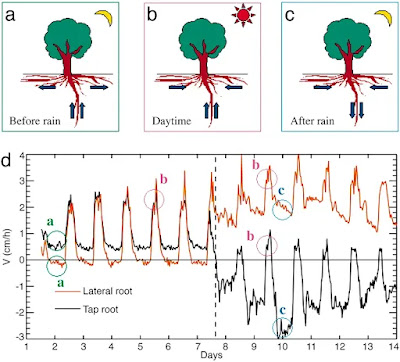
Below is an animated illustration off Todd Dawson's Lab site which beautifully illustrates just what happens during daylight hours, nighttime and even during the rainy season when trees and shrubs are in dormancy state.
Animated imgage - Dawson's Lab

Sap velocity in the taproot and lateral root of P. robustum during the transition from the dry to wet season in the Floresta Nacional do Tapajós.(a–c) Schematics for water movement at nighttime before the rain (a), daytime before and after the rain (b), and nighttime after the rain (c). Arrows shown the dominant flow direction determined by sapflow. (d) Graph showing sap velocity. Positive values mean that water flows to the plant, and negative values means away from the plant into the surrounding soil. The dashed line represents a rain event (36 mm). See the text for a complete explanation.

Root functioning modifies seasonal climate 

~~~~~~~~~~~~~~~~~~~~~~~~~~~~~~~~~~~~~~~~
(Photo courtesy of NetPS Plant Finder)
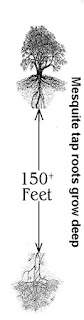
One of the first articles I ever read was a piece done above Todd Dawson's research work on the role Sugar Maple (Acer saccharum) play in it's temperate forested ecosystem. It was exactly similar to something I had read about desert tree called Honey Mesquite (Prosopis juliflora) grows to a height of up to 12 metres (39 ft) and has a trunk with a diameter of up to 1.2 meters (3.9 ft). Its roots are able to grow to a great depths in search of water: in 1960, they were discovered at a depth of 53 meters (175 feet) at an open-pit mine near Tucson, Arizona putting them among the deepest known rootsystems.
"Mother Nature's Irrigators" by Todd Dawson
Of course I already had an interest on the theories and research work by an Austrian Forester and self taught Physicist Viktor Schauberger. This Schauberger spoke of healthy electrically charged water as only coming from deep within the Earth and moving upwards through the soil bringing with it along vital nutrients (or Salts as he put it) which nourished plants and other life on the surface in the process. The invaluable research work and physical naturalistic explanations provided by Todd Dawson, his team and a plethora of other modern day researchers was sadly something unavailable to Viktor Schauberger who was privileged to live at a time when most old growth forests were still intact and in their pristine state and he could observe first hand natural phenomena that we can only dream of now.  With that early research in the back of my mind, this paragraph from the above linked article that caught my eye. It suddenly made sense of some of the things that seemed so mysterious. Take a look at what Todd Dawson and his team discovered with regards streamside trees. One would think that all that lush growth draws it's water hydration from off the surface waters. But not so. Read this one paragraph from the link from:
 "Mother Nature's Irrigators"

"By comparing variations in isotopic concentrations taken from different sources, they were able to show that mature streamside trees do not use stream water but used deep groundwater. When Dawson came to Cornell in 1990, he looked for ways to combine his research in water use with his interest in woody plants and their distribution and physiology. During the summers of 1991and 1992, Dawson observed the water use of Maples." 

Todd Dawson made a further research work of this streamside (Riparian Habitat) water use by Trees. These trees amazingly prefer the deep groundwater to the surface water abundant in what appears to be a healthy surface water situation. Take the time to read the paper they did on this in the link title:
"Streamside Trees That Do Not Use Steam Water" 
Mother Nature's Irrigators* Plants Share Water With Th eir Neighbors
Image - semanticscholar.org

"A LONG-STANDING axiom is that plant distribution is strongly influenced by soil moisture content1,2. While it has been shown that plant taxa inhabiting streamside communities receive or use more water3, it is assumed that this water is obtained from the stream adjacent to where they are found growing. Here we show, using hydrogen isotope ratio analyses at natural abundance levels, that mature streamside trees growing in or directly next to a perennial stream used little or none of the surface stream water. The deuterium to hydrogen content of both source and xylem waters indicated that mature trees were using waters from deeper strata. Although adult trees may have roots distributed continuously throughout a soil profile, it seemed that the most active sites of water absorbtion were limited to deeper soil layers. In contrast, small streamside individuals appeared to use stream water, whereas small non-streamside individuals used recent precipitation as their primary water source. Our analyses provide both a relatively non-destructive method for assessing water sources of plants and a means of assessing potential competitive interactions among cooccurring taxa. In addition, the method may aid in resolving the role of water in determining plant distributions in areas characterized by sharp soil moisture gradients."

(Source)

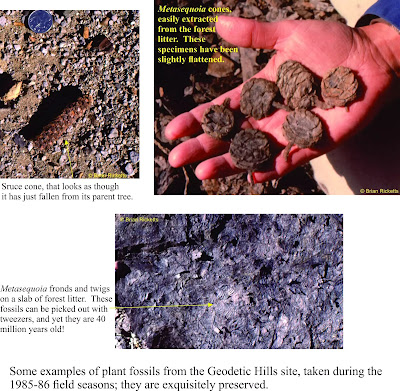
The above info has intrigued my interest because of my passion for finding evidence for an Ancient Earth's minerotrophic hydrological cycle which no longer exists on the Earth for the most part, though it does in parts such as Fens or Sahara Oasis where rain is not a factor. There are hints and clues everywhere and the technologies we can develop from learning about these natural processes are incredible and vitally important given the sad state of health conventional science has brought to mankind and the world around them. A huge discovery in the Arctic (Axel Heiberg Island) of ancient Dawn Redwood trees where actual wood which is not fossilized, but rather well preserved and mummified has provide Chemical Signature clues through Oxygen Isotope study as to the origin and source of water which hydrated those trees. Here is a sort quote of one researchers, Hope Jahren, in an interview of their finding of an ancient climate's past.
"Because the wood is unadulterated, the tissues hold a chemical record of weather patterns during the period the tree lived. Jahren studies carbon, hydrogen, oxygen, and nitrogen because these elements are taken from the soil, water, and air and incorporated into the tissue of plants and animals. 
Jahren and her colleague Leonel Silveira Lobo Sternberg of the University of Miami in Coral Gables, Florida, are examining chemically different forms, or isotopes, of oxygen in these ancient redwoods to reveal weather patterns during the Eocene period. 
Oxygen that a plant uses, said Jahren, comes primarily from water. Determining the chemistry of that water could reveal exactly where it came from. Rain that arrives after traveling long distances over land has a very different chemical signature than rain that travels over the ocean or just very short distances, she explained. 
The researchers' analysis of the oxygen content of the wood revealed "a bizarre absence of oxygen-18, the heavy isotope," said Jahren. Water contains both oxygen 16—the more common and lighter isotope—and the more rare oxygen 18. The analysis suggests that the water contained almost exclusively oxygen 16."
National Geographic Today March 26, 2002

"Arctic Redwood Fossils Are Clues to Ancient Climates" 


Images from Wikipedia Content

Take a further 26 minutes if you are able and view this video on the Quest science video which tracks the field work of Todd Dawson and his team. They take a look at our present hydrological water cycle and proceed to study just how it actually does work. You might say they are taking a more detailed approach by focusing in on the fine tuning of this hydrological cycle that is not necessarily observable the the average person. In fact Todd Dawson reveals more fresh water is store within the earth than on surface. Of course fast forward and this may not be true anymore. As the video's descriptive reference on the page states, 
"Scientists at UC Berkley are embarking on a new project to understand how global warming is effecting our fresh water supply. And they are doing it by tracking individual raindrops Mendicino and north of Lake Tahoe."
Here is the video link which is only about ten minutes long. Enjoy!
"QUEST: Life of a Raindrop"

The animated illustration at the top of this page which shows the various functions of the phenomena called Hydraulic Lift & Redistribution comes from a paper Dawson and other researchers did called,

"Root Functioning Modifies Seasonal Climate"

Abtract: Hydraulic redistribution (HR), the nocturnal vertical transfer of soil water from moister to drier regions in the soil profile by roots, has now been observed in Amazonian trees. We have incorporated HR into an atmospheric general circulation model (the National Center for Atmospheric Research Community Atmospheric Model Version 2) to estimate its impact on climate over the Amazon and other parts of the globe where plants displaying HR occur. Model results show that photosynthesis and evapotranspiration increase significantly in the Amazon during the dry season when plants are allowed to redistribute soil water. Plants draw water up and deposit it into the surface layers, and this water subsidy sustains transpiration at rates that deep roots alone cannot accomplish. The water used for dry season transpiration is from the deep storage layers in the soil, recharged during the previous wet season. We estimate that HR increases dry season (July to November) transpiration by ≈40% over the Amazon. Our model also indicates that such an increase in transpiration over the Amazon and other drought-stressed regions affects the seasonal cycles of temperature through changes in latent heat, thereby establishing a direct link between plant root functioning and climate.

http://www.pnas.org/content/102/49/17576.full.pdf


From time to time I will add to this page further research done by Dawson and other who vision along the same line of thought and discovery. Keep checking for updated page.

Thursday, March 15, 2012

Understanding the Water Requirements of most Plants

 
There's an old saying which derives from some flawed thinking which goes like this: "If a little is good, then more must be better" This could be applied to anything in life. In the case of gardening and landscaping, this is also true of applying fertilizer, though this is for the most part something I personally don't do at all. Not with the practice creating an underground "Earth Internet". Why even watering plants where a health mycorrizal grid or network system has been installed is less of a chore and far more economical, especially for those folks who live in the high water rate district areas of the southwestern United States.  To save time and space, I believe I'll include the 3rd question posed here in this post as it has practical applications which help with overcoming mistakes in different water requirements.

"The correct Plant Community"

The above picture illustrates perfectly what we often think of a when it comes to community plantings in a container pot application.  And true enough we  deliberately choose certain specific plants because they may have the same feeding and watering requirements. However the same applies to wild environments, but also includes our home gardens and urban landscapes. You may be familiar with terms like Chaparral Community, Desert Community, Sub-Tropical or Tropical Community, Grassland Savanah or Prairie Community, Temperate Forest and Arctic Habitat Community. The idea here is that all the plants within any type of habitat community have basically the same conditions and requirements for successful living. This is true enough, though some vary within that community with regards requirements and actually can have an interdependence on each other for health and vigor. This is where a healthy underground mycorrhizal community or "Earth Internet" comes into play. Not only has it been shown and demonstrated that these fungal networks have the ability to transport water to all in the community, but they are able to transfer various plants chemicals produced by one plant to another. It was for these reason that my own personal plant community architecture always including specific plants which grow together in nature. Here's an example of this community symbiosis cooperation program which benefits other plants in transporting beneficial chemical properties between plants.

 Here is an example of the cooperation between two trees. Douglas Fir (Pseudotsuga menziesii) and a common Pacific Northwest tree called Pacific Madrone (Arbutus menziesii). Here is the title below and the abstract of the scientific study. It does get technical at points in the paper, but I think most will grasp the importance of the association of specific plants within any community. 

"Possible Role of Mycorrhizas in Resistance to Decline in Arbutus menziesii"
 Abstract: - 
"A complex set of factors is causing decline of Pacific madrone (Arbutus menziesii) in the Puget Sound region; yet, some trees remain healthy. It is unclear why they do. We are investigating the hypothesis that symbiotic associations between the roots of madrone and soil-dwelling fungi make the trees less susceptible to disease. The effect could occur either directly or by providing physical links to nearby Douglas-fir (Pseudotsuga menziesii) trees through which carbon compounds are transferred to the mycorrhizal systems and, perhaps ultimately, to the madrones. In this initial study, our objectives are to determine whether: 1) madrones growing near Douglas-firs are healthier than madrones not growing near Douglas-firs; 2) healthy madrones have more and/or better developed    mycorrhizal associations than declining madrones; and, 3) madrones associate with the same mycorrhizal fungi as nearby Douglas-firs."
Web-Link:
http://www.forestsoils.org/madrone/ch16_tr.pdf
 Another Web-Link:
 http://soilslab.cfr.washington.edu/madrone/prelim_pp.pdf
  "The Decline of Pacific Madrone (Arbutus menziesii Pursh): Current Theory and Research Directions"
Summary -   
Basically this paper describing a Symposium which dealt with the health and decline issues of Pacific Madrones in the pacific northwest. The same conclusions and plants community observations were noted here between the two trees. Clearly plants within specific ecosystem communities have adapted over thousands of years and have indeed benefited by the "Earth's Fungal Network". This is important info as it has practical applications within any urban landscape and home gardening layout. It's true that much of the scientific information and papers can be heavy at times, but once you grasp the import and meaning of the value of a good 'Fungal Network' operating system functioning within your own landscape, you'll never be forced again into doing things the conventional way which involves chemical fertilizers and pesticides and alot more of your own hard earned money. Establish the right networked community and chemical pesticides won't be necessary. This has been my experience. Never under-estimate the importance of designing the proper plant community network for your landscape and garden.
~~~~~~~~~~~~~~~~~~~~~~~~~~~~~~~~ 

Here's a personal testimonial of something that was a turning point for me in my life to never take for granted just how important the fungal community which I call repeatedly "Earth's Internet" really is to any environment and plant maintenance success. I've known about and studied this for years. I was involved with several forestry planting projects in the San Jacinto Forest District. One such program dealt with biodiversifying the monoculture Jeffrey Pine forest on the Garner Valley Floor just east of Lake Hemet. The Forest Biologist at the time wanted to establish a population of healthy Black Oak (Quercus kellogii) trees in among the already existing and sparsely or loosely spaced tall Jeffrey Pine (Pinus jeffreyi).

Here's a picture of just exactly what the valley floor with pure Jeffrey Pines  look like

 Incredibly, no attempt was made in inoculating the Black Oak seedlings with any type of mycorrhizal inoculent. My favourite for establishing any type of Pine/Oak planting is a fungus called Pisolithus tinctorius or as some folks in the mountains call it 'The Dog Turd Fungus' as referenced on Tom Volk's Fungi website:   

 Well I use to actually collect these very strange looking dried truffles for shipping back to a commercial mycorrhizal inoculant company called Plant Health Care Inc (PHC). The general feeling around that biodiversity planting project in Garner Valley was that there was enough healthy biological material thriving in the soil already and there was no need to inoculate with any commercially produced soil inoculent. 

Unfortunately, none of those Black Oak seedlings survived. Yet I have to say that I totally agree with the goals of that project for creating a more biodiverse vegetative habitat which in would have encourage greater wildlife diversity. I did however manage to later salvage one of the seedlings from Idyllwild area and took it home to plant on my acreage to add to my own private biodiversity collection. Unfortunately that particular day when I arrived back home I was tired. The seedling procurement was an unplanned after thought and I hadn't exactly created that particular ideal spot for placement on the property. Therefore, being tired and in a hurry to wash up, I realized that I had to do something temporarily rather than leave it in a bucket where it most likely wouldn't survive. So sticking it in the ground was a temp solution until I had the time to plan out where I wanted it for good.

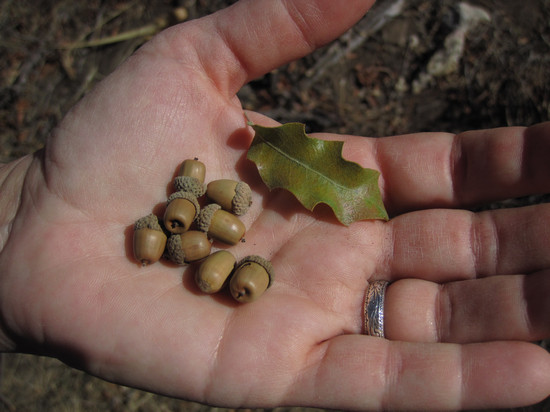
From that point onward I only passively visited the tree. I never replanted the way I thought I would do and like the failed project, I too thought that there was enough biological "Earth Internet" activity going on in my soil to justify being lazy and doing nothing further. What a dipstick mistake that was!!!  The first year I did baby it a bit. Gave it generous portions of water and it did grow just a little over a meter in height. That was encouragement enough for me to do nothing as I had previously convinced myself. Yet I should have soil inoculated with PT Mycorrizae. I didn't and 12 years later and one year before I sold my property, the tree was only a mere 10 inches above that initial years one meter growth spurt. The tree after that first year barely struggled to survive all those other eleven years.  The central leading bud grew only about an inch a year, every year after that first initial year and the leaf size never grew in size beyond what you see below in these small scrub oak leaves. Here's a pic of a man's hand holding some acorns and scrub oak leave to give you a sense of size scale that characterized the small pitiful size of my black oak's leaf size as a result of my neglect.

Clearly, anyone familiar with California Black Oak leaves knows that the size is much much greater than what the above pic illustrates. Nevertheless, I only briefly paid any attention to it because for the most part it was on the back 40 so to speak. But then one day after twelve years I was out performing some soil inoculation on yet another experiment to prove a hydrological network does indeed exist among a grove of pines all connected and mutually benefiting from the same mycorrhizal network.  With some of the PT Mycorrhizae mix I got from (PHC & Dr Don Marx) left over, I walked past that little pathetic Black Oak tree and thought to myself, what the heck, why not ?

photo from ForestryImages.org

As I've done hundreds of other times before, I drilled some small 4 inch deep holes where I thought the feeder roots were under the small trees drip line. The goal of course is to target the feeder roots where those tiny root hairs are present. When the tiny root hair cap which pushes ahead of growth in the soil comes in contact with one of those PT spores, it will hopefully detect those acids given off by the root tip and then germinate. If not the spore simply remains dormant. Once again I proceeded to baby the tree that first month only by watering generously once a week for the first month. Sure enough, there appeared a small thumb sized Pisolithus Truffle almost identical to the one illustrated in the pic below. At this point, I'd like to mention that in almost every inoculation of an already existing tree for which PT Mycorrhizae which is host specific (meaning it will only colonize certain specific species of trees around the globe) I have had the same identical experience. After watering exactly one small thumb sized Pisolithus Truffle will appear around the drip line of the tree. The fact that it appears will be proof of it's colonization of that particular trees root system. It can only form as it has need of drawing from the carbon nutrients from the host tree. However, you will NOT experience or observe any improved growth effects on that tree for the rest of that year. But you will have the satisfaction of knowing that the inoculent took hold. Again see the pic below of the first truffle growth. Once again, it won't be till next year that you will experience an incredible change in appearance of your prized tree.

Once again, it won't be till next year that you will experience an incredible change in appearance of your prized tree. For me the change was an incredibly profound turn around in the way I viewed the importance of the power potential of inoculating before planting. I had always known of the potential benefits, but experiencing something so dramatic etched this experience into my brain cells and I've never forgotten it. Here's what took place that spring after a long winter's dormancy. The buds swelled up rather large and proceeded to explode with a growth spurt that I had not ever seen before with the exception of that first year. Eventually the central leader stem grew one and a half foot. The side branches grew almost exactly 12 inches. The leaf size was about 6 or 7 inches long. Here's a pic below which demonstrate the size of the leaves.

Once the Pt Mycorrhizae is established on the plants there should be no reason to reinoculate it again. Each year new truffle spore will be spread throughout the soil by other critters whose job it is to tillage and work the soil thru and thru. You should also note that in nature there are numerous fungal associations by numerous different species. Like a biodiverse forest, you'll want to inoculate your plantings so that the biodiversity extends all the way deep into the soil. I view PT Mycorrhizae as a pioneering fungus. By that I mean, in any ecosystem after a disaster or disruption like a forest fire, there are always those pioneer species of plants that appear first to pave the way for others in a succession to the ultimate goal of an old growth forest situation. 

In some eastern United States forests, Black Locust (Robinia pseudoacacia) is one of the first trees to appear. Black locust has nitrogen-fixing bacteria on its root system; for this reason it can grow on poor soils and is an early colonizer of disturbed areas. Another example of pioneer species here in Sweden is the Birch[Björk] which will appear after the industrial forester clear cut an entire forest. Consequently I view PT Mycorhizae as just such a pioneer in forest or urban landscape establishment to be then followed by other beneficial fungal inoculations. Here is the PHC Reclamation website which will be of further benefit to those with an interest in reclaiming disturbed sites.

PHC-Reclamation, Inc. - Engineering - Design - Reclamation- Project Management
Once again, this very experience had a profound effect on me. Though I had known for years what the fungus would do and how plants would benefit, it was that deep appreciation of just what I had that finally hit home. I hope that others can and will learn from this experience. It was at that point while standing there looking at the huge difference in growth that I realized just what kind of tree I could have had at that point had I not been so lazy and putting things off as I did. Can YOU imagine what that tree would have looked like after 12 years of this specific "Earth Internet" connection ???????


There are a number of other important things to consider in the landscape. There are the plant community types. Certain plants have identical requirements which means placing them with plants outside of their natural community will be a problem. In your landscape consider features like having a lawn. View the lawn as a lakeside or stream habitat setting. Plants inside or along side this setting will benefit from the extra watering a lawn requires to look good. Other drier habitat plants will not want this. Though they may experience even spurts of growth at first, they will later rapidly decline in health and vigor.

These are all the little things you NEED to consider when planning your landscape whether you appreciate it now or later after failure. Sometimes failure is the only way to learn. I ought to know.