Showing posts with label designing. Show all posts

Saturday, August 30, 2014

Creating Chaparral Alcoves in your Landscape for personal regeneration & meditation retreats

We are also including here such other important descriptive terms such as Chaparral Tunnels, Chaparral Caves, Chaparral Hidden Glens
Image: Californtia Chaparral Institute

From the very first time I gazed at this photograph, I fell love with it. It's mesmerizing and addicting. You just want to step into this place and escape from the outside world even if it's momentarily. It's one of those poster child pictures which would have been recreated onto one of those 1970s popular wall paper murals with a Lava Lamp sitting on a rustic knotty pine end table as part of the decor. But the tangle of biological plumbing/electrical networked infrastructure of the branches above ground and rooting infrastructure below ground all working with cooperative precision and perform all manner of hydraulic life and redistribution or hydraulic descent during the  winter months is just how nature's ecosystems run. People who are clever & intuitive enough to find these old ancient Chaparral Alcoves can experience the exact same energizing natural effects which can be illustrated in a rather unusual way by the re-energizing alcoves that only a mythical Borg could appreciate. Surely you remember the Borg ? However in real life, experiencing the negative ions given off from wet vegetation along with inhaling the various plant aerosols can have exactly that same effect on a human being. It's energizing! Couple that with the informational visual content being transmitted through your eye lens taking in the surrounding beauty [which is the rule in nature & not the exception] and being processed along with all other information coming in through other sense of smell and hearing, the effect can be truly energizing in a real true sense.


Now to the point of this post. I love patterns in Nature, especially artistic natural patterns. I love how they make you feel once you discover and experience them. When I was a little kid, exploring chaparral alcoves and/or tunnels was easier, I was smaller. Gradually I experienced such features near beaches and city parks where the municipal landscapers created such decorative twisting features within their maintained landscapes, but did so with exotic plants. A fine example of this is to visit Pepper Grove at the southern end of Balboa Park in San Diego where they have maintained a twisted grove of Brazilian Pepper trees into a children's playground wonderland and picnic area. Google "Pepper Grove Balboa Park"  and you'll see what I mean. Later during the Southern California wet El Nino event period between 1978-1984 many traditionally dry washes and gulches within the chaparral plant community came alive with babbling brooks of water often running all year long. What made me explore some of these when I was out and about in the bush was the distant sound of water trickles and many times small waterfalls. What I noticed was the beauty of the tangled web or network of various chaparral branches. Often such tangle would open up within these hidden glens revealing a secret location where you could even stand. Such places gave me the idea for replicating such hidden spots by recreating them in the landscape. The twisted tree in the photo to the upper right here is at the beach at La Jolla Shores near San Diego.

Image Mine -  San Diego La Jolla Shores, California


Carmel-by-the-Sea, California
One of my goals on this 2014 trip to California was to photograph such places with their twisted interesting forms from which creative ideas and plans could come to the surface on how to replicate these in the landscapes of Southern California as decorative features, but with native chaparral shrubs and small trees. The chaparral is actually a more perfect fit. They also are more adapted to the drier climate than many of the water loving exotics used instead. For me the use of Brazilian Pepper would be more of a maintenance issue because of it's habit of continual growth and trimming of suckers. True, some chaparral in the beginning may sucker a bit when attempting to recreate a multi-trunk small tree, but with age even that would taper off. When we went up to Monterey to travel south on the Cabrillo Hwy to San Luis Obispo, we did make one stop in Carmel-by-the-Sea and I photographed some examples of the twisting native oaks most people there have in their landscapes. Take note of the gallery below.

Image Mine: Carmel-by-the-Sea neighborhood


Carmel-by-the-Sea, California


Carmel-by-the-Sea California

Carmel-by-the-Sea Monterey Cypress
Many of the neighbourhoods up north that I have seen first hand do incorporate many more of the natives as compared to SoCal, however you will find them in older sections of towns and cities down in Southern California if go go for a Sunday drive. But this is true of most older neighbourhoods in all cities within California. These were among the first plants chosen for decor around one's personal space in the garden in the early pioneer days. But sadly, this understanding of California native plants became lost as more and more exotics were introduced and the fact that introduction often came from human beings migrating in from other lands and cultures who brought over homeland favourites from their former countries. But now with the severe drought and water crisis effecting the southwestern United States in general, many are taking a fresher look at working with the native plants in their respective regions. But more should be done than mere placement of plants along hardscaped outlines. Using such plants should be done in creating artistic & aesthetically eye appeal and senses pleasing settings. These are the same settings you stumble upon when venturing out into the wildscape. While there are many 1000s of natives, there are only a few main types of shrubs that I find  that can be turned into ideal small tree form examples. I say shrubs because as time goes on, more and more landscapes in the modern day housing tracts constructed by today's developers are forcing more and more homes onto smaller lots. There is no longer any room for those large majestic trees. As you can see from the photo of the Monterey Cypress in the above right, even when lots were larger in the past, today just a few decades later such trees have come into confrontation with Utility Giants and their precious above ground infrastructure. At this late date, these scenes have become very common place. Most of the utility right-of-ways are above ground over in the United States, unlike much of modern Europe which has chosen to put such infrastructure under the ground, which is not only aesthetically more pleasing, but also less safety hazard as in windstorms and the wildfire ignition danger potential.

Laurel Sumac, Rattlesnake Mountain, El Cajon CA

The photo above was taken this year at my friend's home who lives backed up against Rattlesnake Mountain. This large Laurel Sumac chaparral shrub has been there since the 1960s back when I remember it as a kid growing up. Under normal rainfall patterns which are now almost nonexistent, the foliage is generally much more dense and heavier. But you can see the beautiful branching pattern and structure for a potential addition into any landscape. I had the privilege to witness a volunteer Laurel Sumac at my Mum's places years back before moving here to Sweden. You can it here at the left side yard of her house here. Unfortunately the neighbour at the concrete paved property on the left hated the small chaparral shrub and insisted it was going to turn into massive tree whose roots would crack and destroy his concrete block wall and he warned there would be lawsuits if it wasn't removed. My mother caved [only after I left] and it was taken out. But even from this vantage point, you can see that it poses no problems and at best is only a small tree created by pruning for multi-trunk form. We also never once watered this Chaparral Elfin tree, it was never necessary. All water came from Seasonal rains. Still, this tree is rarely used or thought of for this purpose by even those who purchase natives. This is reflected by the fact that even native plant nurseries rarely carry it. But it's a gem of a chaparral tree when incorporated among other chaparral.

Image Mine: Ranchita California, Sugarbush (Rhus ovata)

Calflora.net
Sugarbush is one of the favourites for people living in the backcountry. This one in the above photo is in Ranchita California on the road to my brother's place. Many of his neighbours have beautiful mature ones in and around their patio and Bar-B-Q areas where friends and family can enjoy a meal and pleasant relaxed association with each other. These also grow very well down below in the interior valleys away from the coastal areas where they can take exceptional heat as long as they have deep access to moisture in the subsoil. I've planted one in my mother's backyard along with another perfect chaparral shrub called Lemonade Berry. Both are on the southern side of her California Sycamore trees and will eventually provide a perfect privacy screen and tunnel along the pathway leading further to the back. I've also planted Toyon or California Holly which also is a perfect example of a chaparral which can be deep rooted and shaped into a multitrunk small tree. All three of these chaparral also provide good sources for food at different times of year through their flowering period and fruit berry production time which makes them wildlife magnets. 

Below is a project I am working on each year in the front yard. I'm creating more of a Native Fan Palm Oasis of sorts in the background here away from the driveway with smaller shrubs [some native - others not] to buffer the palms and add colourful border at the front. In the far background behind the palms is a lawn which is coming out and will be replaced by a secret hidden away chaparral alcove which will be slightly etched or excavated into the sloping landscape creating an oval circular arrangement of seating and relaxation under a central planter which will be installed next year and planted with some of the more high desert chaparral to match the Oasis theme better. Believe it or not, SoCal deserts do have Sugarbush, Hollyleaf Cherry and Desert Apricot in and around many of the native California Fan Palm habitats, often growing within or right next to the Fan Palms themselves. If you look to the far right in the photo below, you'll notice a dense hedge of low growing Juniper which my mother put in years ago which screens out the insanity of school traffic across the street multiple times a day. You can also use chaparral in this respect as a formal hedge if you wish, as the example above left of the Lemonade Berry (Rhus integrifiolia) being shaped into formal hedge row. California Coffeeberry can also be used this was as I've written about previously. Surprise yourself by having fun experimenting with other ways of substituting some chaparral plants with unique characteristics you thought only the exotics provided.

Photo Mine: Across the street from Pepper Drive School in El Cajon California

Photo Mine
The palm here above behind the Baja Fairyduster is actually a Mexican Fan Palm. On my whole two month stay here I could find only one California Fan Palm which is mostly what I wanted, but alas, I settled for these. The California Fan Palm I did find is already planted just behind that black plastic border along the lawn in the photo at left. It may be difficult to see in the upper left of this photo, but it's there. That lawn of course will come out. I wanted California Palms because their trunks are much bigger and they are slower growing, but bigger broader palm frond canopy. The Meixcan Fan Palms are much more faster growing, but messier to me and get so high that they are very expensive to maintain because you need to hire a professional. The problem is most people want instant landscape and don't have the patience to wait, which really is not that much more time if you know how to make the California Fan Palms happy. A Mexican Fan Palm was already there in the landscape anyway since 8 years back. This one I chose deliberately because of the small pup growing on the side. Palms do this in nature just as the chaparral creates beautiful interesting twisting patterns. I wanted a more natural look anyway as opposed to smooth organized lines common with the majority of landscaping designs. The other surprising wildlife magnet which I had not known before was the Baja Fairyduster in the above photo at the right side of the picture. 

Photo Mine
I was pleasantly surprised one morning when I came out to the front yard to sit along the wall to enjoy my coffee, to hear all the various collection of humming sounds coming from the Baja Fairyduster. Every type of winged insect from Bees to Wasps, every kind of Fly, even Mosquitos and of course Hummingbirds and butterfiles. But it's all those tiny little small predatory wasps which most people mistakenly take for flies and no doubt have killed in ignorance, that I was more interested in. Attracting these guys to your yard will mean you'll have less predatory larva and caterpillars munching your landscape and garden vegetables. They lay their eggs on the caterpillars or if large enough, they capture and stun such garden enemies and take them back to nests they've created either under roof eaves or borrows dug in the ground where there they lay their eggs and seal off the entrance. Knowing such things and how an entire landscape can be both aesthetically pleasing and mechanized in a checks and balances sense will go a long way in helping educate you as to how unnecessary many of the Industrial Science products such as pesticides truly are. The problem though is that they literally own the marketing education on this subject and they've had a monopoly which is backed with massive amounts of money which even goes as far as influencing school textbooks from elementary school right up to the college level. But people can remove themselves from all of that and re-educate themselves and even do their own experimenting within the landscape. 

Sunset Gardening landscape pathways
The main idea behind this post is that you can build into your landscape these amazing Chaparral Alcoves for quiet time which can create such blissful experiences before and after work. Get into the habit of taking time out for yourself on a daily basis in your wild landscape, whether through reading a good book [please dump the electronic devices], meditative relaxation, daily prayer, or just a walk in the open air around your garden chaparral tunnel pathways if you've got the space for them. This will help you feel calmer and more at peace with yourself from the world outside. Order yourself to take a time out which will force you to see the bigger picture and can prevent you from letting the daily stressers of life get you down. Even if it's just sitting in your garden hideaway for a mere 15 minutes a day, that quiet time can help transform your state of mind and assist you in retaining control over your life. There are no cybernetic implants are required here for regeneration. You have all the natural senses of sight, sound and smell necessary for regeneration when the world outside drains you of vital energies. So go ahead and create an award winning Sunset Gardening magazine hideaway landscape alcove or pathway, just do it with Chaparral.

Wednesday, August 13, 2014

Is it safe to plant & water California Natives Plants in Summer ?

Suddenly all the traditional Taboos jump out all at once
Photo credit: laspilitasnursery.com

Ceanothus Celestial Blue
http://www.beautifulwildlifegarden.com/watering-your-native-plant-garden.html 
This Bert Wilson photo above of Ceanothus comes from an article written about the challenges of Summer Watering Native California Plants. Interestingly Bert Wilson's recommendation for ideal planting of natives was anywhere from the end of November thru February or March. The above article was posted on the California Native Plant Society Facebook page for discussion. But as one regular commenter to those pages admitted:
Roger Klemm: "I find this article frustratingly vague, to the point of being at best just plain useless. I mean, in one paragraph they say that new native plants will need water for the first couple of summers, and in the next one they say, without qualification, that "Summer watering kills most natives". Make up your minds, people!"

Of course Roger is correct. The article was vague, very prone to giving only those glittering generalities for nothing more than entertainment value, not at all specific about the serious challenges gardeners face in the real world with Natives and I found it very uninformative as to giving the reader the real intelligent reasons why such a practice could be harmful. Now to be truthful here, I do plant many natives during the heat of summer, but you have to know which ones will let you get away with it. Most California Natives are engineered and adapted to a wet rainy season followed by the longer dry season. In fact unless you live in SoCal's high mountain with hit and miss summer Monsoon Rains, you most likely on average will not have rain for 227 consecutive days on average. Natives are quite well adapted to that with their deeper root systems. But like I said, the exception of course to that rule are those higher elevation plant ecosystems which may get the hit and miss of the Monsoonal Thunderstorms in July/August. I have always found Manzanitas and Ceanothus to be the biggest challenges because they are so sensitive to watering at the wrong time. More so than others. Many other delicate natives can be planted during summertime, but need some sort of shade anyway.
~~~~~~~~~~~~~~~~~~~~~~~~~~~~~~~~~~~~~~~~~~
One of the worst things people can do is attempt to grow and maintain natives the way they do those exotic non-natives they've purchased over the years at the local conventional retail Nurseries. I must say however, that many exotics don't even do well in that regard with conventional or traditional landscape care. Believe it or not many of the techniques you will learn with maintaining and growing the Natives, can also be incorporated and practiced with the exotics whether they have similar requirements or not. Drip irrigation while appearing seemingly simple and logical, doesn't always work with native or exotics. Some plants yes, but for me most are a no. I hate the maintenance part where you have to check the emitters regularly because the lousy mineral laden water you receive from the local water authority or even backcountry well will regularly create calcium or iron buildup which clogs the tiny pore openings. Also, such a system makes the plants dependent and hinders their maturity for establishing a foundation to take care of themselves when you as the parent/guardian aren't around. Yes, I often make comparison with landscaping & good or bad parental care. Some gardeners have this parental nurturing syndrome, even when they know better. The dripline above is at my mother's place, but the emitters haven't worked in ages. They are there because of other already existing conventional features around the perimeter like Rose Bushes, for which only a couple now remain. Of course you'll notice I am attempting to establish a newly planted Mama Bear Manzanita which I purchased on my last trip to Las Pilitas Nursery in Escondido. 'Mama Bear' is a hybrid manzanita between Arctostaphylos stanfordiana bakeri 'Louis Edmunds'(now Arctostaphylos bakeri ssp. bakeri) and Arctostaphylos densiflora 'Sentinel'. So it's an experiment of sorts for me, just like my successful 5 foot Island Manzanita shrub on the opposite side of the driveway in the photo above. 
~~~~~~~~~~~~~~~~~~~~~~~~~~~~~~~~~~~~~~~~~~
So what is it exactly that happens if you do water in Summer ? 
This is the part that no one gets, understands or are ever really told the reasons why you need to be careful with summertime watering. And you deserve an explanation. The tendency and motive behind summer watering is rescuing and helping the plant, when in fact it can be quite the opposite. Ceanothus and Manzanita are the most susceptible to the problems and issues that come from over watering and water at the wrong time. For example, I made a mistake at my Mum's place on my last visit. Temps were already like middle of the summer time temps which were 100+. She hadn't watered in Winter deeply to compensate for the lousy rainy season which really hadn't shown up this year. There was no spring growth because lack of winter rains did not trigger it this year. I deeply watered slowly however, hoping to provide that deep underground moisture which most chaparral live on the rest of the dry year. Unfortunately my well meaning thorough deep soaking three weeks later triggered new flush of growth on all outer stems. The result another three weeks after this bud break was an attack from some sort of pathogen on the new delicate foliage. Maaannn, I knew better too, but what can you do. Now I realize nobody will believe this, but generally it's the same thing that happens to many plants [not just natives] in all Southern California gardens and landscapes, where people have been trained to fertilizer and over water causing these continual spurts of newer growth throughout the year which is attacked from various directions by many different unrelated enemies. What happens underground is a given, soil pathogens. For natives, the soil pathogens which attack roots are mostly dormant in winter, but very much alive and active during the warmer hotter times of year. That's also why germination & seedling success is much better during the cooler wetter months of the year, not just because of the abundance of water availability, but because enemies are sleeping. But when you water during the hotter months, these pathogens are stimulated to do what pathogens do. But mostly it's the above ground foliage conditions I worry about. Gardeners [who are humans with emotions] can feel sorry for plants and feel the need to rescue or help them along. They believe it a kindness to water during extreme temperature days. Why ? Because that's what you'd want if you were suffering. The nature of Humans to respond to what appears to be a stress situation for helping plants in hot weather is usually an emotional one. Not that this is bad, but sometimes emotions get in the way of reason and logic. For example let me illustrate it this way. Advertisers understand the power of manipulating emotions to make a sale and get you to purchase their product. Take the Pet food industry. They market a canned Pet food not based on nutrition, flavour etc that your pet would like, but on something you would like to eat because it has eye appeal, not for your pet, but you. Pets mostly go by smell and don't necessarily care about the looks of the meal. [seriously people, you've seen some of the crap your pet drug home and has eaten in the past] But if it looks like hamburger or steak, then the advertiser has you hooked and you'll buy it. If they based the commercial on what a pet would actually eat, you'd never buy it. Hence we tend to do things to and for our plants because we tend to see and imagine them suffering in 100+ (40C) heat. But now stop here and ponder for a moment something else stupid that I did once! Once upon a time on my property in Anza California, I cared so much for a small Parry Pinyon seedling I discovered under a Redshank Chaparral, that I decided to rescue and help it along. It was hot out and I wanted the tree to grow taller and succeed as a tree. So I watered it & deeply. A couple days later the little once healthy pine seedling was brown, bent over and dead. ðŸ˜± Pathogens were stimulated by the water, coupled with the heat and took charge. Had I left it in it's drought dormancy maintenance mode, it would probably be 5 or 6 foot high to this day. Now let's get to above ground foliage and what happens there and look at a few things which create soft delicate succulent foliage in summer and why that's a bad thing. 

Photo Mine: Carmel-by-the-Sea, California

As I stated before, I worry more about creating conditions in my urban landscape which will cause a flush of succulent delicate growth at the branch tips [tree or shrub] and that's a bad thing in the summertime. Why ? Because every active sucking insect in the world during the hot summer months finds such plants to be like candy. Besides insects, Fungus, Mildews and any number of other blight love to zero in and take full advantage of such conditions on the plants as well. So now do you understand why natives at that time of year are hardened off foliage-wise and in nothing more than maintenance mode ? Nothing wrong with that and if you understand how to maintain that type of landscape, your trimming, clipping and pruning chores will be less as well. I've seen SDG&E [Utility Co in San Diego] hire Davey Tree or Asplund to come clear out their telephone/electrical lines of tree foliage and unfortunately these guys are generally hack jobbers. Their workmanship and artistry is pathetic, as the photo of the Monterey Cypress above illustrates. In fact, this pathetic tree treatment can be seen all over California. We had Davey Tree tear up so much foliage off a giant Shamel Ash we had at one of our properties I maintained, that tree which had a massive trunk and impressive root infrastructure was triggered into responding with a flush of rapid growth and lots of it. The reason was this tree's giant root system which was tapped into the water table just 10 foot below the soil surface was going to provide it with all the water and nutrients it could handle to repair the damage done by Davey Tree. As a result powdery mildew and aphids came out of the woodwork during this hot summertime of the year. But you need to know, it works that way with everything, not just natives. It's just another reason to understand why summer watering can be dangerous to your Native Plant's health if you over do it on a regular basis. 

Jerry Coleby Williams: Sustainable Gardening in our Continually Surprising Climate

What further exacerbates this pest problem in our landscapes & gardens for the natural world is the old traditional way in dealing with these imbalances in the landscape through use of more chemicals to attack and kill the problem. You know, those pest killing chemicals besides the other chemical fertilizers, root stimulators, soil conditioners, etc you use all the time ? People who buy into this horribly flawed science-based educational program as put out there by Industrial Chemical Corporations, whose ongoing propaganda preaches, if something is bad for your plants, kill it with chemicals. Has anyone ever heard Industrial Science ever say, first find the imbalance within your landscape, garden or Farm and only then make the necessary corrections through a holistic approach by just the right community planting for your area, perhaps inserting native flowering plants which attract natural predators to deal with presence of pests in the landscape or garden ? No of course not and this is because such education dooms their obscene profit pursuing business model. Industrial science is at odds with other Nature discovery sciences which deal with more environmental friendly ecologically sound approaches. That is unacceptable to them and they have the political power and money to back up their version of truth. They even have many of the well know Sciency Celebs defending their side and who wouldn't believe them ? 
~~~~~~~~~~~~~~~~~~~~~~~~~~~~~~~~~~~~~~~~~~
Planting Native plants in Summertime when it's 104F+ (40C) ??? ðŸ˜®
Photo Mine (2014)

On the subject of actually planting in 100+ degree heat, I actually have no problem with planting natives in full blown summertime heat even when those awful temps are incredibly high, but I don't necessarily recommend it unless you know exactly what to do. These plants in the photo above were planted in such heat over 8 years ago and actually, I have no irrigation whatsoever established to them. If necessary, I do it by hand once a year when I come to visit. Most people have a hard time believing this when I show them the photos. So at best I slow irrigate deeply with garden hose when I come to visit. Before I leave I give orders to leave them hands off. However, this should really only be done in winter. Again, remember my mistake this year which I related above. The idea is to replicate winter rains [if they are a no show] re-energizing subsoil water stores as they would happen in Nature. The ONLY feeding is done with applying fresh surface mulch for decor as well as nutrients. Shredded redwood is my favourite. Mycorrhizal - MycoApply application is a must. 

I also love to compare raising plants to raising kids when it comes to planting, raising and establishing them. IF you are in any way a responsible parent, then you want your kids to have a good foundation for success later on in their adult life. If you pay their way to every event without ever letting them work for something, they will never learn responsibility on their own & they'll cling to your apron strings for life. Plants will also do that if you over baby and spoil them. Babying them with water through drip irrigation where you've provided reliable water availability all the time does this with natives and shortens their lifespan. It does not encourage natives to go down deep in developing their own structuring of their root system deeply within the earth and that for me is the ultimate goal to strive for. I've already written about what the good healthy science has discovered about a plant's ability to sniff out water, even far away and send roots down or over in that direction.
Water provides a Hydropatterning Blueprint for Rooting Architecture & "Infrastructure"
Manzanita Root off Hwy 74
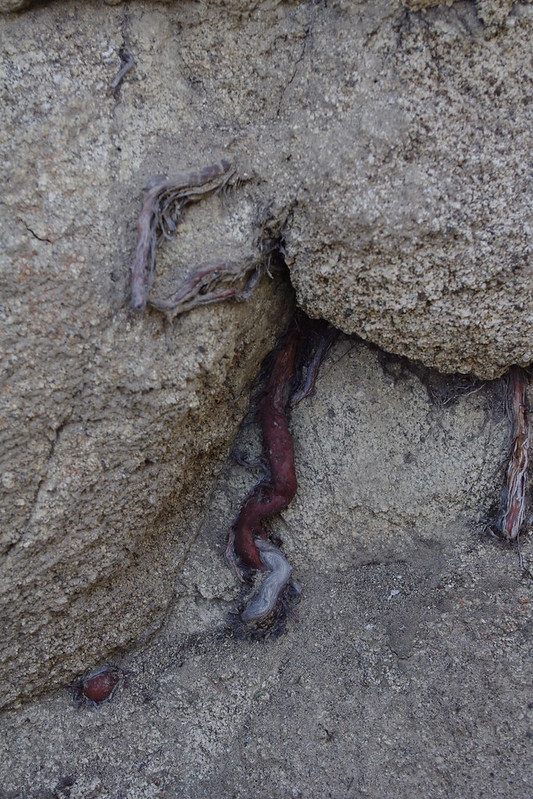
As I stated previously, it does NOT matter that you understand the technicalities of just how the science of it all works. Just simply knowing that plants will find the water is all you need to know and should influence just how you adjust or develop an irrigation system accordingly. Before laying out your native plant landscape, make sure you design the deep pipe irrigation within the hardscape at the very beginning. Of course in such a system you will be watering in between your plants at about three of four feet deep in the soil by means of the deep pipe system. You can life-support your plants during that first year by periodically watering around the areas planted at the surface, thereafter tapering off until it is unnecessary. All the while, you also should be deep irrigating to get that subsoil damp and developing a good water storage capacity. Water inside the earth itself is the best place to store it and train plants to look for it on their own. After the first year you shouldn't have to surface irrigate at all unless there is a real dire need. Even deep irrigation can be overdone. I love a manual system, but I realize many want things on automatic. One of the other problems I dislike with automatic irrigation is people will have it on a daily timer or every other day regimen. It's way too much and is a waste of water and money. Your goal should be to eventually deep water maybe once a month especially during the drier times of the year or not at all it the system you've developed has worked out perfectly. The photo above is of a Manzanita and Redshank root 20 foot below the surface in an un-natural erosion cut from a diverted stream by CalTrans. The soil is not ideal garden soil, but rather decomposed granite and other fractured stone. This should clearly illustrate the power native shrubs and trees have in punching through impossible grological situations which has allowed for their successful survival for countless centuries.
Importance of understanding what happens with Soil Temperature & the effects heat has on a Plant's Root System
  • At 140 degrees, much soil bacteria & beneficial fungi can die
  • At 130 degrees 100% moisture lost through evaporation and transpiration
  • At 100 degrees, 15% moisture is used for growth, 85% moisture lost through evaporation and transpiration
  • At 70 degrees, 100% moisture is used for growth
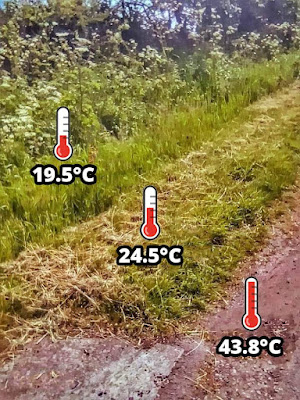
Let's Try This Temperature Difference Illustration Below

Very important link for the using of mulches within an urban landscape in hot climates for cooling the ground conditions as the Native Plants would have them in Nature
So recapping, cool soil around the rootsystem is imperative. Does matter what the surrounding air temperature is, bare soil will heat up with an intensity above what the weather records as temp in the shade. I discovered which back in the 1980s when outplanting in the wild areas of my acreage in the San Jacinto Mountains that the pines that were planted in open bare soil struggled and pull all energy reserves and moisture into just surviving, even when watered regularly. However pines with generous mulch kept soil moist and very kool even where temps above ground were 100F+ or 40C+. The plants with cool roots exhibited long central leader and future branch bud growths, some like my Torrey Pines put on a foot of central leader growth and with no watering. Bare ground with periodic watering had nothing. So my wild planted trees, initially inoculated at time of planting with mycorrhizae and mulched heavily 3 foot around plants outperformed forestry planted seedlings same size in Garner Valley 500 foot higher in elevation, no mycorrhizal inoculation, no mulch applied, and with weekly watering during summer with small tractor pulling water trailer were stunted by comparison to mine with no supplemental watering other than a monsoon thunderstorm. Experiences like this get burned into your memory and you'll never forget.

Back to training kids. The photo at right here is a 'Pozo Blue' Sage I purchased this past June 2014 at Las Pilitas Nursery in Escondido. Many Nursery grown plants can be a couple of years old and therefore may be on a time clock to produce flowers and seed. In other words I view this as having sex resulting in kids. I don't want my kids having sex and babies in their youth. They are neither old nor mature enough to handle this responsibility and will end up in life loosing if they don't know how to support themselves, let alone having kids. They need to learn to take responsibility and care for themselves by learning to work at making a successful living with no dependency on others. Plants are the same way. I don't allow my new plants to flower or produce seed that first year. I know this goes against all conventional emotion & desire, but what else it new ? By nature everyone wants that instant colour in their landscape. But please, resist the mothering temptation, use tough love. Keep in mind that over doing it on the mothering side isn't true love either. I want my plants to concentrate their productive powers and energies into structuring a healthy root system for their later adult life self support. I have no intention of babying and/or allowing them to stay on parental welfare program for the rest of their life or mine. It doesn't work in real life for human beings so why would you think it's okay for your garden or landscape ? Hence, keep cutting off the flowers and seeds pods or berries. I know, it seems so unkind, but your plants will thank you much later in life for showing them tough love this way by their producing a lush healthy beautiful flowering display in your landscape for the rest of your life.
Planting tips in extreme heat & the Gallery below
Photo Mine

Island Man
zanita 'Canyon Sparkles' (Arctostaphylos insularis)
I planted one of these before I left over 8 years ago. I have written about this previously from last year when I photographed this Manzanita next to the 'Pozo Blue' Sage I also planted at the same time. Both doing very well and also planted when it was 100+ degrees fahrenheit. These newer plants above and below were also planted at 100+ degrees which is what the temps where when I came back for a visit out here from Sweden. These plants in the gallery here would be to the right of the larger ones in my photo above and from the article I wrote last year 2013. All mum's roses and other conventional exotics are dying or dead along that south wall/fence and these Natives will replace them thus adding a beautiful living green screen to the fence line to the south. Below is last years article:
"Canyon Sparkles" Manzanita (Arctostaphylos insularis) 
Photo Mine

California Coffeeberry 'San Bruno'

The California Coffeeberry is one of my favourites. The variety I purchase at native plant nurseries is of the type and variety I wrote about with Palo Colorado Canyon in Big Sur which I visited and wrote about a month ago. The natives up and around Anza where I lived for over 20+ years are of a gray olive green by comparison. The Coffeeberry I planted at my mother's place during the 100+ degree heat is a dwarf type variety which will not get as big as the other common ones I planted up in Anza. In fact the one here to the right is a 'San Bruno' Coffeeberry which I planted in 1987. After the late 1980s, we never ever watered it other than winter rains and hit and miss summer monsoons. This photograph was taken in 2011 when my wife and I visited and was still healthy and vigorous when I saw it a couple months ago. It was planted next to the Jeffrey Pine at around the same time. Above both the Jeffrey & San Bruno I had plant to two Ceanothus 'Concha' which is a beautiful hybrid. Decades later they declined as they were overwhelmed by the Torrey Pines which towered above them and were taken out. Even they were never ever watered beyond the first year. Still, San Bruno is an excellent choice. Notice the size after all these years has not gone beyond it's purposed location ? Proper upbringing and no free watering helps.

Photo Mine:

Sunset Manzanita (Arctostaphylos)
I've never planted a Sunset Manzanita before, so I thought I'd take a chance here along the south wall & driveway.
Photo Mine:

Screwbean Mesquite (Prosopis pubescens)
When I first planted this tiny Screwbean Mesquite, it was below the top of the decorative concrete watering well. This is one month later just before I left. It was watered deeply when originally planted and there after once a week. I also heavily inoculated it with a mycorrhizal blended mix from MycoApply. BTW, the decorative border is temporary, it will be removed later when I return. The temperature outside and that whole week when I planted this was over 100+ Fahrenheit. No problem for a heat loving plant, but also a killer if none done right. I never broke up the root ball, which wasn't very extensive anyway. And as always purchase ONLY one gallon plants, they will surpass anything larger and more expensive you purchase. The Engelmann Oak I planted to the left and out of the above photo has grown over a meter in height from it's original 7 inches at time of planting. More on that in another post on artificial staking which replicates what chaparral does in the wild. Again, Engelmann Oak + no irrigation = one meter height.
~~~~~~~~~~~~~~~~~~~~~~~~~~~~~~~~~~~~~~~~~ 
Further Tip which is Imperative
Okay okay, I know, what gives, it can't be that simple. You're correct, time of day is important. Everything that gets planted in any landscape is on life-support. So the time of day during a heat wave [which admittedly should be avoided] should be late late afternoon or early evening after the Sun goes down over the horizon. I do this because it allows the plants a measure of several hours possible root shock & foliage recovery over night. Below here is my brother and I doing this after the Sun went down up in Ranchita California. We planted four Pozo Blue Sages and four California Holly shrubs. ALL were 1 gallon plants. Trust me on this, you will get instant mature landscape the following year. 

Photo Mine
After the Sun goes down, planting time starts. My brother lives out in the sticks of Ranchita so to speak, so any elaborate irrigation system is un-necessary, although the former owners did put some up on this hill above his house. The pool above is basically pond water, no chlorine. He doesn't use it much anyway. So while visiting I took five gallon buckets of water from this pool up to the hill for watering some plants.
Photo Mine
All your preparation can be done during the heat of day with sun shining. Planning the layout and positioning of where each plant will go. Actually digging each hole and deep soaking them with water long before actual planting takes place which goes quickly. Notice that seemingly sterile mineral appearance of this decomposed granite ? Perfect! Mycorrhizae will help fix that along with other mechanism from the surrounding wildscape.
Photo Mine
Aside from final planting hole size modifications and plant placement in the hole, inoculation is a must. Sometimes I'll even poke a couple of holes in the actual root ball and pour a small amount of MycoApply spore powder in the two 3 inch deep holes in the root ball itself for extra measure. And for all the "You don't have to inoculate because microbes are everywhere in the air" folks, nothing is as it seems. I wrote a piece about our adventure when leaving Ranchita the next day via Julian and Inspiration Viewpoint where I found the Pisolithus tinctorius truffles within the chaparral.
What happens to Earth's Mycorrhizal Community when their Hosts fail above ground ? 
image: Symbio
Yes, when the truffle is disturbed or crushed, clouds of mocha chocolate brown spores are released or be set free into the atmosphere. They will then be poofed into the air to fall randomly anywhere, later to be percolated along with water into the soil. Their spores are tiny enough to move with water through & in between soil particles. But unlike many other similar truffle spores, endo-mycorrhizal propagules don't do that, they are to large to move on their own to other physical locations without help. Even if they could poof and blow in the wind, there is no guarantee they'll find a target host plant root. That's why mechanical movement by insects or animals like those evil pocket gophers [who presumably have no other purpose than making gardener's lives miserable] actually can facilitate propagule movement through their feeding and tunnel construction movements. BTW, Etco Micorrhizas also can move around this way. PT Mycorrhizal truffles grow and mature unevenly, with part of the truffle becoming ripe at one end containing the important spore powder, while at the complete other end they are still growing white edible flesh which attracts insects and animals like squirrels. I've actually found some in this half cured condition where SowBugs, Rollie Pollies and even earwigs are feeding on the mix of fresh and dried truffle. Anything, even animals, dining on such a half baked truffle will also mechanically spread spores by means of physical contact. MycoApply has a biodiverse blend of mycorrhizas which is what you want for complete success.
Photo Mine
In my experience it is also imperative to provide a good healthy clean mulch of shredded bark [not chipped, but you can use it] around your newer plantings. I also apply a thin new layer each year thereafter not only for looks and soil moisture retention, but also as the mycorrhizae breaks it down these nutrient will be fed to your landscape. Also imperative with remote plantings, it is important to provide a measure of protection against desperate hungry critters for lush succulent well hydrated plant growth. You can't blame them, and it's especially worse during this time of climate change and drought out there in California. There are no shortages of dead and dying chaparral branches out there in the wildlands. We cut and dragged back several old dead Scrub Oak and Sugarbush branches. We broke them apart into smaller branchlets and place them into the soil around the plantings. Without this, ground squirrels and jack rabbits would have a Smörgåsborg field day. It should also be noted that another danger does exist with summer watering and that's attracting those pocket gophers who are also desperate. The hill above my brother's house has lots of older spring time gopher exploratory mounds in the area so the danger is always present.
 UPDATE: 2016
Foothill Pines (Pinus sabiniana) two year successive growth in remote planting
Here is first season's growth in summer of 2015 which is maybe six inches
Image mine from 2015
Well, here is the following year. Take note of original height which was at the central leader branch buds whorl. The new growth is above this. No real supplemental water other than once a week, then once a month after planting in the summer of 2014. After that winter rains. Take note, this tree did growth another 6 inches this same year after I took this photo, mainly in central leader and branch whorl bude growth.
Here is the 2nd year's growth which seem's to have more than doubled in height. 
Photo mine from 2016
Here is the summer of 2016 almost two years after remote planting and in the heart of California mega-drought. Much much greater growth and branching and again with summer 100F+ (40C+) planting, inoculation with mycorrhizal fungi (Pisolithus tinctorius) & mulched with wood chips. Elevation 4000' in Southern California. Never underestimate the value of mulch. Also take note of the Scrub Oak it was planted next two. This tree became more vigorous after this pine's planting and inoculation with Pisolithus tinctorius. This is the umteenth time I have experienced first hand a old stunted scrub oak explode vigorously in new healthy growth after pine inoculation with spores from this symbiotic truffle.
Photo mine from 2015
This species of truffle does extremely well in very warm or hot climates. It has interconnected the Pinus sabiniana with the Scrub Oak now and will continue to reach out and acquire other preferred hosts greating an extensive interconnected network in which all plants will benefit.
At my mother's place, this is exactly what happened before I left. I chose the most prized perfect looking Engelmann Oak from Las Pilitas Nursery to plant outside of my Mother's kitchen window which is on the south side of the house with no shade. Heat is a major afternoon problem in that kitchen. It was a one gallon, but had beautiful large leaves along with thick healthy central leader and stem, everything I wanted. It was about 8 inches in height and had exploded forth with new healthy vigorous shoots which rapidly put on another 8 inches during my stay. Every care in the world was done to ensure success. Until two days before my flight back to Sweden, a pocket gopher [it was huge too] took the entire tree and sucked it down into it's hole with only the top stem with new leaves poking through the soil surface. I literally almost went crazy. That little mechanical devise to the left here was used successfully to rectify the situation. It didn't bring the tree back, but I sure felt better. Oh I know, how could I possibly feel that way about a poor little critter who was just desperately hungry under such dire drought conditions ? I could your conscience justify doing that ? Easy, I don't like or use science-based chemical poisons, so I opt for the artificial Rattlesnake approach. Rattlesnake ? Yes, look closely at those two artificial fangs, they work perfectly and replicate exactly what happens in Nature. There is not much more to say or advise, except always replicate Nature. Learning this doesn't happen over night. Learn to develop intuitive skills of observation in what a plant looks like under stress and proceed carefully. That doesn't happen over night either. Below are some websites of interest. The first one is simple and from Washington State University which gives a simply easily to follow and understand  illustrated picture show of how the underground soil microbes work and function. It doesn't have much intellect speak which usually makes such reading boring, but enough science terms to make it interesting. The second site is a page from someone's Flickr account for plant pest damage identification. It's interesting:
~~~~~~~~~~~~~~~~~~~~~~~~~~~~~~~~~~~~~~~~~
Further important reading of interest
Hidden Half controls SUSTAINABLE Plant PRODUCTIVITY and Ecosystem Resilience in the Face of Climate Change
Flickr photos: Plant Pests and Diseases Group
Photo is Mine, but it's Bert Wilson inspired
Anyone who knows Bert Wilson of Las Pilitas California Native Plant Nursery knows that Pozo Blue Sage and the Hummingbirds just go together perfectly in Nature photography. This Sage is a magnet for Hummingbirds and unfortunately my niece's cat also knows that as well. This is the same sage in the photo midway down my post here next to the Island Manzanita with Pepper Drive Elementary School in the background.

Monday, July 21, 2014

Water provides a Hydropatterning Blueprint for Rooting Architecture & "Infrastructure"

 
The scent of water in the air or that smell of ran in the air is not a whole lot of moisture. In reality it's nothing more than mere molecules unseen to the eye, yet easily detected by our sense of smell. The point is, it doesn't take much for us to detect water's presence air and that was the point of a new study on how plant rootsystems have the ability to locate where water is and grow their roots towards that higher source of water through sensing. Below is a study published back on June 9th 2014 which I read during my trip in California, on a plant root's ability to sniff out water where ever it may be found. Only now am I commenting on this phenomena. In so doing, the presence of water within any type of soil geology may actually influence the architectural pattern a tree develops for it's eventual mature rooting infrastructure. Understanding and developing appreciation for such plant mechanisms and the environmental triggers that influence their internal sensors which creates growth response even if we don't totally understand all the processes going on, allow us to plan and design our landscape and restoration projects for success. I'll have some examples of plants that made me curious about all of this at the end. Trees such as those in the Desert Mesquite pes family or even Poplar or Sycamore family are great choices for study as these trees are almost obsessed in their search for water. Understandable since they are a riparian water loving tree, even if it's 20'+ to 200'+ feet below the surface of a dry desert wash. If you’re a plant, [especially in dry locations like where I hail from] then finding and exploiting available water resources is pretty crucial to your existence.
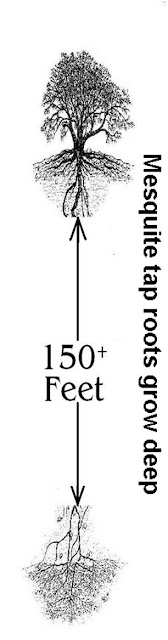
Hence I've written previously about my own testing and playing with seed germination of desert plants such as Mesquite, Palo Verde and Acacia. But sometimes this can be tricky even for these desert dwellers. Localized water availability in soil can be highly variable depending on it's structure and climate, especially where I come from in the southwestern part of the USA, and those plants native to this region must gather water quickly and as efficiently as possible from the environment before putting on much top growth. They may remain small for some years before taking off like a rockrt upwards to 30' or 30' tall. The research in this article below finds that they have the ability to sniff it out water even when it is not immediately available to them. So how do they do it ? As with most of these research papers, much of it may be boring, but keep in mind that you don't have to understand the science of just how plants do this, you only need to be aware that they have this ability and this should influence you in the way you care for and maintain them. It also calls on you to train plant's roots for their future survivability in the landscape or in some remote backcountry out planting as with habitat restoration. The article was called:
"Water provides a Hydropatterning Blueprint for Rooting Architecture"
"Soil is a microscopic maze of nooks and crannies that hosts a wide array of life. Plants explore this environment by developing a complex branched network of roots that tap into scarce resources such as water and nutrients. How roots sense which regions of soil contain water and what effect this moisture has on the architecture of the root system has been unclear."
Wissenschaft – Design – Animation
"New research from a team led by Carnegie's José Dinneny focuses on how physical properties of a root's local environment control root branching and through which developmental pathways these signals act. Their findings, published by Proceedings of the National Academy of Sciences, describe a novel process called hydropatterning that allows plants to optimize root branching for water uptake."
 photo is credited to Pooja Aggarwal

Cross section of Rice root
"Plant roots form a branching network like that above ground, with lateral roots growing out from a main axis. Because water is not uniformly distributed in soil, the structure of the root system networks needs to be regulated in ways that optimizes soil exploration, while limiting growth into water-poor regions." 
"Dinneny and his team developed methods for growing roots in environments in which the distributions of water and air around the root were highly controlled. By analyzing the position where new branches formed, the researchers found that plants tend to place these root branches in close proximity to where water exists, while tiny root hairs appear in areas exposed to air."

photo is credited to Neil Edwards II

This is a cross section of a maize root 
"Dinneny and his team developed methods for growing roots in environments in whiche the distributions of water and air around the root were highly controlled. By analyzing the position where new branches formed, the researchers found that plants tend to place these root branches in close proximity to where water exists, while tiny root hairs appear in areas exposed to air."
Their work revealed that opposite sides of the same single root are optimized to take advantage of air or water resources when the environment is varied. Working with colleagues Malcolm Bennett and Sacha Mooney at the University of Nottingham, micro-scale X-ray tomography was used to build 3-D models of roots growing in soil and revealed that similar processes occur in this more-natural environment. 
 "We had completely underestimated the spatial acuity of the patterning system in the root. It was fascinating to discover that roots can respond to environmental conditions that vary over distances as small as 100 microns, which is the size of a typical soil particle," said Dinneny."
The team named the new phenomenon hydropatterning and they observed it in several plant species, including the important crop plants maize and rice. The process is controlled by signaling pathways in the plant that are distinct from previously characterized drought responses suggesting that hydropatterning could be important for regulating root branching under non-stressful growth conditions. 
 "This simple observation opens up a whole new area of investigation for us," Dinneny said. "How plant cells distinguish between wet and dry environments is an important frontier that may lead to a better understanding of how plants efficiently use water."
(source)
Wissenschaft – Design – Animation
"Using technology called x-ray microscale computed tomography to create 3D reconstructions of root architecture, researchers have been able to peer beneath the soil surface to see exactly what is going on. They find that plant roots are able to distinguish between water and air at extremely small scales – as little as a tenth of a millimetre – and that this is what determines the patterns of root branching along the main root axis; a process they term hydropatterning." 
~~~~~~~~~~~~~~~~~~~~~~~~~~~~~~~~~~~~~~~~~~~
My old place in Anza California

Take special note of the Jeffrey Pine which you see here in front of the Mobile Home. Notice the pine tree's shadow on the ground and the silhouetted shadow outline of the cottonwood tree which is to it's left. This tree when it was around 12-15 foot tall in 1986 had one branch of it's root system grew clear around the right side of this mobile home  the back of to a garden water hose spigot which was over 60+ foot away where there always was a constant leak dripping,  which caused the immediate area of soil to remain damp. More details on this tree below.
riverpartners.org
My best example of this plant water sniffing phenomena that actually got me to even consider what and how roots do what they do was when I first began to ponder just how a Cottonwood tree in my front yard managed to send forth a root system which made a beeline over 60+ feet away from the tree to the region where the utilities entered in the back along the side of my Mobile Home. This was back when I lived in Anza California at my new home which I purchased in June of 1985. This hybrid Cottonless Cottonwood in the front yard was only 10-12 foot tall, but was at least a few years old. The previous owner planted it in 1980 when he developed the site. The people were on and off weekenders and the cottonwood no doubt struggled a bit in the beginning. You should know however that the water facet for the hose bib had an ongoing dripping leak, so over time the immediate soil around the utility box was damp, but not necessarily wet. What alerted my attention to the root's presence was a sapling which sprouted out of the ground next to the faucet. I knew the tree was incapable of producing seed, so I dug down and sure enough hit the root. I did cut it way back, but it was always an ongoing issue the whole time I lived there every few years. Cottonwood roots are incredible as the picture from riverpartners.org reveals. This particular cottonwood was rescued after a flashflood in which five of the main branching roots were over 25 foot long. 

Previously I wrote about the roots of the native California Fan Palm in the deserts of Southeastern California. I had never given any consideration into palm tree rooting development, since I had always assumed as do most people that their roots are mostly fibrous roots as those of most grasses and probably don't stray far from the main region of the tree. I was wrong as I eyewitnessed California Fan Palm roots in one dry wash growing almost 25 foot away from one living tree where they had followed several cracks and fractures in the canyon wall bedrock. At my mother's place where I have partially removed some of her water sucking lawn, I stumbled upon Mexican Fan Palm roots 15 foot away from largest and only palm as you can see above left. I have since installed 4 other palms, both California and Mexican Fan Palm to create an Oasis effect around the already existing Baja Faiyduster, Pride of Barbados and Screwbean Mesquite. The lawn will be total history by next year. My post about my trip up to Mortero Palms Oasis and the pictures I took earlier in my trip near Ocotillo & to Torrey Pines State Reserve also brought incredible visual examples of just how natives seek out water by means of existing pathways provided by soil and bedrock structure this past May 2014 are here:
Getting to the Root of why Natives rule & Exotics struggle or outright fail
~~~~~~~~~~~~~~~~~~~~~~~~~~~~~~~~~~~~~~~~~~
Nitrogen-tracking tools for better crops and less pollution
Now notice what the researchers have also found out regarding the effects on plant root system growth and overall infrastructure when nitrogen is scare.
"Nobody knew the mechanisms of how low nitrogen affects plant roots,"
In their laboratory at Michigan Tech, Busov and Yordanov planted Poplar seedlings under normal nitrogen levels. Then they transplanted them to a medium that contained almost no nitrogen.  What happened? Read the link below and my comments in conclusion below here.
MTU Scientists Get To The Root Of Poplar Tree Genes, Nutrient Efficiency
~~~~~~~~~~~~~~~~~~~~~~~~~~~~~~~~~~~~~~~~~~
Conclusions:
So exactly what do we gain and come away with here after reading both of these studies ? First, it isn't necessary to understand nor completely comprehend everything these researchers bring to our attention. These researchers live and speak in a world all their own with terminology loaded with intellect speak. To often this prevents the pursuit of biomimicry. In fact you should know that many biotechs like Monsanto, etc, while claiming to champion replicating what nature does, actually view nature as flawed, imperfect and a lousy designer. They believe that their collective genius can accomplish a far better product. But to the credit of these researchers and maybe the journalist who put things together, they used terms and illustrations which I believe actually help the average person understand from a design perspective with purpose and intend. Take the researcher who was looking for that gene he said would be the "high hieracrhical regulator" where he used the term "Boss Gene" which would control all function of rootsystem growth. Here's what came next:
“Imagine a manufacturer,” he said. “At the bottom of the hierarchy, you find the laborers. They answer to a foreman who reports to a manager, and so on until you get to the president. If you want multiple laborers to do a complicated job, you start with the president, who will pass the instructions down.” 
“There is a master switch that turns on the engine. The engine activates other switches that make all the little cogs and gears in the machine do what they are supposed to do.”
So who uses such terms and illustrations ??? Someone who labels and recognizes the entire genome as he puts it, "a genetic engine." Someone who wish is to appeal to the average person and wishes to help them increase their personal knowledge of the natural world. Many of the gene switches and other nano-mechanisms they are looking into with their research and attempting to identify, they hope to manipulate and bypass the why and how nature works in the wild and create shortcuts mainly for profit. Okay, I get that. But still there is literally volumes invaluable information here which can actually help the home gardener, professional landscaper or habitat restorationist to grasp and get a healthy headstart on any project.

Hunter Industries

nativerevegetation.org

A newer interesting field in genetics is something called epigenetics or geneomic imprinting in which earlier researchers stumbled upon DNA as being more complex than ever religiously thought. Genes apparently have innumerable switches which can be turned on and off much like a light switch and these are what many are trying to identify and and manipulate, patent and turn into a new product for profit. For most of us here now, just knowing that they have discovered info on a plant's ability to sniff out water should tell us something about plant establishment and maintenance thereafter in the landscape, garden or habitat rehabilitation. As I've attempted over time to pound through  everyone's skull the idea or concept of deep pipe irrigation. You have seen both the pics I'm referencing here, the one from Hunter Industries and the other which shows a home made device. Either will work. Plants need to be trained from youth to develop deeper roots where future subsoil water is going to allow them to mature, maintain  and make a living the rest of their natural lives in your landscape. Most conventional practices have been ingrained into the average person by garden shows or advertising to water regularly and fertilize at time of planting and you should know that there are huge business reasons for them to market their products that way to you. Obviously as we've seen in both research studies above, there are clearly both scientific & natural reasons for not doing so. Fertilizing at time of planting is also another waste of time and as you've read above, does not encourage, promote nor facilitate root growth and development. However mycorrhizal inoculation at time of planting is a must and if some expert insists it's already there or everywhere somewhere in the air, run the other way. From my experience and recent trip, if things above ground are failing in Nature, it's a sure bet things aren't doing well under the soil. More on that later on a mycorrhizal article I'm writing and almost finished with.
Earth's Internet: "Deep Irrigation Methods for Training Deeper Rooting networks" 
I've also got another post in which I'll deal with the reasons for not utilizing the conventional methods of watering not only your native plants, but also the conventional exotic plant stocks you've purchased from the conventional retail plant Nurseries. The problems are identical and also for the same health reasons. This topic was earlier posted in many places around the Net and discussed sometime back after the California Native Plant Society posted a link which warned folks about the dangers of summer watering natives, but as many complained, it was rather vague. It had good points, but yes it was vague about the technicalities of what goes on with the plants and why they die. (Article Here) Personally, having worked with both natives and exotics in SoCal for decades, for me the reasons are identical. Stay Tuned.
"We never know the worth of water till the well is dry" 
Thomas Fuller, Gnomologia, 1732