"Earth's Internet" attempts to document, reference as much of the natural world networking abilities and strategies as possible. Such Scientific findings are at odds with industrial scientific approaches maintaining our planet. Be warned. If your learning approach it based on Memes with short clever quips, you may be disappointed here.
The photograph above was used by science writer, Chris Clark, of Yucca Valley/Joshua Tree high desert fame, who was providing a list of some wonderful Nature Preserves & Reserves to visit in and around San Diego County. It was written back in 2015 and I believe the photo by Scott Davenport was either 2013 or 2014. Wow what a contrast when you look at the other photograph below. Scott Davenport has also taken numerous photos of this same location since which reveal the now dead Torrey Pines. Other people have also, it's a most popular tourist spot. It should be noted that the above photo is usually the only photo which generally is used toadvertise and promote Torrey Pines. What you won't see is today's reality on the ground in a photograph, even from the Torrey Pines State Reserve. Of course it's understandable as to why. For example photographer Phillip Colla took this photos here below.
To be honest, from this angle things look totally dead, but I believe on the other side of the geological formation you can see from a different angle that there is still one live Torrey Pine. What struck me most by the three photographers I'm referencing here, but also all other photographers I've Googled on the net , none of them ever make mention of the dead trees or the changes that have taken place. Their conversation is always about the light, the clouds, the sunset or the sunrise, the geological patterns in the bluffs etc. But nobody says anything about the very trees for which this reserve is named after, Torrey Pines State Natural Reserve.
I must admit, I had special hopes from this photgrapher of Broken Hill, Bodhi Smith, who gave this area shot the title, "Broken Emotions." I thought finally someone who was moved not just by the magnificence of the geological patterns, but actually touched by the decline of the native Torrey Pines here at the Reserve and elsewhere which must surely have served for the inspiration behind this photograph's title. Unfortunately, this was not the case. He was entirely on a different track. Beautiful photo though. Take a look at a couple of quotes I extracted from his description:
"I have been trying to catch a special image of this spot for close to one year now, having shown up to this place numerous times only to go away empty handed. But alas, finally last evening I was able to capture something worthy of my own liking."
"I have just been patiently waiting for the right conditions (clouds, sunset, springtime)...so when I got to Broken Hill, I did not need to figure out where I was going to set up for my shot..."
Here's a special plea to all photographers out there who photo things in Nature. First of all, please date them, especially when taking pictures of the same location year after year. Second, while I understand stand the complexities of that photograph shot setup which requires a measure of concentration, patience and tunnel Vision, please consider a peripheral view of things. None of the photographers that I could find who had taken photos of this spot ever commented on the decline in vegetation, in this case Torrey Pines, which if were a rattlesnake, you would have been sent to the emergency room. Kidding of course, but you know what I mean. Your photos are important for ecological documentation reasons although you may be totally unaware of this. Interestingly however, even the Torrey Pines State Natural Reserve is not interested in today's scenic view. In fact they continue to use an older photograph of "Broken Hill" on the Home page. It's a public relations thing. Go Figure! 😎
Other Locations with Bad News -> North Loop - "The Guy Flemming Trail"
Photo courtesy of Ken Blackford. Copyright Ken Blackford. San Diego, Ca.
Who hasn't visited Torrey Pines State Natural Preserve and stepped off of the old narrow asphalt road where the sign says in bold letters, "North Loop," then right under that, "The Guy Fleming Trail." I've done this many times since the 1960s. This was one of the better and easiest trails to hike and actually get inside of the Torrey Pine forest. Most other trails are broken up with chaparral, but this is forest. Other areas of dense Torrey Pine forest you can only see from a viewpoint distance to protect them. It's also not especially steep or challenging and it takes you right next to the viewpoint of Torrey Pines State Beach overlook. Interestingly the woods at the end of the trail are like the stunted growth of common chaparral we call, "Elfin Forest," because they are windswept by the ocean breezes which have sculpted them this way. Often the signage will comment on the grotesque and/or picturesque shapes and explain the natural phenomena of the windy salty air that created these shapes. But something's changed here as well. As you continue to on ahead walking down a little further in the photo above, you can see in the distance that something has gone terribly wrong here too.
Courtesy of Jeremy Spath, of Spath Gardens, for landscape design and installation in Southern Ca.
Peter Jensen 2017
Almost three years after the green forest photos above were taken, the bark beetles have taken their toll here as well. In actual fact almost everything in the way of older Torrey Pines are dead. This photo at right is provided by the Torrey Pines Association which was founded in 1950 with Guy Fleming as it's first President. The article which accompanied this picture on the right explained why this trail has been closed for a year. Clearly things had to be upgraded from wooden post railings to steel and newer younger trees had to be planted to replace the dead ones. Apparently funds were made available by the Scripts Foundation to complete trail repairs and rehab some of the main attraction ecological features. It will be decades before people we begin to see a glimpse of the beauty that one existed there before. Below here is an except from the article with link by Peter Jensen.
"Poor High Point! A good number of trees have died here in recent years, victims of the drought, and the old railing made of peeler poles was usually in a state of falling-down disrepair. But this trail is finally on the “come back."
To be honest, when my wife and I visited back in 2014, we noticed not much of anything living was doing very well. Take this example photograph of how poorly even the normally tough and resilient chaparral was doing within the Torrey Pines Reserve boundaries. Not good. 😕
So is the obvious answer Global Warming ??? 😵🌄
The obvious popular answer of course is climate change and the last five years of drought. Add to that higher than normal temperatures and less rainfall and those are ideal conditions for pine bark beetles to do their dirty work. If conditions are normal as far as the soil's mositure content sense, then Torrey Pines should be able to manufacture enough sap or pitch to ooze into those bore holes drilled by a pine bark beetle who wants to lay eggs and hatch young. The sap or pitch would drown out any of the beetle larva. So in normal average rainfall years, San Diego and Del Mar average around 10 or 11 inches of annual rainfall, but of course for the past five years they have only received half that amount or less and have had to endure much higher than average Temperatures. So that sounds reasonable as to a cause, but something's just not jiving next door at the Torrey Pines Country Club and Golf Course.
Image - yourgolftravel.som
Photo by Jacob Sandoval
One of the puzzling anomalies regarding the death of torrey Pine trees are the loss of trees at the world class Torrey Pines Golf Course. Now as understandable as it is to see Torrey Pine trees dying at the State Reserve which is the neighbour to the north because of drought, it's tough to phathom what's really going on next door at the golf course. Even "IF" there is climate change, drought, less than average rainfall, none of those things should matter at the golf course which is loaded with massive amounts of water availability. After all, Golf Courses use more water than anywhere else, especially in the drier climates of the southwest or you don't get green grass. Plus there are the other factors of normally hotter months like May & June being cloud covered here with what they term "May Gray" or "June Gloom." Temps at their hottest here are generally in the 70s Fahrenheit or 20s Celsius. And yet take a close look at this photo of a dead tree in the middle of green wet grass taken by Jacob Sandoval. I'm always telling people who want to plant natives which prefer things a little on the dry side, don't plant next to or in lawns because this is comparable to things like a lakes or bogs when it comes to constant available water. Watch this video below.
This video below was done by San Diego resident, Dale Williams, who argues that aluminum, in combination with acid fog, weakens Torrey Pine trees and was the primary cause of their die-off in 2014-16. Frankly, I'm not altogether sure, but here is Dale William research take on the subject.
This photo above the video are the bark beetle pheromone traps used to attract and capture these little pests that are killing the trees. The link below the photo is from News 8 (CBS) in San Diego which aired back in January 2016. The second video is from ABC 10 News just a couple of months later. Take note however that in both videos, we're not talking drier areas like Torrey Pines State Reserve, but rather trees inside green lawns in both the gold course and city of Del Mar. The news reporters said that the traps should help save the trees until winter rains come, but that's nonsense since these trees have incredible access to water already, plus Torreys have always been subject in Nature to drier habitat locations. Former Nature Film producer, Jim Karnik (no deceased as of earlt last year 2017), also provided a good video on this very subject. It's a pity that many environmental groups paid little attention to Jim's passing away. In fact this video below which appears to be his last, only received 55 views EVER. I guess non-profits are more interested in donations and membership drives.
For a very long time now I have wondered if maybe the underground microbiology could itself be in decline in many areas as well. Most humans only have in their minds things that we can see. The underground microbiome is completely out of sight and therefore out of mind. Think of the forest as a sort of an amusement park like Disneyland. The tourists only see the beaty colour and glitter of the theme part, but they never see the behind the scenes sophistication of the machinery, computer systems, staff, security, etc, etc, etc that make it all work and function smoothly. Many nature lovers assume that nothing could possibly harm that tough microbiological community. That's why when I've suggested people inoculate plants at time of planting, even in the wild, the typical sarcastic response I have gotten has been, "You don't need to inoculate because fungal spores are just everywhere out there in the air." Not a very scientific take, but more of a blind faith affirmation. Human beings have so radically changed nature's surroundings, that past normal behaviours of the natural world are not responding and functioning as they once did. Yes, mycorrhizal fungal spores are no doubt well populated within many healthy wild soils like the large population of fungal spores taken from a soil sample in the photo above-right by Soil Scientist & Mycorrhizal Fungi Specialist, Dr Wendy Taheri.
But she also sampled industrially maintained agricultural soil from somewhere in the Midwest in which a big commercial farmer had followed the recommended agricultural practices as recommended by biotechs and agro-chemical corporations. The difference is stunning and not what you think when you look at both sample photos side by side. The picture here with less spores has far less than you think. Those really tiny white looking spores are not mycorrhizal fungal spores at all, but rather soil Nematode pest eggs which attack plant roots. So it's still puzzle as to the gold course and Del Mar city properties which are well water. But they are also industrially maintained through science-based synthetic chemical regimens. This is what I question and focus on. After all this blog is about underground soil networks mainly dealing with mycorrhizal fungi networks and plant root system infrastructure. Hence, "Earth's Internet." Not to mention the other fascinating phenomena associated with both. This is why I wrote back on July 2014 about not finding specific truffles of Pisolithus tinctorius mycorrhizae in my favourite collecting locations in the San Jacinto Mountains anymore. (See Here)
Photo is mine from
My photo 2016
(Pinus sabiniana) in Ranchita
Prior to the missing mushrooms or puffballs, the Coulter and Jeffrey Pines just above Anza Valley within the Table Mountain area had been in major decline. Trees everywhere were dying, but I had first noticed that the puffballs or truffles were now missing when previously there were always 100s of them after a summer monsoon Thundersstorm or even in their Springtime crop appearance. Everything to do with mycorrhizal fungi shut down and then next the trees went. Oddly enough I found other valuable collecting locations in the forests and chaparral biomes south of the gold mining town of Julian in San Diego county. The picture above is the truffles I found south of Julian. In the year 2014, I remote planted a Foothill or Digger Pine (Pinus sabiniana) on some of his wild acreage far away from any irrigation sources in Ranchita, California in eastern San Diego county above Borrego Springs. I planted this foot tall one gallon container tree you see here in the photo in between the native chaparral (next to a scrub Oak). My brother watered them that first summer (we planted in summer with temps at 104 F) clear thru to winter, he didn't need to water thereafter. The tree as you can see here is now about three to four foot tall as of 2016. He recently told me it's much bigger now. My point here is that the microbiome is important and it may be in decline like everything else we see. I've successfully remote planted Torrey Pines in a low elevation mountain range around El Cajon, Santee and Lakeside. Most locals know it as Rattlesnake Mountain. Here is a link to my successful experience in this hotter than coastal conditions with Torrey Pines which proved far healthier than those along the coast and in drought conditions. But even these important components may be in decline at Torrey Pines State Reserve and explain far more than just hotter temps and lack of rainfall. These trees have been here for 1000s of years and I've certainly not seen the serious problems there in my lifetime like we have now.
Wild Torrey Pines on Rattlesnake Mountain in between the cities of El Cajon and Santee
You should know that now the Torrey Pines on Rattlesnake Mountain no longer exist. They were all between 25' to 30' high. Biggest ones were actually starting to produce cones, but the Sky Ranch Housing Development residents took offense the the presence of the Torrey Pines and chain sawed every one of them down. When I came back for a visit I found them all missing. The neighbours all saw me and came out yelling what I was doing back there. I told them I was photographing Coast Cholla colonies and the Torrey Pines but they were gone. I was informed that the Torrey Pines were a fire hazzard and actually caused fire (which was an ignorant thing to say and poor excuse for killing them). Then I was told that the police were being called because I was trespassing on Rattlesnake Mountain Conservation Area preserve. So I left and never came back. I got in contact with the Center for Natural Lands Management and the Naturalist in charge of the area's oversight and he feigned ignorance about the trees ever being there. This was an untruth because when Sky Ranch Construction began, a survey of all plants and animals was done well ahead of time and conservation sensitive area tape was all around this huge area. So I figured the chainsaw activity had his organization's blessing. Doesn't matter, they weren't native, wasn't my land and it's not worth the hatred I incurred by the residents. The destruction took place in 2013.
This photo is mine from 2018, Table Mountain 4,500' elevation east of Anza CA
Some important info you should know about these Torrey Pines and my experience with planting them as small seedlings back in 2005. Climate is much more radically different than along the Del Mar coast where the seed originated. The early and middle 1980s were rough years freezing termperature-wise. Back then every years for about five years we experience a northeastern high winds which brought frigid arctic air down from Canada. The Coachella Valley lost numerous grapefruit citrus orchards. These Torrey Pines at six foot tall experienced temperatures down to 6- below 0 Fahrenheit which is 21- Celsius. We experienced terrible Santa Ana high winds with gusts 60 to 70 miles per hour and through it all these trees survived. Only real damage was from the tips of all needles back one half an inch the needles turned brown. However, also during those years in summers, the trees all grew over three to four foot in height. When I experimented with outplanting seed in wild areas of the property, they germinated and emerged pushing up through the snow in March which is early for most native Pinyon, Coulter & Jeffrey pines trees up there, but apparently no visible signs of damage. It was an amazing experience and there is still so much more to know about these amazing trees. You should know that other Anza area residents have also grown huge Torreys, but down in the valley at 4,000' elevation.
There's an old saying which derives from some flawed thinking which goes like this:"If a little is good, then more must be better" This could be applied to anything in life. In the case of gardening and landscaping, this is also true of applying fertilizer, though this is for the most part something I personally don't do at all. Not with the practice creating an underground"Earth Internet". Why even watering plants where a health mycorrizal grid or network systemhas been installed is less of a chore and far more economical, especially for those folks who live in the high water rate district areas of the southwestern United States. To save time and space, I believe I'll include the 3rd question posed here in this post as it has practical applications which help with overcoming mistakes in different water requirements.
"The correct Plant Community"
The above picture illustrates perfectly what we often think of a when it comes to community plantings in a container pot application. And true enough we deliberately choose certain specific plants because they may have the same feeding and watering requirements. However the same applies to wild environments, but also includes our home gardens and urban landscapes. You may be familiar with terms like Chaparral Community, Desert Community, Sub-Tropical or Tropical Community, Grassland Savanah or Prairie Community, Temperate Forest and Arctic Habitat Community. The idea here is that all the plants within any type of habitat community have basically the same conditions and requirements for successful living. This is true enough, though some vary within that community with regards requirements and actually can have an interdependence on each other for health and vigor. This is where a healthy undergroundmycorrhizal communityor"Earth Internet" comes into play. Not only has it been shown and demonstrated that these fungal networks have the ability to transport water to all in the community, but they are able to transfer various plants chemicals produced by one plant to another. It was for these reason that my own personal plant community architecture always including specific plants which grow together in nature. Here's an example of this community symbiosis cooperation program which benefits other plants in transporting beneficial chemical properties between plants.
Here is an example of the cooperation between two trees.Douglas Fir (Pseudotsuga menziesii)and a common Pacific Northwest tree called Pacific Madrone (Arbutus menziesii). Here is the title below and the abstract of the scientific study. It does get technical at points in the paper, but I think most will grasp the importance of the association of specific plants within any community.
"Possible Role of Mycorrhizas in Resistance to Decline in Arbutus menziesii"
Abstract:-
"A complex set of factors is causing decline of Pacific madrone (Arbutus menziesii) in the Puget Sound region; yet, some trees remain healthy. It is unclear why they do. We are investigating the hypothesis that symbiotic associations between the roots of madrone and soil-dwelling fungi make the trees less susceptible to disease. The effect could occur either directly or by providing physical links to nearby Douglas-fir (Pseudotsuga menziesii) trees through which carbon compounds are transferred to the mycorrhizal systems and, perhaps ultimately, to the madrones. In this initial study, our objectives are to determine whether: 1) madrones growing near Douglas-firs are healthier than madrones not growing near Douglas-firs; 2) healthy madrones have more and/or better developed mycorrhizal associations than declining madrones; and, 3) madrones associate with the same mycorrhizal fungi as nearby Douglas-firs."
"The Decline of Pacific Madrone (Arbutus menziesii Pursh): Current Theory and Research Directions"
Summary -
Basically this paper describing a Symposium which dealt with the health and decline issues ofPacific Madrones in the pacific northwest. The same conclusions and plants community observations were noted here between the two trees. Clearly plants within specific ecosystem communities have adapted over thousands of years and have indeed benefited by the "Earth's Fungal Network". This is important info as it has practical applications within any urban landscape and home gardening layout. It's true that much of the scientific information and papers can be heavy at times, but once you grasp the import and meaning of the value of a good 'Fungal Network'operating system functioning within your own landscape, you'll never be forced again into doing things the conventional way which involves chemical fertilizers and pesticides and alot more of your own hard earned money. Establish the right networked community and chemical pesticides won't be necessary. This has been my experience. Never under-estimate the importance of designing the proper plant community network for your landscape and garden.
~~~~~~~~~~~~~~~~~~~~~~~~~~~~~~~~
Here's a personal testimonial of something that was a turning point for me in my life to never take for granted just how important the fungal community which I call repeatedly "Earth's Internet"really is to any environment and plant maintenance success. I've known about and studied this for years. I was involved with several forestry planting projects in the San Jacinto Forest District. One such program dealt with biodiversifying the monoculture Jeffrey Pine forest on the Garner Valley Floor just east of Lake Hemet. The Forest Biologist at the time wanted to establish a population of healthy Black Oak (Quercus kellogii) trees in among the already existing and sparsely or loosely spaced tallJeffrey Pine (Pinus jeffreyi).
Here's a picture of just exactly what the valley floor with pure Jeffrey Pines look like
Incredibly, no attempt was made in inoculating the Black Oak seedlingswith any type of mycorrhizal inoculent. My favourite for establishing any type of Pine/Oakplanting is a fungus called Pisolithus tinctoriusor as some folks in the mountains call it 'The Dog Turd Fungus'as referenced on Tom Volk's Fungi website:
Well I use to actually collect these very strange looking dried truffles for shipping back to a commercial mycorrhizal inoculantcompany called Plant Health Care Inc (PHC). The general feeling around that biodiversity planting project in Garner Valley was that there was enough healthy biological material thriving in the soil already and there was no need to inoculate with any commercially produced soil inoculent.
Unfortunately, none of thoseBlack Oak seedlingssurvived. Yet I have to say that I totally agree with the goals of that project for creating a more biodiverse vegetative habitat which in would have encourage greater wildlife diversity. I did however manage to later salvage one of the seedlings from Idyllwild area and took it home to plant on my acreage to add to my own private biodiversity collection. Unfortunately that particular day when I arrived back home I was tired. The seedling procurement was an unplanned after thought and I hadn't exactly created that particular ideal spot for placement on the property. Therefore, being tired and in a hurry to wash up, I realized that I had to do something temporarily rather than leave it in a bucket where it most likely wouldn't survive. So sticking it in the ground was a temp solution until I had the time to plan out where I wanted it for good.
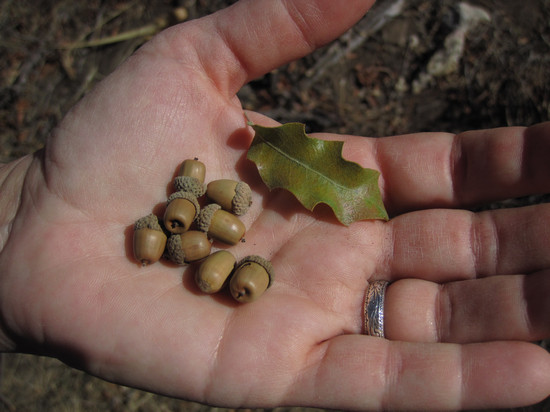
From that point onward I only passively visited the tree. I never replanted the way I thought I would do and like the failed project, I too thought that there was enough biological "Earth Internet"activity going on in my soil to justify being lazy and doing nothing further. What a dipstick mistake that was!!! The first year I did baby it a bit. Gave it generous portions of water and it did grow just a little over a meter in height. That was encouragement enough for me to do nothing as I had previously convinced myself. Yet I should have soil inoculated with PT Mycorrizae. I didn't and 12 years later and one year before I sold my property, the tree was only a mere 10 inches above that initial years one meter growth spurt. The tree after that first year barely struggled to survive all those other eleven years. The central leading bud grew only about an inch a year, every year after that first initial year and the leaf size never grew in size beyond what you see below in these small scrub oak leaves. Here's a pic of a man's hand holding some acorns and scrub oak leave to give you a sense of size scale that characterized the small pitiful size of my black oak's leaf size as a result of my neglect.
Clearly, anyone familiar withCalifornia Black Oak leaves knows that the size is much much greater than what the above pic illustrates. Nevertheless, I only briefly paid any attention to it because for the most part it was on the back 40 so to speak. But then one day after twelve years I was out performing some soil inoculation on yet another experiment to prove a hydrological networkdoes indeed exist among a grove of pines all connected and mutually benefiting from the same mycorrhizal network. With some of the PT Mycorrhizae mix I got from (PHC & Dr Don Marx) left over, I walked past that little pathetic Black Oak treeand thought to myself, what the heck, why not ?
photo from ForestryImages.org
As I've done hundreds of other times before, I drilled some small 4 inch deep holes where I thought the feeder roots were under the small trees drip line. The goal of course is to target the feeder roots where those tiny root hairs are present. When the tiny root hair cap which pushes ahead of growth in the soil comes in contact with one of those PT spores, it will hopefully detect those acids given off by the root tip and then germinate. If not the spore simply remains dormant. Once again I proceeded to baby the tree that first month only by watering generously once a week for the first month. Sure enough, there appeared a small thumb sized Pisolithus Trufflealmost identical to the one illustrated in the pic below. At this point, I'd like to mention that in almost every inoculation of an already existing tree for which PT Mycorrhizae which is host specific(meaning it will only colonize certain specific species of trees around the globe)I have had the same identical experience. After watering exactly one small thumb sized Pisolithus Trufflewill appear around the drip line of the tree. The fact that it appears will be proof of it's colonization of that particular trees root system. It can only form as it has need of drawing from the carbon nutrients from the host tree. However, you will NOTexperience or observe any improved growth effects on that tree for the rest of that year. But you will have the satisfaction of knowing that the inoculent took hold. Again see the pic below of the first truffle growth. Once again, it won't be till next year that you will experience an incredible change in appearance of your prized tree.
Once again, it won't be till next year that you will experience an incredible change in appearance of your prized tree. For me the change was an incredibly profound turn around in the way I viewed the importance of the power potential of inoculating before planting. I had always known of the potential benefits, but experiencing something so dramatic etched this experience into my brain cells and I've never forgotten it. Here's what took place that spring after a long winter's dormancy. The buds swelled up rather large and proceeded to explode with a growth spurt that I had not ever seen before with the exception of that first year. Eventually the central leader stem grew one and a half foot. The side branches grew almost exactly 12 inches. The leaf size was about 6 or 7 inches long. Here's a pic below which demonstrate the size of the leaves.
Once the Pt Mycorrhizaeis
established on the plants there should be no reason to reinoculate it
again. Each year new truffle spore will be spread throughout the soil by
other critters whose job it is to tillage and work the soil thru and
thru. You should also note that in nature there are numerous fungal associations by numerous different species. Like a biodiverse forest, you'll want to inoculate your plantings so that the biodiversity extends all the way deep into the soil. I view PT Mycorrhizae as a pioneering fungus. By that I mean, in any ecosystem after a disaster or disruption like a forest fire, there are always those pioneer species of plants that appear first to pave the way for others in a succession to the ultimate goal of an old growth forest situation.
In some eastern United States forests, Black Locust (Robinia pseudoacacia)is one of the first trees to appear. Black locust has nitrogen-fixingbacteria on its root system; for this reason it can grow on poor soils and is an early colonizer of disturbed areas. Another example of pioneer species here in Swedenis the Birch[Björk]which will appear after the industrial forester clear cut an entire forest. Consequently I view PT Mycorhizae as just such a pioneer in forest or urban landscape establishment to be then followed by other beneficial fungal inoculations. Here is the PHC Reclamationwebsite which will be of further benefit to those with an interest in reclaiming disturbed sites.
Once again, this very experience had a profound effect on me. Though I had known for years what the fungus would do and how plants would benefit, it was that deep appreciation of just what I had that finally hit home. I hope that others can and will learn from this experience. It was at that point while standing there looking at the huge difference in growth that I realized just what kind of tree I could have had at that point had I not been so lazy and putting things off as I did. Can YOU imagine what that tree would have looked like after 12 years of this specific"Earth Internet" connection ???????
There are a number of other important things to consider in the landscape. There are the plant community types. Certain plants have identical requirements which means placing them with plants outside of their natural community will be a problem. In your landscape consider features like having a lawn. View the lawn as a lakeside or stream habitat setting. Plants inside or along side this setting will benefit from the extra watering a lawn requires to look good. Other drier habitat plants will not want this. Though they may experience even spurts of growth at first, they will later rapidly decline in health and vigor.
These are all the little things you NEED to consider when planning your landscape whether you appreciate it now or later after failure. Sometimes failure is the only way to learn. I ought to know.


 Who hasn't visited Torrey Pines State Natural Preserve and stepped off of the old narrow asphalt road where the sign says in bold letters, "North Loop," then right under that, "The Guy Fleming Trail." I've done this many times since the 1960s. This was one of the better and easiest trails to hike and actually get inside of the Torrey Pine forest. Most other trails are broken up with chaparral, but this is forest. Other areas of dense Torrey Pine forest you can only see from a viewpoint distance to protect them. It's also not especially steep or challenging and it takes you right next to the viewpoint of Torrey Pines State Beach overlook. Interestingly the woods at the end of the trail are like the stunted growth of common chaparral we call, "Elfin Forest," because they are windswept by the ocean breezes which have sculpted them this way. Often the signage will comment on the grotesque and/or picturesque shapes and explain the natural phenomena of the windy salty air that created these shapes. But something's changed here as well. As you continue to on ahead walking down a little further in the photo above, you can see in the distance that something has gone terribly wrong here too.