Showing posts with label mycorrhizal grid. Show all posts

Wednesday, May 2, 2012

Forest Floor Plants That operate in the Grid Network

 Here's what the University of Austin Texas had to say in it's description of this awesome forest floor plant.
"A very aggressive fern of worldwide distribution for dry woodlands. The only fern for most dry shade situations. Ideal for dry Post Oak (Quercus stellata) forests and pine forests. The tripartite, furry, silvery fiddleheads emerge in early spring. The roots colonize aggressively and extend deep in search of moisture, as far as 10 feet deep in some locations."
Western Bracken Fern
This plant above was very aggressive and vigorous in the San Jacinto mountains where I observed it. It's own personal nature as a component of the forest floor grid is obvious. Deep rooted for a fern as noted above and any possible mycorrhizal grid connection make it a worthwhile study for any forest rehabilitation project. Most projects only consist of tree plant with little attention to other complex factors. Let me provide an observational example. Along Hwy 243 in the San Jacinto Mountains halfway between the lower city of Banning CA and the high mountain town of Idyllwild CA, there is an area just west of Bay Tree spring and the James Preserve called Vista Grande. The area of Vista Grande has a Ranger Fire Station and a near by Girl Scouts Camp. The area between the Scout Camp and the Ranger Station is relatively flat, almost like a saddle on this particular part of the ridge top where the state highway travels across. Here is a portion of a map of what I am talking about.
Vista Grande Fire Station on Hwy 243 with Lake Fulmer just a few miles past the station.

Now the only reason I'm giving the above references is because I cannot find no photos out there of the surrounding landscape across the street and around the fire station. However if you can do a Google Earth Search of Vista Grande Fire Station & Hwy 243 CA, you can actually follow the Car mounted Camera drive and pan around at the view of the massive amounts of the above mentioned Western Bracken Fern which grows prolifically out in the open between sparsely forested areas across and around this Ranger Fire Station. Clearly the grid is deep and healthy in this area as there are no streams or springs at the top of this particular area. This is a very dry area prone to forest or brush fires every single year. Yet at this hot dry location (often 90+F) we find the Western Bracken Fern thriving out in the open, not under the cool shady canopy of a heavily wooded old growth forest scenario next to a stream.

Ribes nevadense, 
Mountain Pink Currant
Native to 4000-8000' throughout California. When I lived in Idyllwild CA this plant flowered in April to July with 6" and looks like hanging pink fireworks brush strokes in the night sky. This is one of those plants that can grew along the creeks in shaded areas or sometimes just in moist woodland areas under the pines. It can survive drought well but most likely receives some moisture from the grid if available.

Rosa californica, the California Wild Rose
Tree of Life Nursery does a wonder description piece on this plant here 
http://www.californianativeplants.com/index.php/plants/featured-plants/46-rosacalifornica
Basically this plant does a nice job of spreading itself completely  through a networked system of underground Rhizomes which sprout up even far away from the plant. Like all other plants it no doubt has connections through the underground grid of VAM mycorrhizal networks. This is yet another example of a keystone species, that is, a plant that cements a relationship between the other plants, the animals, birds and insects that inhabit the area, but also connecting through the grid and transporting all manner of water and nutrients to other plants along and within the mycorrhizal grid. And I'll stop here with this plant and explain more of my personal observations about the effectiveness of the grid or fungal network. 
I lived up in Idyllwild California before moving to Anza just to the south and west of this area. There were two more personal educational observations out in the natural world I witnessed in that high mountain town that have stuck with me ever since the early 1980s and helped me to understand the importance of "Earth's Internet"

There's a major stream that runs through the town of Idyllwild called Strawbeery Creek. One day while walking the creek I came across what I thought was the Western Dogwood (Cornus-nuttallii) I was interested in identifying as many San Jacinto Mountain natives as I could. I often went fishing early in the morning along that creek before going off to work down the mountain in either Hemet CA or Palm Springs CA. Finally I thought I had discovered it. But it wasn't till a couple years later I went back to look at it and discovered it wasn't a Dogwood at all. Here's what I saw.


It was a CHEERY TREE and not just any cherry tree, but a Queen Anne Cherry tree. Unlike the deep purple Bing or Red Pie cherries, these were those deep orange yellow with the splashes of red on them. Incredibly I was also suddenly startled by a Stellar's Jay  who popped out of the branches with one in his beak.
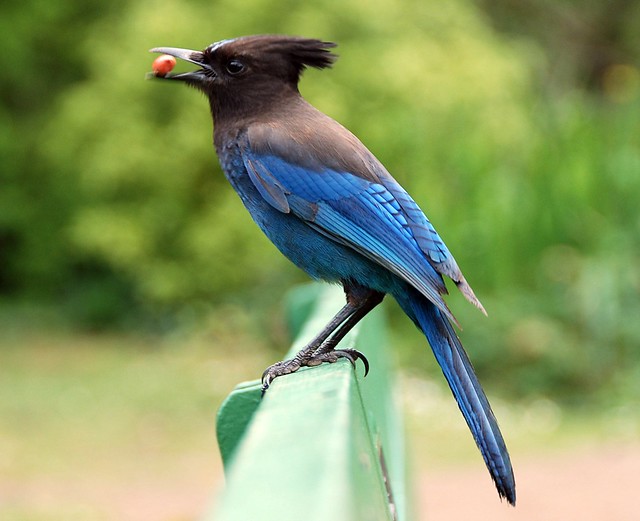
Years have past and not only is that original tree still there, but many others have volunteered, no doubt courtesy of the Stellar's Jay's habitat of gathering as many as possible and burying them elsewhere. As far as the original tree, I can only assume that there was a hiker out for a stroll eating these cherries and spitting them out where on of the pits got lucky. Still, how could such an domestic Orchard type of a tree succeed like this ? On another odd note, being that it was an orchard tree and only seeing trees grow abundant fruit out in the open full sun as the AG Experts no doubt would insist, how could this tree be so successful in the dark of the forest ? The native trees along this creek are practically giant hundred years old trees, some a few hundred years old. Again how can they succeeded in virtual shade and produce so much ? Hmmmmmmm!! 

Another example and just a few hundred feet away up the creek along the road in someone's private property. The major intersecting roads are South Circle Drive and Village Center Drive. At the junction facing north you simply drive or walk on Village center Dr towards the shopping area. Cross Strawberry Creek and immediately on your right is a property with a rather large Standard Red  Delicious Apple tree just off the road and property line. Now this tree is also in perpetual darkness of the old growth shaded forest, yet it produces abundant red apples every year I've seen it. So how does that work ? Don't they need to be out in the open sunshine in an Orchard somewhere receiving as much of the Sun's Energy as possible to be successful ? Evidently not! Watch the video below for possible explanation about may be going on under the ground.
Prof. Suzanne Simard who talks about Mother trees

 Clearly all that was necessary for these orchard trees which by the way are both originally forest trees anyway, was to be connected to the mycorrhizal networked grid. Like those tiny small little LED lights plugged anywhere into the spread out electrical miracle called Smart Fabric which looks much like a table cloth with various folds replication ridges and valleys of a Topo mapped landscape, so too any plant connected to the natural underground mycorrhizal grid will create a success story in the environment for which it's found. 


Image - Wikipedia


As long as the grid is healthy and active, any plant can be successful. Keeping the mycorrhizal grid intact or at the very least trying to repair it in the garden or urban landscape will be a plus. Both of those fruit trees clearly received not only water and soil nutrients, but also any other photosynthates manufactured by the giant trees towering above and transported through the grid to the fruit trees. These photosynthates of course are nothing more than any substance synthesized in photosynthesis, esp a sugar. The fungi benefit and so do the understory plants. 

Clearly the grid is important and should be respected when designing or creating any urban garden/landscpae environment or any agricultural endeavor. We however DO NOT live in that kind of world. While many good scientists and researchers have revealed a great many things found and observed in the natural world to be replicated in all of our human socirty environments, these researchers are clearly outnumbered by the numerous scientists who work for this world's giant bohemoth corporations and enterprizess. Power and obsession with wealth creation are the major drivers of a handful of individuals on this planet. Unfortunately the consequences of these old archaic failed Green Revolution Technologies have got to be put to rest and more unconventional technologies (which actual deal with the way the real world works) which think outside the corrupt scientific conventional box must be pursued. Our Earth cannot handle anymore of imperfect human meddling. In the mean time it is hoped that individuals reading here will research, study and observe for themselves first hand just how nature was originally put together and put to practice even replicate the reality found all around us in nature.

Friday, March 23, 2012

"How I First Became Addicted To The Internet"

I was addicted to the internet long before there was an internet as we know it. I'm talking about the 'Earth's Internet' of course. Back in the late 1970s, I had a strong driving curiosity about the ancient minerotrophic hydrological cycle made reference to in the Bible book of Genesis. This is not a religious discussion here, but I have always been curious if such a system of hydrology could have existed and how would different diverse ecosystems operate under such conditions. So I tend not to dismiss what others choose to call fables, but rather assume that past descriptions could have some legitimacy, though the people of the ancient past may not have known how to explain what they saw. They did their best given the circumstances. I have another blog which deals with the geophysics of our planet, it's hydrology and what science has discovered that may or may not explain any of the references to such a system mentioned in the book of Genesis. Again, this is not a discussion of those events, but merely an explanation for what motivated me originally to delve into Mycorrhizal Networking as a viable piece of engineering for which to derive useful technologies and practical applications. For a further read on the ancient hydrological cycle, please go to this blog which also deals with Viktor Schauberger , anomalous properties of water , etc "Primary Water" 

So back to basics and origins of my interest. Back in the 1970s I had no clue if such a system existed or not. So allowing it to be a given, or assuming the account was true in my own mind at least, my main focus was on the end game and not the beginning of how such a cycle would work, but the question of just how would plants react to such a system. No Rain ? Impossible! Of course I always loved forests, Botany, nature in general and how things worked, but my technical background and experience was definitely in the 'Green Horn' or 'Rookie' category. It was when I was in high school and when I was in the Future Farmers of America (FFA) program and showing my sheep at the  San Diego County's Del Mar Fair   that I came across something that would change my perception of how forest floor ecosystems actually worked and started looking for evidence for this. Of course there were researchers, though not as many today, out there researching answers about Fungal Networks. But there sure as heck was no internet and Libraries were long and laborious to plow through to find out info on the subject. Anyway, here is what happened.

Ever go to any County Fair where they have all those Commercial Products and Innovations buildings where company's or small business entrepreneurs pay a hefty fee for booths to hawk their wares ? Some of these guys are actually real Hucksters and showman with those corded microphones connected to their heads spouting off about the virtues of their company's latest line of cookware, Kitchen gadgetry or some other innovation not out in the conventional markets yet. There was one booth there where this guy had something like what in today's technological terms or lingo is called 'Smart Fabric' - 'Smart Cloth' or even 'Lite Bright Fabric'. This man went on to talk about all the futuristic things that such cloth was going to be able to accomplish. It was hard to believe at the time, but take a look at what they have done today with this technology:
'Smart' fabric glows in response to allergens Researchers developed electrically conductive cloth using carbon nanotubes 
Solar dress charges your MP3 player 
Carbon Nanotube Clothing Could Take Charge in an Emergency [Slide Show] 
"Wearable Technologies" - iPod coat 


And the list of things appears to be endless. Take a look at these expensive nanotechnology light tablecloths that go for about $500 a piece.
Light Emitting Diode (LEDs) table covers to light up your dining 


So once again, these things above were what this guy was envisioning in the future. Skeptical and admittedly unimpressed, there was one object lesson I got out of his demonstration which was amazing and mind/brain imprinting to say the least. He had this rather large cloth of fabric rolled out over a table. The cloth or fabric sheet wasn't neatly fitted on the table like the picture above, but rather is was loosely laid out with all sorts of mounds, folds and dips in what in my mind looked a lot more like the terrain of some Topographical Map. The folds and dips to me in my imagination were like peaks and valleys, ridges and low hills of a real geographical terrain or landscape in real life.  It was a sort of landscape and in this landscape he demonstrated the properties of this electrically conductive material by plugging in these light-emitting diodes (or LEDs) to illustrate how the fabric had properties which allowed a low electrical conductivity which was harmless to the human touch to light up these little tiny LEDs when you plug them anywhere in that fabric. He had a box of different coloured LEDs and allowed the public to plug one in where they wished. Sure enough, there was no electric shock, even though you felt a little spooked. It was truly amazing to me but for different reasons.

I looked at these LEDs not as little lights, but as little Trees in a naturally occurring well orchestrated  Mycorrhizal Networked Grid to be found in any healthy ecosystem's physical landscape. I reasoned that if tree/shrub seedlings could be inserted into a rich Mycorrhizal Landscape then like the lights which were tapped into the electrical energy of the 'Smart Cloth' then these trees would have a better chance in any reforestation project or even someone's home gardening landscape. It wasn't until years later in 1990 that I decided to perform my own crude rookie experiment using real trees in the landscape. I had already heard about the successful research of former US Forest Service Scientist Dr Donald Marx who later became head scientist for Plant Health Care Inc (PHC) which even at the time was in it's infancy. Dr Marx established research of just how beneficial it was to establish reclamation projects with a good Mycorrhizal Inoculant with each tree seedling planted into an old mining site to be reclaimed. Clearly on such sites there was no longer a healthy grid. Some of my experience with a mycorrhizal fungi may be found here on one specific type called  Pisolithus tinctorius at be found here on this page of the blog.
Is the Plant Watered Properly? 
  What I decided to do was plant various Pine Tree (Jeffrey, Coulter, Apache) varieties on a 1/4 of an acre plot and fairly evenly spaced, but I didn't want the area to look like some organized unnatural Christmas Tree lot. There were also a couple of small native scrub oaks in this area and I left them in place. One volunteer 6 inch tree which already was present on this same location was a Coulter Pine which no doubt was planted there by the Blue ScrubJays who have a habit of incessant seed harvesting and planting these for later food storage. Unfortunately for them and fortunately for us and nature, they don't always remember where they plant seeds. To illustate the architectural layout and what I did, here an animation of a tree layout by a company called 'Voltree' (more on them in a future post) The area planted then looked something like this illustration below.

 
After the trees were planted, inoculated with a good mix of ecto-mycorrizal spores of Pisolithus tinctorius and sort of evenly spaced apart, I allowed two years to go by before trying my experiment. It was my belief that all trees connected to a healthy, productive mycorrhizal networked grid would all be hydrated no matter where the source of the water H20 came from or was located in any topography or terrain in any environment. Take a look at those trees above with the orange coloured dots connected to each other in that animated graph or chart. This is where Voltree in the picture has applied their sensors which I'll write about in a future at another time. But for the moment, just imagine taking an irrigation drip line and placing it on one of those points of origin. After a couple hours I believed that all trees on that plot would be hydrated no matter what their position in the grid and distance from the point of water source origin. I wasn't disappointed. In a hot dry summer climate as we have there in Anza CA where winter rainy season is long gone and just before any of the potential summer monsoonal moisture drops some summer rains on the landscape, there is a phenomena of the hard dry and tight Pine Tree buds (especially the central leader bud) start to exude droplets of pine pitch all around all buds when the plant is hydrated with a drip irrigation line or a garden hose turned on with low pressure. Here's a pic of what the dry hard buds look like before being given water.


And here are some pictures of what the Pine Pitch droplets begin to look like after being watered. As the minutes and hours went by in the hydration experiment, every tree eventually exhibited the same exact phenomena of a hydrated pine tree being hydrated and oozing pitch from their buds. I would wait a week and conduct the same experiment all over again , but the next time I'd place the irrigation drip line in a different position or location in the networked grid as illustrated in the Voltree graph. The trees all flourished and clearly there was indeed a healthy underground unseen network of the mycorrhizal grid.

Today those trees are approximately 7 to 10 foot tall. I sold this property back in 2001 and I visited it last summer of 2011 with my wife from Sweden. Sadly a renter who was a tree trimmer and rented it in 2002-2004 took out many of those trees to have a place for parking his equipment. The property was sloping and this location where the trees were was the only fairly level spot for him to create space. Needless to say I was a bit stressed when I saw they were gone, but hey, it's not my place or business anymore. So whatever. However, here are some pics of the trees that still exist from that Mycorrhizal Networked Grid Project.


And as I pan around with the camera to the left of me photographing this Jeffrey Pine , you will see three of the evenly space tree examples. In fact these trees are part of what My son Jared and I planted when we came back from a Nursery in Corona, CA. One of the trees my son took back to his home in San Marcos CA and planted, nurtured and generally babied alone. I took some Pisolithus tinctorius spores down with me from the Mountain property and inoculated that tree about a year later. The tree was maybe neglected a bit, but was huge the last time I saw it. If I get a picture of it, you'll notice it may be a little bigger than these as it is a Torrey Pine and faster growing when young. The tree to the left in this picture below is the ScrubJay planted Coulter Pine I mentioned earlier. You'll still see some equipment parked in the back ground, but these are the newer owners.

This would be an ideal project for any student out there to under take, not only the actual trees, but illustrating the grid work of the 'Smart Fabric' & LEDs example. Feel free to use any and all methods mentioned above or on this site. There are certainly other applicable mycorrhiza species around the globe and this planting scheme will work in any country on the planet given the correct species of mycorrhizae with the correct host tree or shrub. There appears to be many visitors to these pages from several countries and if you have any questions about your area, please ask them in the comments below. Thanks again.


Enjoy!