Showing posts with label reseach. Show all posts

Sunday, April 2, 2017

Observation, Reflection, Pondering, & Questions unveil how Nature really works

Medical Dictionary Definition of  Periphery
"the outward bounds of something as distinguished from its internal regions or center"
If you've been reading this blog for very long, you know I value having an open minded peripheral view of nature as opposed to the often Tunnel Vision approach many scientific researchers take. I have two examples here of different approaches to research studies and their outcomes which were based on either broad observational viewpoint or a narrow minded tunnel vision approach. I've often had numerous discussions with defenders of the industrial science business model approach to agriculture versus a biodiverse perennial plants and mycorrhizal soil system approach. The response to the observed evidence outdoors based on the reality of how nature maintains and sustains has always been met with, "Your evidence confirming an observation is evidence that your observation is wrong." Well not is so many words, but these are the very people who are religiously hung up on "evidence-based science" and "peer-review." Pure unadulterated blind faith belief in both of these states as an only means at arriving at a truth can be easily debunked by viewing the effects on Nature. Below are the  two contrasting approaches as to how science is done, with the later example being the most universally common ne practiced and the degradation of our Earth's ecosystems are evidence that the first approach should become more well funded.
Scientists follow seeds to solve ecological puzzle
Mice hammer a rare native plant by feasting on its seeds, but their spoliation is human-enabled
Credit: Molly Kuhs

"Scientists Tiffany Knight and Eleanor Pardini in restored dune habitat at the Point Reyes National Seashore in Marin County, California. Plants native to the area, such as the Tidestrom's lupines that surround them, are adapted to stiff winds, dune blowouts and winter storms at sea."

Credit: Eleanor Pardini
Up in Marin County in northern California at the Abbotts Lagoon in Point Reyes National Seashore, there is a sand dune ecosystem where a rare low growing spreading flower called, Tidestrom's Lupine (native), is being eaten from existence a, Deer Mouse Peromyscus maniculatus (also native), but which also prefers the seeds of another more common larger Lupine called, Chamisso Bush Lupine (again also native). The basic dilemma here was that there was a decline in the rare Lupine populations around these sand dunes. The situation was so dire that realistically it was thought they would go extinct. The mouse was eating both types of Lupine seeds and even preferred the larger more common Bush Lupine seeds, but the smaller low growing Lupine was still the one that was declining. But they eventually determined that Humans were in actuality the enablers of the imbalance that had taken place between various NATIVE components of the ecosystem. That was the interesting part. Incredibly, this was not one of those textbook cases of some foreign exotic plant or animal wreaking havoc on some California ecosystem. True, a European Beachgrass was utilized in an attempt to stabilize the sand dune, but they could well have chosen any native California bunch grass with the same imbalanced result. These were native organisms out of balance struggling within a familiar ecosystem for which as the researchers explained, "the spoliation was human enabled." One native California organism pitted against another. What I love most about this article were the well thought out questions that drove the researchers which the author published at the beginning:

"What bothers a plant? Why are some plants rare while others are common? Are the rare plants simply adapted to rare habitat or are they losing the competition for habitat? Are their populations small but stable, or are they dwindling?   
And how can scientists usefully frame these questions when there are so many possible variables? 
One way is to compare related — or congeneric — species that have many traits in common but also differ in some ways. This clears out enough underbrush that carefully designed experiments can provide answers."
Washington State University St Louis: Scientists follow seeds to solve ecological puzzle

Credit: Eleanor Pardini

"The common Chamisso bush lupine holds its seed pods above the ground or hides them in the middle of its shrubbery. This lupine’s architecture makes its seeds less vulnerable to predation while they remain on the plant."

Credit: Steve Kroiss
This little native Deer Mouse at right was at first glance the trouble maker. In the old days the rule of thumb from the Scientific Orthodoxy would be to recommend without question a science-based synthetic pesticide to eradicate the Mouse. Problem solved! But was this little mouse really at fault ? Nature is loaded with all manner of living things which do not think, reason and scheme like humans. They are however incredibly sophisticated complex biological machines being run and directed by an informational communications network (DNA) & complex sensory system which responds to environmental cues. The researchers found that some time back a human decision was made by the Park Service to prevent dune erosion by planting a type of beachgrass. Apparently there were a combination of domino effects that went negative. It would seem the beachgrass provided safe haven for the little Deer Mouse who felt safe and embolden to venture out and eat the seeds of the rare Tidestrom's Lupine. But two years into the study the Park Service then removed the beachgrass to save another bird's (Plover) nesting site. Here is a description of what happened next:
The removal of beachgrass has already taken the pressure off the rare lupine. There are two reasons for this, Pardini said. One is that Tidestrom’s lupine is adapted to a disturbed habitat and needs wind and dune blowouts to thrive. The second is that with the beachgrass gone, mice have to take bigger risks to take lupine seeds.   
“Tidestrom’s lupine is popping up like crazy in the restored areas,” Pardini said. “The seed germination rate is very high, survival rate is extremely high, it’s reaching high densities in the restored zones, the plants are huge and they’re extremely fertile.”
(Read the entire Article HERE)
You can read the rest of the entire article on your own. It's loaded with lots of interesting reading. But now lets take another look at the second approach to research which at the beginning on the surface appears to be a faster way to shortcuts, but in reality holds back valuable strides forward. Especially when urgency is the motivating factor.

Fighting World Hunger: Robotics Aid in the Study of Corn and Drought Tolerance
Credit: Gui DeSouza

Credit: Gui DeSouza
This next study is an old one. This ongoing insistence that only biotechs can find the answers to drought resistence in preparation for future climate change. But in this case it takes an unnecessary course of direction. The attempt here is to get a little too cute with electronics. Robotics right now is a hot topic and all industries are looking at them to save time and money. The article and video they provide starts out justifying the research by the all too common cache phrase, "In the fight against world hunger . . "  They then continue on with numbers and stats along with a dire prophetic warning of time running out. 
"Developing drought tolerant corn that makes efficient use of available water will be vital to sustain the estimated 9 billion global population by 2050."

So the message here is that developing drought resistent corn crop varieties can only be accomplished with robotics facilitated by a $20 million grant and hopefully something positive will just happen by 2050 to save the world from hunger ? By contrast most of the early mycorrhizal research decades ago was done outdoors in a natural environmental setting. Being outdoors provided Mycologists and other researchers to observe the reality of how nature really works. Scientists (Mycologists) watched, observed, pondered and formulated numerous questions not just on the fungi alone, but their interaction with every other living thing around them. What has always beens a puzzle to me is why the mycorrhizal soil management systems approach has never been as well funded as the industrial science approach to bland boring monocultures ? But that's not really what industrial science is all about. Their goals are entirely different from tradtional study and research, take a look at a quote mentioned in the video at time spot 1:08:
"We're trying to automate as much as we can. We're trying to install networking so we can do everything from the Lab -- we can remotely log into the devices, collect images, download the image and all that so that we don't have to go to the field as much."
University of Missouri: Fighting World Hunger: Robotics Aid in the Study of Corn and Drought Tolerance
Image - Mycorrhizal Applications Inc

The industrial approach is all about what they imagine to be shortcuts provided by this robot which might mean greater returns on investment. The study on the mouse vrs the Lupine had no such monetary funding or future $$$ ambitions to motivate those researchers involved. But seriously, Robots to identify heat stress in plants ??? Question: Does the average farmer really need a robot to tell them which corn plants are stressed and which ones are doing fine ? Look at the pic above. All this continual talk of Biotech research work going into finding that right drought resistence gene has always been a complete waste of time. There has been for 1000s of countless years a tool Nature has always had available for dealing with drought resistence in plants. That would be the various varieties of mycorrhizal fungi who have a vested interest in the health and welfare of their hosts. So why the high techie robots ? Yes, in these modern times, fungi are probably not as sexy and sophisticated as modern technological advancements like robots, but their function as mutualistic partners with crop plants is far superior to anything biotech scientists or robotics engineers could ever do to problem solve quick solutions just around the corner, let alone a decade or two away. Our planet Earth doesn't have a decade or two. Pursuit of a mycorrhizal approach is in reality the real shortcut. The biggest roadblock is that a genetically modified seed comes with a lot of required aftermarket baggage ($£€) like a plethora of synthetic fertilizer inputs, herbicides, insecticides, fungicides, miticides, etc which do nothing more than provide the promise of obscene profit for a handful of giant chemical corporate entites. Now to be completely fair here, I'm sure this Associate Professor, Gui DeSouza, and his intelligent engineers are conscientious people and know their electronic gadegtry stuff very well. But modern Science's biggest problem is wanting to do almost everything inside of some Laboratory. Much of today's Science left the outdoors decades ago. That's not to say that there are no scientists today who no longer practice outdoor research, because many still do. The researchers at the Dune site proved this to be true. But I highly doubt any of these industrially motivated guys have much understanding of underground soil mycorrhizal networks and their relationship with any plant let alone crop plants. 


The direction the prevailing industrial Scientific Orthodoxy is to white wash the bad news to the public by their propagandizing which is almost identical to the words of warning by Patrick Henry who himself was quoting from a biblical text of (Ezekiel 13:10) where false prophets were suckering the common people into believe the coming dire situation was really not all that bad. Our present dire reality is that this world doesn't have until 2050 to find solutions. There's no luxury of time to piddle around, beg for funding for pet projects and problem solve for profit. Ecosystems are deteriorating faster than ever before and have been for some decades. The picture I often use above from the University of Florida and Mycorrhizal Applications Inc testing the product MycoApply with multiple blend of fungi species points a glaring spotlight on how this drought & heat stress resistence can be dealt with in one season on many corn (& other crop) varieties that they already know will grow well in hot climates. It also exposes what a real propaganda sham this biotech search for that illusive mysterious drought resistent gene really is about. If their goal really was about feeding the world & food security, the mycorrhizal approach would be snapped up instantly. What this is really all about, is Industrial Agriculture in bed with Industrial Science trying desperately to keep a status quo monopoly on agribusiness. As that is the case, they are stubbornly committed to a tunnel vision industrial answer approach and not any peripheral view of anything outside of their narrow minded small inner circle of elitest ideas. 

Speaking of Sand Dunes

The beauty of the animal, plant & bird dilemma at the Sand Dune Project was that these researchers did spend quite a bit of time outdoors for four years. They also came up with not only great questions one after another based on observations, but also created some beautiful terminology along the way to illustrate and expose the multiple ways humans have managed to screw up the environment even without introducing any invasive exotic non-native species of plants, birds or animals. Expressions like, "subsidized native predators" & "spoliation is human enabled," which fits nicely with Martin Luther King Jr's, "sincere ignorance" & "conscientious stupidity." Take a look at their final thoughts in the Dune/Beachgrass/Mouse/Lupine research:
A Final Twist
"A final twist Ironically, the beachgrass was removed not to help the rare lupine but rather to help the endangered western snowy plover (Charadrius alexandrinus nivosus). Just as the lupine lost germination sites to the grass, the plover lost nesting habitat.   
And both the lupine and the plover suffered from subsidized native predators. In the case of the lupine, the predator is the deer mouse; in the case of the plover, it is the common raven (Corvus corax),   
“Corvid populations have been exploding worldwide since the 1970s,” Pardini said. “You can see it in the Christmas birdcount data. One reason is that they feast on the refuse people provide.   
“So the emerging story about human intervention and the ravens is analogous to the one about the grass and the mice,” she added. In both cases, people are subsidizing a species that is upsetting the balance that once existed between other species: on one hand two lupines, in the other two birds.
The summary sheds light on so many things. Humans have not only subsidized various forms of invasive species which have brought about environmental ruin to many areas of our Earth, but they've also somehow managed to pit one native organism against another unintentionally. Previously most all native things have lived in almost perfect balance for 1000s of years. Suddenly, a form of new freedom promising scientific enlightenment bulls it's way onto the world scene 150+ years ago and we find ourselves as an actual slave to it's death dealing consequences. The beauty of the Lupine/Mouse study on those Northern California sand dunes illustrates how humans can truly unmask and expose the cause and over a long period of time use the powers of observation within peripheral viewpoint of an entire environment, inspire numerous thought provoking questions and come up with a nonsynthetic pesticidal solution for creating back the natural balance again. Giant corporations are easy big targets to blame because of their extraordinary size for expossure. But what really frightens me are all those small to medium size property owners out there who still buy into the rat poison advertisement indoctrination as a first option in arriving at problem correction. Take a rural drive almost anywhere and look how the average property owning citizen lacks the understanding in taking a natural balanced approach to maintaining the ecology of their land. This is the kind of approach that should be easily taught in elementary school through high school (secondary school) long before a student gets to college. Just think of all the unnecessary baggage they wouldn't be lugging with them when they finally do go to a University ? 😵


Dr. Eleanor Pardini's Research Blog


Friday, June 24, 2016

Positive Interactions and Mutual Dependence between two Desert Plants

I caught this older 1978 black and white photograph by accident the other day while looking through some old archived literature on an unrelated subject. Mostly I was looking at mesquite dune references for building windbreaks or shelterbelts with native flora after removal of Tamarisk. I'm ever so thankful I made this find. It needs light shed on it.
Image is March 1978
"
Four-year old Prosopis tamarugo competing with native
 Atriplex atacamensis in the San Pedro de Atacama salt flat"

And so read the caption under the black and white photograph taken on March 1978 which was found down at the very bottom of this United Nations agriculture website. Can anyone appreciate the inaccurate misleading understanding back then regarding plant inter-relationships and mutualism ? Do I hear "Mother Tree" or "Nurse Plant" from anybody ? No of course not. Back then as today, we use hear people say that beautiful shrub or tree [depending on whether you champion the tree or shrub] in such a photograph seems to have the appearrance of being choked to death or strangled by the less desirable shrub. The times really haven't changed all that much with not only your average Gardener and commercial Landscaper, but also your average Professional Forester. Anyone else notice the word/term, "competing" being used in the description above of the two plants in that black and white photo ? Do either of those plants really look like they're suffering at the hands of the other ? There is an irresponsible blind faith religious concept called "Survival of the Fittest" which has done more harm than good and has set back positive scientific research more than anything else. Even today, Biomimicry leaves a foul taste in the mouths of some Ideologues who cherish an old inept Victorian Era worldview of our planet's natural world. I've seen such plant associations before, photographed them and written about them in this blog. Take a look below.

Photo Image - Kevin Franck (2013
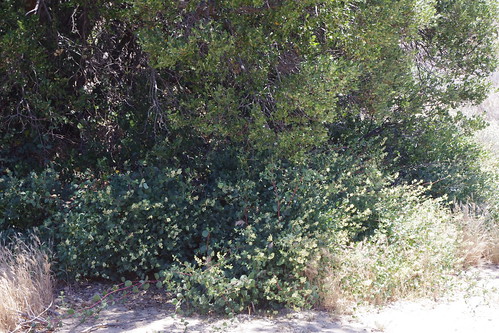
This is an Oak tree at the bottom of my brother's property in  Ranchita California. This region in many ways is very much an interior high desert ecosystem. Very dry, cold/hot and windy at times from  any direction. And yet, take a closer look underneath that Oak tree. On a much closer inspection, this is Chaparral Honeysuckle (Lonicera interupta) and may seem odd at first being way out on this dry flat, especially considering it is still recovering from the infamous Pines Fire of 2002. Most likely some bird stopped at this Oak tree weigh station rest area and took a  dump which may have contained some Honeysuckle berry seeds. Or perhaps a Coyote or some other animal literally dropped by after dining. Yet from the appearance of vigoriously growing foliage, do we see one plant outcompeting the other here ? No!
Photo Image - Kevin Franck (2013)
This group of riparian trees above, Cottonwood, Willow and Mexican Elderberry are also associated with not only Snow Pea, but also Wild Rose. The area is east of Lake Henshaw in San Diego county cloase to the Junction of Hwy 79 & 76. Do any of these plants look to be out competing or chocking out their neighbours in some blind faith concept known as "Survival of the Fittest" ??? Hardly. But strongly entrenched blind faith human dogma concepts are hard to weed out. And yes, many evolutionary concepts which originated from an ignorant Victorian Era have held on to the present. Their continued presence in the textbooks has held back good science and ruined many an ecosystem ever since they were conceived in response to justification of a new preferred  worldview. What is needed is some major deprogamming and re-education.
~~~~~~~~~~~~~~~~~~~~~~~~~~~~~~~~
 The plants in the black & white photograph. Prosopis tamarugo and Atriplex atacamensis

Image - creces.cl
Tamarugo Forest or Bosque
The Tamarugo (Prosopis tamarugo) is a deciduous legume tree growing up to 18 m high, with a crown ranging from 15 m to 20 m in diameter. Its root system consists of a deep taproot (down to 6 m) with lateral roots (down to 1.5 m). Leaves are bipinnate with 10-15 pairs of 5 mm long leaflets. Spike-like inflorescences bear golden yellow flowers. Fruits are peanut-shaped pods borne in clusters, 2 to 4 cm long. They contain an edible pulp and ovate seeds (3-4.3 mm long).
image - Nomad Desert
"The tamarugo is native to Chile (part of the Atacama desert is known as Pampa del Tamarugal). It is also found in Argentina and was introduced into India and other saline deserts of the world. It can grow up to an altitude of 1500 m. It thrives on salty sandy soils or clay loamy soils with a salt encrustation to a depth of 60 cm. It prefers the normal desert climate: high day temperatures, a large day-to-night temperature range, almost total lack of rainfall and intense sunlight. Tamarugo can withstand 10 to 12 months of drought."
Tamarugo mist watering  on leaves
"At the beginning of the 20th century, the tamarugo was almost extinct when a forest inspector noticed its ecological interest and created tamarugo plantations in the Pampa del Tamarugal. Since then, the tamarugo has been used to afforest saline deserts and has increased the overall productivity of the Tamarugal. The tree absorbs air moisture through its leaves and dispatches the collected water to its roots and to the surrounding soil, thus participating in the protection of soil water reserves. It is also a windbreaker and protects animals and people from the sun." 
(Source)
There are a number of amazing qualities about this species of Prosopis (Mesquite) and others. They can all be long lived. Often 100s, 500 to 1000 years old. One particular tree in South American country of Peru, a Hurango (Prosopis pallida), is in fact called the "Milenario de Hurango" because it has been found to be estimated at 1074 years of age. It was once part of a greater forest which has just about disappeared in the  Palpa region of Peru. As a land restoration tree, the Prosopis species in South America can access subterranean waters 60 meters (almost 200 feet) deep by means of a large tap root. It is one of the few trees/plants which can tolerate saline soils and transform such otherwise inhospitable landscapes into usable fertile soils. Part of the salty soil tolerance comes from it's association with micro-organisms on their root systems. 
Cachiyuyo (Atriplex atacamensis) 'Saltbush'
Taken on November 22, 2014 - Lucas Burchard Señoret

Planta del Desierto. Cachiyuyo (Atriplex atacamensis)
Chiu Chiu. Calama. Loa. Antofagasta. Chile

This plant in the photo above is what is commonly known by name as "Saltbrush" which where I come from is one of the few plants which will grow on saltflats of Coachella and Imperial Valleys. Atriplex is the plant referenced in that black and white photograph at the beginning of this post. It's not exactly an ornamental one we would chose for the urban landscape, nor even a specimen sought after by collectors of California Native Plants, but never the less it does have some amazing beneficial qualities. For example after stumbling upon the subject of Prosopis tamarugo from South America on the Food and Agriculture Organization of the United Nations website and the negative reference at the bottom of that page where gives the impression that the Atriplex was being demonized as the villan and Tamarugo as the victim. I realized that neither was true because from my own personal experience in researching on how nature utilizes sophisticated complex mechanisms for survival and success, the truth is clear that this has zero to do with "Survival of the Fittest" and more to do with survival of the mutually cooperative. Take a look at this one paragraph from the above book published in January 2007, titled:
"Positive Interactions and Interdependence in Plant Communities"
"Studies by Jose Facelli and Amada Temby (2002) in Southern Australia have also demonstrated a complex array of facilitative and competitive mechanisms working simultaneously in interactions between shrubs and the annual plants that grow around them. Shrubs altered soils, the seed bank, the effects of large vertebrates, and the subcanopy microclimate. But in a very interesting contrast to many other studies in similar systems, canopy effects were negative, reducing the effects of annuals, where as the roots of one shrub species, Atriplex vesicaria, facilitated annual species growing on the edges of it's canopy. Trenching around Atriplex shrubs decreased the abundance of annual plants. Facelli and Temby attributed the positive effects of Atriplex shrubs to hydraulic lift, and the decrease of nearby annuals after root severing to impeding the flow of water from the roots into shallow soils. Both positive and negative effects occurred in this system, but the typical of mechanisms in this system were reversed, with canopies inhibiting and root facilitating understories."
 (book source - short version)
 The mechanical benefits of hydraulic lift and redistribution of water to other plants within desert communities is fascinating and too the ability tolerate saline soils is also important when such soil degradation around the globe is increasing. Aside from being viewed as an important habitat creating tool, there are also some claimed health benefits to consumption of certain varieties. As always, thorough research and investigation on the part of those interested in such benefits and plant identification should be pursued. 
OrganicFacts: Potential health benefits of Saltbush (also known as saltbush or orache) for members of the Atriplex genus
Some concluding remarks on these plants and related ones & their landscape restoration value to people
Photo Image - BBC


The remarkable nitrogen-fixing Prosopis trees are an important source of food, forage timber and fuel for the local people of South America. But what is more important from a restoration self-sufficiency standpoint and something the average person knows very little about (if anything) and very few researchers are able press forward into the mainstream science education are the subjects - Hydraulic Lift & Redistribution - Hydraulic Descent. As referenced above with the plant Saltbush (Atriplex atacamensis) which can pull to the soil surface subterranean moisture to the benefit and well being of other plants around it. So too can the Prosopis species not only employ hydraulic lift and redistribution to entire plant ecosystems, but as other researchers have pointed out, they have the ability of removing vast amounts of surface waters during the rainy season and pumping this water deep underground, recharging aquifers and later utilizing these stores when the hot summer months appear. They also accomplish this task while still dormant in winter. The majority of these old growth Mesquite bosques are long gone. The evidence points to human stupidy and greed as the reason for their absence. The stupidity will be ongoing if they continue to ignore their value in hot dry arid saline soil desert regions which have also increased in temperature due to lack of vegetation cover. The companion planting of differing plant species is also another topic that should be shoved down people's throats until they're blue in the face. It's for their own and nature's good. Even now in one of the other links I've provided below, research is being done on experimenting with companion planting of Lavender & Arizona Cypress which have been observed to form healthier mycorrhizal associations and plant establishment. The old school science-based conventional ways of doing things is slowly killing this planet and biomimicry is going to come to the fore more and more. The bogus reforestation concept of stripping land bare of all competing shrubs so that more economically and aesthetically pleasing trees may flourish has done more harm than good and it continues. Most of this newer scientific understanding of plant mutualism will fall on deaf ears when it comes to human government and giant corporate business interests back by industrial science. However, it's hoped that such info will benefit small communities around the globe, habitat restoration groups, urban landscapers and home gardeners who more often have a passion for the natural world and a biomimetics approach which totally eliminates these destructive conventional science-based technologies. The pursuit of such conventional textbook mandates have over the past 100+ years degraded this planet to the point of serious climate disruption. At the bottom of this post below the references is one such interesting tool which could be of benefit to many. I'll post a link later.

Some interesting links and other references
Food & Agriculture Organization of U.N. - Prosopis Part I
FAO - PART TWO: PROSOPIS TAMARUGO, Phil.

The Huarango and Algarrobo forests of coastal Peru: rays of hope

BBC - Tree planting in the driest place on Earth

Science Direct: Lavandula species as accompanying plants in Cupressus replanting strategies: Effect on plant growth, mycorrhizal soil infectivity and soil microbial catabolic diversity
Hydraulic Lift and Redistribution of Water for the Benefit of other Plants in San Diego County
Adenostoma fasciculatum (chamise or greasewood): Worthless Brush or potential Nurse Plant ???

Photo Image: Groasis-Waterboxx
I have another post on this very subject of mutualism where an ingenius product by a company called Groasis-Waterboxx has experimented throughly [with the help of it's own customers] and successfully in hot dry desert regions around the globe. Even practicing planting with mycorrhizal inoculum and companion planting with two differing species of plants for successful establishment as you see in the photo above. Stay tuned.
Update June 27, 2016: 
Okay, here is the link I've created on companion planting using the Groasis-Waterboxx Cocoon. Their website also has vast amounts of tips, ideas and documented testimonials on the successes with this device. Enjoy:
How to Biomimic Nature's Companion Planting & the Reasons You Should

Image - Groasis-Waterboxx