Showing posts with label watering. Show all posts

Tuesday, June 28, 2016

Groasis Waterboxx: Desert Greening, Root Infrastructure Development, Water Savings, Teaching Kids Nature, etc, etc, etc

The Groasis-Waterboxx is a device designed to help grow trees in dry areas. It was invented and developed by Dutch former flower exporter Pieter Hoff, and who won the Popular Science Green Tech Best of What's New Innovation of the year award for 2010.

image - NotCot

Plants on Life-Support
I've never used these Groasis Waterboxx products, but more and more I'm intrigued as I've stumbled across videos, articles and testimonials as to their effectiveness in dryland plant establishment. While the advent of drip irrigation brought hope for saving massive amounts of water and preventing  waste, my dislike for drip systems as a dominant solution practiced by most all professionals came from having the primary responsibility of the maintenance of the system as a landscape supervisor. The various emitter heads easily clogged as a result of the SoCal municipal water loaded with chlorine and it's high mineral content. Not to mention insect intrusion and wildlife desperately chewing and biting the plastic lines in search of a drink. Also,  I've found that many plants become too much dependent on dripsystems and would not mature unless weaned off early and gradually. Many commercial and homeowner urban landscapes have had plants on drip systems for for so many years that basically they are on a life-support system. Disconnect and they do not have the underground infrastructure to survive without it. So training plants as opposed to making them technology dependent interested me more and more. The other drawback with dripsystem maintenance is that the water is always present on the surface which creates damp opportunities for weed seeds to germinate. Mulch helps, but I always wanted to encourage my plants to develop deeper rootsystems into subterranean layers of the earth. This ensures better survival rates, plant vigor and health during the hotter months of the year. Here is what the device looks like.

Image - Goasis-Waterboxx
From the description at the groasis.com website, the waterboxx is quite simply a round device made from polypropylene. The device has a diameter of 20”and is 10” high – about the size of a car tire. The waterboxx holds 16 liters (4 gallons) of water and 75mm (3 inches) of rain is sufficient to fill it 100%. And believe it or not, one box filled with water is enough for an entire year. The waterboxx cocoon is designed to capture both rainwater and dew condensation, which collects in the chamber underneath the cover, and the internal mechanisms prevents the water from evaporating. The cover also helps produce condensation and captures the water by a process of physics. You can plant one or two plants/seeds in the open center pipe sleave in the soil. The water enters the box through the two openings and also the cap can be used to refill if necessary. They have designed optional wind protectors which can be attached if you have an area with strong winds. 

Notice the illustration below of those two pipes which function as a type of siphon and at the same time prevents water in the box from evaporating. There are one or two wicks inside the container on the bottom which then externally tap into the ground beneath the box and drips a small amount of water to the plant daily. After about a year the plants roots should have grown deep enough to reach a subsoil water source on its own (perhaps several feet or meters below ground) you can then remove the box and the plant should thrive on its own. You can reuse the waterboxx multiple times, but the wick must be replaced. 
Image - Groasis.com

This concept biomimics nature in that it forces plant roots to penetrate deeper into the subsoil layers as you can see in the illustration below. Water's movement is dictated by the downward pull of gravity and very little will move horizonally if the soil conditions are right. Even in rocky soils, the water will find the easiest way of penetrating downwards through cracks for which roots will follow. Interestly, some good scientific research has discovered that plant roots actually have a sensory system which will detect the presence of misture, then track water and growing in that direction. Researchers discovered this and published studies back in 2014. They also discovered that providing synthetic fertilizers at planting time in the hole (common science-based planting recommendations practiced by conventional commercial industries) hindered the ability of the plant to develop proper rooting structure. When you find time, follow this link below the illustration here:


Water provides a Hydropatterning Blueprint for Rooting Architecture & "Infrastructure"

The concept of this Groasis Waterboxx is to biomimic Nature, which doesn´t plant trees and shrubs, but rather but sows seed, by means of birds and animals, on top of the soil. Their manure functions as a type pf protective cover so that a capillary column (humidity column) can develop inside the soil. The seed germinates, develops its root in the capillary column and once water is found deeper in the soil, the leaves will develop and evaporation and photosynthesis can start. The problem is not growing trees on rocky soils or in sandy deserts, but planting and germinating and then bringing the tree through the planting period until it has grown enough to get water from the soil's capillary pore structure on its own. This is the what & how the Groasis Waterboxx apparently solves with these problems.


Image - Kevin Franck
You need to understand though what Peter Hoff is talking about when he often references capillary pore structure of soils. Interestingly I experimented with an easy to understand capillary action with an old fashioned traditional glass jar and papertowel project (often used in elementary schools) and a seed from a Catsclaw Acacia (Acacia greggii). The capillary action allowed water to travel upwards through the fibers of the papertowel which lined the outer edges of the glass jar with a couple of inches of water on the bottom of this tall jar. Much like the one I did with several different desert seeds to the right here in 2013. In my 1970s experiment, the Acacia seed germinated and for a couple of weeks, a single white taproot immerged and grew straight downwards. At the bottom of the jar the root spun around the glass bottom several revolutions until finally it triggered top growth of a couple of leaves stems. Aside from the physics involved, the plant clearly had encoded programming instructing the roots to grow furiously fast to reach deeper layers of soil prior to sprouting the leaves. This encoded strategy within the plant's DNA no doubt insured the plant's survival in an otherwise inhospitable desert habitat. So again, the logic behind the waterboxx is to “copy” or replicate what Nature does with a seed when it develops its roots before the actual plant starts to grow above the ground by providing itself with water before the water begins to evaporate. When using the Groasis Waterboxx, the same principle applies here if planting a plant instead of a seed. It is therefore imperative that the tree must be as small as possible. The waterboxx does not disturb the soil and therefore maintains the existing capillary pore structure in the soil.


Recommended Seedling container size & notice
the Mycorrhizal Fungi ?

In all soil there is capillary water action happening, but as soon as the sun rises & shines on the soil the capillary dries up, the Groasis Waterboxx prevents this. Every place on earth has some rain season, even the middle of the Sahara, Sonoran, Mojave, Kalahari, Gobi deserts, etc, where the rain falls and evaporates within days and that is all the rainfall most of these places will receive for a very long time. Therefore the problem is not a lack of water but the rapid capture, storage and slow distribution of water over a period of time to the plants. The waterboxx captures this rainwater and distributes it via an ingenious stand-alone system which also  involves condensation. During the night the temperature of the surface drops lower than the surrounding air due to radiation. Due to the temperature difference between the surface of the waterboxx and the air, the air surrounding the waterboxx is cooled below the dew point and the air condenses at the surface of the waterboxx, forming droplets. The waterboxx’s design not only collects dew but enhances the generation of condensation on a daily basis. This water produced is produced and collected by means of physics is then utilized in small daily dosages throughout the year. To avoid evaporation, the waterboxx cover encloses the tree, therefore neither the capillary nor the distributed water dry out.  The buffer in the Groasis Waterboxx functions as an equalizer of the soil. It avoids extreme temperatures and stimulates the root growth. Here is a video they have created to explain how the system works in replication of nature.
(Word of caution. I'm not a fan of the music they use, so turn the volume low on youtube. I would have preferred a narrator. However it's still educational with the text provided)

Recommended Planting Techniques
Image: Ziska Childs
The beauty of using this Groasis Waterboxx is that they encourage and advise starting with seeds, young vegetables, flowering plants, and young trees. The one of the things I love about their recommendation as far as size is something I have always practiced and advised. Use only one gallon or less. However their advice is not one gallon plants which may still have some root spinning in the container, but rather plants grown in elongated tubes with very young seedlings as shown in the photo at the left in the five gallon bucket. Or you can plant a seed such as emerging seedling germination as seen below with it's tap root at about a quarter inch long. But notice also the young plant in the second photo below the two oak acorns. This would be incredibly effective with bareroot planting projects for forest restorations. 


Images - Groasis.com
When it comes to traditional Forestry or Timber company restoration projects, massive amounts of trees are planted with the expectation that a large percentage with not make it leaving only the lucky few. With such a system as this you could increase survival rates close to 100%. The little chart figure below is desert survival when using their Waterboxx and not using their waterboxx. Think of how high the survival rates would be in chaparral or forest ecosystems if habitat restoration techniques employed this product.

Image - Groasis.com
For best results, they recommend that your plants selected plants should be native to the area you are planting. To make the right choice before planting, you would need to look around the area and take note of the oldest species that are thriving. These are the species that should be planted in the area. Once the species are chosen the planting process would be simple. If you use a capillary drill like the one recommended by Goasis, clean the top layer of the soil by cutting away the weeds, but they insist you not get into the soil or pull the weeds – in other words you don’t want to destroy the natural capillary structure of the soil pores. Dig the small planting hole, approximately 5 inches (10 cm) deep and 4 inches (8 cm) wide. Then put the seedling or sapling with the tree’s roots in the hole and fill the rest with potting soil while pushing towards the roots. Pour a few liters of water through the open center of the Groasis Waterboxx, and ensure the tree and its root make good contact with the soil. Now you can place the Groasis Waterboxx on top of it without its top, place stones in the Groasis Waterboxx to prevent it from being blown away. Continue to add water until it overflows and then place the top on the waterboxx and carefully close it to avoid unnecessary evaporation. Add the two tubes in the top openings and add some extra water on top which will go into the open center of the waterboxx allowing for the soil under the box to remain humid.
Plant instructions for the Groasis Technology
Incorporating Mycorrhizal Fungi and NO FERTILIZER (Synthetic or Organic) at time of outplanting is imperative  (My Own Opinion)

As many here reading this blog know, I am adamantly pro-mycorrhizal and almost zero fertilizers. Mt preferred brand in the United States is Mycorrhizal Application Inc's products under the MycoApply label. Interestingly, on my last visit I contacted PHC's distributor, Lebanon Turf , for all Plant Health Care Inc's products which I used in the past, but they informed me last month when visiting my mother in California that the State did not allow their products inside of California. I was actually looking to test their PHC Tree Saver product (which is mostly P.T. Mycorrhizal spores), but it never happened. No matter, the MycorrApply works great. I'm sure Europe has a collection of good brands available here. Below is a good video example on how dedicated the Groasis folks are to the strict use of mycorrhizal fungi. Below that I've provided a link to their entire mycorrhizal advice and testomonials Library:

Without listing all the videos on using Mycorrhizal Fungi along with the Groasis-Waterboxx, here is one of their Youtube accounts called Groasis Vegetables which contains the entire series of tutortorials of incorporating fungi & beneficial bacteria with the plants
Groasis Vegetables & Mycorrhizae - Video Library
~~~~~~~~~~~~~~~~~~~~~~~~~~~~~~
Is it possible to use one gallon container Shrubs/Trees with the Groasis Waterboxx Cocoon ??? 
Most certainly, but you'll have to do a bit of plant root pruning prep to make sure the tree or shrub will form a proper deep rooting infrastructure which is ultimately the goal here. This video below is an excellent ilustration of what to do with container nursery grown plants prior to planting where the root system has a spin around problem. I've used this technique without using the Groasis Waterboxx for decades now and it does not hurt the plant. It simply encourages resprouting  in a downwards movement as you will see with a Mango tree where after 20 days has put on straight downwards growing roots 80 inches deep into the subsoil. Wonderful testomonial video on just how quickly and deeply the root systems are encouraged to grow.


Some Reading References on Perfect Root Infrastructure
How to create the perfect tree: We teach you how to repair destroyed primary roots 
Groasis Waterboxx Removal after one Year
After about one year the plant primary roots should have grown deep enough to reach the underground water and have become strong enough to survive without the help of the waterboxx. This stage becomes evident when the trees exhibit a strong growth phase. When this happens, the polypropylene waterboxx can be removed and used for a new planting. The claim by Groasis is that the polypropylene waterboxx can be reused 15 to 20 more times. This lessens the cost of the box over time. If you haved used model that has a double opening for two or three plants, and more than one plant has suvived, this is also the time to cut the weakest of the plants and leave the strongest one to grow. Below is one of two Groasis Biodegradable Plant Cocoons. The one below is for "Orchard and Garden" while the other which you'll see in a link I'll provide below of both is to be used in remote outplanting projects like "Reforestation and Habitat Restoration" projects. 


Image - Groasis Waterboxx
Introduction of the Growboxx plantcocoon®
~~~~~~~~~~~~~~~~~~~~~~~~~~~~
Some Groasis Waterboxx Success Stories & their are hundreds, but here are just a few

Image - Groasis-Waterboxx

Sequoia gigantea (Sierra Redwood)
DewHarvest: Sequoia Progress in Indiana with the Groasis Waterboxx

Image - Groasis Waterboxx
This is an Anti-Desertification Project in Kuwait where the plants on the left were drip irrigation and on the right grown with the Groasis Waterboxx Cocoons
http://www.kuwait-oasis.com/Groasis-technology
Coachella Valley Habitat Restroation Projects and teaching School kids
Image - Groasis.com
Desert Springs Middle School Pipe Canyon Project
Raymond Cree Middle School - Whitewater Restoration Project
Desert HotSprings High School - Dos Palmas Oasis Project
Palm Springs High School - Whitewater Land Reserve
San Isidro Ski Resort in Spain
This video below shows the plantation of trees in rocks. The plantation is in San Isidro ski resort Spain. The planting is above the tree line. The tree line in San Isidro is at 1,800 meters (6000 feet). In winter there is one to two meters of snow on Waterboxxes and their the saplings. The Groasis Waterboxx protects them well. Over 90% of the trees survive. The other kool things is that both mycorrhizal inoculation and companion planting of different trees and shrubs is discussed. The idea is to increase protection from avalanche potential.


The nasty rugged terrain and soil conditions remains me of many of the regions I come from in the San Jacinto Mountains above Palm Springs California.
Image - Groasis.com

Image - Groasis.com

Image - Groasis.com
There are lots more things to talk and discuss, but the website is a treasure trove of many other ideas, techniques and successful restoration programs going on around the globe. Click on their website and learn more. I merely tried putting things in logical order and touched on some scientific research here and there which back up some of the ideas they have which even they may not be aware of. Just one more word on subterranean water and plant's preference for this type of water. I've written about this before because of my fascination with hydrological minerotrophic systems. Todd Dawson has spent massive amounts of time research hydraulic lift and redistribution. Here is a link to a post I did and research he did on findings of streamside trees hydrating themselves from deep subsoil layers as opposed to surface waters.
Todd Dawson's Lab - Streamside Trees that do not utilize Streamside Surface Water
Recent Related posts I've published this week associated with Groasis Technology, Companion Planting, Mycorrhizal Fungi, and Habitat Restoration in remote locations
Positive Interactions and Mutual Dependence between two Desert Plants
How to Biomimic Nature's Companion Planting & the Reasons You Should
Is it safe to plant & water California Natives Plants in Summer ?
Some Further Important & Interesting Research References

Researchgate Report: the Groasis waterboxx © - La Primavera Agricultural Cooperative - Italy
Groasis Waterboxx Main Youtube page
Groasis Vegetables & Mycorrhizae - Video Library


Thursday, March 15, 2012

Understanding the Proper Soil Make Up in Landscaping or Habitat Restoration

The best way to answer this question is to relate some of my personal experience with just this question. Sometime you cannot learn except the hard way. Hopefully the readers here won't have to go through such disappointments, but like many kids, there may be no other way for some folks to learn a lesson any other way but "The Hard Way" - The right plant in the right soil? Other question also appear, like how can you change a poor soil into a fine one where plants will thrive ???

The question of course is no doubt dealing with soil requirements for which almost every plant may have specific requirements for successful living. My one experience dealing with a small-Medium tree called Tecate Cypress (Cupressus forbesii) which has some important and unique soil requirements if you plan on using them in your urban garden soil. This should be a great illustrative example of what we're talking about with reference to this question with regards what is right as well as wrong. 

One of the best ways I've ever found in successfully learning about various plant requirements is to actually go out and visit where they grow in the wild. The make up of the soil where Tecate Cypress grows in the wild is what most home gardeners would consider some of the nastiest soil for gardens in the world. Sure enough, their native habitat's soil is rugged, rocky, decomposed granite and even a fair amount of Adobe characterisitics in this soil which is sticky when wet, but hard as a rock when dry. Yet, Tecate Cypress actually succeeds in this nasty looking soil environment. Actually it thrives there. One of the reasons it does thrive in these type of soils are the mycorrhizal symbiotic relationships for which the subject matter of this particular blog deals with. Yes, even in these soils an underground  "Earth's Internet" plays a major role or they wouldn't exist there in the first place. However, there is yet another important reason these plants benefit and indeed actually thrive from this type of soil. It's called foundational structure.

Tecate Cypress for the average gardener in Southern California is a bit of a mystery tree. Very few people have ever seen it and for those who have it is a bit difficult to find at your average Nursery unless that Nursery is specifically a California Native Plant Nursery. One reason most people have never seen it in the wild is because for the most part it is fairly inaccessible in it's native habitat. The terrain is steep and often there are very few trails or roads for which to visit. And if there are roads leading to them, most of these are in closed off wilderness areas and if you do find a way of getting there you must do so through private land and the owner's permission. Yet for me it is one of the most beautiful of Cypress trees. The younger trees have a bright green foliage and the bark is a cinnamon red, much like that of a Manzanita shrub. If I get a good link pic for the bark I'll post it in the future, but you may be able to google image it. 
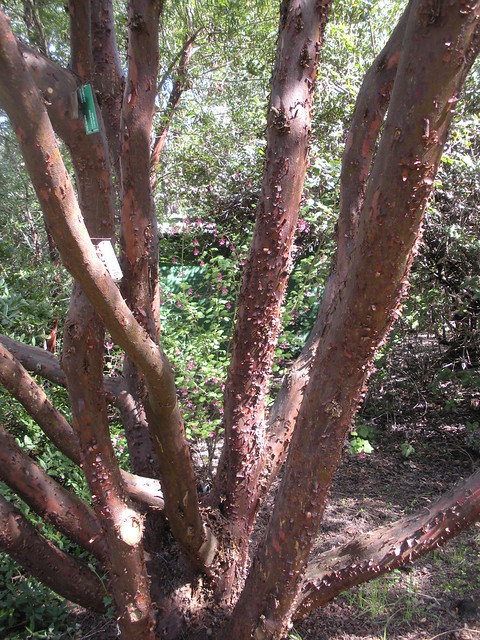
red bark of Tecate Cypress
It was one of my hopes to establish a unique Tecate Cypress woodland garden theme in my mother's landscape. However the tree has one flaw and that can be fatal. As a seedling and indeed, young tree, it is exceptionally fast growing. So much so that it's above ground branching structure will out perform it's own root system and become very top heavy. In my mother's backyard I built up a rather large retaining wall planter to construct my woodland garden. My mother's property and surrounding hectares of land around this were created from alluvial floodplain soils of sandy loam deposited over 1000s of years from the canyons above an area called Rattlesnake Mountain in El Cajon CA. Perfect soil for gardening, in fact this particular beautiful sandy loam soil is several meters deep. However it was my experience the second year when we received a heavy rainstorm and the winds blew some of the trees over or at least bent them over to the extreme. It should be noted however that in their native habitat the high winds are far worse, but the tough soil structure keeps the root system sturdy and also the accompanying chaparral act as a sort of plant staking support component. Take a look at how this works from the picture below of Cuyamaca Cypress with same soil requirements.

Cuyamaca Cypress with Chaparral Support System
~~~~~~~~~~~~~~~~~~~~~~~~~~~~~~~~
Tecate Cypress with Chaparral Support System
This past year my wife and I flew back to San Diego from here in Sweden and I had to cut all of them down but one. I felt horrible for doing it but it was necessary. Here's a picture below of this very planter location back in the year 2003 and you can see in the picture how some of the trees were already starting to lean over a bit. This is because the soil was very loose and sandy in it's structural make up. This may have been okay if the natural support system of a chaparral environment was in place, but it wasn't. Often times in a garden urban landscape setting we have to artificially stake up trees which would have been no problem in a wild setting.

Sadly in 2006, just before I moved over to Sweden, we had a very windy and rainy springtime storm in April 2006 which knocked over most of those trees. It was necessary to pull them back up and stake them with large posts to keep them upright, but it was difficult and the multiple stakes were aesthetically unsightly. Unfortunately this was necessary if I wanted to save them. There were further storms the following years and sadly that soft sandy loam perfect garden soil just wasn't strong enough to support all that top weight. With the "Earth Internet" planting strategy establishment game, I never use ANY chemical fertilizers what-so-ever. I did inoculate all of the plantings with a mix of both endo-mycorrhizae and ecto-mycorrhizae blended fungal spores along with beneficial symbiotic bacteria in the mix from a company called Plant Health Care Inc (PHC). I also heavily mulch around all of the plants. This not only adds a natural carbon feed to be downloaded by the complex sophisticated  mycorrizal network grid which exists underground, but it then is uploaded by the plants which transfer these beneficial nutrients which were made available to them from this grid. Yes you could use fertilizers to accomplish the same thing, but the health content wouldn't be the same and any mycorrhizae will actually disconnect and disassemble the healthy grid in the presence of heavy chemical usage. On an interesting note, it was in 2005 and the mulch I used came from the tree trimmings of some Canary Island pine trees from my work place and for which numerous volunteer seedlings popped up before I moved to Europe. I left them to grow naturally and had to thin the ones I didn't want. The result is that these trees which eventually replaced the Cypresses are now close to 30' high since I left in May of 2006. It's their nature to grow fast as well, but I'll have more on this in a future post. 

Here are some helpful ideas and very easy to understand tips on the benefits of an "Earth Internet" mycorrhizal based system by Linda Chalker-Scott an associate professor in the department of Horticulture and Landscape Architecture at Washington State University

"Why does the myth of phosphorus-induced root stimulation persist? The answer probably lies in theeffect phosphorus fertilizers have on mycorrhizal relationships. When plant roots are in low phosphorusenvironments, they exude organic acids from their root tips. These acids allow mycorrhizal fungi topenetrate the roots and form the networks that assist plant roots in taking up water and nutrients.Mycorrhizae are particularly adept at extracting phosphorus from the soil.""If phosphorus levels are too high, however, the roots do not exude the organic acids and mycorrhizalconnections do not form. This forces the plant to put more resources into root growth to compensate forthe lack of mycorrhizae. So in a sense phosphorus will increase root growth – but at an added cost to theplant. The resources expended by the plant in growing additional roots to take the place of mycorrhizaeare not available for other plant needs.""Shrub and tree species that are mycorrhizae-dependent have a difficult time surviving in soils wheremycorrhizae cannot develop. In particular, seedlings and newly transplanted materials are less efficient inabsorbing water and minerals from the soil and are more likely to suffer transplant shock than plantswhere mycorrhizae are present. Adding mycorrhizal spores to soils where phosphorus is too high isineffective – the spores will remain dormant."

On this same question and subject of soil structure, I had another unique experience in working with the soil on my sister's property in a brand new housing tract built in the year 2000 in Lakeside California. Like most newer housing tract developments in Southern California, most of the good agricultural land like my mother's property which use to be an Orange Grove are just about used up, but these newer tracts are built on steeply sloped hills or mountains. The building plots have certain specific compaction requirements which are necessary in order for the house to have a stable foundation. This of course is only logical given the sad experience by many folks who have homes in older developments which have been lost in well known southern California landslides as a result of poor clay soil accounting or consideration of the soil's structural make-up which no doubt was ignored in favour of making a quick profit in a desirable location, usually somewhere on the sea coasts where there is often a lack of solid bedrock for stability. My sister's property was prepared by the contractors who scraped off all top soil, used dynamite to blast through the granite bedrock and crushed this rock into various sizes only to be formed into the future housing pads and then compacted with heavy machinery for stable building foundations.

Image - Nic Lahoux
After the houses were built, they proceeded to apply a layer of brown Adobe looking earth and actually called this topsoil. Not only is this a major obstacle for the establishment of the usual horticultural selections you buy at your local retail nursery, but it is also a huge challenge for native plants from the same area. The soil structure is almost like that of Rammed Earth Construction  which is a new form of eco-designing house construction which has lately become popular for some. So your soil is almost like a solid concrete block wall. Water percolation is almost nill.
I found this out when constructing the hardscape which consisted of irrigation layout, retaining wall, pathway and step construction. I also found it necessary to create and build up raised planting beds and retaining walls around the perimeter and corners of her property. In the area where the lawn was I had to dig out countless large stones in between very little decomposed granite soil which was beneath the 6 to 8 inch phony labeled top soil added for nothing more than what I'd call "Eye Candy". I'm not at all a promoter of adding soil amendment to any tree or shrub plantings. However with the lawn it was a must. We had 5 deliveries of large bins of soil amendment from the local Home Depot. The work was tough and took a huge amount of extra time. The rock chunks I threw behind the retaining walls and mixed in with the soil there as it wouldn't have mattered to the trees and shrubs I would install there later. As always, I innoculated the ground where I wanted to establish the lawn, trees and shrubs. Interestingly, a healthy and thriving "Earth Internet" mycorrhizal web network will actually over time break down some of this compacted soils, but again, it will take some time 

 The bottom line when it comes to soils, you need first to familiarize yourself with you own property and the ground that lays underneath. Clay soils likewise have their own challenges , but there are plants that will work well in these, but you have to know which ones. If the nursery you do business at actually knows it's local business and has done their homework on what works in that area, then you should be able to get some sound advice from them. Also I have found from personal experience that it actually helps to get in your car and drive around the various local neighbourhoods in your area and take notice of the successful gardens/landscapes and ask questions of those homeowners. Again, knowing your soil and what plants will work is the first route to success and by all means DO NOT forget the benefits of establishing your own underground "Earth Internet"

Stay tuned for more articles and don't hesitate to ask specific questions on this.