Showing posts with label wildfire. Show all posts

Wednesday, February 7, 2018

Southern California: Breathtaking Natural Wonders that will one day Disappear

My Postcard World

In the old days back in the 1950s, animated post cards for travelers were everywhere like this California Natural Wonders postcard. I've always loved the map card's artwork and this one of California is really kool with all the little animated cartoony characters. This map card shows all the different natural wonders throughout California, like the giant redwoods, Death Valley and of course Yosemite National Park, just to name a few. California was always promoted and advertised as a land of wonders and rightly so. But I want to focuss on Southern California and many of the wonders which are now either gone or will be going soon. Did you know that Southern California boast one of the largest Lodgepole Pines ?


Photograph - Bryant Olsen - June 19, 2010

ebay.com - prefab log cabin kit
Most of us when we think of the lodgepole Pines, we may think of those dense woodlands in the northern reaches like Yellowstone where 80% of forest there is Lodgepole pine. We may also think of where their name comes from because these were used by the Native Americans there who did use them for lodgepoles for the typical Indian Teepee. The density of a Lodgepole Pine forest is such that because of the phenotypic plasticity scenario they often are associated with, competition is so incredibly extreme that all these trees can do is grow up as opposed to out. Hence we get a pole that is so perfect, that many prefab log cabin kit companies use the Lodgepole Pine for this very purpose.


Photograph - Jim Peaco - Yellowstone Sept 1998


Another name for a Lodgepole Pine forest is a Matchstick Forest. Not only because they actually do look like a book of matchsticks, but they are also known to go up in an explosion of fierce forest fire like matchsticks when ignited. Whenever the subject of wildfire comes up together with Lodgepole Pine, you almost always get an associated headline that reads, "Fire Adapted Forests & Fire Ecology." Fire Ecologists are passionate bunch when it comes to wildfire, so much so that they sometimes seem to almost worship fire as the only means for saving a plant community. This doesn't mean that fire cannot be used for good. Because it most certainly can. I know because I've used it on my own  land. But the question is, "Is fire really all that necessary in every and all circumstance and with what frequency ?" Opinions and beliefs among fire ecologists vary. Some say the necessary interval between wildfires should be 30-50 years, other say 70-130 years. Trust me there is no real united consensus among them. How often do you hear or read about them bickering amongst themselves for position as to each one's expertise in the public eye through various journals ? Now take a look at this megafauna dude below known as a Mastadon. He was mainly a browser. Can you imagine what effect he had on keeping forests and chaparral bush habitats open and airy ??? Or what about the giant ground sloth ???


No matter who you wish to believe or follow, almost none of them will acknowledge the benefits of grazing and browsing animals as a means of healthy ecosystem maintenance. Megafauna are almost never mentioned as part of the term "Natural" for no other reason than they no longer exist. Yet we often hear the term, "Pristine Wilderness." This term most generally means untouched pre-European white man landscape. But this also most often gives the impression that the Native American is somehow considered as having a sub-human status. Like a sort of animistic conservation force guiding nature. Indeed, the Native Americans are much revered and worshipped by fire ecologists and even environmental groups because of this ongoing romantacized myth that these people were the ultimate ecological land stewards. When we listen to their public lectures or read their articles in journals, the conversation almost always comes from the standpoint of the methods used by the Indians as land stewards. What has always bothered me is that I know for a fact that the Native Americans were and still are equal to all other human beings. They are prone to mistakes as everyone else. So are we to believe they only lit fires for conservation purposes ? What about mistakes with fire like lighting fires during a Santa Ana wind event to cook supper or deliberate acts of war utilizing fire against other hated enemy tribes ? The list is endless, but apparently if they made stupid mistakes, are we then to believe this too is a part of natural because they were natives??? Now consider this item below.
Champion Lodgepole Pine in San Bernardino National Forest
"Champion Lodgepole Pine"

image - bigbearlake.net
Wow, now that's not exactly what one thinks of when the image of a Lodgepole Pine comes to mind. The world "Champion Lodgepole Pine" (discovered in 1963) is a magnificent, double-topped tree that towers above the surrounding forest reaching a height of roughly 110 feet. It's age is estimated to be older than 450 years, which means that it germinated about the year 1560 CE. You really have to stand back at a distance to get the full view from across the meadow up there in the San Bernardino Mountains near Big Bear. The trail getting there features a wet meadow and other mature conifers including this largest recorded Lodgepole pine (Pinus contorta) in California! But some puzzling questions come up about the fire ecology dogma we are force fed about what is "natural" & "normal" when it comes to fire ecology. Take a look at those low hanging branches on this massive Lodgepole in the photo taken by Walter Feller above. Are we to believe that no fire blew through here and used those low hanging branches as a fire ladder at any time in it's 450+ years of life from 1650 onward ??? Clearly when this tree was young, the dense branches would have been from the ground up for a 100+ years anyway, with time and age naturally pruning off lower branches eventually. But still, these other giant dead limbs are almost touching the ground, how did all those fires miss this tree ??? There has been some remarkable work done on fire history and it doesn't really jive with all the blind faith dogma we've been fed. Back in February 2017 of this year, the Smithsonian Magazine printed an article about research done which stated that 84% of wildfires in North America were human caused. Interestingly, on the west coast of the United States the percentage is actually 90%. Here's the article below:
SmithsonianMag: Study Shows 84% of Wildfires Caused by Humans
Now back this past September, ScienceMag, did an interview with one of the researchers of that original study, Jennifer Balch, a wildfire ecologist at the University of Colorado in Boulder. Surprisingly, California itself is up around 90% higher than nationwide average of human caused wildfires:
"Nationwide, humans are responsible for starting 84% of wildfires, according to a paper co-authored by Balch, published this past March in the Proceedings of the National Academy of Sciences. In California, the eastern United States, and the coastal Northwest, people are behind more than 90% of wildfires."
Now here is a breakdown on highest reasons in order of highest stupidy just why many wildfires come about:
"So the breakdown: Of the approximately 1.5 million wildfires in the government record, 25% were burning of trash and debris; about a quarter (22%) were unknown human causes. The next biggest category is arson, [then] heavy equipment, campfires, children, and smokers. Those are the seven biggest categories.  Fireworks didn't rank in the very top for the whole year, but it does pop on July 4th. It’s the day with the most fires. Over 7000 events started on July 4th alone. They were predominantly started by fireworks. It's unfortunate that our Independence Day didn't fall in January or December when it's cooler and wetter.
So now we have to assume that out of all these wildfires, natural wildfire only accounts for a mere 10% which might translate to lightning storms (rarely volcanoes). Most of these occur within the middle of the country along either side of the Rocky Mountains all the way west to the Pacific Ocean. That 10% is still not a lot of wildfire if we want to label something natural in the forest maintenance department. When researchers study wildfire and proclaim it's hallowed importance to mantaining a healthy vegetative ecosystems, rarely do any of them ever account for the historical presence of large animal herds (herbivores like deer, elk, antelope, etc) and possibly even still farther back, the one time extistence of the herbivore megafauna presence which would have kept forests and chaparral bush habitats with well pruned understories.

But it was when Native Americans (also real human beings) finally arrived on the scene, that they then would introduce their reasons for utilizing wildfire, like running buffalo (bison and/or other megafauna) off cliffs and gradually putting pressure on slow moving megafauna species towards extinction through hunting, then yes everything did change. But some are still clinging to this Indian Burn dogma as natural phenomena for no other reason than ideologically driven religious dogma and politics. I'll move on and put other references at the bottom of this post. The final point here is that environmental components and other natural mechanisms now have changed for the worse and unfortunately this Champion Lodgepole tree's good fortune for avoiding catastrophe has run out. No doubt the end is nearer than we think for this tree also. If a catastrophic forest wildfire doesn't take the Lodgepole Pine tree, then perhaps it'll succumb to another fate like that of the last ancient Ponderosa Pine tree in Idyllwild California earlier this year 2017 which finally died and was professionally removed.


Image from myidyllwild.org
I wrote about this very tree in 2013. In all my searching while I lived up there this was the biggest Ponderosa Pine in all of Idyllwild and before that early logging in the area, such large trees were very common. But here is the last final documentation I am aware of. Sorry to be the bearer of bad news. 😞
Saturday in Idyllwild viewing it's most gigantic Ponderosa Pine
Image is mine from 2013 - Idyllwild California
One sad thing for sure we can count on is that this mega-drought is not over and this despite many eco-groups & government officials proclaiming the drought over and all is well, offering proof through photo posting on social media sites of a record year of wildflower abundance. And most bought into that. Scott McLean, a spokesman for the state’s Department of Forestry and Fire Protection, also known as Cal-Fire said this in June 2017:
“Everybody’s excited about the drought being over but all that moisture enhances the grass crop. It’s denser and higher, and it catches fire very easily."
(Source) 
Yes and the 2017 wildfire season turned out to be another record year of destruction. But lo & behold we are hearing again the drought was not over as propagandized last year. The death of trees will now only escalate. Previous news reports had estimated that 100 million trees in California had died thus far as a result of the 4 or 5 year mega-drought, but now a new report has that firgure at 129 million trees. As a news report just today stated, the warmer temps, lack of rain and snow are allowing more bark beetles to survive, when the normal cold should be killing and reducing their numbers. But that's not happening right now.
"Unseasonably warm and dry winter giving Bark Beetles in the Sierra a second lease on life" ABC30 Action News


More Bad News for another natural icon, Torrey Pines 😬
Photo: Scott Davenport/Flickr/Creative Commons (2013)
Major decline in Torrey Pines & SoCal Forests in general
Sad to imagine decline and general death in Torrey Pines, but it's true. The top photo is a favourite viewpoint for 1000s of photographers, both professional and amateur. Take note of the beautiful iconic scene in the top photo from 2013. Below is a photo of this same geological location as it exists today. Notice the dead trees ? Many blamed drought, but oddly enough down the road at Torrey Pines Country Club and Golf Resort, 66 trees planted many decades ago in association with massive networks of golf course green lawns are dead as well. This is a strange anomaly because the golf course setting creates a wetter climate scenario which is the extreme opposite of the State Reserve circumstance just to the north. Thus far no one is really taking note of the difference.


Broken Hill Sunrise by Phillip Colla (2015)

Other examples are just plain devastation of natural areas by wildfire. In San Diego County, the 2003 Cedar Fire almost completely obliterated the entire Cuyamaca Stat Park. For those who don't know this region in the San Diego Mountains, it was like the Yosemite of Southern California with numerous square miles of no development, just raw unbridled wild old growth forest. It's all gone now and numerous generations after generations will never see Cuyamaca's old growth splender with the exception of old photographs. Go ahead and google it for yourself. Mankind is debating back and forth about whether or not humans are the cause of climate change. No one now disputes climate change is upon us, but rather the argument appears to be who or what is at fault for the climate change. Presently, the Scientific Orthodoxy is fingerpointing at the whole of mankind as fault for climate. Oddly enough there is an element of truth to that.


This Lemming animation above is well known. The animals themselves have often been the subject of overpopulation and mass suicide myths. Interestingly back in 1951, there was a science-fiction piece published entitled, "The_Marching_Morons" which depicted an over-populated planet run by a handful of Elites who viewed the rest of humanity as nothing more than unintellectual morons (compared to themselves) who needed to be controlled. You see, the morons over-populated (prolithic at having babies) Earth as compared to the intellectual elites who didn't procreate as much. Sound familiar ??? Sounds like much of the scientific environmental talking points from scientists who blame global climate change on everyone else but themselves. The sad reality fact is that mankind only follows the bad leadership it has been given. People have been conditioned and trained that way from birth. Secular Science has truly further created a mainly materialist minded human being who only wants more and more THINGS (TOYS) like the wealthy among them have. Mind you, this same materialism infects the conventionally religious among mankind who also have been material minded for many centuries as opposed to anything spiritual. And science for the past 150 years has oblidged their hunger for materialism with their technologically advanced products. Unfortunately these products and other wares demand raw materials taken from Earth's dwindling easy to get natural resources and science has oblidged there as well by providing more efficient technologically advanced destructive means by which these raw materals could be extracted. In so doing they have reverse engineered vast ecosystems across the globe, much of which provide weather and climate controls, clean water filtration and food production by incredibly complex and sophisticated mechanisms for countless 1000s of years which other more responsible parts of science are now only beginning to understand. Yes the average poor slob human beings are viewed as those moron Lemmings and Big Consensus Settled Science represents the Elitists who now attempt to run things and fingerpoint at everyone else as the problem. Really guys ??? 😔😕

I'll add more examples as I have time, but clearly many many more major natural attractions in California will continue to be in decline, despite so-called proclamations from environmental groups that all is well.

Other References on Reason for Decline
What's the real connection between Droughts & Wildfires ?
Burn Baby Burn - Fire Ecologist Celebrate Fire Season


Wednesday, July 6, 2016

BREAKING NEWS: Apparently Trees don't really Gulp, Guzzle & Water Hog, only Humans do that

Somewhere Roger C. Bales & Michael Goulden just fell off  the proverbial chair

Artist John Cox, Terre Haute, Indiana.
 (White Cloud 1942 - published in Life 1948)
Those large wildland Mega-Fires are actually Ecologically Beneficial - Seriously ???
KANSAS CITY, Mo. (AP) — The wildfire that scorched nearly 600 square miles of land in Oklahoma and Kansas in March cleared out more eastern red cedars in a week than local efforts to eradicate the invasive species could have accomplished in decades, conservation experts say.
"This was an ecological cleansing for the environment," said Ken Brunson, wildlife diversity coordinator with the Kansas Department of Wildlife and Parks. "That's mixed-grass prairie down there. Prairie survives with fire."
(Source - St. Louis Post-Dispatch)

(Aron Flanders/US Fish & Wildlife Service photo via AP)
May 2014 photo provided by Aron Flanders of the US Fish and Wildlife Service shows eastern red cedar infeastation in Southern Barber County in Kansas before the Anderson Creek wildfire. 
The article from the St. Louis Post-Dispatch was entitled, "Wildfire in Kansas, Oklahoma called 'ecological cleansing'" and the same theme was carried by other News outlets. But doesn't that new label or terminology, 'ecological cleansing', have an eerily familiar ring to it ? 
"Ethnic Cleansing" - is the systematic forced removal of ethnic or religious groups from a given territory by a more powerful ethnic group, with the intent of making it ethnically homogeneous. (Wikipedia)
Keep watching out there for this latest derogatory term to make the rounds and become a regular part of the scientific community's more enlightened vocabulary. Especially where industrial business interests are concerned. One of the biggest mistakes human beings make when attempting to describe something in the natural world is they tend to judge and view things about Nature only in human terms and you cannot do that with the natural world around us. The common flaw in human viewpoint on things in nature are generally based on things they like or dislike, things they view as beautiful or things that are ugly, things that annoy or please them, etc, etc, etc. Things that are inconvenient, bad, creepy, spooky, evil, good, are motivated by loads of emotional bias. In the case of the Eastern Red Cedar (Juniperus virginiana), there are economic considerations. Take a further look at what US Fish and Wildlife Service, Aron Flanders says regarding Eastern Red Cedar:
"Yes, we killed the trees with the wildfire, but we didn't remove the problem," said Aron Flanders, a biologist with the U.S. Fish and Wildlife Service. "The trees still standing will act as a shelter for the next generation of trees."
(Aron Flanders/US Fish & Wildlife Service photo via AP)
The May 2016 photo provided by Aron Flanders, of the US Fish and Wildlife Service shows reduced eastern red cedar infestation in Southern Barber County in Kansas after the Anderson Creek wildfire.  The wildfire that scortched nearly 600 square miles of land in Oklahoma and Kansas in March 2016 destroyed homes, killed livestock and damaged thousands of miles of fence. But conservation experts say it also cleared out more eastern red cedar trees in less than a week than local efforts to eradicate the invasive species could have accomplished in decades.
Apparently to some experts like Aron Flanders, if these dead trees are not removed by allowing logging companies to come in and harvest them, then this disastrous scenario will happen:
Red cedars, also known as junipers, are fast-growing, drought-resistant trees that are useful for erosion control along canyon edges in the region's Red Hills. But they're a nuisance on prairie land because they crowd out native grasses, suck up moisture from the soil and reduce the amount of forage area for wildlife and livestock.
(Credit: US Forest Service)
Does some of the terminology sound familiar ? These trees are known to 'suck water', 'guzzle water', or 'gulp down water' ??? This was the same stunt pulled in California where certain hydrological experts made the same accusation against all the trees in the Sierra Nevada Mountains. The claim was that the lack of water in streams, rivers and reservoirs were drying up not because of the four (going on five) year drought (climate change induced), but rather because the native vegetation was at fault for gulping down all the available water which prevent big industrial agricultural interests from getting their big share. After all, they only want to feed mankind. Their theory suggested that if logging companies were allowed to harvest and thin throughout the Sierra Nevadas, that water would return to the streams, rivers and lakes of California. But oddly enough we don't have to wait that long to see if their theorized massive logging projects would bring improved stream flows, because the media has been posting this news headline everywhere:
A record 66 million trees have died in Calif., increasing fire risk
=========================================
The Water Guzzling Alert: Roger C. Bales is still on the Tree Logging warpath for Industrial Agriculture again
New York Times: Sierra Nevada Snow Won’t End California’s Thirst - by Henry Fountain, April 11, 2016 
=========================================
The big question though to those hydrological experts is, did they do any studies in regions where millions upon millions of dead trees occurred and did shy mystic water magically increase in the streams, rivers and lakes ? No and the reason is you need water from normal rainy seasons to make that happen in the first place. Despite the less than as advertise El Nino saviour coming to the rescue, it didn't even make a dent in the drought. But back to the controversy of the Eastern Red Cedar, the ranchers and others with vested agricultural interests who have greatly exaggerated the Eastern Red Cedar as greedy user of water and those imaginary detrimental side effects these trees have on grasslands. Rumor has been spread around that the Eastern Red Cedar consumes 50-60 gallons of water daily, stealing it from precious grazing lands. However that appears to be a gross exaggeration. Oklahoma State Division of Agricultural Sciences & Natural Resources said this:
"With funding from the U.S. Geological Survey and the Oklahoma Agricultural Experiment Station, Giulia Caterina, graduate student, Will and Chris Zou, ecohydrology assistant professor, found that, on average, redcedar trees used six gallons of water per day."

The Eastern Red Cedar's biggest drawbacks are mainly a lousy public relations, because for the most part humans judge this native tree as having no value either economically or aesthetically in the opinion of the person who hates it. People have a flawed tendency to judge most things in the natural world the same failed way they misjudge other human beings who are from different cultures, races, ethnicities, etc. Hence we have a ruined planet as a result both physically and socially. I've stumbled upon this stupid reasoning with native plants in the chaparral plant community of Southern California where humans place value on certain specific plants because they have good ornamental value, can make money off them or generally have that eye candy curb appeal. So what exactly did Ralph Waldo Emerson mean by looking for "virtues" in a weed ? We should first define weed. A weed should not necessarily be considered one of those usual pesky annual ruderals which invade and carpet your yard for which Roundup is employed. Truthfully a weed is any plant that interferes with a human being's opinion of what they consider to be useful, pretty, good, of economic value, etc. The term "virtues"  equates 'good qualities'. Emerson is just saying that plants classed as weeds may turn out to have uses we may not as yet know about. For example many chaparral plants in Mediterranean climates act as an important erosion control component mechanism for a time after disasters. Thereafter other more desirable plants can grab a foot hold and are helped to survive early life and eventually replace the chaparral nurse plants. Certain Chaparral nurse plants [many of them disliked as dull or mundane] have this same quality of mothering or nursing many valuable tree saplings until the trees are large enough to succeed them as an old growth forest. But there is no getting away from the repetitive ignorance for which most ignorant people accel. Much of the ignorance and arrogance comes from the very people who should know better for know other reasons than their credentials. Take note of one Professor's biased opinion of the Eastern Red Cedar.

If these were California Redwoods, beautiful and pristine, or some useful tree species to man or animals, I might feel differently.  But even when they're allowed to grow with plenty of space around them, Red Cedars often aren't very pretty or useful.
Professor James Roush, Kansas State University
Photo Devan McGranahan & M.C. Christy
Interestingly, the Eatern Red Cedar does have excelling value even if the elites among us refuse to recognize and acknowledge this value. For example aside from being an actual native to Oklahoma and eastern Kansas/Missouri, the areas further east are Virginia, North Carolina etc. In the eastern USA they mainly invade reclaim the old abandon farm fields. Much like the unused farmland in the photograph above somewhere in the midwest. In the wild the Red Cedar is a pioneer tree. Where they form woodlands. Eventually the more desirable hardwood trees develop and emerge from the Red Cedar's nurse plant services and replace them in about 100+ years. Therein lies the main problem for humans. It's called  impatience. No one wants to wait 100 long years before they can harvest. That's the same thing out west where chaparral is demonized as a competitor plant [often claimed to be an invasive in it's own native habitat] instead of a facilitator of Timber tree species. Industrial Corporate Science [SweTree] here in Sweden has also developed GMO Trees which can be harvested in 20 years instead of 100 years. This process is also helped along by helicopters dumping loads of synthetic pellet fertilizers to bypass what they view as slow inferior natural systems. The Red Cedar Trees also aid wildlife with both shelter and food. Interestingly, contrary to what humans think, the Red Cedar is incapable of planning, scheming and invading on it's own. It simply responds to environmental cues and opportunities provided by wildlife. Take a look at the recent research below of how birds create newer ecosystems.

Migratory birds can disperse seeds long distances & create new ecosystems ???

Image - Francesco Veronesi 2010
Common Redstart male (Phoenicurus phoenicurus)
Some species of plants are capable of colonising new habitats thanks to birds that transport their seeds in their plumage or digestive tract. Until recently it was known that birds could do this over short distances, but a new study shows that they are also capable of dispersing them over more than 300 kilometres. For researchers, this function could be key in the face of climate change, allowing the survival of many species.
(Source: American Journal of Botany)

Image: Sherri Patrick Brandt
Hmmm, I think there is a reason this bird on the right is called a Cedar Waxwing. They have a love and passion for all kinds of berries. But there are actually 20+ other birds which will dine on the Eastern Red Cedar berries as well and yes, they slowly extend ecosystems or create newer ones. Apparently they too should be considered the new evil villans behind invasiveness. Anyone who has ever tried to germinate Juniper berries [which is what Eastern Red Cedar actually is], know the difficulty in making that happen. Artificially they need to use something like sulfuric acid to soak seeds in order to break the hard protective shell coating to allow water to penetrate. Any bird's or animal's digestive tract is the perfect environment for that task. In many of the negative commentary I've read about Eastern Red Cedar and especially by the so-called Experts on the subject, they warn about allowing the trees to remain because they produce 1000s upon 1000s of seeds that fall off the tree and produce more trees. Some of this stuff is the most ignorant propaganda I've ever read by any experts in official positions of authority. Maybe they should kill off all the birds and that will seal the deal. Read up on how China did that with Sparrows and how well that worked out for them.

The real Water problem is not Nature, but rather a Human created Climate Disruption
Let's take a few examples. Another demonized Juniper in this region of the central plains is the Ashe Juniper which has been on the receiving end of other derogatory labeling to excuse and smokescreen human stupidity and ignorance. The Ashe Juniper as well as the Red Cedar in Texas has been labeled as "Water Thief", "Sunction Pump", and "Water Hog". Oddly enough, most of the negative articles demonizing these plants are produced by local industry leaders in commercial agriculture and Media sources whose own economy is based on those in the Ranching biz. Another demonized tree, Western Juniper, in eastern Oregon is also being accused of being invasive in it's own native range. Oregon State University who provided the research for the study was funded by the Oregon Beef Counsel. See my link below under references called "Pretzel Logic." Now below is another link which shows how important Junipers are to wildlife. So important that the Golden Cheeked Warbler of Texas is extremely endangered because of the Cattle Industry destroying habitat for raising beef.
"Golden-cheeked warblers are endangered because many tall juniper and oak woodlands have been cleared to build houses, roads, and stores. Some habitat was cleared to grow crops or grass for livestock. Other habitat areas were flooded when large lakes were built."
Golden-cheeked Warbler (Dendroica chrysoparia) 
Below here is yet another report on the lying assertions made against the Ashe Juniper of Texas which often is found with Eastern Red Cedar. The Ashe Cedar like the Red Cedar also has been given the reputation of being a water guzzler, but responsible scientific research has proved otherwise. These researchers had no vested financial interest in the outcome of the study because of who funded them.

Plateau Land & Wildlife: New Research Shows Ashe Juniper not the Water Hog It Was Thought To Be
Historically the Edwards Plateau was a dynamic mosaic of grasslands and woodlands and much more savannah like. Cedars were found mainly in canyons where they were protected from wildfires. When settlers arrived, the introduction of cattle led to overgrazing, and, combined with the lack of fire, gave cedar the opportunity to expand its range and take over.
Now let's look at the real problem behind native prairie grass loss. Take into consideration what was reference above about agriculture. Human greed from it's earliest start on the North American continent where people from Europe fantasized about making fortunes in cattle ranching brought in more cattle than the land could support. The problem is, bobody ever considers the plant world's ecosystems as a cooperating biologically fine tuned run machine, but that's exactly what it is. Or rather was. Take a close look below at what overgrazing actually does to root infrastructure of prairie grasses.

University of Florida

Photo - Mark Mauldin
Both photos above and to the right show grass experiments where the blades were deliberately clipped and kept clipped at varying length levels from the ground surface. They basically replicated wild prairie lightly grazed to heavy overgrazing. The photo at right is from a Canadian research station showing the root growth of bunchgrass plants that were kept clipped at certain levels. In each case the above ground foliage dictated how well the root system developed and maintained health and vigor. Now look at this photograph below of a bahiagrass pasture in Washington County, Florida, that has experienced significant stand loss. Before any efforts to salvage or replant this pasture can be successful, the factors leading to the decline must be identified and addressed. In many cases the shorter roots and struggling grasses succumb to a pest called 'Ground Pearls.' But in the photograph below, does anyone see any invasive Red Cedar or Ashe Junipers out there causing the prairie grasses to descend into a major decline ???

Photo by Mark Mauldin
People clearly are going to have to do their own homework on this. Mankind has set a climate change process in motion which is having a major ecosystem disrupting domino effects all over the Earth. Chaparral plants systems are replacing dead and dying trees throughout California. Experts want to blame chaparral which are incapable of evil thought, scheming and planning to ruin things for human business ventures. Had people actually paid close attention to much of the available good science out there instead of shortcut industrial science, then maybe the planet wouldn't be in the toilet right now. Frankly I don't know what else there is to say. Each one is going to have to decide which authority they are going to believe and follow. In the mean time, considering there are no real viable materialist solutions, why not enjoy reading up on some history on what Nature use to be like from an early explorer's writings who first discovered these natural wonders. Pay close attention to what things use to look like before intellectuals 150+ years ago told us nature was flawed and badly designed and only Man's enlightenment could fix the copying errors and make a profit on the deal all in one shot.
Juan Bautista de Anza & Pedro Font Diaries archive
 ~~~~~~~~~~~~~~~~~~~~~~~~~~~~~~~~~~~~~~~
Further Reading References
Pretzel Logic & the "Denial of the science is malpractice" Mandate Define science ?, What science ?, Who's science ?
New Research Shows Ashe Juniper Not the Water Hog It Was Thought To Be
http://www.landsteward.net
Our Love-Hate Relationship With The Red Cedar Tree

Thursday, February 20, 2014

A Classic Picturesque Engelman Oak Scenery Gone Forever

The 2007 Poomacha Fire was the beginning of the end for the picturesque Engelman Oak woodland settings around those hairpin switchbacks of Hwy 76 on Palomar Mountain west of La Jolla Indian Reservation. And for that matter other associated plant communities.
NASA satellite photo (provided by NSPO, Taiwan National Space Organization)
 from October 23, 2007, showing the active fire zones and smoke plumes.


Hairpin switchback on Hwy 76 at Palomar
I almost want to start out making an apology for never once thinking of taking photographs for future historical reference of what once was. How often lately I have written about many things I know and have experienced, but like many other Natural World accounts, I too can only story tell what I've experienced. This particular specific location where 76 sharply spirals down hill had numerous picturesque and contorted Engelman Oak trees which were reminiscent was something you would see only along ridges in tropical rainforest mountaintops. 


Courtesy Scott Turner, Escondido CA
The often twisted but picturesque patterns of some trees are often much like the wildlife pruned Acacia tortilis of the African Savanna. California's Engelman Oak is actually interesting that way in that it seems to self-prune into itself into interesting more open patterns than the common dense forms of the various Live Oaks. You'll often see them in what could be considered Southern California's own form of Oak Savannas like those of Central California foothill regions. The best view in the past was driving past the Palomar Mountain junction turnoff and heading west from La Jolla Indian Reservation. It was from this high vantage point that one could see out towards the west the patterns clearly and distinctly. Sometimes I'd pull over on one of the viewpoint turnouts just to take it all in. And yet never once did I ever consider to photograph it for future reference. I always and mistakenly assumed it would always be there. In the times we are presently living in, nothing should be taken for granted as if it will always be there. But I did photograph this region this past Spring of 2013. Before I arrived, I truly wished this spot had escaped the horrible onslaught of the Poomacha Fire of 2007. No such luck. Below here is basically a gallery of what is left.


Photo: Mine
Before dropping down and spiraling into the back and forth switchbacks, you'll see the western edges of the Palomar Mountains which I believe is the Agua Tibia Wilderness. The area was blitz heavily by this fire. I watched it all late night over here in Sweden as both the Witch Creek and Poomacha Fires did as they pleased. I read through the pages of the online San Diego Union where a concerned wildlife enthusiast hiked up Pauma Creek where remnants of the native Southern California Stealhead Trout were located and they were still some in tiny pools alive but just barely. The danger of course was the coming winter rainy season which would have filled these pools with tonnes of silt and other sediment and debris. He alerted what he thought were the correct officials to send teams in to rescue the trout before the disaster which was sure to happen. As is usual, it was insisted that certain studies would need to be performed followed by discussion. However, it did appear some made it but many many areas didn't and some pools disappeared under tonnes of debris. It will of course take years of winter rains and normal high water flows to scour out those pools once again, but of course there is that present decades drought problem. The story can be followed here on the San Diego Trout's own website. Very interesting read with many photos of before and after in the referenced links
http://www.sandiegotrout.org/archive.html 


Photo: Mine
This is yet another photo taken which is actually further east near the San Luis Rey River Campground. The dead trees are those of the tough Big Cone Douglas Fir trees which I always associate more with Chaparral than I do other forest trees, although they do mix with other large trees. They have the ability to survive and actually thrive on hot steep southern slope where no other tree can succeed. Well, other than Engelman Oak which has a survival strategy of being drought stress deciduous and partially sheds half it's leaves in desperate times if need be. Big Cone Doug fir will actually sprout from the truck and branches again, something the other native conifers are not capable of doing. Mountain Center California has prime examples of this sprouting after fire along Hwy 243 if you know where to look for them.


Photo: Mine
This is the last open space of meadow just before you start dropping down into the steep switchback of the Pauma Grade on Hwy 76 where Pauma Valley and the Rincon Reservation / Casino which are are below. I wonder how many people have actually passed by here before and never truly appreciated the scenery before the fire took it away ?
Photo: Mine
Now finally coming around that first turn to the left on the Hwy 76 switch back where you start to grasp the more open view of the hilltop and ridge terrain scenery and of course one this shot is from the first turnout location you come to. This view shows some trees still intact and making a recovery of sorts, but looking nothing like their former glory. You also can see where many did not survive the fire to make the survival journey at all as the dead snags clearly indicate. Still there is enough holdover evidence of the areas once dominant ecosystem of Engelman Oak woodlands.


Photo: Mine
Same exact turnout as in the photo above this one, but the camera angle is further to the left looking directly across the other side of the road up the hill at the Engelman Oaks that survived. Notice the heavy cover of White Sage (Salvia apiana). This is common after fire. Fire to appear from my own observational view since the middle 1960s is that Deerweed (Lotus scoparius). Everyone should know that in many chaparral settings, especially nearer the inland valleys and coastal areas, these two shrubs are the first to comes back after fire wipes out the mature California Buckwheat / Sagebrush along with Laurel Sumac. In the old days after a fire tore through an area, the initial Springtime explosion of numerous varieties of wildflowers would be the first stage recovery component, followed by Deerweed which would blanket the hillsides for the first several years with White Sage moving in only to eventually overwhelm them. White Sage at the beginning will be huge, but will eventually yield to the California Buckwheat & Sagebrush. White Sage will always be present thereafter, but in a much smaller form. Laurel Sumac will sprout from the root crown immediately after the fire if moisture conditions are healthy in the sub-soils. It is these plant components which government agencies will almost always want to bypass, and clear the land by stripping it to the bare earth and immediately proceed to plant oak or other more desirable tree species if they were present in the location formerly. Especially is this true if the area were an officially designated Preserve or Park where the Public demands they do something quickly about restoration. Rather than actually educate the public as to the necessary role the early plants play in land revitalization as far as progression provides, they opt for a quick fix eye candy approach of replacing trees immediately with public approval. This is a shame because a healthier survival rate is produced and the earlier forage is better for the animal recovery. But always remember, these places are about pleasing people, not wildlife.

Photo: Mine
This is the second turnout looking back up back across the Hwy 76 road again to the east. The lower areas where most of the one time picturesque Engelman Oak trees once existed were much harder hit by the raging Poomacha Fire. Most were gone and those that were trying to come back were struggling. Only a few single seemingly untouched looking specimens appeared as lone comebacks. Ones like this next picture below here.

Photo: Mine
 Same second turnout location, but this photo faces north towards the western edge of the Palomar Mountains which are in the background to the north. Around this particular tree were numerous wonderfully lush green examples of California Holly or Toyon as can be seen just behind the guard railing. You'll notice all the brown on the lower part of the shrub ? All over San Diego County on my road trip almost all vegetation was dead and brown from the ground up to a meter in height. This is San Diego County and CalTrans way of road maintenance of their roadway easements by means of chemical pesticides.


Photo Courtesy of OneOakGrowers
I wish years ago more people had known about Engleman Oaks as far as landscape value. I wish I had done more with them. Tough little trees which need very little care if started off properly. Now there are desperate times with water becoming an even greater issue than at any other time in history. They are picturesque and seem to naturally self prune as I have already mentioned. They are not as dense as the heavier foliage Live Oak tree species. While Lives Oaks in nature require perhaps a deeper bottom land valley soil, the Engelman Oak can survive and actually thrive in some of the nastiest looking shallow rocky soils with often times a mix of adobe or red clay and on a southern exposure. Seriously, what other tree survives and thrives under those conditions ? 
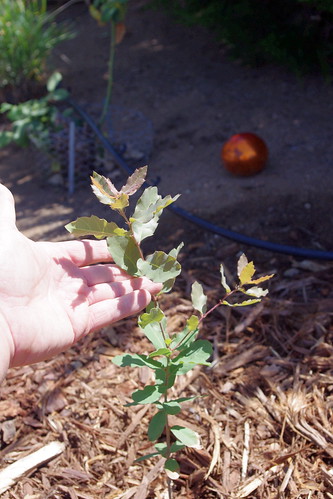
Before returning to Sweden, I actually planted some Engelman Oak tree seedlings at my mother's and brother's places. At my brother's place I also planted Foothill Pine (Pinus sabiniana)  in carefully selected locations near deeply rooted chaparral and Scrub Oak this past 2013 Spring before leaving to come back here. I simply planted in non-amended native decomposed granite soil and also inoculated the soil with a diverse mycorrhizal mix from Mycorrhizal Applications Inc. I kept tabs on their continual progress  from my mother and brother up in Ranchita and from what I was told, everything did exactly what I explained would happen. Hence I am excited to come back and find out just how well everything has progressed thus far. I have written a couple of other posts on the Engelman Oaks last year and will write another this coming June 2014 as I will again be out there. I'm also curious if any truffles will be found near by. I am also curious if the surrounding native Scrub Oaks have also improved in their leave cover and lusher vitality. This is also my experience after inoculating during the second year. Below I'll link again to my former posts. I'm sorry that most people reading this will never see what once was in their lifetime. Like the 2003 Cedar Fire before them, no one reading at present will ever experience the wonderful biodiverse old growth forest which once was Rancho Cuyamaca State Park. The real danger is that with so many more people and so much irresponsibility going on around the globe screwing up the climate, things will never be the same. More wildfires will mean less and less permanent recovery if they occur year after year. Below here is an example of a month and a half growth after planting before I came back to Sweden. It is said to be double that height now. The drip in the back ground is to the rose bushes, not the Oak sapling. Water was actually withheld after initial first week. 

Photo: Mine

Engelman Oak Sapling in El Cajon California
~~~~~~~~~~~~~~~~~~~~~~~~~~~~
Further reading References:
Engelmann Oak (Quercus engelmannii) an Often Ignored Native in the Landscape
What We Need Here is Wildfire to Propagate !!!
http://www.californiachaparral.org/

Friday, July 26, 2013

Revisiting Black Locust and their Root Networks

New Mexico Locust - Anza California
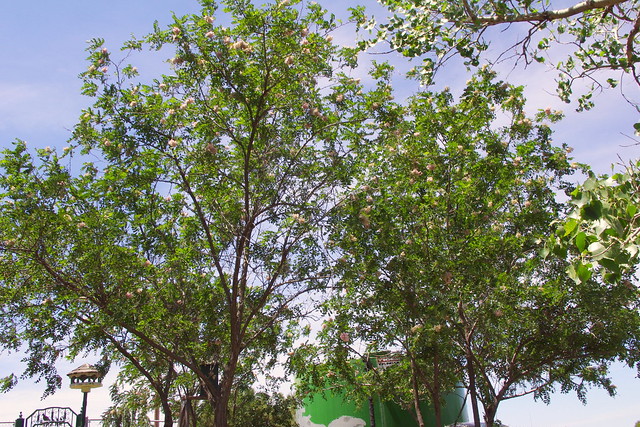
I've previously written a couple of posts on the subject of Locusts and I never seem to find areas where I am satisfied with knowing everything about them. This past Spring April/May when I last visited Southern California, I ran across some old plant friends of mine again. I went back to Anza and revisited my old New Mexico Locust woodland patch. Still thriving and in full bloom at the time. You could say this is a follow up to what I've written previously here about networking with New Mexico Locust which I'll post the link at the bottom of this post.
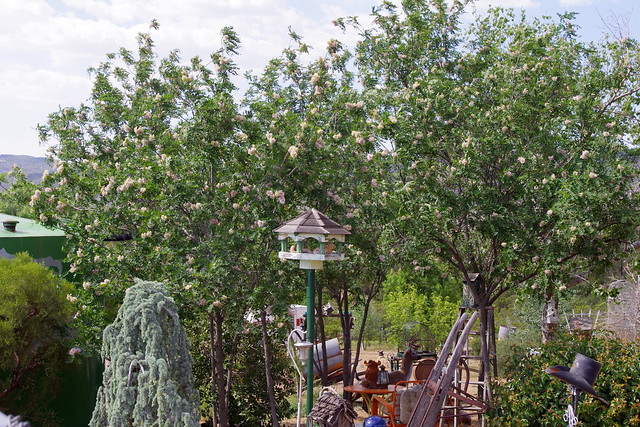
Photo: Mine
The lady who now owns it is quite a collector  of things. She runs an antique barn down in  Anza. But the New Mexico Locusts which  really don't get much higher than what you  see in the picture
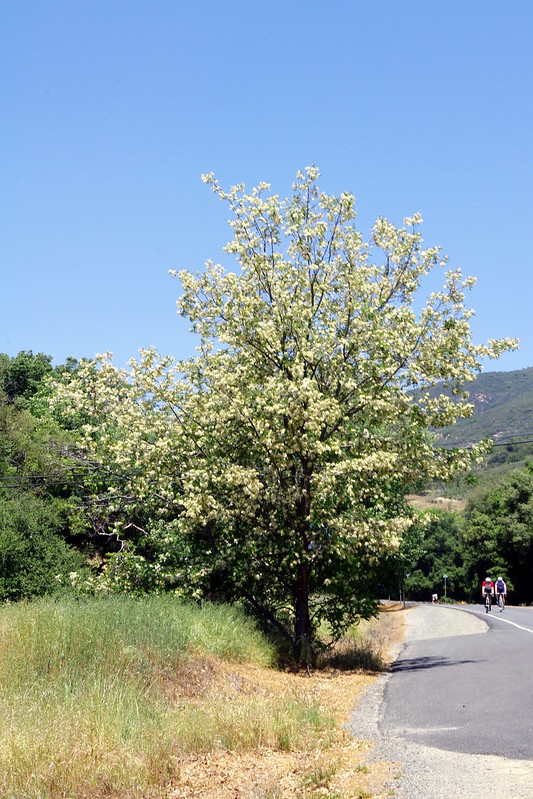
Photo: Mine
This is a Black Locust (Robinia pseudoacacia) and it's location is on Hwy 79 north from Santa Ysabel CA and right directly across the street from the south entrance to Santa Ysabel Indian Reservation on School House  Rd. This medium sized tree has been here for ages and  was an early Landscape plant in many rural area gardens  and properties of San Diego County. On the opposite  side are some younger trees which may have germinated by seed or by underground root networks. Incredibly though, this small tree just seems like it's been here forever. Well, as far back as my memory will take me. Of course when we were all kids in the early 1960s and took drives into the San Diego backcountry I would see them everywhere. I assumed of course that they were native to the wild here. But that was not the case. One of the reasons I thought them to be native was/is there incredible ability to survive and thrive under hot and otherwise harsh conditions. In many way they are very similar to Engelmann Oak which is native and a tough survivor. At the very least in some areas, you could label them as naturalized. But not so much as a negative like an overwhelming invasive such as Tamarisk or Brazilian Pepper Tree.

Photo: Mine
I took the above pictures on my early visit into the backcountry, but below are some pictures of an area I always admired for a long row of Black Locust at the foot of a hill along Hwy 67 just north of Poway Road Jct. It is just south of an old Antique & Curio shop which burned down during the 2003 Cedar Fire and south of Mount Woodson. It's also across from an outdoor parking for hiking in an open space area directly across Hwy 67 called Iron Mountain Trail that you see above here. When I was a kid and we past by this area on weekend drives, I always thought these were some variety of Native tree. They were never watered that I knew of and this area is a hot dry harsh by garden standards climate spot. Yet they always thrived here But the Cedar Fire put a stop to that temporarily, like every other plant in it's pathway. What I was curious about how ever is what has caused the explosion of growth of far more trees than historically existing prior to fire ? Actually it is the fire ecology that was responsible for spread by underground sprout re-vegetation by extensive root networks, than by any seed dispersal spreading. And it makes more sense. I found a page from the Michigan Department of Natural Resources which considers it an invasive there. First a bit of history regarding this tree, it's origins, and native habitat. 
Black locust is native to the southern Appalachians and the  Ozarks, where it occurs on slopes and forest edges. It has  been planted in 48 states and was noted as spreading in  jack pine barrens in Michigan as early as 1888. It tolerates a  wide range of soil conditions, and spreads clonally as well as  by seed. Its dense thickets shade out native vegetation. As a legume, black locust fixes nitrogen and soil nitrogen  levels are higher under old trees. It produces more leaf litter  and that litter has much higher nitrogen concentrations  than most native tree species. Soils under black locust also  have elevated levels of phosphorus and calcium. 
Habit: 
 Black locust is a deciduous, medium-sized tree ranging in  height from 12-25 m (40-82 ft) and 30-60 cm (12-24 in) in  diameter, although trees in Michigan have reached 1.5 m (5  ft) in diameter. It has a narrow crown and an open, irregular  form with contorted branches. Black locust has an extensive  network of lateral roots and forms dense clones. 
Reproduction/Dispersal of Black Locust
Black locust reproduction is primarily vegetative, although  it can also reproduce by seed. It sprouts from the roots and  forms clones, particularly in sandy soils. It also sprouts easily  from stumps in response to damage.  Black locust grows rapidly and matures early; some trees  may produce seed at six years of age. Heavy seed crops occur at one or two year intervals.  The seeds have a hard, impermeable coat and require scarification to germinate. They are heavy and fall close to the  parent tree, although birds may move them over longer distances. Michigan Flora notes that seeds may remain viable in  the ground for up to 88 years. Seeds can accumulate in the  soil a density of 29,817 seeds/acre in second-growth mixed  forest. Densities are much lower in mature forest. Trees begin suckering at four or five years of age. A fibrous  network of roots connects a black locust grove, with the  oldest trees in the center and younger trees around the  periphery, In late-successional communities, black locust  becomes rare, as the species is shade-intolerant.
(Source)
 ~~~~~~~~~~~~~~~~~~~~~~~~~~~~~~~~~
A more positive piece on Black Locust and Fire Ecology was from the University of Georgia
"THE ROLE OF BLACK LOCUST (ROBINIA PSEUDOACACIA} IN FOREST SUCCESSION"
Abstract:
Soil nitrogen mineralisation and nitrification potentials, and soil solution chemistry were measured in Black Locust (Robinia pseudo-acacia L.), in pine-mixed hardwood stands on an early successional watershed (WS6), and in an older growth oak-hickory forest located on an adjacent, mixed hardwood watershed (WS14) at Coweeta Hydrologic laboratory, in the southern Appalachian mountains, U.S.A. Nitrification potentials were higher in black locust and pine-mixed hardwood early successional stands than in the oak-hickory forest of the older growth watershed. Ammonification rates were the main factor controlling nitrification in the early successional stands. There was no evidence of inhibition of nitrification in soils from the older growth oak-hickory forest site. 
Within the early successional watershed, black locust sites had net mineralisation and nitrification rates at least twice as high as those in the pine mixed-hardwood stands. Concentrations of exchangeable nitrate in the soil of black locust stands were higher than in pine-mixed hardwoods at 0–15 cm in March and they were also higher at 0–15, 16–30 and 31–45 cm depth in the black locust dominated sites in July. Soil solution nitrate concentrations were higher under black locust than under pine-mixed hardwoods. Areas dominated by the nitrogen fixing black locust had greater nitrogen mineralisation and nitrification rates, resulting in higher potential for leaching losses of nitrate from the soil column in the early successional watershed."
~~~~~~~~~~~~~~~~~~~~~~~~~~~~~~~~
So there are pros and cons to this beautiful tree. So what's new, most of the cons are a result of human ignorance and even stupidity. The tree has potential just as any other living thing on this planet. Depending on it's location around the globe it could enhance or becoming an uncontrollable overwhelming invasive. Please take a look below at some pictures of the trees along Hwy 67 that most motorists never give a second glance at. It's a pity really. They've truly beautified this location along Hwy 67 since the early 1960s. Back then I remember viewing them along Hwy 67 just past Poway road heading further east towards Ramona when we took weekend family drives to Julian and seeing these 15 or so single large trees. But that all change dramatically after the 2003 Cedar Fire which seemingly destroyed everything. I say seemingly because appearances above ground were deceiving. It was what was happening underground that made the incredible difference which was never evident for decades until tragedy struck.

Photo: Mine


Photo: Mine


Photo: Mine


The above photos show far far more young Black Locust trees, than were originally present before the fire. Rather than seed [which could also be a very real possibility], these trees most likely regenerated by vegetative sprouting from their extensive root system network infrastructure. The consequence of the 2003 Cedar Fire is now there are 10 times as many Black Locust trees [most likely clones] as previously present before the fire. Now mind you, you'll have to look closely as these little Locusts which are woven in among the Laurel Sumac, but they are everywhere far up the hill and grow right down to Hwy 67. What an incredible come back.

Below is an aerial photograph just after the 2003 Cedar fire which consumed this entire area. The Antique shop of course is obliterated and the hill where these masses of Black Locust trees are located is on the very far right where the Hay 67 ends at the photo to the right. You can also see the Iron Mountain Trail parking area across the street. Mount Woodson is over on the left, but out of the picture. They Hwy 67 on the left running towards Ramona at this point travels through some of the most beautiful old growth Oak Tree Chaparral mosaic you'll ever find and if Fire never hit this area EVER, it would still be healthy and perfect as it is.
image: USFS
Just some closing thoughts. While the paper from Michigan was a bit negative on them as a take over invasive, I have never noticed this problem here. Mostly because I think the drier climate keeps them in check. Only this fire option has created a spread, so maybe that could be a game changer. You should know that as a tree choice, when they flower and develop those characteristic white flower clusters which look more like white Wisteria blooms, the fragrance is powerful at night and smells of Orange blossoms. My first experience with this was at Cahuilla Market. I asked the then owner, Chuck Mckee if he had orange trees up around his place and he said no it was the Locust trees. My old New Mexico Locusts in Anza I find to be far more aggressive when it comes to underground spreading and cloning even far away from the parent tree. I planted only one and there are presently about 5 or 6 main trees left with a couple of sprouts in the Redshank. While I lived there and during wetter times, there were spreading prolifically everywhere. So clearly the drier climate keeps even them in check. Amazingly however, they never have shown signs of any drought stress as far as I could tell. Especially since they are never irrigated. Their nitrogen fixing and networking abilities are well known and their ability to help Ponderosa Pine regeneration in New Mexico is well documented. It's all about knowing your native plants and being aware of their requirements and limitations and how practical landscape design and maintenance can prevent any future problems.
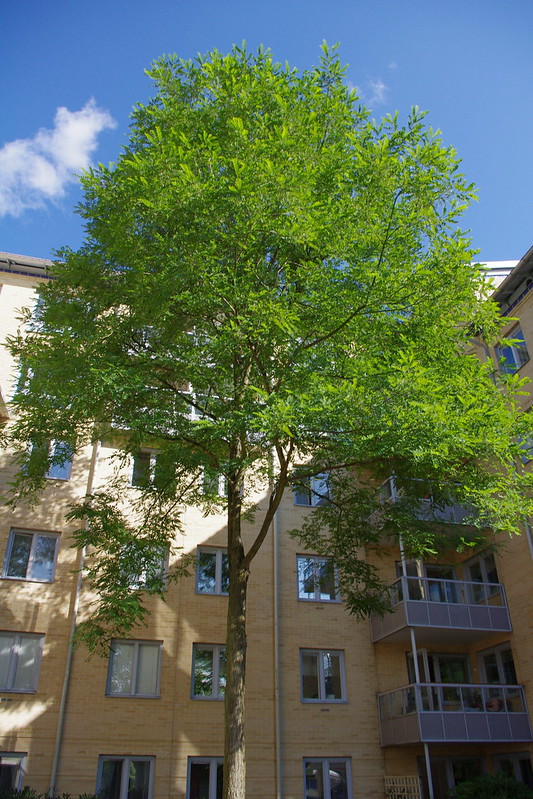
Photo: Mine
Black Locust at the end of the line of the #10 Trolley line at Guldheden between two apartment buildings in
 the south of Göteborg Sweden.
 the south of Göteborg Sweden. For further info on Locust potential for rebuild the land, please see the article on New Mexico Locust.
Networking with New Mexico Locust