Friday, April 19, 2013

Attention Eco-Activists: Why not challenge yourself to restore the Land that was Lost ?

Question: Why don't Eco-Activists save things closer to home in their own backyards ???  2nd Question: Why do so many of them rarely  volunteer for any kind of restoration projects closer to home ??? 😒

All over the planet we are overwhelmed with all manner of Activist Protest movements to save anything. Now that's commendable, but I've never seen so much angry activism over so many different types of issues in almost every corner of the globe all at once. For the purpose of this post, let's narrow down the angry list to one specific area of concern. This would give us Nature and our Earth's various eocsystems. In almost every protest chant when it comes to ecology or environmental issues, you most often will hear, "We need to Save this Area for future generations."  Okay, I can most certainly understand and appreciate the emotional take here and at times I too have lamented about what has happened to some of our most beautiful and pristine wildland areas, especially in Southern California where such places have a bad misfortune of disappearing at an alarming rate because it is deemed more important to grow the economy. But for all the angry protesting, politicking & finger pointing blaming ideological opponents for the ruin in some National forest or other wilderness area, I often times see things closer to home which are almost always overlooked as a better opportunity to make an incredible improvement. These areas are so close that if they were rattlesnakes they'd be dead. Here is an example of what I'm talking about, an area I once always considered the Yosemite of Southern California, Rancho Cuyamaca State Park. Now should that have been saved and set aside ? Absolutely, it's a perfect example of doing the right thing and no one would argue against the decision to set aside that area as a park or preserve. But unfortunately, in an instant of time in October 2003, the Cedar Fire consumed everything about that Park so completely, that most all old growth forest is gone forever. Most people now living and for generations to come will never see that beautiful area ever again as it once was. With climate change now at full steam ahead, it's highly doubful the majority of trees will ever achieve old growth status. Now while I find that such places are worth saving, there are clearly other regions closer to Home (city urban areas) which have long since been written off by such activists as having little worth, value or nothing more than a lost cause because the area visually appears so degraded, we can only write it off as a loss. This type of thinking is nothing more than a con. The California Native Plant people are constantly pushing homeowners to dump their lawns and plant natives. Yet numerous hills and strips of land in between urban housing and commercial development areas are ignored as having no value whatsoever. Let's look at some of these target areas for saving which capture more attention by Eco-Activist organizations, but which most people have never heard of. 
Update August 2018 - Duke University News
Duke University put out a study about how many locations are chosen for Wilderness or National Park designation. Surprise Surprise, it's got nothing to do with those locations being precious biodiversity hotspots. Mainly it's because of their emptiness & lack of human development (wildness as far as the eye can see). Of course that remoteness and lack of public recognition soon changes when Outdoor Gear manufacturing companies like Patagonia, Black Diamond, etc masquerade as an Ecology Champion in order to market more of their outdoor products. Soon the championed wilderness or Monument they fought to have designated (saved from human activity) is suddenly inundated with their customers only to later find the landscape ruined and in more danger than previously advertised.
"Protecting half of Earth might not be necessary, but would it be sufficient given the current trends of protection? The predilection of national governments is to protect areas that are “wild,” that is, typically remote, cold, or arid. Unfortunately, those areas often hold relatively few species. Our analysis shows that protecting even as much as half of the world's large wilderness areas will not protect many more species than at present."

Take the Example of Bears Ears National Monument

Artwork - Jim Styles
 
The article in The Canyon Country Zephyr is worth the read

Photo - Mine

This is just one of many island-like Hills which are located within the El Cajon city limits. But you'll also find many in other parts of San Diego and Riverside Counties. Most of the native chaparral has long since been gone, replaced by non-native invasive weeds from the European Mediterranean or Northern Africa regions. This particular hill was stripped many years ago of native coastal sage scrub and planted with the common Red River Eucalyptus gum trees from Australia which was common practice almost 100 years ago. You can see the living and dead remnants of Eucalypts on the top of this hill and the numerous cut stumps of those which were harvested. Still, the native chaparral plant community never did really come back, but there are a few surprising hold overs. 

Photo - Mine

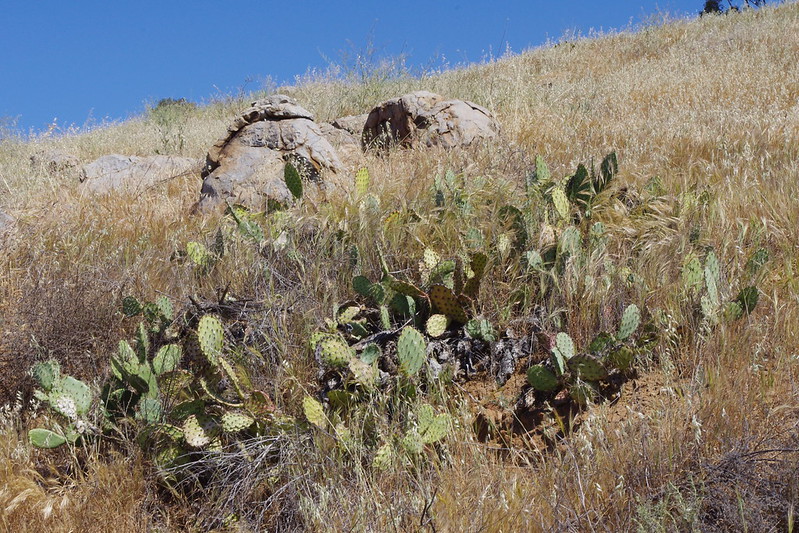
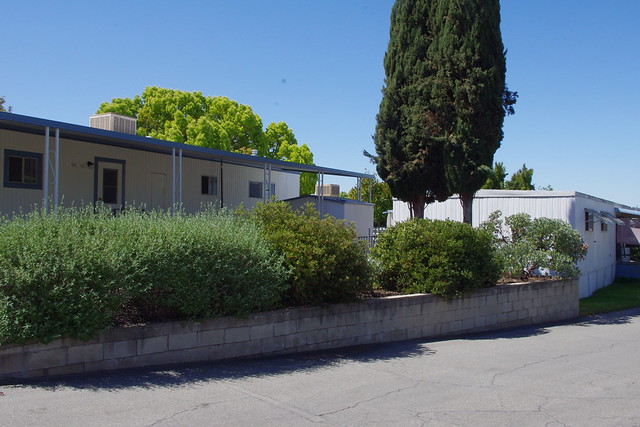
On this Hill east of Gillespie Air Field is a hold over of times past. This is a native Prickly Pear Cactus which surprisingly has gotten much bigger since I first encountered it in 2002. Still, you can see the overwhelming smothering of the non-native invasive weeds. However further down below near the Mobile Home Park, there is a rather large healthy colony near some large granite boulders and smooth  flat granite bedrock where Metate Grinding Holes are located. No doubt the natives may have planted these some centuries back when their village was present. I've also noticed most native metate locations will also contain one, two or three Mexican Elderberry. This area is also next to a natural spring within the trailer park which has been capped. Want to find a former native encampment or village site ??? Then keep a keen eye out for these specific plants.

Photo - Mine

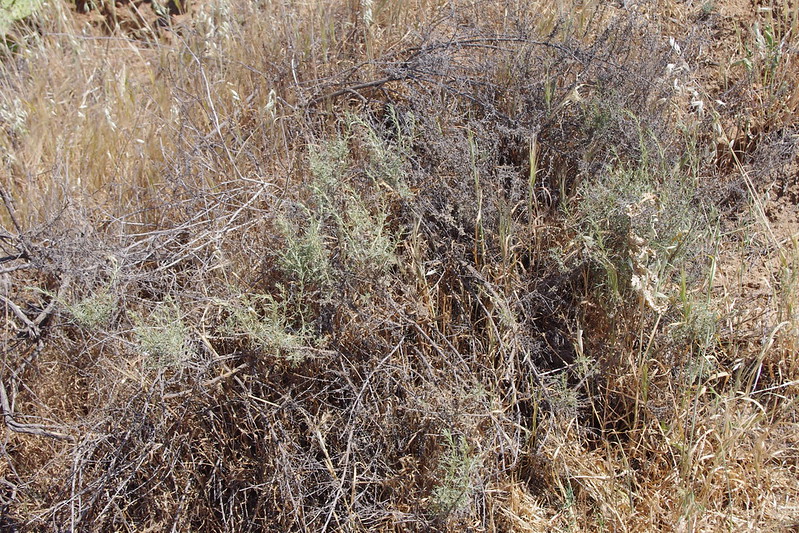
This California Sagebrush (Artemisia californica) is being overwhelmed and smothered by the heavy weedy intrusion of the non-native grasses like this cheat grass and non-native wild Black Mustard from the Mediterranean. This particular plant is the ONLY specimen on this entire hill. I know because I have thoroughly searched this entire hill for others. It is a main target featured plant when saving and setting aside habitat for the California Gnatcatcher, such as the conservation area on Rattlesnake Mountain to the north of this location which the rules demanded that open space be set aside during the construction of the Sky Ranch Housing Development. We always wondered if one day some developer would come along and turn those mountains into another Mount Helix rich folks paradise to the south, but the mandated open space totally prevented that from happening.

Toxicodendron diversilobum, Western poison oak or 
Pacific poison oak
 (syn. Rhus diversiloba)

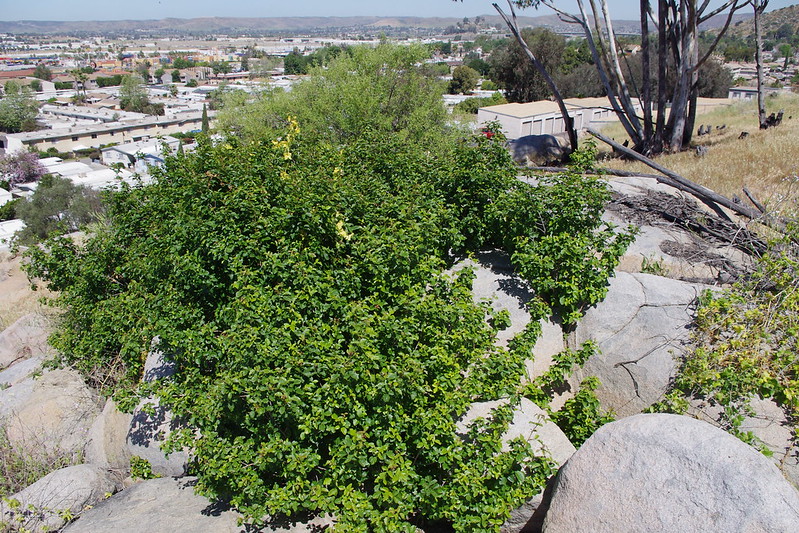
Finding this plant for the first time back in 2002 was a wonderful surprise and an unexpected shock at the same time. But interesting none the less because it further intrigued me as to what the orignal historic vegetation content of this hill was really like a century ago. Such a plant as this one (Poison Oak) I've only associated with areas of high moisture content and usually on on the north side of a mountain. The Rattlesnake Mountain chain to the north of this Starlight Hill location and would have been an ideal location for this plant because of it's many springs, seep and cienegas. And yet, from all my decades of hiking all around up there on Rattlesnake Mountain, I have never once stumbled across this native Poison Oak species high up there.

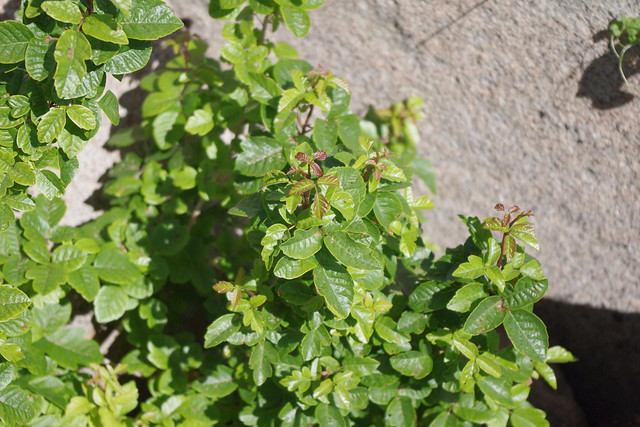
Close up view of the Poison Oak foliage
Just a few further comments on this plant which I consider a strange anomaly of sorts because there is none of this that I have ever found along all of the mountain ridges of the Rattlesnake Mountain chain. In almost every instance where I have ever encountered it when out hiking on So-Cal, I have never found it in such a dry hot south facing slope location before. It has always appeared to be in areas of higher moisture content. One clue as to why it survives and does so well here is the fact that there are several granite boulders outcroppings all over this small hill in El Cajon as is also the case with other such hills to the east and south of here. It's these geological rock features which fascinated me years ago and inspired the use of many rock or other similar hardscape features which can act as a sort of mulch to prevent moisture loss and they also tend to concentrate rainfall allowing for such unique areas to have a higher water content than any of the surrounding soils. So in drought years there is no problem. Even in drought years you get a little rainfall, but in this geological feature it becomes concentrated. An illustrative comparison would be noticing the lusher higher growth of vegetation along desert highways as opposed to plants out away from the pavement. Runoff does concentrate and benefit those plants near by closer to the road. Such natural features can actually create a micro-climate effect of sorts which will allow plants to grow where they normally would not succeed. I hope to document and photo some areas in Riverside Co as prime dry hot locations where plants which normally require a heavier moisture  content not only exist, but actually thrive in these locations. Still, this Poison Oak plant was unexpected by me when I first encountered it and my pondering or meditation kicked in as to where this plant's ancestral heritage came from, much like the Rattlesnake Mountain single Lemonade Berry tree colony I've written about previous at one single location on all that big mountain chain. Such pondering triggers other questions, like, "What was the climate like way back when ?" or "What was the entire complete plant community like at one time ?" Another kool feature to keep in mind when it comes to seed collection or gathering cuttings, this could have unique genetic qualities useful in some habitat restoration projects as this plant's internal system may have engineered some important drought tolerant qualities into it's DNA that others may not have. Other clues as to past wetness are given the fact that, at the very foot of this small hill there are some exposed flat granite smooth bedrock with Metate grinding holes and these near a once well known Artesian Spring at the bottom of this rock platform, it's probably safe to assume that native Coastal Live Oak were also present in abundance as well as they once were on the alluvial fans emerging from cnayons at the foot of Rattlesnake Mountain which were stripped and planted with citrus orchards. Take a close look at the area of the once Native American encampment or village site of times long past.

Photo - Mine

This is the granite bedrock site of the native American Metate grinding holes. Notice the Prickly Pear Cactus which no doubt was part of the native's pantry and out of this picture frame to the left are some abundant examples of Mexican Elderberry, also a common plant near these village food preparation sites. The weedy invasive plants have a tougher go of it here, although they are still present.

Mexican Elderberry (Sambucus mexicana) 
Just above the historic Native village site. Actually this small chaparral tree is very common in and around the rocks here on this hill. I find it ncredible how Europe is so crazy about their Native Elderberry Trees and local Californians pay them no mind nor give them a second thought as a cultivated found source like the Natives did. Not even the majority of so-called Native Plant enthusiasts.
Now maybe I should get to the point of my post here. I have always found that most Save Nature Activism Groups never give many of the city locations a second look. Mostly these are written off and ignored by the majority in favour of more eye candy appealing locations which still contain native flora. Not everyone has this worldview, but certainly the majority view these locations as worthless and beyond hope and yet, these are right there in their own neighbourhood backyards. I look at such weedy locations as a challenging blank canvas to be restored to what it once was. Of course doing so means you must dump the conventional modern day enlightenment wisdom in plant healthcare (which generally comes with a price tag on it) and actually replicate what nature actually does. I'm happy that there are many who are nature lovers, love hiking and suchlike, but there is more to loving nature than mere surface knowledge. I often find that many greatly lack deeper practical application of what they see or observe on their short or long hikes. By practical application, I'm referring to their own personal garden and landscape projects. There are many who don't understand the basic fundamentals of plant growth in nature and that there is clearly more to buying a plant at your local Native Plant Nursery and plugging it into the ground. Conventional Care as espoused by the Commercial Garden Products (like Drip Irrigation, etc) industry will kill the natives and often shorten the life of other non-native Nursery Grown plants. I also find that while many are willing to support a cause, even if it's merely clicking the "LIKE" button on an Eco-Activist Facebook page or being hooked into giving a donation, most never consider personal commitment by investing personal time and energy with involvement on restoration work projects. This is too bad, because even if you fail at something in terms of a project commitment, you also learn from that valuable experience. Weeding out the conventional bad old school science-based wisdom is a tough thing to over come. It's a complete turn around from things you've been taught & raised to believe and indoctrinated to place your faith in without questioning. Maybe we should call the hands on workshop a deprogramming experience. You know, things like dumping chemical fertilizers and installing a permanent irrigation infrastructure, believing all the while you are doing something for the plant's own good ? But gain understanding of how the natural world actually works and you'll never go back to that failed conventional modern day wisdom which is presently killing our planet Earth.

Image from Google Earth

Actual Area is east of Gillespie Field airport in El Cajon CA

A healthy chaparral or coastal sage scrub plant community is a mycorrhizal one. On the other hand, the weedy type annual plants (wild radish, black mustard, cheatgrass, yellow star thistle, etc) generally come  from a flood plain with it's bacterial system where most of the nutrients wash down from the higher locations and collect and settle on the valley floors. In the old days, weeds never really got a foothold on mountainous areas or foothills, but times have changed as these areas have become richer in nutrient content, no doubt as a result of various pollution components by mankind which have gradually accumulated over the decades to allow for this unnatural succession of invasive non-native annual plant community to take over. Not to mention the complete disappearance of the healthy mycorrhizal community which outcompetes weedy ruderals for nutrients that keeps the weeds in check. This is where I took it upon myself while working there to experiment with a portion of that Starlight Hill that I have revealed to you in any of the photos. First thing that has to be dealt with on such a location is what I consider a radical extreme measure of dealing with any heavy weedy system in a swift kick blow to the weedy plants themselves. First step would be to use a weed eater or Fishing line power trimmer to cut down as far to the ground as possible any and all weeds. dead or alive. Next, while I don't like chemicals, in some extreme cases where used properly and not over done, products like Roundup can be used after the next rainy season growth appears. After this initial extreme KILL, heavily mulch these areas to suppress the newer weeds from appearing on the area to be re-established with chaparral or any other native plants from any area of the globe being restored. In the old days, most southern facing slopes had a sterile decomposed granite soil base spaced between the individual plants with the plant's own dander or mulch underneath it's own vegetative drip line. This is not the case now. In fact you cannot allow any bare spaces between plants for a few decades, given the changes which have taken place on our once pristine natural world. Allow these spaces and weeds will fill in these spaces. So keep these areas between plants mulched until they grow large enough to merge with each other. What I did on this hill project was plant both native Chaparral and native tree species, with the exception of a few non-native Mediterranean trees which can take drier conditions. Also remember, this hill site was to never have an irrigation system, so proper healthy natural establishment done the right way in the beginning was a must. The native chaparral plants I used were Lemonade Berry, Californian Holly (Toyon), Cleveland Sage, etc.
Importance of understanding the Mycorrhizal Grid
Image from updated Google Earth (2018)

Image- Ryan Cummings (2011)
The photo above has been updated from Google Earth street view at the end of Marlinda Way in El cajon, California at the foot of Rattlesnake Mountain. When I was a child in the late 50s & early 60s, the flowers here to the right were the main players. There were loads of TidyTips, California Poppies, Lupines, Blue Bells, etc. All of them have been replaced by Black Mustard, Yellow Star Thistle, Wild Radish, Cheatgrass, etc. All non-mycorrhizal non-native invasive plants which have change the soil microbiology from a mycorrhal one to a bacterial one. These plants do this when they invade and through their root exudates release chemicals which disrupt the chemical signally for symbyosis to take place between host plants and the mycorrhizal fungi. Decades ago industrial commercial agriculture planted Black Mustard between rows of grape vines and trees in orchards. Believe it or not Mustard are one of the best fumigants for soil, not only removing both good and bad fungi, but also root nematodes which would attack both orchard trees and grapevines in the vineyard for which farmers would have to employ otherwise toxic chemical fumigants to accomplish the same thing. But the farmers never really dealt with the mustard before it goes to seed and therefore Mustard escaped into the surrounding wild hillsides much like the photo below of a Northern California Vineyard.

Image - Naomi's Garden Blog

Image - Jade Meadow Farms
The photo of course is beautiful and picturesque, but it has also brought ecological consequences with the practice. Such invasive plant escapees have replaced the native California wildflowers and coastal sage scrub shrubs. Many modern biodynamic organic farmers are practicing the use of sheep to graze the mustard, not only in vineyards, but also in massive Solar Farm fields. This provides an alternative to other damaging science-based practices requiring synthetic pesticides. In so doing, farmers have the vines higher up on the trellis and using stubby legged Babydoll Southdown Sheep for this purpose. When I was in vocational agriculture and studying sheep, the larger taller breeds like Suffolk along with the stockiness of Hampshire were the focus because of meat production. Certain other breeds were dying out only saved through people who were champions of such breeds. How wonderful some people helped save those breeds and new purpose has been discovered for their use. This is where you also need to correct the soil's microbiology back to a mycorrhizal one in a restoration project. Decades of neglect ensure almost no beneficial mycorrhizal fungi existed to maintain healthy plantings. First, you need to understand and realize that out there in the untouched Natural world where plant communities are very healthy, there is an underground network grid on all mycorrhizal sites which interlinks all the plants that are coupled to it. This grid or network can range from the smallest lichens to the largest trees in any forest ranging from 100s of miles on out to 100s of miles of prairie. So it is imperative that a good fungal species blend of mycorrhizal mix be added at the very moment of planting for a good healthy start and to change the underground soil infrastructural makeup to something which will allow the plants to succeed. IMPORTANT: DO NOT listen to those who criticize inoculating the soil at planting. Actually you only need to inoculate the plant, not all the soil. The fungi will move throughout the soil. Often their biased view is that it's not necessary to inoculate because the fungal spores are just out there everywhere in the air. Forget it. If it were really there, the invasives would not have been so successful. The native trees I planted, believe it or not were Tecate Cypress and Coastal Live Oak, both of which thrived immediately. Non native trees were mostly volunteers of Aleppo & Canary Pine which were already around the properties below in the housing that was maintained by the company I worked for. What can I say is this, they were free and after all, it was only an experiment anyway. Even if failure were to happen, this was a major learning expreience. The first couple years the plants were babied with once a week watering the first several months down to once a month the second year. After that no more water. Such a watering strategy replicates what I learned here:  
Lessons Learned from the Bajadas (Alluvial Fans)
Okay, so below is a photo of  basically what the once weedy area looks like today below here. Keep in mind both sides were nothing but fire prone weeds before.
Photo - Mine

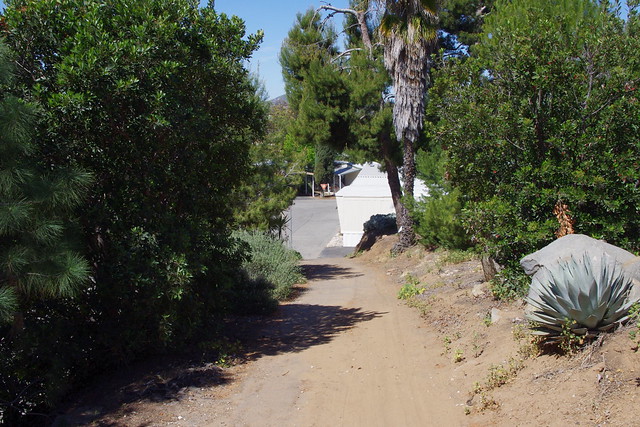
This is looking up the Landscape and Maintenance Service road for which plants were established on both sides of the road to provide privacy screening for the work of chipping and gravel and soil dumping which was necessary for the normal Park maintenance. Often times such areas are unsightly branches and trimmings piles and it detracts from the tidy cleanness of the Park Community. At the top where the road turns left, you'll notice the Tecate Cypress which actually provide a good green screening, Aleppo Pine is easy to identify and many of the small trees are actually Toyon and Lemonade Berry. Cleveland Sage is to the right.

Photo - Mine

This is looking back down the maintenance road. Notice the Silver Agave on the right. I collected that back in the 1990s from the Huachuca Mountains above Sierra Vista Arizona and brought it down we me when I left Anza CA. This Agave was actually growing on the forest floor up there under trees when I first discovered it. It originally was the size of my fist when I collected it. It was one of the pups around a bigger one.

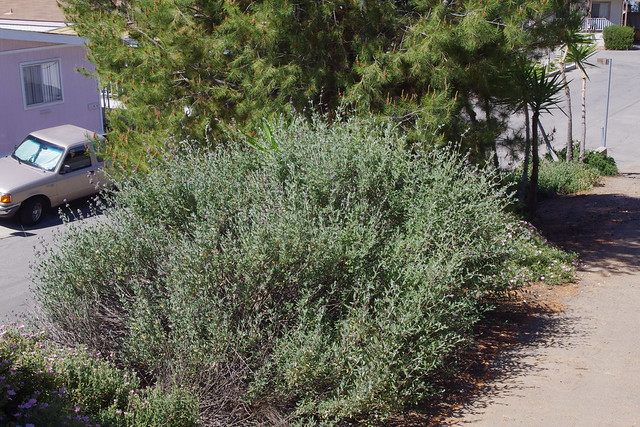
Cleveland Sage (Salvia clevelandii)
This is on the south side of the maintenance road
Aleppo Pine (Pinus halapensis)

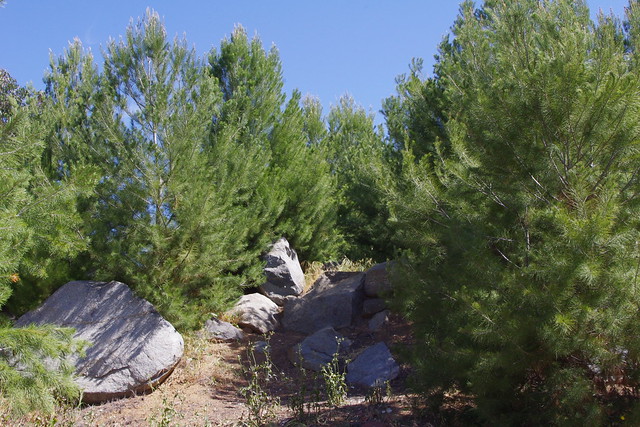
This is on the north side of the maintenance road opposite from the previous picture of the Cleveland Sage. Only weeds appear to be some Sow Thistle, but not much more. Continued use of mulch keeps them in check. These Aleppo Pine Trees here are 8 years old. There is absolutely no irrigation. My previous experiments in Anza California in dealing with the interconnections of a strong mycorrhizal grid network underground between a large group of pine trees are clearly present here as you can see these trees are  exceptionally healthy with little or no irregation. This underground interconnected network between all the tree root systems can shunt water from lower reaches where some irrigation from the Park may be transported uphill to the trees at the higher elevations above. The front Office and pool are of the Park has some extremely large Canary Island Pines for which somehow became colonized with Pisolithus tinctorius truffles. Every Spring the truffles appears and I'd collect them. Most of the Pisolithus tinctorius inoculent used on this hill came from those truffles I collected. Now the only water is the little rain from winter's rainy season which has been mainly drought. When planting trees and shrubs, remember to mulch heavily. It suppresses weeds and breaks down slowly by the fungi which feed the nutrients back to your plants.

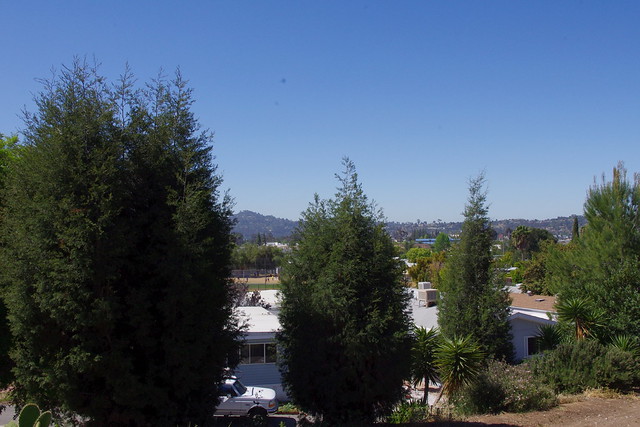
Tecate Cypress ( Cupressus forbesii )

These trees are actually larger than they appear here in the photo. I had to stand back quite a ways to include all of them. The lower tall slender one is almost 20 foot in height as it is much much lower at the bottom of the bank. All of them show no signs of slowing down to a comfortable growth. None, with the exception of the lower one receives any watering. The lowest one may have roots near some irrigated plants nearby.

Photo - Mine

Same Tecate Cypress, but now viewed from below the bank. All of the Tecate Cypress were also colonized with mycorrhizae. The soil is decomposed granite with some adobe red clay and very little organic material. Only organics are the mulches place around the rooted areas.

Lemonade Berry (Rhus integrifolia)

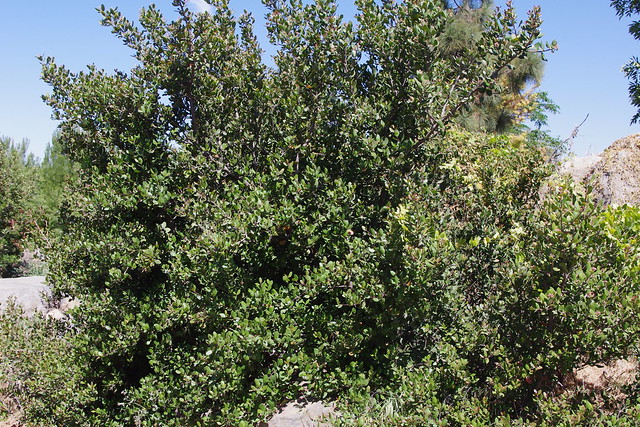
This is a large chaparral shrub and was given to me by the Company's owner to plant where I wished. This specimen came from Scripps Ranch area. I really was unsure if it would take as it had been in a one gallon pot for a long while after being transplanted from the wild. It looked stunted and could easily been written off, but fortunately, a good mycorrhizal mix is mostly all that was needed. To the right and on the back of the bush is wild cucumber vine growing up into the branches. How fortunate for the wild cucumber to fiend an old friend where most others are lacking.

Coast Live Oak  (Quercus agrifolia)

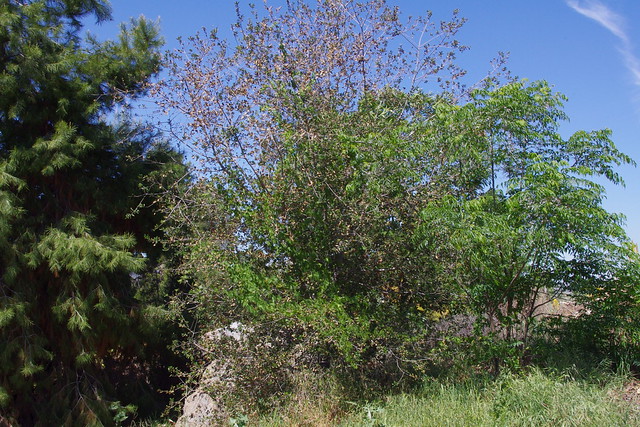
Of all things that would disappoint me, is the sorry condition of the Coastal Live Oak as upsetting, but it's still alive. When I last visited here in July of 2011, the vegetation was healthy, thick and dense. Now the leaves are half green and half brown, almost as if poisoned with Roundup. Not sure how sensitive it's roots are, the new maintenance person may have sprayed to heavily dose of roundup around it to maintain the rid the area of weeds around it. Still it has been a success otherwise as I heavily inoculated it with various Ectomycorrhizae , in particular Pisolithus tinctorius. There is a volunteer Texas Umbrella or China Berry Tree growing to the right of the tree and it has wild Cucumber Vine growing up into it. I'll have to work on this area with permission of course.

Photo - Mine 

Looking up at at the once weed infested hill from across the street below. I actually have a photo back in Sweden of this hill before anything was done, but I'll have to scan it at a later date and post it. The transformation is remarkable and possible for any location. I have actually got some conventional camera photos of this area before much was done, but I'll have to scan them and upload here later. 

Photo - Mine
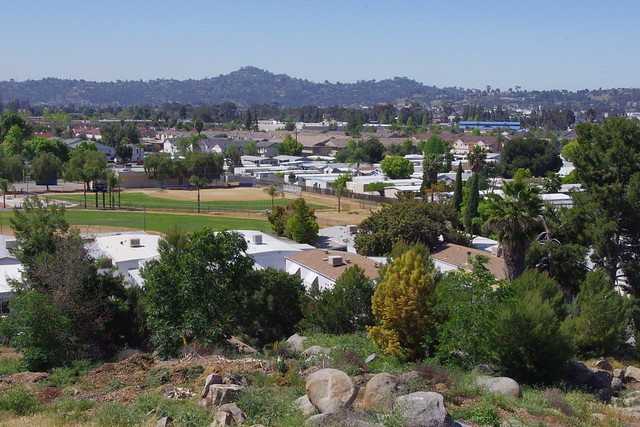
Looking down from the hill at the restoration project below. This is looking directly south towards Mount Helix in the southern end of El Cajon Valley.
Cleveland Sage (Salvia clevelandii) - Howard McMinn Manzanita
(Arctostaphylos densiflora) - Big Berry Manzanita (Arctostaphylos glauca)
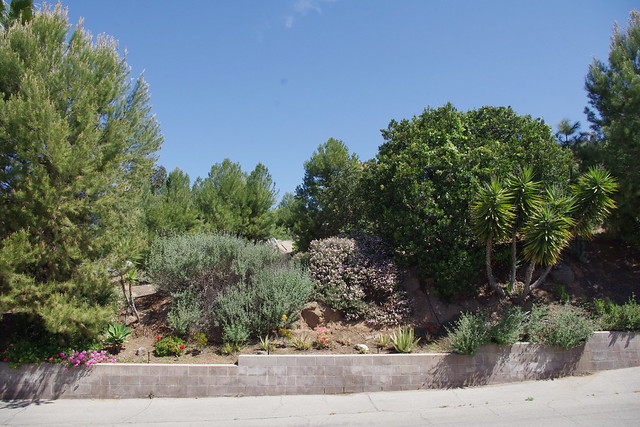
These were planted on along the top of a wall to replaced the conventional dying Retail Nursery plants which had outlived their usefulness. They were inoculated with mycorrhizae mix from Dr Mike of Mycorrhizal Applications Inc and no supplementary water is necessary with the exception of some periodic deep slow watering once or twice in the summer.

Howard McMinn Manzanita and Bigberry Manzanita

Well to mostly sum things up, anyone can create a small project like these and go far farther that what I did if they get up. The experience is a fun learning thing. I'll have to photograph and post some of the plants I installed on my mum's property which is a third of an acre. The Cleveland Sage and Manzanita, which by the way is "Canyon Sparkle" ( Arctostaphylos insularis) does exceptionally well here in interior valley HOT El Cajon CA. Yet is is advertised as a coastal cooler climate plant. Of course the soil is a very deep sandy loam and roots are deep. A mulch is always kept around the roots and of course it was heavily inoculated with mycorrhizae at time of planting. No summer watering has ever been necessary after the first couple of years. Most watering is rainy season ground storage and maybe some slow soak winter soaking for later usage throughout the year. It resides next to a Cleveland Sage and both look so natural. Incredibly, I now understand why this "Canyon Sparkle" or Island Manzanita got it's name. The newer foliage is exceptionally  glossy bright green and does reflect an awesome amount of sunlight on a bright sunny day. Of course the older foliage is a bright beautiful green anyway. Still! I've noticed more and more that the Freeway planting projects are going mostly native now around here locally. Good for them and us. Here's the post on my mum's place: 
"Canyon Sparkle" Manzanita
One of the best non-profit organizations, which actually does do a hands on restoration and education program is the,  Back to Natives Restoration, group out of Orange County in Southern Califonia. You won't find the long time traditional in your face activism tactics like civil disbedience, foul language, threats etc comon among many of today's groups. Mainly they education young people and to be honest, I've never seen an organization like this that attracts so many volunteers as this group. This is refreshing, because environmentalism has gotten a black eye where most causes are based and identify with something they hate as opposed to something they are for or love.
https://www.backtonatives.org

image - PBS
Still Interested in Environmental Activism ???
Then stop being distracted by the plethora of environmental non-profits who promise if you donate to them, join in their monkey wrenching covert schemes or trust their "Occupy" worldview of overthrowing an ideology they hate which will make the world a better place and challenge yourself to restoring a local urban area landscape they have written off as unsalvageable decades ago. Nature has always had the tools for turning things around again. You may find it will require some outdoor time which must be purchased away from your time wasting routine of lurking on many worthless Facebook sites, but that will be a healthy thing. You remember, like the old days pre-internet ??? Start with your own backyard or local habitat beautification project. It's local and it's not that far to go from a time and expense-wise point of view as far as fuel is concerned. Areas of local restoration could include the entire restoration of the San Diego River riparian corridor from Mission Trails Regional Park all the way to El Monte Valley in Lakeside California. Or anywhere else on the planet where the misuse and abuse of Science by profit obsessed corporate entities has caused environmental ruin. Here's an example of what hard working volunteers are doing within the urban areas of San Diego County.

Artist picture of Walker Preserve entrance
(Walker Preserve Trail Santee)

Earth's Internet: "Santee's River Walks: Mast Park & Walker Preserve"
Lakeside River Park Conservancy
Time Out Post: Guerrila Habitat Improvement


Saturday, April 6, 2013

Massacre on the Mountain

Rattlesnake Mountain Changed Forever

This Torrey Pine Tree was planted in 1980 on Rattlesnake Mountain in El Cajon California and this photo I took  in 2011 on a visit home from Sweden where I presently live. This particular tree was 30' tall.
The last thing I expected was to come home and start off on a negative note. Since I haven't had time to post much of anything lately and when I did, it was generally on a subject matter dealing with a negative topic, this trip was going to be different and informative about things I've discovered, appreciated and accomplished over the last few decades. I wanted to deal with forensic clues in the form of vegetation anomalies I have accidentally stumble across over the past few decades which defied explanation, which gave clues of a different climate and ecosystem past in Southern California. Well, no such luck. Things have taken a turn for the worse on Rattlesnake Mountain. I suppose my spirits are down a bit as well, but nothing surprises me anymore in this modern day system. The trees I have for so long cherished and spoken about are now gone. I had always considered that some event like wildfire consume them or housing development would bulldoze them, but never in my wildest imagination did I expect this deliberate chain saw massacre which was done for stupid ignorant reasons. When I told friends who had known of the trees I planted over three decades ago, they were sad for me and wanted to console, but the reality wasn't so much sadness as it was disappointment of the average person's stupidity and ignorance. Mostly my reasons for lack of sadness are that I don't regret the experiences I gained and learned in the way of practical application by replicating nature (Biomimicry or Biomimetics) and gaining a much deeper understanding of the value of our native Chaparral as host or nurse plants. Take some interesting statisitcs about Laurel Sumac as having good nurse plant potential.
Some interesting facts about Laurel Sumac and it's ability as an ideal nurse plant which utilizes Hydraulic Lift & Redistribution of sub-soil water which facilitated this Torrey Pine to thrive
Photo taken by friend in 2011
There's a remarkable story behind this Torrey Pine and another Torrey Pine tree's success up on Rattlesnake Mountain in El Cajon. Follow the link below at the bottomm of this post as to how this was possible through trial and error over many years looking for the right nurse shrubs.
I went up there yesterday to photograph the Torrey Pines and the trees were totally gone. While I was looking around the site where the large Laurel Sumac which provided the means of serving as an excellent Mother Tree still stood, several irritated home owners came out and yelled at me for trespassing on conservation area land and demanded to know what I was photographing. I kept calm and explained I was taking pictures of Coastal Cholla Cactus (Coastal Cholla never was originally native to this location when I was a kid and I established a one acre patch which has since spread on it's own) in bloom and those of Prickly Pear Cactus, plus I was looking for Cactus Wren nests which I noticed the year I left for Sweden in 2006. Actually, all I saw were the old abandoned nests of the pre-housing development construction before I left in 2006. Nothing new of note anywhere. I'm assuming the Wren's were frightened off by the closeness of the development. But documenting the tree slaughter with photographs was mostly what I was seeking after because I could see from the paved road that both Torrey Pines were gone. I asked one of the disturbed neighbours about what had happened to the pine trees and the ignorant unscientific explanation given made it all I could do to hold back keeping my mouth shut and emotions in check. One of the men said to me, 
 "Those trees are a huge fire hazard, they were producing cones and once those seeds escape, they will spread everywhere and will cause fire and create a bigger fire hazard endangering these houses." 
Seriously ??? Torrey Pines cause fires ? I thought people caused fires around here ? In the whole history of fire on this mountain every single one was always human caused. No brushfire in my almost 60 years of lifetime were ever started by natural causes. None of what he said was true and a fire starting as a result of more trees would never have happened anyway. I was told I was a trespasser, threatened with police being called and fined $1,000 if I didn't leave their precious conservation area. These trees were nowhere near any of the houses as this photo below of the other smaller tree poking out from the Laurel Sumac clearly shows.

photo: Mine
This Torrey Pine in the photo at right here was the smaller of the two trees. It was a bit stunted, contorted, twisted and was developing a beautiful picturesque form. It was once of the survivors of a wildfire that swept the area earlier. One single lower branch to the south of the tree survived and grew upwards into a crooked twisted tree. Ironically, the accusation of the non-native status of the trees was ridiculous, because if you do an inventory of the plants they have utilized on the terribly  scarred disturbed hillsides they created during construction, you have non-native yuccas, Iris, Mediterranean Rock Rose which is from Spain and elsewhere in the Mediterranean. There are other non-native plants, but perhaps I'll document that at a later date. There is also this constant water drenching from an elaborate irrigation plumbing infrastructure everywhere on these hillsides all around this development, something which is abnormal for native coastal sage scrub, but necessary to keep the non-natives alive. I'm actually shocked more strategy planning and attention wasn't provided by the so-called Conservation people from Escondido who are in charge of the oversight of this official conservation area. Just the irrigation pipe and other fixtures alone must have cost a fortune. The other negative is that this destruction of native coast sage scrubb ans replanting coupled with early years of heavy irrigation have mostly benefitted and spread all the non-native noxious weeds I mentioned earlier and more. I'll walk up and do list of many of the non-natives for a later post.

photo: Mine
This is the exact spot of the 30' tall Torrey Pine which was butchered by Sky Ranch residents who themselves trespassed on to this Conservation area land and took it upon themselves to enforce the modern day unscientific  thinking that So-Cal native plants are evil mega-fire causing living organisms that need eradication in order to save human life. So what more is there to say. I kept my cool and didn't get into any confrontations even though that seemed to be the intent of those few I was speaking with. I'll post below a couple of pertinent photos of the damage done by those residents from the surrounding neighbourhood who not only trespassed onto the Rattlesnake Mountain Habitat Conservation Area themselves, but also took chain saws and destroyed a rare wild growing tree native to San Diego county.

These signs exist everywhere around Rattlesnake Mountain now. Of course I don't own the land and they can do with it what they wish, but it's amazes me how this land for numerous decades prior was always spat upon & figuratively urinated on by humans without fear of prosecution before anyone decided it had some sort of ecological worth aside from the economic value to a handful of business benefactors. I actually contacted that telephone number on the No Trespassing sign and asked the biologist,
 "If the penalty for trespassing on Rattlesnake Mountain Habitat Conservation Area is $1000, could you tell me what the penalty for trespassing and taking a chain saw and removing valuable rare protected wild San Diego County tree species is ?"
The headquarters from where this Rattlesnake Mountain conservation area is given oversight is north from here in the city of Escondido. The biologist I spoke with on the telephone was nice enough and seemed to have already known about the removal. He said he was previously tipped off prior to the chain saw massacre and had visited the site himself. I never actually got a straight answer as to why these trees were destroyed, but it appears that there were several complaints to his office after I wrote my first article on the successful planting of trees by utilizing the Laurel Sumac as a nurse plant. Laurel Sumac is really the only shrub up there that stays richly evergreen all year long, aside from one single small colony of Lemonade Berry which has also been severely cut back for housing. Those Lemonade Berry are so ancient that they look almost look small oak trees and I thought so when I was a kid back in the very early 1960s. They are located just uphill here from this cactus where the Torrey Pines also were.

Photo - Mine (2013)

I will post a link here below of an album I created of several photos, not just of the dismembered trees, but also the growing Coastal Cholla and Prickly Pear Cactus colonies which are just starting to bloom now. The cactus colony is beautiful. One photos of the ground where Cholla Cactus joints have fallen off and rolled away from the parent plant explain just how the plants are able to spread so easily. I am also fascinated by what appears to be some sort of allelopathic chemical properties of these cacti plants in that none of the invasive weeds seem to grow anywhere around them. Well who knows, maybe it's just good luck. The biologist knew of the Cholla Colony and told me that Coastal Cactus Wrens were his favourite study. The Wrens never were there prior to my planting of both Cholla and Prickly Pear throughout the 1970s. The cactus Coast Cholla joints were rescued from yet another housing project from the 1970s near Santee Lakes across the valley to the west of Rattlesnake Mountain.


photo: Mine
Believe it or not, I am not totally bummed out here. I always knew this scenario would play out in one way or another. That same day I also that had a bit of a surprise to view a location where I previously worked as head landscapers for a property management company on Bradley Avenue which is south of this location, where I converted a non-native weed infested hill [almost exclusively Cheat Grass] in El Cajon which has a portion of it forested with Coastal Live Oak, Tecate Cypress, Toyon (California Holly), Lemonade Berry and Aleppo Pine on a south slope exposure. My goal was another experiment to see whether or not non-native weed (Runderals) infested locations long written off by the Native Plant peoples for saving, if such locations could be converted back and restored. I heavily inoculated all the plants with various forms of Mycorrhizae and beneficial bacteria. The first two years the plants were babied with water and mulch and then left to their own with no water other than the below average historical rainfall that has plagued So-cal for the past couple of decades. Most of the trees are between 15' to 20' in height now. Large height and wide spread growth on the chaparral species of Toyon and Lemonade berry planted. Mostly the main purpose was to try and experiment by replication of exactly how things perform in nature and IF they can be utilized in an urban landscape setting and/or any habitat restoration project. I'm thrilled and happy to say that they can succeed if left to their own devices, even when climate is considered less than ideal.
Attention Eco-Activists: Why not challenge yourself to restore the Land that was Lost ?
~~~~~~~~~~~~~~~~~~~~~~~~~~~~~~~~
Some Photo Updates:
Photo of Saguaro on Rattlesnake Mountain in 2011

This photo was taken with a friend in 2011 of the Saguaro which I planted back in 1980 when friends from Tucson brought over a foot tall Saguaro from a Nursery there. It came complete with State of Arizona permission certificate as well. The original size of the Saguaro grew quickly to over six feet tall until some idiots with a shotgun or rifle blew it to Kingdom Come for target practice. A six foot tall saguaro blown all the way to ground level and they must have just done it before I came because fresh cactus pulp was spread everywhere around. All my life from the 1960s onward such lousy bad luck things like this have always continually happened for decades on that mountain. One day a couple of years after they destroyed the Saguaro, I went back up there in the early 1990s and saw that the wound had calloused over stump to the ground, but there also were two small buds or pups that popped up on either side of the rugged bark from which two competing Saguaros appeared. Finally as of 2011, this is what it looks like. The Biologist I spoke with knew of it's presence, but firgured it was a barrel cactus someone planted above at Sky Ranch and it rolled down the mountain. This biologist was a puzzle as I spoke to him twice and the 2nd time he claimed he's never seen the Torrey Pines, but did see the Cactus when surveying and cataloging the plants up there. That's strange since he previous said he knew of their presence. Also odd that if he stood by the Saguaro, he surely would have seen 20 foot to 30 foot high lush full Torrey Pines. Unbelievable the world we live in and wondering who can you trust. 😠
Update April 2023 Amazing Saguaro Recovery ðŸ˜®
After Covid lockdowns and ability to travel again, my wife and I flew from Sweden to San Diego for an El Cajon visit with family. I was curious as to what has change since our last visit in 2018. Here are photos of the lowly Saguaro which is now a towering giant of sorts.

Photo - Mine (April 2023)

I put my hand up high for scale. This Saguaro is now 8.5 foot tall. So it was maybe only 3.5 or 4 foot tall in the 2011 photograph which means in 13 years it put on another 4.5 feet in height. Now what's amazing about that is that for 5+ years there was a severe drought which effected California from top to bottom. Extreme drought with very little rainfall.

Photo - Mine (April 2023)

This photo I took to show the base and the rugged oak-like bark near ground level. Very tough and healthy Cactus. I was amazed looking all around it that there was no herbivore damage like Rabbits, Rats, bird peck holes or even insect activity. Very clean and smooth green flesh under all those spines. In the past I did see Yellow Jackets and other wasps within the rib folds.

Photo - Mine (April 2023)

Photo - Mine (April 2023)

Anyway while wonderful news, I'm also aware that anything can happen that will destroy the Saguaro again. There is always the ever present danger of brush fire which Saguaros have no ammunity to recover from. Friends have told mme on both instances, "You must be so sad now", but the fact is, while I was and am still disappointed, I value more the experience which lead me to better conservation practices regarding habitat restoration in remote plantings and practical application within the Urban Landscaping industry for which I was always able to successfully install any plant community theme.

Photo 2011 - Rattlesnake Mountain - El Cajon California

Photo by James Gallagher, Sea and Sage Audubon
Well, the above photo is a close up of the San Diego Coastal Cholla colony on Rattlesnake Mountain. This particular spot was where I first saw the San Diego Coastal Cactus Wren nest in the middle of all that tangle of Cholla arms with spines. For those who think of Cactus Wrens living only in the deserts, think again. Here is an example on the right of a San Diego Cactus Wren which lives in coastal sage scrub habitat where colonies of Coast Cholla still exist. In the same photo above and to the below right out of the picture is a colony of Desert Agave I brought up from Ocotillo outside of Anza Borrego State Park back in 1981. When I left for Sweden in the Spring of 2016, that was the only time I saw the main older Agave with 50+ spread pups all around it's base finally send up a giant flower stalk. It was wonderfully beautiful. This Coast Cholla colony has also spread further from the main body and it too was loaded with flower blooms everywhere for the first time since I first planted thise cacti joints in the ground. It's actually odd that this area wasn't more protected back in 2005 since in the original housing development land preparation phase when they did an inventory of plants prior to any bulldozing, this entire area was roped off with conservation tape and posted as protected area. One would have thought that more care would have allowed protection of the Torrey Pines which are also native to San Diego County.

Photo - Mine (2013)

These Cholla joints are everywhere within and outside the two main colonies. Not difficult to understand how they can easily spread within coastal sage scrub habitats. Below I also added a Prickly Pear Cactus pad here and there planted in the soil. Previously they were not here either. The prickly Pear varieties I chose were the mature native plants father below near the artesian spring where they are next to the Native American Metate grinding holes in the flat granite bedrock. I believe the natives carried and planted Prickly Pear beaver tail pads near all their camp settlements where ever they moved because it was a major part of their diet. Same can be said of Mexican Elderberry for the same reasons.

Photo - Mine (2011)

In the photo above take note in the foreground of some of that invasive African Bunch Grass which are commonly planted along freeway cutouts and shoulders to supposedly prevent erosion and hold the banks together. They are the ones with the fuzzy seed stalk heads. Many other non-natives such as Yellow Star Thistle & Black Mustard have made their way up here as a result of the Sky Ranch Housing Development construction which stripped the landscape and allow encroachment. 

Photo - Mine (2013)

This is at the top of the hill where the last remnants of the Lemonade Berry Colony still thrive, but they are only a whisper of their former glory. In the 1960s & 70s there were larger trees behind this scene where houses now are. The trunks of these looked´so very ancient and the bark was identical to that of any Coastal Live Oak. When I was a kid I thought these were oak trees, until one Spring where I saw those sticky flat red berries and I  knew it wasn't Oak. As far as I know, these are the eastern most extent of Lemonade Berry in San Diego County (not sure really) because they dislike frost and will easily get frostbite leaf burn. This location never did freeze even when we had frosts below in the valleys. I do not even recall seeing any over in Lakeside which is on the other side of this hill. I do know that the people behind the creation of the San Diego River Walk Project are planting them along the river near Santee Drive-in Theater. Still, I cannot believe they took a chain saw to these special tree-like shrubs.

Monday, February 18, 2013

Scrub Jays, Seed Hoarders, Plant Propagators & All Round Forest Promoters

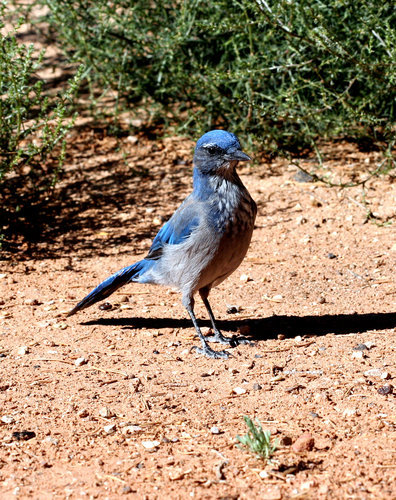
Western Scrub Jay or Pinyon Jay varieties of the same Species
Photo by Yale School of Forestry

The word/term Species is such a fuzzy word. It often gets muddled depending on the subject, the one using it and the context under which it is being used, the term could possibly have 16 different meanings. Why there is even this concept of terms in "Molecular Species". Who would have thought it. In some ways the subject of the great variety within the same species is what I touched on when I wrote the post, "Is it really "Taxonomic Exuberance" or "Phenotypic Plasticity" ?" In the science world there is a rush to find newer species and be forever immortalized as the discoverer. There is a lot of fame, glitter and glory for such on individual, but does all this pursuit of that precious prize cause a fudging of the truth at times ? That is often the subject of discussion and debate. Remember those infamous Finches that Darwin speculated about ? Who could forget. But even the Grants who researched them for 30 years on the Galapagos Islands generally found nothing more than mere oscillation in the epigenetic response to changes in the environment. More importantly for the average person is, what can we actually observe in the field minus all the assumptions and assertions which in reality are not explanations at all ? So what about Scrub Jays ? Are there really difference species ? There are many unique varieties, all of which have many of the same personality traits which characterize just who they are more than what they are. Yes there are different markings and shapes, but basically they all seem to come from the same mold. Much like the Florida Scrub Jay you can see below here.

image: CSS Dynamic

Florida Scrub Jay
But this is also a continuation of sorts with an earlier post today I had on my most favourite Pinyon pine tree, the Parry Pinyon (Pinus quadrafolia). I didn't want to corrupt that post by going off topic, but the Western Scrub Jays are as much an important factor in the life cycle of the Parry Pinyon habitat as are other Jays around the globe are to other ecosystems. Given the latest News Reports on scientific studies revealing that now most all Pinyons are having the inability to reproduce viable seed, such findings no doubt should lead many to conclude that entire ecosystems will disappear as we have known them. While the Pinyon Jay's diet has a great variety of seeds and acorns on it's menu from which to choose from, clearly their numbers will be drastically reduced given the disappearance of huge reduction in Pinyon/Juniper habitat.

Credit: Audubon.org
Recently there was an article from the University of Cambridge in it's online Research News section dealing with the subject of Eurasian Jays. I never knew there was such a bird, but why not ? It's appearance of course is close to the common Western Scrub Jay I am use to seeing and it has all the same bad boy nonsense reputation of the Scrub Jays of North America. I joke about their reputation because of their bad habitat of raiding things and taking off with them link the Cat Food in my former Cat's food dish. I'd hear a commotion out on the front deck and run out there clapping my hands and shooing the Scrub Jay away. Hardly afraid of me, the bird would fly off to the end of the deck and land on the railing, then proceed to curse and swear at me in what seemed like the garbled sounds of a Grackle with a sore throat. I'd also blame them for raiding my garden after planting seed, but I'll get to that further on down the page. Back to this Eurasian Jay. This hoarder is an expert at strategies for preventing others from stealing off which food they have hoarded for future pantry usage. Below is the link to the entire article:

Photo by University of Cambridge
http://www.cam.ac.uk/research/news/hushed-hoarders-and-prying-pilferers
There is something else interesting about these birds which I would imagine most of the birds in this family possess. Remembering where their caches are after planting. But I've also wondered if they don't also choose a specific Chaparral species for planting specific types of seeds or nuts. That is intelligence of course, but also it's important that they don't remember where they have planted each seed or not, otherwise forests wouldn't be born. We often take for granted that though they are not created like us, they never the less possess an amazing amount of brilliance even though much of it may be contained within the frame work of encoded instinctive behavior. Still they are quite capable within this frame work at a sort of free will in choices and decision making. Take a long look at this video which is quite entertaining. It shows the Eurasian Jay in a pen and an experiment at planting nuts. There is no listed link, so here is the link address:
http://www.youtube.com/watch?feature=player_embedded&v=T8bQnAhT-4E
The Eurasian Jay in the above video is so funny. Did you notice he had the ability to remember each pot he planted the nut in ? He chose a newer fresh pot each time. Watching this video, I suddenly had a wicked idea come across my mind. If the gardening sales business times get rough for Las Pilitas Native Plant Nursery or Tree of Life Native Plant Nursery, they can simply lay the shade house workers off and hire cheaper labor who will work for peanuts like a couple of Western Scrub Jays to do essentially the same thing with seed flats. Okay, just a thought. Very kool video though, wish it was longer to see if the bird would fill up every single pot and remember which ones were left. Another interesting video is of a Western Scrub Jay actually pecking out the nuts from a Peanut shell. Peanut shells are easy to deal with, but I've always wondered how they manage harder pine nuts and oak acorn shells. Actually I have observed when they deal with them and I'll tell you, but first watch how they tackle the problem.


Image- US Forest Service

I was always puzzled for a long time as to how the Western Scrub Jay uses it's food cache in the wintertime. How do they get such hard nuts out of their shells. Of course a peanut is easy, but they don't have the sane hardware for a beak as Sparrows, finches and other seed eating birds who crush and grind their food to open the casing and exposing the kernel or even a woodpecker who is champion of them all. I mean those other birds can do some damage easily to any hard shell. So how does a Scrub Jay accomplish it ? Well I started to say something about it here earlier today in this post about - Parry Pinyon (Pinus quadrafolia)  - but I decided to create a newer post than meander off topic over there.  I got a first clue from planting various pine seeds my self by out planting them directly into the ground, as opposed to nursery pots or flats. Of course I had to create a wire mess to protect them not only from Scrubs Jays, but countless other ground foraging birds. I was specifically looking for exact timing of seed swelling, shell splitting and taproot emergence long before any above ground leaf appearance. I discovered that the actual pine seedling appeared in end of February, even the Torrey Pines pushing up through the snow on my property in an experiement, but actual root swelling and seed coat splitting with root tip emergence was early December. While continually inspecting this area, I noticed not only were Scrub Jays milling around and poking in and around their own caches, but so were Towhees and Thrashers along with other ground foraging birds. Quite often I'd find acorns and pine nuts with their shells and root left intact, but the nut inside completely gone. As the seed kernel inside swells from moisture and begins to split the hard shell, it's formerly complex proteins are broken down only to become less complex as a result of water's action in initiating the growth cycle

smithsonianmag.com
I realized it was only then that the birds could deal with it much more easily, but fortunately they don't get all of them, which is how forests progressively make headway. The hydrated action of the seed is a growth trigger for the softening of the seeds and swelling them making their nuts split and reveal a much softer tissue, reminded me of why we humans soak hard shell beans or peas over night, some of us like me allow it to run to the point of having the taproot stems emerge. This further lessens the complexity of certain protein molecules & if done properly, can eliminate the sugar-like compounds called oligosaccharides or Phytates which will prevent the beans from giving you *cough-cough* gas. Both human and animals have a difficult time digesting these complex compounds without the natural processes of hydrating (soaking), sprouting and fermenting components which make nutrients more readily available to all of us. But back to ALL Scrub Jays, the question is, how do they know this ??? Or do they ??? How do other birds who raid their seed and nut caches know this ??? For the most part they don't, but what, how and why they do what they do is mainly encoded into their DNA for their behavior pattern and how it got there is an entirely another subject, but nevertheless it's there. Still, it is interesting and should provide more incentive for further research and practical application in a wide variety of uses, even habitat restoration techniques. Every single component has to be respected and that includes the chaparral plant community which is known to be demonized and getting a bad rap.

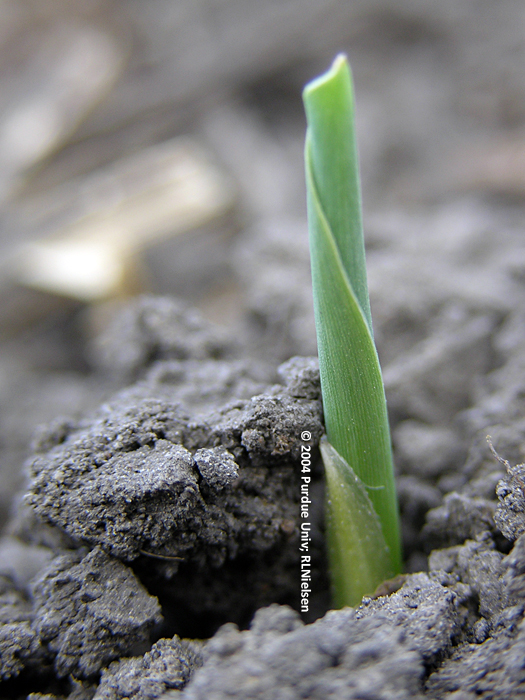
Purdue University
 Something happened in my garden that only then did I fully understood the other benefits of the seed or nut being left in the ground long enough, both oak and pine nuts swell and split which makes it easier. It clearly made sense, but something else very important confirmed later this to me and really drove home the point. When spring finally comes around in late April early May, I always had a garden on my property. Planting Sweet Corn was always a must and like always I pre-soaked the seed and inserted them evenly spaced apart down inside the furrow about a foot and a half apart. As a general rule I always got emergence around 7 or 8 days, but before I could see them pushing through, I noticed there were these little holes drilled into the ground right where I had planted each one, but it was odd because I had never seen a tip popping through or seen what was eating the seeds. My first blame game was the Western Scrub Jays, but I was wrong. Later just after putting another round of pre-soaked swollen seeds into the same barren rows, I spent a more keen eye at the end of day six to see what or who was doing the dirty work. Hidden behind a scrub oak for most of the morning, there he was , a California Towhee and even a Western Thrasher got into the game. They got a few seeds, but then I saw what exactly they were looking for. It was that first tiny yellowgreen spiraling spike of corn seedling pushing upwards through the soil level.  Never underestimate a Bird's Eye to see anything minute and tiny to us. Looking for such clues as seed germ emergence of the immature sprout by birds that there may be a juicy tasty morsel underground that is ready to be harvested. Incredibly most seeds or even animals and birds that hatch from eggs, there is either a nutritious yoke sac or seed kernel left over at the time of emergence which functions as food stores to the young organism until it can actually feed & fend for itself. But the birds (and no doubt squirrels) all some how know this too, although it's mostly instinctive. That's why they are always scratching around under the dander beneath a tree or shrub looking for goodies. Once I scratched around there trying to figure out what they were after, I found no real insects since many times it was still winter dormancy or hibernation for many. Suddenly I realized it was the early germinating seeds and nuts they were after. Kool!


See, there's still enough meat on the bone to satisfy any
 wild creature which that first sprout tip breaks the soil level.

Recent articles on the climate change effects on vegetation, especially pinyon pines has some disturbing negative trends which are breaking down these ecosystems. It could have dreadful effects on creatures that depend on them as this paragraph from the article from University of Colorado in Boulder relates. 
Source: Southwest regional warming likely cause of pinyon pine cone decline
"Wildlife biologists say pinyon-juniper woodlands are popular with scores of bird and mammal species ranging from black-chinned hummingbirds to black bears. A 2007 study by researchers at the University of Northern Arizona estimate that 150 Clark's Nutcrackers cached roughly 5 million pinyon pine nuts in a single season, benefiting not only the birds themselves, but also the pines whose nuts were distributed more widely for possible germination."
Can you imagine the value of the industriousness of these ScrubJay bird workhorses and the major contribution the offer any and all ecosystems around the globe ??? If we just contemplate 5 plus million pine nuts harvested and planted, the majority of which feeds not only the Jays & Clark's Nutcrackers, but all other birds and animals with just enough of the seed germination with just enough nuts & acorns becoming future mature Pines or Oaks producing adults. It's a perfect system when fully functional. True, we could look at the ScrubJay as a noisy chatterer, a greedy pest invading our gardens or stealing our seeds. But really we humans should be grateful that such birds have an instinctive obsession with collecting and hoarding things no matter what and for how long. The natural world (both plant and animal) is dependent on their greediness. But is it really fair to use terms like selfishness and greediness is it ??? Evolutionists like Richard Dawkins have when he asserted that the natural world is basically selfish and out for it's own interests. He even wrote a book about it called, "The Selfish Gene" I think that those words should only associated with humans and not nature. But franly, Richard Dawkins, is only following the lead invented by his most admired mentor and secularist religious leader, Charles Darwin.
Unfair to Judge Nature based on mere Human Opinion of what is Moral & Immoral

The above famous quote by Charles Darwin is a classic example of human ignorance. Classic and understandably he did have a beef with the Biblical God who he felt refused to answer his prayers about healing his daughter who eventually died after his repeated prayers for help. Seriously, if you have opportunity, see the flim, The rule in science is that all scientific data & conclusions must use physical terms and come from a naturalistic worldview perspective. Any MetaPhysical (beyond physical like supernatural) explanations are of limts and against the rules. Yet in Darwin's assumption about the Caterpillar & Parasitic Wasp he went against his own rules. He used his own flawed human definition of moral and what is immoral to judge that there is no God because a loving benevolent Creator would never create what appears to be such a harsh scenario within the natural world. But Darwin was a Scientist and how do Scientists arrive at truth ??? They use something called the "Scientific Method" to arrive at the truth. So this method involves making conjectures (hypothetical explanations), deriving predictions from what's known as hypotheses as logical consequences, and then carrying out experiments or empirical observations based on those predictions the Scientist then test their hypotheses by conducting experiments or research studies.

Image - David Moskowitz

So naturally we would have to wonder what Scientific process with regard the Scientific Method did Charles darwin use to arrive at his conclusion that if there was a loving God he never would of created such an immoral way of natural balance in Nature. You see in evolutionary worldview everything is Survival of the Fittest. The natural world is a violent place and has not room for believe in a Creator. But what version or standeard of morality did darwin use and by what authority is that standard right or wrong, good or bad, moral or immoral ??? How could Darwin get into the mind of an intelligent entity his says already does not exist and tell other humans what that entity would or would not do ??? Now to be honest, I feel his question like any sincere question is a legitimate one. It's just not a Scientific question which can arrive at a truth based on his own rules for concluding the truth. Birds, Animals & other crotters are not the only thing people judge as of no account. There are 10s of 1000s of plants out there in the Natural World which take a hit also. Here is one of particular note I wrote about:

Adenostoma fasciculatum (chamise or greasewood): Worthless Brush or potential Nurse Plant ???

~~~~~~~~~~~~~~~~~~~~~~~~~~~~~~~~~~
Further Reference Reading:
http://www.californiachaparral.com/cplantsanimals.html
http://www.laspilitas.com/California_birds/Jays_and_magpies/scrub_jay/scrub_jay_in_your_garden.htm
http://www.laspilitas.com/California_birds/Mockingbirds_and_Thrashers/California_thrashers_in_your_garden.htm
http://www.laspilitas.com/California_birds/Sparoows_towhees_and_buntings/Caifornia_Towhee/California_Towhees_in_your_garden.htm
Little Did I Know at the Time, Parry Pinyon was only the Beginning! 
Is it really "Taxonomic Exuberance" or "Phenotypic Plasticity" ?