 |
| Get'em, he's not one of us!!! |
"Also Kevin, developing GMO's is not "against nature". Anything that occurs in the natural observable world is natural. Skyscrapers and bridges are as naturally occurring as bee hives."Unbelievable !! So apparently if I'm reading this correctly, we're to believe that all those Industrial Solar Farms and Wind Farms installed within pristine wild environments are officially natural and anybody against those projects would be labeled anti-science ? I was totally surrounded and outnumbered by intellectuals, but not a genius among them. Only one older commenter knew what I was talking about and apologized for all the vicious hatred I bore the brunt of. Actually I was trying to explain the benefits of how and why mycorrhizal fungi are a superior mechanism choice over BOTH conventional breeding [as championed by the Organics gang] and Genetic Engineering [as championed by the Industrial Science Crowd], of which both techniques were mentioned in the December Intelligence Squared debate in which the audience was informed it would take 10 years to develop for drought resistant plants. But with the mycorrhizal fungi, you will actually get instantaneous results that very first season. No matter, this will be my last post on the subject of GMOs. But first, a bit on natural weed control which would negate using chemical pesticides.
~~~~~~~~~~~~~~~~~~~~~~~~~~~~~~~~~

 |
| image: Rick Halsey |
 |
| Image: Kevin Franck - Julian California |
~~~~~~~~~~~~~~~~~~~~~~~~~~~~~~~~~~~~
 |
| Mycorrhizal Applications Inc |
 |
| Monsanto |
In a previous post about the Intelligence Square Debates on GMOs between Team Monsanto & Organic, I reference the above photo from Mycorrhizal Applications Inc. The subject in that December debate had both sides talking of the need to either breed different Corn varieties for drought resistance to grow in the hotter climates of Africa or Genetically Engineer Corn [Droughtgard Hybrids] for drought resistance. Both sides were dead wrong. The drought resistant tools have always been there since the beginning of time with regards life on Earth and it was poor preparation on the part of the Organic team not to reference this and to no surprise a deliberate silence on Team Monsanto's part not to reference it since there is no real money in such a proposal. What was fascinating about the University of Florida study of MycoApply [which I do use] in the above photograph is that there is a clear distinction between corn grown conventionally without MycoApply and those Corn roots which were inoculated with it. Something else is interesting about that photo. Notice in the control square patch on the right where mycorrhizae has moved and spread underground from the Mycorrhizal inoculated side on the left and the healthy looking stalks along the border are also reaping the healthy benefits of the fungi moving underground into their root zone. I mean isn't that kool or what ? Well, Okay, so now what about the weeds ?
Mike Amaranthus in a teaching seminar referenced this photograph here to the left which shows Douglas Fir seedlings with and without mycorrhzal fungi colonizing their roots. Mike stated that when they examined these poorly growing seedlings, they were phosphorus deficient. So the next obvious thing was to check the phosphorus levels in the soil, but the odd thing about that was that when they tested the soil, it was high in phosphorus levels. But yet again, those trees were phosphorus deficient. What they found is that the Methyl Bromide which is a broad spectrum fumigant to kill diseases in the soil, also killed any beneficial organisms which would have helped these Doug Fir seedlings extract the phosphorus from the soils more efficiently. In my early days of schooling and my ornamental hort agricultural courses we used this chemical as a fumigant for sterilizing soil for nursery seed germination application. My Ag instructor told is that this stuff is extremely deadly and could kill humans even if breathed even briefly. It was developed in the 1930s and also found to deplete the Ozone and in many countries is supposed to be phased out by 2015. This really spooked me back in the early 1970s and it is what got me into looking at alternatives for finding safer more biological solutions for preparing potting soil media and eventually brought me to mycorrhizae. As much as I was interested in entering the Nursery business, I did not want that to be part of my regularly performed weekly duties.
Now getting back to Phosphorus. This necessary plant nutrient is key to understanding what all plants need and how they acquire it, including weeds. Take note of what this photograph is illustrating for us here. Imagine for a moment if we could digitally remove the fungi mycelial threads from the picture. There would be only one main single tap root and two or three slender branch roots. Now imagine those stunted Douglas Fir trees without the mycorrhizal colonization in that high phosphorus content in that soil. The seedlings do not have the performance enhancing tool-kit to allow them to excel in growth as the other taller seedling did who did have the mycorrhizae. As Mike Amaranthus stated, we're talking maybe ten miles worth of threads in a single handful of soil. The stunted trees were not capable on their own to access available phosphorus. Interestingly however, weeds excel under non-mycorrhizal conditions unlike trees and shrubs. They thrive in a more bacterial soil system. The interesting thing about phosphorus is that it doesn't move very well in the soil, so if trees or shrubs don't have a mycorrhizal soil system in place, they cannot access the phosphorus. The mycorrhizae also produce a chemical which dissolves the phosphorus and readily feeding it to their hosts, again something plants alone don't have the ability to procure by themselves alone.
This was also yet another feedback Mike Amaranthus has received from many his commercial organic farm customers. The purchase of MycoApply of course was mainly for drought resistance and improved nutrient uptake, however they reported a side effect provided by the mycorrhizae they did not expect. They had reported less weeds. An interesting thing about weeds the majority of which are ruderals, is that they are mostly non-mycorrhizal and therefore have competitive edge in non-mycorrhizal soils over crops planted within disturbed soils sites like those environments created by industrial agriculture. Weeds thrive in a bacterial soil environment and therefore have no problem accessing the phosphorus without any competition for it. However, weeds do get outcompeted and starved for phosphorus in a heavily healthy mycorrhizal system. This was something Bert Wilson of Las Pilitas Nursery wrote about on their website quite regularly. He preached and preached about mycorrhizal systems versus a bacterial systems. He wrote of how bacterial systems favour weeds [ruderals] and mycorrhizal systems favour trees and shrubs. The man had a wealth of knowledge and more importantly it came from hands on practical application from getting off his back side by experiencing the outdoors and any knowledge he gained had zero to do with any controlled indoor Lab experiments. Although Bert did have a degree in chemistry, he was not a well known celebrity type or ruling Scientific Orthodoxy. However, Bert Wilson was much appreciated and loved by the 1000s who benefitted from his knowledge and the California Native Plants he and his family grew at the Las Pilitas Nursery. I'll post some of Bert Wilson's links on weed control at the bottom in the references.
So both Mike Amaranthus and Bert Wilson spoke of weeds not being able to compete within a mycorrhizal system. So why is this ? It's a thing called phosphorus. Weeds excel in a bacterial environment which industrial agriculture and conventional chemical gardening and landscaping create by killing the mycorrhizal biological controls within the soils. They rob the soils of phosphorus. More and more literature is proving that in these mycorrhizal landscape beds and organic run farm fields where mycorrhizae is used to enhance performance in crops, the weeds are starved for phosphorus. In the disturbed soil environment created by industrial agriculture, the weeds are very aggressive at capturing the soil phosphorus far better than mycorrhizal crop plants who lack mycorrhizae on their root systems under conventional farming practices. This is where the industrial agricultural model benefits Corporate profiteering interests. Not only can they sell their expensive patent protected GMO seeds, but all the other chemical fertilizers, herbicides and some insecticides where the precious GMOs fail. It's a win win for all those former WWII chemical companies and an expensive proposition for the farmers that feel shackled to the system. Were it not for U.S. Government Subsidies, the conventional Farmers would never earn a living. That's why Organic wheat growers and other organic farmers don't qualify for the Government teat life support entitlements, because they make profit. Because they plant into their crops a good healthy mycorrhizal blend within their soils and those same weeds cannot compete in a mycorrhizal environment with it's massive rooting network grid infrastructure. So it's a P related factor and this is what Mike Amaranthus' customers have been experiencing and why they are noticing fewer weeds. Now does anyone here reading this have any idea of potential for ruin of some powerful wealthy Biotech Industry's business model ? Do you think they are just going to lay down and accept defeat ? Not on your life.
There are also some other important points to consider regarding farm cost savings and higher production yields with mycorrhizae. The University of Wisconsin made a study of the effects of Mycorrhizal Applications Inc's product called MycoApply on potato yields, profit and another extremely interesting thing about the application of phosphorus in the field. It was found that where conventional grown potatoes needed 120 lbs of phosphorus added per acre, under the mycorhizal applications to the potato fields, only 30 lbs was needed. Hence less phosphorus and more efficient mycorrhizal nutrient competition and uptake means less fertilizers. There was also an added bonus of more yield of potatoes per acre and profit by the usage of mycorrhizae into the soils. So drought tolerance, superior nutrient uptake which negated tons of fertilizers on industrial site, 200% increase in water hydration which made plants drought resistant and the added plus of less weeds or stunted weeds which could not compete. So it was win win all way round.
Most all conventional farm grown crop plants routinely face a challenge of absorbing enough of certain key elements, such as phosphorus, nitrogen, potassium and iron. What choice is there ? The Biotech Industrial Business Model doesn't allow for the formation of a healthy fungal grid underneath the soil. The synthetic fertilizers will prevent that from happening. However, the field crops which are colonized by the Mycorrhizal fungi don’t face that same obstacle. The fungi produce specialized acids and enzymes that break the bonds that bind those nutrients like rock phosphates which are generally unavailable to non-mycorrhizal roots even if they are abundantly high in the soil. Many Landscapers and Gardeners who have learned a more organic approach out of necessity recognize this huge advantage of having plants with roots tied into an extensive fungal network. Compost and other organic fertilizers alone are not enough. It’s no surprise that a plant with hundreds, if not thousands, of miles of fungal hyphae working on the plant’s behalf to mine key nutrients and freight them back to through the roots to the plant structure above ground is far better able to grow faster, stay healthier, and ultimately yield more than it would without the fungi’s partnership.
 This is something industrial agriculture is far behind and lacking because there is no money in such a business model. The Biotech model engineer it's patented seeds to quite literally be drenched in more chemicals and not less as advertised. This makes them outrageously expensive and unattainable by many of the small farmers in the poorer developing countries. When India Farmers failed with those GMO seeds which were heavily promoted as a simply a "Just Add Water" recipe by India's celebrity Bollywood culture as part of the Biotech public relations media blitz, the poor farmers bought into their sales pitch. When things went wrong, Monsanto blamed them for not purchasing and using their chemical fertilizers and pesticides which they were engineered to work in conjunction with. Seriously, dirt poor third world people do not have the money to buy that chemical junk and India Farmer customers who make one to three dollars a day cannot afford to buy more expensive food which makes the "We just want to feed the world" slogan a joke. Now take a look below here at this extreme weed infested maize field. This is actually the results of years of abuse in this field with chemicals and other bad land management practices.
 In Southern California this super weedy infestation phenomena is common on hillsides and illustrates years of abuse. This field is one in Arkansas and probably represents years of spraying and drenching crops with their chemical junk. The soil is lifeless for the most part and synthetic fertilizers must be heavily added in hopes that the crop gets at least some kind of nutrition even if artificial. It's a numbers game. The weeds thrive in a bacterial soil environment where a mycorrhizal presence is totally absent. When the situation is turned around into a mycorrhizal one, the fungi out competes the weeds for that phosphorus. But the situation above is an example of one of those drastic circumstances I mentioned earlier where a weed killer like that evil Roundup may be needed to remove the bulk of weed density. But you have to stop that chemical application soon, along with the implementing of planting good cover crops which are mycorrhizal to get the problem corrected underground, and then plant a food crop. After planting and harvesting, it will be imperative to have a rotation scheme. Never, never leave soil without mycorrhizal roots in it. If you don't soon plant a cover crop, the fungi may die out and you'll have to start over. Good cover crops are fava, vetch, barley, rye, sorghum, velvet bean, sudangrass, sunnhemp, daikon radish, agricultural mustard, amaranth, safflower, lupin, etc. This will also prevent nitrogen leaching, enhance the soil biology, fixate nitrogen, increases soil mineralization, and prevent erosion. Neglect the cover crops and you'll have to inoculate all over again. Be prepared, that once mycorrhizae is established, weeds may not totally disappear as their seeds will always blow in from somewhere else, but if they do germinate, they will always be stunted in growth because they cannot compete with the mycorrhizae for that precious phosphorus.
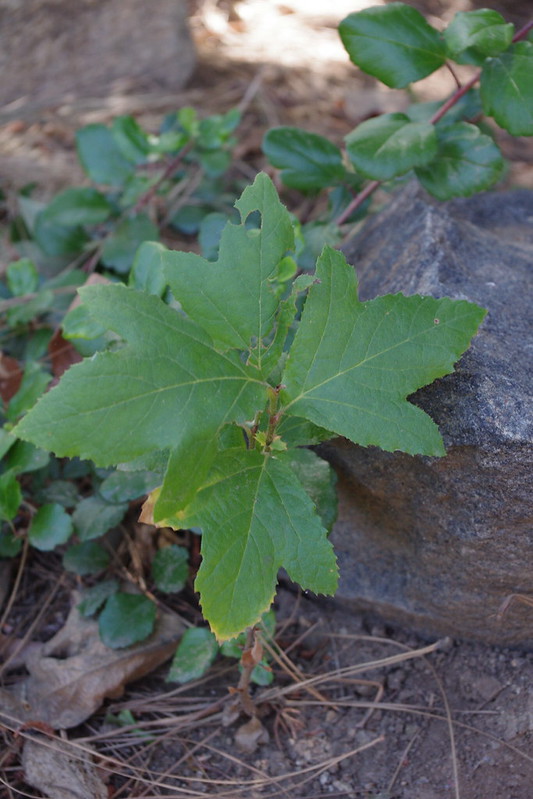
 This is really something I should have written about previously with regards Farming because it has always been my experience and method for preparing planting sites prior to urban landscape installation and maintenance for years. This is also true in the wild with any habitat restoration where hands on presence at remote location sites to insure success is impossible. For example the various landscape beds around my mother's place as the picture to the right is a perfect example. Now a couple of weeds will grow now and again and if they do they are extremely stunted in growth and only an inch or so high. The funny thing however about a healthy landscaped condition which is mostly mycorrhizal in nature, you will get weeds [unwanted Plants], but not the quite the type you are most likely thinking of. I get loads of tree and shrub seedlings. Take for example this California Sycamore seedling below. It was this Sycamore that I removed and planted at my sister's place over in Lakeside California. I planted it along the wash of the old San Vicente Creek through the Moreno Valley north of Lakeside.
 This tree volunteered in a dry raised planter bed I built which really no longer gets much water with the exception of the rainy season which only comes once a year. The first few years back in 2003-05, I did inoculate the Tecate Cypress, Pines Saplings and smaller shrubs like Spicebush [Calycanthus] and the spreading Catalina Currant you see in the background which when grown inland has to be grown under shade of trees. So the germination of this little Sycamore seedling in 2013 came as a pleasant surprise. But not a total shock as I always understood that after two and three years the weeds all but disappeared as a result of a health fungal network. One of the worst weeds was stinging nettles which were always an issue, but under the healthy mycorrhizal control they haven't been a pest at all. You should also know that they always were a problem since the late 1960s here when they first appeared in our garden. In some places where there are no mycorrhizal plants on that property, they still persist in spring. Many chaparral species off Rattlesnake Mountain above this location like Laurel Sumac are appearing every year and they were never an original part of the plantings. Now I have no problem with such unwanted shrub or tree seedlings. It's easy enough once a year to pluck them out of the ground. I may have a healthy nature replicated system, but I have none of the plant control components like Deer, squirrels, rabbits etc which would have kept excessive seedling presence in check. In the front yard all shrubs in the pea family are sprouting up everywhere. Again, it's easy enough to pluck them out. But I've always taken it as a compliment when they appear because it means something positive happened under the soil. No weed issues, no insect pest problems, but there are lots of beneficial insects as I've written about previously.
This all translates as biomimetic application as far as caring for and maintaining all plants under any and all circumstances, even on a smaller controlled industrial scale. But don't count on the industry ever latching hold of it. It doesn't make as much profit for the Industrial Ag business model and they will fight and/or manipulate media and use the neanderthal type of blind faith defenders who will question nothing they do or say, nor get off their back sides into the outdoors and explore a world beyond their electronic devices or Labs to find out how nature really works. So this is for individuals who actually give a rats backside. Until the end of the present system anyway, this is the direction this world will always be heading. It's not enough to read this stuff or the links I'll provide below. You have to go beyond head knowledge and make practical application in real life and that is what will provide the wisdom on how to properly use this information and be successful.
 Once again, this is my last piece on Biotechs and GMOs. The topic is too much of a waste of time for those who are warm and fuzzy in their own comfort zone ideology where beating up imagined anti science Fundies is the perverted intellectual sport of choice in our modern times. Personally I think they all deserve each other. This world doesn't exactly have many genius' who can prevent problem, but there are a plethora of intellectuals who will gladly claim that they solve any problem, but this usually comes with a high price. In any event, below is one more little tidbit which should illustrate how corporate industrial agricultural ventures will not be going down without a fight any time soon.
 |
| Photo Credit: Oregon State |
 |
 |
| Bert Wilson - Las Pilitas Nursery |
So both Mike Amaranthus and Bert Wilson spoke of weeds not being able to compete within a mycorrhizal system. So why is this ? It's a thing called phosphorus. Weeds excel in a bacterial environment which industrial agriculture and conventional chemical gardening and landscaping create by killing the mycorrhizal biological controls within the soils. They rob the soils of phosphorus. More and more literature is proving that in these mycorrhizal landscape beds and organic run farm fields where mycorrhizae is used to enhance performance in crops, the weeds are starved for phosphorus. In the disturbed soil environment created by industrial agriculture, the weeds are very aggressive at capturing the soil phosphorus far better than mycorrhizal crop plants who lack mycorrhizae on their root systems under conventional farming practices. This is where the industrial agricultural model benefits Corporate profiteering interests. Not only can they sell their expensive patent protected GMO seeds, but all the other chemical fertilizers, herbicides and some insecticides where the precious GMOs fail. It's a win win for all those former WWII chemical companies and an expensive proposition for the farmers that feel shackled to the system. Were it not for U.S. Government Subsidies, the conventional Farmers would never earn a living. That's why Organic wheat growers and other organic farmers don't qualify for the Government teat life support entitlements, because they make profit. Because they plant into their crops a good healthy mycorrhizal blend within their soils and those same weeds cannot compete in a mycorrhizal environment with it's massive rooting network grid infrastructure. So it's a P related factor and this is what Mike Amaranthus' customers have been experiencing and why they are noticing fewer weeds. Now does anyone here reading this have any idea of potential for ruin of some powerful wealthy Biotech Industry's business model ? Do you think they are just going to lay down and accept defeat ? Not on your life.
There are also some other important points to consider regarding farm cost savings and higher production yields with mycorrhizae. The University of Wisconsin made a study of the effects of Mycorrhizal Applications Inc's product called MycoApply on potato yields, profit and another extremely interesting thing about the application of phosphorus in the field. It was found that where conventional grown potatoes needed 120 lbs of phosphorus added per acre, under the mycorhizal applications to the potato fields, only 30 lbs was needed. Hence less phosphorus and more efficient mycorrhizal nutrient competition and uptake means less fertilizers. There was also an added bonus of more yield of potatoes per acre and profit by the usage of mycorrhizae into the soils. So drought tolerance, superior nutrient uptake which negated tons of fertilizers on industrial site, 200% increase in water hydration which made plants drought resistant and the added plus of less weeds or stunted weeds which could not compete. So it was win win all way round.
 |
| Illustration by Michael Rothman |
University of Wisconsin Potato trail with MycoApply
Summary of 2011 results
• MycoApply® treated plots averaged higher yields at all input levels of phosphorus.
• Yield increases were greatest @ 25% of conventional phosphorus inputs (30 lbs /acre vs 120 lbs / acre.)
• Yields from MycoApply® treated plots shifted significantly to higher grade potatoes (which bring higher prices)
• Net savings on phosphorus alone = at least $81.00 / acre with MycoApply® vs standard conventional P inputs.
• Net revenue increases ranged from $319 to $1,095 per acre on MycoApply® treated plots, depending on phosphorus inputs.
Influence of MycoApply® on yield response to phosphorus fertilizer in Russet Burbank potato
~~~~~~~~~~~~~~~~~~~~~~~~~~~~~~~~~~~~~~
 |
| Mycorrhizal Applications Inc. - MycoApply gave higher yields in potatoes with only a fraction of the fertilizer |
2013 Maine Potato Trials with “MycoApply®” Summary
• 6 trails on 6 farms with MycoApply®
• Average yield with MycoApply® was 366 cwt/Acre. Potatoes over 10 oz was 24%
• Average yield withNO MycoApply® was 319 cwt/Acre. Potatoes over 10 oz was 21%
• Average MycoApply® Advantage was 47 cwt/Acre.
• We estimate potato prices $8.50/cwt
http://mycorrhizae.com/wp-content/uploads/2013-Maine-Potato-Trials.pdf
~~~~~~~~~~~~~~~~~~~~~~~~~~~~~~~~~~~~~
 |
| Mycorrhizal Applications Inc |
This is something industrial agriculture is far behind and lacking because there is no money in such a business model. The Biotech model engineer it's patented seeds to quite literally be drenched in more chemicals and not less as advertised. This makes them outrageously expensive and unattainable by many of the small farmers in the poorer developing countries. When India Farmers failed with those GMO seeds which were heavily promoted as a simply a "Just Add Water" recipe by India's celebrity Bollywood culture as part of the Biotech public relations media blitz, the poor farmers bought into their sales pitch. When things went wrong, Monsanto blamed them for not purchasing and using their chemical fertilizers and pesticides which they were engineered to work in conjunction with. Seriously, dirt poor third world people do not have the money to buy that chemical junk and India Farmer customers who make one to three dollars a day cannot afford to buy more expensive food which makes the "We just want to feed the world" slogan a joke. Now take a look below here at this extreme weed infested maize field. This is actually the results of years of abuse in this field with chemicals and other bad land management practices.  |
| Image Credits: USDA/Public Domain - Arkansas Cornfield |
This all translates as biomimetic application as far as caring for and maintaining all plants under any and all circumstances, even on a smaller controlled industrial scale. But don't count on the industry ever latching hold of it. It doesn't make as much profit for the Industrial Ag business model and they will fight and/or manipulate media and use the neanderthal type of blind faith defenders who will question nothing they do or say, nor get off their back sides into the outdoors and explore a world beyond their electronic devices or Labs to find out how nature really works. So this is for individuals who actually give a rats backside. Until the end of the present system anyway, this is the direction this world will always be heading. It's not enough to read this stuff or the links I'll provide below. You have to go beyond head knowledge and make practical application in real life and that is what will provide the wisdom on how to properly use this information and be successful.
Update February 16, 2015: "Fertilizer Use to Surpass 200 Million Tonnes in 2018"
 |
Fertilizer Use to Surpass 200 Million Tonnes in 2018 Food and Agriculture Organization of the United Nations |
Any math folks out there ? Remember those University studies Mike Amaranthus mentioned on MycoApply and Potatoes ? Remember how those organically grown potatoes colonized with Mycorrhizal fungi how they only had to apply 30 lbs of Phosphorus per acre as opposed to 130 lbs per acre as required by the conventional Agricultural farming methods ? So what are we talking about as far as percentages when it comes to drastically reducing this outrageous number referenced above by the United Nations of an increase 200 Million tonnes. Even without doing the numbers, can you see what kind of a fight lies ahead for any group promoting far more responsible farming methods as recommended by companies like what Mycorrhizal Applications Inc is doing ? Can anyone see the handwriting on the wall of just how these Agricultural chemical giants will not stand for their obscene wealth generating business model being dismantled bit by bit ? Seriously people, think about this!
~~~~~~~~~~~~~~~~~~~~~~~~~~~~~~~~~~~~~
Good Resources for Studies on Mycorrhizas and Weed Control
Australia: "Weed Control - A new discovered benefit of mycorrhizal fungi"
Biological weed control with soil fungi? Antagonistic effects of arbuscular mycorrhizal fungi on the growth of weeds
Mycorrhizal fungi suppress aggressive agricultural weeds
Mycorrhizal fungi for weed control
Glyphosate herbicide affects belowground interactions between earthworms and symbiotic mycorrhizal fungi in a model ecosystem
Further Update February 11th, 2015 (Trinity College Dublin, Ireland)
Friendly Fungi Could Help Barley Growers Feed the World Without Chemicals
Bert Wilson's mycorrhizal recommendations
Weeds and their effect on the Ecosystem
California Native Oaks and Mycorrhiza: The Growth and Ecology of California Native Oak Trees
Native plant roots: what goes on below the surface
California Soils and native plants
This reference link below has a page of numerous sub-links, so please click on them and read them. Bert deals mainly with California Native Plants, but the basic fundamentals as far as mechanisms are the same globally. Only the finite details and local applications depending on ecosystems will be unique, but that is where you need to explore personally.
http://www.laspilitas.com/nature-of-california/plant-articles
Introduction to California's Ecosystem


