Showing posts with label Landscaping. Show all posts

Friday, May 11, 2018

Science-Based Herbicides vs Holistic Grazing in Weed Management of National Forests

Forest Service to cut hundreds of ponderosa pine trees near Sisters killed by the herbicide "Perspective."
(Ryan Brennecke/Bulletin photo)

photo by Jim Anderson
Recently back on May 4th in the News, there was a sad report of a tragic event which took place along many of Oregon's Highway right-of-ways where conventional science-based weed abatement practices of spraying dangerous herbicides, like Bayer's toxic weed product known as "Perspective" which was supposed to target broadleafed weeds and other fire flamable vegetation, some unintended consequences took place. Apparently, this has been the practice by Oregon Transportation Department for some time as it is also around the country. While the target may have been the broadleaf weeds and other flammable weeds through a seemingly easy no break a sweat approach management version provided by science-based toxic chemicals and hopefully acquiring immediate results, the chemical apparently made it's systemic way underground, perhaps further facilitated through the mycorrhizal grid network to the Ponderosa pine rootsystems which eventually later led to the Ponderosa Pine's succumbing to the toxic effects a few years later. Interestingly it does seem that there were warning labels on this side effect on non-target trees and shrubs which were totally ignored. Without further explanation, here are the two links. First is from August 2016 and the second from May 2018 a few days back.
The Nugget Newspaper (Sisters, Oregon) "The warning bell is ringing!"
The Bend Bulletin: "Forest Service to cut hundreds of ponderosa pines near Sisters killed by herbicide"
===============================================
A more viable & responsible Solution and one that Perfectly Biomimics Nature
Photo: Washington State DOT Flickr Photostream

(Photograph courtesy Texas DOT.)
This photo above is of goats clearing grass and weeds near Olympia area highway interchange. Something seriously needs to change for the better. Herbicides need to be shelved and never used again. Of all the grazing & browsing animals, goats are basically biological mowers/browsers and can perform a similar function as mechanical mowing but without burning fossil fuels and generating carbon emissions. Another advantage is that some weed seeds are sterilized as they pass through a goat’s digestive system, allowing for more effective weed control than mechanical mowing or chemical herbicide spraying. Goats can also easily access steep and uneven terrain along highway shoulders and cutouts. Of course there are the usual concerns over the use of grazing in highway applications which may include higher costs associated with fencing, watering and supervising the animals; liability; and potential distractions to drivers, but I think much of these costs could be a non-factor if the Highway Departments did not try and manage this themselves and awarded grazing rights to responsible herdsmen who could provide a better professional hands on project of oversight. We're not talk just throwing the animals out there and seeing what happens. They do have to be responsibly managed and not left on their own. Clearly areas like this region in Oregon where 1000s of large Ponderosa Pines must now be removed could have benefitted by this holistic approach as opposed to the conventional science-based practices which have been used for decades. Most all roadside landscape plants should be natives to the areas the roads are located which eliminates watering and benefits wildlife, especially the native pollinators. Below are some links to sites which further explain the benefits.
Roadside vegetation management in the Netherlands
https://environment.transportation.org/"Invasive Species/Vegetation Management"
Roadside Best Management Practices that Benefit Pollinators Handbook for Supporting Pollinators through Roadside Maintenance and Landscape Design
US ARMY: Unconventional Sustainability Method using Sheep & Goats in Hawaii Nabs Award
https://www.wsdot.wa.gov/THE USE OF GRAZING ANIMALS IN ROADSIDE VEGETATION MANAGEMENT
===============================================
Grazing to Reduce Wildfire Risks also Biomimics Nature
Photo by johndeerefurrow.com

Another interesting article in John Deere's online journal, "The Furrow," provided interesting feedback on experimental practices of Fall grazing of invasive annuals like cheatgrass to reduce wildfire risk and helping to provide nutrients to the soils. Here is that link:
https://www.johndeerefurrow.com/2017/09/01/forage-not-fuel
Also, remember my last post on the environmental effects of the presence of megafauna (large herbivores) and the roles they all played in forest and prairie health and almost total absence of wildfires ??? 😲 Yes, studies showed that fire while being naturally present was not the major destroyer and killer it is now. Well, here it is again:
Megafauna were the "Ecosystem Engineers" not Wildfire

National Park Service / Neal Herbert

Now, one would think that the environmentalists and government agencies would all be for such a holistically sustainable approach to weed management which actually replicates Nature through Biomimicry, right ??? Wrong! The modern day environmental movement has a murderous hatred of ranchers and as many of the leadership in this movement have admitted, they want this industry to go extinct. This is a really sad video.
The Eco-Activist Movement's rejection of utiling grazing and browsing animals for any Vegetation Management

In this video posted by journalists from the Wall Street Journal on March 30th 2018, "The Last Cowboy at Pine Creek Ranch," they discuss one ranching family, who, after a 40-year battle, was wrecked by government agency rules designed to make ranching unprofitable and impractical. Wayne Hage won his case in court numerous times, proving his grazing and water rights were his legally, not publicly owned and controlled as the government insisted. Yet each victory was appealed by the heavy hand of government, moving the case to the next court and the next judge in the system, forcing Wayne to spend more and more on legal fees. The government plan was simple and obvious. Destroy him financially until he was forced to give up. Now the the government and environmentalist's viscous tactics have finally forced this family to give up the fight as they prepare to move off the ranch and let the ecoactivists and government have their spoils in the war over the rangelands. The Federal land managers were aided in this travesty by the environmental group known as Western Watershed Project (WWP); the program’s director, activist Mike "Buffalo Man" Mease, who was interviewed in the video had this to say.

A cow is a non-native species to America and when we set them free on the wildlands of the west, they don't know what they're doing out there. As they will walk and eat every blade of grass in front of them, as they walk Cattle hoofs are not cleft. They are one single pallet which compacts the soil, unlike native animals which have cloven hoofs which aerate soil.”
Amazingly, most all the Government agencies and environmentalist groups including Mike Mease's Western Watershed Project & Buffalo Field Campaign, etc generally know full well that grasslands developed under intensive grazing from large herds of bison (pre-1800s saw 60+ million Bison according to stats) and other wild animals (millions of Elk, Deer, Antelope, etc), which through co-dependency became necessary for both soil and plant health. Yet in practice however, most of these militant groups have become more and more hostile to the presence of cattle or other domestic grazing/browsing animals presence on the land, which they variously blame for native species loss, range degradation and forest destruction, erosion, pollution, global climate change and even labeling ranching operations as public theft. In justification of this warped thinking, WWP’s spokesman, Mike "Buffalo Man" Mease, claims cattle harm grasslands because they are not “native.” He provides a nonsense explanation about cattle hooves compacting land by calling them "single pallet" as opposed to the native animals like Antelope, Elk, Deer, etc which have cloven hoofs which aerate soil. If any animal could be labeled as single pallet, then would that not better describe such animals as Horses which have a uni-hoove (or single toe). Cows have cloven hooves with dewclaws. Interestingly, both horses and buros were present in larger numbers centuries ago and had positive effects on the land. But take a look at the differences below.

Images - Mother Nature's Tillers


Mike "Buffalo Man" Mease's knowledge here is confusing as you listen to the very words leaving his mouth given the fact that he labels himself with the knickname, "Buffalo Man" which should leaves folks puzzled. Bison (Buffalo) and Cattle have the same identical hooves. Once again, there were once over 60,000,000,000+ Bison in pre-1800s in North America. So by his definition when using the hoove design argument, was Nature in trouble when such vast numbers existed just a century ot two ago ??? And if so, then why does he champion more and more buffalo on the landscape ??? Surely from his outdoor experience and credentials he must know what is right ??? Oh wait, he doesn't have any biology or conservation credentials. Mike Mease has a B.A. in Radio/Television and Psychology from the University of Montana. This is almost the same identical credentials of another infamous eco-activist, Kieran Suckling of militant Earth First fame and co-founder/director of the Center for Biological Diversity out of Tucson, Arizona. Neither of them are biologists. Like Mease, Suckling wants ranching to go extinct:
“Ranching is one of the most nihilistic lifestyles this planet has ever seen. Ranching should end. Good riddance.”
CBD director Kierán Suckling to the Washington Post.
In the interview with the journal High Country News, when he was asked if his lack of any science degrees were a hindrance to his work. He responsed:
"I think the professionalization of the environmental movement has injured it greatly. These kids get degrees in environmental conservation and wildlife management and come looking for jobs in the environmental movement. They've bought into resource management values and multiple use by the time they graduate. I'm more interested in hiring philosophers, linguists and poets. The core talent of a successful environmental activist is not science and law. It's campaigning instinct. That's not only not taught in the universities, it's discouraged."
Well that's wonderful. Learning how nature really works and pursuing degrees in environmental conservation and wildlife management are totally worthless. Civil disobedience, eco-terrorism and psychological warfare thru sue and settle are something to be admired. Kieran Suckling once boasted that he himself engages in a kind of psychological warfare (which for a fact he is credentialed with his degree in Philosophy) by causing stress to already stressed public servants when he bragged, "They feel like their careers are being mocked and destroyed -- and they are. So they become much more willing to play by our rules." 
(Source: High Country News)
I'll never understand the murderous hatred eco-activists openly display towards ranchers on the part of the environmental movement which is in fact killing nature, not preserving it. So much about ecology movement these days has become like a fanatical version of a religious Jihad or kind of animist holy war. While there were clearly practices within traditional ranching that were irresponsible in the past, that is not the case with many ranchers today who see great worthwhile value in helping to preserve wildlife and restoring the land's vegetative ecosystems. It's not just a matter of their livelihood for profit, but also their love and passion for conservation which has also become their hobby. Rather than demonizing all ranchers and lumping them onto the Bundy Bandwagon, they should embrace and ally themselves with the more responsible ranching land stewards. But thus far they have refused to do so.


Image - Cow Hooves

Take a close look at both photos above and below here of both cattle and Bison (Buffalo Hooves). Both cattle and bison hooves are split. The two animals are so closely related (same 'kind' of animal) that they can actually interbreed. They are roughly the same size and weight. Whether on a forest floor or on grasslands, when cattle herds are hands on managed and grazed in a way that mimics bison herds in large numbers, timing and behavior, their physiological effects on the landscape are similar to the bison. Under these conditions cattle can stimulate plant growth like grass and the native weeds (which cattle won't necessarily eat), but which in turn benefit creatures which like the weeds like the pronghorn and deer and the native insects necessary to sustain grassland birds like quail and grouse. In so doing cattle and bison sequester carbon and add organic humus to soil, which increases its fertility and water-retention, thus improving watersheds. But given Mike "Buffalo Man" Mease's lack of understanding that there really are no physical differences of cattle to buffalo, are we to assume ancient historical buffalo herds of 60+ million were a bad thing within the pre-1800s environment ??? 😕 Hardly!

Image - Bison Hooves

When you look at the various hooves and their imprints, you should be able to notice that they closely resemble chisels. They have the ability to cut into the soil, churn it up, break up crusts and clumps, create pockets to hold moisture, trample old vegetation into the ground. Humans have terminology for this action. We call it tilling and cultivation. Of course animal disturbance on the land done the right way only disturbs the top few inches, not feet like science-based mechanized innovation. But grasslands, forests and wildlife have steadily declined since the massive bison herds were wiped out over 150 years ago. So to offset this horrible ecosystem decline, these so-called defenders of Nature, which apparently also includes many in government, academic and the general conservation bureaucracy seek to banish cattle completely off the landscape. And yet Cattle properly managed through a hands on holistic approach are the only true substitute for those missing keystone grazers, the (Bison herds). What's worse, environmentalists have no idea of how, why or what other animals to replace the Bison with out on the landscape. They never offer any real world viable solutions other than promoting the need of reducing mankind through science-based abortion, eugenics and hospital oversight over euthanasia programs. After that, they want to turn everything into their version of wilderness and Nature will just fix the problem all by itself.


Interestingly, regarding these chisel design patterns of hooves: the  Rodale Institute has developed a crimper-roller that’s designed to trample green manures and old stalks into the ground. The tines work like chisels. Vineyards have available to them a smaller, even more chisel-like adjustable “eco-roll.” And Ames Lab at Iowa State University have also produced an imprinter-roller that tries to imitate the hoofprints of passing buffalo, to be used in Colorado prairie restoration. All of this is about bomimicry when it comes to the ecological management of the landscape that went on for thousands of years with 60+ million forest and prairie Bison. Keep in mind, such innovation is necessary in the absence of herbivore animals. Animals are the original ecosystem management component [tool] and that's by design.

In conclusion, this information and news items are for people who do own land and who want to manage that land in a holistic manner which will enhance ecosystems and wildlife. There are numerous services that grazing and browsing animals can perform if properly managed which would negate the using of more science-based toxins. As for all these enviromental groups which lay claim to being the only solution for representing Nature, run the other way folks. There is a Proverb 24:21 which states the danger in associating with these types of groups, it says, 
" . . and do not associate with those who are calling for change [or allegiance with, and are dissenters, rebels, revolutionaries]." 
Our world today is characterized by militant activism against anything and new ways of being offended, angry and outraged seem to be invented or fabricated now on a daily basis. Save your money folks and pursue rescuing and rehabilitating nature under far more peaceful responsible circumstances. My wife and I just recently visited my hometown from Sweden which is San Diego California this past April 2018. Everything there seems to have taken a turn for the worse. California is literally riddled with misdirected people who are looking for any reasons to become activists for whatever cause. People now days seem to be at war with whatever is popular on social media that outrages them and considered trendy to participate in. Very few seem to have a normal life anymore, whatever normal life once was. In the mean time, being credentialed with regards to environment issues are ultimately meaningless when these so-called credentials conflict with common sense and reality on the ground.


Sustainable Dish with Joel Salatin


Wednesday, September 13, 2017

Southern California: Engineering an Urban Landscape patterned after the blueprint found in Nature

Some interesting facts about Laurel Sumac and it's ability as an ideal nurse plant which utilizes Hydraulic Lift & Redistribution of sub-soil water which facilitated this Torrey Pine to thrive
I've written previously about this specific location in El Cajon California on the famous Rattlesnake Mountain regarding the Torrey Pines planted there over 30+ years ago and the emotional response by many folks over the irresponsible actions by Sky Ranch Housing  residents who cut them down with chainsaws and the blind eye stance by Center for Natural Lands Management to what took place even though the conservation area has a plethora of threatening signage around this mountain about the consequences of trepass into this conservation area (I would presume this also means Sky Ranch residents). I did contact someone at the CNLM (Ecologist Markus Spiegelberg), but he said there was nothing they could do. He claimed he never saw the trees, which wasn't true because he did initial plant inventory and did notice the San Diego Coastal Cholla Colony which I also established 30 + years ago along with one Saguaro I had and didn't know what t do with because my father did not want it in his yard. Yet Markus found it's presence way back when interating. The 30' tall Torrey Pines were all next to this colony, so he new, plus he said they did not belong there anyway. They were non-native. The irony is the restoration work of all Coastal Sage Scrub habitat ruined by Sky Ranch construction which he over saw contains non-natives like Mediterranean Rockrose, etc. However this post isn't about them or the negative actions they undertook. This is for people who wish to understand why these trees succeeded in such an inhospitable environment for trees where failure should have been the norm. The practical applications I used so many years ago which were inspired of biomimicry (strictly replicating how Nature works) is even more important now in view of the major declines of Torrey Pines at their native habitat in La Jolla and Del Mar along the coast which I just now wrote about in this link below.
Earth's Internet: "Major decline in Torrey Pines & SoCal Forests in general"
My photograph from 2011

This Torrey Pine tree above was one of many planted during the winter rainy season of 1980/81 after a wildfire had raged all across the Rattlesnake Mountain range between the cities of El Cajon, Santee and Lakeside that previous hot summer of 1980. I had planted other Torrey Pines during the 1977, but the wildfire of 1980 consumed all of them. It was in the middle 1970s when I was taking Ornamental Horticulture that some research was just coming out about the idea of nature having some plants which acted as nurse plants for tree seedlings. That intrigued me and my first experiments with testing for the best nurse plants were with California Buckwheat shrubs. While they worked okay, many plants failed after a couple of years and I eventually settled on Laurel Sumac which I found far more successful. I eventually chose the location I did because it was remote and rarely had visitors. It was on the direct south facing slopes of Rattlesnake Mountain towards direct sunlight. Not exactly an ideal location for trees in the dry west. Very little trails or reasons for people to hike around there. The tree in the photo above was over 25' in height when this photo was taken in 2011. It grew slowly at first, then started shooting up more as it matured. Under more ideal conditions it would be almost double that height like my 4 Torrey Pines I planted at my home in Anza California at elevation 4,500' (Table Mountain) back in 1986. Those trees are about 50', but the San Jacinto Mountains also get far more measurable rainfall per year compared to the interior hot valleys east of San Diego. An important part of that rain also comes in the form of Summer monsoonal thunderstorms from Mexico, something El Cajon never sees. This tree below is the smallest of the two Torrey Pines mainly because it became overwhelmed by it's nurse plant's foliage until it much later found a way out from the Laural Sumac's canopy. Hence you can see the crocked picturesque angle it had to take much like the Torrey Pines along the Sea cliffs. 

Photo is mine from 2011

Image - AZ Plant Lady
Again this photo above is the smaller of the Torrey Pine which like the larger one was planted within the influence of a large Laurel Sumac chaparral shrub, but at time of planting after wildfire was burnt to the ground. The shrub resprouted and grew rapidly. Eventually enveloping both trees, but the upper tree had managed to have it's central leader always protruding through the Laurel Sumac's canopy. While this lower tree's foliage struggled with not only the larger Sumac's foliage, but also from competition from another Laurel Sumac on the other  side as there was a second shrub. I watered them once a week during the first Summer by carrying milk jugs full of water, three in each hand. It was tough going and generally 100+ Fahrenheit in summer. Later I switched to very early mornings or evenings after sunset, but still light outside. I had to also be careful so as not to drawn any suspicion from neighbours. And of course you know the reason why. My method of using the milk jugs was not like the one in the picture above, but rather I would turn them upside down partially burried and water would percolate slowly straight down into the soil directly next to the seedling. But after a year, this method was no longer needed.

Photo is mine from 
The following two years after that first hot summer the trees were doing excellent under their nurse chaparral shrubs (Laurel Sumacs and California Buckwheat), but something more was needed because I was not going to pack mule water up that mountainside forever which would force the seedlings to remain on life-support. Eventually they had to mature and stand on their own in the wild. For about eight good years the trees grwe slowly, but remained healthy. Something more was needed and again there was newer research coming out in some Ag & Forestry Journals about numerous symbiotic fungi which lived on plant roots and kept their hosts alive in the wild. 
(Research was tougher come by back in the 1970s as access was limited to conventional brick & Mortar libraries, school textbook references and subscriptions to journals. Today we have the internet which provides mountains of research on how nature works. And yet amazingly biomimicry still doesn't represent mainstream science.
Human understanding of plant ecosystem mechanisms in the wild was improving in the late 70s - early 80s. I found the research of US Forest Service Biologist, Dr Donald Marx (former senior scientist for PHC), who was studying which was the best species of ectomycorrhzal fungi that would benefit new pine and oak seedlings for survival. His conclusion was Pisolithus tinctorius like the one I collected here in the photo above from the San Diego County backcountry just south of the gold mining town of Julian. So I figured why not. The dried puffball truffles which looked like dog turds had the dark brown powdery substance (spores) I needed to make this work. So almost a decade after planting in 1980, I dug small three inch deep holes (about four) around all sides of the Torrey Pine seedlings with my finger and drop in some of the chocolate coloured spore powder into the holes, then back fill it in with soil and watered. I made about a dozen holes and inoculation points far enough away from the tree trunks where I thought the root hair feeder roots would be. It was crude in comparision to what I use now because many of the commercially prepared mixes today come with root growth stimulators like humic acid, etc. These are important because they encourage new root hair growth which is necessary for the fungi to begin to colonize. The fungi will only colonize the root hair tips or cap when it comes into contact with the spore. I worked quickly because in 1982 I was moving to Idyllwild California up in the San Jacinto Mountains. Take note below of the benefits of fungi and plant root interactions.


You can see clearly the colonized roots on the pine seeding at right. The image on the left has been digitally altered to remove the fungal web so that the actual pine seedling root system are exposed. As you can see, pines without fungal colonization are at a huge disadvantage from a water distribution area point of view. Frankly it was still some years later that I became more familiar with the value in nutrient uptake as well. For me, access to water was the more important factor at that time. It wasn't till the middle 1990s I found out that this particular fungi increases both water and nutrient absorption from 200% to 800%. Some of the central leader stems on the trees were now growing more than a foot high in a season and producing next years leader with numerous branch buds six more inches in length. That explained to me even further why I always had success with pines and oaks on my acreage up in Anza, California, when I mostly attributed the healthy vigorous growth to better access to more water availability because of higher geographical rainfall totals. This particular fungi is an ectomycorrhizal fungi symbiotic companion which generally prefers trees, but the nurse shrubs I used in El Cajon were endomycorrhizal. So no real connective interactions between pines and shrub. However, the PT mycorrhizae will travel underground 200' away from it's host looking for water and nutrients, so any water acquired by the nurse plant shrub from deeper sub-soil will be released in the top surface layers of soil and picked up be the ecto-fungi. More on that function and phenomena we call hydraulic lift below.
A Perfectly Natural Phenomena of Older Needle Drop in Evergreens like Pines
Image - affordabletrees.com

Photo: Ladd Livingston,
Idaho Department of Lands, Bugwood.org
Some people become alarmed when they see yellow dead and dying needles within their urban landscape pines or other evergreens. No worries, if the older, interior needles of your evergreen pine trees or even shrubs are yellowing and dropping, rest assured it is probably not a disease or an insect infestation. It is the normal fall needle drop, sometimes referred to as seasonal needle drop. All conifers loose at least some of their needles every year. Most conifers (Pines) will retain needles through several growing seasons as indicated by the branch whorls which count as a years growth in a season. But think of the foliage of a Pine tree or any other tree or shrub as a living biological manufacturing plant. They will shed and remove any of their older, less efficient needles each fall. Generally these are the oldest needles from past years. Prior to shedding these needles they will change color from their healthy green to yellow, orange and brownish-red like both photos above and to the right. Early in the shedding process, while the needles are still attached to the branches, these trees may appear to have an unhealthy appearance which can cause unnecessary concern. In urban landscapes people generally want everything to be perfect. Below is a beautiful illustrative graphic from Michigan State University which helps you to understand the process.

MSU Graphic

Take note in the graphic above, it indicates two and a half years growth is still going strong. However, about three and a quarter years growth is being shed. In some cases this could also be due to drier, maybe even drought conditions. Hence the elimination of older needles may help limit transpiration surface to help the tree survive.
References on Dead or Dying seasonal Pine Needle Drop
http://msue.anr.msu.edu/news/dying_and_falling_needles_on_evergreens_is_a_natural_process_in_the_fall
http://byf.unl.edu/natural-needle-drop
http://msue.anr.msu.edu/news/fall_needle_drop_a_natural_phenomenon_in_conifers
https://www.thespruce.com/fall-needle-drop-1403324
Why the ability of Pine Trees to hold many growth years of their needles is important
My last photograph taken 2013
 Tree was diliberately destroyed the following year 2014

Colorado State University
One of the more remarkable things I noticed when I took this last photo in 2014 of the largest Torrey Pine on Rattlesnake Mountain in El Cajon, California, was the fact that the tree was still carrying all it's needles on every branch and the central leader on all it's growth whorls six years back. Same was true of the Torrey pine that was half this size. Keep in mind these trees were 30+ years old and survived only on the meager rainfall averages (many of which were drought years) within an interior environment where the temperatures soared to 100+ Fahrenheit which is common. The photo at right is of a drought stressed Ponderosa Pine which has all it's needles turned brown with the exception of that present year's growth. This is also often common scene in Southern California urban landscapes where much of the trees and shrubs are on some sort of irrigation life-support infrastructure. When water rates soar sky-high, then the householder cuts back. Unfortunately the underground root structure has not developed naturally to where sub-soil moisture cannot be reached and all supporting cast members present in a wild setting like deeply rooted shrubs and mycorrhizal fungi are greatly reduced or more than likely completely absent. Often the root water transportation infrastructure and it's landscaping will suffer the most. Take this example below.

Image Google Earth (2914)
 Interchange between Freeway 52 & I-15

These pines are actually Torrey Pines planted along the western side of Interstate 15 heading south to San Diego just before the Freeway 52 interchange. Take close note of the extreme stress they are in holding only present years growth of pine needles and tiny needles at that. Torreys have some of the largest and longest needles of most pines. These are also natives and not that far from the coastline where they are native. This location also experiences a strong marine air influence of daily cloud cover, especially in May-Gray & June-Gloom periods. Still they are stressed more so than those Torrey Pines further east in the much hotter inland interior valleys of Santee, Lakeside & El Cajon. Not to mention the location on a southern slope face of Rattlesnake Mountain in direct intense sunlight. I should say that some of the Torrey Pine seedlings I did plant within the shelter of California Sagebrush and California Buckwheat did well for a few years, but at about 10 years they looked much like these example you see here above and below. Eventually they died or were vandalized by idiots with guns for target practice. Only the trees planted within Laurel Sumac fared exceptionally well. The installation plan and maintenance techniques are clear, Nature needs to be replicated through biomimicry. Now look at this same location below with a Google Earth shot in 2017.

Google earth Same location along Interstate 15 (2017) 

Take note of the lusher greener plants in the foreground. In San Diego this past rainfall season they had much heavier rainfall records, but also an irrigation system and plants have been installed in the foreground. The trees are still in an incrediblly stressed out state with only present growth barely hanging on. Water is not the only key here, but rather colonization of Pisolithus tinctorius mycorrhizal fungi. PT mycorrhizal fungi is the best fungi for plants growing in hot dry areas. Yes, species does matter in this case. But so does a supprting cast of native deep rooted chaparral shrubs in the right strategic placements in this industrial landscape.
Supporting Cast Members in the Landscape, includes various species of Chaparral
Photograph by David Magney (2005)

San Alijo Lagoon Conservancy
This is the nurse plant chaparral shrub above and to the right called Laurel sumac (Malosma laurina) which has outstanding bright green foliage all year. These large clusters of cream flowers appear in the summer. Later the dried flowers and seed heads turn a rusty red-brown. The leaves tend to fold up along the midrib, especially during dry weather whuch apparently helps reduce exposure to the dry hot summer sun of the coastal sage scrub plant community, especially in the hotter interior valleys and mountains nearer to the coast. This gives the plant another common name reference, the taco shell plant. This along with a colony of very old, almost ancient, looking Lemonade Berry which are at the top of this mountain at the head of this normally dry wash (sometimes perennial stream) are the largest shrubs on this hill. Everything else is California Buckwheat, California Sagebrush, White Sage, Gold Yarrow, Monkeyflower, Deer Weed, Coastal Prickly Pear Cactus, Coastal Cholla Cactus, Coastal San Diego Barrel Cactus, etc. My choice for nurse plant was Laurel Sumac in 1980 which turned out to be a great choice and here's why:
"Laurel sumac roots are deep and extensive; vertical root depth of one individual in the Santa Monica Mountains exceeded 43.6 feet (13.2 m)"
US Forest Service - Malmosa laurina

One of the most amazing phenomena of a good nurse plant is it's deep root system ability to extract water from very deep subsoil layers and bring it to the surface. This process is known as Hydraulic Lift & Redistribution. Not only for itself, but also the more shallow rooted shrubs and perennials around it. But it's also beneficial for tree seedlings like oak or pine which would otherwise fail and not make it to the sapling stage of life and beyond towards being a fully mature tree. Especially at night will nurse plants like Laurel Sumac pull up incredible amounts of moisture for themselves and other plants as you see here on the left in the illustration. In places like Africa, plants like grasses and other forbes on the Savanna benefit by growing closest to those giant picturesque Acacia trees like Acacia tortilis. Young tree seedlings also benefit as a tiny emergent seedling from the nurse plant's shade before it pushes through the shrub's foliage when reaching for the sky on it's own. But there is so much more to this hydraulic movement of water.

There is yet another reverse type of phenomena known as Hydraulic Descent where in winter rainy season when the shrub or tree is dormant and not actively growing above ground, the root system is still active underground taking surface soils saturated with rainwater and sucking in and pumping that water into deeper sub-soil layers. If an ecosystem is healthy enough, this collective action by trees and shrubs can recharge acquifers. Many soils are to tough for water to percolate on it's own, so a healthy vegetated ecosystem like an old growth forest or even an old growth Chaparral Plant Community of Southern California will saturate the deeper layers of sub-soils for later usage during the hot summer months. Now even though this shrub is endomycorrhizal and will not form interconnected relationships with pines, oaks, etc, they will still release water from their lateral roots at the surface which can then be accessed by the ecto mycelium or fungal strands. When I lived at elevation 4,500' I used the chaparral shrub called Redshank or Ribbonwood as a nurse plant. Take a look at this gallery of trees below from my former acreage in Anza California.

Photo Mine 2012
These to Coulter Pines above and below were planted across from one another. These trees were foot high bareroot trees I planted on a remote section of my acreage in Anza California. No irrigation. Although these were wild collected from along roadsides, I still inoculated them with Pisolithus tinctorius or P.T. Mycorrhizal Fungal spores. I also located them next to Scrub Oaks or Redshank Chaparral Shrubs. If Redshank was unavailable then I would use it's cousin Chamise or Greasewood (shrub gets blamed for intense wildfires), both of which are also ectomycorrhizal, but under only certain environmental conditions like times of heavy rainfall years. This is important to know because such knowledge allows for foresters to plant trees like Jeffrey, Coulter or Torrey Pines to pioneer into predominantly chaparral areas. Thus the shrubs and trees can interconnect through the mycorrhizal network and young trees throughout youth will be assured of being hydrated by their chaparral nurse plants. Up in Anza the Parry Pinyon will interconnect with Chamise and redshank during the wetter years. Sadly the present property owner removed some of the chaparral around the trees and built this shed between them. Still the healthy start for these trees has been a success. 
Photo is Mine 2012
The three trees below here are two Ponderosa and one Coulter Pine. The Coulter was actually a volunteer under a Redshank which was planted by a scrubjay from pine nuts taken from a large maturee tree next to my front porch. The two Ponderosas I planted within the same chaparral. At one time they were all surround by Redshank and Scrub Oaks, but the present owner wanted all brush removed. But notice on all my trees the five or six years growth of needles still on their whorls ? Very little leaf dander under these trees. This is a sign of very healthy trees. An odd side effect was that there was also an improvement in shrub vegetation and vigor after I inoculated with fungi, especially from the scrub oaks. Truffle formation was everywhere after that. The other fascinating thing here is that these trees are already baring pine cones.
Photo Mine 2012
Below are the three Torrey Pines I planted in Anza, California
Photo Mine 2012
These four Torrey Pines were planted on this bank behind the house in association with California Coffeeberry, San Gabriel Flannelbush and California Holly (Toyon). The year was 1985 where we has a couple of winters (3 in a row which had extremely low subzero temps from Arctic blasts from Canada and high wins at times from 50 to 60 mph. It was insane. The only problem for the Torreys were the very tips of all needles turned brown for about an inch in length. No problem, because after those three winters the central leader grew more than a meter or more in length, with often a secondary growth spurt after summer monsoonal thunderstorms which were intense with heavy rainfall. So no worries at high elevations and no supplementary watering after that.
Examples of Nurse Plant Mutualisms found in Nature within San Diego County
Photo is mine from 2013
The photo above shows a stand of Fremont Cottonwoods on the Henshaw Valley floor in northeast San Diego County. Take note that these large deeply rooted Cottonwood trees are able to support other smaller native plants like this wild native California Rose (Rosa californica) hedge. Other plants are also able to thrive under these trees like the native Snowberry (Symphoricarpos albus laevigatus) and Western Bracken Ferns. This location is amazing because of it's distance away from the forests on the mountainside and the fact that birds or animals originally brought the seeds of these plants to the trees through their feces droppings.
Photo is mine from 2013

Calflora
This photo is much further east in the backcountry community of Ranchita where my brother lives. This is a much hotter drier area just before the landscape drops down into the Anza Borrego Desert. The tree is an Interior Live Oak and the plant below which it is supporting is the native Honeysuckle. Take this Oak tree away and the honeysuckle dies. The area is just too harsh and dry for it to thrive without a companion nurse plant. No doubt a bird flew within the foliage of this Oak tree, pooped after eating the honeysuckle fruits somewhere else and poof, a honeysuckle seedling.

Photo is mine from 2013


Photo is by Cody Bish
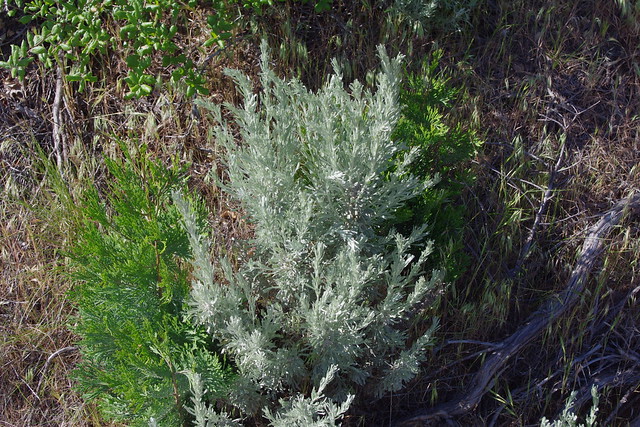
One of my favourite nurse plants is the Silver Sagebrush which thrives in the dry high mountain valleys and high deserts steppes of the western United States. The photo at the top is along Montezuma Road in Ranchita almost across from Old Mine Road turnoff. These Silver Sagebrush (Artemisia cana) are nursing along numerous Incense Cedar seedlings and Saplings. Older trees of Cedar were planted several decades ago along this road and San Felipe Road further west. In 2002 there was a wildfire that burned from Julian to the mountains north of Ranchita above Warner Springs. Many of the trees (Coulter Pine, Incense Cedar, etc) escaped the Pines Fire's fury and were years later producing seed which successfully germinated as you see in the top photo taken back in 2013. Another common association with Silver Sagebrush is the Indian Paintbrush seen in the photo here on the right. What many never realize is that Silver Sagebrush is an excellent facilitator of hydraulic lift and redistribution of water. While many will say that the Indian Paintbrush is partially parasitic to Silver Sagebrush, I imagine that this remarkable water hydraulics phenomena goes a long way in why Indian Paintbrush works out successsfully in growing in association with this Artesemia plant. Below are two other posts I've written more extensively on this mutualism with both plants & Artemesia.
An Icon of the Old West, Sagebrush (Atermisia tridentata) is Still Demonized as a Competing Invasive in it's Own Native Habitat
Lessons Observed From the Ranchita Hwy Beautification Project
Tragic End to one of the koolest 30+ year  Forestry Nurse Plant Experiments I've ever accomplished in 2014
Image taken from Google Earth

Image is mine from 2011

San Diego Coast Cholla
When the Sky Ranch Housing Development bulldozed it's way across the western part of the Rattlesnake Mountain range, they stopped short of the colony of Torrey Pines and Coastal Cholla colony. The San Diego Coast Cholla Cactus are also another endangered species from the coast sage scrub plant community. There never was Coast Cholla on Rattlesnake Mountain before, only San Diego Coast Barrel Cactus for which there were 1000s of them when I was a kid in the early 1960s and now only a handful, almost extinct. But I was excited to see that when they pre-stripped the land of all vegetation prior to bulldozing for roads and housing unit property pads, that they had roped off with special environmental sensitive area tape protecting the pines and cacti. Kool I thought. That was on an earlier visit in 2007 when I came back for a visit from my new home in Sweden. Above here you can see the construction and if you gaze up that rainwater runoff channel you can see one of the larger Torrey Pines just behind and to the left of the concrete roof tiles stacks. Unfortunately this did not last.

My photograph from 2011

This photo above shows a different viewpoint on how close the Sky Ranch Housing Development came to the Torrey Pine experiment. In fact this is the same smaller Torrey Pine I posted above, but out of view of the housing. Sadly in 2014 these Sky Ranch home owners and I'm guessing with the blessing of the Conservation Area Biologist (I only say I'm guessing because he was very vague on the telephone when I called to report the incident and was disinterested in doing anything about the trespass and destruction), cut down with chainsaws all of these Torrey Pines. They were in their backyards and the wives ran into the house to get their husbands because I was photographing the area. The husbands weren't exactly overly friendly. The reason these residents gave me was that they were a fire hazard. The biologist in Escondido said they were non-natives to the Coastal Sage Scrub within this designated California Gnat Catcher Conservation Area. This was bunk, almost a century prior to this Rattlesnake Mountain being considered as a conservation area, no one ever gave a rat's backside about Rattlesnake Mountain. In fact the very landscape company they hired to restore areas damaged or disturbed by the Sky Ranch contractors installed numerous exotic non-native Mediterranean plants like Rock Rose, some type of Iris and a variety of other non-native cactus to this mountain. Friends and neighbours were upset for me, but frankly while I was bummed in the beginning, I had always understood the property was never mine and the trees could succum to whatever disaster came along, be it wildfire or housing development. In any event what cannot be taken away is the valuable experience and knowledge I gained from these nurse plant experiments. So seriously, nobody should hold anything against these folks. That's just the way our world works.

😲😭

Gallery of Photographs Documenting the Destruction of the Torrey Pines
Photo is mine 2014


Photo is mine 2014

Photo is mine 2014

Photo is mine from 2014
Above is the photo of the signage threatening anyone with trespass which can be found everywhere around the conservation area borders. Interestingly when I was confronted by the residents wondering why I was taking photographs by angry people in their backyards, I asked the reason for the Torrey Pines being cut down. The unbelievable excuse I was given was that these pines posed a wildfire hazzard and the larger trees were producing cones and seedlings were discovered along the bank behind the backyards. Seriously, seedlings ??? That would have meant if the cones were truly matured (I had previously seen cones, but didn't know if they were mature enough the previous year), that ScrubJays had been taking the heavy pine nuts and planting them somewhere, since the heavy Torrey Pine nuts are unable to sail away on wind currents like other pines. The Sky Ranch Housing development also has allowed invasive plants such as non-native weedy invasives like Mediterranean Wild Mustard, Yellow Star Thistle, European Wild Oats, Cheatgrass, and African Fountain Grass (commonly planted along freeway cutouts in Southern California). For example, in this photo on the right I brought in numerous Coastal Cholla sections and planted them within the coastal sage scrub. Previous Cholla colonies were never there and surprisingly Cactus Wren are present when they never were before. But African Fountain grass has made it's way here. I believe the Sky Ranch landscapers planted them along the road cutous like CalTrans has done along freeways. None of these invaders existed in mass qualities at this high of elevation on Rattlesnake Mountain prior to Sky Ranch Development.

List Image - Sky Ranch

These invasives have an epigenetic effect in the releasing of chemical root exudates which hinder the chemical signaling between the native shrubs and/or trees and their mycorrhizal partners. Eventually this coast sage scrub landscape will disappear and become like the shrubless hillsides of northern Santee and Fletcher Hills west of El Cajon which are now nothing more than non-native grasslands. But at least many reading who may live in this area will get a glimpse of how Nature of SoCal works and how they can replicate the mechanisms within their own landscapes. Seriously, anyone reading can easily replicate this within their own landscapes. The local area newspaper, El Cajon Californian (online), has a nice reecent article about the Rattlesnake Mountain Conservation Area and visiting certain portions of it which are open to public and the challenges of ridding that area of invasive non-native weeds. 

https://eccalifornian.com/exploring-the-breathtaking-beauty-of-rattlesnake-mountain-habitat-preserve/

Also another news source, inewsource.org, had an interesting article from September of 2016 about the dire situation of all forests within San Diego county disappearing for good.
http://inewsource.org: If San Diego County Lost it's Forests
And here is my own take on climate change's effect on San Diego County and how people can counter it's effects on a personal level.
Face of the Climate Change & Drought in San Diego County 
An Urban Landscape Success Story at the foot of Rattlesnake Mountain's Sky Ranch Housing Development
Image Mine in September 2015
California Fan Palm (Washingtonia filifera) growth explosion with Mycorrhizal Fungi
This is my mother's place above, the same place I grew up in from 1961 all the way through high school until I left home in 1977. It's at the foot of Rattlesnake Mountain across from Pepper Drive Elementary School in El Cajon. There is no irrigation infrastructure  here and the entire landscape is native plants with heavily inoculated mycorrhizal associations. Yearly applications of mulch is the only fertilizer they ever get. Annual weeds do not appear anymore. The only weeds are shrub and tree seedlings and these are easy to deal with once a year. You can read about this landscape from the link below the photograph.

Further Educational References on Practical Applications Biomimicing Nature
Chaparral Biome & it's Forest building abilities with or without Wildfire

My source for most mycorrhizal fungi mixes is out of Oregon http://mycorrhizae.com

Aside from that I have always wild collected specific truffle species with great success.