"Earth's Internet" attempts to document, reference as much of the natural world networking abilities and strategies as possible. Such Scientific findings are at odds with industrial scientific approaches maintaining our planet. Be warned. If your learning approach it based on Memes with short clever quips, you may be disappointed here.
Anybody else have a Love/Hate Relationship with Taxonomy and Taxonomists ??? 😒
To answer this question in the Post's title, People Do! 😉
Image - Psychology Today
No really, it's true. People have that right. Well, just suppose half the people believe what is said at Genesis 2:19-20 where Man is given the assignment of naming the animals, birds, seas creatures, etc. Then of course there is the present day secular gang who adamantly insists there is no God and deem it their responsibility not only to name, but classify Nature. And voila, we now actually have two opposing ideologically driven sides who are surprisingly on the same page with something. Who woulda thunk it ? 😲 Yeah I know, but like I've always said, both sides are the mirror image of each other. Much to the irritation of the Sciencey gang of course. 😉 Giving common names to living things can run into the hundreds of names on a single organism alone, given all the various languages, cultures, ethnicities and historical civilizations over centuries, etc. One of the strategies that was supposed to simplify things and fix the confusion so that identity of a specific living organism could be universally assured worldwide was to provide scientific names in Latin. Okay that made sense, as long as all peoples agree. But I've found long ago that not even that works. Which brings me to some other puzzling terms & labels in english like, "species," "sub-species," "speciation," "breeds," "races," "cultivators," "hybrids," etc, etc, etc. Different terms, but ultimately in each instance still require all the same mechanisms for which provide changes. How many of you know that there can be upwards of 16 different definitions for the word "species" and that there is no universally accepted answer among scientists and other researchers ??? How many knew there are such things as different species of molecules, chemicals, etc ??? How many of you knew that there is no universally accepted idea on what accounts for "speciation" (which refers to the formation of new and distinct species in the course of evolution) ??? Take a long hard look at our natural world going down hill and you'll soon realize that science clearly does NOT know everything about Nature as they promote themselves as the only authorized keepers of knowledge & truth. I'll provide more examples of more things that bug on this subject down below.
Image - Amazon
But first, Biologist Carol Kaesuk Yoon, who wrote the book, "Naming Nature," which delved into the historical tensions between evolutionary biology and taxonomy. Carl Linnaeus (1707-1778) was the Swedish botanist, physician and zoologist, who formalised the modern system of naming organisms called binomial nomenclature. But even Linnaeus struggled in the eighteenth century to define this sciencey word/term "Species" in light of living things tendency to change (mutate) over time while still relying on the usual imperfect human gut felt intuitiveness & common materialistic propensity with making purely visual judgments by mere outward appearances. Later as taxonomy modernized by moving into the laboratories, the results appeared counterintuitive to humanity’s innate predisposition for order in the world. In otherwords things became more muddled and fuzzier than previously thought. But by conceding scientific authority to taxonomists, Dr Yoon then argued, that mankind contributes to their own alienation from nature. No surprise here since the average human being has been indoctrinated into allowing the credentialed (politics, religion, business, scientists, etc) to do all their intellectual thinking, research and personal study for them and accept blindly whatever makes their own personal worldview feel good.
People are no longer interested in going outdoors. It's as if they've been possessed by some alien force, we'll call technology and social media. Who needs a real life when you can have a virtual life with 100s of make believe friends. If they want to see Nature then they Tech companies invented Pinterest, Google Plus, Facebook, etc. They can look at all those pretty doctored up photographs with no titles or description. I'm just not that way, I've got to find out things for myself and verify that they are true. I can't just take some narrator's (David Attenborough, Robert Redford, etc) word or ideological take on the subject. Take my biggest pet peeve here on plant classification manipulation.
What the heck is up with all these Plant Name changes ? 😕
Image - Pacific Horticulture
My number one interest is how we've come by the names given to plants (& how we classify them), since plants are the biggest influence regarding my love and passion for nature. Over the past few years there has been some major upheavals in the scientific name change department. This photo above of a California shrub from my home town is known commonly as Deerweed (Acmispon glaber), but it was formerly known as (Lotus scoparius). Other reclassifications have taken place. Cupressus stephensonii, the species known as Cuyamaca Cypress, which is endemic to the Southern California county I come from, San Diego, has also been reclassified as Hesperocyparis stephensonii. And the list of reclassifying is endless. Rather than rant on this subject anymore, here is an article in Pacific Horticulture: "Why Plant Names Change" which provides a fascinating account on why there have been so many changes. The interesting thing is that it just begs more questions. Take a look at a few of these questions below from a Nursery industry business perspective when it comes to things being labeled accurately that would be of great interest to the home gardener, professional landscaper, and commercial farmer.
The Future of the Taxonomy of Cultivated Plants
"In agriculture and horticulture, at least 80% of taxonomic problems are related to the cultivar. In particular, questions such as (a) “Am I really dealing with a new cultivar?” (b) “To which species does a cultivar belong?” (c) “How can I recognize a cultivar phenotypically, especially if it is a hybrid?” and (d) “Does the cultivar-group system always work?” continually impact on the work of those dealing with the classification and naming of cultivated plant material."
Okay, those are common sense logical questions anyone would ask. Now in this same link above and just below the the abstract which I've partially quoted here above, the article also brings up yet another term to further muddle an already challenging task of separating things into scientific ordered categories and that was the subheading title here:
IS THE INTEREST IN CULTONOMY EQUALLY DIVIDED?
Cultonomy ??? Yes, Cultonomy focuses more on the classification of cultivated plants or 'cultivators' using only few classification categories. Still, what we really are discussing here are varieties of the same "kind" *cough-cough* "species" of wild parent plant and the various well known vegetable varieties we all know and love from the grocery store. Even though we would never come close to guessing that the varieties listed below all come from the same single cursed invasive parent Mustard plant many gardeners, landscapers, conservationists curse, we should still be amazed at the great "variety" that has resulted from a single plant. The other thing that should impress is the massive amount of informational content within the this wild Mustard plant's DNA for which the epigenetic mechanisms play a major role in accessing Apps, Files, Programs, etc (formerly known as Junk DNA) by turning on or off switches in genes allowing a certain gene or combination of genes to be expressed in various specific ways.
Whaaaaat ??? You mean all those veggies come from one common ancestral plant we call wild mustard ? Yup it's true! So how is all this possible ? Well, apparently, about 2500 years ago, Brassica oleracea was solely a wild plant that grew along the coast of Britain, France, and other countries around the Mediterranean. That wild form which still exists today as do other familiar ones known as wild mustard which looks like the one here in the photo to the right and is also a well known weed to most Western Home Gardeners. Yup, this plant has taken over many parts of the southwestern United States on slopes which were once chaparral and especially coastal sage-scrub covered. But what's interesting is that the change within this plant are itself incredibly fascinating. And more incredible are the mechanisms within the genetics (epigenetics) which allow such changes to occur. These changes occur whether dumb luck by changed environmental cues which created the changes or whether they were intelligently directed by humans. Which leads us to more questions. If intelligent humans can purposefully direct and choose for changes in plants and we label to result as a "cultivator" or "variety," how come we don't label (bare with me here) them different species, brees or races ? Why not call different humans "cultivators" (since two intelligent people can make an intelligent choice to have children) or maybe "breeds" like we do with animals ? So we can call we humans collectively a "species," but would different races be "sub-species" ??? Amazing how nonsensical things can become when you layout in the open ?
You see, nobody here is arguing there is no change out there in Nature, but rather what exactly are the mechanisms for change and why do we humans label things the way we do. I mean is it really dumb luck or rather incredibly amazing complex responses within an organism's genetic makeup to outside environmental cues, purposed or otherwise which result in these changes ??? And why do these changes created by the same mechanisms really constitute all these different labels like a "Species" ??? "Sub-Species" ??? New "Breed" ??? New "Variety" ??? New "Cultivator" ??? Or ????????? 😕 A while back in 2016, there was an article in National Geographic about the change of feather colour in a bird known as Northern Flickers. It was noticed that some yellow Northern Flickers were sporting feathers which were mysteriously changing to a reddish-orange plumage and the theory was that the western Red-Shafted Northern Flickers were mating with the eastern Yellow-Shafted Northern Flickers creating the orange variety. But both these birds live so far apart from one another. So how did this change happen without such cross breeding ??? It was discovered that in some areas the yellow variety of Northern Flickers were eating the red berries of an introduced non-native invasive Honeysuckle. Whatever was in the pigment (rhodoxanthin) within the berries of the Honeysuckle, it had an effect on the colouration of the plumage. It's kind of like when a person eats or drinks too much carrot juice and their skin can turns a bit yellow orange, otherwise known as Carotenosis. 😲 Still, no one has yet placed a new species label on such an effect. At least I've not yet heard of an Orange Flicker species label. But the Northern Flicker story is fascinating and illustrates part of what makes or causes changes to occur. Here is what Matt Chew, Research Professor of Arizona State University, commented on to the Auduban Society about the term they used, "invasive" (Matt hates this term with a passion).
"The basic finding here is that flickers that eat honeysuckle berries transport rhodoxanthin to their feathers, and ornithologists finally figured that out. Ockham's razor should have been applied to this morphological problem long ago, and at last a simple, obvious solution was recognized. But it's embedded here in a pretty thick matrix of nativist ideology." (Source - Auduban)
Matt Chew referred to William of Ockham (Ockham's Razor) who taught that entities should not be multiplied without necessity. Seriously, dumb luck is said to always be King in creating change. The Science textbooks have always told us that changes over long deep time through random unplanned purposeless mutations (copying errors) coupled with Natural Selection (A label invented for an idea that says randomly generated variation, would be poorly designed (i.e., hindering reproduction capability) and wouldn't get propagated) are what give us different successful species. Except of course when it doesn't work that way. There are numerous well known evolutionary icons out there which are said to illustrate speciation. Darwin's Finches, Stickleback Fishes, Ciclid Fishes, Blind Cave Fish, Peppered Moths (now we have peppered snakes), etc. On the subject here of the Peppered Moths, the classic story goes like this. The peppered moths went from being mostly light-colored to being mostly dark-colored during the industrialization of 19th-century Manchester, England. The phenomena was called “industrial melanism,” and they attributed this to natural selection. The theory went, that dark-colored moths were supposedly better camouflaged on coal soot polluted-darkened tree trunks and this is what likely helped them to survive predatory birds who couldn't see them. But then later after air quality improved because of clean air legislation in the mid-20th century, the lighter-colored moths became more common again. We are told this is how new species develop. I once had conversation with guy who insisted this is how speciation works. You couldn't convince this guy otherwise. I gave him an illustration of an Earth populated with human beings, half the population being white people and the other half black people. I said what if something caused all the white population of people to be killed off and totally eliminated, this does not mean that suddenly all the black population become a new species. They're still human. Like water off a duck's back folks. And you will still find this story in most all of the biology textbooks teaching this icon of Darwinian evolution.
Images - Eawag/David Marques
Here's another example above with these three-spine sticklebacks which were introduced to Lake Constance in Switzerland around 150 years ago (a blink of an eye in evolutionary terms). Since then, the fish have apparently begun splitting into two separate types: one that lives in the main lake (pictured above left, female top, male in breeding colours below), and the other that lives in the streams that flow into it (above right). So I guess if the environmental field changes, as in the case of Stickleback fishes, Darwin's Finches, Peppered Moths, Blind Cavefish, etc, all which seemingly changed overnight when the environmental changes occured dramatically, it just question begs why would it occur 10,000 times faster within one or two generations on certain occasions when we were told it took 1000s or millions of years for the lucky development to happen in the first place ??? For example there have been experiments which have shown blind cavefish acquired functional eyes and eyesight in one generation of cross breeding with other different cave fish. They've now discovered that the loss of eyes in fish living in dark Mexican caves was not due to genetic (copying error) mutations, but rather due to genetic regulation or what we call epigenetics. Specifically, methylation of key development genes which originally repressed the eye expression, but which the later experiments revealed could be reversed to express once again the eyesight program. So to bring things up to a level of nonsense again for illustrative purposes, why don't we call blind humans another species ??? I know I know. Matt Chew also hit on another interesting point:
"Importantly, no one has ever justified calling plants "invasive" by any scientific method. That's because it isn't a scientific claim. Although widely endorsed and regularly deployed, it is an egregious metaphor, intended to incite negative sentiment. It is a powerful figure of speech, being used to indoctrinate, not educate. Codified into laws and regulations, it supports a significant chemical biocide industry."
Yup, sure enough, the term "invasive" being used here is a human construct and implimentation of the term really only helps to serve certain specific industrial science business interests for killing an unwanted evil invader. (plant, animal, bird, fish, whatever) 😒 So the manufacture of and use of terms can be used to manipulate meaning and justify a religious belief, polictical strategy, environmental agenda, etc. But now what about these Northern Flickers ???
Image - Michael S. Quinton, National Geographic Creative
Two uniquely different birds, same "kind" or "species" of the Northern Flicker. The one above is northern yellow-shafted flicker with normal coloration flying out of its nesting hole. The red-shafted northern flicker below lives in western North America, far from where the new strangely red-orange northern yellow-shafted flickers live. So for the yellow-shafted northern flicker, “you are what you eat” has proven freakishly true. They ate red berries and pigment changed feather colouration. Same could be said of identical human twins separated at birth. Both live and grow up under radically different environments and although both have identical DNA, the outward appearance & changes can be dramatic. See and watch the video:
Image - Michael S. Quinton, National Geographic Creative
The Religious Icon Known as Tree of Life
Illustration - NewtonsApple.org
You may remember from your school science textbooks that iconic Tree of Life proposed by scientists to explain the origin of every living thing ? Classification and labeling within this tree was supposed to hold so much promise in our understanding of life, where it all came from and how it all works. Except that something happened along the way in how we now understand things. With the field of genetics getting past that facricated roadblock called Junk DNA, we've discovered multiple amazing things about the way the genomes of life work and operate and it has dashed many old long cherished scientific myths. For example this iconic Tree of Life no longer looks like a tree, but rather a messy tangle of a black widow spider's web. Now there is more confusion rather than clarity and those begging questions that come along with it. Once again, Matt Chew exposes some uncomfortable flaws with word semantics.
"Words matter. Invasion is a coordinated, purposeful activity. It isn't just a way of expressing how we feel about something showing up where we didn't expect it. To demonstrate that honeysuckle is invading, we need to show that honeysuckle knows where it is, knows there is somewhere else to be, knows how to get there, and intends — as a species, mind you — to take and occupy territory that it does not presently control. Not an easy array of tasks."
Good point on the real meaning of this word/term invasive within the context of blaming an organism for planning, scheming, knowingly intending to accomplish something selfishly evil as any sentient being would do. Unfortunately for the promoters, plants are not sentient beings. To utter such words could actually be considered heretical to Darwinian thinking. But getting back what Matt Chew said about using words/terms being utulized for one's personal agendas:
"a powerful figure of speech, being used to indoctrinate, not educate. Codified into laws and regulations."
It's Matt's words here which inspired me to write about a subject of terminology being used in Science for promoting political, religious or business agendas. A website I sometimes follow, but only rarely comment on is A NEW CENTURY OF FOREST PLANNING. The site for me holds some mild interest with regards to forest management and ecosystem health. Generally there is some interesting discussion on practical management of National Forests which includes a wide array of uses by the public for recreation and commercial usages. The site is often used as a platform of debate between two competing ideologies with opposite worldviews, mostly between a handful of the same regular characters. One side championing Timber Industry business interests and the other Environmental Industry business interests. A post was introduced back on March 1st 2018 by the site's Admin, Sharon, who brought up some outstanding points on what exactly qualifies as a unique species. The subject was about Extinction on the National Forests. If anyone is familiar with the Environmental Movement's tactics on how they go about getting what they want, you'll understand they first need to locate and find a specific subject (animal, bird, amphibian, reptile, plants, etc) to champion and save from extinction. This is where the fuzziness and muddled nature of the definition shell game (word semantics) with regards Species comes into play. In the New Century article on extinction about species in National Forests, an example was provided on a rare "species" *cough-cough* "variety" or "sub-species" of the San Gabriel Mountains Blue butterfly (Plebejus saepiolus aureolus) and this lawsuit was going forward to punish and hold accountible the US Forest Service who apparently allowed this critter to go extinct. Or so we are led to believe. The accusasions came from none other than the Center for Biological Diversity. This professional environmental business organization is known for it's talent in a gaming strategy called, "Sue & Settle." Nobody plays it better than they do.
This isn't to minimize the importance of conserving and saving unique animals or plants on Earth, but rather when something is said to go extinct, is it really extinct given the information we now have on genetics or is this just a ploy ? Have these environmental folks actually searched every square hectare of land area to see if it may reside elsewhere ??? Take this butterfly example. What made it distinct from all other butterflies of this same species ??? Was it's unique differences something similar to the dietary changes in the Northern Flicker ??? Or was it some other environmental anomaly which actually made it break off from other butterflies of it's "kind" - "family" - "species" - whatever ??? Interestingly it was never proven or actually listed as a species, but at best seemed to be a "sub-species." An article came out last month (March 2018) in the online journal, Daily Mail, which provided a number of bullet points on this present species crisis and the sixth extinction. It wasn't exactly helpful in enlightening the public about how science defines species. And it was extremely mysterious in informing the public how they arrived at their conclusions. Again, just more murkiness. Here are a few relevant bullet points on the subject of species as they used the term in the article.
"Two species of vertebrate, animals with a backbone, have gone extinct each year"
My Thoughts: The definitions of what exactly constitutes the process of speciation is a mess and lacks clarity in my view. Matt Chew's reference to the deliberate use of the term "invasive" as being politically useful is the same here regarding species going "extinct." In this case, environmental groups will use specific terms which are especially useful for fundraising more money from followers or their political allies who have access to government coffers. But if we apply the above bullet point to the discussion at Forest Policy Planning site, who gets to decide that life forms like the San Gabriel Mountains Blue butterfly (Plebejus saepiolus aureolus) was a species and it went extinct ??? We don't have clarity on what species really means and in the case of this butterfly, it was wasn't exactly classified as a separate species, but at best a sub-species. So when the Center for Biological Diversity says that they have “gone extinct,” how do they know that these butterflies did not simply mingle in with the larger population of the same kind of butterfly somewhere else where they may have hybridized and later separated ??? I’m not trying to make light or fun of the situation here, but just what exactly we are talking about when it comes to species ??? Who'd like to read a fun Butterfly naming species story ???
Florida Museum photo by Kristen Grace
In the above photograph,Tom Emmel displays the set of Cyllopsis tomemmeli that he collected as a 17-year-old in 1959, but suddenly today almost 60 years later it is given a name as a new species. But is it really a new species or variety of the same kind of organism ?? Who knows, but the article is interesting and should create more questions about how we arrive at conclusions:
"There are an estimated 8.7 million plant and animal species on our planet"
My Thoughts: How exactly did they arrive at all these numbers and stats, especially before today's genome mapping tools came out ??? And if these genome mapping tools were used, what were the cutoffs used for determining a new species ??? How exactly are they made & determined ??? Are they applied specifically or broadly across the board ??? It's a lot like reading other science articles with all these deep time dates dealing with millions or billions of years. Mainly we have to take it on faith that the researchers know what they are doing for no other reasons than because they are said to be credentialed.
"About 86% of land species and 91% of sea species remain undiscovered"
My Thoughts: How do they know what has or hasn't been discovered and that these percentages are correct ??? I can't do that, so how can they do that ??? I mean these numbers are so specific, but what really is the underlying foundation for them ??? The real percentage numbers could be higher or lower, but how would they even know ??? This reminds me of another dubious science discipline, Astrobiology, and something I read in an online site about extraterrestrial life being out there somewhere in the universe.
“We know there are exterrestrial aliens out there, we just haven’t found evidence for them yet”
If you want to read more of this, here is the link to the DailyMail Online sixth extinction article (HERE). Oh and one final bullet point from the article about this mystical future event alluded to about the coming Sixth Extinction.
"Earth is enduring the sixth mass species extinction which is plunging the planet into 'global crisis', scientists have warned."
My Thoughts: Today, Science has become the head of a modern day doomsday cult. They fingerpoint at the rest of humanity for the present climate change and never once accept or attribute blame to themselves for leading mankind down this path through their own inept scientific understanding and technology built on such ignorance. Traditionally in the past, we've all known of these various oddball religious groups who were often labeled as Doomsday Cults. But now appears the present secular belief system has caught up and have created their own version of a modern day academic Doomsday group think. You cannot read anything these days without this incessant love affair with the celebrated Sixth Extinction. I'm not minimizing the dire downward trend of the planet's ecological health. But I have no need of a scientific paper to tell or inform me that things are changing out in Nature everywhere across the globe for the worse. Take note below of an area of Switzerland, where Trachycarpus fortunei (Chinese Fan Palm) is spreading on the southern side of the Alps in moist forests and building self-sustaining populations.
Image - Vinvent Fehr
Here is a video from the photographer of this photo above
There's really nothing more here to explain about the ongoing continual mass confussion of life classification on the part of the Scientifically credentialed. One day proper classification of all living things will come about, but not at the hands of the present Scientific Orthodoxy. I believe scientists have only barely scratched the surface about the informational content of DNA and the infathomable future potential possibility for providing further future change which can give mankind interesting observations for all eternity. I believe that most of the past extinct creatures are in a sense probably still with us today in one form or another. My last post on the extinction of Megafauna well illustrates that many are still with us. Remember the extinct Giant Ground Sloths, well we still have Sloths that exist today, just not giant ones. Remember those Mammoths and Mastodons ??? Yes, these are also gone, but remember scientists have found that the frozen fossil DNA is actually the same almost identical DNA that still exists in today's African & Asian Elephant populations and that at one time they all interbred with one another. If future environmental conditions improve and go back to what they were when Earth was heavily vegetation from Pole to Pole, then the possibility of their gradual return could be a reality. Who knows. Of course we'll need another type of major climate shift. What about Dinosaurs ??? Remember Juarassic Park's sick Triceratops ??? Did it strike anyone else as to the uncanny similarity in it's skin, legs and feet, face, etc to present day Rhinos ??? While many have proposed Rhinos come from a type of Triceratops, I'm going way out on a "Just So Story" limb here and propose that Triceratops actually came from Rhinos. Is it really all that far fetched ??? I know, the Triceratops looks so much more elaborate and complex in it's development. But so does Cauliflower, Broccoli, Cabbage, Brussel Sprouts, Kale and Kohlrabi when you compare them to their unremarkable lowly weed parent plant the wild mustard (Brassica oleracea). Maybe like the exotic more spectacular looking cultivators, the various Triceratops were also the dead end hybrids of Rhinos. Pay close attention to this spellbinding talk in the video below, as paleontologist Jack Horner tells us the story of how iconoclastic thinking revealed a shocking secret about some of our most beloved dinosaurs.
So it turns out that many of these different dinosaur species fossil discoveries, were never new species after all, but were mere adolescence of the adults. Go figure! 😊 See how easy it is to create a just so narrative ??? Like Jack Horner said, Scientists love to name things. He also said Scientists have egos. Let's face it, there's a lot of fame, glitter and glory out there to be acquired if one can get their name up in lights for a new discovery. Also, future funding and notoriety are great motivation drivers to taxonomic exuberance. Believe it or not, most Evolutionary Biologists admire and follow Rudyard Kipling's lead in this "Just So Storytelling" tactic all the time, so I would encourage you to please read the Wiki article link below on Mr Kipling's Just So Stories children's book. Be careful folks about what and who you're donating your hard earned money to for scientific research. Species ? 😏
No need for any references, you've got enough to chew on, think about, meditate and ponder on for a while 😉
“Sure, you can name a tree, categorize it, safely identify it. But that tree exists, living the fullness of its quiet life, even if in its long history no man ever stood before it and labeled it "Pine." It knows itself already and mysteriously encounters the sun each day, nameless.” Ivan M Granger (poet)
Please don't be offended by this "Tunnel Vision Science" meme. I'm not really an anti-science Luddite, but I've been considered one by many sciencey types who insisted I didn't know what I was talking about. Especially where it comes to rejecting what is supposed to be progressive mjodern science which knows better than Nature, because well, Nature is after all imperfect and flawed. You see there is this little religious dogma called "Argument from Poor Design" which was fabricated decades ago to help evolutionists argue with right-wing Fundies in those asinine time wasting origins debates. But I love it when amazing things out in nature overturn strongly entrenched conventional Paradigms. This argument from poor design has done more to hold back good science and our correct understanding of the natural world more than anything else. You know, when I write a post about habitat restoration or Urban Landscaping & making practical application of things learned and observed in Nature, my personal interest for the most part is not to try and impress the prevailing conventional scientific orthodoxy which often times I find ideologically driven. It's to help others. Let's take the U.S. Forest Service officials who informed me by letter back in the early 1980s, that any forest establishment in Anza Valley would never work after I requested their advice on Forest practices. After all, who would know better than those US Forest Custodians with those much coveted titles before their names and alphabet soup initials after their names on a business card, right ? I've been at odds with many of the local Forest officials in the San Jacinto Mountains for almost 2+ decades and many were actually friends. But changing their policy (worldview), methods and land maintenance applications, that's just way too much red tape ribbon cutting for me. Mostly I've enjoyed simply helping out the average home owner or land holder who actually cares about their little slice of paradise and are looking for real natural world viable alternatives that the conventional wisdom rejects because it doesn't fit their worldview of a conventional paradigm. I think influencing the average property owner who cares makes more sense, because collectively they can actually outnumber most Government landholdings. A Home owner has no political agendas or baggage which motivate what they do, other than beautifying their own place and if done properly make a true success to be replicated by fellow neighbours. Although these folks have to be taught this along proper guidelines. Unfortunately while many rural folks are sincere and well meaning and believe what they are doing is the right thing, they haven't had the best of examples when it comes to reforestation of the native landscape. Perhaps collectively, with the correct education, they can embarrass the largest landowner into submission, or at least get them to take notice. I seriously want the average person to succeed at their own pet projects on their land. I also want the Forestry to succeed, but under the correct methods. I've also seen what private people can do to land when they don't care and pursue improper land stewardship which comes from ignorance. No one is at fault for being ignorant, but it is your fault if you choose to stay that way. But everyone can learn something new if they are humble, open minded and have the passion and willingness to take a complete turn around view of how nature actually works and develop practical applications from the things observed. This past weekend I revisited some of my own older pet projects up in Anza California from about three decades ago. One of the first projects was back at the end of 1983, I got an privilege to be caretaker of a property for former Terwilliger (ANZA) residents Ken and Linda Dawson (now long since gone to Arizona last I heard). They gave me free rent and I in exchange watched and helped maintain their property. I had already experienced doing things the conventional way I learned in School with regards Forestry and Agriculture and I failed whenever I made practical application from the official version of habitat restoration techniques. Some things learned were good, but I also found ways to improve upon them. As I've previously written here on this and my other blog, I used already existing Nurse Plants or Mother Trees to establish and facilitate native tree or other plant restoration. The official Forestry tree planting programs and policies almost always even to the present day call for stripping the land of what they mistakenly believe are competing chaparral brush and other plants deemed unworthy of existence in favour of trees. So most reforestation projects call for techniques which mimic a home gardener or large scale industrial Farmer. But Nature doesn't work like that. To interest the Dawson's and 4 other Terwilliger & Anza residents to go for improving their landscape with native forest trees, I revealed to them a program where the California Department of Forestry through a Nursery called L.A. Moran in Davis California would sell them bare root trees suited to their area climate and elevation for mere pennies a piece. This also offered some Tax advantages which sweetened the pot. Of course there was a catch. There was a minimum 250 trees per species they had to purchase. The project also couldn't be done for nursery resale profit. Their motive was to improve their wildland and to make the idea extra tasty, I gave each of them official tax documentation where they could write off for seven years many benefits for doing so. I guess Charles Rasmussen [now deceased] benefited the most on the tax benefits. There were of course criteria for what were considered acceptable tree planting projects such as Christmas Tree Farm, Lumber Operation and/or things like growing trees for eventual firewood sales, even wildlife habitat improvement, but the transplanting of these trees into Nursery containers for any retail profiteering was absolutely forbidden. Now here's what happened next. After holding a meeting back in November of 1983 with all five property owners, I explained just how we should proceed once the trees arrived. First you don't wait until the trees arrive to prepare your land. You do all of this well ahead of time because once they arrived there is an extremely tiny window of opportunity to transplant these bare root packaged trees from their airtight sealed containers which retain moisture out into their permanent location. If delicate tree roots even remotely dry out, the root hairs are destroyed and your project will never establish. If the trees are left too long in their packaging they will rot or mold. As far as land preparation, the main message I wanted to get across was NOT to totally strip and remove chaparral shrub vegetation from their properties. But rather selectively weeding out less vigorous shrubs was okay, but the majority should stay. Only ONE resident (Dawsons) did what I recommended. Ken Dawson had a really kool small scale tractor with tiny backhoe for which he was very skillful at using with meticulous precision. The other residents totally stripped their land down to bare exposed soil and installed irrigation lines. One of them listed instructional info from the U.S. Forestry & L.A. Moran Nursery as reasons for going ahead and doing what the US Forest Service recommended. Whatever! ALL properties eventually lost most all of their tree plantings, with ONLY the Dawson family being successful. They also used irrigation for a few years but mostly as an establishment measure which would replicate an area's wet rainy period (El Niño) which cycles back and forth in Nature. What Ken, Linda and I did was to be selective in removing older diseased looking chaparral, but left all healthy looking Scrub Oaks, Manzanitas, Sugarbush, Largest Redshanks or Ribbonwoods, old growth Mountain Mahogany & Chamise (Greasewood). It was until a decade later when I found Chamise & Redshank to be the best Nurse shrubs for Pine & Oaks. It would be a further two decades before somebody with credentials confirmed this in a study on how Ecto-Mycorrhizae (Pioslithus Tinctorius) would colonize both chaparral shrubs in wet periods allowing pine and oak seedlings to form a bond for better survival. Yet still to this day it's rarely spoken of. [On an interesting note here, after the partial clearing the land and transplanting the bare root trees, we also noticed Sugarbush and Manzanita seedlings began making an appearance that summer, but no fire necessary for germination. Hmmmm, I feel a paradigm shift coming]
Image: Ryan R600
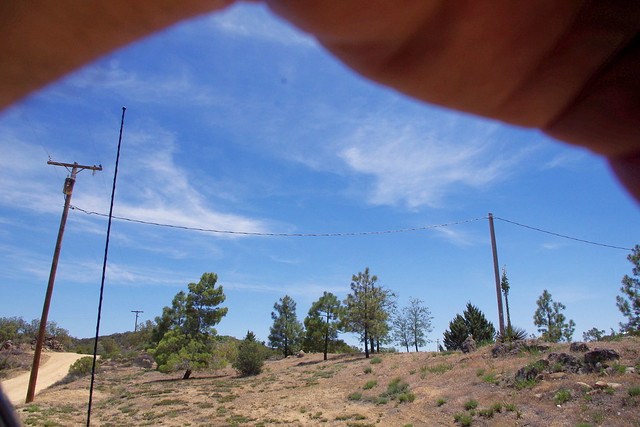
The photo above is illustrative to understanding the actually scale of the small backhoe Ken used in the selective removal of shrubs without damaging the entire underground mycorrhizal network. The rule I've always followed is leaving between 40% - 60% of the native chaparral. We planted all 500+ trees which included Coulter Pine, Jeffrey Pine and Incense Cedar. The Anza Chiropractor, Eugene Abbott, retired Bell Telephone guy Charles Rasmussen (deceased now) and one other nearby resident's trees all failed. Two years ago I stopped by Rasmussen's old place at the far west side of Lightning Road and one single short stunted pine tree was left. The log cabin Washburn's place on the north side of the property next to Lightning Rd was stripped bare and plowed with a tractor and trees planted in very even concentrated rows. Take a look below at what is left of the 500+ trees they planted as we drove by on Tuesday. The Dawson's place was planted mostly by Ken and Linda and myself when they came up from their main place in Vista CA on the weekends. Seeing this has been a huge reward even though it belongs to other folks.
This photo on the right is the Poverty Hill Ranch owned by Elgie Washburn. Although Elgie and his wife Lucille lovingly watered by hand and cared for their trees, this is what they have left of all those Jeffrey and Coulter Pines from the front view on Lightning Road. They really did work hard though on watering those trees by hand in the beginning. I almost wished now I had thought to bring over some of my mycorrhizal mix to inoculate their trees as well. This photo was taken from Mary Ann Kiger's truck passenger side. It does look like they thinned them out pretty good. Actually it wouldn't hurt to give them all a shot of inoculation dose of MycoApply and see what the results would be next year. More trees are out of view to the right of the photograph here. Dawson's place is just ahead as you turn left onto Thunder Road and down to the last house at the dead end.
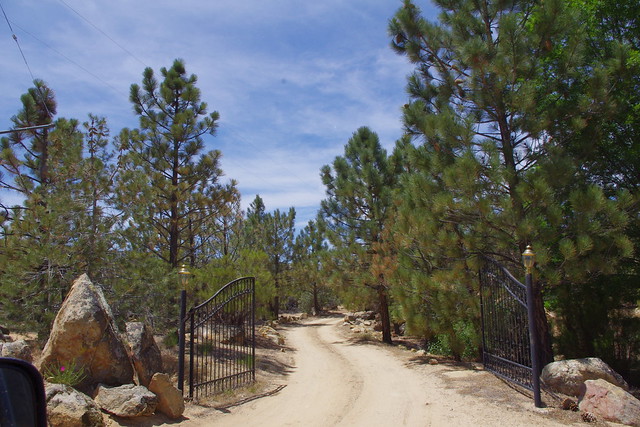
This is the entrance to Ken and Linda Dawson's old place which I was caretaker for a couple of years. We left 60% of the Chaparral species of healthy plants in place and 40% at other locations depending on the geology. Even after clearing some areas by hand, we left the underground biological grid intact and actually newer seedlings of Sugarbush and Holly Leaf Cherry germinated among the pine seedlings we transplanted. In fact so did a couple Manzanitas, no fire required as insisted upon by the scientific literature. At the beginning, I inoculated with Pisolithus tinctorius collected in Burnt Valley area and some years later with a Mycorrhizal mix from PHC. Ken installed an extensive above ground drip system to run for the first few years to replicate a good wet season. Thereafter the system was slowly shut way down until it wasn't a necessity any longer. The present state of that irrigation is dismantled now anyway. I have no irrigation issues in the beginning for establishment of plants. This replicates a period of good winter rainy season followed by good monsoonal moisture where many systems (especially alluvial plain Riparian ecosystems) get their natural foothold established. There is a natural precedent for following this rule in a post I wrote on "Lessons from a Bajada (Alluvial Fan)".
Photo Credit: Mine
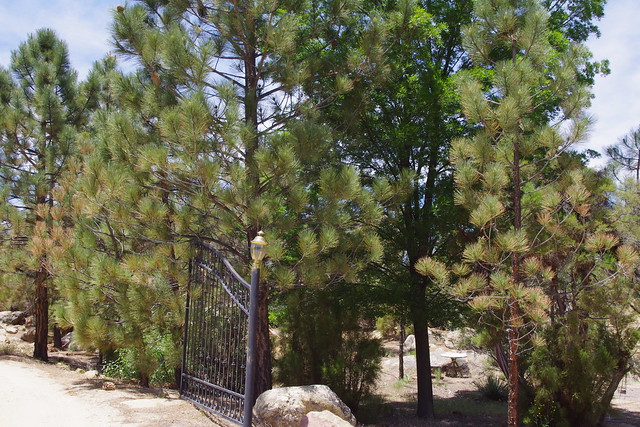
This shot to the right of the gated entrance shows also a Black Locust and other trees in the back ground like Incense Cedar. The Cedars did not fare as well, but there are some further up the drive as well as larger Jeffrey & Coulter Pines. HOWEVER - there is a vicious Pit Bull at the newer owner's house and other Dogs. DO NOT go to this house and inquire of anything. I have no idea who the present owner's are, but I drove up there to introduce myself and explain some of the history background of the place, but my VW Bug was attacked by this almost demonic expression looking Pitbull and it scratched the Driver door and tore off the rocker panel to where it dragged the road and I had to stop and repair it with some wire someone gave me. Seriously, DO NOT drive onto this property and get out of your car if you visit this place.
Photo Credit: Mine
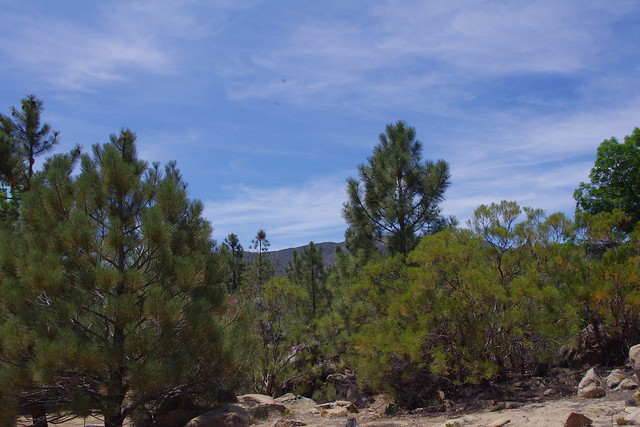
This view at the dead end part of the road shows the still intact Redshanks and Manzanitas. These were old growth chaparral which were left intact because of their deep rooted infrastructure and their beautiful appearance. The pine tree establishment success however reveals that the chaparral's presence meant much more. The beauty is that unlike the other property owners, Ken & Linda left the ground intact which saved the already existing underground fungal network which benefited the Pines who merely tapped into the system.
Photo Credit: Mine
This shot allows you to see closer up some of the Incense Cedar which made it. There are also chaparral plants in the background here. I believe the Dawson's and Washburn's also shared some Knobcone Pines, but not many of them made the transplant. I think Washburn's Knobcone pines may have done even better than the Dawson's Knobcones.
Photo Credit: Mine
Finally this is the tail end of the Thunder Road dead end cul du sac. Notice the Manzanita and Greasewood still existing among the Jeffrey and Coulter Pines ? I have to admit I wasn't expecting much as with everything else that has gone wrong in So-Cal, but like the weed infested hill in El Cajon where I attempted to re-establish a completely ruined ecosystem, this trip back was truly an encouragement to all Nature loving folks who wish to reclaim land as well as saving prized wild landscapes. Here was that earlier article:
Just a quick note to all those Eco-Activism folks who may get their knickers in a twist over the above title. It was meant as a teaching point and not a slam on your favourite 1960s styled activism protest cause. If you didn't read it through then you missed the main import of the post which was not a slam against your saving something some where out in Nature, but rather to point out some most often overlooked areas within city limits for which to rehabilitate. These overgrown non-native weed annuals on ruined lands closer to cities are so easy to dismiss and/or write off, but they were at one time as pristine as areas you want to save further out in any wilderness. Also, they are closer to home and so access is generally easier for busy people trying to make a living. Hands on work with plants is most educational, more so than mere reading of books or internet sites and the outdoor experience tends to burn important instructional teaching points into your memory banks, even when you make mistakes, you can learn from these as well.
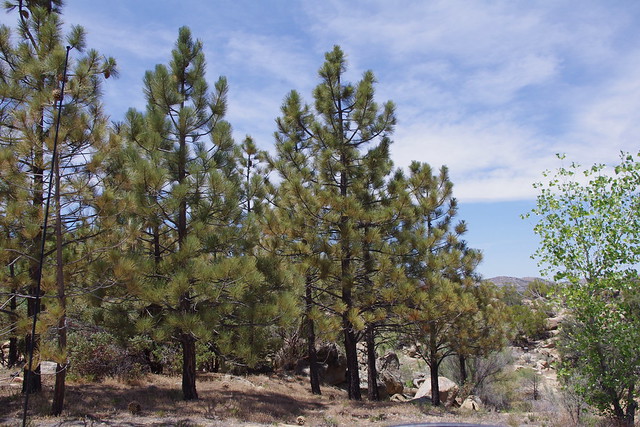
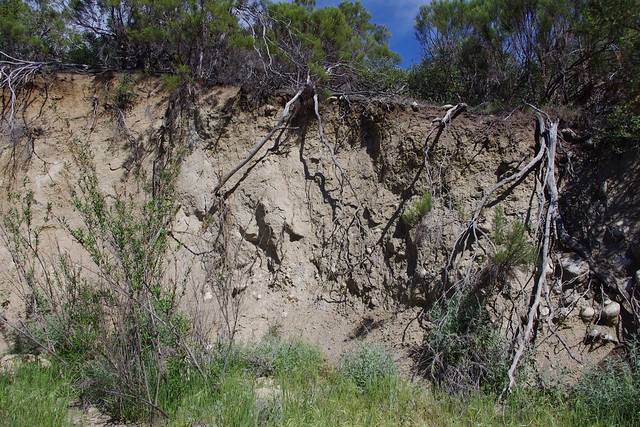
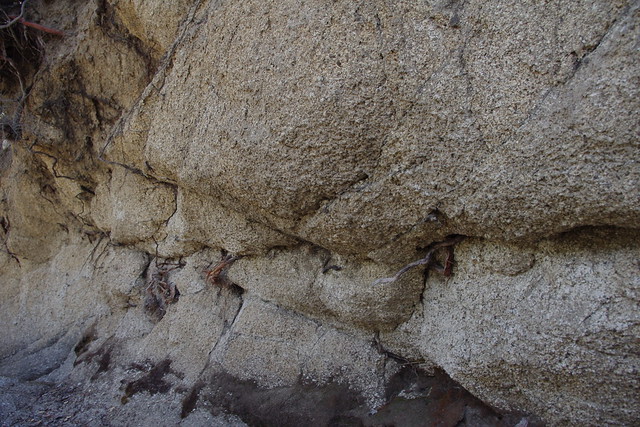
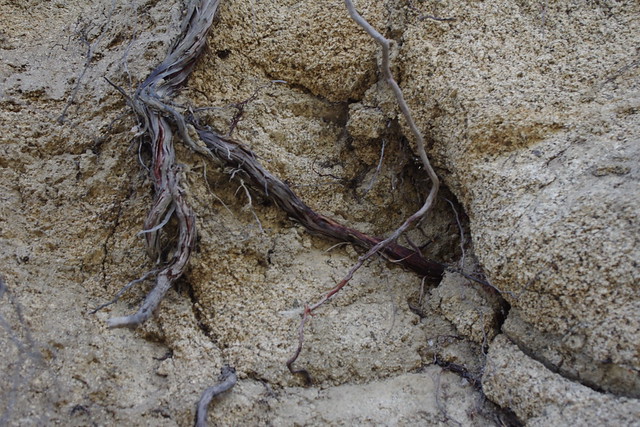
These next series of photos are merely illustrative of the natural mechanics of how an early developing Forest system survives within the Chaparral Plant Community. That Dawson property above has some of the lousiest rocky hard adobe soil and what most average folks would consider terrible Landscape or Gardening canvas. The land referenced above is a giant boulder strewn, rocky fractured underground with decomposed sterile looking granite with a lot of red hard adobe-like clay which is hard as a rock when dry, but slick as snot when wet. Most people in their conventional right mind would never think of attempting what we did here. Ken Dawson said that the real estate people informed him that they couldn't sell this last piece at the end of the road just because of that bad condition of the land. But he loved the rocks as his family was into crystal mining down over in the mountains above the Pala Indian Reservation in San Diego County. Even the well water here has seriously nasty high iron content which is hardly suitable for drinking and also quite often screwed up irrigation lines and indoor plumbing without a major filtration system attached to the Well itself. These first three photos below are of the hike I took with two friends on Tuesday where we documented the unnatural erosion cut above Hwy 74 which was to allow the road department the luxury of not having to build a bridge which would have upped the construction costs. In so doing they gouged a gully in the higher ground of the wild landscape which severely has eroded sharp steep cuts into this part of the Earth. There is clearly nothing natural about this newer stream bed here which normally takes hundreds or even thousands of years to create and settle to conform with the surrounding landscape and eventually to establish itself with riparian species which for the most part are completely missing here, unlike the former stream course which is still performing wonderfully with rich diversity of streamside habitat plant life by underground moisture. Take a look at the next three photos and see what has happened. Keep in mind I am merely illustrating what chaparral plants do underground and how they allow trees to encroach on their habitat and actually help them to succeed.
All Three Photos: Mine
The top two were actually shots taken side by side. The last one is the rocky side where the granite boulders have slid down in the erosion cuts as a result of being undermined by a torrent of winter water flows. While this action which took place decades ago is sad, they are however illustrative of the obvious unnaturalness of this creek which is no more than an eroded wash or desert dry gully. But there is a learning experience here from the exposure of the deep underground chaparral plant networks which should not go unnoticed.
All Three Photos: Mine
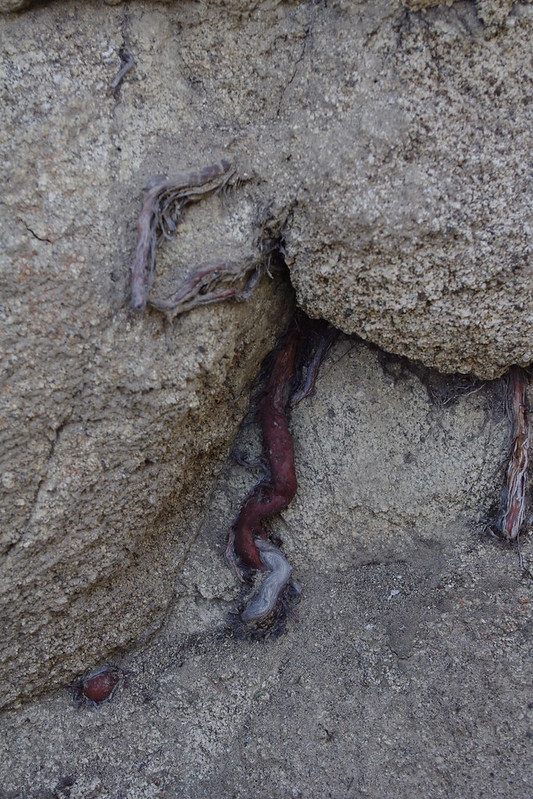
I've taken these photos to illustrate the 12 to 15 foot depth of what can clearly be identified as Greasewood or Chamise, Manzanita and Redshank or Ribbonwood. Think of these constructs as living biological mechanical plumbing infrastructure for supporting a larger system we call a forest. There are never any good reasons for making a slam against Chaparral plants, but rather a praise for the major positive contribution they make as to their importance within any ecosystem. People need to also keep in mind how most chaparral facilitates water movement deep underground even when they are dormant in winter months. Rain water when it falls, by nature will run off and will not soak deep on it's own, but certain plants will inject the soils within it's deeper layers with generous amounts of moisture to fill water deeper table aquifers and for later use in the topsoil system during dry periods for all vegetation's benefit.
Two Important Phenomena in Nature Illustrated Below which Explain Water Movement in Soils
Hydraulic Lift & Redistribution
Both phenomena, hydraulic lift & hydraulic descent, are imperative for healthy plant ecosystems. Removal of deep rooted shrubs and trees from off the surface of the land destroys this natural biological hydrological system. The Hydraulic Lift and Redistribution of deep subsoi moisture by deeply rooted plants pulls water up from deeper layers of the ground and redistributes this life saving moisture to more shallow rooted plants. The mycorrhizal grid network will further enhance this process as all plants are interconnected.
The other opposite phenomena known as hydraulic descent is a process of when plants (shrubs & trees) are dormant during winter or rainy season months and not actively growing, but have the ability to take abundant surface water from upper rain soaked layers and pump it down deep into the earth to be later used during summer months and or facilitate water table and aquifer levels. Most people have no idea this goes on and how purchasing rural land acreage and hiring the local Joe Six-Pack to bulldoze and clear your land is working against your own interests. Yet this is exactly what the US Forest Service for decades has recommended for planting and estaaablishing of plantation trees for reforestation. Strip land and lightly till prior t tree planting. The myth is that chaparral is an evil competitor for water and nutrients and this is completely false. Redshank or Ribbonwood (Adenostoma sparsifolium) & Chamise or Greasewood (Adenostoma fasiculatum) are some of the deepest rooted shrubs and therefore make perfect facilitatirs of Hydraulic Lift & Descent. Add to that PT Mycorrhizal associations and you will more than double the growth of Pine & Oak than the methods espoused by the US Forest Service science-based recommendations.
Hydraulic Descent
Below here is a great animation by Bert Wilson on his Las Pilitas Nursery website which illustrates the value and potential of transforming what looks otherwise like a worthless rocky piece of land like that of Ken Dawson's property. Native trees and shrubs in this area will always find a way to break through the hard-pan or bedrock subsurface regions of a tough soil profile and find a way to tap into moister layer which are indeed down there, whether or not it appears that way to you on a first impression basis.
Bert Wilson: Las Pilitas Nursery
I can't preach and sermonize enough about the importance of leaving most existing chaparral plants within your landscape alone and injecting the soil when transplanting trees with a good healthy diverse species blend of Mycorrhizal and beneficial Bacteria mix. Replicating initially a period of wet rainy season for the first few years through extensive drip irrigation and then tapering off to hands off watering after a few years are essential for allowing your forest system to develop an incredible infrastructure underground which will sustain the system thereafter, even enough to weather some drought years with little attention. Most Land Barons or Home owners make the terrible mistake of leaving their drip irrigation on for life and that makes plants dependent. It creates a type of flawed system on artificial life support. It doesn't work. It's a lot like Welfare. Welfare, while it may have had an original noble motivational beginning has never worked in the USA or Europe for that matter in the making of productive citizens since they are never truly encouraged to be weaned off the support system. It makes people lazy or unable to care for themselves and dependent on the entitlement meal ticket they were never weaned off from. Care for plants will actually work the same identical way, and if you don't believe this, take a tour of most people's properties who have never taken their landscape off the drip system. Maybe the video by Northwestern Forest Soils BiologistSuzanne Simard is again appropriate here on how a forest works.
Here are some great recent Studies which have been told time and again, but more proof of how Nature works under the ground: