Showing posts with label Wildfires. Show all posts

Monday, June 26, 2017

What's the real connection between Droughts & Wildfires ?

"There are three things that are never satisfied. There are really four that never say, ‘I’ve had enough!’  These things are the cemetery, the childless mother, the land that never gets enough rain, and Fire that never says, ‘I’ve had enough!’  
Proverbs 30:15-16 (International Children's Bible)
David McNew / Getty Images

I used a children's simplified wording in the above text to help readers understand what was written centuries ago was not only true back then, but even more so today. It describes a reality of certain realities in lifes faced by human beings which are inescapable. You don't even have to accept the bible to agree with what is clearly stated. The common grave of mankind is always hungry and never satisfied for more occupants. Child barreness would be a welcome circumstance to those obsessed with scientific population control by means of eugenics. In a later text at Luke 23:29, a future time of distress is foretold, and the “barren women” it states would be happy, relieved, not having the anguish of seeing their children suffer. I suppose that would be true of our times. Today drought and lack of rain are plaguing many lands all around the globe and the problem is growing and growing as if it's never satisfied. And of course we are experiencing a time of extreme wildfire which is worse today than at any time in the past and fire's hunger (figuratively speaking) seems to never be satisfied. But focussing on the last two subjects, drought (land with no rain) & wildfire, is there really a connection ? Wow, who knew ? Earlier this year, Jennifer Balch, a wildfire ecologist at the University of Colorado in Boulder, and other researchers published findings that 84% of wildfires are now started by humans as opposed to natural causes (lightning, volcanoes, etc). But wait, it gets worse folks. They also emphatically said this:
"In California, the eastern United States, and the coastal Northwest, people are behind more than 90% of wildfires. And, by starting so many fires, humans are essentially lengthening the fire season, into times of the year when natural causes—such as lightning—don’t play a major role."
Really, the West Coast (California, Oregon, Washington & British Columbia) is at 90% human caused wildfires ??? 😕
Science Magazine: "Who is starting all those wildfires? We are"
During these past four or five years, the world's fire ecology experts have been making connections between these furious wildfires and severe droughts which they insist are making wildfires even worse. Droughts can occur in any climate, whether it's hot or cold, dry or humid. So is that true or false ? Yup, it's true. Same thing is true of wildfires. But have you ever noticed in the literature when these two words are almost always surgically linked together by the fire ecologists, that the word "Drought" almost always preceeds the other word "Wildfire" ? The idea conveyed here being that the droughts are responsible for causing the extreme wildfire events we experience today. But you might be interested to know that surprisingly the words should really be in the reverse. Some of NASA's latest research finds that it is most likely the wildfires and diliberate prescribed burning that have helped to bring on the droughts. On the surface, to average folks it might seem only logical that the higher temperatures & lack of rainfall brought on by climate change are expected to increase the amount of moisture that evaporates from land, vegetation and lakes (basically sucking everything dry), which would also cause rainfall patterns to shift to more drought conditions. Hot temperatures coupled with dry conditions would also seem to increase the likelihood of more extreme wildfires. But now the reverse seems to be the cause and folks should not be surprised. Earlier this year,  January 2017, some researchers from NASA provided proof that it's the Wildfires, especially those whose origin has a human causasation are responsible for less rainfall, hotter temperatures & Climate Change. 
"A periodic temperature shift in the Atlantic Ocean, known as the Atlantic Multi-decadal Oscillation, plays a role, as does overgrazing, which reduces vegetative cover, and therefore the ability of the soil to retain moisture. By replacing vegetative cover’s moist soil, which contributes water vapor to the atmosphere to help generate rainfall, with bare, shiny desert soil that merely reflects sunlight directly back into space, the capacity for rainfall is diminished."  
"Another human-caused culprit is biomass burning, as herders burn land to stimulate grass growth, and farmers burn the landscape to convert terrain into farming land and to get rid of unwanted biomass after the harvest season."
Now this I have found fascinating, the idea of herders burning the land to stimulate grass growth to increase grazing productivity for harvesting the animals for food. Where have we heard this before ? One of the major justifications often cited for prescribed burns is that the ecological Native Americans (considered by many experts as the original environmentalist) burned the landscape to create better grazing for animals they made a living off of. But in view of the new information we've received from NASA, are we to believe this was still a good thing environmentally in view of the consequences referenced below as we continue reading ?
As with overgrazing, fires dry out the soil and stymie the convection that brings rainfall. Small particles called aerosols that are released into the air by smoke may also reduce the likelihood of rainfall. This can happen because water vapor in the atmosphere condenses on certain types and sizes of aerosols called cloud condensation nuclei to form clouds; when enough water vapor accumulates, rain droplets are formed. But have too many aerosols and the water vapor is spread out more diffusely to the point where rain droplets don’t materialize."  


Yup, even in the Earth's great oceans, microscopic organisms, along with other organic particles and salt, are thrown into the atmosphere every time an ocean wave breaks. Identifying the chemical composition of sea spray sheds light on how there is an  ocean-cloud connection, and how ocean biology may impact how clouds form and the climate. So too with the natural volatile organic compounds given off by vegetation. Disrupt any of the natural components which enrich our atmosphere with organic compound particles which act as nuclei for water molecules to form droplets and we get less rainfall and more drought. That apparently is what too much fire does.
For example, in years that had more than average burning during the dry season, measurements of soil moisture, evaporation and vegetation greenness—all of which help to trigger rain—decreased in the following wet season. Even within dry seasons, the amount of water decreased in areas with more humid climates as the burning became more severe.  

Illustration - ScienceDirect.com

Back during the early 1980s in the San Jacinto Mountains of Southern California when we had the heavy winter rainfall seasons caused by the El Niño & Hawaian Pineapple Express moist wind jet stream, I noticed that cloud formation during the following Summer's monsoon season was exceptionally heavy and complete. The main reason was heavy moist ground sturation on the surface from winter storms which lasted for months. It was a very green period where nothing turned brown or dry. After this time with normal or drier winters, summer monsoon cloud formation was more isolated as opposed to solid formation over all land mass. The areas where cloud formation was consistent had to do with an untouched area from development and contained old growth vegetation whether it was forest trees or solid old growth chaparral shrubs. The fragrance of aerosol release was also more powerful in those areas as well. Knowing what we do about aerosol importance as a nuclei particle for droplet formation, it makes perfect sense how mechanical or wildfire removal of such natural biological mechanism would stifle cloud formation and rainfall and if large enough effect, create droughts. If enough localized and regional droughts around the globe come together, then we get climate change. But in all the ideological debates we are fed out there by Climate Change champions, almost no one mentions what the NASA folks have provided here as evidence for climate change. Such information just never seems to be mainstream, but always on the fringes. It's much more sexy talking about factories and Coal/Oil in order to score some political points against one's political enemies, than telling the truth by providing a more complete picture of the present situation.
“The removal of vegetal cover through burning would likely increase water runoff when it rains, potentially reducing their water retention capacity and invariably the soil moisture,” Ichoku said. “The resulting farming would likely deplete rather than conserve the residual moisture, and in some cases, may even require irrigation. Therefore, such land cover conversions can potentially exacerbate the drought.”
NASA Study Finds a Connection Between Wildfires and Drought

Illustration - ScienceDriect.com

The illustration above has been adapted from Luiz E. O. C. Aragão's, “The rainforest’s Water Pump” which teaches us that like many ecosystems where much of the rainfall over tropical forests comes from water vapour that is carried by the atmosphere from elsewhere like oceans and falls over land during the rainy season, there is also a large component of mositure which is ‘recycled’ after the rainy season has passed. During what would normally be the dry season, rainwater is pumped by trees from soil into the atmosphere through evapotranspiration. This water exits the forest trees as evapotranspirated vapour infused with aerosols are pumped into the atmosphere where cloud formation is able to take place and again fall as rain in monsoonal thunderstorms. So the water sources does not necessarily have to come from oceans, but rather the land itself. The atmospheric transport of water vapour into the forest is balanced by the exit of water in the form of vapour and run-off. It has been discovered that the world's present mechanized deforestation reduces this important evapotranspiration and inhibits this water recycling. This decreases the amount of moisture carried away by the atmosphere, reducing rainfall in regions to which the moisture is transported. Decreasing evapotranspiration also leads to increase localized run-off and raises river water levels which increases water loss back to the seas.

Some of us (like me for example) generally take certain things for granted until some excellent responsible research comes along and shakes us out of our soft warm and fuzzy blanket comfort zone of ignorance. I always thought drought made fires worse and climate change makes droughts worse. But clearly (& this makes total sense) humans have brought on the very the climate disruptions and severe drought conditions through their incessant agricultural burning (not to mention the stupidity factor in causing wildfires) and irresponsible land stewardship in general that are the result of healthy old growth vegetation removal. BTW, for a long time now, many trees in the western United States have been putting most of their resources into defensive measures to just survive. Very little offensive strategy has been employed into putting available resources into the production of seeds. But that's the way it is with any organism. When times are good for food & water, then we have population explosions. When times are bad, it's all about survival. Oddly enough regions further north have been experiencing what has happened in Southern California since the 1990s. I used to collect seed and back in the late 90s, many pine nuts were hollow.  In recent years researchers have noticed after most of these major fires, very little in the way of pine seedling reappearances were observed after these fires.
Colorado's wildfire-stricken forests showing limited recovery
Image - University of Colorado Boulder
“It is alarming, but we were not surprised by the results given what you see when you hike through these areas,” said Rother, who earned her doctorate from CU Boulder in 2015 and works as a fire ecologist at Tall Timbers Research Station in Tallahassee, Florida.   
Among the most barren sites were those of the 2000 Walker Ranch fire in Boulder County and the 2000 Bobcat Gulch fire in Larimer County, where approximately 80 percent of plots surveyed contained no new young trees.   
“This should be a wake-up call, that under the warming trends associated with human-caused climate change, significant shifts in forest extent and vegetation types are already occurring,” said Veblen. “We are seeing the initiation of a retreat of forests to higher elevations.”   
Previous research has suggested that hotter, more severe fires make it harder for the forest to bounce back by killing mature trees and reducing seed stock. But the study found that even after lower-intensity fires, presumed to have had less effect on mature trees and seed stock, seedlings were still scarce. Hotter, drier areas at lower elevations or on south-facing slopes had the fewest seedlings.
(Source)
animated image - gutenberg.org
The prevailing paradigm in fire ecology within the Scientific Orthodoxy reminds me of those evil stepsisters from the story of Cinderella where they tried cutting their toes off to fit in that Prince's glass slipper. They insist their narrative version must be true despite what the data says to the contrary. As a general rule, what data they do present for their case is often theory ladened, which means that any claimed observations have been inffected by the theoretical presuppositions held by the fire ecology investigator. There's no shaking the blind faith of a determined fire ecologist who insists life evolved in such and such a way through it's Creator fire or that fire is a kind of hallowed tool used by Indians (Native Americans) who are often considered the ultimate in ecosystem conservation. Facts are Native indigenous peoples of the past and their descendents today were and still are equal in every way to the Europeans they first encountered. This includes not only the capacity for love and goodness, but also the inherited tendency towards flaws and imperfection common to every human on the planet. Yes they used fire. A few may have used it as a type of conservation tool, but they had no more control over it than we do now. There is evidence that they also misused and abused fire for war against their bitter enemies (other Natives, not white men), used fire for hunting down prey chasing 100s of them over a cliff at a time, unattended campfires etc. They also used it for agriculture on a smaller scale which brought about localized or regional droughts centuries ago which doomed some ancient empires in Central and South America (Nazca, Maya & Aztecs). Now take a look below at some satellite photos of cloud formation which clearly exists because of the presence of healthy vegetation, no matter what the plant community ecosystem it is. But seriously, note where and over what the clouds form. Trees & Shrubs!

Image - scantours.net

The photo above is Ascension Island in the South Atlantic. This at one time was a true desert (in the true sense) island with almost most no vegetation other than some mosses, lichens, ferns, and small annuals and/or perennials. I reprinted parts of an article about Ascension Island which came out in 2013 by journalist, Fred Pearce, from Yale Environment 360, where he wrote about how a true desert island was basically transformed by19th cebtury British Sailors who brought in plants for gardens and escaped into the wild and by a Bristish Colonial Botanist, Sir Joseph Hooker, who wanted to actually terraform the island and infuence the increase for rain which was almost zero and provided no water supply. That's all changed now as rainstorms come in and even heavy clouds of mist precipitation provide water for natural ponds and streams.

Image - islandholidays.co.uk

Incredibly, not everyone has been pleased with this islands amazing transformation. The political activist environmental group, Center for Biological Diversity, is strongly opposed to such terraforming because the claim of invasive plants taking over and destroying the tiny native ferns and lichens would be wiped out. This has been proven false. I have kept in contact with the island's conservation officer, Stedson Stroud, who has provided photographs of these rare ferns and lichens actually doing much better by growing on the braches and trunks of this non-native vegetation. The non-native have created a healthier environment which has caused such specimens to grow bigger than they did previously on the desert island environment. People on this planet are going to start questioning who and what so-called non-profit organizations they are putting their trust and money into. Here are two links for which I have written about this remarkable island and it's turn around which has valuable climate change solution teaching lessons for us.
Climate Change and Ascension Island
Ascension Island's Green Mountain Cloud Forest Created by Mist ?
NASA Earth Observatory image by Joshua Stevens


Image - Yann Arthus-Bertrand 

Orinoco River near the Esmeralda,
Amazonas region, Venezuela

Image: Jeff Schmaltz, MODIS Land Rapid Response Team, NASA GSFC
The various aerial and satellite images over the past couple of years have fascinated me as to how vegetative land surfaces encourare cloud formation as opposed to bare land or even seas. The picture above shows cloud formation over forest, but not the river. The picture to the right shows cloud formation over these Indonesian islands, but not the surrounding sea. Back in the 1980's a brazilian physicist, Eneas Salati, proved that the rainfall in the Amazon had consequences that are felt across the globe. Only 20–30 % of the rainfall actually stays in the region. Mostly, it evaporates back to the air to be carried by currents to regions such as the Andes, the Atlantic, and the South Atlantic towards South-Africa through phenomena such as cloud formation. If you've followed the news over the past few years, countries bordering Brazil have lost rainfall because of the forest deforestation which has resulted in the dismantling of these cloud formation mechanisms. When large areas are deforested or the forest becomes fragmented, the system of cloud formation breaks down. Put simply, no cloud formation, no rainfall, no rainforest or any other type of vegetated ecosystem.
Some more interesting references:
Science Direct: "Anthropocene" - The significance of land-atmosphere interactions in the Earth system—iLEAPS achievements and perspectives
Pacific Northwest National Laboratory: "Born by Bubbles, Destined for Clouds"
Then there's always that one anomalous Ponderosa Pine discovery somewhere out in Nature observed giving live birth to a Sapling that throws all those sacred Fire Ecology Paradigms out the window & into a tailspin
Image - Jennifer DeMente

Okay I'm only kidding 😆

I'm not exactly keen on this obsession with celebrating fire or justifying it because the Indians (Native Americans or other non-white indigenous peoples) did it. Like modern humans today, they may have responsibly used some fire, but they also misused and abused it which makes them equal to human beings today. I was corrected by a scientist when I referenced my sadness about what has happened with all the human caused fires throughout the mountains surrounding Tucson Arizona. Her response was puzzling as she parroted the modern day secular religious paradigm of all fires being natural. This planet is clearly in trouble if the present failed leadership continues.
Burn Baby Burn - Fire Ecologist Celebrate Fire Season

Saturday, April 5, 2014

Breaking News: Fire Ecology Updates, Bird digestion aids Seed germination & Ed Morgan deserves an Acquittal

First: Ed Morgan's Acquittal
Courtesy US Forest Service
For many of us growing up in the 1960s, we remember those US Forest Service public announcements about "Because Only You Can Prevent Forest Fires". But in 1968, a man named Ed Morgan was publicly exposed as a could care less city dweller who hated Nature, even though he was just coming back from a day at the lake with his 1950s cold war wholesome looking family. You remember his wife Maryland, son Casey and daughter Kelly-Sue ? Their lives would never be the same. Ed's crime was simply throwing a cigarette outside his driver's side window. The arresting authorities called it a weapon and Ed was accused as being a killer. Sure enough that decision on Ed's part caused the death of countless trees, shrubs and other wildlife. Ed Morgan's Constitutional Rights were however violated, since he had no formal court trail as demanded by Law. He was only tried and convicted in 1968 by the Press (Rod Serling). Here's a transcript of that trial below:


Forest fires were suppressed and considered evil back there in the 1960s. But times have changed and so have attitudes. Today fire is actually considered the ultimate hero and savior in regards to land management. Why today, many fire ecologists now know that Fire is not a destructive force at all as once believed, but rather a Creator of Parks. They insist they know this because of Scientific Research which reveals to them that Indians did this practice in the old West all the time and conditions were Park-like as a result. Why, it is said you could race your friends on horseback through the woods, something you can't do today. But it wasn't just the Native Americans that used fire, white settlers did so as well. In fact you can Google many many reports of Settlers, US Cavalry, the Railroad Industry etc who directly set or inadvertently caused fires by their actions. Take for example this account of the fire history written by Jim McKee, Historian for the Lincoln Journal Star:
Settlers fought fire with fire when calming prairie flames — 11/4/2007
"Most of territorial Nebraska was covered with grasses - from the tall and mixed grassy areas of the east to the short-grass plains west of the 100th meridian. In the late summer, the grass died, dried and turned to virtual tinder just waiting for an uncontrolled campfire, arson, lightning strike, or, with the coming of the railroad, embers from an unchecked smokestack to start a prairie fire."

 Prairie fires of the West, Currier & Ives, 1872
Yes, those Human caused Prairie Fires could last for months or until the first rains or a natural barrier put a halt to their destructive march across the landscape. Those big upside down cones on those Steam Locomotive chimney stacks were spark arrestors, which as you can see from the painting didn't always do their job very well. 
"Two fires in one consisted of a headfire, which ravaged instantly, ahead of a prairie fire, which was followed by a slower but more thorough backfire. The heat generated by the fire created an updraft that caught tumbleweeds or combustible debris, sucked them upward and blew them to start other fires. Once started, a prairie fire simply kept spreading until rain quenched it or it reached a natural wall such as a stream, although fires were even known to jump the Missouri River and burn for a month or more."
"An October 1871 prairie fire jumped the Blue River, and in 1893 a 25 mph fire burned thousands of square miles. 1910 saw several hundred acres of the Nebraska National Forest consumed, and in 1925 more than a million acres burned, burning nearly 50 percent of the Bessey Division of the forest. In 1972, a 385-square-mile fire narrowly missed the National Forest."
Incredible as all that burned acreage is, it's also interesting to note that the U.S. Government was already involved with purposed &/or accidental prescribed burns whether they meant to or not back in the 1800s. One account I read last year was of a Cavalry Officer in New Mexico who complained to his Superiors that he was having a tough time getting his troops to be responsible and not through down their cigarette butts along the trail where they kept lighting grass fires. In fact control burns were first used prior to this westward expansion during the Civil War against the Confederates. But also interesting, is that the first control burns in the wild wild west were used to control Indians, but not vegetation. That came later.
"In October 1864 the U.S. Cavalry purposely set a fire "to control Indians" and managed to start a blaze that ultimately spread westward into Colorado and Wyoming and as far south as Texas before it burned itself out."
Incidentally, Arizona Old West Historian, Marshall Trimble agrees with many of the catastrophic fire events which happened during this period which he says were into the millions of acres. Now given the historical evidence that Cowboys, Indians, Railroad Barons, and even the U.S. Cavalry were involved in purposed or not wildfires, especially with cigarettes carelessly thrown about which oddly enough according to the science, resulted in pristine paradisaic park-like Forests conditions back there in the 1800s, is it any wonder Ed Morgan deserves an acquittal for doing what we now understand was the right thing ? Of course this was back in the 1960s when attitudes weren't as enlightened as they are today, and since Ed being a smoker as a result of buying into the other science-based research of cigarette health at the time, Ed probably isn't around with us anymore. But his children may still may be among us. Wouldn't you agree that Casey & Kelly-Sue would have the legal right to sue the US Government for their Father's false arrest, false imprisonment and defamation of character in the Press ? 
Note of admission to Readers: Yes yes, okay, I know Ed Morgan and his family are nothing more than made up fictional characters of a myth for some official government advertisement promoting the Science Doctrine of the day, but so is much of the fire ecology research which is funded by powerful special agricultural interests when it comes to the Science of Prescribed Burning programs today. Such research  actually champions obliterating whole tracts of land under the guise of helping Nature in a less than viable eco-green sustainability policy - "Burn Baby Burn"
~~~~~~~~~~~~~~~~~~~~~~~~~~~~~~
Update: Fire Ecology Breaking News
Previously back on December 19, 2012, I wrote an article on the subject of An Icon of the Old West, Sagebrush (Atermisia tridentata) . There was a study done in June 2003 correcting the myths about Big Silver Sagebrush which has been demonized by government land managers and Ranchers alike for almost a century. There were several Axioms or bullet points that were dealt with, but first, here is the abstract that all of them in the light of recent Ecology News which came out April 2, 2014. Here are a couple of quotes from that article about long held religious beliefs about Big Silver Sagebrush:

USDA: "Countering Misinformation Concerning Big Sagebrush"
Abstract:
"This paper examines the scientific merits of eight axioms of range or vegetative management pertaining to big sagebrush. These axioms are: (1) Wyoming big sagebrush (Artemisia tridentata ssp. wyomingensis) does not naturally exceed 10 percent canopy cover and mountain big sagebrush (A. t. ssp. vaseyana) does not naturally exceed 20 percent canopy cover; (2) As big sagebrush canopy cover increases over 12 to15 percent, bare ground increases and perennial grass cover decreases; (3) Removing, controlling, or killing big sagebrush will results in a two or three or more fold increase in perennial grass production; (4) Nothing eats it; (5) Biodiversity increases with removing, controlling, thinning, or killing of big sagebrush; (6) Mountain big sagebrush evolved in an environment with a mean fire interval of 20 to 30 years; (7) Big sagebrush is an agent of allelopathy; and (8) Big sagebrush is a highly competitive, dominating, suppressive plant species"
I'll only deal with a couple of these Axioms (For the purpose of quick definition: "A self-evident principle or one that is accepted as true without proof as the basis for argument; a postulate") The first Axiom is a beauty and it has been bulldozed and smothered by new evidence as far as fire ecology goes. 
Axion #6
"Mountain big sagebrush evolved in an environment with a mean fire interval of 20 to 30 years (Winward 1984), or as expressed by Winward (1991, p.4): “These ecosystems, which have developed with an historical 10-40 year fire interval, were dependent on this periodic removal or thinning of sagebrush crowns to maintain their balanced understories.”
This is what was published in the US Geological Survey website on March 24, 2014. The title of the report is titled: "Post-Fire Stabilization Seedings Have Not Developed Into Sage-grouse Habitat"
"Burned areas, whether treated or not, generally lacked shrubs even after 20 years, and in low elevation areas especially, non-native plants like cheatgrass were often too prevalent for burned sites to be used as sage-grouse habitat. This is important because it means that for at least 20 years following wildfire, burned areas of the Great Basin are not likely to be used by sage-grouse, regardless of emergency stabilization treatment. With this kind of time lag, a substantial amount of sage-grouse habitat is lost each year to wildfire, while gaining relatively little through natural plant succession or emergency stabilization treatments."
""This is part of a growing body of science demonstrating how difficult it is to rehabilitate sagebrush landscapes once native vegetation is lost through wildfire," said USGS ecologist David Pilliod, who co-authored the publication. "Restoration in the Great Basin is a huge challenge for land managers not only because of difficulties associated with reducing non-native plants and establishing natives, but also because of the rate at which landscapes with sagebrush and other native vegetation are lost. These habitat losses can have negative consequences for sage-grouse and other wildlife that depend on sagebrush."
 (source)

 Credit, Robert Arkle, June 2011
"A sea of non-native crested wheatgrass (left) fills the path of the Poison Creek fire, which burned on the remote Owyhee High Plateau, tucked into the southwest corner of Idaho, in 1996. Nearly two decades later, an abrupt transition to healthy sagebrush marks the edge of the fire. The Jarbidge Mountains sit on the horizon."   
You can clearly see the demarcation line or barrier where for 20+ years the Big Sagebrush, which has NOT evolved a thing regarding fire as it is incapable of sprouting from the crown again, has not even by means of transmitted seed by wind or birds been able to make any headway back into it's former territory as insisted upon by earlier flawed biased research, no doubt funded by special agricultural interests.


Credit, Robert Arkle, June 2011
"An early summer storm passes over sagebrush country near Hollister, Idaho. The area has not burned within the 20 year time frame of the study. It features mature sagebrush, but also non-native cheatgrass, mustard, and crested wheatgrass, and barbed-wire fencing, which provides perches for predatory birds. Non-native plants and human infrastructure diminish the quality of the habitat for sage grouse."
(Source) Ecology Society of America: "Sage Grouse Losing Habitat To Fire As Endangered Species Decision Looms"
I want ever one to also take special not of the barb wire fencing and the Big Silver Sagebrush which has come back with a vengeance here. Now why is that ? Because this is a fence line and a favourite perch of almost any kind of bird which uses this as a weigh station for taking a short rest & pooping where it wishes along the fence. I pointed this out in my last post dealing with Western Juniper which is presently demonized in eastern Oregon as an invasive. But birds are spreading those hard heavy seeds about, not wind and it especially noted along fence lines which is proof of the various birds diet. I also pointed this out about the spread of Tecate & Arizona Cypress up in Ranchita California through the chaparral plant habitat up there where along the road, the chain link fence line has numerous young Arizona Cypress. These facts pull the chair out from under the fire ecology insistence that these plants need fire to propagate themselves into newer areas and that germination is impossible without it. For all you day hikers, explorers and other assorted researchers, start paying more attention to fence lines when you're out among chaparral plant species and write these incredible  observations down on note pads for future reference. 

Note Axiom #4
Nothing eats it, or as expressed by Tueller (1985, p. 29): “It is ironic that the dominant plant and highest producer on this area of 30,000 square miles is essentially unpalatable.”
In another report or study on the creatures which do depend on Big Silver Sagebrush as an import food source, this paper published by the US Forest Service by Bruce L. Welsh contradictions that unpalatable myth. 

Abstract: - "This paper challenges the notion that Big sagebrush (Artemisia tridentata) is a range plant of low value. Present data that documents the consumption of Big Sagebrush seeds by Dark Eyed Junco (Junco hyemalis), horned lark (Eremophila alpestris), and white-crowned sparrow (Zonotrichia leucophrys), and shows the nutritive value of the consumed seeds to be high in energy, crude protein, and phosphorus."
USFS: "Add Three More to the List of Big Sagebrush Eaters"
~~~~~~~~~~~~~~~~~~~~~~~~~~~~~~~
Update: Bird Digestion Aids in Seed Germination
Image credit: Joshua Tewksbury

The short-billed Elaenia, here with a ripe chili pepper in its beak, is the most
common consumer of chilies at the study site in southeast Bolivia.
After birds eat a wild chili pepper, more seeds grow. 
"When a South American bird eats a certain wild chili pepper, its gut changes the seeds in ways that may improve the seeds' chances of growing into new pepper plants, a new study suggests."
Inside Science: "Bird Gut Boosts Wild Chili Seed Survival"
 Other reading references of import on the role of Birds:
What Is the Fate of a Silent Forest: "The Ecology of Bird Loss Project" 
~~~~~~~~~~~~~~~~~~~~~~~~~~~~~~
The roles birds and other wildlife play in ecosystem maintenance and sustainability is often hidden and unknown to most of this world's Official Experts who should know better, let alone the average person on the street. It's clear however that some researchers get it and have done so for years, yet their paper work is often ignored and shelved for sometimes decades in favour of more colourful pseudo-science which plays better in the careers of those more interested in the Economic and political policy making aspects. The average person is often by nature a mere Lemming (who who doesn't do their own homework and opts for allowing others to do their educational research & thinking for them) and they have been trained and conditioned that way, especially through the 20th Century. Most of the natural world's health problems in every ecosystem have to do with mankind feeding themselves and the Industrial powers that run those profit feeding programs. That is what most of the above News was about. Prescribed burning is promoted as "because it helps nature be what it use to be" which is a lame lazy excuse for other ulterior motives for land management uses. Yet the average poor sap on Earth won't question it because it's inconvenient. Because it means the average person may have to do their own homework and actually think for themselves. The story in Oregon on the demonization of Western Juniper for it's supposed "invasiveness hurts the ecosystems" was nothing more than a smokescreen for powerful the Beef industry which needs more grasslands for cattle, which in reality are the true non-native invasive organisms on the landscape. Try and reason all of this to the average person on the street where their food comes from, the ecological cost, even the health consequences of our Food's manufacture and they slip back in to their lazy comfortable Thurston Howell III default answer, "How vulgar!" Like the Howells, nobody wants to hear it. If you've ever watched that old comedy show from the 1960s, Mr & Mrs Howell would often say this after it was explained to them by the Professor where food really comes from down on the Farm, when they had previously stated they always thought it came from a can at the Grocery Store. It's the same with Meat production and availability. People don't care what the environmental consequences are, they just want to find their steak behind the glass counter when they get the craving for it. People are seriously going to have to start cutting back. Chalmers University here in Gothenburg Sweden came out with a study just on the very thing. (Read it Here) Same can be said for Vegetable & Fruit produce available from all over the world. We have things available all year long produce-wise which we use to have to wait for next season. That too cuts into the Earth's ecological health program. The costs for transport of these products across oceans it's worth that cost, especially since often times it has no real flavour about it whatsoever.


I have to admit that I was very serious when I said to those outdoor enthusiast who do love nature and love seeing & photographing all those pretty things, to do more than simply enjoy what is on the surface when you are out there hiking around. That's a great start but there is far more. Make your outing an educational one. Challenge yourself in what you think you know. I'm talking about those fence row lines. You've all seen the birds flying in and rest on the Barbed Wire or Chain link Fence. But you never give a thought as to why trees and shrubs seem to link growing next to fences, even when it's out in the middle of a field. 
United Kingdom
Think real hard about how that seedling got established way out in a field, especially when the seed is a heavy one, unlike the cottony fuzz as that of willow or cottonwood which can carry for miles, or with wings of a maple or pine seed to propel it far away from the Mother tree. Ever stumble upon barb wire fence where a tree whose trunk is growing into the the wire and wonder, why didn't they clear the land better before building that fence line ? They probably did, but critters with wings came along and pooped sometime way back and up popped a tree growing into the fence years later. Fence lines tell great stories of what birds like to eat. Not all birds are the glamorous looking ones that get noticed, but what they accomplish in a healthy ecosystem does get noticed, although you're totally oblivious to the reasons for it. So when some ecologist comes along and tells the world that some obscure piece of land is important habitat for some minor sounding bird you never heard of before, think about it. You won't be able to unless you have first put forth the effort to develop appreciation for such things in the first place. Once again, here is my post about the spread of Cypress out in Ranchita where fire isn't a requirement as the literature insists. 
What We Need Here is Wildfire to Propagate !!!

Thursday, January 16, 2014

Air Pollution harms Native Chaparral Plants and increases the Wildfire risk

Photo: National Park Service.
This was certainly no surprise to me. I have been wondering about this possible phenomena nitrogen enrichment actually degrading native vegetation for a couple of decades now by destroying the underground mycorrhizal network and creating a more favourable nutrient enriched soil which converts the healthy symbiotic mycorrhizal fungal grid system to a bacterial one that favours non-native weeds (Ruderals). Well low and behold there are finally others who've gotten a clue about this by actually researching this very real possibility. The study which was done in the Santa Monica Mountains did indeed show harm not only in the degenerative effects of Chaparral native plant seedling regeneration, but also a favourable system for various weeds and other non-native grasses which are labeled as flash fire plants. The photo above right shows Interns measuring plots of California Sagebrush that have been injected with various levels of nitrogen as part of a three-year study to learn how air pollution is impacting native plants and increasing the fire risk. Below is the actual article:
Date: January 14, 2014  
Contact: Kate Kuykendall, 805-370-2343 
THOUSAND OAKS, Calif. Initial results from experiments conducted in the Santa Monica Mountains indicate that high levels of nitrogen may adversely impact native plants and, by extension, increase the risk of wildfire.
"No one will be surprised to learn that our data shows increased air pollution on the eastern end of the mountains, closer to Los Angeles," said Dr. Irina Irvine, restoration ecologist for Santa Monica Mountains National Recreation Area. "What's more intriguing about this study is learning how high nitrogen levels affect native vegetation and what that might mean for fire risk in such a fire-prone region."
The preliminary results are from the first year of a three-year study undertaken by Irvine, UC Riverside's Dr. Edith B. Allen and the U.S. Forest Service's Dr. Andrzej Bytnerowicz and Dr. Mark Fenn.
Researchers measured atmospheric nitrogen deposition levels at 10 sites throughout the Santa Monica Mountains and found significantly higher pollution levels in the eastern end (See map) . At the two sites with the best air quality, they added various levels of nitrogen into experimental plots of coastal sage scrub to simulate pollution levels found throughout the mountains. 
Higher levels of nitrogen led to a decline in native shrub seedlings and an increase in nonnative grasses. Other studies in Australia and California have demonstrated a link between nonnative grasses, also known as "flashy fuels," and larger and more frequent wildfires.
Funded by the National Park Service's Air Resources Division, the $100,000 study will help scientists better determine the "critical load" when vegetation shifts, causing alterations to the structure and functionality of ecosystems. Coastal sage scrub once covered much of coastal California and is now an endangered habitat type, primarily due to development. 
Generally attributed to vehicle emissions in the Santa Monica Mountains, nitrogen deposition is the air pollution from industry, agriculture and transportation that settles out of the atmosphere and onto the earth's surface.
Santa Monica Mountains National Recreation Area (SMMNRA)is the largest urban national park in the country, encompassing more than 150,000 acres of mountains and coastline in Ventura and Los Angeles counties. It comprises a seamless network of local, state and federal parks interwoven with private lands and communities. As one of only five Mediterranean ecosystems in the world, SMMNRA preserves the rich biological diversity of more than 450 animal species and 26 distinct plant communities. 
Visit: http://www.nps.gov/samo/index.htm
UC Riverside's Plant and Botany Sciences Department conducts cutting-edge research in plant biology to advance fundamental scientific knowledge and solve critical issues for the state of California, and educates and trains graduate and undergraduate students to become science professionals and informed global citizens. 
Visit: http://plantbiology.ucr.edu 
USFS Pacific Southwest Research Station develops and communicates science needed to sustain forest ecosystems and other benefits to society. Headquartered in Albany, Calif., it has research facilities in California, Hawaii and the U.S.–affiliated Pacific Islands. For more information,  
(source)
Warning: You should know the California Chaparral Institute's owner, Richard Halsey, has dismissed this research as of little account & flawed. Whatever! 😒
Photo: Joe Decruyenaere

Adenostoma sparsifolium and Ceanothus megacarpus,
upper Stunt Canyon, Santa Monica Mountains
~~~~~~~~~~~~~~~~~~~~~~~~~~~~~~~~~~~~~~~~~~~~
(Update: Jan 17, 2014)
The above article is fascinating and certainly revealing of what is happening out there in the Natural World not only at present, but has actually been going on for the last several decades. It is popular today to blame everything wrong with the Earth as global warming. Global Warming has always been a lousy title for describing what is going wrong with the Earth, especially climate. But there are so many natural components to ecosystem breakdown that very few of the Experts seem capable of putting all the pieces together. Yes there are these CO2s exacerbating the problems with regard climate, but there is so very much more. Almost all of Earth's old growth vegetation systems are being depleted and if you have read much within these "Earth Internet" archives, you've come to realize from the references provided, along with my personal observation and practical application (without practical application, any knowledge or understanding is completely useless), that science for decades has known about the major role playing that healthy vegetation (& not just this love affair with Rainforests love, not that there is anything wrong with rainforests mind you) play in global cloud formation, seasonal rainfall and overall global climate moderation. But vegetation breakdown doesn't simply happen by means of climate change. From the above article, clearly it is a mechanisms issue. If there is a breakdown in the adjoining plant components like beneficial fungi or bacteria, then the bad health and eventual death of vegetation won't need to experience drought for total shutdown. 

There have been other articles in the past, some decades ago alluding to this potential problem in the future. But guess what ? The future has arrived and with a vengeance. For example this paper (here) by Duke University in 1993, which suggested that, "Increased nutrient availability reduces vesicular-arbuscular mycorrhizal (VAM) associations with plants". Of course complete understanding then was not what it is now, but at least they were giving this as a possible future issue. But then there was another paper in 2003 by the Ecological Society of America, who has a commitment to soil ecology and rebuilding ecosystems. They had a great piece on this same issue, which clearly had gotten worse since the studies since 1993, and there was a great illustration inside this piece which unfortunately I cannot link to anywhere, but I've substituted one below from another site for learning purposes only. 

Illustration - semanticscholar.org

The subject in the paper was, (nitrogen enrichment alters mycorrhizal allocation at five mesic to semiarid grasslands) and the illustration in that paper as you scroll down at page #1897 had an animation of two grassland plants, on the left with normal healthy microbial soil and on the right, soil with nutrient enrichment of nitrogen. The left side had far more roots and mycorrhizal networking associated with the plant, the one on the right dramatically less root and fungal colonization. Now look above left at the photos. This is a Pine seedling colonized on the right with ecto-mycorrhizae,  Pisolithus tintorius and the photo on the left has been digitally altered to remove the fungi in the picture and reveal the lack of enhanced mechanism which the the fungus offers the plant for vastly improved growth and survival. The nitrogen nutrient enriched soil will destroy this mycorrhizal colonization of the plant as represented by the picture on the left. This destruction is actually a removal of a major extensive network plumbing network which is extremely efficient at providing 200% more water and nutrients the plant would otherwise not receive on it's own. You can test this out yourself in your own healthy organically maintained landscape, if you even have one, by changing your maintenance regime to Scotts Miracle Gro or any other Industrial Science produced product sold at your local hardware. But rather than do this, take not only my word, but the studies done on this. Over decades this nitrogen(& other nutrients) has built up in our wildland soils to the point of where concentration levels have increase so much, we are now seeing the unhealthy effects of most all vegetation foliage. This is especially true in the western USA where dead or dying ecosystems are now not only a horrible habitat for wildlife, but even more of an increased wildfire hazard. It also offers clues as to why there would also naturally follow the present  breakdown in weather creation and maintenance mechanisms around the Earth.
(Further Update February 16, 2014)
University of Minnesota study finds, Fertilization destabilizes global grassland ecosystems
(earlier July 3, 2013) Study reports on declines in ecosystem productivity fueled by nitrogen-induced species loss
University of Nebraska - Lincoln "Worldwide study finds that fertilizer destabilizes grasslands"
 Nutrient Network: A Global Research Cooperative
Further research is also being conducted on the possible negative effects of Biocrustal degradation in deserts as a result of nitrogen nutrient enrichment. Here is an advert looking for research participants for a project running from Spring of 2014 to 2015 at the University of Las Vegas. This was originally posted at my attention from Mathew Bowker's site. Clearly, no living ecosystem is immune from the effects of nutrient enrichment where it doesn't belong.
Biological Soil Crusts: The Role of Trampling, Climate Change and Nitrogen Deposition in Affecting Community Species Composition
 ~~~~~~~~~~~~~~~~~~~~~~~~~~~~~~~~~~~~~~~~~~~~
(Further Update February 19, 2014)
Another interesting article on a little plant called Duck Weed in ponds or lakes. Often times demonized for taking over and becoming weedy. Over fertilization of waterways or otherwise known as Eutrophication, is actually what is responsible for this excessive growth of Duckweed. Much like the pea soup green of an algal infested pond, it's the human overuse of fertilizers or other nutrient enriched runoff from streets during rainstorms which fuels the population explosion other organisms. It is not the fault of the organisms, but rather once again human error. Needless to say, this was also an enlightening article. It reveals how duckweed has been  been used to clean up contaminated waters and as a source to produce pharmaceuticals. Now as a source to create biofuels. Still, it's human cause imbalances in nature which trigger the imbalances.
Pond-dwelling powerhouse's genome points to its biofuel potential
Now, continuing on with an even later article from the same Ecological Society of America recently in 2011 entitled: Using Air Pollution Thresholds To Protect And Restore Ecosystem Health  which deals with the same issues of air pollutants and their effects on the environment as a result of their prolonged accumulation over time in the soils. The USFS also did a reprint of it (here). It's this accumulation factor over time that I have also wondered about which may further make invasive weeds & other non-native grasses gradually more and more successful over the past decades. These were most always bottomland dwellers as a historic rule. They thrived where traditionally an accumulation of nutrients from much higher elevations over time build up in mountain meadows and/or lower elevation valley floodplains. They thrive in a nutrient higher bacterial setting, not a nutrient poor mycorrhizal setting on mountain tops. However nutrient poor such a setting is on mountains, it nevertheless suits the chaparral plant community perfectly. Clearly there is more we need to know about how this system works so successfully. When I was a kid growing up in El Cajon and if Rattlesnake Mountain or any other wild region did catch fire, the following Spring after Winter rains, it was mostly native wildflowers smothering the landscape, many of which are nitrogen fixers as part of Nature's soil rehabilitation mechanism which would appear in complete cover, only to gradually disappear or rather become smaller and more inconspicuous as chaparral took over in the gradual natural progression or plant succession. Take a look at the picture below posted on David Senesac's blog where he photos still pristine areas after fire in western Riverside County CA.

Photo by David Senesac

Spring 2008 Wildflower Trip Chronicles 
from Lake Elsinore to Coyote Canyon

Wikipedia (Deerweed)
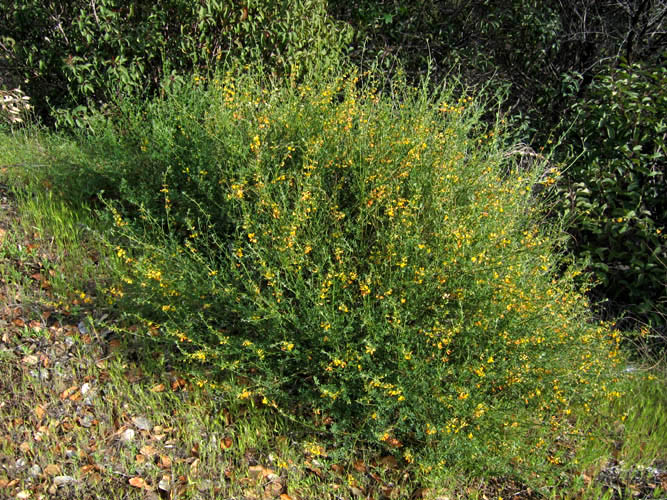
The above picture of a mass flower scene with multiple species of wildflowers was typical of what I saw growing up as a kid in and around El Cajon. The following year after such beautiful displays however, these wildfire annuals would give way to more longer lived perennials like Deerweed (Lotus scoparius) and White Sage (Salvia apiana) which were always the two dominant plants to rule over the mountainous landscape prior to Cal-Buckwheat & Sagebrush asserting their dominance a decade later. Like the various species of native California wildflowers, the White Sage and Deerweed would always remain present, but in smaller forms in between the dominant Sagescrub plants. Still, decades after the 1960s, you could sense things changing if you lived in and around this area and hiked it's pathways yearly. Something more than human mechanical damage is allowing these plants to succeed on the slopes where they never historically could before.


Photo Mine (2013 Rattlesnake Mountain, El Cajon California)

Invasive non-native African bunch grasses normally used by Cal-Trans and seen along Interstate Freeways in Southern California for supposedly holding banks together and preventing erosion. This view is on Rattlesnake Mountain in El Cajon and was taken in Spring of 2013 prior to me being threatened by surrounding neighbourhood Sky  Ranch Housing Community residents for being on protected conservation land. These were the same neighbourhood community people that chained sawed the remaining 30 foot Torrey Pines behind this shot because they said the were an invasive species and were known to cause brushfires. The trees had their first crop of cones that previous year and the folks insisted they would spread. They did indeed reseed with some seedling under California Buckwheat with help of ScrubJays, but most of the ones I saw did not make it through these dry present drought years. Even still, what a success story. Yeah, what a crime that would have been to see such plants as Torrey Pines succeed. You should however take note in the scene above and on the other side of those non-native African Bunch Grasses at the top of the picture are several solid acres of invading Mediterranean Black Mustard and Yellow Star Starthistle which previously never existed up there before. Especially prior to Star Ranch Development. While these plants (with the exception of Starthistle) were in existence back in the 1960s on the El Cajon Valley floor, they were non-existent in the higher elevations above and never did make any headway, even after fire. Now the soil dynamics have clearly changed, becoming somehow enriched and which proves that something else is allowing them to be successful beyond the usual human soil disturbance. Clearly nutrient enrichment by means of pollution may well be the culprit, even if it comes in the form of rainfall with a nutrient content even if slight. Over decades, concentration buildup takes it's toll.

There was something else the article mentioned, that I had briefly noticed and thought about previously, but dismissed it as of little consequence. This is the increase in Mistletoe and such beneficial organisms such as Lichens on chaparral plants. As previously written about before in this blog citing studies, Mistletoe can be actually beneficial, despite it's being unfairly demonization by the so-called experts. The above referenced article at the top however, also mentioned this about Lichens:
“Fertility sounds like a good thing,” Driscoll said, “But over-fertilization can cause the sudden overgrowth of some plants, algae or bacteria at the expense of other species.” The characteristic algal blooms that follow sewage releases or agricultural runoff are caused by the influx of nutrients. Overgrowth of plant life in estuaries can push oxygen levels so low that fish die. 
Tree-inhabiting lichens and tiny, distinctive, single-celled algae species called diatoms are very sensitive to nitrogen compounds, and so changes in their relative abundance make good early warning signs for larger ecosystem changes, say the authors. Atmospheric ammonia is a particular problem because it is not regulated.
Image: Rick Halsey - Chaparral Institute
Now the term here being used is Tree-inhabiting Lichens. These Lichens have been present everywhere in chaparral and other plant communities since before Trees and Shrubs were in existence and they are actually foundational to ecosystem recovery and plant succession. There is an ignorant viewpoint of lichens as tree-inhibiting or destroying and this was parroted around the middle of last year after the 2013 Mountain Fire near Idyllwild California. The resident Biologist referring to chaparral with an abundance of Lichens and Mosses labeled the community as old and decadent, in other words in need of burning by fire. What interested me in the abundance of the presence of Lichens is not that they kill trees and shrubs, but that under stressful environmental or other unhealthful conditions they will be more abundant. Lichens are not tree or chaparral killers, but their increased presence may mean that there quite possibly may be a break down in the immune system health of these plants, whose natural defenses have allowed Lichens to increase. Perhaps drought or as is the case here, increased nitrogen increase. I have noticed increase in Lichens on Chaparral, but have paid it no mind in the past. Now I myself will rethink the observation the next time I'm out in the field. It may well be that these lichens could be viewed upon as bioindicators that the nitrogen cycle is cascading to the extent that the ecosystem is in collapse. Any research references or Foresters will tell you that lichens do not harm trees, and that typically, they grow so slowly as to be imperceptible. Here are some relevant quotes from that US Forest Service piece about increased presence of Lichen being an indicator of something else going wrong, aside from increased nitrogen's effect on invasive weeds:
US Forestry: "Setting Limits: Using Air Pollution Thresholds to Protect and Restore U.S. Ecosystems"
"Biodiversity of plant communities is sensitive to N added by air pollution. Nitrogen-loving species are often favored and increase in prominence as ecosystem nitrogen availability increases. Forests and woodlands in many regions of the world show large changes in epiphytic lichen communities in response to chronic atmospheric nitrogen deposition. These lichen community impacts occur at nitrogen pollution thresholds as low as 3-6 kg/ha/yr."
The photo below here is illustrative of massive amounts of excessive Lichen growth on Chaparral in the eastern Anza area and especially Burn Valley. This area also has one of the worst problems of over colonization of Mistletoe which also is strangling what life is left in these shrubs. But it is hardly the sole reason for the major decline in chaparral health. Drought in combination with nutrient enrichment no doubt favour such a decrease of plant health and increased growth activity of Lichens and Mistletoe. But for some years to the present, this region was also my best mycorrhizal truffle collection area, but as time went on, sharp declines in truffle formation and availability became apparent. Along with the sharp decline in truffle, I also saw massive die offs in Coulter & Jeffrey Pines at these same exact locations. It is interesting that lack of truffle presence was followed by sudden die offs of trees. This first happened in and around 1990, but was not limited to eastern Anza. Garner Valley was effected in mass die off as was the whole of eastern Palomar Mount and over in Arizona when we would visit Prescott National Forest in and around the city of Prescott. Literally 10s of 1000s of trees were dying or dead. It was a sad time, but certainly a memorable one as everyone was talking about it back then. Of course the Bark Beetle gets the blame, but as with Lichen increases there is clearly something else going on which is unseen to the naked eye.
photo by Vandekar

Chaparral being swallowed by excessive infection of Lichens
"Lichen community change from oligotrophic [Oligotrophs are characterized by slow growth, low rates of metabolism, and generally low population density] and to eutrophic species dominance" [fast-growing, nutrient enriched like this one, bigger than the branch it's on!]

From Table 1., Nitrogen Deposition: US Forest Service
"Adding nitrogen to forests whose growth is typically limited by its availability may appear desirable, possibly increasing forest growth and timber production, but it can also have adverse effects such as increased soil acidification, biodiversity impacts, predisposition to insect infestations, and effects on beneficial root fungi called mycorrhizae. As atmospheric nitrogen deposition onto forests and other ecosystems increases, the enhanced availability of nitrogen can lead to chemical and biological changes collectively called 'nitrogen saturation.' As nitrogen deposition from air pollution accumulates in an ecosystem, a progression of effects can occur as levels of biologically available nitrogen increase."
It would be interesting for those who are avid outdoors people and love hiking to take special note of areas with increased Lichen colonizations which were never observed before and take ongoing note of any increase and death of trees or shrubs. This of course would not be the fault or result of increased Lichen grows as it would indicate something unbalanced and going on terribly wrong within the soil itself which is actually creating the so-called decadence or branch die-off as many mistakenly describe Chaparral. It has been well known for some time that in the landscape and garden, the excessive use of high nitrogen fertilizers will actually harm beneficial soil organisms and actually attract pests to your plants. This may actually be the cause of so much ecosystem decline around the Earth, aside from the usual suspects, and may not have been noticed previously until present high levels of contaminants have reached this present critical concentration levels everywhere. There truly is far more than mere global warming and CO2s effecting our natural world. In any event, experimenting with various fertilizers in the landscape may just illustrate this point more rapidly. Again, pests get a bad rap, but only because hidden things are out of balance. 
~~~~~~~~~~~~~~~~~~~~~~~~~~~~~~~~~~~~~~~~~~~~
Update: April 8, 2015
"Nitrogen deposition reduces Swiss plant diversity"
"High human atmospheric nitrogen emissions lead to a reduction of plant diversity. Researchers at the University of Basel analyzed plots all over Switzerland and report that the plant diversity has decreased in landscapes with high nitrogen deposition. The journal Royal Society Open Science has published their results."
(Source: University of Basel)
"Nitrogen deposition poses a threat to the diversity of Europe's forest vegetation"
"Unless nitrogen emissions are curbed, the diversity of plant communities in Europe's forests will decrease. Atmospheric nitrogen deposition has already changed the number and richness of forest floor vegetation species in European forests over the last 20–30 years. In particular, the coverage of plant species adapted to nutrient-poor conditions has reduced. However, levels of nitrogen deposition in Finnish forests remain small compared to Southern and Central Europe."
(Source: Finnish Environment Institute SYKE)
Even seemingly isolated and pristine areas like Desert ecosystems which seem far removed from polluted environments are in trouble. Update 2018
Image: Saguaro National Park
"Healthy ecosystems can naturally buffer a certain amount of pollution, but as nitrogen and sulfur accumulate, a threshold is passed where the ecosystem is harmed. “Critical load” is a term used to describe the amount of pollution above which harmful changes in sensitive ecosystems occur (Porter 2005). Nitrogen deposition exceeds the critical load for one or more park ecosystems (NPS ARD 2018)." 
Park Air Profiles - Saguaro National Park


Anyone care to take a guess what the nitrogen and other contaminant concentrations levels are in and around the wild landscape we call Asia ??? What effect does this have on those native plants and their symbiotic companions ??? Oh wait, too late. A Japanese Scientist has already answered this here in the New York Times:
Scientist Says Pollution From China Is Killing a Japanese Island’s Trees 
~~~~~~~~~~~~~~~~~~~~~~~~~~~~~~~~~
Further Educational Reading References
http://www.fs.fed.us/psw/publications/fenn/psw_2011_fenn002.pdf