Thursday, May 16, 2013

Establishing a Forest where the Experts said it would Fail

Please don't be offended by this "Tunnel Vision Science" meme. I'm not really an anti-science Luddite, but I've been considered one by many sciencey types who insisted I didn't know what I was talking about. Especially where it comes to rejecting what is supposed to be progressive mjodern science which knows better than Nature, because well, Nature is after all imperfect and flawed. You see there is this little religious dogma called "Argument from Poor Design" which was fabricated decades ago to help evolutionists argue with right-wing Fundies in those asinine time wasting origins debates. But I love it when amazing things out in nature overturn strongly entrenched conventional Paradigms. This argument from poor design has done more to hold back good science and our correct understanding of the natural world more than anything else. You know, when I write a post about habitat restoration or Urban Landscaping & making practical application of things learned and observed in Nature, my personal interest for the most part is not to try and impress the prevailing conventional scientific orthodoxy which often times I find ideologically driven. It's to help others. Let's take the U.S. Forest Service officials who informed me by letter back in the early 1980s, that any forest establishment in Anza Valley would never work after I requested their advice on Forest practices. After all, who would know better than those US Forest Custodians with those much coveted titles before their names and alphabet soup initials after their names on a business card, right ? I've been at odds with many of the local Forest officials in the San Jacinto Mountains for almost 2+ decades and many were actually friends. But changing their policy (worldview), methods and land maintenance applications, that's just way too much red tape ribbon cutting for me. Mostly I've enjoyed simply helping out the average home owner or land holder who actually cares about their little slice of paradise and are looking for real natural world viable alternatives that the conventional wisdom rejects because it doesn't fit their worldview of a conventional paradigm. I think influencing the average property owner who cares makes more sense, because collectively they can actually outnumber most Government landholdings. A Home owner has no political agendas or baggage which motivate what they do, other than beautifying their own place and if done properly make a true success to be replicated by fellow neighbours. Although these folks have to be taught this along proper guidelines. Unfortunately while many rural folks are sincere and well meaning and believe what they are doing is the right thing, they haven't had the best of examples when it comes to reforestation of the native landscape. Perhaps collectively, with the correct education, they can embarrass the largest landowner into submission, or at least get them to take notice. I seriously want the average person to succeed at their own pet projects on their land. I also want the Forestry to succeed, but under the correct methods. I've also seen what private people can do to land when they don't care and  pursue improper land stewardship which comes from ignorance. No one is at fault for being ignorant, but it is your fault if you choose to stay that way. But everyone can learn something new if they are humble, open minded and have the passion and willingness to take a complete turn around view of how nature actually works and develop practical applications from the things observed. This past weekend I revisited some of my own older pet projects up in Anza California from about three decades ago.

One of the first projects was back at the end of 1983, I got an privilege to be caretaker of a property for former Terwilliger (ANZA) residents Ken and Linda Dawson (now long since gone to Arizona last I heard). They gave me free rent and I in exchange watched and helped maintain their property. I had already experienced doing things the conventional way I learned in School with regards Forestry and Agriculture and I failed whenever I made practical application from the official version of habitat restoration techniques. Some things learned were good, but I also found ways to improve upon them. As I've previously written here on this and my other blog, I used already existing Nurse Plants or Mother Trees to establish and facilitate native tree or other plant restoration. The official Forestry tree planting programs and policies almost always even to the present day call for stripping the land of what they mistakenly believe are  competing chaparral brush and other plants deemed unworthy of existence in favour of trees. So most reforestation projects call for techniques which mimic a home gardener or large scale industrial Farmer. But Nature doesn't work like that. To interest the Dawson's and 4 other Terwilliger & Anza residents to go for improving their landscape with native forest trees, I revealed to them a program where the California Department of Forestry through a Nursery called L.A. Moran in Davis California would sell them bare root trees suited to their area climate and elevation for mere pennies a piece. This also offered some Tax advantages which sweetened the pot. Of course there was a catch. There was a minimum 250 trees per species they had to purchase. The project also couldn't be done for nursery resale profit. Their motive was to improve their wildland and to make the idea extra tasty, I gave each of them official tax documentation where they could write off for seven years many benefits for doing so. I guess Charles Rasmussen [now deceased] benefited the most on the tax benefits. There were of course criteria for what were considered acceptable tree planting projects such as Christmas Tree Farm, Lumber Operation and/or things like growing trees for eventual firewood sales, even wildlife habitat improvement, but the transplanting of these trees into Nursery containers for any retail profiteering was absolutely forbidden. Now here's what happened next.

After holding a meeting back in November of 1983 with all five property owners, I explained just how we should proceed once the trees arrived. First you don't wait until the trees arrive to prepare your land. You do all of this well ahead of time because once they arrived there is an extremely tiny window of opportunity to transplant these bare root packaged trees from their airtight sealed containers which retain moisture out into their permanent location. If delicate tree roots even remotely dry out, the root hairs are destroyed and your project will never establish. If the trees are left too long in their packaging they will rot or mold. As far as land preparation, the main message I wanted to get across was NOT to totally strip and  remove chaparral shrub vegetation from their properties. But rather selectively weeding out less vigorous shrubs was okay, but the majority should stay. Only ONE resident (Dawsons) did what I recommended. Ken Dawson had a really kool small scale tractor with tiny backhoe for which he was very skillful at using with meticulous precision. The other residents totally stripped their land down to bare exposed soil and installed irrigation lines. One of them listed instructional info from the U.S. Forestry & L.A. Moran Nursery as reasons for going ahead and doing what the US Forest Service recommended. Whatever! ALL properties eventually lost most all of their tree plantings, with ONLY the Dawson family being successful. They also used irrigation for a few years but mostly as an establishment measure which would replicate an area's wet rainy period (El NiƱo) which cycles back and forth in Nature. What Ken, Linda and I did was to be selective in removing older diseased looking chaparral, but left all healthy looking Scrub Oaks, Manzanitas, Sugarbush, Largest Redshanks or Ribbonwoods, old growth Mountain Mahogany & Chamise (Greasewood). It was until a decade later when I found Chamise & Redshank to be the best Nurse shrubs for Pine & Oaks. It would be a further two decades before somebody with credentials confirmed this in a study on how Ecto-Mycorrhizae (Pioslithus Tinctorius) would colonize both chaparral shrubs in wet periods allowing pine and oak seedlings to form a bond for better survival. Yet still to this day it's rarely spoken of. 

[On an interesting note here, after the partial clearing the land and transplanting the bare root trees, we also noticed Sugarbush and Manzanita seedlings began making an appearance that summer, but no fire necessary for germination. Hmmmm, I feel a paradigm shift coming] 

Image: Ryan R600

The photo above is illustrative to understanding the actually scale of the small backhoe Ken used in the selective removal of shrubs without damaging the entire underground mycorrhizal network. The rule I've always followed is leaving between 40% - 60% of the native chaparral. We planted all 500+ trees which included Coulter Pine, Jeffrey Pine and Incense Cedar. The Anza Chiropractor, Eugene Abbott,  retired Bell Telephone guy Charles Rasmussen (deceased now) and one other nearby resident's trees all failed. Two years ago I stopped by Rasmussen's old place at the far west side of Lightning Road and one single short stunted pine tree was left. The log cabin Washburn's place on the north side of the property next to Lightning Rd was stripped bare and plowed with a tractor and trees planted in very even concentrated rows. Take a look below at what is left of the 500+ trees they planted as we drove by on Tuesday. The Dawson's place was planted mostly by Ken and Linda and myself when they came up from their main place in Vista CA on the weekends. Seeing this has been a huge reward even though it belongs to other folks.
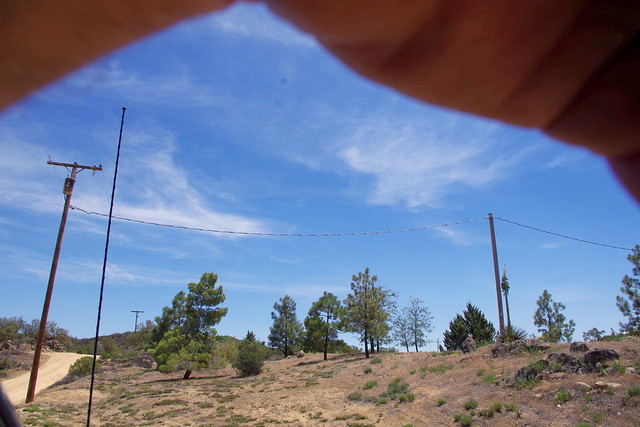
This photo on the right is the Poverty Hill Ranch owned by Elgie Washburn. Although Elgie and his wife Lucille lovingly watered by hand and cared for their trees, this is what they have left of all those Jeffrey and Coulter Pines from the front view on Lightning Road. They really did work hard though on watering those trees by hand in the beginning. I almost wished now I had thought to bring over some of my mycorrhizal mix to inoculate their trees as well. This photo was taken from Mary Ann Kiger's truck passenger side. It does look like they thinned them out pretty good. Actually it wouldn't hurt to give them all a shot of inoculation dose of MycoApply and see what the results would be next year. More trees are out of view to the right of the photograph here. Dawson's place is just ahead as you turn left onto Thunder Road  and down to the last house at the dead end.

Photo Credit: Mine

Lessons Learned from the Bajadas (Alluvial Fans)

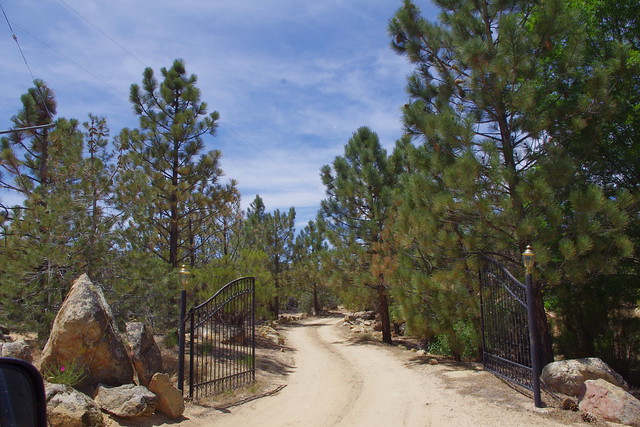
This is the entrance to Ken and Linda Dawson's old place which I was caretaker for a couple of years. We left 60% of the Chaparral species of healthy plants in place and 40% at other locations depending on the geology. Even after clearing some areas by hand, we left the underground biological grid intact and actually newer seedlings of Sugarbush and Holly Leaf Cherry germinated among the pine seedlings we transplanted. In fact so did a couple Manzanitas, no fire required as insisted upon by the scientific literature. At the beginning, I inoculated with Pisolithus tinctorius collected in Burnt Valley area and some years later with a Mycorrhizal mix from PHC.  Ken installed an extensive above ground drip system to run for the first few years to replicate a good wet season. Thereafter the system was slowly shut way  down until it wasn't a necessity any longer. The present state of that irrigation is dismantled now anyway. I have no irrigation issues in the beginning for establishment of plants. This replicates a period of good winter rainy season followed by good monsoonal moisture where many systems (especially alluvial plain Riparian ecosystems) get their natural foothold established. There is a natural precedent for following this rule in a post I wrote on "Lessons from a Bajada (Alluvial Fan)".

Photo Credit: Mine
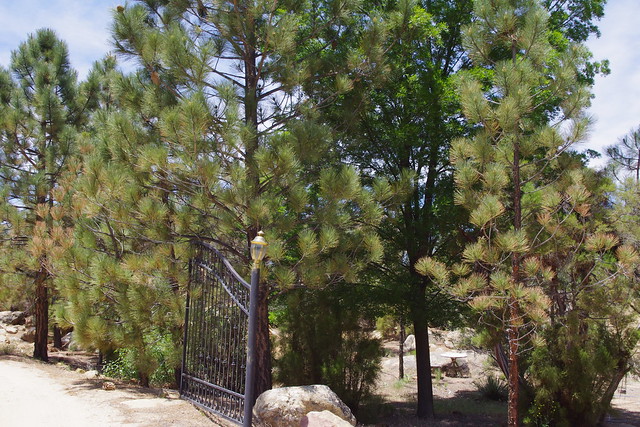
This shot to the right of the gated entrance shows also a Black Locust and other trees in the back ground like Incense Cedar. The Cedars did not fare as well, but there are some further up the drive as well as larger Jeffrey & Coulter Pines. HOWEVER - there is a vicious Pit Bull at the newer owner's house and other Dogs. DO NOT go to this house and inquire of anything. I have no idea who the present owner's are, but I drove up there to introduce myself and explain some of the history background of the place, but my VW Bug was attacked by this almost demonic expression looking Pitbull and it scratched the Driver door and tore off the rocker panel to where it dragged the road and I had to stop and repair it with some wire someone gave me. Seriously, DO NOT drive onto this property and get out of your car if you visit this place.
Photo Credit: Mine
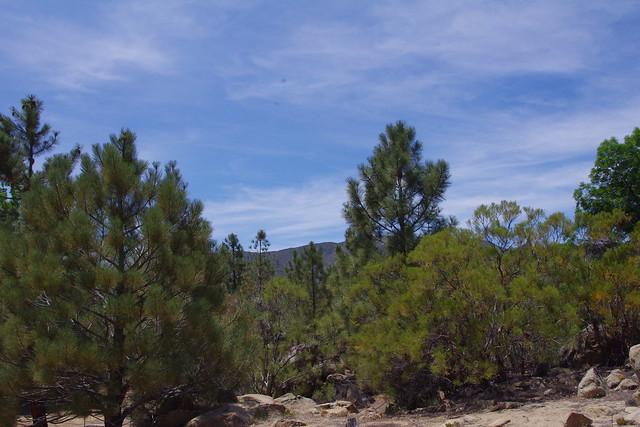
This view at the dead end part of the road shows the still intact Redshanks and Manzanitas. These were old growth chaparral which were left intact because of their deep rooted infrastructure and their beautiful appearance. The pine tree establishment success however reveals that the chaparral's presence meant much more. The beauty is that unlike the other property owners, Ken & Linda left the ground intact which saved the already existing underground fungal network which benefited the Pines who merely tapped into the system.
Photo Credit: Mine
This shot allows you to see closer up some of the Incense Cedar which made it. There are also chaparral plants in the background here. I believe the Dawson's and Washburn's also shared some Knobcone Pines, but not many of them made the transplant. I think Washburn's Knobcone pines may have done even better than the Dawson's Knobcones.
Photo Credit: Mine
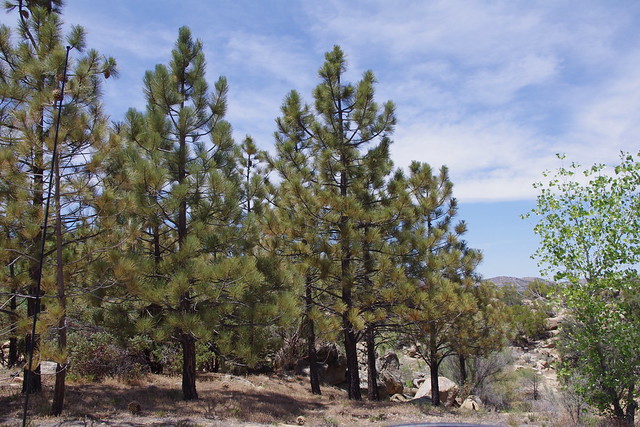
Finally this is the tail end of the Thunder Road dead end cul du sac. Notice the Manzanita and Greasewood still existing among the Jeffrey and Coulter Pines ? I have to admit I wasn't expecting much as with everything else that has gone wrong in So-Cal, but like the weed infested hill in El Cajon where I attempted to re-establish a completely ruined ecosystem, this trip back was truly an encouragement to all Nature loving folks who wish to reclaim land as well as saving prized wild landscapes. Here was that earlier article:
Note to All Eco-Activists: Why not challenge yourself to restore the Land that was Lost ? 
Just a quick note to all those Eco-Activism folks who may get their knickers in a twist over the above title. It was meant as a teaching point and not a slam on your favourite 1960s styled activism protest cause. If you didn't read it through then you missed the main import of the post which was not a slam against your saving something some where out in Nature, but rather to point out some most often overlooked areas within city limits for which to rehabilitate. These overgrown non-native weed annuals on ruined lands closer to cities are so easy to dismiss and/or write off, but they were at one time as pristine as areas you want to save further out in any wilderness. Also, they are closer to home and so access is generally easier for busy people trying to make a living. Hands on work with plants is most educational, more so than mere reading of books or internet sites and the outdoor experience tends to burn important instructional teaching points into your memory banks, even when you make mistakes, you can learn from these as well.
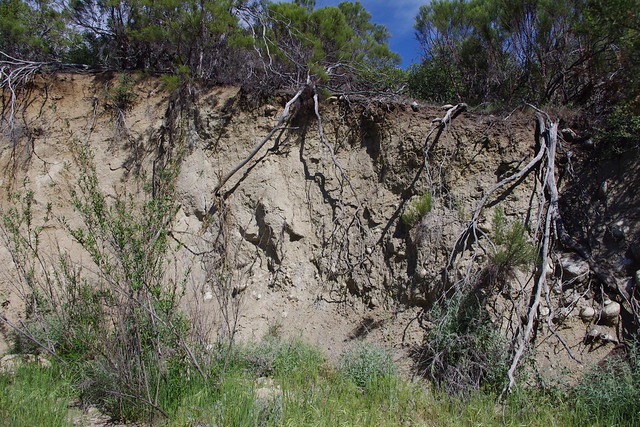
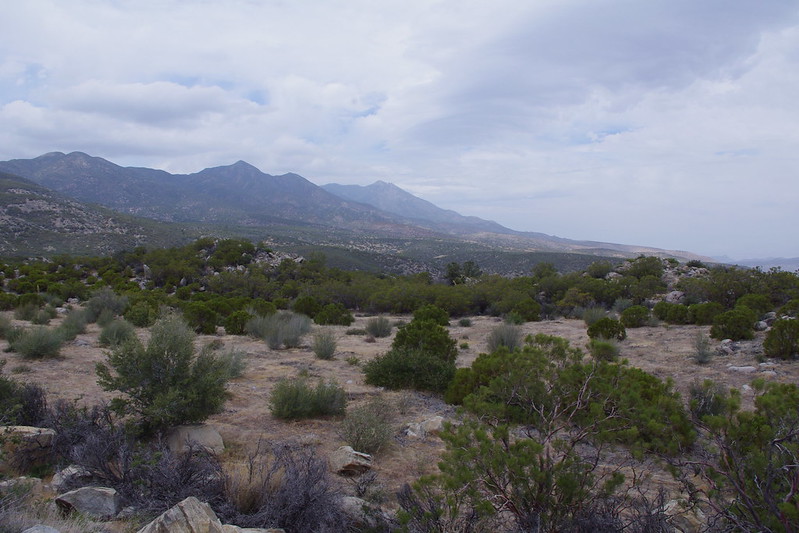
These next series of photos are merely illustrative of the natural mechanics of how an early developing Forest system survives within the Chaparral Plant Community. That Dawson property above has some of the lousiest rocky hard adobe soil and what most average folks would consider terrible Landscape or Gardening canvas. The land referenced above is a giant boulder strewn, rocky fractured underground with decomposed sterile looking granite with a lot of red hard adobe-like clay which is hard as a rock when dry, but slick as snot when wet. Most people in their conventional right mind would never think of attempting what we did here. Ken Dawson said that the real estate people informed him that they couldn't sell this last piece at the end of the road just because of that bad condition of the land. But he loved the rocks as his family was into crystal mining down over in the mountains above the Pala Indian Reservation in San Diego County. Even the well water here has seriously nasty high iron content which is hardly suitable for drinking and also quite often screwed up irrigation lines and indoor plumbing without a major filtration system attached to the Well itself. These first three photos below are of the hike I took with two friends on Tuesday where we documented the unnatural erosion cut above Hwy 74 which was to allow the road department the luxury of not having to build a bridge which would have upped the construction costs. In so doing they gouged a gully in the higher ground of the wild landscape which severely has eroded sharp steep cuts into this part of the Earth. There is clearly nothing natural about this newer stream bed here which normally takes hundreds or even thousands of years to create and settle to conform with the surrounding landscape and eventually to establish itself with riparian species which for the most part are completely missing here, unlike the former stream course which is still performing wonderfully with rich diversity of streamside habitat plant life by underground moisture. Take a look at the next three photos and see what has happened. Keep in mind I am merely illustrating what chaparral plants do underground and how they allow trees to encroach on their habitat and actually help them to succeed.
All Three Photos: Mine
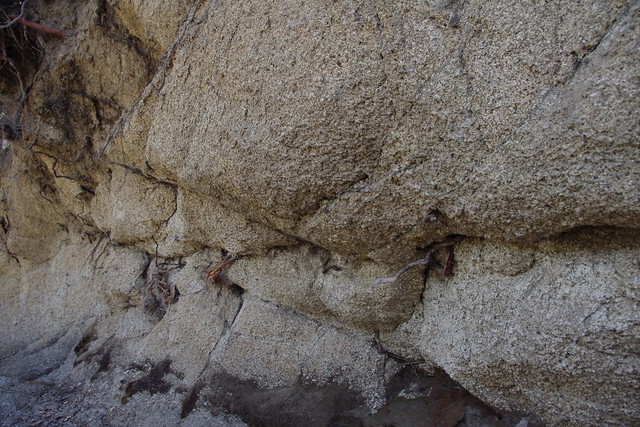
The top two were actually shots taken side by side. The last one is the rocky side where the granite boulders have slid down in the erosion cuts as a result of being undermined by a torrent of winter water flows. While this action which took place decades ago is sad, they are however illustrative of the obvious unnaturalness of this creek which is no more than an eroded wash or desert dry gully. But there is a learning experience here from the exposure of the deep underground chaparral plant networks which should not go unnoticed.


All Three Photos: Mine
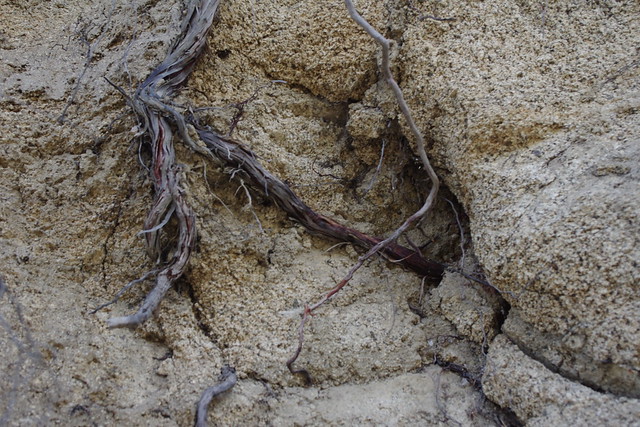
I've taken these photos to illustrate the 12 to 15 foot depth of what can clearly be identified as Greasewood or Chamise, Manzanita and Redshank or Ribbonwood. Think of these constructs as living biological mechanical plumbing infrastructure for supporting a larger system we call a forest. There are never any good reasons for making a slam against Chaparral plants, but rather a praise for the major positive contribution they make as to their importance within any ecosystem. People need to also keep in mind how most chaparral facilitates water movement deep underground even when they are dormant in winter months. Rain water when it falls, by nature will run off and will not soak deep on it's own, but certain plants will inject the soils within it's deeper layers with generous amounts of moisture to fill water deeper table aquifers and for later use in the topsoil system during dry periods for all vegetation's benefit.

Two Important Phenomena in Nature Illustrated Below which Explain Water Movement in Soils 

Hydraulic Lift & Redistribution

Both phenomena, hydraulic lift & hydraulic descent, are imperative for healthy plant ecosystems. Removal of deep rooted shrubs and trees from off the surface of the land destroys this natural biological hydrological system. The Hydraulic Lift and Redistribution of deep subsoi moisture by deeply rooted plants pulls water up from deeper layers of the ground and redistributes this life saving moisture to more shallow rooted plants. The mycorrhizal grid network will further enhance this process as all plants are interconnected.

The other opposite phenomena known as hydraulic descent is a process of when plants (shrubs & trees) are dormant during winter or rainy season months and not actively growing, but have the ability to take abundant surface water from upper rain soaked layers and pump it down deep into the earth to be later used during summer months and or facilitate water table and aquifer levels. Most people have no idea this goes on and how purchasing rural land acreage and hiring the local Joe Six-Pack to bulldoze and clear your land is working against your own interests. Yet this is exactly what the US Forest Service for decades has recommended for planting and estaaablishing of plantation trees for reforestation. Strip land and lightly till prior t tree planting. The myth is that chaparral is an evil competitor for water and nutrients and this is completely false. Redshank or Ribbonwood (Adenostoma sparsifolium) & Chamise or Greasewood (Adenostoma fasiculatum) are some of the deepest rooted shrubs and therefore make perfect facilitatirs of Hydraulic Lift & Descent. Add to that PT Mycorrhizal associations and you will more than double the growth of Pine & Oak than the methods espoused by the US Forest Service science-based recommendations.

Hydraulic Descent
Below here is a great animation by Bert Wilson on his Las Pilitas Nursery website which illustrates the value and potential of transforming what looks otherwise like a worthless rocky piece of land like that of Ken Dawson's property. Native trees and shrubs in this area will always find a way to break through the hard-pan or bedrock subsurface regions of a tough soil profile and find a way to tap into moister layer which are indeed down there, whether or not it appears that way to you on a first impression basis.

Bert Wilson: Las Pilitas Nursery
I can't preach and sermonize enough about the importance of leaving most existing chaparral plants within your landscape alone and injecting the soil when transplanting trees with a good healthy diverse species blend of Mycorrhizal and beneficial Bacteria mix. Replicating initially a period of wet rainy season for the first few years through extensive drip irrigation and then tapering off to hands off watering after a few years are essential for allowing your forest system to develop an incredible infrastructure underground which will sustain the system thereafter, even enough to weather some drought years with little attention. Most Land Barons or Home owners make the terrible mistake of leaving their drip irrigation on for life and that makes plants dependent. It creates a type of flawed system on artificial life support. It doesn't work. It's a lot like Welfare. Welfare, while it may have had an original noble motivational beginning has never worked in the USA or Europe for that matter in the making of productive citizens since they are never  truly encouraged to be weaned off the support system. It makes people lazy or unable to care for themselves and dependent on the entitlement meal ticket they were never weaned off from. Care for plants will actually work the same identical way, and if you don't believe this, take a tour of most people's properties who have never taken their landscape off the drip system. Maybe the video by Northwestern Forest Soils Biologist Suzanne Simard is again appropriate here on how a forest works.


Here are some great recent Studies which have been told time and again, but more proof of how Nature works under the ground: 
ScienceShot: Shhh, the Plants Are Talking
Plants Talk: Seedlings Thrive with Encouraging 'Words'
Fungus network 'plays role in plant communication'
PHYSORG: Plants use underground networks to warn of enemy attack
~~~~~~~~~~~~~~~~~~~~~~~~~~~~~~~
Here are the best info standbys for local So-Cal Plant information and education:
The California Chaparral Institute
Mycorrhizal Applications Inc & MycoApply
~~~~~~~~~~~~~~~~~~~~~~~~~~~~~~~
Native Plant Purchase & Educational Resources:
http://www.laspilitas.com/
Tree of Life California Native Plant Nursery


Wednesday, May 8, 2013

Plant Forensics for Determining a Climate's Ancient Past

Maybe the title should have been - "Climate's Ancient Past, but recent Demise". Scientific myths abound as to what once was in the southwest's moister climate history which helped establish and maintain far more extensive forests than at present. We are told that forest cover was far greater than today in California, but that was 1000s of years ago. Part of learning & extrapolating the truth of a matter can be found by looking up old archive references and reading historical diaries and other official accounts from the recent past. Much of the problem is we don't have many photographs documenting things we'd truly love to know and understand about Nature. People from a couple hundred years ago are long gone and their memories and valuable experiences are long gone. Without them we are left to the biased speculative assumptions which motivate researchers today. (Including me I suppose) For me, even if I appreciate a written paper, I've just got to verify it for myself, know what I mean ? Pouring over such old documents and even gleaning clues from literature which was never intended to be written from a Naturalist perspective still can reveal important informational clues.
 (read about the importance of archives and older folks experiences) 
First off, I have to admit, I this fascination [okay obsession] with the past climate influence of the area's Ancient Lake Cahuilla which was located directly to the east and south of this mountain range and what caused it's decline. Then there there is the recent research material released this past year of two different volcanoes ( Salton Buttes & Sunset Crater - AZ) erupting very closing during this same time period in the southwest and the same uncanny decline of the Ancient Anasazi civilization almost simultaneously ? Seriously, all these events [volcanic eruptions (earthquakes?), Lake Cahuilla's decline, Anazasi decline as result of environmental change] happen in close time frame proximity with one another in the southwest.  Hmmmmm, this is where I've always wondered if there could possibly be any unusual plant anomalies held over from the change  to provide any clues to a wetter climate's historical past ? Well maybe. I have yet another post on possibilities of ancient Lake Cahuilla's influence on climate and vegetation in the next month or so. Keep a watch out for it. But for now, I actually have two examples of plants that I found fascinating years ago. It was actually back in the early 1980s, but I never before gave a thought to document them as I had no interest in proving anything to anyone else but myself. What a mistake that was. I wish I had documented more. Sad how things change so rapidly in a downhill fashion in our modern times, especially when it comes to the Natural World. Anyway, take a look at two important examples I have now documented on my 2013 trip back to the USA.

Photo credit: Mine!
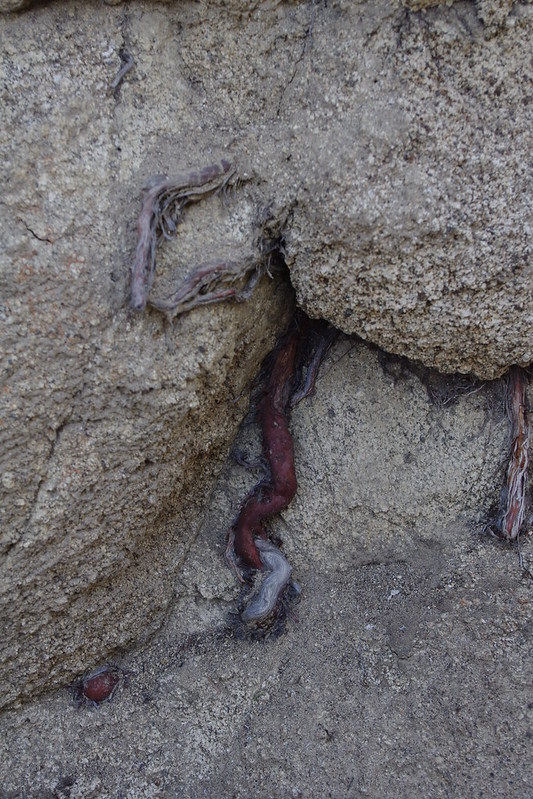
I know, it's not much to look at, but this small tree wasn't always like this. It was always heavily adorned with green delicate looking foliage which would loose it's leaves in the Autumn. Flowers were five separate distinct white petals, and a small green to purple fruit at the end of the season. This particular remnant of a tree is perhaps an indication of a once wetter moister climate is listed as, 
Utah Serviceberry (Amelanchier utahensis)

Thanks to Tom Chester for the official identification

photo - Sally & Andy Wasowski
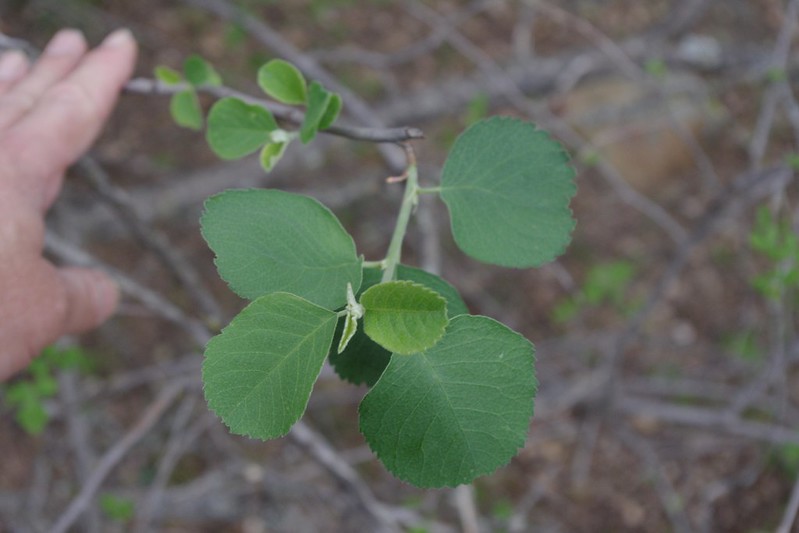
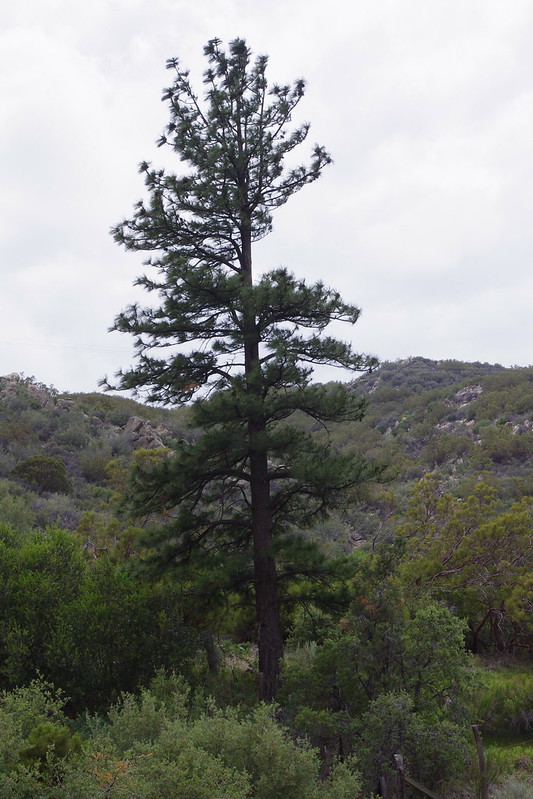
For my first few years living on Table Mountain in Anza just above where this tree is located in the watershed of Hamilton Creek in Burnt Valley. Truthfully I never noticed it before as it must have simply blended in with the surrounding chaparral plant community. That is UNTIL one Spring during those heavy rainfall Winter periods in the early 1980s, I saw the most spectacular white blooms on this small tree which were gorgeous in their mass display. The photo to the right here shows an example of such spectacular flower display potential in wetter times. Unfortunately, this present 2013 drought in Anza CA would not produce anything. But this year in 1984 I stop  and got a closer look. How could I not. The scene stood out in stark contrast to the surrounding vegetation. It was just of course unusual because it didn't seem to fit the surrounding profile of the other trees and the chaparral. After all, the Anza region was normally a very dry summer hot and dry winter cold area and I thought, 'how could such a plant be so out of place' ? But it was just a few feet from the creek which no doubt was an advantage. The only other place I had later ever seen this small tree was in the North Fork of the San Jacinto River watershed just to the west of the Hwy 243 north of Pine Cove / Idyllwild regions. Interestingly, those particular Utah Serviceberry specimens were inside an old growth forest setting where it was darker and far more moister than the Burnt Valley location. That was the start of my thinking about a different type of climate that may well have existed way back when. I tried like crazy to find another example of this plant all through this watershed and have never ever found a single one other than this one and it's barely hanging on. This is it. Clearly it's seed came from somewhere, just like the Seed source for the small colony of Lemonade Berry on Rattlesnake Mountain. Odd plant puzzles like this should challenge all people to investigate and learn more about the environment around them. At the very least it keeps hikes interesting if you challenge yourself to set out to specifically explore and find newer treasures. Not everything in the nature has been found, discovered or becomes known to mankind, despite what this world's leadership may want you to believe. To this very day, I have never found another single tree of this species in this region, but that doesn't mean there is none. The hills, canyons and dry washes above and around this tree are also littered with 100s of mummified remains of both Coulter Pine and Jeffrey Pine logs, with only a few living stunted remnants to give any clues of a different climate past. I also found some mummified remains of some small Incense cedar, but that remains to be photographed if I can find them again. I also need permission from Agri-Empire to go back onto their land to investigate. When I found those, I brought it to the attention of Wildlife Biologist Tom Roberts up in Idyllwild back in 1983, but he wasn't overly interested back then. Understandable since he was fighting further development up in Garner Valley at the time. Even still, the presence of Incense Cedar would definitely speak of a time when conditions in this particular area were wetter. This was also the same time period when another single specimen plant anomaly got me thinking about a wetter climate past. Believe it or not, it was a single Jeffrey Pine (Pinus jeffreyi) on Hwy 74 along the Santa Rosa Mountain section of the highway that made me begin to wonder again, but more on that at the end here. First, here are some closer shots of the Utah Serviceberry which although looking dead, is struggling to come back by way of three or four healthy suckers from it's large trunk base.

Photo Credit: Mine!
Utah Serviceberry  (Amelanchier utahensis) 
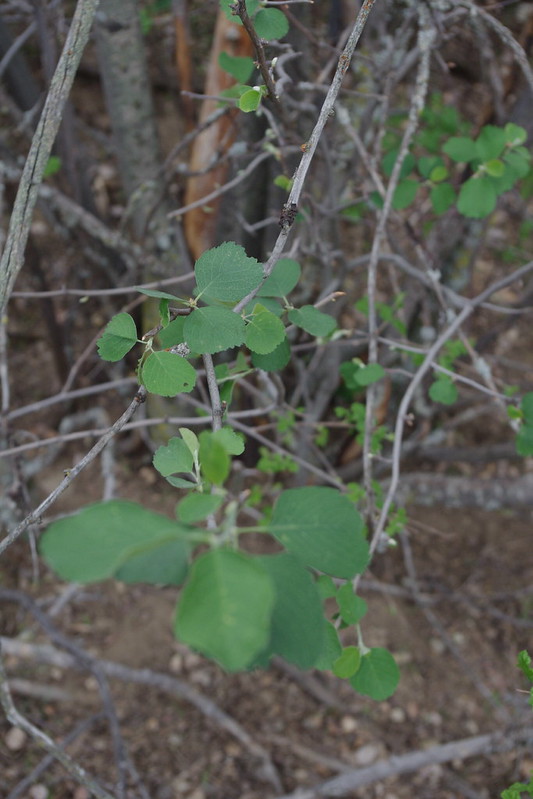
This is a close up shot where I had to pull up from the base some of the newer growth struggling to come back again. I was shocked and disappointed to see this tree mostly dead until on closer inspection saw that it was still clinging to life through the growth of a few suckers from it's root stock base.
Photo Credit: Mine!
Pale leaved serviceberry, Service Berry, Utah Service Berry, Western Serviceberry
Again, another shot of the growth trying to make a come back  from a different location at the trunk base. Here is a bit more info and highlights of this rare plant of the San Jacinto Mountains.
Photo Credit: Mine!
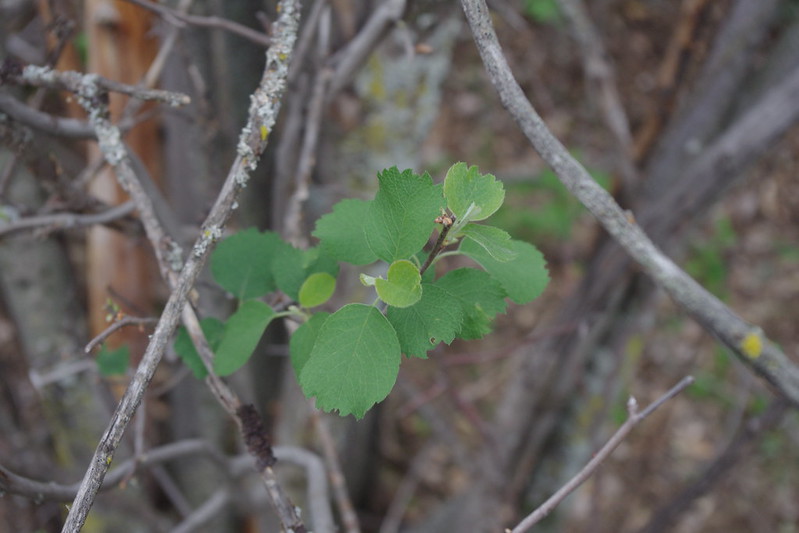
Once again, this is simply another shot of a different sucker to the left off the main trunk at the base. This small tree was always multitrunk and beautiful in appearance. It's just a shame the conditions lately have deteriorated so much that not only this plant, but many others are having a rough go of it.
Now there was another plant anomaly which always gave me pause when I passed by it while regularly traveling on Hwy 74 when  commuting to work in the Coachella Valley in the deserts below from my home in the high mountain valley of Anza California. This singular Jeffrey Pine (Pinus jeffreyi) is located on the very eastern border of Santa Rosa Indian Reservation along route Highway 74 in the San Jacinto Mountains. When I see such lone plant anomalies, I stop and take pause wondering where did the parent seed come from. Of course, perhaps someone planted it along the highway, but this was actually not the case. For whatever reason either the CalTrans or other individuals (perhaps Forest Service) have periodically cleared the chaparral from around this tree as the photo will indicate if you do a surrounding chaparral plant community comparison. One day with time on my hands I finally stopped and decided to investigate much deeper. Another reason is that I saw another pine further on down the dry wash or Arroyo in the direction of Palm Canyon watershed. That particular tree was very much struggling for it's life. It only had needles from the previous year's before growth along the whorls of it's branches. Most healthy Pines of any variety will have six or seven years growth of pine needles still clinging to the branch growth whorls from each previous year's growth cycle. This tree is now presently gone for good and actually fallen over as the photo below will reveal. It was associated with an Interior Live Oak (Quercus wislizenii) which still appears to be healthy. You can see into the Oak tree's interior main trunk which is visible because of the competitive growth with the Jeffrey Pine once on it's north side.
Photo Credit: Mine!

Jeffrey Pine (Pinus jeffreyi) 
This is looking west on Highway 74 with the pine to the left, and no doubt ignored and never given a second thought by passers by. On closer inspection if you drive by slowly, you'll see cut chaparral meant I guess as a fire break measure to protect this tree.
Photo Credit: Mine!
Here is a much closer shot of the Jeffrey Pine. The foliage on this particular tree has always been healthy and I have collect cones for seed from it in the past for germination.
Photo Credit: Mine! 
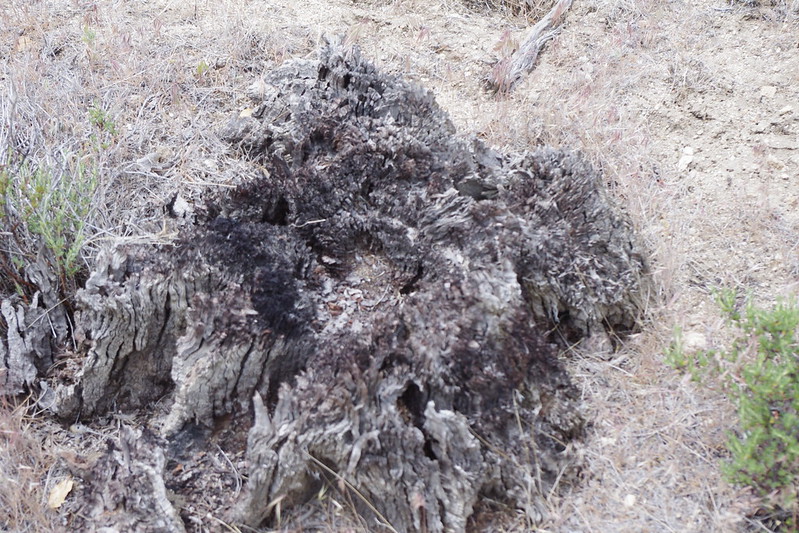
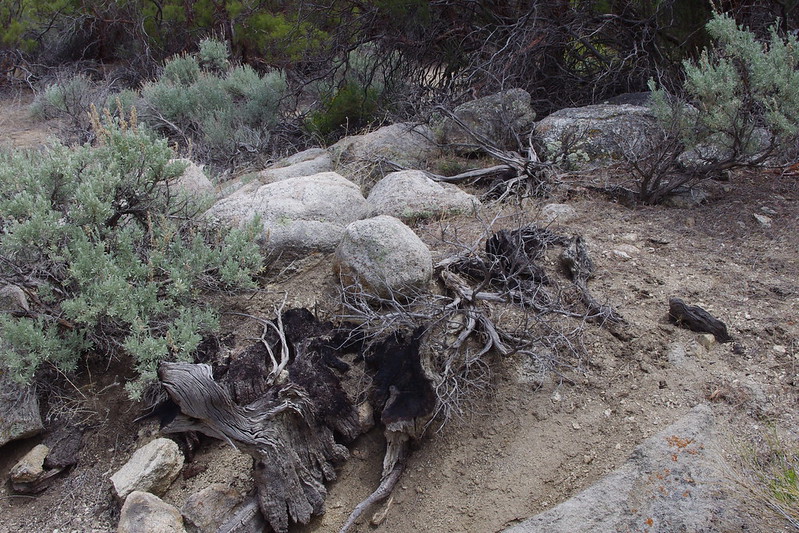
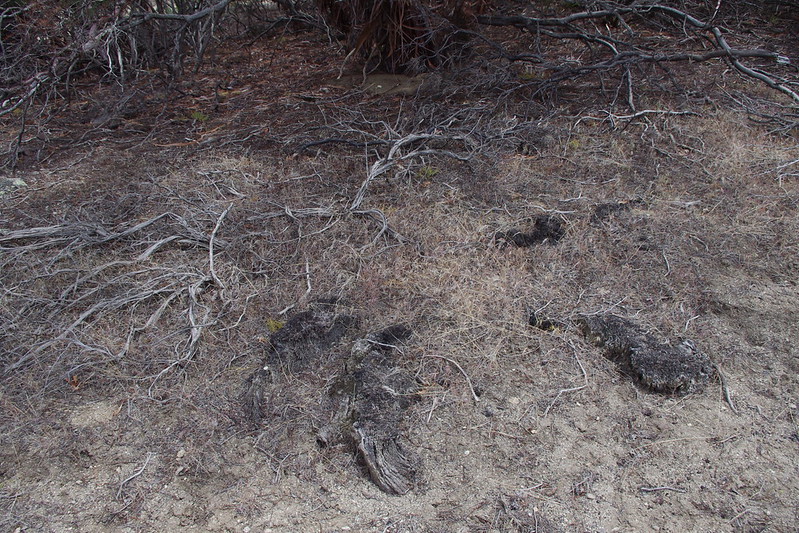
This is an area just east of the Jeffrey Pine along Hwy 74 looking northwards towards Palm Canyon which opens out into Palm Springs.  These geologic features of granite boulder outcroppings divided by various elevations of steppes or dry bunch grass meadows (many are loaded with native bunch Grasses) are where most of the fire charred stumps are to be found. In the past I have found large charred stumps a couple feet in height in some of the granite outcrops, but most are within the flat steppes. There is a steppe below this one where I bushwacked and photographed the following Jeffrey Pine charred stump anomalies for which you will find no mention anywhere in any historical literature.
Photo Credit: Mine!
This is the third steppe down from the roadway where I took the photo of the Steppe near the road above this one. This is where most of the stumps I've photographed are to be found. I had no more time to bushwhack and photograph others as my brother was waiting for me in the Jeep parked along the Hwy 74 where pullouts are few to be found. I was gone for almost an hour and had to turn back again. Still these stumps were both thrilling and sad again to see & imagine what once was.
Photo Credit: Mine!
This is the dead Jeffrey Pine carcass fallen away from it's former neighbour the Interior Live Oak (Quercus wislizensii). This tree was seen by me alive back in the very early 1980s before dying finally in the late 1980s and also is located in that meadow or dry steppe pictured above this photo. The next four photos will be a collection of those ancient almost disintegrated charred stumps which will eventually disappear completely in the future.
Photos Credits: Mine!
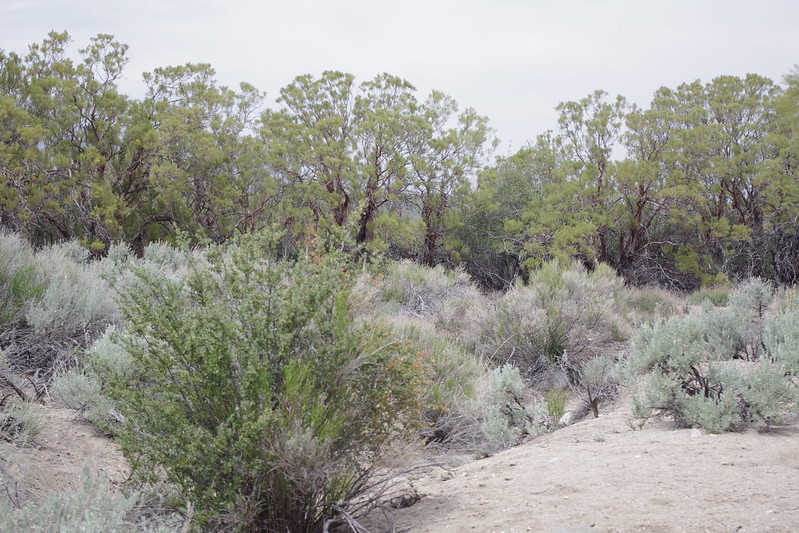
All these stumps were the easiest examples to find. Many others are deep within the old growth Redshank or Ribbonwood (Adenostoma sparsifolium) pictured in the photo which I must say in the second steppe meadow photograph above were giant old growth examples although the photograph may not reveal the true height of these Elfin Forest giants.  Though these stumps have deteriorated quite a bit, they nevertheless reveal what once existed and was later destroyed by human carelessness with fire.
Here is a reference from my previous article or post which covered two studies in which the vegetation redistribution was debated by two competing Theorists for lack of better description of their behavior. Here is the link to my previous post on the subject of the  fire and vegetation changes on Santa Rosa Mountain and a partial quote about the significance of two very major fires
Santa Rosa Mountains & Climate Change - Will Anyone Pay Attention ?
When I first arrived in Idyllwild, I inquired of the Control Burn Supervisor Steve Raybould and Wildlife Biologist Tom Roberts about what fire deforested the entire north face of Thomas Mountain above Garner Valley. Back when I first arrived in those mountains in 1981, there were still many of the burnt snags and logs  that were still visible everywhere on that north face. Presently when passing through the area on Hwy 74 last Sunday, most are gone or hidden by the Chaparral. Both Tom & Steve told me of two major fire events, one around the turn of the Century and another in the 1940s which later finished everything off. The fires came from the direction of Santa Rosa Mountains and they both said it was the Santa Rosa Indians who started them through carelessness. People often love to romanticize the Native Americans as almost being a part of Nature and being one with the land, but the fact is they are not animals, but real human beings just like anyone else with the same failings as other people. I really don't care if the people responsible for those fires were Purple with Green Stripes and Pink Poka dots. The major cause of change in this case was & has always been human and the consequences of these events resulted in certain name changes of specific geographic locations within Anza Valley and the surrounding countryside. Names like "Old forest Road" (where no forest actually exists) and even the name "Burnt Valley" itself  truly leaves one to wonder about the why question. I'll deal with these in another future post I already have set aside as a draft. I just need more photos to verify causes of the change as indicated by clues. Anyway, historically the fires were 1922 and later 1947 and they burned big time from the Santa Rosa Mountains to Lake Hemet and through Burnt Valley and the southern face of Thomas Mountain. Whatever was left after the climate change back then was eliminated permanently after both those fires with any come back having great difficulty as I will show. Below is one part of a paragraph from my previous post link above referencing material from one of the researchers who looked for plant growth changes as a result of fires and for which I do agree.
They also followed the same fire history as referenced in the other study which indicates a huge major fire 91 years ago which would put that around 1922 and another major fire around 1947. Sure enough you can check Cal-Forestry historical fire records and the early 1920s and late 1940s had major fires in the Santa Rosa Mtns. Here is a link to this website for fire records:  Cal Dept of Forest & Fire 
Further Reading on ancient Lake Cahuilla and it's potential for influencing a much wetter milder climate, see the other post from February 11, 2013. Also an associated article regarding San Joaquin Valley from it's Historic past. 
What exactly is the weather phenomenon known as the "lake effect"?
 AND
 What California's San Joaquin Valley Once Was!
Enjoy the Reads if  further interested.

Tuesday, May 7, 2013

IRRIGATION ISSUES: Why Isn't Nature Replicated more often ?

Image - Treehugger

I'm puzzled by the lack of interest STILL when Nature is completely ignored in favour of the modern Scientific Idiocy which continues to exist for no other reasons than modern innovations and techniques make money. It's all about the money, so "follow the money". The problem is the conventional thinking is truly killing our planet and making life on this planet more and more difficult for every living thing. I have to go back to one of my pet peeves when it comes to water use. Coming from the southwest, I'm use to there being a rainy season and a dry season, with perhaps a little monsoonal moisture just to keep things interesting. It wasn't till I came back to the city after 24 years in the mountains above Palm Springs, that I realized how much had changed in the Landscape maintenance department. First off, there were far more pests and diseases to deal with. I was clearly out of touch with what had further developed on Southern California coastal and interior valleys with regards the challenges of landscape and gardening maintenance. Every plant, shrub and/or tree seemed infected with something. I hadn't seen this in the wilds, because frankly, such pest war conditions generally don't exist there as a result of Nature's balance. In Nature when Spring comes around after months of winter rainfall, there is naturally that initial flush of bloom and newer foliage growth. That's not only logical, but to be expected. But by summer most plants in the wild are merely maintaining health and vigor of it's foliage and slow development of it's fruit or seed. Bugs don't attack because plants will manufacture a host of various bitter alkaloids in their saps or resins to make plants distasteful to most insects and other creatures. Often with Spring growth, there is more watery sap which contains less of these bitter flavours and attacks will be at a minimum because the population of past are lower at this time. 

image - rootsimple.com
In the Cities and Farms however it's a more different story. Things are forced when it comes to growth. Watering is quite often at regular daily intervals. Yet that's not what Nature does. In the urban landscape, plants (shrubs or trees) are never encouraged to develop an root infrastructure of deeper roots. Why would they, water on the surface is always readily available in the urban landscape. No need to growth to depth. The problem is when summer comes around and pest insects are more abundant and active, these same succulent growth patterns in both shrubs and trees encourage more and more population explosions of insect pests. Such pests would be at a minimum if the landscape was trained and maintained as Nature does it in the wild. Therefore extra Gardening work is called for as plants grow excessively and block or crowd roadways, sidewalks, structural overhangs etc. Unnecessary growth that would not exist and forced to be dealt with had Nature been replicated. Even diseases like Powdery Mildew (like the squash leaves above) and other blight would be held to a minimum. It's not that such organisms don't exist in the wild, they do. But they are mostly so few that their effects are minuscule and hidden from view. 

(BanksPhotos/iStock)
There is a plethora of supplies for dealing with the consequences of doing the wrong thing when it comes to gardening and landscaping. While chemical fertilizers contribute to the problem, it actually starts with WAAAAAAYY too much watering.
This is where the big money is made by conventional Retail Nurseries and the big business commercial interests which provide them with innumerable products to basically kill things, often in more ways than one. People are so indoctrinated into the historical ignorant conventional ways of doing things, which are often sold as convenient and easy, that they are often NOT open to newer education as to how things really work out in Nature. True, it does take some education and understanding on how things work, which in turn requires a fair amount of investment in one's personal time. but the rewards are worth it. In actuality it is extremely less complicated and far more simple than making continued applications with commercial products which really increase more workload in the garden and commercial urban landscapes. Want to work harder ?, then keep on pursuing the conventional wisdom that brutalizes nature and see what real hard work is really like. Lets get back to irrigation. Last year I wrote about Hunter Industries Deep Pipe Irrigation  products which in actuality do replicate nature. Out in nature, specific dominant plants have deep foundation root system structure through which they employ a process of physics known as hydraulic lift and redistribution. They draw water up from very deep layers of the soil, perhaps even from the water table itself and redistribute this water to all others plants via a mycorrhizal networked grid which interconnects all plants with one another. Not  only is water shared, but also various natural chemical compounds that each differing plant shares with it's neighbours, once again via the fungal web or grid.

A few weeks back I was at  Las Pilitas California Native Plant Nursery  just north of Escondido on old Hwy 395 across from the Champagne Lakes Camp ground and I over heard some customers speaking about watering their Native plants several times a week in summer and often for a couple of hours a day. This is absolutely a waste of money and does NOT benefit the native plants. My Mum's yard is soft very deep sandy loam soil and I haven't had the need to install deep pipe because the roots are deep anyway through proper training. Water period is NEVER done here for most. Growth is kept in check and pruning thus far has been rare. No pest ever have been a problem and feeding is provided for by the mycorrhizal grid  which is feed nothing but clean wood bark mulch which gradually adds nutrients, puts off weeds, shades and cools the root zone and prevents evaporation from the ground. Roots will both hydrate and feed from those deeper roots during summer months. while most people believe surface roots to be the main water and food intake mechanisms, this is also true of deeper roots. And don't forget the mycorrhizae and beneficial bacteria which makes these superior deep irrigation methods all possible. I purchased a good size bag of MycoApply fungal spore mix from Horizon Irrigation Supply on engineer Road in San Diego, but you can go to  Mycorrhizal Applications Inc  and find the nearest supplier or distributor close to you. It is a must application no matter who you buy or purchase from.

Image - UC Davis
In the Central Valley of California, irrigation in many orchards is still done the old antiquated way by means of flooding. In the wake of water shortages due to climate change, such methods are old and outdated and have been proven to be the main causes of increases in Insect Pests and fungal diseases as the link to the article below here reveals.
U.C. Davis: "Buried Drip Irrigation Reduces Fungal Disease in Pistachio Orchards"
Abstract:

"Alternaria late blight, a fungal disease affecting both leaves and fruit, can lower the quality of pistachios and reduce grower profit. High humidity in orchards increases the magnitude and severity of the blight infections. One cause of high orchard humidity is the evaporation of water from the soil surface, which in turn is enhanced by irrigation systems that wet the surface. In this study, we tested the use of buried drip irrigation, which reduces orchard floor wetting, to see how well it controlled the disease. When compared with a traditional flood irrigation system, the buried drip system reduced orchard humidity and dew duration and increased temperature. This significantly reduced leaf symptoms of the disease and fruit infection at harvest. Additionally, more shells split open with the buried drip method, resulting in a higher yield of marketable pistachios."

Even if Modern Orchard management employs sprinkler irrigation methods over the older outdated flooding practices, this still provides another consequence of summer weed growth which requires more chemicals like weed killers. Naturally much to the delight of commercial business corporate interests around the globe who profiteer one way or another on chemical sales increased by status quo conventional farming and landscape practices. Summer weeds like Sow Thistle here in Southern California thrive on bad irrigation practices. But don't worry, Monsanto has an answer for that in the expensive brand named product called Roundup. But unfortunately, decades of chemical uses whether fertilizers or pesticides kill many beneficial soil organisms which is what makes plants unhealthy. Just like in human beings, eat junk foods and live an unhealthy lifestyle and any number of physical ailments will take their toll on your body. Plants are no different in this way.

Image - UC Davis

Summer weeds grow according to the wetting pattern conditions of the microirrigation patterns. The  microsprinklers in the foreground encourage more weeds than the subsurface drip in the back. My preferred irrigation for urban landscapes is deep pipe irrigation which puts water into the subsoil where roots if trained properly can have plenty of access to. There is no better places to water to be delivered and stored than in the deeper layers of the soil. Weeds are mostly eliminated and surface/air evaporation is eliminated. water loss is mostly through evapotranspiration which is where it should be.
Image Hunter Industries
Deep Irrigation Methods for Training Deeper Rooting networks
This image above is one that I posted last year which shows just how water can be delivered to the subsoil. Yet in my post, I also showed how it was possible to invent and build your own. This is neither tough to do nor is it rocket science. It truly does replicate what Nature really does in the wild and in keeping itself healthy and balanced.
My Photo
Mum's backyard in El Cajon in prior to Sewer line hookup. Now notice the Navel Orange tree foliage which is very full and healthy and the fact that there is actually fruit in the tree. No surface irrigation was ever used in maintaining this tree and the Meyer Lemon next to it on the right. Fact is, back in the middle 1970s there was an issue with my parent's Septic Tank leach lines. New distribution box and lines were put in and one line ended in between both these trees. Now look at the photo below what happened when this system was changed over. The septic was discontinued and public sewer utility was hooked up. 
Photo Credit - Mine!
This photo is after the City Sewer line hookup was installed. The septic system leach line is no longer functional. Therefore free water is no longer available to be delivered 4 - 5 foot underground between the Navel Orange and Meyer Lemon trees. This photo was taken May 3, 2013. Water is expensive here and my Mother  can't afford sprinkling or flooding the surface, only to have it evaporate and encourage WEEDS. I've cut down some of the weeds and added California Sycamore mulch from the tree trimmings of a couple weeks ago. Surface irrigation is a waste of valuable money and your time and is not necessarily healthy or necessary for the tree, even domestic bred fruit trees. Deep irrigation replicates hydration conditions like those found in the Chaparral plant community and old growth Forested situations.
Above here I find this illustrative of how you can do a Do-It-Yourself home Deep Pipe Irrigation invention which you can easily do yourself and install in what are called swales which are excellent anyways in rainwater catchment. These may be hand watered to fill tube and allow for deep soil percolation, or you may use the system set up by companies like Hunter Industries. Either way, you and your landscape wins!