Showing posts with label Good Science. Show all posts

Wednesday, November 4, 2015

The Arrogance and the Ecstasy: The difference between Good Science & Bad Science when it comes to Soil Health

"Soil Without Biology is simply Geology" 
Darin Williams


I love the inner workings of soil ecology, especially on the level of microbiological mechanisms working together to create that perfect health scenario where soil becomes rich and black emitting that healthy fragrance of earthy freshness which excites the senses. Not all people today are on the same page of soil health. Certainly industrial science and their intellectual defenders consider those not on board with their version of perceived educational level as nothing more than Luddites who have beliefs in nothing more than myths and fables when it comes to practices for making healthy soils either in the home backyard garden, urban commercial landscape or even commercial scale farming. Today if you reject the popular Agro-chemical and Biotech industry's schtik on land management,  growing crops or any other care for landscape or gardening maintenance, you are accused of being nothing more than being anti-science or pseudoscience. There is in reality no such positions. The reality is that there are only good or bad science. But the usage of such terms is almost always meant as a derogatory insult by people who view themselves as your intellectual superiors, who when backed into a corner, having run out of answers to logical questions posed by other people seriously concerned with ecology issues. Let's illustrate it this way.


Photo Image: The Telegraph in UK

Say a great majority of people who drive Automobiles do so recklessly, disrespect traffic laws, take short cuts, speed faster and faster to obtain their goal without regards to other human life on or off road. How reasonable would it be if a minority complained about the reckless driving of others, sought more help from official channels to create new laws and regulation or at the very least to enforce the traffic laws which were already on the books, but the powerful majority rather than giving us satisfying answers instead  justified their irresponsible driving and instead accused the other side of being "Anti-Automobile" or "Pseudo-Drivers." In recent times, the popular term 'anti-science' as used by those defending the Agro-Chemical - Biotech Industry has emerged in defending their corporate business models and at the same time going on the offensive to label someone else's position of biomimicking Nature in farming or landscape practices as inherently ‘pseudoscientific.' It is crucial to note that the ‘anti-science’ accusation is often nothing more than the usual irresponsible strawman and red herring arguments which are generally a last resort tactic used to stifle fair-minded discussion and intelligent debate. The strategies they most often employ are condescending questions accompanied by the abusive, insulting, not infrequently obscene language that's typical of a certain online demographic of anonymous sock-puppeted avatars which appears to operate better within a herd mentality with an agenda to silence any dissenting views, which traditionally have been the lifeblood of scientific progress. Looking back historically, most college students were often encouraged to engage in scientific inquiry as opposed to just sitting there in class and being expected to absorb all the same facts as the Professors presented them. This is where newer generations come up with newer intriguing observations followed by improved technological innovations. But seriously folks, these are the new lows to which scientific discussions have sunk to and behind the scenes these degenerate methods of scientific discussion are backed by the very corporate entities which promote themselves as the real victims of anti-science bullies. Nothing could be further from the truth.


Harvard Univ., Cambridge, MA (1993–2009)

Harvard Yard Restoration Project

Not long ago something came up that I had read about a couple years back from Harvard University which I thought was brilliant at the time, but didn't comment about by writing a post on the subject. Looking back I really should have. But now take a look at this very short video on the landscape department at Harvard University who have taken the conscious responsible step not to use any synthetic chemicals (fertilizers, pesticides, herbicides or fungicides) in the maintenance of their lawns which have a very high foot traffic. Their decision has also greatly reduced their costs and cut water use as a result of this practice which has increased water percolation deeper into the soils allowing the groundskeepers to water using 30% less of what they were using. Now you'd think after watching this video, everyone would be on board the organic bandwagon championing their successful approach right ? Well, not everyone and in fact they were viciously attacked and maintenance practice methods are now being labeled as being anti-science and loaded with myths lacking peer-review. Watch the video and I'll follow up with the part of this post first dealing with subheading below dealing with the "Arrogance" - The video runs about 3:30 minutes, the video link below that from Vimeo is about 5:54 minutes.


Harvard Yard Soils Project
~~~~~~~~~~~~~~~~~~~~~~~~~~~~~
 The Arrogance when it comes to Soil Science
I seriously loved the biomimetic practical application done by the Harvard University Landscape staff in attempting to provide a more healthy environment within the commercial landscape by actually replicating what Nature is programmed to do perpetually out in the wild and also for the benefit of the students who attend Harvard and also helping to dramatically cut costs in the university's grounds maintenance budget. I can personally relate to every single thing mentioned within that wonderful video having been a head gardener and landscape overseer with a property management company. However, not everyone was pleased with that video and it's content describing the successful program referenced in the Harvard Yard Soils Project mentioned in the original Home and Garden section of the New York Times. This was the case with the Professors over at the Washington State University Agriculture Extension page which is connected with a public relations Group who champion so-called peer-reviewed industrial agriculture as the ONLY version of science that they consider to be the answer to the Universal question, "What is Truth?" In a sickening response by means of a sort of orthodoxy approved rant written by one of it's main contributors, Jeff Gillman takes the stage and proceeded to demonize what the Harvard maintenance crew have done by labeling their program as "VooDoo Science", a phrase he cherishes because it was coined by one of his beloved Professors named Mike Dirr from the University of Georgia's Ornamental Horticulture Department. The article he wrote on their blog was called, “If Harvard Says That It Works Then It Works Dammit!” which preceded to poke fun and insult everything in a New York Times article in their Home & Garden section 
NY Times: "The Grass is Greener at Harvard"  which revealed what the Harvard groundskeepers and supervisors were doing in their Yard soils restoration project along with the methods and explanations they gave in the video interview for taking this holistic organic approach to modern landscape maintenance. I'll give some of the examples of this gang's condescending & arrogant approach which is a common theme which runs throughout their blog pages to the Public, then you decide.
"We share the opinion that many organic techniques, such as compost tea, are “Voodoo Science” (that’s a term I stole from Mike Dirr) and so she thought I’d be interested in the techniques that Harvard was using."
Readers here need to understand that one of the largest targets for anger expression over at the The Garden Professor pages are against those gardeners/landscapers who advocate the use of compost teas. They literally hate it, insisting it is not scientific because there is no peer-review on the topic. Generally rather than intelligently explaining their position, the usual tactic is to demonize the practice as anti-science, not having peer-review [** see footnote on flaws of peer-review] and generally rejected by the agro-chemical industry as a whole [gee what a surprise that is]. No kidding, the industry manufactures, packages, slaps a label to items to be sold at a high profit, so are people really surprised why the professional agro-chemical companies would demonize something that basically costs a potential client time as opposed to giving over money from their wallets ? I am not necessarily an advocate of Compost tea, I mostly apply compost or mulches to my urban landscapes and allow the microbiological organisms to do the work for me. You should note that these professors also advocate the application of mulches and compost, but demonize anyone for practicing the use of compost teas. However, I have successfully used variations of compost teas within the early time frame of seed germination over to replanting seedlings into one gallon containers. In my germination media I have a fairly sterile germination flat media loaded mostly with vermiculite because I want to minimize the risk of damping off. While the seedlings are in the flats, they have no need of added plant food as they early on live off the seed germ which provides them all they need for early life nutritional requirements. But as the seedlings grow bigger and stronger in the flats, these requirements change and they need to be transplanted into larger containers and of course food nutritional requirements increase as well. I won't use synthetic chemical pellets for feeding as these are often too rich and mostly wasted in the watering process. The teas really cost nothing or less to make, with some of the ingredients mentioned in the video and article which were used by Harvard crew I also have used like the Molasses which is for the benefit of the bacteria, not the plant. I also used Seaweed extract and a weak addition of Fish emulsion. I do not keep seedlings and small plants long in the pots as I am not in the nursery business and I out-plant as soon as possible for a specific project where I want the young plants to develop extensive root infrastructure within the native soils and not in containers. But I found the organic lawn cocktail intriguing and support the Harvard Landscape crew in their responsible holistic approach to create an microbiological based deep soil which allows no chemical run off or ground water infiltration and more efficient use of watering with less time and volume required. I also know of the water percolation qualities which are far superior to organic soil systems than the synthetic maintained soil systems which close soil pores and repel water causing far more runoff. Jeff Gillman's article runs through the same theme of the usual derogatory hubris followed by an acknowledgement that they have had positive results which in his opinion had nothing to do with real science. Indeed his intellectual summary where he utilizes his intellectual speak was:
"Bullpucky"
"So why are the people at Harvard raving?  Well, it looks to me like they did a bunch of good things, incorporated one Voodoo science technique, and then attributed an inappropriate amount of their success to the Voodoo science technique.  Go Harvard!"
The less than good and fair scientific critique his article provided the readers was followed by further arrogance and condescending diatribes in the comments section at the bottom of Jeff's article by some of the other contributing professors and their cult following. For example, here is what Garden Professor Linda Chalker-Scott had to say:
"Bravo Jeff! As I like to point out to people, nature creates its own compost tea by rainfall trickling through compost used as a mulch. Gee, how simple! What riles me is that the carbon footprint of this practice is conveniently ignored. It takes ENERGY to continuously aerate this stuff. People that apply it to other peoples landscapes use ENERGY to drive there." 
This was one of the most irresponsible and seriously unintelligible  things I have ever seen this woman respond to in print. She too like Jeff Gillman is an advocate [evangelical religiously driven] of the "peer-reviewed" only because a Scientist's says so gang. She exclaims that what riles her most here is the issue of carbon footprint here with running equipment to aerate the tea mixture. In a previous comment back in 2010, she said this about the energy wasting Carbon footprint problem issues where she grossly exaggerated how Harvard Yard recommends aerating or oxygenating these compost Teas. 
"The compost tea I object to is that which requires pump aeration 24/7. What an incredible waste of energy."
Carbon footprint - 24/7 energy wasting hours of electricity or fuel for a generator ??? At the Harvard Yard's own website, they give recommendations for brewing the compost teas and lawns it says require only 18-24 hours of aeration. (Source) This is hardly 24/7, but I kid you not, most of their cult following will not even attempt research the golden gems of perceived truth which flow from the mouths of any of these Garden Professors. The other important point is that from Harvard's own website, this compost tea brewing and application isn't done on a continual regular weekly basis. At most every two or three weeks, or at least once a month. Hardly something that causes regular energy waste and damaging the Earth's Carbon Footprint.  Never underestimate the need to hold to one's faith commitments no matter how biased or unscientific. Seriously, folks, can anyone see the uncanny similarity here to past historical intimidation of Ecclesiastic Hierarchical religious structures which controlled Academia in the Dark Ages and the uncanny similarity of this present day Scientific Orthodoxy which must not be questioned ? Let's discuss energy wasting and carbon footprints with synthetic fertilizers. In 1909, it was a German chemist named Fritz Haber who developed a high-temperature, energy-intensive process to synthesize plant-available nitrate from air. The USA's Industrial agriculture's reliance on this same source of plentiful synthetic nitrogen is literally killing the soils on this planet. Mr Eric Fleischer was quoted in the article they criticized who said this about the Nitrogen issue:
“Once you get that nutrient cycling system going, it can produce 150 pounds of nitrogen an acre. With that kind of available nitrogen, why would you fertilize?”
Ask any garden professor how Nature historically provided nitrogen from the air to plants in nitrogen poor soils prior to the green revolution. Okay, since they aren't exactly on board with biomimicry I'll give it a go. The atmospheric nitrogen was acquired by soil bacteria from deep porous soils which actually breathed and turned such gaseous nitrogen into a form which then became available to plants. This same process as practice by the landscape crew at Harvard allowing microbes to do the work is exactly what the Harvard Yard project was and is all about. But these professors poking fun and making these "aeration is anti-science" arguments are just plain stupid and really exposes the angry bias the professors have against practices that work in replicating nature and exposes the flaws of their preferred industrial science-based regimen. What Linda and Jeff  are condemning when talking about aeration is something that is also being practiced by almost every single sewer treatment plant across the United States and they are doing it for the same exact reasons as stated by the Harvard Yard maintenance crew.
"In wastewater treatment processes, aeration introduces air into a liquid, providing an aerobic environment for microbial degradation of organic matter. The purpose of aeration is two-fold: 1) to supply the required oxygen to the metabolizing microorganisms and 2) to provide mixing so that the microorganisms come into intimate contact with the dissolved and suspended organic matter."
(Source - US Gov. EPA: "Wastewater Technology Fact Sheet Fine Bubble Aeration")
So here is another question. Are the EPA and Professional Sewer Treatment Plants across the United States using peer-reviewed science in aeration or are we to now believe what they are actually doing should be given the label VooDoo pseudoscience ??? Are they collectively insisting that their readers believe the EPA, their  Scientists & Engineers who work for the Sewer Treatment Plants are actually "anti-science" Luddites ??? Remember, both Linda Chalker-Scott and Jeff Gillman made fun of the crew at Harvard Yard for the aeration idea which they incorporated into the compost tea solution. Then she further condemns them with this last line in her statement:
"But somehow we just can't let nature do the work for us."
But that is exactly what the Harvard Yard folks are attempting to accomplish. Let nature do the work by adding things that won't hinder microbiological soil organisms the way synthetic chemicals manufactured by their cherished industrial science colleagues do, that was the very point they made. Linda Chalker-Scott's and Jeff Gillman's insistence on adding compost on top of the grass instead of the compost tea is also not the answer since this would be an aesthetics issue, the same as if they directly applied steer manure like most people did on their lawns in the old days. Does anyone remember this Harvard Yard is a student lawn for studying and associating with each other at lunch and other break periods at a school ? Is there anybody who still remembers the synthetic chemical industry's original product promos on those TV Ads to home gardeners and landscapers who used to purchase steer manure at the retail nurseries to use on their lawns ? It was said that the synthetics didn't have the foul stench of natural steer manures which offended gardeners and their neighbours. It was said that natural fertilizers also contained dangerous e-coli bacteria and other pathogens which were unhealthful for humans. Hygienic practices help eliminate any potential hazards regardless of such fears. But suddenly now, we've now gone full circle and back to "Let Nature do the work, but don't feed them nutrients found in the compost teas, provide them with synthetics." Except the microbes dislike the synthetics. Mycorrhixal fungi won't even colonize the plant's root system.

So to sum up, apparently it would seem that the position of Jeff Gillman, Linda Chalker-Scott and other Garden Professors is that the US Government's EPA and Wastewater Treatment Plants around the United States are indeed using VooDoo anti-science techniques which do nothing but waste energy, add to the problems of climate change and ultimately do nothing to the garden according to their own personal version of scientific worldview. Okay, whatever! Not everybody in the comments section was pleased with the condescending arrogance which was on full public display. These three outraged people had this to reply:
"OK, so where's YOUR data? All I see is a lot of smug sarcasm. Give us some science. That's your job. I can be convinced either way. As soon as somebody comes up with some good data I'll get on board with their argument. The advocates of compost tea haven't done it. Neither have you. Nor has anyone else, I assume, since you don't cite any research. Why is horticulture so afflicted by bad science and no science at all? Step up to the plate, folks. 
 Owen Dell, ASLA, Santa Barbara, California
"From a natural perspective, you are adding organic materials to the soil, instead of killing the microbes with synthetic chemicals. This has an overall positive effect on soil composition, *THE BASIS* for plant health and its ability to defend itself against pests and diseases. By the way guys, do you think Harvard or anyone with a proven recipe for compost tea would broadcast it over the internet? This is proprietary information folks! People are going to be able to charge a *premium* for compost teas over synthetic fertilizers. The process is simple and inexpensive. Simply take nature and tweak it a little. Nature will appreciate the 75 cents in electricity used to aerate each batch. Compost teas help facilitate an overall better growing environment."
Russ Stevens
"Hi Russ. Thanks for your comment. Here's the thing — I really don't care if you, Harvard, or anyone else gives us their recipes (though, actually, Harvard does give you their recipe online). If you haven't run a replicated experiment then we're not going to care what you think of compost tea. That's the way researchers are — they demand evidence. Without it we simply won't believe you. A picture of a happy lawn or garden is meaningless. I've seen plenty — both with and without compost tea."
Jeff Gillman
"I absolutely approve of your need for solid evidence. However, Harvard has switched from fertilizer to compost tea and reduced the amount of water needed by 30%. I don't care about any of the other benefits other than water reduction. The root growth is much deeper, so more water is absorbed. I am not sure how you are addressing this other than rolling your eyes. So, are they lying, mistaken or right? Because it has to be one of them."
Noah Binder
"Hi Noah, As I mentioned in the article above, Harvard started doing a lot of stuff that has proven to be useful (like aerating and and adding compost to the soil) along with using the compost tea. It seems much more likely that these practices are causing the benefits that you mention rather than the compost tea. If it is indeed the compost tea providing these benefits then that needs to be proven using research methodology."
Jeff Gillman 
In another recent article penned by the Garden Professors, was an article called, Academic Freedom vrs Science Based Advice , the same failed insistence on science-based, peer-review, etc, etc, etc is promoted again and again as a religious doctrine. I'll never understand why their posts must always carry examples of other people's garden or landscape practices which outrage them. They conveniently ignore the glaring problems that completely sink their pet science-based theories on what they think all pro-organic people or advocates believe in by focusing attention on nonsense trivialities [real or imaginary] that they think they can win debating points on. They will often times do this by inserting unquestionably obvious silly claims out of Farmer's Almanac and other New Age publications and imagine that by inserting these citations in many of their posts, they attempt to attribute to ALL pro-organic gardening & landscaping people a blanket identification of them all as nothing more than a bunch of anti-science Luddites and that is a flat out lie. That is actually contrary to how they think science works, NOT how science works. I'll provide some of the recent articles on the fallacy of that precious peer-review and Scientific Method myth at the close of this post below. Now let's get away from all this negativity and talk some positives and real world practical applications as practiced by Harvard Yard and others like Farmer  Gabe Brown. BTW, as an important side point, you should be aware that the inspiration or reason for this latest rant against compost teas once again from the Professor gang because believe it or not, somebody at Washington State University Extension Program is offering free classes on how to make compost teas and no doubt this has infuriated these very Professors within the scientific orthodoxy there at Washington State:
http://www.extension.org/pages/73211/making-and-using-compost-teas#.VjjhN_mrSUl
~~~~~~~~~~~~~~~~~~~~~~~~~~~~~~~~~
The Ecstasy when it comes to Soil Health

photo image by Ray Weil
The soil on the right has been farmed and tilled the conventional way where chemicals and tillage are the norm. On the left, no-tillage practice and the use of cover crops which encourage mycorrhizal fungi and other beneficial microbes. The soil on the left is healthy and fluffy which greatly facilitates water percolation, while the soil on the right has almost fossilized closed pores which impede water percolation and encourages far more  runoff


The above illustration is a beautiful example of what regular heavy use of chemicals on an industrial level as recommended by Big Ag results in a bacterial soil system on the right and how cover crops which encourage a mycorrhizal system on the left, it doesn't take a science expert or peer-reviewed paper to understand which one is healthy and which is not. One of the best things I can relate to are the deeper more extensive root systems such as the example of the Harvard Yard grass sample in the photo at right which is the result of vastly improved lawn health which has provided superior water percolation. Remember on the positive side regarding irrigation, they said they were able to cut water usage by 30% which resulted in yard maintenance water savings of over two million gallons of water a year. Things like this are important bits of info which have strong potential in drought ravaged areas of the west coast of North America and elsewhere around the globe. The reasons of course are  that the soil structure is now more porous and can more easily facilitate greater rainfall and irrigation capture and store it like a sponge for future needs. This was the same identical experience of Organic Farmer Gabe Brown who after years of healthy soil development of cover crops extending the mycorrhizal soil structure, one exceptional thunderstorm downpour dumped 13 inches of rain in one hour at it's peak. Gabe Brown's farm fields faired far better when compared to his neighbour who conventionally farmed with chemicals and plowing lost tonnes of topsoil, while Gabe's fields only experienced runoff after 8 inches had fallen. Even the Ag Extension Agent later estimated his soil percolation capacity at 8 inches of rain per hour. Harvard was happy to obtain one inch per hour. Now I'll provide my own critique of the article from my own 30+ years of holistic practical application through observation perspective, otherwise known as biomimicry or Biomimetics.
New York Times: "The Grass is Greener at Harvard"
Other positives experienced by the Harvard Yard crew were the complete elimination of chemicals for which the Harvard Yard folks then allowed *cough-cough*, "nature to do the work for us"
"The organically grown grass on campus is now green from the microbes that feed the soil, eliminating the use of synthetic nitrogen, the base of most commercial fertilizers. No herbicides or pesticides are used, either. Roots reach eight inches into soil that was once so compacted the trees planted in it were dying." 
“And we don’t have to buy compost or fertilizers, so we’re saving an additional $10,000 in those materials.”
 The other criticism by the professors when asserting that compost tea was scientifically worthless [in their biased opinion] and that application of compost directly onto the grass would allow nature to break down the compost naturally and allow nature to work for them, had one major flaw. Yes, you could do that and naturally nature would break it down and the grass would benefit. But these Professors clearly have not kept in mind the maintenance aesthetic reasons for why Harvard took this compost tea approach in the first place. See why as they explained it here:
“At commencement, rain or shine, we have 10,000 people here,” Mr. Carbone said, gazing at the expanse where chairs are traditionally set in front of Memorial Church. “We get about 6,000 to 8,000 people here every day.”
As a maintenance person in charge of making a park and surrounding urban landscape aesthetically pleasing as possible, especially in the case of high traffic use lawns, you cannot practice the old school method of dumping layers of compost, steer manures or other top dressing which will take longer to break down and in the mean times create a nightmare of a mess where people track this stuff all over sidewalks and inside classroom buildings because it clings to their shoes. Does any of this make any sense to anyone reading ??? It didn't the garden Professors. But the compost tea also itself came from the composted materials which were actually provided for free by means of the regular garden maintenance like grass clippings from mowing, shredded bark, branches and leaves from the University's own trees and shrubs. Past old school practices meant spending large volumes of money to haul this organic material to far away landfills which also require a fee for dumping.
"The test plot’s new ability to absorb and hold water (thus reducing irrigation needs), coupled with the benefits of composting 500 tons of grass clippings, pruned branches, leaves and other material that was trucked off campus to the tune of $35,000 a year, quickly convinced Mr. Carbone that the program should be expanded."
Wow, more huge savings is also money earned. The tea also wasn't just brewed from those composted materials. Does anyone remember in the video what other ingredients were added to the compost tea brewing process and why ? If not, you can also go to their own website and read the specifics of the tea ingredients, why they are used and what they do. The link also provides different measurements for differing applications. Additional ingredients were Seaweed Kelp extract, Hydra-Hume [Humic Acids derived from Leonardite], Molasses, liquefied Fish Emulsion. Does anyone know what these additional ingredients do for the soil microbial community ? Notice in their own Results report below that the goal was not to focus attention on feeding plant foliage and growth, but on root development and soil maintenance by stimulating the underground microbial community and also the other living organisms or critters which thrive and benefit the plants by their presence. The last point is also imperative as the absence of excessive nitrogen in the soils allows slower growth above ground of the plant foliage, in this case the lawn which doesn't have to be mowed as regularly. As a former commercial landscaper and head maintenance grounds person, this goal is exactly what you ideally want because it lessens the work load require in maintenance. 
Illustration from Harvard Yard's own Summary report


Lignite or Brown Coal
Using molasses provides some sugars and trace elements for the beneficial bacteria which thrive off sugars and remember the goal here is not feeding the plant foliage, but rather the underground microbial community. The usage of Hydra-Hume is interesting as these are root growth stimulating humic acids derived from Leonardite (source), which comes from further broken down Lignite which itself is also called brown coal which is a low grade form of the black coal, but still important. Plant Health Care Inc or (PHC) whom I previously purchased my mycorrhizal mixes from in the past, farms and packages mycorrhizal fungal mixes and their blends utilize humic acids in their injectable to help  stimulate plant's root hair growth which are necessary for mycorrhizal fungi colonization. The use of Kelp or Seaweed extracts and Fish Emulsion are also interesting and I found a link on their effects with regard to plant growth as a bio-stimulant. There were three categories tested by the Horticulture Department at North Carolina State University, Seed Germination, as a Transplant Production Fertilizer and Foliar Fertilization Spraying. Believe it or not I agree with their findings, the only time I have ever used such liquid mixes with these two products is in the Transplant Production as I stated above. But I have also used them with delicate tropical plants like Cannas which are sensitive to the harsher synthetic fertilizers which always tended to burn the leaves, even when very little was applied. Here is the link for your own reading:
https://www.ces.ncsu.edu/fletcher/programs/ncorganic/research/sea.html
Below here is one photograph of a Harvard Yard Groundskeeper from that New York Times article utilizing a spray application of the compost tea on shrubbery. I am not an advocate of any type of foliar spraying, just as I am not an advocate of amending soil prior to planting. Is it because they don't work or offer anything of value ? No, they may well eventually provide something of value to the plants but not enough where it matters and I basically believe it is more of a waste of time and money. One point I will agree with those Professors is adding the mulch under the trees and shrubs where there is no grass. Let nature handle the mulch break down, but also inoculate to make sure that efficiently does take place. It would also lessen the time it takes to brew more teas if you just concentrate on the lawn care. Many urban landscapes do not have the healthy microbial ecosystems that healthy untouched forests and other chaparral plant communities do. So I make sure. 


Image: Harvard Yard Soils Project
The difference for me and those professors is that I don't have a driving need to condemn, insult and condescendingly put down and make fun of those people who wish to do things that way and I couldn't care less whether their version of science and peer-review says it's okay or not. The Garden Professors have a cult following which gives them a pass on the insults and derogatory name calling. From what I've noted recently, it appears to have nothing more than cheap entertainment value to the faithful. There was one other point which neither the Harvard Yard video or article, nor did the Professors pick up on. Remember Harvard Yard said they got rid of using all chemicals ? Beyond the obvious fertilizers and pesticides, they also do not use fungicides. Take a look at what was said here in the article:
"And the 40-year-old orchards at Elmwood, which have been treated with compost tea, are recovering from leaf spot and apple scab, two ailments that had afflicted them."
"We can already see the leaf spot has receded, and the trees have a much more vibrant canopy," said Dr. Faust
So why is it that these problems dwindled to almost nothing when they changed over their system to a organic one ? Do you remember how nature prevents fungal disease, powdery mildew and other pest attacks in plant communities ? Why do we have a massive increase in fungal attacks on plants in these modern times which results in these increased uses of the agro-chemical fungicides ? If you don't know, take a walk out into a healthy pristine forested area and view how most all of the common blight and insect attack problems just don't seem to exist there as they do under many of the artificial conditions we humans have provided within the urban landscape utilizing the industrial maintenance regimen recommended and advertised by the industrial science business model. In most all organisms, disease and other problems are prevented through healthy immune systems which are capable of extracting important trace elements like copper, zinc, manganese, etc. Why aren't these trace element nutrients easily available now ? It's because many of these synthetic chemical herbicides, which includes Glyphosate in Round up are heavy metal chelators which tied up those nutrients so that they are no longer available to the plants. These chelators are small molecules that bind very tightly to metal ions. People don't even know that the original usage for glyphosate was a descaling agent, before Monsanto purchased the patent and gave us that wonderful weed killer. Heavy usage of this product prevents the plants obtaining these important trace elements and then we get fungal diseases and then we have to purchase more synthetics fungicides to spray on the plants to counteract the effects of the disease. At that point the system further degrades and spirals down hill as a result of following the conventional science-based business model where ONLY the Biotechs and Agro-Chemical companies come off the winners, at least from a profit potential standpoint. But nature and humans still lose. That's is the reason I see why Harvard has experienced a dramatic drop in these blights and other fungal diseases, although they didn't really mention it or maybe they don't actually know why there was a dramatic drop. I'm sure someone there does.
~~~~~~~~~~~~~~~~~~~~~~~~~~~~~~~~~
Update Alert (Nov. 30, 2015)
 WSU Ag eXtension releases Compost Tea Webinar which brings on further unwarranted and ignorant  criticism by the Garden Professors (hardly a surprise)
 Washington State University Ag Extension Compost Tea Webinar Revisited
~~~~~~~~~~~~~~~~~~~~~~~~~~~~~~~~~
 My Own Personal Experience in building healthy Soils within the Urban Landscaping business (Home Garden and Commercial)  

Photograph taken in May 2011
The photograph here of my mother's front yard in El Cajon California where I grew up was taken in May 2011. Take special note of the palm tree in the landscape foreground at right. The roses along the hedge are gone as is the expensive to maintain lawn which is in an area of Southern California where water rates are hiked up on a regular basis now during this mega-drought. I completely have changed all of this over to a drought resistant Oasis setting with Mexican Fan Palms, California Fan Palms, Screwbean Mesquite, Mexican Redbird of Paradise, Baja Fairyduster and in the far background two blue/green Mexican Fan Palms native to Baja California. Nothing has regular irrigation to it and over the period of four years all plants were inoculated with a rich blend of mycorrhizal fungi and beneficial bacteria. Every year since 2011 a thin later of shredded cedar and pine bark mulch has been applied to building up the cool shaded mycorrhizal soils which have improved dramatically. In the photograph below, this shot was taken prior to a day long monsoonal storm which hit San Diego County in California on the 14th of September 2015, this year. It's the same location as above, but four years later with no synthetic chemicals ever applied. The storm dumped close to two inches of rain here on September 14, 2015. I'm not a fan of any Nursery grown plant over one gallon. It's simply not necessary when you create healthy soils. Last year that largest palm behind the Baja Fairyduster nearly doubled in size because for the first time, I inoculated it in July 2014.


Image: Mine (September 14, 2015)
This photograph was taken immediately after the rainstorm had subsided. The landscape here is on a gradual slope. The plant community itself has several years of soil care with no chemicals ever applied other than decorative shredded cedar & pine bark mulch. The soils have also been inoculated with a multi-blend of mycorrhizal mix from MycoApply for several years to build up the microbial content of the soul beneath the mulch layer. A fresh thin layer of mulch is applied every year which is gradually broken down by the mycorrhizal and beneficial bacterial community. No other feeding is ever required and on this trip to California, I had neighbours come over and even parents dropping and picking up their kids from Pepper Drive School across the street asking me what special fertilizer I used to keep the landscapes shrubbery flowering constantly. To be honest, I had never given the longer period of flowering a second thought, but it's true, other landscapes these same shrubs have a limited two month or more window of flowering, while these shrubs are five or six months in flower bloom. I would reply that I never ever fertilize with anything, I simply inoculate with a multi-species blend of of beneficial fungi and some beneficial bacteria. It totally goes over their heads because they are so indoctrinated into understanding that only something like a special Scott's Miracle-Gro can accomplish any such thing. There's a lot of work in the deprogramming business to be done now days.


Now back to the afternoon monsoon rain in El Cajon. During that storm, water from the housing development on top of the mountain above in that photograph came pouring down all the rain and curd gutters across from my mother's place. The water was crystal clear and heading for the ocean. What a complete waste. No infrastructure as yet exist to capture any of this illusive rainfall which shows up so irregularly now days. I spent an house walking over back and forth filling up an orange five gallon Home Depot instantly by placing the bucket nose first towards the mountain in that curb. Two seconds at most and the bucket was full. I would bring the bucket back and dump the entire contents onto one of the shrubs in the landscape. In the above photo, it was mostly directed at the red flowering shrub in the fore ground of that Mexican Fan Palm. The shrub is a Baja Fairyduster. I must have dumped more than 10 full five gallon buckets on the center of that shrub and almost instantaneously the massive amount of water simply disappeared. Same situation with that Island Manzanita planted by the curbside you see above right in the photo. Numerous buckets of rainwater dumped on this shrub and almost instantaneous percolation with zero runoff whatsoever. Why ? Because the ground underneath those shrubs is like a sponge soaking up whatever you throw at them. Now look at the short videos of the rainfall we had in El Cajon California which was indeed a rare event.
~~~~~~~~~~~~~~~~~~~~~~~~~~~~~

My wife took two 30 second videos of the warm monsoonal rainfall we experienced with the second one quickly showing you the rainfall across the street. The water is running off the housing development in the hillside above ran strong and clear. The video is after the rain had already climaxed in intensity. The water at it's peak was stretched out into the middle of the street. But this water once again is mostly wasted as it makes it's way to the Pacific Ocean far down stream. Something has to change in order to capitalize on such a free resource which is dwindling during this climate change influenced mega-drought the experts say is here. 
The best way for me to illustrate what happens in heavy carbon based biologically created soils is to have you view a TV Advertisement from a company that produces a rather porous asphalt which has exceptional storm water runoff percolation structure built into it which is illustrative of what mycorrhizal soils accomplish in nature. Pay close attention as they reveal a side view of the surface porosity abilities all the way through to the ground level.

~~~~~~~~~~~~~~~~~~~~~~~~~~~~~~~~~
In Summary of Good and Bad Science 
I no longer visit the "Garden Professors Blog" as the atmosphere  over there went from helpful advice to this ongoing ever increasing  arrogance of ONLY peer-review & science-based answers the universal question, "What is Truth ?".  When others readers over there wrote or commented about seeing something with their very  own eyes and being successful at some specific practice in landscaping, gardening or commercial farming, the humiliating response from some of these academics is it was not enough to convince the Professor Orthodoxy that what they were doing was scientific-based or peer-reviewed to translate as a truth. The replies were often that if what a commenter said was indeed true, then science would have peer reviewed it and publish it in a respected science journal and only then could it be even considered an admitted truth. But even that is tentative if we (The Garden Professors) doesn't meet the personal standard of what we consider real science. There are things I agreed with over there a couple of years ago and still do, but the mood and feel of the atmosphere morphed into one of arrogance, pompousness, snarly smug sarcasm, derogatory name calling against fellow academics at another university nothing to gain but fulfillment in life in knowing they've accomplished something wonderful to the benefit of their fellow man. I'll tell you, had it not been for this latest round of bashing people who loved gardening and landscaping and just happened to successfully use Compost Teas, then I would have never have written this post. That's to bad because what the Harvard Yard people did accomplish in a healthy sustainable and responsible way deserves their own post minus the negativity which for which I found a need to defend what they have done.


Disclaimer:
Ask an Expert Trending Questions
are general questions answered by a
variety of individuals within the
eXtension system, not The Garden 
Professors  
The above disclaimer is on the Ag Extension's own website which advertises the Garden Professor's page. Clearly the extension wants to separate or distance themselves from that blog. It is clear there is a rift over there as the latest post by one of the Professors angry at the free offering by the Extension to the public to participate in the webinar on "Compost Teas". These days it seems keeping a career as a Professor at any University means you can be totally wrong, still keep your job and enjoy a great reputation as an revered Academic as long as you adhere to the prevailing Industrial Science business model. Of course the way you keep your career on track is to pretend to look excited and glad when your failed expectations get exposed in the comments section under one of your own hubristic garden rants. Just keep hyping the public relations schtik of industrial agro-science that promises how only they can feed to world or heal the Earth and your career will  be safe. Seriously people, do any of you really believe that such a prestigious academic institution such as Harvard University is going to actually have people on their staff who practice pseudoscience beliefs, publish anti-science papers and employ Voodoo Science Luddites to run their Harvard Yard maintenance programs ??? In the end, no one needs peer-review to arrive at the truth. Science today is a useful tool, but it's hardly something to regard as hallowed. You've heard it been said to follow your heart ??? Don't trust your heart, use your head along with a well trained conscience. Once again, while I respect many of the things written and discussed over there, the mood over time gradually degraded to one of being in some kind of higher plain parallel universe with the folks running it evolving some a sort of secular version of a god complex which rather than draw people hungering for truth and understanding about the natural world and how to better maintain it, many walk away more discourage than when they came. The sad thing is many of the faithful followers somehow are there mostly for the entertainment value of the controversy and outrage against those considered uneducated Luddites.
"The gullible believe anything they’re told; the prudent sift and weigh every word."
Proverbs 14:15 
For the folks with a bit of time on their hands (like 59 minutes), here is a video talk by Gabe Brown of Bismark,  North Dakota who farms 5400+ acres utilizing most of the same techniques as Harvard Yard and does so without GMOs or the need for industrial Agro-Chemical companies advertised regimens.

~~~~~~~~~~~~~~~~~~~~~~~~ 
In defiance of the WSU Garden Professor's attempts are squelching their own Agricultural Extension's Webinar about how to make and use Compost Teas, here is that Webinar. It's a little over an hour so make time
Washington State University: "Making and Using Compost Teas" 
~~~~~~~~~~~~~~~~~~~~~~~
What Harvard Yard actually says about their own Restoration Program 
http://www.nytimes.com/2009/09/24/garden/24garden.html
http://www.energyandfacilities.harvard.edu/facilities-services/landscape-maintenance/organic-maintenance-program
http://www.mvvainc.com/project.php?id=30
http://www.slideshare.net/harvard_uos/harvard-yard-soils-restoration-project-summary-report-22509-4936446
http://www.gardeningwithmicrobes.com/HarvardYardProject2-25-09.pdf 
~~~~~~~~~~~~~~~~~~~~~~~~
The Religious Fallacy of Peer-Review
The Myth of the Objective Expert

"Many nonscientists perceive reviewers to be impartial. But the reviewers, called independent experts, in fact are often competitors of the authors of the papers they scrutinize, raising potential conflicts of interest."
NY Times: For Science's Gatekeepers, a Credibility Gap
"By promoting the sanctity of peer review and using it to justify a number of their actions in recent years, journals have added to their enormous power."
~~~~~~~~~~~~~~~~~~~~~~~~
Playing the "Peer-Review" Card to Shut Down Dissent
The treatment of peer-reviewed science as an unquestionable form of authority is corrupting the peer-review system and damaging public debate. 
"Increasingly, peer review is cited as kind of unquestioned and unquestionable authority for settling what are in fact political disputes. Consequently, the findings of peer review are looked upon, not simply as statements about the quality of research or of a scientific finding, but as the foundation for far-reaching policies that affect everything from the global economy to our individual lifestyles." 
"Increasingly, peer review has been turned into a quasi-holy institution, which apparently signifies that a certain claim is legitimate or sacred. And from this perspective, voices which lack the authority of peer review are, by definition, illegitimate. Peer review provides a warrant to be heard -- those who speak without this warrant deserve only our scorn."
"You can almost visualize peer-review dogmatists waving their warrant and demanding that their opponents be silenced. For someone like George Monbiot, the British climate-change alarmist, peer review is the equivalent of a holy scripture. Boasting of his encounter with an opponent, who challenged him to a debate on speed cameras, Monbiot wrote: "I accepted and floored him with a simple question." Predictably, the question was: "Has he published his analysis in a peer-reviewed journal?"
http://www.spiked-online.com/newsite/article/8227#.VjoWAvmrSUk
~~~~~~~~~~~~~~~~~~~~~~~
The Peer-Review system Under Attack
"The process is under assault from critics who say it is ineffective at filtering out poor research, while it perpetuates predictable work at the expense of more imaginative thinking. In the long run we all suffer, argues Don Braben of University College London, because economic growth depends on unpredictable scientific advances."
http://www.ft.com/intl/cms/s/0/47e1e30a-3818-11dd-aabb-0000779fd2ac.html#axzz3qXAokn6p
"For centuries, this is how science has operated -- through research done in private, then submitted to science and medical journals to be reviewed by peers and published for the benefit of other researchers and the public at large. But to many scientists, the longevity of that process is nothing to celebrate."
"The system is hidebound, expensive and elitist, they say. Peer review can take months, journal subscriptions can be prohibitively costly, and a handful of gatekeepers limit the flow of information. It is an ideal system for sharing knowledge, said the quantum physicist Michael Nielsen, only "if you're stuck with 17th-century technology."
http://www.nytimes.com/2012/01/17/science/open-science-challenges-journal-tradition-with-web-collaboration.html
"The blame for this sad situation lies with the people who have imposed a publish-or-perish culture, namely research funders and senior people in universities. To have "written" 800 papers is regarded as something to boast about rather than being rather shameful. University PR departments encourage exaggerated claims, and hard-pressed authors go along with them."
http://www.theguardian.com/science/2011/sep/05/publish-perish-peer-review-science

 U.S. Supreme Court has recognized that good science will not always be published in a peer-reviewed journal
"Publication (which is but one element of peer review) is not a sine qua non of admissibility; it does not necessarily correlate with reliability, and in some instances well-grounded but innovative theories will not have been published. Some propositions, moreover, are too particular, too new, or of too limited interest to be published."
"Judgments based on scientific evidence, whether made in a laboratory or a courtroom, are undermined by a categorical refusal even to consider research or views that contradict someone's notion of the prevailing "consensus" of scientific opinion. Science progresses as much or more by the replacement of old views as by the gradual accumulation of incremental knowledge. Automatically rejecting dissenting views that challenge the conventional wisdom is a dangerous fallacy, for almost every generally accepted view was once deemed eccentric or heretical. Perpetuating the reign of a supposed scientific orthodoxy in this way, whether in a research laboratory or in a courtroom, is profoundly inimical to the search for truth. A categorical refusal even to examine and consider scientific evidence that conflicts with some ill-defined notion of majority opinion is a recipe for error in any forum."
"Unable or unwilling to investigate scientific methodology and determine just what is orthodox and "generally accepted," the Ninth Circuit instead seized upon publication in a peer-reviewed scientific journal as the badge of respectability, the sine qua non of admissible "good science." The court thereby converted that editorial tool into something no scientist or journal editor ever meant it to be: a litmus test for scientific truth. This is not the way scientists work in their laboratories and symposia, and it is not the way that science should be used in the courtroom if the goal is to ensure the most accurate and valid judgments possible."
 "As scientists, physicians, historians of science and sociologists of science who are members of the "scientific community," amici can assure the Court that this is not how scientists work in their pursuit of truth. Amici challenge the Ninth Circuit's premise that the only "good science" is that which is "generally accepted" and published in peer-reviewed journals, and reject the notion that scientific analysis and conclusions that might diverge from what a court deems the published "consensus" are so unreliable as to be wholly unworthy of consideration. The quality of a scientific approach or opinion depends on the strength of its factual premises and on the depth and consistency of its reasoning, not on its appearance in a particular journal or on its popularity among other scientists. Even if it were possible to determine the existence and character of a "consensus," which is itself a task fraught with difficulty, prevailing views and conventional wisdom have all too often been consigned to the dust heap of the history of science. If the purpose of the Federal Rules of Evidence is to enable the fact-finder to make the most informed decision possible, by providing the assistance of qualified experts who possess "scientific, technical or other specialized knowledge [that] will assist the trier of fact to understand the evidence or to determine a fact in issue," Fed.R.Evid. 702, then it would be a grave mistake to require that all scientific analysis be supported by a consensus and published in a particular form in order to be considered."
https://supreme.justia.com/cases/federal/us/509/579/case.html
 The Scientific Method is a Myth
"It’s probably best to get the bad news out of the way first. The so-called scientific method is a myth. That is not to say that scientists don’t do things that can be described and are unique to their fields of study. But to squeeze a diverse set of practices that span cultural anthropology, paleobotany, and theoretical physics into a handful of steps is an inevitable distortion and, to be blunt, displays a serious poverty of imagination. Easy to grasp, pocket-guide versions of the scientific method usually reduce to critical thinking, checking facts, or letting “nature speak for itself,” none of which is really all that uniquely scientific. If typical formulations were accurate, the only location true science would be taking place in would be grade-school classrooms."
"All of this paralleled a shift in popular notions of science from general systematized knowledge during the early 1800s to a special and unique sort of information by the early 1900s. These notions eclipsed habits of talk about the scientific method that opened the door to attestations of the authority of science in contrast with other human activities.  Such labor is the essence of what Thomas Gieryn (b. 1950) has called “boundary-work”— that is, exploiting variations and even apparent contradictions in potential definitions of science to enhance one’s own access to social and material resources while denying such benefits to others."
http://blogs.discovermagazine.com/crux/2015/10/28/scientific-method-myth/#.VjopCPmrSUm

Tuesday, June 11, 2013

Lessons Learned from the Bajadas (Alluvial Fans)

What is a Bajada (or Alluvial Fan) ? 😏
Image by Walter Meayers Edwards, NationalGeographic

Image - Wing-Chi Poon
You've seen them everywhere, especially if you've traveled throughout the deserts in the southwest. This one above is from the Death Valley area. But if not, then somewhere you have observed mini bajadas or alluvial fans like the one here on the right taken by photographer, Wing-Chi Poon. You can tell it's a miniature alluvial fan because some unknown visitor who didn't appreciate the sediment as an alluvial fan left their footprints there. Ever wonder how certain physical phenomena happen when they don't happen anywhere else ? Generally in the past when I was younger and more curious about natural phenomena I'd stumble upon, I was usually by myself alone with my own thoughts. I generally would be curious about how things in nature worked and replicating those observations for a beneficial purpose. Take clouds for example.

Image - GS Land Survey

Image - Steve Coder
Ever look up into a prefert crystal clear blue sky on a calm day and see that one single little whisp of cloud and ask yourself, "What's making that one tiny cloud appear and nowhere else?" or "Why right exactly there in that spot?" Then question leads to other questions like what conditions make clouds form in the first place ??? Then you start looking around at the ground or landscape underneath that cloud looking for any physical objects that would or could influence it's formation (like orographic lift, etc), but you just can't identify anything. Although as a kid in the 1960s plants were my main interest early on. But not so much later my interest later involved a fascination with countless anomalous properties involving water. Not only such things as cloud formation, but other things like water percolation deep into the soil, also the reserve known as Capillary action or water's ability at upward movement, etc. But why ??? Because of something I had read about what we would today call 'primitive earth' found in all places, Genesis 2:5-6
"No bush of the field was yet on the earth and no vegetation of the field had begun sprouting, because Jehovah God had not made it rain on the earth and there was no man to cultivate the ground. 6 But a mist would go up from the earth, and it watered the entire surface of the ground."

Now for all you Humanists out there reading this atart rolling your eyes 👀, just roll with me here. 😁 I am not a young Earth creationist nor do I have any interest in promoting Christendom's version of creationism. But as a kid who listen to my dad read the story, this particular anomaly intrigued me. I mean it seemed so unnatural and hard to believe. What I have actually concluded about that text found at verses 5 to 6 of Genesis 2 is that it is explaining conditions on an early earth long before humans appeared on the scene. In fact it said that this was the scene before man. And that makes sense. From a secular perspective, how do most Scientists describe an early earth ??? It's a place of extremes long before Darwin's mythical warm little pond showed up. No type of life could live there. I'm very fascinated with early earth experiments. As a child and later in high school as a biology student, I followed the work of the Stanley Miller& Harold Urey experiments of creating primitive earth with a sterile environment with nothing ore than various chemicals, minerals, water and an electrical arc charging the tight container's atmosphere to simulate energy from Thunderstorms or volcanoes, etc. The obtained a few organic compounds for building blocks for life, but further exposure to the electrical arc destroyed these. They later built a trap to protect the organic compunds, but that was it. Early Earth was most certainly a dangerous place for life.

Stock Image - Science Photo Library

Later other early earth researchers like Gerald Joyce and Jack Szostak who likewise conducted their own experiments with a kind of mythical RNA World they claim started life. They have the vision of primordial soups as a sort of Wizard's potion in their experiments. Because Gerald Joyce and Jack Szostak have often Lab created their own particular RNA ribozyme they engineered via “test tube evolution” enzymes for a purposed outcome. Other Origin of Life researchers here in Europe have used computer simulations which have provided a sort of virtual molecular laboratory and claiming that withintheir virtual computer world they observed information strings which began to replicate quickly and efficiently as expected. However that’s only because they programmed the computer with their own intelligence and bias. And that's where I have to stop and ask questions. I'm all for earth earth experiments and I have no doubt any number of chemical elements and forces of physics were involved. No question. But in any and all these experiments what we observe is not something in a wild experiment that has been observed in real time, but rather recreated in the laboratory the environmental conditions that they believe existed early in the earth’s history. In these experiments, these origin of life Scientists referenced above have manufactured some of these molecules found in living things. So this just begs the question, "If the chemicals in their experiment truly represent the earth’s early primitive environment and the Lab manufactured molecules they produced represent the building blocks of life, whom or what do Stanley Miller, Harold Urey, Gerald Joyce or Jack Szostak who performed all these experiments represent ??? Do these scientists represent blind undirected forces of chance without purpose or intent or do they respresent an intelligent entity ??? Science today does not like being questioned and they hate inconvenient truth when it comes to this subject. You see for me, the Genesis 2 verse five represents a controlled environment where life develops without hindrance for countless 1000s of years, much the above controlled lab conditions employed by all the OOL Researchers. See, I'm kool with all that, my only problem is that they try and pass their results off as blind undirected evolution of first life as a 'happy chemical accident' (Dawkins) without purpose or intent in that fabled 'warm little pond' (Darwin).

So how does one go about getting to the truth of a matter. If you were to become an expert in exposing what counterfeit USA dollars are, how would you go about it ??? Would you think it necessary to research and learn, maybe memorize every single counterfeit bill ever discovered ??? No! What you'd do is study, research and memorized the real genuine currecy, then whenever you stumbled across a counterfeit it would be easy to expose as a fraud. It's the same with nature. So many things have been written about it and so many things are dead wrong. This is NOT a matter of reading the right book by some famous researcher, but rather getting off your backside and going outdoors and observing for yourself. Human leadership (Scientist, Politician, Corporate, etc) have reverse engineered so much about this planet weather creation and moderation mechanisms that certain natural phenomena once common in the past are now extinct in many areas. This led me years ago to study other anomalous properties of water, such as how upward movement of water would work in ecosystems with hillsides, etc. Various healthy mycorrhizal associations actually helped faciliate that. Some trees are fantastic as water shunts or ram pumps for moving water up hillsides better than others because they are both endo & ecto mycorrhizal. May of these being riparian trees. The mycorrhizal grid can take over from there.

Photo images by David Genney

The above images are a hillside forest of Scots Pine and Birch in Scotland. The picture is from a mycorrhizal eye-view of a Scottish pine woodland. The lower part of the image is a cross-section of the tight network of ectomycorrhizal root tips and their exploratory fungi This type of mycorrhizal network takes over the role of explorer, nutrient gatherer and water hydration infrastructure. Take a close look at this illustration below from Bert Wilson's website for Las Pilitas Native Plant Nursery. Bert did more education than all the other Native Plant organizations and non-profit environmental groups combined. He very much understood the underground network or grid which keeps all ecosystems flowing and thiving.

Animated Illustration - Bert Wilson - Las Pilatas Nursery

BTW, I'm not the only one who has asked questions to myself in wonderment over something observed like a single cloud in blue sky. Remember that whisp of cloud photo and question posed ??? It orignally comes from the U.S. Geological Survey website. The title of the page is:

USGA: "The Little Cloud That Could ... But Why?"

Image by NASA, ASTER

Alluvial Fan in Taklimakan Desert,
XinJiang Province, China 

So now let's focus on the hydrology of Bajadas and practical applications we can derive in creating new ecosystems and wildlife habitats. My first interest started as farback as 1980 during a heavy rainy period known as El Nino. You should know that this same observed phenomena from Bajadas in vegetation establishment can be incorporated in laying the foundation for any type of landscape development you wish to install, no matter what theme you choose to employ. The photo above is a vast alluvial fan blossoms across the desolate landscape between the Kunlun and Altun mountain ranges that form the southern border of the Taklimakan Desert in China’s XinJiang Province. Take note of the right side is the active part of the alluvial fan or bajada, and the clue is what appears to be the blue reflection from water currently flowing in the many small branching streams. This beautifully illustrates and answers another question of mine. I'm originally from southern California, have you ever see a massive boulder strewn dry miles wide expansive floodplain in up San Bernadino or Riverside County areas and wondered how a giant specimen of a water loving California Sycamore or Fremont Cottonwood got there when that tree is a mile or more from any main river or creek channel ??? Me too. It has a lot has to do with a wetter than normal rainy season in facilitating establishment and root infrastructure development to the water table. We call these El nino events. Alluvial Fans or Bajadas are also known for their changing direction or meandering back and forth with several stream flows. It is during these times seed germination and establishment can take place where a watercourse was never permanent. Amazingly this rare phenomena can be replicated in any restoration project and urban landscape where water is rare, precious and expensive. And done during any year. That's what I did at my mother's place with six  6 inch high California Sycamore seedings from gallon containers which were planted in September 2005 which grew over 20' tall by June 2007. Let's take a real quick short lesson here, shall we ??? Look below.

Most of us in dry areas of the Southwestern United States picture the water loving Sycamore in a habitat where was can be permanently seen when visited or even if streambed is dry, it's a perennial stream and Sycamores generally line it's banks. But this is not the only place you'll find the picturesque California or even Arizona Sycamore.  There's just something about the way Sycamores in the southwest grow in Alluvial Fans, that seemingly inhospital places in which they thrive anyway, the way the Santa Ana wind moves, shapes and contorts them, the filtered quality of their shade. For me, all of this has moved my imagination for several decades. 

Image of I-215 freeway in Devore - Google Earth


Here is an example photo taken from Google Earth along the Interstate 215 freeway in Devore California. This is a normal dry hot (100+ Fahrenheit or 40+ Celsius) and often times exposed windy area north of San Bernadino. The geographical habitat is an expansive alluvial floodplain with fierce hot bone dry winds from the infamous Santa Ana Winds. Most of the vegtation type is low growing sage scrub or chaparral and grasses with annual wildflowers. But in the photo above do you notice the small sycamore right smack in the middle of all this ??? Have you ever wondered, how did such a water loving tree get here and how does it still survive now ??? A further question is how does such a sapling eventually turn into a giant multi-trunked specimen like the one here above and to the right in an alluvial woodland ??? If you figure out the how and why, you'll be able to establish anything in a restoration project or urban landscape layout and have it thrive for life.
Definition of an Alluvial Fan or Bajada: http://en.wikipedia.org
"An alluvial fan is a fan- or cone-shaped deposit of sediment crossed and built up by streams. If a fan is built up by debris flows it is properly called a debris cone or colluvial fan. These flows come from a single point source at the apex of the fan, and over time move to occupy many positions on the fan surface. Fans are typically found where a canyon draining from mountainous terrain emerges out onto a flatter plain, and especially along fault-bounded mountain fronts. A convergence of neighboring alluvial fans into a single apron of deposits against a slope is called a bajada, or compound alluvial fan."
The above definition by Wiki aptly describes what most around the world, but especially those in drier locations have observed at one time or another with regards geologic features which emerge from most mountain canyons. But it's this interesting habit of main channel oscillating back and forth like a slow moving pendulum depending on heavier flow patterns brought about by a wetter than normal rainy period which creates these interesting plant neighbours. But there have always been a number of questions that plagued my mind over the years. For the purpose of simplicity (my wife says I write too much text), let's restrict this post to Southern California and in particular Riverside County. There are several Bajada land formations which define most of the inland empire cities from San Bernardino to Los Angeles. Most people don't even realize they are living on many of these alluvial fans or flood plains. Many while commuting never give them any thought or second look. Most river or stream beds have been straightened and channelized for commercial convenience sake. But there are several tree establishment puzzles that took place decades ago which question beg. How did such large old growth Sycamores and Cottonwoods become so well established when they appear to be so far away from the stream bed channel ??? From what I always knew of such riparian species, they need generous amounts of water to survive the early years of their life, so what gives with these examples on dry locations ? Cyclic wet periods are extremely key to establishment of all large trees and should be studied as such and El Nino events remembered not for their destructive potential, but for habitat establishments in the wild.

Image From Google Earth

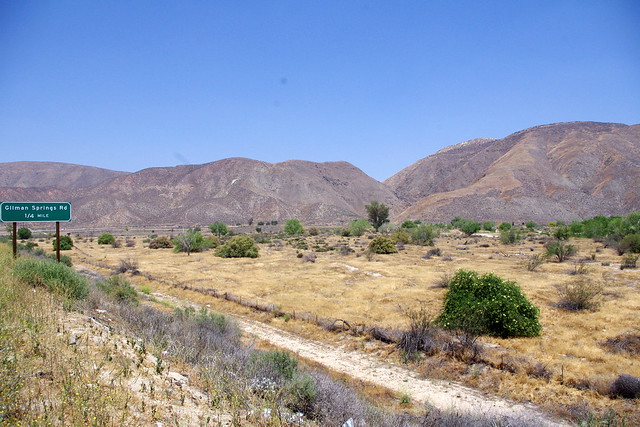
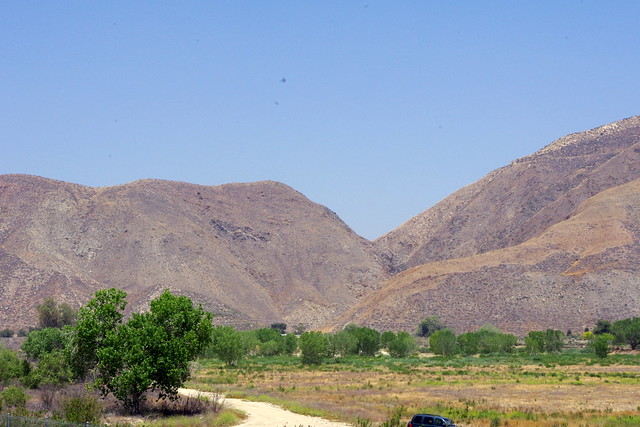
This next photo below is of a Bajada or Alluvial Fan which emerges from what I thought was once labeled as Portrero Wash or Creek at the bridge on Gilman Hot Springs Rd, but the sign is now removed. It's source is the city regions of Beaumont and Banning CA and in particular the Sun Lakes Country Club and Golf Course. As you may see from the Google Satellite map the Alluvial Fan was at one time much wider than now. It is restricted by an eastern boulder, cobblestone and sand barrier or Levee on the east which protects the Church of Scientology's Military Compound and to the western side is the raised easement of Hwy 79. During the 1983 floods a large pond or small lake was formed just directly west of where the Portreo Creek flows under Gilman Hot Springs Road below the junction of Hqy 79 & Gilamn Hot Springs Road. The water flow our of the mouth of the canyon fan our evenly and the entire alluvial fan was like a complete even flow with no visible serparate stream channeling in the beginning. This persisted all year long. What is left can be seen with several lines of stream channels which fan out at massive flood stages which are characteristic of most alluvial fans, and hence the name. It also became completely vegetated with mainly Willows and Cottonwoods and a few California Sycamores. So dense and complete that the entire Bajada or Alluvial Fan was a solid green. Here is a view of it today from Portrero Creek brdge from Gilman Hot Springs Road. Take note that only a few main large trees were fortunate enough to survive creating the spread out riparian woodland.

Image from Google Earth


Photo Credit: Mine
This photo is looking directly north on Hwy 79 leaving the Hemet/San Jacinto Valley heading north through Lamb's Canyon to it's destination at city of Beaumont. You can see the canyon at top center where the force of water over the years has created this massive Bajada. Not sure why the name of this Portrero creek in the Canyon was removed, but it once had a name on the bridge which crosses over it on Gilman Springs Rd which is actually the old original Hwy 79 before the political realignment. While this alluvial fan is fairly dry looking now, it always wasn't so, especially between the wet years of 1987 thru 1983. Take a look below at some surround city and town historical rain totals. Keep this in mind as it is important.

Image - hvrc.com
Hemet & San Jacinto Valley looking north towards the foothills of the San Bernadino Mountains. Porptrero Creek and the alluvial fan which ran all year would be over on the far right of the photo. 
Hemet California

Historical Annual Rain Totals of a wetter period

1978  -  26.60 inches
1979  -  13.47 inches
1980  -  18.86 inches
1981  -  08.29 inches
1982  -  16.90 inches
1983  -  21.03 inches


Riverside California
Historical Annual Rainfall Totals Same Period
1978  -  12.92 inches
1979  -  12.87 inches
1980  -  15.77 inches
1981  -  08.10 inches
1982  -  15.07 inches
1983  -  22.91 inches


Idyllwild Calfornia

Historical annual Rainfall same period as above

1978  -  46.99 inches
1979  -  29.62 inches
1980  -  45.65 inches
1981  -  15.81 inches
1982  -  49.47 inches
1983  -  56.87 inches
All these figures above are of the rainfall averages for the wetter "El Nino" years. That was an amazing time period of wet. Too bad the officials didn't take advantage of it to rebuild several important ecosystems.
"Flooding in the vicinity of State Street (Highway 74) and Ramona Expressway,  February 21, 1980, as a result of the breach of the San Jacinto River Levee." 
Again, keep in mind please and burn into your memory if you can, this six year heavier than normal time frame which has valuable learning potential aside from destructive forces which often are the result of human poor planning anyway.

Photo Mine

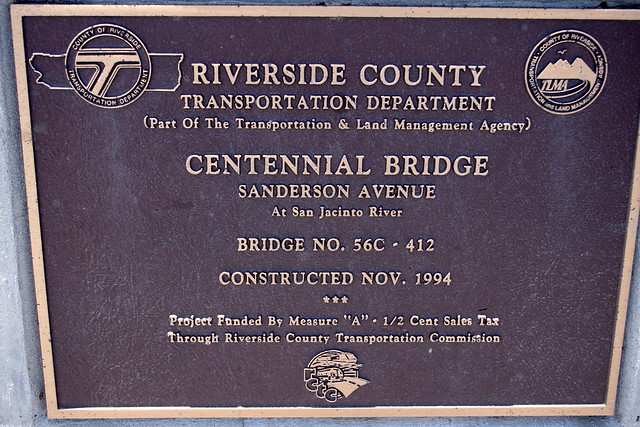
Major construction of San Jacinto River
bridge on Hwy 79 in Riverside County 1994
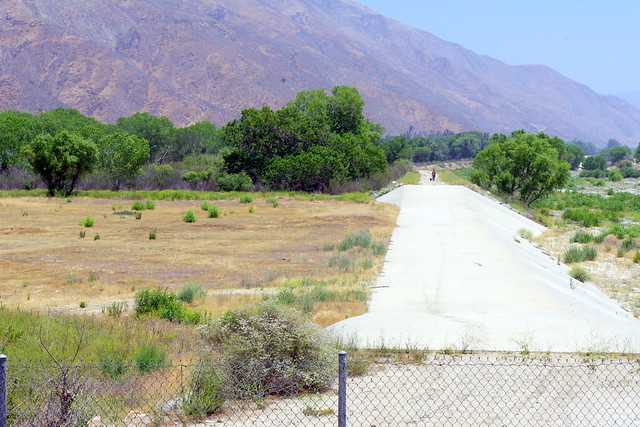
I've given some averages here of three locations which give an average perspective of the overall rainfall to western Riverside County. For those folks who remember this wetter rainy period of time, this was during a significant "El Nino" event. For many, it was the first time the term really came to life and had meaning. It was a major time of bridge washouts and road closures. As you can see, the closer to mountains and foothills, rainfall amounts are far more significant, than the interior valleys. Even still, rainfall for all of southern California everywhere was greater than in times past or for that matter ever since. Because of the greater rainfall during these six winters, ground water saturation was at it's greatest and summer monsoonal thunderstorm build up was vastly improved during this period as a result of greater electrical conductivity between the negatively charged ground and positive charged atmosphere. Previously in a couple of earlier posts, I have alluded to the anomalous weather pattern of isolated thunder storm build up in and around Anza which is incredibly easy to spot and observe during periods of less winter rainfall which creates less ground surface conductivity with the exception of specific heavy old growth vegetated areas where good healthy hydraulic lift and redistribution takes place bringing moisture up to the surface from deeper soil layers and for which cloud formation and/or Thunderstorm development is much greater as a result. During these wetter winter periods, because the ground water table is very high and saturation is so complete, such storm development was never an isolated incident. In fact it was so complete that development was common in those days from the deserts all the way to the Ortega Mountains above Lake Elsinore. Now this is where noticeable heavy vegetation increase could be observed in most alluvial fans, but I'll focus here only on the one originating from the mouth of that Portrero Creek for which the drainage came from the higher elevations of Banning and Beaumont California. There were several times when the Gilman Hot Springs Rd had closures. During this heavy rainfall period, water ran completely over the entire alluvial fan all year long in the wettest of these years. Thousands of Willows, Cottonwoods and Sycamore trees created a triangular carpet of bright green all the way to the San Jacinto River main channel to the south from the Gilman Springs Rd bridge.

Photo: Mine


This photograph is a closer view of the Portreo Creek Alluvial Fan which emerges from the mouth of that canyon straight ahead gradually fanning out all the way down to the San Jacinto River from the Hwy 79 Bridge over the San Jacinto River. Prior to this greener look above which resulted from this heavier rainfall period, there were only a couple of large Cottonwoods and a single large California Sycamore specimen for which seemed always somehow out of place to me back then because all the rest of the alluvial material was like dry desert wash, there was no riparian green as you see it presently. At the end period of theEl Niño Event, the entire alluvial fan or Bajada was a complete mass of green as 1000s and 1000s of young riparian seedlings competed for space. Water flowed over this entire area for a few years thereafter. Now as you see, natural forces of the drier hotter climate have allowed only the most successful to have made a permanent place in this newer riparian ecosystem. Again, before the rains, only a dozen large old growth California Sycamores and Fremont existed on this otherwise dry rocky almost barren Desert Bajada. This greener scenario was more like it was when Juan Bautista de Anza  journeyed through Hemet Valley and wrote about it's flora and fauna, but on a much grander scale than this example which is still greatly restricted as compared to times prior to European settlement.

photo: Mine
This is looking directly to the east on the Hwy 79 bridge looking east towards the actual town of San Jacinto and the mountains beyond which bare the same name. This concrete barrier was created when the Hwy 79 bridge over the San Jacinto River was built in 1994. Traffic was diverted east towards the city of San Jacinto via the Ramona Expressway to State Street and north across a now replaced Iron Truss Bridge to Gilman Hot Springs Rd and then back west again to Hwy 79. In those early days Hwy 79 wash nothing more than a giant flood plain wash and when flooded, closures were common.

Photo: Mine
This shot is on the complete opposite side from the one above it looking west towards a normally dry lake bed called Mystic Lake, so named because of it's often times appearance and then disappearance depending on the amount of water flowing down the San Jacinto River which drains off the San Jacinto Mountains on the eastern side of Hemet Valley. The river itself runs through Lakeview and Nuevo making it's end at Lake Elsinore which also filled completely during this flooding rainfall period between 1978 to 1983. Even Lakeview itself had numerous shallow lakes giving viewers an historical perspective of what this region was as a massive riparian wetlands for which Juan Bautista de Anza first wrote about in his journal or diary. I first encountered this diary from the Riverside County Library as it was recommended to me by a Forester up in Idyllwild in 1981. One passage Anza wrote about was when ascending Bautista Canyon from Anza Valley to the Hemet Valley. He saw a massive bright colouration on the valley floor of solid white and thought it was snow. Mind you, he and his troops had spent all winter in and around Anza before hitting Valle Vista east of Hemet in March the same year. When he arrived on the valley floor at what is now the city of San Jacinto and west to the area of Mystic Lake, he found that the white colour he saw up in the higher elevations were nothing  more than masses of wetland habitat birds of various kinds. Mostly white Snow Geese. Almost hard to believe such great quantities of wildlife once existed. 

Photo: Mine
This shot is on the same north end of the bridge looking south, not just at traffic, but down into the River bottom. The river itself is channeled as usual, but the bridge extends a mile further south above the flat bottom landscape. This is because when at full flood stage, the earthen channel levees often disintegrate and those fields south of here turn into massive shallow lakes, the type that would have supported huge vast Riparian Cottonwood and Sycamore Forest woodlands which would have successfully even withstood drier periods as the water table here has always been close to the surface. I'll have later posts on that.

Photo: Mine
View looking in the direction of the Scientology Compound and the mature Cottonwood trees well established which had not existed prior to the flooding period. 
Photo Credit: Mine
This view of the Bajada from Hwy 79 eastward is near the Jct of Hwy 79 & Gilman Springs Road. During the massive flooding stages pouring out from points north in Beaumont which has records of over 30+ inches of annual rainfall at times, the mass of water fanned out completely all across the triangular bajada like some giant river delta. Even curving around this direction here. The Trees never really sprouted much on this side away from the main channel, but those that did, didn't linger long, a few years at best and dwarfed or stunted. A small lake did form at the left of this photo, but dried up or percolated into the porous ground in little less than a year. Prior to Hwy 79, water spread out over the entire plain to the west. Such land of course has been consumed by Agricultural Ventures, so any original riparian forests would have been eliminated in favour of what seemed at the time more profitable usage of such valuable nutrient rich landscape. 

Photo Credit: Mine


Photo Credit: Mine

photo: Mine
The top photo here is taken from the Gilman Springs Rd bridge looking north up the throat of the Canyon and Portrero Creek. During the yearly rushing of water through here for a few years, cars were always parked here during the hot summer months and hikers and bathers would make their way up this canyon to pristine water holes and waterfalls. The region was leased up stream by a private country club who always had Security Guards kicking people out or arresting them. There was always controversy about this in the Press Enterprise which is the official Riverside Co newspaper. The bottom photo is of a small tree-like shrub called False Indigo Bush (Amorpha californica), which previously I personally had only seen from Santa Rosa Indian Reservation eastwards through the Santa Rosa Mountain range. The last photo is simply a close up of the compound leaf which is similar to Black & New Mexico  Locust which I have written about before. The flowers that I have seen are almost like an upright lupine flower stalk and dark purple.


Photo Credit: Mine
And finally we have a direct south facing view from the bridge over Portrero Creek on the Gilman Springs Road. It's strange as to why they removed the sign at the bridge identifying the name of the waterway, but here is a link which removes all mystery as to it's historical identity.  The only thing that I can come up with is they wanted to disguise it's identity to hikers and other Nature explorers out from a sensitive area.
http://bridgehunter.com/ca/riverside/56C0523
For the moment, this is what I have and my personal account of what physically took place at this geographical location called Portrero Creek & it's Bajada particularly during the 1980s. This was of course a major part of my work route in commuting for many years. But I did promise to discuss what lessons could be learned from this, so what are they ? Well I always had personal questions in my mind about isolated tree establishments of large solitary trees which existed on dry locations for no apparent logical reasons, especially water loving riparian tree species. Numerous areas like Waterman Canyon in San Bernardino or Cable Wash in Devore or Lytle Creek, all have similar riparian tree establishment puzzles which have clear explanations for their presence if time, observation and experience are taken into account over a period a couple decades. My good fortune was to have seen the Portrero Creek Bajada (alluvial fan) when it was at it's driest barren state and to be observant when the transformation took place especially towards the middle 1980s. 

From such observation, one can glean from such experience that not only riparian, but even several other plant community ecosystems can become establish anew when these cyclical wetter periods emerge. Although with climate change it is doubtful that such periods will reveal themselves any longer. Still, much can be learned and practical application be created artificially in an urban landscape setting, or habitat restoration project, or with simple home gardening projects. During such unique wetter periods, plants are babied and nurtured during these times of plenty, then gradually the system tapers off in it's generous abundance and allows the earlier established plants to fend for themselves. The stronger plants/trees with the deeper root systems will become the winners, while the weaker ones fail and naturally thin out as the natural program demands. I have used this technique in replication, not only in urban landscape establishment, but in remote habitat restoration and it does indeed prove successful over time. Of course for me, I always inoculate with a good blend of mycorrhizal mix at time of planting. I found myself the last week before I left to come back to Sweden in a disagreement with this inoculating at planting time with a Native Plant nursery person who said that the micro-biological activity is everywhere floating in the atmosphere and it was not necessary. Why yes, there are spores everywhere in the air. But there is also more and more damning evidence that microbiological ecosystems in the ground are suffering some decline just as everything else above the ground. Toxic acid rains and many more chemical and GMO Plant contamination are having an effect on mycorrhizae. I've actually inoculated trees in wild out-plantings and had surrounding Chaparral like Scrub Oak and other trees make drastic improvement through the interconnections, which indicates to me all is not well in the wild. As time goes on, more and more researchers will come to the conclusions that Nature alone cannot function as it normally once did and that some major artificial assistance to speed things up will become necessary. I not only do not like hearing this, but hate having to say it as well. One more important side note about Bajada Basins and Alluvial Plains. Throughout the western North America, they have been huge storage components for water. Many streams or rivers that emerge from mountain canyons will often be seen disappearing deep into the alluvial fan. This is not the result of evaporation, but the looseness of the course rock and sand which allows water to easily filter and percolate deeply into the earth inside these geological forms. The best place to store water is underground, not behind dams or any other surface lake. It's also the best place for the plant world to access water during lean times. (See footnote @ bottom)

Now as far as the urban landscape goes, most ecosystems or plant communities you install should only have surface drip irrigation for the first few years at most. I'm not exactly a fan anymore of drip irrigation both for the expense and ongoing maintenance. But irrigating the landscape for the first few years, mainly supplementing the winter rainfall by deep soaking replicates the cyclic flooding events that in times past made their appearance and created the wild landscapes centuries ago. You really only need two or three good years of heavy irrigation, then taper off. Do not keep your yard's landscape welfared on a life-support system or the plants will never mature properly on their own. 

Now unfortunately while visiting here, I also had the opportunity to observe several public and professional landscape systems installed by the Sky Ranch development utilizing Native plant settings or themes, but employing a method of irrigation that used a massive un-necessary rainbird sprinkling systems which created large surface soil coverage over vast areas which facilitated massive amounts of weeds to grow to 3 or more foot of height and often times out competing the native plants.  The goal here should have been to merely establish the plants ay the beginning with just enough regular water for root development and later as I have written about before, installing a method of Deep Irrigation Methods for Training Deeper Rooting networks  and then later updating this with IRRIGATION ISSUES: Why Isn't Nature Replicated more often ? The Deep-Pipe irrigation would only have been necessary in just a few key location for the benefit of the entire plant community and kept off a regular timer and used only when necessary. The bottom line is that people just don't get the gist of allowing plants to maintain health and vigor without forcing new growth during hotter months through excessive watering and fertilizing which not only encourages weeds, but attracts all manner of insect pests and fungal diseases and/or other blight. Go out into the wild and you don't see this. This is because they are in maintenance mode by means of sustenance from a deeper underground hydrological system which works well when properly established.
Hwy 52 and 67 Interchange @ El Cajon & Santee California
Photograph is from July 2014

A prime bad example of Government mandates is this photo above of a Cal-Trans Landscaping Project under and around the Interchange on and off ramps of Hwy 52 & Hwy 67 between El Cajon and Santee employing the wrong irrigation techniques which again employ massive Industrial Strength Rainbird arrays. But I was happy to see Native California Plants being used. The idea of using native pants was a good one, but planning and irrigation infrastructure wasn't well thought out ahead of time. Also, I highly doubt any thought to mycorrhizal inoculation of the plants and heavy mulching was done. They'll eventually kill off everything they had set out to accomplish with the Native Plants theme by their excessive watering and overhead sprinklers which only encourage weeds. This area is already overwhelm with not only the annual type weeds, but also invasive Tamarisk everywhere which will outcompete the natives. Here's a link to a post I did on reclaimed water used in municipal projects with this one abve included.
Reclaimed Water: Municipal Projects, CalTrans Landscaping & Pompous Grass Resorts

In the Rattlesnake Mountain chain far above this Freeway Interchange where the Sky Ranch Development was established, they have followed the same identical flawed pattern as that of the Cal-Trans Native Plant Landscaping Project.  We're talking Mega-Overkill with regards another industrial sized Rainbird Irrigation System which has a double daily watering regimen which has not been changed since the initial installation. The photo to the left here is on the top ridge of the development which buffers between the neighbourhood housing and the wild Conservation No Trespassing protected area. While I applaud the use of Coast Live Oak and other ornamental chaparral shrubs, there are weeds overwhelming the system everywhere, especially in the lower valley near Pepper Drive Elementary School. If they were worried about some naturalized Torrey Pines  potentialy causing brushfires and insisted they had to be chopped down to prevent that, then they have almost guaranteed wildfire by the way they have mismanaged the landscape in the conservation area which is mainly weeds.

The really sad part is when Government, which everyone assumes knows better, pulls blunders like this terrible landscape layout in the link above, then the same bad example is followed by a large major commercial Landscaping firms, what chance is there that your average home and/or land owner will ever get the message ? I'm telling you, this simple basic fundamental stuff about nature needs to be taught long before College or even High School level learning. It should be elementary School teaching.

Image - Google Earth


Now take a close look at another bad example from the mighty Sky Ranch Housing Development on top of Rattlesnake Mountain in Santee, California. While it is commendable they have established some native Coastal Live Oak trees and one other native chaparral plants, they will ruin it all if they don't change a flawed irrigation system that has existed for over 8 years now. The irrigation here is simply overkill and a huge waste of money.The only way to describe what they have done here in this infrastructure which must costs 10s of 1000s of dollars all over ths mountai from top to bottom is that the plants are all basically in a hospital situtation where everything is on life-support. What happens when you take a human off life-support ??? That's right, usually that decision is a death sentence. Same with plants where biomimicry of how nature establishes ecosystems is totally ignored and rejected in favour of Univerversity science-based recommendations.

Further Interesting Reading:
Juan Bautista de Anza National Historic Trail Historic Resource Study


So how does what we've learned about Bajada or Alluvial Fan tree establishment help us further up in elevation with regards ecosystem establishment ??? Take a look at the photo above. This is a single Foothill Pine (Pinus sabiniana) which has ventured out within the rugged landscape of Chamise and Manzanita. From a human standpoint not exactly ideal habitat. Or is it ??? Chamise and it's cousin Redshank are two of the most superior Nurse plants for pines and oaks, but you'll never hear them from the prevailing scientific orthodoxy whose opinion on Chaparral trmups everything else. Chamise is the rugged rangy shrub here on the right. The opinion of most people it they hate it because it's a greedy agreesor. This is a flat out lie.

I'll have a series of posts dealing with Juan Bautista de Anza's Journal and Natural World documentation experiences and divide them into three or four parts. They are seriously important to what nature once was and how it functioned. They were also detailed in such a way as to report on the local Natural resources which were present and potential money making Ventures for the Empires for who these expeditions were funded for in the first place. Anza's description was almost dead on accurate for the region I'll be relating to between Western Arizona all the way to Riverside California. Keep close watch. Side note on Alluvial Basin Water Storage: Arizona Geology Blog.

Aquifer depletion, Arizona alluvial and Black Mesa basins