Showing posts with label drought. Show all posts

Sunday, April 2, 2017

Observation, Reflection, Pondering, & Questions unveil how Nature really works

Medical Dictionary Definition of  Periphery
"the outward bounds of something as distinguished from its internal regions or center"
If you've been reading this blog for very long, you know I value having an open minded peripheral view of nature as opposed to the often Tunnel Vision approach many scientific researchers take. I have two examples here of different approaches to research studies and their outcomes which were based on either broad observational viewpoint or a narrow minded tunnel vision approach. I've often had numerous discussions with defenders of the industrial science business model approach to agriculture versus a biodiverse perennial plants and mycorrhizal soil system approach. The response to the observed evidence outdoors based on the reality of how nature maintains and sustains has always been met with, "Your evidence confirming an observation is evidence that your observation is wrong." Well not is so many words, but these are the very people who are religiously hung up on "evidence-based science" and "peer-review." Pure unadulterated blind faith belief in both of these states as an only means at arriving at a truth can be easily debunked by viewing the effects on Nature. Below are the  two contrasting approaches as to how science is done, with the later example being the most universally common ne practiced and the degradation of our Earth's ecosystems are evidence that the first approach should become more well funded.
Scientists follow seeds to solve ecological puzzle
Mice hammer a rare native plant by feasting on its seeds, but their spoliation is human-enabled
Credit: Molly Kuhs

"Scientists Tiffany Knight and Eleanor Pardini in restored dune habitat at the Point Reyes National Seashore in Marin County, California. Plants native to the area, such as the Tidestrom's lupines that surround them, are adapted to stiff winds, dune blowouts and winter storms at sea."

Credit: Eleanor Pardini
Up in Marin County in northern California at the Abbotts Lagoon in Point Reyes National Seashore, there is a sand dune ecosystem where a rare low growing spreading flower called, Tidestrom's Lupine (native), is being eaten from existence a, Deer Mouse Peromyscus maniculatus (also native), but which also prefers the seeds of another more common larger Lupine called, Chamisso Bush Lupine (again also native). The basic dilemma here was that there was a decline in the rare Lupine populations around these sand dunes. The situation was so dire that realistically it was thought they would go extinct. The mouse was eating both types of Lupine seeds and even preferred the larger more common Bush Lupine seeds, but the smaller low growing Lupine was still the one that was declining. But they eventually determined that Humans were in actuality the enablers of the imbalance that had taken place between various NATIVE components of the ecosystem. That was the interesting part. Incredibly, this was not one of those textbook cases of some foreign exotic plant or animal wreaking havoc on some California ecosystem. True, a European Beachgrass was utilized in an attempt to stabilize the sand dune, but they could well have chosen any native California bunch grass with the same imbalanced result. These were native organisms out of balance struggling within a familiar ecosystem for which as the researchers explained, "the spoliation was human enabled." One native California organism pitted against another. What I love most about this article were the well thought out questions that drove the researchers which the author published at the beginning:

"What bothers a plant? Why are some plants rare while others are common? Are the rare plants simply adapted to rare habitat or are they losing the competition for habitat? Are their populations small but stable, or are they dwindling?   
And how can scientists usefully frame these questions when there are so many possible variables? 
One way is to compare related — or congeneric — species that have many traits in common but also differ in some ways. This clears out enough underbrush that carefully designed experiments can provide answers."
Washington State University St Louis: Scientists follow seeds to solve ecological puzzle

Credit: Eleanor Pardini

"The common Chamisso bush lupine holds its seed pods above the ground or hides them in the middle of its shrubbery. This lupine’s architecture makes its seeds less vulnerable to predation while they remain on the plant."

Credit: Steve Kroiss
This little native Deer Mouse at right was at first glance the trouble maker. In the old days the rule of thumb from the Scientific Orthodoxy would be to recommend without question a science-based synthetic pesticide to eradicate the Mouse. Problem solved! But was this little mouse really at fault ? Nature is loaded with all manner of living things which do not think, reason and scheme like humans. They are however incredibly sophisticated complex biological machines being run and directed by an informational communications network (DNA) & complex sensory system which responds to environmental cues. The researchers found that some time back a human decision was made by the Park Service to prevent dune erosion by planting a type of beachgrass. Apparently there were a combination of domino effects that went negative. It would seem the beachgrass provided safe haven for the little Deer Mouse who felt safe and embolden to venture out and eat the seeds of the rare Tidestrom's Lupine. But two years into the study the Park Service then removed the beachgrass to save another bird's (Plover) nesting site. Here is a description of what happened next:
The removal of beachgrass has already taken the pressure off the rare lupine. There are two reasons for this, Pardini said. One is that Tidestrom’s lupine is adapted to a disturbed habitat and needs wind and dune blowouts to thrive. The second is that with the beachgrass gone, mice have to take bigger risks to take lupine seeds.   
“Tidestrom’s lupine is popping up like crazy in the restored areas,” Pardini said. “The seed germination rate is very high, survival rate is extremely high, it’s reaching high densities in the restored zones, the plants are huge and they’re extremely fertile.”
(Read the entire Article HERE)
You can read the rest of the entire article on your own. It's loaded with lots of interesting reading. But now lets take another look at the second approach to research which at the beginning on the surface appears to be a faster way to shortcuts, but in reality holds back valuable strides forward. Especially when urgency is the motivating factor.

Fighting World Hunger: Robotics Aid in the Study of Corn and Drought Tolerance
Credit: Gui DeSouza

Credit: Gui DeSouza
This next study is an old one. This ongoing insistence that only biotechs can find the answers to drought resistence in preparation for future climate change. But in this case it takes an unnecessary course of direction. The attempt here is to get a little too cute with electronics. Robotics right now is a hot topic and all industries are looking at them to save time and money. The article and video they provide starts out justifying the research by the all too common cache phrase, "In the fight against world hunger . . "  They then continue on with numbers and stats along with a dire prophetic warning of time running out. 
"Developing drought tolerant corn that makes efficient use of available water will be vital to sustain the estimated 9 billion global population by 2050."

So the message here is that developing drought resistent corn crop varieties can only be accomplished with robotics facilitated by a $20 million grant and hopefully something positive will just happen by 2050 to save the world from hunger ? By contrast most of the early mycorrhizal research decades ago was done outdoors in a natural environmental setting. Being outdoors provided Mycologists and other researchers to observe the reality of how nature really works. Scientists (Mycologists) watched, observed, pondered and formulated numerous questions not just on the fungi alone, but their interaction with every other living thing around them. What has always beens a puzzle to me is why the mycorrhizal soil management systems approach has never been as well funded as the industrial science approach to bland boring monocultures ? But that's not really what industrial science is all about. Their goals are entirely different from tradtional study and research, take a look at a quote mentioned in the video at time spot 1:08:
"We're trying to automate as much as we can. We're trying to install networking so we can do everything from the Lab -- we can remotely log into the devices, collect images, download the image and all that so that we don't have to go to the field as much."
University of Missouri: Fighting World Hunger: Robotics Aid in the Study of Corn and Drought Tolerance
Image - Mycorrhizal Applications Inc

The industrial approach is all about what they imagine to be shortcuts provided by this robot which might mean greater returns on investment. The study on the mouse vrs the Lupine had no such monetary funding or future $$$ ambitions to motivate those researchers involved. But seriously, Robots to identify heat stress in plants ??? Question: Does the average farmer really need a robot to tell them which corn plants are stressed and which ones are doing fine ? Look at the pic above. All this continual talk of Biotech research work going into finding that right drought resistence gene has always been a complete waste of time. There has been for 1000s of countless years a tool Nature has always had available for dealing with drought resistence in plants. That would be the various varieties of mycorrhizal fungi who have a vested interest in the health and welfare of their hosts. So why the high techie robots ? Yes, in these modern times, fungi are probably not as sexy and sophisticated as modern technological advancements like robots, but their function as mutualistic partners with crop plants is far superior to anything biotech scientists or robotics engineers could ever do to problem solve quick solutions just around the corner, let alone a decade or two away. Our planet Earth doesn't have a decade or two. Pursuit of a mycorrhizal approach is in reality the real shortcut. The biggest roadblock is that a genetically modified seed comes with a lot of required aftermarket baggage ($£€) like a plethora of synthetic fertilizer inputs, herbicides, insecticides, fungicides, miticides, etc which do nothing more than provide the promise of obscene profit for a handful of giant chemical corporate entites. Now to be completely fair here, I'm sure this Associate Professor, Gui DeSouza, and his intelligent engineers are conscientious people and know their electronic gadegtry stuff very well. But modern Science's biggest problem is wanting to do almost everything inside of some Laboratory. Much of today's Science left the outdoors decades ago. That's not to say that there are no scientists today who no longer practice outdoor research, because many still do. The researchers at the Dune site proved this to be true. But I highly doubt any of these industrially motivated guys have much understanding of underground soil mycorrhizal networks and their relationship with any plant let alone crop plants. 


The direction the prevailing industrial Scientific Orthodoxy is to white wash the bad news to the public by their propagandizing which is almost identical to the words of warning by Patrick Henry who himself was quoting from a biblical text of (Ezekiel 13:10) where false prophets were suckering the common people into believe the coming dire situation was really not all that bad. Our present dire reality is that this world doesn't have until 2050 to find solutions. There's no luxury of time to piddle around, beg for funding for pet projects and problem solve for profit. Ecosystems are deteriorating faster than ever before and have been for some decades. The picture I often use above from the University of Florida and Mycorrhizal Applications Inc testing the product MycoApply with multiple blend of fungi species points a glaring spotlight on how this drought & heat stress resistence can be dealt with in one season on many corn (& other crop) varieties that they already know will grow well in hot climates. It also exposes what a real propaganda sham this biotech search for that illusive mysterious drought resistent gene really is about. If their goal really was about feeding the world & food security, the mycorrhizal approach would be snapped up instantly. What this is really all about, is Industrial Agriculture in bed with Industrial Science trying desperately to keep a status quo monopoly on agribusiness. As that is the case, they are stubbornly committed to a tunnel vision industrial answer approach and not any peripheral view of anything outside of their narrow minded small inner circle of elitest ideas. 

Speaking of Sand Dunes

The beauty of the animal, plant & bird dilemma at the Sand Dune Project was that these researchers did spend quite a bit of time outdoors for four years. They also came up with not only great questions one after another based on observations, but also created some beautiful terminology along the way to illustrate and expose the multiple ways humans have managed to screw up the environment even without introducing any invasive exotic non-native species of plants, birds or animals. Expressions like, "subsidized native predators" & "spoliation is human enabled," which fits nicely with Martin Luther King Jr's, "sincere ignorance" & "conscientious stupidity." Take a look at their final thoughts in the Dune/Beachgrass/Mouse/Lupine research:
A Final Twist
"A final twist Ironically, the beachgrass was removed not to help the rare lupine but rather to help the endangered western snowy plover (Charadrius alexandrinus nivosus). Just as the lupine lost germination sites to the grass, the plover lost nesting habitat.   
And both the lupine and the plover suffered from subsidized native predators. In the case of the lupine, the predator is the deer mouse; in the case of the plover, it is the common raven (Corvus corax),   
“Corvid populations have been exploding worldwide since the 1970s,” Pardini said. “You can see it in the Christmas birdcount data. One reason is that they feast on the refuse people provide.   
“So the emerging story about human intervention and the ravens is analogous to the one about the grass and the mice,” she added. In both cases, people are subsidizing a species that is upsetting the balance that once existed between other species: on one hand two lupines, in the other two birds.
The summary sheds light on so many things. Humans have not only subsidized various forms of invasive species which have brought about environmental ruin to many areas of our Earth, but they've also somehow managed to pit one native organism against another unintentionally. Previously most all native things have lived in almost perfect balance for 1000s of years. Suddenly, a form of new freedom promising scientific enlightenment bulls it's way onto the world scene 150+ years ago and we find ourselves as an actual slave to it's death dealing consequences. The beauty of the Lupine/Mouse study on those Northern California sand dunes illustrates how humans can truly unmask and expose the cause and over a long period of time use the powers of observation within peripheral viewpoint of an entire environment, inspire numerous thought provoking questions and come up with a nonsynthetic pesticidal solution for creating back the natural balance again. Giant corporations are easy big targets to blame because of their extraordinary size for expossure. But what really frightens me are all those small to medium size property owners out there who still buy into the rat poison advertisement indoctrination as a first option in arriving at problem correction. Take a rural drive almost anywhere and look how the average property owning citizen lacks the understanding in taking a natural balanced approach to maintaining the ecology of their land. This is the kind of approach that should be easily taught in elementary school through high school (secondary school) long before a student gets to college. Just think of all the unnecessary baggage they wouldn't be lugging with them when they finally do go to a University ? 😵


Dr. Eleanor Pardini's Research Blog


Thursday, February 16, 2017

Heavy Winter precipitation in the Western United States is apparently meaningless

Is the California drought finally over ??? Incessant rainfall and snowfall leads to terrific flooding in the Golden State as thousands of homes are evacuated 
Image from The Daily Mail
But officials also warned that though the rain has eased conditions, the drought isn't completely over

The average person falls for the big Media bluff that all is well when weather conditions take an apparent turn about from the long hard drought. Especially when it's an extreme turn of events like the massive snowfalls and rain flooding events presently hitting California and other western regions. In the back of people's minds they are telling themselves things are back to the good ol'days. But now after Californian's have been praying for rain for five years, now they are praying for a break in the rainfall. Perhaps they may believe what the UC Merced Hydrologist Roger C. Bales theorized was correct after all. Get rid of all those greedy water sucking trees and streamflows will rise. Less trees gulping water means fuller streams. Not so fast. Most of that so-called science about removal and thinning of Sierra Nevada Forest trees was more of a public relations stunt funded and backed by the giant Timber Industry and down stream Industrial Agriculture business interests which has a love affair with massive flood irrigation methodology. The imaginary myth was theorized that less forest trees gulping down water would translate more water in streams and rivers filling up reservoirs. While I looked for research on any type of documentation of millions of dead trees actually proving this reverse phenomena to be true a couple years ago, I hadn't found any until now. Apparently the research had been there a little over a year ago, but got very little success in attracting Media attention. Not as sexy as Roger Bales and Michael Goulden's theories I guess.
Recent tree die-offs have had little effect on streamflow in contrast to expected increases from hydrological studies
Images from Nature.com

Clockwise from top left the photos are Spain, Colorado, New Mexico and Argentina.


We've all read the stories and seen all the horrific  photographs of what Mountain pine beetles have done to the western forests over the past decade due to hotter temperatures and drier summers. These bark beetles have infested and killed  thousands of acres of not only western pine forests, but other forests around the globe are now also in trouble as well. Researchers like Roger C. Bales (UC Merced) and Michael L. Merced (UC Irvine) have previously predicted that as trees died or were mechanically removed by logging and thinning, streamflows would increase because fewer trees would be greedily gulping up water through their roots and transpiring it up into the atmosphere. In the imaginations of the Hydrology boys, less trees equate more water runoff for agriculture down in California's Central & San Joaquin Valleys. Back in December 2015, a study by  the University of Utah geology and geophysics professor Paul Brooks and his colleagues in Arizona, Colorado and Idaho, found that if too many trees die, then compensatory processes would kick in and might actually reduce water availability. This is the exact opposite of what Bales and Goulden speculated would happen. But what Brooks and others discovered is that when large areas of trees dieoff, the forest floor becomes sunnier, warmer and windier, which causes winter snow and summer rain to evaporate rather than slowly recharging groundwater. In fact in describing what happens with the snow which usually melts and slowly percolates into the ground, what actually happened was a phenomena called "sublimation." This process of sublimation is where snow and ice change into water vapor in the air without first melting into water. The opposite of sublimation would be "deposition", where water vapor changes directly into ice (such a snowflakes and frost). So what happens with much of that heavy snow we've seen in recent photos does not all melt and infiltrate into the subsoil layers, but rather a good percentage of the snow evaporates up into the drier warmer atmosphere. What is interesting is that the regions studied were much of the high elevation headwaters areas for the Colorado River which fill down stream reservoirs like Lake Powell and Lake Mead which have been experiencing rapidly falling water levels. This effects water potential for Arizona and Southern California.
Abstract:
"Recent bark beetle epidemics have caused regional-scale tree mortality in many snowmelt-dominated headwater catchments of western North America. Initial expectations of increased streamflow have not been supported by observations, and the basin-scale response of annual streamflow is largely unknown. Here we quantified annual streamflow responses during the decade following tree die-off in eight infested catchments in the Colorado River headwaters and one nearby control catchment. We employed three alternative empirical methods: (i) double-mass comparison between impacted and control catchments, (ii) runoff ratio comparison before and after die-off, and (iii) time-trend analysis using climate-driven linear models. In contrast to streamflow increases predicted by historical paired catchment studies and recent modeling, we did not detect streamflow changes in most basins following die-off, while one basin consistently showed decreased streamflow. The three analysis methods produced generally consistent results, with time-trend analysis showing precipitation was the strongest predictor of streamflow variability (R2 = 74–96%). Time-trend analysis revealed post-die-off streamflow decreased in three catchments by 11–29%, with no change in the other five catchments. Although counter to initial expectations, these results are consistent with increased transpiration by surviving vegetation and the growing body of literature documenting increased snow sublimation and evaporation from the subcanopy following die-off in water-limited, snow-dominated forests. The observations presented here challenge the widespread expectation that streamflow will increase following beetle-induced forest die-off and highlight the need to better understand the processes driving hydrologic response to forest disturbance."
(Source)
Tree mortality is increasing worldwide which also includes Canada
Image - Natural Resources Canada
Tree mortality is increasing worldwide including Canada
"Tree mortality will likely increase in areas where extreme weather events become more frequent. Climate change projections indicate that in some parts of Canada, droughts and other extreme events are expected to become more frequent in the future. These changes could trigger increases in tree mortality and episodes of forest decline in affected areas, posing challenges for forest management and the long-term supply of forest resources and services, including carbon balance."
So just how well are all these forests regenerating on their own without mankind's help and interference ??? Despite Environmental Activist insistence that this is the only way Nature can heal, in almost all cases the natural world is failing!
Image - University of Colorado Boulder

Researcher Monica Rother at the site of the 2000 Walker Ranch fire in Boulder County.
Eighty percent of plots surveyed there contained no new trees.
The studies and observations by the researchers from the University of Colorado Boulder exposes the bleak reality. It makes sense though. Trees under extremely high stress from drought, pine beetle attacks and catastrophic wildfire events will dump most of what's left of their energy resources into defensesive strategies (Survival) and very little towards offensive strategies (seed production). Here are a few excerpts from the report:
“It is alarming, but we were not surprised by the results given what you see when you hike through these areas,” said Rother, who earned her doctorate from CU Boulder in 2015 and works as a fire ecologist at Tall Timbers Research Station in Tallahassee, Florida. 
Among the most barren sites were those of the 2000 Walker Ranch fire in Boulder County and the 2000 Bobcat Gulch fire in Larimer County, where approximately 80 percent of plots surveyed contained no new young trees.  
“This should be a wake-up call, that under the warming trends associated with human-caused climate change, significant shifts in forest extent and vegetation types are already occurring,” said Veblen. “We are seeing the initiation of a retreat of forests to higher elevations.”  
Previous research has suggested that hotter, more severe fires make it harder for the forest to bounce back by killing mature trees and reducing seed stock. But the study found that even after lower-intensity fires, presumed to have had less effect on mature trees and seed stock, seedlings were still scarce. Hotter, drier areas at lower elevations or on south-facing slopes had the fewest seedlings.  
“Fire severity is definitely relevant, but climate appeared to play the greatest role,” in limiting forest recovery, said Rother.  
“I don’t want to present this as being entirely negative,” said Veblen. “For me, the negative aspect is what it indicates about the future.”
(Source)
So the main thrust of the message from this report is that it now seems that Nature is no longer able to restore itself in many areas. Humans have done so much extensive damage that it is also necessary for them to actually intervene and mechanical help Nature. The protesting and politically motivated wilderness designation or Nation Park status will never work. Unfortunately most people (& this includes Scientists) do not have the full understanding of how the natural world functions and operates. Much of our understanding and progress has been held back and stuck in neutral because of of silly ideologically driven worldview as mandated by this world's Scientific Orthodoxy which controls the prevailing scientific thought which has infected all Academia. Way too much time and energy has been spent by Academia and environmental organizations on religious concepts such as (Argument from Poor Design) to battle against what they call religious fundies. The argument basically trashes numerous components of our planet's natural world as being flawed, imperfect and badly designed. The argument then promotes the lame idea that this is proof there is no creator because an intelligent designer would never have created or engineered things in such & such a way. Hence, instead of creating technological innovations which apply biomimicry or biomimetics (replicating natural designs when it comes to technological innovation by observing designs found in Nature), our world's intellectuals have instead pursued innovation based on flawed human reasoning and understanding. This is what has brought us much of the genetic engineering in agriculture and a plethora of dangerous toxic synthetic chemicals to deal with the imbalance in pest invasion that humans ultimately caused in the first place. Nature have never worked that way and nature has kept balance for countless 1000s of years without human interference. Suddenly now there are some Biomimicry organizations who are on board with replicating natural designs, but they have to first undo deprogram all the people who have been fed the prevailing secular koolaid and then re-educate people as to how nature really works. This is not so much a slam against the worldview obsessed as it is a wake up or shake up call for people everywhere, irrespective of your belief system, that nature no matter how one believes if origined, has never been flawed, imperfect or badly designed. This is where flawed thinking brought California the inept theory of tree removal bringing us more water. Do you see how this has now backfired ??? Here is another example of how Forest ecosystem failure and collapse needs human intervention from India:
In order to restore tropical rainforests, it is not enough to simply set up protected areas and leave them to their own devices. In particular, tree species with large fruit and seeds distributed by birds will have to be actively planted. This is one of the conclusions of a large-scale study by scientists from ETH Zurich in the Western Ghats, the mountain range running along the western coast of India. 
“For rainforest restoration projects to be successful, you have to give special attention to these trees,” says Kettle. “If you want to encourage them to spread, the only option is to collect their seeds, set up tree nurseries and then actively plant out the saplings at a later stage.”
(Source)

Nature is becoming less resilient and no longer able to sustain itself as it has done for countless 1000s of years. One disappointing thing about the study of dead trees not increasing stream flows was the silence on the phenomena known as "hydrological descent" in which living trees (also shrubs), even when dormant, which pump excess surface water during the rainy season down into deeper layers of the subsoil layers helping to recharge the water table aquafirs. That should have been included in this study and it wasn't. Can you imagine what low percentage of this California rainy season's (2016-2017) precipitation has actually percolated into the California landscape and how much has blown out back into the Pacific Ocean through massive flooding runoff ? After years of drought a lot of bare ground will almost fossilize to where the soils pores will close up tightly and the phenomena of capiliraary action needs time to heal properly. The state of California has no infrastructure in place to funnel massive amounts of this excess freshwater back towards the interior desert riparian habitats. Think of aquatic environments like Mono Lake, Owens Lake and further south the Salton Sea which already has a major ecological water problem. Or how about any of the other maze of dry lake beds throughout the Mojave Desert. Could such filling of these large natural basins have a moderating effect on the state's regional, if not statewide climate and weather ? Not to mention benefits to wildlife ? According to all of the above studies we just briefly touched on, humans are going to have to actually intervene now and make the necessary corrections. Instead of dumping money and manpower into ineffective angry protest and destructive civil disobedience, people need to go beyomd clicking "LIKE" on a Facebook page article about environment and physically get out doors and start restoring ecosystems based on natural design which was never ever flawed. However, how well historically has that been working out for us ??? 
Can collective groups among mankind  really work together to reverse these trends we've just read about ???


We all know how well it turned out for Humpty Dumpty. All the King's horses and all the King's men were unqualified and ill equipped to fix anything back together again. Governments, Business Leaders, Scientists & Religious leaders likewise do not have the answers nor the management skills we need for a real world viable solution either. The common people around the world are taking to the streets in a last desperate resort in protest and they too are likewise ill equipped to put anything back together again. The people protesting are often not exactly sure of what they are protesting about when interviewed by some in the media. It doesn't matter what they are protesting, or what message is on their signs because they are usually are nothing more than hollow slogans. And this is taking place most everywhere globally. Fixing and correcting things takes real cooperation and working peacefully together. That's not how this world we're all forced to live in works presently. Even today's angry environmental movements seem to have no answers other than protesting something or someone they hate. They never really offer any viable alternatives other than kicking other people off a piece of some sacred real estate and saying, "Nature will just find a way" to heal itself. In the studies above that will not happen. Each and every day, Salman Rushdie's word in that CNN interview ring true:


"Classically, we have defined ourselves by the things we love. By the place which is our home, by our family, by our friends. But in this age we're asked to define ourselves by hate. That what defines you is what pisses you off. And if nothing pisses you off, who are you?" 
Salman Rushdie
There really are some decent organizations out there that actually go beyond hate motivated protesting. They also demonstrate how energy is better spent educating the public in following natural design and in participating in hands on habitat restoration work. One of the main organizations that comes to my mind is the group, (Back to Natives Restoration) who actually provide a valuable service to local urban communities and in education work to the public. Same can be said for other native plant nurseries like (Las Pilitas Native Plant Nursery) and (Tree of Life Native Plant Nursery) who offer not only healthy viable native plants, but also extensive educational programs to help enlighten their customers and general public as to how nature really works and replicating installation and care with less water and no industrially manufactured science-based synthetic (fertilizers & pesticides) chemicals. All these organizations are strictly founded and identify themselves based on something they truly love, not something they hate or what pisses them off.
In Conclussion
At the very least we know where things really stand concerning our Earth's environment when the media attempts to paint a rosy picture of things not being all that bad as we first thought. It's worse folks. We also now know for a certainty that all those Politically motivated and Industrial Business interest funded hydrological studies conducted at several California Universities were dead wrong from the start. In fact their flawed schemes were never close to the truth, but many of us already knew that.


Sunday, May 19, 2013

Climate Shift May effect Monsoon Season in the Southwest

Shift from traditional July/August to a later September/October Monsoonal Summer Weather pattern.
Image Credit - US Forest Service
QUOTE:
"A delayed monsoon could affect growth of grasslands and other vegetation in the southwestern US and northwestern Mexico. One of my most favourite times to pay a visit to Arizona was always sometime in July/August. The reason is because after the first summer rains, everything comes to life and turns vibrant green. Especially the Bunch Grass Savannas which are normally dry." 
 "A delay in the summer monsoon rains that fall over the southwestern United States and northwestern Mexico is expected in the coming decades according to a new study in the Journal of Geophysical Research. The North American monsoon delivers as much as 70 percent of the region's annual rainfall, watering crops and rangelands for an estimated 20 million people."
Source: Earth Institute:"Study Predicts Lag in Summer Rains Over Parts of U.S. and Mexico"
Sonoran Desert Image - Jeremy Weiss
 
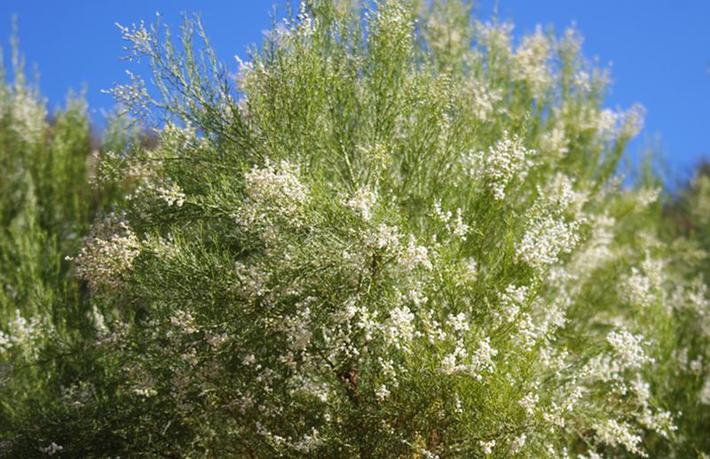
A delayed monsoon could effect vegetation across the Sonoran desert, including Saguaro Cacti. Personally I'm curious about such a delayed effect on Southern California's chaparral plant species like Redshank/Ribbonwood  (Adenostoma sparsifolium) which bloom in the traditional time of the summer season in August after the start of the Monsoon in July. 
Rich Spring and early Summer green before the onset of the summer monsoon rains the Southern California Mountains.
Credit: Bert Wilson - http://www.laspilitas.com

Redshank chaparral in bloom just after the summer monsoons hit the southwest. This time of year with the monsoons the air is filled with the sweetest and spiciest aroma you can imagine. Redshank is predominantly responsible for this. Redshank gives off these Aerosols (VOCs) which are also responsible for cloud formation in which water molecules utilize aerosol particals for a nuclei droplet formation (billions upon billions of which make our clouds), along with other trees like Oaks and other Chaparral plants which manufacture other isoprenes, terpenes and monoprenes. All these plant as well are deeply ground into the earth and provide the release into the air under just the right atmospheric conditions negative ions which also contribute to weather creation.

Image by Arleen Webster

Last week I drove up Burnt Valley Road to my old place. I should have taken a photo of the thick dense healthy Redshank. This valley driving up has one of the richest in green colour of  Redshank elsewhere. It is almost pure Redshank or Ribbonwood stands. What was sad is that more and more property owners have moved in and have removed massive quantities on their land. I often wonder why people move to an area they beautiful, only to destroy it. Most new and old Anza residents continue to bring up exotic nonnative plant species to this high desert/mountain area and most all look terrible. Very few things succeed in these areas, including some people. 
This is what the hills will be as far as colour when the flower blooms are dried to a rusty red colour. This will most often be in September/October. One does wonder how all of this will change when and if the monsoonal moisture is actually delayed as Researcher insist.
Sadly, it is a bit scary how all of this might change if global weather patterns disrupt such a wonderful southwestern localized phenomena.
Further Reading of Interest:
University of Arizona: "Monsoon failure key to long droughts in Southwest"