File Under: "Peer-Review" - "Settled Science" - "Science-Based" & that holiest of holies - "Scientific Consensus"
 |
| Image: greekboston.com |

The ancient Greek god Zeus (Roman god: Jupiter) was the incomparable, supposedly the first of the all the other gods and an exceptionally formidable figure of the Olympians. The name Zeus signifies “splendid” or “sky.” Often alluded to as the sky god who controlled lightning (regularly utilizing it as a weapon) and thunder. For years scientists have called the unexplained phenomena of Lightning and Thunderstorms triggering the abundant appearance of truffles after such rainfall events as nothing more than ancient myths or fables propagated by the both Greek and Roman philosophers. In the middle east the Bedouin peoples have for centuries collected the white Desert Truffles after thunderstorms and same with many nomadic peoples of Africa who collect the Kalahari Truffle which colonizes a shrub of the Rock Rose family after thunderstorms. So there is indeed evidence from many historical eras and cultures from around the globe, but as usual our modern world's intellectuals view such accounts as nothing more than anecdotal evidence. So what is anecdotal evidence ? Anecdotal evidence is a term they apply to a story account which regard as unreliable or hearsay. Where there may be only one or a few anecdotes presented in the story, it is then assumed that there is a large chance that the narrative may be unreliable due to biased cherry-picked observations. I've always found the expression, "anecdotal evidence" to be used by intellectuals when they find themselves incapable of explaining any mysterious phenomena. It's yet another sort of default answer taken from their debate toolbox. In other words in their small Hypothesis Myopia worldview, if a well known respected scientist has researched and written a paper about it, and if this paper has not been "peer-reviewed", and if it has not been published in a respected "science-based" journal, and only if it has been accepted by a "scientific consensus", only then should anyone consider it "settled science." Well, I beg to differ and in my 3 decades of experiencing I always counted on this amazing this phenomena when going out to collect such mycorrhizal truffles which was always fruitful after such monsoonal rainfall events in the summer. And I might add in the same exact locations year after year for a couple of decades. But this doesn't mean that both Greeks and Romans were wrong about what they saw either, just perhaps in the way they went about in explaining the reasons behind what they saw would be odd. I mean, viewing a thunderstorm as a war between gods throwing lightning bolts at each other isn't really scientific is it ? Here is what writer, Anna McHugh of the website, "Crazy About Mushrooms", had to say about those Greek & Roman stories.
"According to some Greek authors, this great god Zeus hurled “mushroom seed” to earth on lightning bolts, which explained the sudden appearance of fruiting fungi after storms. The Romans similarly assumed that mushrooms and thunderstorms were inexplicably linked, and most Roman-era writers who attempted to explain mushroom biology noted that thunderstorms were critically important in the life cycle of fungi. As history informs us, the Roman Empire followed that of the fractionalized Greek world power. As with so many other things, the Romans also looked to the Greeks for an understanding of fungi (truffles), and Roman literature related to mushrooms leans heavily on Aristotle’s Natural Histories, which classified mushrooms as plants with invisible seeds. Other Greek writers called mushrooms “sons of the gods,” because they appeared mysteriously in the wake of thunderstorms and caused much puzzlement to the curious and clever Greek thinkers of the 4th and 3rd centuries BCE.
(Source)
Interestingly, another individual by the name of Robert Gordon Wasson (1898-1986), an Ethnomycologist [I didn't even know there was such a thing], wrote this about some written historical accounts of thunderstorms being associated with mushrooms.
"Lightningbolt and Mushroom"
"The inquirer who turns to Littre to learn about truffles, on reading the entry under truffe, comes upon a nugget of curious information that certainly fails to catch his attention. It seems in certain regions of France (presumably there where truffles abound) the country folk in thundery weather are wont to say, Voild un ban temps pour les truffes, 'What fine weather it is for truffles!' Why in thun- dery weather? Not when it rains, mind you, but when it thunders. Nothing in Littre alerts the reader to the mystery that here lies hidden. The saying of these French rustics seems to be one of the surviving traces in Europe of a belief that reaches back in time deep into prehistory and in space wherever Eurasians or their descendants have lived. It is the end of Ariadne's thread that we propose to follow far and to a far-reaching end."
"Pliny the Elder declared that truffles were disposed to grow in the time of autumnal rains, and above all (in the full-bodied Elizabethan translation of Philemon Holland) 'if the aire be troubled and disquieted with many thunders: during that season there will be good store of such Mushromes, &ic, especially (I say) if it thunder much':
'De tuberibus haec tradwitur peculiariter: Cumfuerint imbres autumnales, ac tonitrua crebra, tune nasci, & maxime e tonitribus.' [Hist. Nat., bk 19:37]
When Philemon Holland around 1600 rendered tuberibus, 'truffles', by 'mush- romes', the word 'truffle' and the plant it represents were as yet unknown to the English-speaking world. Juvenal wrote of the longed-for thunder in springtime [sic] that replenishes the table with truffles:
'Post hunc tradentur tubera, si ver tune erit et facient optata tonitrua cenas maiores.' [Satire V: 116-118]
~~~~~~~~~~~~~~~~~~~~~~~~~~~~~~~~~~~~~~~~~
Possible Explanation for what may be happening by Tom Volk

Tom Volk, Professor of Biology at the University of Wisconsin - La Crosse, had an excellent scientific explanation for why he believes storms with lightning and thunder trigger the growth of mycorrhizal truffles. His explanation came from another page on his website where the subject titled: "Terfezia and Tirmania, Desert Truffles (terfez, kama, p/faqa) Delicacies in the sand or manna from Heaven?" In this article he mentions the associations between a couple of ecto-mycorrhizal species with plants of various the Rock Rose desert or Mediterranean shrubs (family Cistaceae). He stated that this may also provide an explanation for folklore shared by Bedouins in the Israeli Negev and truffle hunters in Morocco, claiming that truffles will grow where lightning strikes during thunderstorms. So it was nice that he mentioned the folklore of Bedouins who for centuries may have been eye witnesses to this intriguing phenomena as well as African Bush peoples and Australia's Aboriginals, but here he provides a possible explanation as quoted below:
A possible explanation by Lightning triggering Truffles

"Absorption of nitrates by the plant is enhanced considerably by the truffle, because the truffle’s mycelia and ascocarps reduce nitrate at a much higher rate than the rootlets of the plant alone. This is believed to play an important role in the release of spores. It may also provide at least a partial explanation for the persistent observation made by desert truffle collectors that strong lightning during rainy thunderstorms in fall will bring out the truffles in large quantities during the spring. Nitrogen is an abundant element. About 80% of the air is nitrogen. Inorganic nitrogen may exist in the free state as nitrite (NO2-), nitrate (NO3-), or ammonia (NH3+). It can also exist in the free state as a gas (N2). During a rainstorm accompanied by lightning, a very high electrical potential is discharged instantaneously, and nitrogen can be dissociated to nitrogen atoms or nitrogen free radicals. The atoms and free radicals can form nitrogen compounds with water molecules, which include hydrogen, oxygen, and nitrogen atoms. These compounds are water soluble and are dissolved in the water drops surrounding them, which in turn carry them down to the ground. The hydrogen-nitrogen-oxygen compounds have ionic nature, and can easily form potassium salt, natrium salt, and other cationic metal salts once they hit the ground where these metal cations selling truffles in the open market. photo courtesy of M.M. Mirrehare available. Some of these nitrogen-hydrogen-oxygen metal salts are effective fertilizers. Those could be present in much higher concentrations in the soil after massive lightning and thunder rainstorms have occurred. It is known that fungi require nitrogen compounds in order to initiate fruiting. Maybe the persistent claim made by many local collectors that truffles abound in the areas hit by strong lightning and thunder rainstorms, has a scientific base. The Bedouins of the Negev even call desert truffles ‘the thunder fungus’."
(Source)
~~~~~~~~~~~~~~~~~~~~~~~~~~~~~~~~~~~~~~~~~
Tom Volk's - "Dog Turd Fungus"
 |
| Image: Tom Volk |
I can hear you thinking, "This is the most beautiful Fungus of the Month ever...." Well maybe not, but this month's fungus is useful and appealing in many other ways. I can still remember the first time I saw this fungus in nature. I was on one of the Alexander H. Smith Lake States Forays in the early 1990's (way back in the last century...) with other midwestern mycologists, and a jokester grad student found this fungus. He thought he had found some dog droppings, and, trying to make a joke, he brought it on the end of a stick to his professor, saying, "Look at the nice fungus I found for you." However the joke was on the student, because he had actually found Pisolithus tinctorius! Ever since then I have called it the dog turd fungus. I have also seen it called "dead man's fist" (not dead man's fingers), dyemaker's false puffball, and simply "dyeball." In my experience, this fungus can most commonly be found growing associated with conifers (or occasionally oaks) in areas that are very sandy or otherwise have very poor soil. Pisolithus tinctorius is widely distributed throughout North America and other continents, and I have personally seen it in Wisconsin, Mississippi, northern California, Florida, and Massachusetts. It's always a fun find and can be very abundant in some areas. Maybe you can play some tricks on your mushroom hunting companions if you find it.
(Source)
~~~~~~~~~~~~~~~~~~~~~~~~~~~~~~~~~~~~~~~~
How Tom Volk's 'Dog Turd Fungus' was a turning point in my understanding of the importance of Mycorrhizae in 1983
 |
| Image: Cheryl Dean (Deep Canyon Blog) |
 |
| Image: Mine (2014) Julian, Ca |
The photograph above is the Hamilton Creek Canyon area east of Anza Valley California. This is taken from a pullout on Hwy 74. What first intrigued me back in 1981 when I first move up into the San Jacinto Mountains and in particular this canyon, was it's rugged fractured rocky geology with almost no soils and the masses of huge Pines and Oaks which inhabited this area. Like most people who were schooled in the 1970s with conventional practices of industrial agriculture and landscaping, I had only really heard slight reference and/or rumor of the incredible mutualism which existed in the natural world's plant communities. Going back to Hamilton Creek Canyon, I was curious how those huge trees were able to exist on what appeared to be an impossible landscape. Both sides of the Canyon walls are made up of this same sterile looking rocky geology. Climbing up these canyon sides was a challenge as the rocks easily dislodge and slippage was often. At a couple of points where I dislodge larger rocks, I noticed on the undersides where numerous white fungal strands of an ectomycorrhizal fungi were everywhere underneath this Martian looking landscape. That was my first huge clue that the rumors were correct. Further up along the tops of the ridges I found my first answers in 1983 where truffle examples of a fungi called Pisolithus tinctorius were all over the place. They look identical to the example I took a photo of in 2014 on my last visit to California you see in the picture above right. The truffles when fully matured and dry look like stones. What I noticed was that they were always associated near and around all Oaks (Scrub, Interior Live, Engelmann, etc) and Pines (Coulter, Jeffrey, Parry, etc). They were also always abundant a month after the first summer monsoonal rains came up from Mexico and more so than Springtime.
 |
| Image: Mine (2014) Julian Ca, next to US 25¢ coin for scale |
Back in those days I was pretty much on my own. There was no internet to easily type in key words and/or phrases into a Google search bar and obtain an instantaneous plethora of numerous references to mycology. You either went to the library or consulted an expert on the phone or in person, but it was tough even back then if you were ignorant of all the terminology used by the experts. Also back then most of the scientific papers were mostly available to other researchers, not really the public. There were no inoculum producing companies in existence and they would be more than a decade away. So trial and error on my part was the norm. Mostly I'd open up the dried powdery chocolate brown puffballs and mix the spore powder in the soils when planting any trees and shrubs. In those days I had no clue of PT Mycorrhizal fungi being host specific to only certain types of trees and shrubs. I had no understanding of the differences between ecto & endo mycorrhizas. But once the 1990s came with the opening of the internet, all sorts of information doors opened up regarding mycology. But not much info on the Thunderstorm and truffle formation phenomena. Mostly if it was referenced at all it was usually in a negative derogatory put down of being nothing more than a myth, fable or something of folklore found only in a Farmer's Alamanac believed on by anti-science Luddites. No matter, my successes with Pine and Oak inoculation, though crude at first was successful. And when I collected them, it was a mere two or three weeks after major monsoonal thunderstorms.

But it was this personal observation of numerous truffles emerging from the soils near oaks and pines after first several monsoonal season thunderstorms that gave me the hint there may be something to this so-called folklore. In fact more so than the appearance of the Springtime truffles. Over the years I identified the best places for truffle appearance and would collect a few weeks after the first storms appeared. Like amazing clock work there they always were. I'd wait for some time because with these truffles you want them dried out and cured so to speak. What I wanted was the dried truffles with spores, not the fresh ones with white flesh underground which are edible. On that edible note, I've observed squirrels and soils insects like Sow Bugs and Earwigs eating these PT mycorrhizas which were almost always half ripened. You will often find a dried truffle above ground still growing below ground with the new white flesh. This strategy seems to encourage hungry living things to dine on them while being coating with spores to carry to newer locations. Of course if broken, they will also spread spores into the wind. The PT truffles have a chocolate brown powder which has an aroma reminiscent of English Toffee or Caramel. Caution should always be used in trying not to breath any spores of any kind as they can have an effect on the lungs. This has been noted in the past with many mushrooms and I'll post a link in the references on this below.
 |
| forestryimages.org |
Everyone should know that this is just one of 1000s of varieties of fungi which benefit plants. Specifically I have always found this one on the fringes of the forests in the hotter drier regions. There are however several unique varieties of Pisolithus all over the globe with uniquely developed characteristics for those regions. I've never really found it in old growth forests, but that's not to say it isn't present there or in other habitats, but I've just never collected it in such environments. Dr Donald Marx of Plant Health Care Inc (PHC) said of all the species of mycorrhizal fungi, this particular PT fungi is the best at old mining site rehabilitation and reforestation. Indeed, I have always found it doing well on the fringes of forests and in areas where tree movement creeps into the chaparral. The region of the southwestern United States benefits by it's presence. It increases water and nutrient uptake by 200%, although some have said as much as 800%. Still, 200% isn't bad. My experience on my property is that when I inoculated pines I've planted on my property (believe it or not most always in Summer), the first occurrence of the truffle on the pines was a small thumb sized truffle like the one you see in the picture at the right here. Other than that there usually will be no other noticeable change observed on the plant. Now I say usually because that doesn't mean that is the rule. I'm just saying that the first month after truffle formation at the base of the small seedling or sapling after I've inoculated, I've just never personally noticed any improvement in growth. But there may well be other circumstances where growth and vigor is immediate. What you will notice are a couple of other important things that following Spring. First. The leaves of Oaks or needles of Pines will always be huge and stem growth from buds often shoot out a foot of new growth. This happened to me a year prior to selling my property in 2001. In 1988 I brought down a meter tall Black Oak (Quercus kelloggii) sapling from the town of Idyllwild to the north in the higher elevation country which I had rescued from a Highway road cutout slide one winter when the rains were heavy. I immediately planted it in an out of sight spot on my property's heavy chaparral plant cover. The first two years it did very well, but thereafter it did poorly and I forgot about it. I never inoculated at time of planting because I was rushed and just in a hurry. Mostly I forgot I had it and periodically every couple years I'd stumble across where I planted the tree. The growth of stems at the end of the 1990s was at best one inch off each bud of central leader and side branches per year. Leaves were a mere inch long and the tree just struggled to survive. The summer prior to my leaving I was out inoculating with (PHC) Tree Saver Injectable on other plants, when I again stumbled upon this Black Oak I had planted and forgotten. So I thought what's to lose. I'll post a picture and link about this PHC product in the references below. In my opinion, this specific product is the best on the market for Pisolithus tinctorius colonization, but I'll explain why at the bottom. But after boring several 2 or 3 inch deep holes in the short drip area around the Black Oak and deeply watering, abouta month later the same thumb nail sized truffles appear as per habit at the base of this Oak Sapling. However, the following Spring the effect on growth was both shocking and outstanding. I was blown away and could have kicked myself as to why I did not do this a decade earlier. The central leader and all major branch bud stems grew over a foot in growth length and the leaves were huge with some being 7 inches in length or more. My only regret back then is that I never took before and after photos with a camera. Second. The other observation was that the fungal strands moved underground several meters from the new trees I inoculated and colonized had overwinter already establish the wild scrub oaks which prior to that Spring were also struggling and rangy looking with sparse foliage. The trees were loaded with large leaf foliage and also had truffle emergence on the outside of their driplines as well that same Spring. This debunks the so-called insistence that there is no reason to inoculate because the spores are just out there somewhere in the air and will find the tree roots. It's a farce for anyone to insist this. People can experiment on their own and test out their own applications, but take before and after photos. The entire experience can be satisfying and rewarding. Again, I will post a deeper explanation below in the references and explain what the list of ingredients do within the mycorrhizal mix from (PHC).
Now take special note of one last scientific take on evidence and innovation of biomimetic application of devices created for mushroom and truffle farms in copying what Nature does with soil fungi through the effects of lightning and rainfall during thunderstorms. This article comes from Cornell University's Mushroom blog. And I have every confidence that some Professors out there who will consider the Cornell University researchers and employees at as anti-science Luddites for even considering this subject. Much the way Harvard Yard researchers and landscape maintenance employees were put down for using a microbial based compost teas for landscape care and dumping all synthetics in favour of this new holistic method and successfully since 2008. They've saved 1000s of dollars a year in the process.
~~~~~~~~~~~~~~~~~~~~~~~~~~~~~~~~~~~~~~~~~~
 |
| image: Cornell University |
Here is an article from the Cornell University Mushroom blog where this phenomena is intelligently addressed and technological innovations designed to replicate electrical shock to damp soils on truffle farms which have proven to double the amount of truffles or mushrooms on those farms. For anyone who already farms for those underground truffles or above ground mushrooms, then this article and the information it contains will be of great interest for you. So here is a reprint of that Cornell Blog article published in 2013.
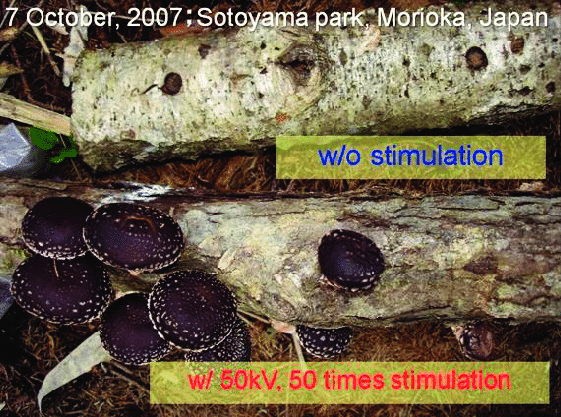
"The farmers of Japan say thunderstorms are good luck– they make the mushrooms grow.1 And mushrooms and thunderstorms are partners in folklore all over the world. The ancient god Soma may even have been a mushroom himself. In the book, Soma: Divine Mushroom of Immortality, Gordon Wasson2 argues that Amanita muscaria, the classic red or yellow fly agaric, is the identity of the mysterious Soma, god of the RgVeda, a sacred collection of ancient Vedic Sanskrit hymns. These hymns are some of the world’s oldest religious texts, and from them we know Soma is “the child of the thunderstorm”. Is Soma really a mushroom? Are mushrooms the children of thunderstorms? Read on."
"Science, alas, has had little to say about mushrooms and thunderstorms. Until now. Recently, scientists in Japan have demonstrated a link between lightning and prolific mushroom fruiting. Although their interest in lightning and mushrooms is not driven by a religious quest, their research may inadvertently shed light on an ethnographic mystery."
"In Japan, mushrooms are particularly coveted for their delicious, nutritional, and medicinal qualities and demand is outstripping supply. But now scientists are finding ways to harness the power of electricity to increase mushroom production. Can you imagine farms where man-made lightning bolts strike the ground and induce large flushes of mushrooms? Well, this is what scientists in Japan are doing."
"Today, shiitake (Lentinula edodes), buna-shimeji (Hypsizygus marmoreus), eryngii (Pleurotus eryngii), and matsutake (Tricholoma matsutake) mushrooms are high value health foods in Japan.1,3 Matsutakes now sell for $439 U.S. dollars a pound. Before you think you might get rich by growing some, you must consider that these are ectomycorrhizal mushrooms that only grow symbiotically with their pine tree hosts, so the world’s harvest is entirely collected from the wild. Although harvest of these mushrooms in Japan peaked at 12,000 metric tons in 1941, harvest declined to 34 metric tons in 2005, not due to lack of demand but due to many threats to these red pine forests, including a pine wood nematode infestation that has been wreaking havoc in these ecosystems.3 People want more mushrooms. Let’s harness the power of lightning."
"The use of direct current (DC) electric fields on living tissue is not a new idea, but has a long and contentious history. Even back in 1985, when Robinson wrote a review of the topic, he was able to find 8 reliable reports involving plant cells and 4 on animal cells responding to DC fields. The reports ranged from growth of neurons towards the negative electrode to a “healing” response of wounds. Many of these observations seem to have been dismissed as “laboratory curiosities,” unlikely to have much real world application. In Japan, though, electrical stimulation has been used in the production of Shiitake, Buna-shimejo, and eryngii mushrooms for almost half a decade. And this technology doesn’t seem to be limited to mushrooms, as farmers are also using electromagnetic field technology in the production of tomato, lettuce, strawberry, and some ornamental plants."
Below is the schematic drawing of the SPLG is from Figure 2 in Islam and Ohga’s interesting 2012 paper.
"The results were yields of matsutake mushrooms just about double the yields in unzapped control plots. A monstrous flush came two weeks after the pulse and a second one nearly as large 3 weeks after. But it wasn’t just the quantity that increased, the quality, as measured by weight and size of individual matustake mushrooms also showed dramatic increases: Harvests from the zapped plots were, on average, almost 70% heavier then controls. If you thought mushrooms were magical all on their own, the combination of mushrooms and electricity might knock your socks off."
"Fungi are mysterious things and the mechanism by which electrical stimulation promotes mushroom fruiting is still not much understood. Perhaps the mushroom mycelium is responding to an apparent threat of death by redoubling its reproductive efforts? Many electrifying questions remain. Like: how does the zapping affect forest trees? Can the high fruiting rates be sustained without damaging the mushroom-tree symbiosis? When’s the next thunderstorm due in my neighborhood?"
"In the meantime, if you feel like experimenting (safely, of course) with mushrooms and electricity, you might want to check out this intriguing post about a New York City mycophile who grew his mushrooms amid Jazz music, artificial fog, and static electricity. Or, next time you go in the woods foraging for mushrooms, look for trees recently struck by lightning. Who knows what you will find. Maybe you will even have an encounter with the god Soma, child of the thunderstorm."
An Assortment of Cornell University's
Reading References
1. S. Tsukamoto, H. Kudoh, S. Ohga, K. Yamamoto, and H. Akiyama, “Development of an automatic electrical stimulator for mushroom sawdust bottle,” in Proceeding of the 15th Pulsed Power Conference, pp. 1437–1440, Monterey, Calif, USA, June 2005
2. R.G. Wasson. “Soma: Divine Mushroom of Immortality.” 1968.
3. F. Islam and S. Ohga, “The response of fruit body formation on Tricholoma matsutake in situ condition by applying electric pulse stimulator,” ISRN Agronomy, vol. 2012, Article ID 462724, 6 pages, 2012. doi:10.5402/2012/462724
4. K. R. Robinson, “The responses of cells to electrical fields: a review,” Journal of Cell Biology, vol. 101(6): 2023–2027, 1985.
5. S. Tsukamoto, T. Maeda, M. Ikeda, and H. Akiyama, “Application of pulsed power to mushroom culturing,” in Proceedings of the 14th IEEE International Pulsed Power Conference, pp. 1116–1119, Dallas, Texas, USA, June 2003.
6. W. R. Adey, “Biological Effects of Electromagnetic Fields,” in Journal of Cellular Biochemistry 51:410-416. 1993.
7. S. Ohga and S. Iida. “Effect of electric impulse on sporocarp formation of ectomycorrhizal fungus Laccaria laccata in Japanese red pine plantation.” J. Forest Res. 6: 37-41. 2001.
(Source Cornell University)
Finally, the western scientific discipline of mycology (and other science related fields) has long disregarded this supposed relationship between lightning storms and truffle or mushroom formation. Either it has been chalked up to be nothing more than superstitious nonsense, in the view of modern man's agricultural obsession with industrial science, or else it is mistaking correlation for causation (accusation of it being anecdotal evidence), as they claim it's nothing more than the same rainstorm which created the lightning and thunder which also delivered the rains that woke up the mycelium from its slumber and provoked the mycorrhizal fruiting bodies. Hopefully people will reject the ongoing scientific arrogance and go outdoors for themselves and see whether this phenomena is true or not. By all means experiment and have fun doing so. This post is a collection of articles and writings on the phenomena of Lightning of Thunderstorms triggering the emergence of Mushrooms and Truffles along with my own past experiences with this incredible phenomena when collecting these fungal fruits are meant to provide a condensed resource of information on the subject. As always with any of my posts, I'll periodically update as newer research appears in the science news feeds. It's my hope that everyone finds this compilation of subject materials invaluable, because you won't get this from the conventional Academic sources which are shackled to corporate business interests. I've never bought into the assertion, assumption or conjecture that the lightning in the atmosphere changes theg aseous nitrogen into something water soluable and therefore the water from Thunder Storms is like a kind of Miracle-Gro for plants. I've tested all manner of trying to create super solutions to stimulate growth and nothing close to what Thunderstorm water has on the effects pf plant growth. FACT - It's all about physics and the restructuring of water molecule structure size into something far smaller and energized. I'll write more about that on another page. You'll be amzaed. 😍
Update 2018
High-Voltage Methods for Mushroom Fruit-Body Developments
Update 2020
Stimulatory growth effect of lightning strikes applied in the vicinity of shiitake mushroom bed logs
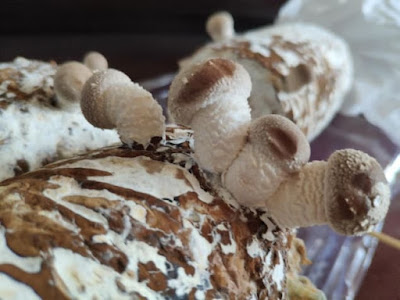 |
(Courtesy: EricABCAT/CC BY-SA 4.0 - 2020)
Lightning seed: shiitake mushrooms growing on a log |
~~~~~~~~~~~~~~~~~~~~~~~~~~~~~~~~~~
Some Fun Reading References
Tom Volk: Lightning and the Truffle (Desert Truffles)
National Geographic: Lightning Makes Mushrooms Multiply
Modern Mechanix: "Tiny Thunderbolts Help Mushrooms Grow (Apr, 1923)"
Some Precautions on avoiding breathing the Truffle or Mushroom Spores
CDC: Respiratory Illness Associated with Inhalation of Mushroom Spores -- Wisconsin, 1994
~~~~~~~~~~~~~~~~~~~~~~~~~~~~~~~~~~~~~~~~~
Some things to seriously consider about Plant Health Care Inc's product PHC® Injectable for Trees & the list of ingredients within and what they do.
 |
| Plant Health Care Inc - PHC® Injectable for Trees |
I've read several of the articles by internet Sciencey Guru types whose sole purpose in life on the Net appears to be debunking perceived or imaginary gardening and landscape myths about the uselessness of soil inoculation. I've already mentioned the "Spores are everywhere out in the Air" dogma by the Scientific Orthodoxy, but there is far more. Often I've seen criticism & demonizing of many of the other ingredients which are also present in many mixes. Here are a few and what they are for. Take the list of ingredients on the package of PHC® Injectable for Trees in the picture above.
PHC® Injectable for Trees - Ingredients List
The ectomycorrhizal lest contains a single species and the is Pisolithus tinctorius (1.78 Billion spores/Lb Pisolithus tinctorius). I have no idea how the count these spores. Next they list four VA Endomycorrhizal (VAM) Fungi (each @ 20,000 spores/Lb). Next they list six species of beneficial soil bacteria in the mix (each @ 4 billion cfu/Lb). Most of the criticism I've read about the ingredients list are these others which I'll talk about a few. First off, none of this is any type of fertilizer for the plant, which is often what I have rad from critics which in actuality exposes their true ignorance. So let's take a few of them.
SOIL/PLANT AMENDING INGREDIENTS
15.8% Humic acids (derived from Leonardite)
Anyone know what humic acids are which are derived from Leonardite ? For the purpose of this discussion, these humic acids are included within the mix not as a fertilizer as they are present to stimulate the plant's root growth and in particular those tiny root hair. In order for germination of the spore to take place, the root tip with end cap must have active growth and actually touch the spore for germination to be triggered. Next, what is Leonardite ? Leonardite comes from coal fields, especially brown Coal which is a lower grade coal and otherwise known as Lignite. These products were formed by the decomposition of organic plant material. Most all of it was created during the Earth's massive extinction even (irrespective how one wish to spin or fairytale that event) where ancient forests and other dense plant community ecosystems were scoured from the surface of the earth being thrown together and immediately buried with tonnes of sedimentary debris, much like the action of a volcanic lahar which bulldozes everything in it's path and buries it at the end of the flow with tonnes of mineral fill. Leonardite is the further degraded and refines part of Lignite (comes from the term "Lignin" which is what gives wood it's strength).
0.2% Formononetin
Doesn't sound like much, but the Flavonoid, Formononetin, stimulates the mycorrhizas to activity on their hosts. Only a trace is necessary for the desired effect of hormonal stimulation, much the way a mere trace of BisPhenol-A contamination has on a developing fetus with major endocrine disruption. Here is a link on it's importance to potato plants and mycorrhizal effectiveness.
Influence of a flavonoid (formononetin) on mycorrhizal activity and potato crop productivity in the highlands of Peru
---------------------------------------------------------------------
MICROBIAL NUTRIENTS - 68.9%
11.2% Soluble seaweed extract (derived from Ascophyllum nodosum)
Seaweed or Kelp extract are another target of critics who say it does nothing as a fertilizer for plants, hence the criticism on compost teas which contain this product. Again for all those critics out there, this is never professionally meant as a plant fertilizer, but rather as the subtitle here suggests, it's a microbial stimulant. This is to stimulate the microbial community into action for the benefit of feeding and caring for their host plants.
0.2% Yucca plant extract (derived from Yucca shidigera)
While you may find many who will describe this on the internet as a feed for plants, it's main purpose here while encouraging the microbial community, is also a great replacement surfactant to the petroleum and other synthetic surfactants presently used in Agricultural spraying of any kind (insecticides, herbicides, fungicides, fertilizers, etc). Plant Health Care sells the Yuccah quarts and gallons. The recommendation is use in all spray and/or injection applications as a wetting agent and soil penetrant (allows mycorrhizal spores to also move easier within soil pores). Keep in mind that this product I'm describing above is actually an injectable to be used in an actual injection machine. Try mixing any fungal spores with water and see what happens. They float on the surface. This is why such products as Monsanto's Roundup is loaded with synthetic surfactants to allow the Glyphosate to completely emulsify within the water or it would float on the surface. The surfactants used in Roundup however are dangerous to aquatic environments, so the Yuccah version is meant as an ecological replacement. So the next time you read about negativity of soil inoculents being worthless and the other ingredients are having no effect, understand that these self-promoting intellects have probably never done their thorough homework on them despite what they spew in type.
PHC Yuccah Wetting Agent & Soil Penetrant
Periodically come back and look for updates