Showing posts with label replication. Show all posts

Friday, August 5, 2016

Biomimicry: Streamlining Innovation for Environmentally Sustainable Products

Bio-mimicry found @ Polyface Farms Innovations

"In this interview with Joel Salatin, Joel talks about how the regeneration of his family farm utilized the patterns discovered from observing natural grazing and migration of wild animals in native plant communities. This discussion unlocks the secrets of Nature to create a system of pasture based agriculture that actually builds soil, diversity and interdependent relationships between farming and God. In respecting the natural process of Nature, Joel and his family have built a thriving  farm business, while restoring ecological integrity to the land. This method of farm management creates community amongst its workers and consumers and provides a spiritual connection to the land and its inhabitants." 
By Karen Rybold-Chin
Here are a couple other video links from the Mother Earth News fair, West Bend, Wisconsin and videos featuring Joel Salatin who continues on about biomimicry of Nature as opposed to working against Nature. 
Joel Salatin, Sacrifice and Sacredness of food
Joel Salatin: Synergy between Nature, Science and Technology
More examples of biomimicry of nature regarding agriculture. Industrial agriculture's worldview is about feeding crop plants with unnatural synthetic fertilizers. Natures way of feeding the plant is rather feeding the microbiome which in turn feeds the plant. There is no money in this for the Industrial Agricultural business model, hence their vicious resistence. Will Harris, owner of White Oak Pastures down in Georgia, tells us about his movement away from industrial agriculture to regenerative farmer. 
VIMEO: One Hundred Thousand Beating Hearts
Nice video interviews and stories on Biomimicry with Will Harris, owner of White Oak Pastures and Joel Salatin of Polyface Farms in Swoop, Virginia which was released yesterday and this comes off the heals of a newly released research paper published entitled:
Industrial Research Institute: Biomimicry: Streamlining the Front End of Innovation for Environmentally Sustainable Products
Overview: "Biomimicry, defined as innovation through the emulation of biological forms, processes, patterns, and systems, is particularly valuable for its focus on solution discovery, as opposed to solution validation. GOJO Industries, Inc., used biomimicry to drive environmentally sustainable product innovation. The approach proved both efficient and effective: in comparison to a historical new product development project with a similar objective and scope, the biomimicry-driven project produced double the intellectual property and, based on a preliminary assessment of lead product concepts, at least double the energy savings for just one-sixth the resource commitment. Biomimicry also showed potential to increase the overall speed of front-end innovation. This case study suggests that biomimicry may be a highly promising approach for driving innovation, and particularly environmentally sustainable innovation, but further investigation is needed to validate the conclusions of this single case study. The authors will discuss their study in more detail at an IRI-sponsored webinar, October 7, 2016, 12–1 pm EST. For more information, visit;
Brown Bag - Biomimicry: Streamlining the Front End of Innovation for Environmentally Sustainable Products

Heart-inspired double-acting bladder pump
Other Designs in Nature for Inspirations in Technological  Innovation
Photo by Gregory Smith via a Creative Commons license

The California Condor is North America’s largest bird. Their
broad wings and massive bodies give them a powerful presence in the air.

Take the design feature of the Californnia Condor. Giant wingspan and at the tips of wings something we call winglets. So what are they for ??? When human genius designed the first airplanes they imagined kool looking designs which appeared more streamlined and assumed to have less interference and resistance in flight. Much of this inovation came during a time of World War II. But in the era of big airline jets, price wars and cuttings costs, something had to be done about airline efficiency. But what ??? How appropriate we look at the wing and wingtip winglet of the German Lufthansa airline who actually uses the Condor as their company's logo. Human physics and the reality of physics found in nature are often two different thing. Only after painful experiences will humans acknowledge mistakes and look for change. In a nutshell this winglet design pattern after a reality found in nature with regards large soaring birds like Condors and Eagles, it was found that such a designed created more stability and airplanes encounter far less turbulance. But another wonderfull thing is that as a result of such efficiency in design, the airline industry as a whole saved billions of dollars in fuel costs every year. This is one of those, "Did it Evolve or Was it Designed ???" moments ðŸ˜„

Nature-Inspired Biomimicry from the Sea!
image - Treehugger

 Mercedes-Benz looked towards the boxfish for their bionic car concept. Noting the aerodynamics and efficiency of the boxfish's shape, the engineers decided to apply the characteristics of the fish to a car. The result is a very streamlined vehicle with a 65% lower drag coefficient than other compact cars out at the time (2005).  

How to Biomimic Desert Plants to stay COOL! 

Saguaro Cactus stays cool by having ribs that provide shade and enhance heat radiation
"The same applies to the intricate structural designs of cacti, which are exposed to a great deal of heat pressure in the desert. Their heat-reflecting capacity is low, since their surface is greatly reduced so as to cut down on evaporation. Nature has solved the problem by equipping many cacti with cooling ribs. These shade the cactus's surface against the scorching sun and simultaneously improve heat radiation. The alternating planes of light and shade of the vertical cooling ribs of the torch thistle produce rising and falling air currents, which improve heat radiation. And when the sun reaches its highest position, it hits the torch thistle from above, where it presents its smallest surface. A botanist discovered that torch thistles perish of burns when they are placed horizontally in the sun."
Kingfisher - Bullet Trains & Tunnel Speed
Image - 500 Series Shinkansen / Sam Doshi

Species 2000 & ITIS Catalogue of Life: 2008 Annual Checklist 
Excerpt: "[W]e had another challenge that we pursued to the test run phase. Half of the entire Sanyo Shinkansen Line (from Osaka to Hakata) is made up of tunnel sections. When a train rushes into a narrow tunnel at high speed, this generates atmospheric pressure waves that gradually grow into waves like tidal waves. These reach the tunnel exit at the speed of sound, generating low-frequency waves that produce a large boom and aerodynamic vibration so intense that residents 400 meters away have registered complaints. For this reason, we gave up doing test runs at over 350 km/h.

"Then, one of our young engineers told me that when the train rushes into a tunnel, he felt as if the train had shrunk. This must be due to a sudden change in air resistance, I thought. The question the occurred to me - is there some living thing that manages sudden changes in air resistance as a part of daily life?"

"Yes, there is, the kingfisher. To catch its prey, a kingfisher dives from the air, which has low resistance, into high-resistance water, and moreover does this without splashing. I wondered if this is possible because of the keen edge and streamlined shape of its beak. The beak of kingfishers allows splashless entry into water due to the wedge shape it makes with the head that is round in cross section. 

"So we conducted tests to measure pressure waves arising from shooting bullets of various shapes into a pipe and a thorough series of simulation tests of running the trains in tunnels, using a space research super-computer system. Data analysis showed that the ideal shape for this Shinkansen is almost identical to a kingfisher's beak.  

"I was once again experiencing what it is to learn from Nature, seeing first hand that a solution obtained through large-scale tests and analysis by a state-of-the-art super-computer turned out to be very similar to a shape developed by a living creature in the natural world. The nose of our new 500-Series Shinkansens has a streamline shape that is 15m in length and almost round in cross section.

AskNature.org - Beak Provides Streamlining: Common Kingfisher
Read more about the bioinspiration behind the Shinkansen Train in Zygote Quarterly

Animated Illustration - Artist: Emily Harrington

Take about 15 minutes here and watch Janine Benyus talk about biomimicry of designs found out in Nature. It's a 17 minute TED Talk where Janine Benyus provides a message for inventors. When solving a design problem, look to nature first. There you'll find inspired designs for making things waterproof, aerodynamic, solar-powered and more. Here she reveals dozens of new products that take their cue from nature with spectacular results.
TEDGlobal 2009: Janine Benyus: Biomimicry in action
This video above is great as far as an explanation of why we should copy designs found out in Nature first. For exampe, one presenter named Janine Benyus who I commend for her work and efforts, makes an excellent point. She reference the idea that medicines from the Rain Forests and she clarifies this by saying it's not so much identifying some molecule for a cure, but rather an 'idea' for the cure. But the problem here is, ideas as we know them only come from an intelligent Mind, not blind unguided forces without purpose or goals. With that in mind there's a caveat or warning or proviso of specific stipulations, conditions, or limitations that come with such a statement. What Janine Benyus is saying is in direct conflict with the Theory of Evolution proponents who have for decades pushed the "Argument from Poor Design" strategy to pimp a worldview. The problem is that it's Nature who's been given the shaft, not the rightwinger fundies they are attempting they are targeting in debates. I appreciate many ToE followers here won't like this, but this biased religious outlook goes back all the way to Darwin and his writings which are loaded with metaphysical religious assumptions and asserted that, "If their were a God he never would have created things in such and such a way." Take note, I find this viewpoint question to be a legitimate one to ask, but it has nothing to do with Science. Science cannot answer what an intelligent entity it's believers say doesn't exist in the first place would or wouldn't do in any given situation. I mean seriously, what repeatable experiment have they offered thus far ? None! This doesn't mean that we can't practice biomimicry, because we can. But irrespective of how anybody on this planet thinks or believes how life's origins came about, the harmonious way life in all ecosystems operates is in no way flawed or badly designed as this world's elites have shoved down people's throats and coerced them to believe. What has resulted is the degraded natureal world we all live in now. Climate Change ? It's easy to blame humans as many scientists do, but maybe they should start pointing fingers first at their fellow bought and paid for corporate scientist brothers who have developed irresponsible technology which has brought natural systems to it's knees. 

Scientific American
Ponder for a moment how much eco-friendly sustainable technological innovation has been held back because a Scientific Orthodoxy [every bit the mirror image of Christendom's Ecclesiastical Hierachical Structure when they ran Academia] with power and authority has controlled for 100+ years how mankind should view our natural world ? Take these present Biotechnology and Agro-Chemical Companies. Their worldview of Nature is that it's flawed, inept, inefficient and badly designed and the only way the world will be saved is through the superior genius of their guiding hand. Did you know, most of their geneticists generally have no clue as to how whole plant systems work in cooperation with other plants within any ecosystem outside the Lab ? Their belief about the informational content of DNA is that it's not information as we know it at all, but rather nothing more than copying errors, random meaningless patterns, most of which they insist is nothing more than Junk. But the latest scientific research is now proving otherwise. Take the findings of ENCODE. And there have always been other science disciplines which have revealed the truth, but they haven't always had the powerful backing and financial resources to move forward against the tidal wave of Industrial Science.

Responsible Scientific researchers have shown that Mycorrhizal Fungi and Beneficial Bacteria and a host of other critters living in the soil have been perfectly maintaining the natural world's soils for possibly countless milleniums of time. We really don't know for how long, other than the usual blind faith speculations of deep time thrown in for eye candy in a research paper. Those in power and authority and with a financial stake in keeping the status quo are bent on keeping things as they are. But their actions are in direct conflict with Science disciplines like mycology, ecology, entomology, soil science, etc, etc, etc. This creates conflict of loyalties for many environmental activists who are immersed in this culture of science, but fear to criticize industrial science because of being labeled an Anti-Science Luddite. At least biomimicry or biomimetics separates and defines itself. Take this graphic below. The historical pattern timeline shows us when the well known Biotechnology companies and Agro-Chemical corporations actually took power and control over food production in the early 1990s when they manipulated politicians and directly wrote the book on regulations of their genetically modifying organisms to work in conjunction with industrially produced synthetics which work directly against ecosystem designs found out in Nature. Now take a look at how far the superweed problem has become as a result of increased pesticide usage. This is wasn't supposed to have happened given all the public relations and damage control propaganda they spewed into the Media and it's all worldview driven folks.

Graph from Iowa State University

People are going to have to start making responsible personal decisions soon. Who's side on the issue of universal soverignty are you going to choose ? Science claims that life on Earth has been around for over 100 millions years and that's fine. But an article dealing with important research on the stability of all earthwide ecosystems showed that during  all those millions of years life the natural systems were always stable. But it references human beings creating agriculture 6,000 years ago and from that point on as people spread out across the planet taking thier agriculture with them, they have been making bad decisions ever since and all life has been greatly effected in a negative way. And horrifically, it has been the past 100+ years of this imaginary enlightenment and free thought that has brought our world climate change, various forms of pollution and species extinction to the point of where many experts say it is irreversible. Unfortunately most of those "Culture of Science" people don't want to admit this flaw in the past few decades of Scientific thinking and practice. Keep watch, the latest phrase in many science journals being used more often now is "Beyond the Point of no Return." Take a look at the graph here below. This isn't my made up invention or research, this came from Scientists who are being forced to admit the flaw of a 20th century which has championed free thought and critical thinking. 

Graphic from Smithsonian Magazine
http://www.nature.com

Smithsonian Magazine: Humans Caused a Major Shift in Earth's Ecosystems 6,000 Years Ago

None of the clearly negative effects of human leadership and present consequences should prevent any reader here from practicng biomimicry within their own personal sphere of endeavours with regards to habitat restoration, agriculture, urban landscaping and home gardening. Everybody has a choice. The main problem is everyone on the planet has to do this.
References & Links on Biomimetics
https://germinature.com
http://www.asknature.org

Clarification on the differences between Science and Corporations in creating intellectual property in the form of patented products for obscene profit.
Very little of what is being discussed with regards to the biotechnology industry is actually "Sciences" or even "one of the sciences". What we're really talking about isn't any of the sciences at all, but rather technology or to be more specific using their own words, engineering. Most all true sciences are about studying things out in the natural world and figuring out how they work. The "scientific method" deals with how we successively refine our understanding of natural phenomena. It does not say anything about how this knowledge can, could, or should be applied. The sciences are essentially analytic in nature.

It's our world's corporations who along with their lawyers have created this idea of intellectual property based on the scientific work of others. Their research engineers were more interested in creating products to be patented. Yet their work was all based on the information provided by researchers funded by Academia.  Their researchers may even use scientific methods in obtaining their goals, but they are not so much interested in the discovery of knowledge and the wisdom in using that knowledge as they are in focussing attention on creating something for profit.

In the process of misusing abd abusing ´this scientific knowledge, our natural world has been introduce to genetically modified organisms, , Nuclear Weapons, BPA in drinking water. We now have climate change, destruction of the Ozone, melting Arctic & Antarctic glaciers, Chernobyl, Thalidomide, Fukashima, plastic pollution in the oceans and dead zones, etc. All of these symptoms and negative consequences are the result of various irresponsible  technological innovation brought to us by modern industrial engineering. Yes, they used information obtained from science, but they cannot lay the fault at the feet of science which was always  about discovery and wonder. Science simply enabled these efforts by providing the basic knowledge needed, but the downside from what they created has produced unforeseen and unintended consequences in their various attempts to use that knowledge to satify this economic thing called consumerism. Biomimicry is really not all that expensive. In many cases it's a matter of changing one's practices and management without purchasing products and that is what nakes biomimetics unattractive to corporations.

Remember the movie Jurassic Park and that lunch room debate scene where actor Jeff Goldblum plays this highly articulate four-eyed genius (Dr Ian Malcolm) who tries to warn everyone about the dangers of playing God ? Of all the scenes in that movie, this one sticks with me the most because it is so accurate in it's content and reflective of today's reality. The Jurassic Park Technicians did not actually research all the science behind the genetics, but they did they misuse and abuse the discoveries of others for creating intellectual property and patented products (Dinosaurs). Biotechs are the same, they engineer product for profit. If they actually cared about feeding mankind and becoming proper custodians of the Earth, they would have pursued more of a mirror of how Nature accomplishes this through biomimicry. Instead, they are infected with the ideological doctrine that Nature is flawed, imperfect and poorly designed. Only they can fix it and anyone who tries to get in their way is an Anti-Science Luddite. It matters not that these people in opposition to their business model are indeed interested in other responsible sciences like Mycology, Soil Biology, etc, etc, etc. Here's the story line below. See if you recognize it better now.
Dr Ian Malcolm: "Don't you see the danger, John, inherent in what you're doing here? Genetic power is the most awesome force the planet's ever seen, but you wield it like a kid that's found his dad's gun."
The Jurassic Park Lawyer, Donald Gennaro:  "It's hardly appropriate to start hurling generalizations..."
Dr Ian Malcolm: "If I may... Um, I'll tell you the problem with the scientific power that you're using here, it didn't require any discipline to attain it. You read what others had done and you took the next step. You didn't earn the knowledge for yourselves, so you don't take any responsibility for it. You stood on the shoulders of geniuses to accomplish something as fast as you could, and before you even knew what you had, you patented it, and packaged it, and slapped it on a plastic lunchbox, and now you're selling it, you wanna sell it." 
Jurassic Park Owner/CEO, John Hammond: "I don't think you're giving us our due credit. Our scientists have done things which nobody's ever done before . . " 
Dr Ian Malcolm: "Yeah, yeah, but your scientists were so preoccupied with whether or not they could that they didn't stop to think if they should."
Pausing here for a moment to fast forward. After trying to justify his technology by saying he could bring back California Condors and hearing Dr Ian Malcolm's continued resistence to the Jurassic Park's genetic modification technology, CEO John Hammond (Richard Attenborough), uses the same identical cowardly strategy often employed by most biotech apologists against the opponents of their technology. 
CEO John Hammond: "I simply don't understand this Luddite attitude, especially from a scientist. I mean, how can we stand in the light of discovery, and not act?"
Dr Ian Malcolm: "What's so great about discovery? It's a violent penetrating act that scars what it explores. What you call discovery, I call the rape of the natural world."
 (Jurassic Park Lunch Debate - 3:55 minutes)
Image - Oregon State University
I read one article recently by a major GMO apologist, Henry L. Miller, who was championing GM technology for Climate Change and creating drought resistant crops. Hence the need to genetically manipulate crop plant genomes to better withstand heat and drought. Monsanto for example has already done this with their Drought Guard patented crop seeds. This is not biomimicry. Biomimicry would be utilizing Nature's toolkit which has existed for 1000s of years. Mycorrhizal fungi act as an extension of a plant's root system and increase water and nutrient uptake anywhere from 200% to 800%. And it costs far less, often if managed properly after the initial soil inoculation, it's free. And ultimately that is the major reason for the major stumbling block and why the Biotechs and Agrochemical Corporations refuse to go down that road. Opportunities for biomimicry are all around everyone in the natural world. The problem is that they are not opportunities for most of this world's giant corporations and the governments that support them. Their geneticists know very little about how whole plant systems work outside their Lab. There is still very little these biotechs and their engineers know about the very organism, Agrobacterium, they have in the past used to infect target crop genomes with the transgenes. There have been some concerns with their use of the Agrobacterium which is a naturally occcuring soil organism. In fact take note of what one research paper said about our scientific understanding of Agrobacterium:
"Many of the blockbuster discoveries on Agrobacterium-plant interaction have been cited briefly in this narrative. However, much remains to be learned. The chemical signaling between Agrobacterium and plants in the natural environment of the plant’s rhizosphere has yet to be fully explored. In addition, the trafficking of the T-strand from the inception of the transfer process to the plant cell nucleus provides an area of fruitful research opportunities for interdisciplinary investigations. The full potential of using Agrobacterium as a mutagen and a transfer system for genes into an ever expanding number of eukaryotic cells has yet to be realized. After 100 years, the tale of Agrobacterium is not yet finished."
Agrobacterium: The Natural Genetic Engineer 100 Years Later
So apparently after all this time, there is still so much they do not know about this organism, but they're using it anyway. But wait, this version of the technology has to be regulated and it's really imperfect because they really have no clue where the information of the transgene will end up within the genome. In other words, in what context of other genes does this gene end up working with ? No problem they say, CRISPR will save the day.
"It won't be long before CRISPR allows us to bend nature to our will in the way that humans have dreamed of since prehistory. When that will is directed toward something constructive, the results could be fantastic—but they might also have unintentional or even calamitous consequences."

Jennifer Doudna - Co-Inventor of CRISPR

Seriously, "Bending Nature to our Will" ??? It's being promoted as more precise and accurate and because the biotechs will only be editing and deleting genes instead of introducing foreign genes by means of a viral facilitator, they've now convinced the government it has no need of regulation. This ignorant worldview of the meaninglessness of informational content within DNA even extends here as well. Take the issue of deleting the gene which causes browning in the common white button mushrooms. Read the warning on this potentially irresponsible act by Mycologist Paul Stamets on how this fungi will be effected by not having this anti-viral gene and the consequences if this specific genome gets out into the wild.

Supporters of giant corporate entites need to stop pretending that Biotechs are all about Science, when their true objective is mainly politics, economics and promoting a worldview after their own image. Their hands are dirty in political advocacy. Their writings only have value if they are discussing observable, repeatable, testable facts about natural phenomena. That's how real science is defined. Even then, you have to watch closely the materials and methods being used here, and see if the conclusions logically follow from the data. A true scientist ceases to be a scientist when he leaves off the original ideals that science was built upon. The understanding of the cause-and-effect structure of the natural world according to testable hypotheses. Biomimicry on the other hand is the practice of science that takes rigor, integrity, and humility. It views nature as having great vakue in it's designs which in turn should be replicated, rather than being put out there for promoting a profit. They have always had a problem with bioethics. They actually work very hard towards preventing people from having the ability to know the truth about our natural world and food we eat  and that ultimately is the true Anti-Science.


Friday, June 24, 2016

Positive Interactions and Mutual Dependence between two Desert Plants

I caught this older 1978 black and white photograph by accident the other day while looking through some old archived literature on an unrelated subject. Mostly I was looking at mesquite dune references for building windbreaks or shelterbelts with native flora after removal of Tamarisk. I'm ever so thankful I made this find. It needs light shed on it.
Image is March 1978
"
Four-year old Prosopis tamarugo competing with native
 Atriplex atacamensis in the San Pedro de Atacama salt flat"

And so read the caption under the black and white photograph taken on March 1978 which was found down at the very bottom of this United Nations agriculture website. Can anyone appreciate the inaccurate misleading understanding back then regarding plant inter-relationships and mutualism ? Do I hear "Mother Tree" or "Nurse Plant" from anybody ? No of course not. Back then as today, we use hear people say that beautiful shrub or tree [depending on whether you champion the tree or shrub] in such a photograph seems to have the appearrance of being choked to death or strangled by the less desirable shrub. The times really haven't changed all that much with not only your average Gardener and commercial Landscaper, but also your average Professional Forester. Anyone else notice the word/term, "competing" being used in the description above of the two plants in that black and white photo ? Do either of those plants really look like they're suffering at the hands of the other ? There is an irresponsible blind faith religious concept called "Survival of the Fittest" which has done more harm than good and has set back positive scientific research more than anything else. Even today, Biomimicry leaves a foul taste in the mouths of some Ideologues who cherish an old inept Victorian Era worldview of our planet's natural world. I've seen such plant associations before, photographed them and written about them in this blog. Take a look below.

Photo Image - Kevin Franck (2013
This is an Oak tree at the bottom of my brother's property in  Ranchita California. This region in many ways is very much an interior high desert ecosystem. Very dry, cold/hot and windy at times from  any direction. And yet, take a closer look underneath that Oak tree. On a much closer inspection, this is Chaparral Honeysuckle (Lonicera interupta) and may seem odd at first being way out on this dry flat, especially considering it is still recovering from the infamous Pines Fire of 2002. Most likely some bird stopped at this Oak tree weigh station rest area and took a  dump which may have contained some Honeysuckle berry seeds. Or perhaps a Coyote or some other animal literally dropped by after dining. Yet from the appearance of vigoriously growing foliage, do we see one plant outcompeting the other here ? No!
Photo Image - Kevin Franck (2013)
This group of riparian trees above, Cottonwood, Willow and Mexican Elderberry are also associated with not only Snow Pea, but also Wild Rose. The area is east of Lake Henshaw in San Diego county cloase to the Junction of Hwy 79 & 76. Do any of these plants look to be out competing or chocking out their neighbours in some blind faith concept known as "Survival of the Fittest" ??? Hardly. But strongly entrenched blind faith human dogma concepts are hard to weed out. And yes, many evolutionary concepts which originated from an ignorant Victorian Era have held on to the present. Their continued presence in the textbooks has held back good science and ruined many an ecosystem ever since they were conceived in response to justification of a new preferred  worldview. What is needed is some major deprogamming and re-education.
~~~~~~~~~~~~~~~~~~~~~~~~~~~~~~~~
 The plants in the black & white photograph. Prosopis tamarugo and Atriplex atacamensis

Image - creces.cl
Tamarugo Forest or Bosque
The Tamarugo (Prosopis tamarugo) is a deciduous legume tree growing up to 18 m high, with a crown ranging from 15 m to 20 m in diameter. Its root system consists of a deep taproot (down to 6 m) with lateral roots (down to 1.5 m). Leaves are bipinnate with 10-15 pairs of 5 mm long leaflets. Spike-like inflorescences bear golden yellow flowers. Fruits are peanut-shaped pods borne in clusters, 2 to 4 cm long. They contain an edible pulp and ovate seeds (3-4.3 mm long).
image - Nomad Desert
"The tamarugo is native to Chile (part of the Atacama desert is known as Pampa del Tamarugal). It is also found in Argentina and was introduced into India and other saline deserts of the world. It can grow up to an altitude of 1500 m. It thrives on salty sandy soils or clay loamy soils with a salt encrustation to a depth of 60 cm. It prefers the normal desert climate: high day temperatures, a large day-to-night temperature range, almost total lack of rainfall and intense sunlight. Tamarugo can withstand 10 to 12 months of drought."
Tamarugo mist watering  on leaves
"At the beginning of the 20th century, the tamarugo was almost extinct when a forest inspector noticed its ecological interest and created tamarugo plantations in the Pampa del Tamarugal. Since then, the tamarugo has been used to afforest saline deserts and has increased the overall productivity of the Tamarugal. The tree absorbs air moisture through its leaves and dispatches the collected water to its roots and to the surrounding soil, thus participating in the protection of soil water reserves. It is also a windbreaker and protects animals and people from the sun." 
(Source)
There are a number of amazing qualities about this species of Prosopis (Mesquite) and others. They can all be long lived. Often 100s, 500 to 1000 years old. One particular tree in South American country of Peru, a Hurango (Prosopis pallida), is in fact called the "Milenario de Hurango" because it has been found to be estimated at 1074 years of age. It was once part of a greater forest which has just about disappeared in the  Palpa region of Peru. As a land restoration tree, the Prosopis species in South America can access subterranean waters 60 meters (almost 200 feet) deep by means of a large tap root. It is one of the few trees/plants which can tolerate saline soils and transform such otherwise inhospitable landscapes into usable fertile soils. Part of the salty soil tolerance comes from it's association with micro-organisms on their root systems. 
Cachiyuyo (Atriplex atacamensis) 'Saltbush'
Taken on November 22, 2014 - Lucas Burchard Señoret

Planta del Desierto. Cachiyuyo (Atriplex atacamensis)
Chiu Chiu. Calama. Loa. Antofagasta. Chile

This plant in the photo above is what is commonly known by name as "Saltbrush" which where I come from is one of the few plants which will grow on saltflats of Coachella and Imperial Valleys. Atriplex is the plant referenced in that black and white photograph at the beginning of this post. It's not exactly an ornamental one we would chose for the urban landscape, nor even a specimen sought after by collectors of California Native Plants, but never the less it does have some amazing beneficial qualities. For example after stumbling upon the subject of Prosopis tamarugo from South America on the Food and Agriculture Organization of the United Nations website and the negative reference at the bottom of that page where gives the impression that the Atriplex was being demonized as the villan and Tamarugo as the victim. I realized that neither was true because from my own personal experience in researching on how nature utilizes sophisticated complex mechanisms for survival and success, the truth is clear that this has zero to do with "Survival of the Fittest" and more to do with survival of the mutually cooperative. Take a look at this one paragraph from the above book published in January 2007, titled:
"Positive Interactions and Interdependence in Plant Communities"
"Studies by Jose Facelli and Amada Temby (2002) in Southern Australia have also demonstrated a complex array of facilitative and competitive mechanisms working simultaneously in interactions between shrubs and the annual plants that grow around them. Shrubs altered soils, the seed bank, the effects of large vertebrates, and the subcanopy microclimate. But in a very interesting contrast to many other studies in similar systems, canopy effects were negative, reducing the effects of annuals, where as the roots of one shrub species, Atriplex vesicaria, facilitated annual species growing on the edges of it's canopy. Trenching around Atriplex shrubs decreased the abundance of annual plants. Facelli and Temby attributed the positive effects of Atriplex shrubs to hydraulic lift, and the decrease of nearby annuals after root severing to impeding the flow of water from the roots into shallow soils. Both positive and negative effects occurred in this system, but the typical of mechanisms in this system were reversed, with canopies inhibiting and root facilitating understories."
 (book source - short version)
 The mechanical benefits of hydraulic lift and redistribution of water to other plants within desert communities is fascinating and too the ability tolerate saline soils is also important when such soil degradation around the globe is increasing. Aside from being viewed as an important habitat creating tool, there are also some claimed health benefits to consumption of certain varieties. As always, thorough research and investigation on the part of those interested in such benefits and plant identification should be pursued. 
OrganicFacts: Potential health benefits of Saltbush (also known as saltbush or orache) for members of the Atriplex genus
Some concluding remarks on these plants and related ones & their landscape restoration value to people
Photo Image - BBC


The remarkable nitrogen-fixing Prosopis trees are an important source of food, forage timber and fuel for the local people of South America. But what is more important from a restoration self-sufficiency standpoint and something the average person knows very little about (if anything) and very few researchers are able press forward into the mainstream science education are the subjects - Hydraulic Lift & Redistribution - Hydraulic Descent. As referenced above with the plant Saltbush (Atriplex atacamensis) which can pull to the soil surface subterranean moisture to the benefit and well being of other plants around it. So too can the Prosopis species not only employ hydraulic lift and redistribution to entire plant ecosystems, but as other researchers have pointed out, they have the ability of removing vast amounts of surface waters during the rainy season and pumping this water deep underground, recharging aquifers and later utilizing these stores when the hot summer months appear. They also accomplish this task while still dormant in winter. The majority of these old growth Mesquite bosques are long gone. The evidence points to human stupidy and greed as the reason for their absence. The stupidity will be ongoing if they continue to ignore their value in hot dry arid saline soil desert regions which have also increased in temperature due to lack of vegetation cover. The companion planting of differing plant species is also another topic that should be shoved down people's throats until they're blue in the face. It's for their own and nature's good. Even now in one of the other links I've provided below, research is being done on experimenting with companion planting of Lavender & Arizona Cypress which have been observed to form healthier mycorrhizal associations and plant establishment. The old school science-based conventional ways of doing things is slowly killing this planet and biomimicry is going to come to the fore more and more. The bogus reforestation concept of stripping land bare of all competing shrubs so that more economically and aesthetically pleasing trees may flourish has done more harm than good and it continues. Most of this newer scientific understanding of plant mutualism will fall on deaf ears when it comes to human government and giant corporate business interests back by industrial science. However, it's hoped that such info will benefit small communities around the globe, habitat restoration groups, urban landscapers and home gardeners who more often have a passion for the natural world and a biomimetics approach which totally eliminates these destructive conventional science-based technologies. The pursuit of such conventional textbook mandates have over the past 100+ years degraded this planet to the point of serious climate disruption. At the bottom of this post below the references is one such interesting tool which could be of benefit to many. I'll post a link later.

Some interesting links and other references
Food & Agriculture Organization of U.N. - Prosopis Part I
FAO - PART TWO: PROSOPIS TAMARUGO, Phil.

The Huarango and Algarrobo forests of coastal Peru: rays of hope

BBC - Tree planting in the driest place on Earth

Science Direct: Lavandula species as accompanying plants in Cupressus replanting strategies: Effect on plant growth, mycorrhizal soil infectivity and soil microbial catabolic diversity
Hydraulic Lift and Redistribution of Water for the Benefit of other Plants in San Diego County
Adenostoma fasciculatum (chamise or greasewood): Worthless Brush or potential Nurse Plant ???

Photo Image: Groasis-Waterboxx
I have another post on this very subject of mutualism where an ingenius product by a company called Groasis-Waterboxx has experimented throughly [with the help of it's own customers] and successfully in hot dry desert regions around the globe. Even practicing planting with mycorrhizal inoculum and companion planting with two differing species of plants for successful establishment as you see in the photo above. Stay tuned.
Update June 27, 2016: 
Okay, here is the link I've created on companion planting using the Groasis-Waterboxx Cocoon. Their website also has vast amounts of tips, ideas and documented testimonials on the successes with this device. Enjoy:
How to Biomimic Nature's Companion Planting & the Reasons You Should

Image - Groasis-Waterboxx


Monday, October 5, 2015

Adenostoma fasciculatum (chamise or greasewood): Worthless Brush or potential Nurse Plant ???

My subject here, Chamise or Greasewood is a much demonized shrub in the Chaparral Plant Community. Quite often it is blamed for most of the catastrophic wildfires in Southern California and often accused of being an invasive take over of habitat from more desirable shrubs and trees in it's very own native habitat. So much of what is misunderstood by the public has likely been the fault of  Journalists, Politicians, the very Departments and Agencies in charge of  land management oversight and those bought and paid for Scientists who back the business interests of corporate agencies who should know better. We could say that humans treat Chamise they way they often mistreat and Judge their fellow human beings because of differences in appearance, race, culture, ethicity, language, etc. So this post should be interesting to many who may have hated this precious important shrub in the past.
(Image: Mine)

Adenstoma fasciculatum Chamise & Cuyamaca Cypress
Inspiration Point off Hwy 79 south of Julian California

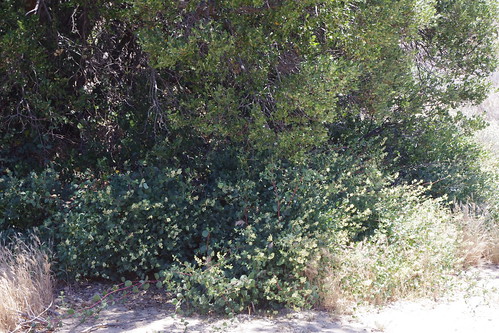
These are simply some pictures I took from last weekend on our trip once again to Julian California. Admittedly in my past, I too had negative feelings or impressions about this Chamise or greasewood as it is sometimes called, but most of it was based on my ignorance. I mean just look at it in the photo above behind the Cuyamaca Cypress. See how dull coloured and rangy looking it is ??? If you've ever been out hiking, you've likely been scratched and cut trying to bushwhack their it's impenetrable barriers. And yes it's other common name 'Greasewood' refers to the high content of volatile oils within it's stems which burn ferociously during a wildfire. What I love looking for when hiking and exploring outdoors are specific nurse plant examples [older well known ones and newer yet to be discovered ones] when I'm out in the bush. Always looking for which plants may be the best parent plants for use in practical application in habitat restoration or in community planting of the urban landscape. This poor shrub in the photograph above is also called by a purposeful derogatory name as Greasewood because it has a high content of volatile organic compounds, but then so do most other plants. But it conveys the idea that Chamise is worthless for nothing else than burning. A reality check here should reveal to you that all plants made of organic matter will burn. Just look at those colder Boreal Forests locations near the Arctic circle, even those of Temperate and Tropical rainforests. They all burn with great ferocity given the right circumstances. But this chaparral plant's mere presence will invoke the usual hatred by many an fire ecology expert and landowner determined to eradicate it in favour of what many humans consider plants with more eye-candy appeal. Often blamed for the reasons and causes of catastrophic wildfires and chocking out the more desirable plants, this in reality couldn't be further from the truth. 

image: Mine

Inspiration Point, Hwy 79 south of Julian
The reality is that this plant, Chamise or Greasewood, will grow where many others won't or can't. It most often will be one of the last holdouts in drought, holding down the soil erosion where others fail and disappear. Interestingly Chamise is strictly a Enfo-Mycorrhizal shrub like most Chaparral plants. Buy I had no idea or clue before readign the research that during wetter rainy season times that Chamise allows itself to be colonized by many Ecto-Mycorrhizas which actually facilitate the higher succession plants like Pines and Oaks to grab a foothold and pioneer out into new virgin territory, even other chaparral like California Holly or Toyon as seen in the photo here to the right. Below the high country town of Idyllwild California in the San Jacinto Mountains while driving east along Hwy 74 from Hemet through the San Jacinto River Canyon, you can see on the lefthand side of the road which would be the south facing slopes on the north side, numerous Toyon shrubs within the Chamise. Without the presence of Chamise, such srubs would never make a foothold by pioneering out into virgin territory without Chamise. Eventually if times are favourable and long enough, the Chamise itself will become the victim of succession through the chocking action of competition of the very seedling in it's care as will eventually happen with the Cuyamaca Cypress in the photograph at the top and below.

image: Mine (2015)

This young Cuyamaca Cypress above is sandwiched between Chamise and Mountain Mahogany chaparral which clearly are helping support this immature cypress to adulthood. These Saplings were everywhere in the chaparral. Conventional practice by forestry and Timber agencies would have stripped the land bare prior to planting believe that such chaparral actually kills rather than nurse along such important forest species.

image: Mine (2015)

This one appeared all by itself in an opening in the chaparral, but that doesn't mean there were no underground connections going on as far as a mycorrhizal grid network for them to tap into. In this photo, take a look in the background just above the Sapling central leader in the photo and slightly to the left and you can see yet another sapling emerging through the Chamise. Clearly Chamise has been an important Nurse Plant success story here for Cuyamaca Cypress. In fact underneath and inside the canopies of the Chamise were several broken truffles of the Mycorrhizal fungi Pisolithus tinctorius which contain a huge drop of dried truffles which appeared this past Spring. A special note on Southern California's Ectomycorrhizal Fungal Diversity on surprising hosts came from the US Forest Service. Under a subheading with the same name, comment on observation of Ectomycorrhizal colonization on Chamise (Greasewood) was noted to occur in particularly wet years such as El Nino events. If true, then this coming year's El Nino event predictions for SoCal could be a window of opportunity for habitat restoration if anyone is actually paying any attention to this. This is an opportunity that has not really presented itself in almost two decades.
Ectomycorrhizal Fungal Diversity
Chamise (Adenostoma fasciculatum) normally forms arbuscular mycorrhizae with all genera found in the region. However, during wet years (El Niño), we found EM associated with its roots and EM fungi in the stands (Allen and others 1999b). There was a high diversity of fungi ranging from Cenococcum and Balsamia spp. (ascomycetes) to a variety of basidiomycetes such as Pisolithus sp., Cortinarius spp., and Hysterangium separabile. We also found a new species of Rhizopogon: R. mengei (Allen and others 1999a). This is an important finding, since all other known species of Rhizopogon are associated with conifers. In addition, we sequenced the dominant fungus found on the root tips of chamise, and this fungus was an unknown species of ascomycete, most closely related to Sarcocypha emarginata (97 percent similarity in the sequence alignment of the 5.8S region, 63 percent similarity in ITS1, and 59 percent similarity in ITS2), a common fire-following fungus."
That last line in this research article's paragraph about Adenostoma fasticulatum and the other possible or potential yet to be discovered plant host to Mycorrhizal colonization relationships is really an understatement. For me personally it opened my eyes to understanding what I had observed at locations in Anza where Pine, Oak and other plants were actually able to pioneer out into pure Chamise habitat and thrive with what many have considered an invasive competitor. Just think, what if the world's Scientific community had actually been pursuing more responsible research from a biomimetic approach all these past decades as opposed to this obsession with the artificial synthetic version of plant healthcare ??? You know what I mean, Corporate obsession with Patents for GMO products, manufacturing product on a mass scale, slapping a label on product and charging outrageous prices for artificial this same unnatural product which is not nearly as effective as the real deal found in Nature ??? Quite possibly we wouldn't be living in the present train-wrecked natural world we all are forced to endure as a result of the misuses and abuses of Industrial Science. 
"There are clearly plant/fungal symbiotic combinations that we do not understand and have yet to explore."
USFS: "Biodiversity of Mycorrhizal Fungi in Southern California" 
Prior to the trip to Inspiration Point south of Julian, it had rained fairly heavy from recent Monsoonal Thunderstorms the week before this week's visit, but it hadn't been long enough and soaking enough to trigger any summer emergence of truffles this time. But at the very least I did find numerous broken dried out truffles with mature chocolate brown spores easily dislodged when rubbed from their compartmentalized interior honey comb-like chambers. At least this was proof the system was still functioning in this spot south of Julian. This cannot be said for my former truffle collecting hotspots on the outskirts of Anza a year ago.

image: Mine

Pisolithus tinctorius or Tom Volk's Dog Turd Fungus

The photograph below is of the actual single living parent tree for which all these seedlings originated that the 2003 Cedar Fire did not take completely down, although the old scars are still present. I collected one cypress cone this time to see if I can germinate some seeds and out plant the seedlings as an experiment on the hillside near my home here in Sweden. I'd love to see if they will take this climate's prolonged dark winter and long cold periods. In the photo's background of course you can clearly view Scissor's Crossing of Hwy 78 and San Felipe Road in the desert below. 

Image: Mine (2014)

Mostly I wanted to explain here the importance of Chamise and it's value to land managers and private land owner's who otherwise are prone to stripping such plants from their landscape mistakenly believing they are making an improvement. I have no problem with creating defensible space around their homes and other dwellings for wildfire protection or even wishing to create what they consider more desirable trees and shrubs, but the Chamise is an asset and ally in this area and not the enemy. For example, like it's cousin Redshank or Ribbonwood, Chamise has some of the deepest roosystem infrastructure diving down several meters deep into the subsoil layers which are rich in moisture content. During the hotter Summer months, Chamise is the perfect Nurse Plant for an Oak or Pine Seedling because Chamise performs a service called "Hydraulic Lift and Redistribution". The process involves lifting water from deep in the Earth and bringing it to the surface and sharing water with surrounding plants via the Mycorrhizal Grid Network. Thus valuable seedlings of pine and oak can thrive. We're talking Survival of the Mutually Cooperative, not Survival of the Fittest. And amazingly, all plants who perform this service also perform a reverse of this during winter dormancy. How ??? They remove excess water from the surface during the rainy season and pump it deep into the earth, there to be stored for later use that summer and some water may even percolate deeper and recharge the water table or Acquifer. How kool is that ??? 😃


Old school bigoted ideas and biased assumptions promoted for decades by ignorant land managers have got to be rejected. I'll provide a few more links below, although I appreciate many will find such boring. Not the fault of the subject matter, but mostly the researchers who by nature never have been great communicators to the public as a whole. That in itself is one of the biggest problems of most of this world's leadership in general. As a final note, the use of Chamise in the urban landscape would be limited or none at all. Most of this post was to direct attention away from the negatives about this chaparral plant and it's important purpose within the Southern California Chaparral landscape. It's importance in covering the land quickly after fire and important role as a nurse plant or mother tree for other ecosystem succession plant life. The decades of conventional land management wisdom have been a failure, now perhaps acknowledging the reality of how the programmed mechanisms in Nature really work is the only hope left for humankind ib rebuilding the land. 

Photo by Pete Veilleux - Big Sur wilderness - October 2016

The photo above was posted on a Facebook page by member Fred DeVault. It's an incredible example of how well chaparral works for forestry as opposed to the long standing ignorance as advanced by giant timber interests. So is this survival of the fittest or rather survival of the mutually cooperative ??? To further illustrate how an ecological succession of a climax forest trees progresses, here is an animation video provided by Buck and Sons Landscape Services.
Ecological Succession of the Climax Forest

There is something extremely important to remember here. The Cedar Fire (2003) tore through massive amounts of both  old growth Chaparral and Forested regions of San Diego County mountains. Many of these beautiful pristine places of ecological climax succession took hundreds of years of long term gradual development to reach such an old growth state. But it took one unfortunate irresponsible act which triggered a massive catastrophic event over a mere couple weeks to almost completely destroy it all. To help illustrate in human terms, most of this world's Sports Stars, Hollywood Film & TV  Celebrities, Popular Political Personalities, Nobel Prize Winners, all manner of other world renowned Heroes etc spend decades building up their careers and reputations to attain what most people would consider a celebrity climax status of sorts later in life. Many times these stars crash and burn their reputations through one senseless act which becomes public. Often times most never recover. If they do it takes many more decades if they have the luxury of that kind of time and even then their celebrity fame never mirrors their former glory. We now live in a time like that where ecological circumstances have changed drastically where recovery may not heal as programmed over and over for thousands of years with no problem. Understanding the biological mechanical components for recovery are more important than ever because life on earth no longer has the luxury of time on their side anymore. 

One of my favourite images of  Adenostoma fasticultaum - Chamise with Trichostema lanatum - Woolly Blue Curls which can most commonly be seen growing together in the lower slopes of the San Jacinto Mountains  west of Mountain Center near Idyllwild California. Especially when hiking the South Fork Canyon Trail off Hwy 74. When you view it under such light, the plant is rather beautiful in appearance with all the extra add ons. Much like a stock muscle car in a dealership showroom, purchased and later modified by it's own to enhance performance.
Image by Bert Wilson of Las Pilitas Native Plant Nursery
~~~~~~~~~~~~~~~~~~~~~~~~~~~~~~~~~~~~~
This young lady is Lizzie Velasquez who was photgraphed in Washington, DC, on October 27, 2015. Lizzie Valasquez has a rare disease and was bullied for her appearance throughout her childhood. There's not a person reading who doesn't understand the trauma of grade school bullying. Most people picked on so severely withdraw from public and never have a normal life. Yet Lizzie has become a motivational speaker and advocate of anti-bullying legislation. She is the subject of a recent documentary: A Brave Heart: The Lizzie Velasquez Story. And people being judged today over a plethora of nonsense reasons continue. Every human being has real value but you have to put the effort forth to get to know what that value is. Bare with me here. There is an excellent Biblical example of not judging people by mere appearance. The ancient nation of Israel did not have the conventional style of government rule that the surrounding nations had. The spoke with the Prophet Samuel and demanded he anoint a King over them instead of Judges. Samuel warned them of the consequences of having a human King and all that he would demand from them. The Israelite God, Jehovah, told Samuel to listen to them and select a King. One was selected, Saul, he was a good choice at first, but later turned out to be a bad King. So a new choice was needed to replace this bad King. So Jehovah told the Prophet Samuel to seek out a family in a certain city. Once their he said his choice was among the Sons of a man named Jesse. Samuel looked the Sons over and chose an eldest son named Eliab. The entire event is recorded in 1 Samuel chapter 16, but take special nore of verses 6 & 7:

"As they came in and he saw E·liʹab, he said: “Surely here before Jehovah stands his anointed one.” But Jehovah said to Samuel: “Do not pay attention to his appearance and how tall he is, for I have rejected him. For the way man sees is not the way God sees, because mere man sees what appears to the eyes, but Jehovah sees into the heart.”

The lesson here is an obvious one. Humans are limited in that they have no ability to reads hearts and judge others. It takes great effort and pateince in getting to know another person and their worth. My point is it's the same with anything in Nature. Today humans have their favourite trees, shrubs and perennials, which also means they no doubt have plants they dislike or even hate. People are the same when it comes to other things in nature like animals, birds, fish, snales, etc. People will kill what they do not understand. Chamise for the most part has quite often been one of those plants. Hopefuly a little more info here about what some researchers have found sheds a different light on Adenostoma fasciculatum. Now maybe other scientists and credentialed land managers will also pay attention.

Further Reading References
Ectomycorrhizal fungal diversity separating the wheat from the chaff
USDA Forest Service: "Biodiversity of Mycorrhizal Fungi in Southern California"
When Mycorrhizae debunks the Scientific Orthodoxy on what & who they'll colonize
~~~~~~~~~~~~~~~~~~~~~~~~~~~~~
And finally, what motivates human hatred of specific organisms in the Natural World ?
Human mistreatment of the Natural World is a mirror of the way they treat each other