Saturday, March 1, 2014

Old Growth Tree Roots are far far more than Nature's Climate Thermostat

www.fragmentedforests.org
In fact I'll go well beyond the article that I am going to reference Here from Oxford & Sheffield Universities which was mainly about tree roots up in mountains. You know how it is, mostly the popular subject is rainforests, but there is far more to climate mechanisms than that. In my own personal biased opinion, all types of plant community rooting infrastructures offer this service where ever they may be found or located together still in one very functional piece. Very little is actually left anywhere with regards Earth's original functioning biological cloud formation weather mechanisms otherwise known as an old growth forested habitat. And what is left is a fraction of it's former glory. Proof is the fact that our planet's finely tuned well oiled machine for sustaining all life is in serious need of an overhaul. Rebuilding and replanting these once pristine forested ecosystems calls for actual understanding of the various components within the system, the various roles differing plant species play (not to mention animal shaping of plant systems) and the complex multitasking phenomena role played by these various structures within each plant. In other words there is more to reestablishment than merely having Boy Scouts volunteer to plant trees just anywhere that looks and feels good. 


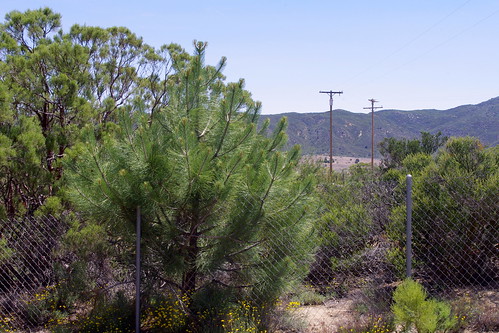
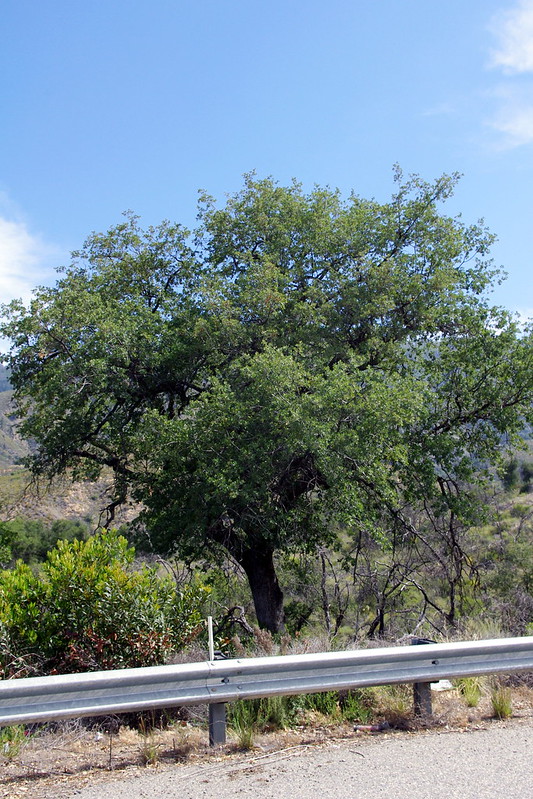
credit: Mine - Foothill Pine (Pinus sabiniana)
Things have to be well thought out and prepared for. Specific Plants need to be selected and the intact wild infrastructure left in place. Knowing the rooting depth and role each species of wild plant may play a major part in remote out planting when it comes to seedling survival. Though I haven't done any habitat creation or establishment in several years, in Spring 2014, I did so up in Ranchita California where my brother lives. He has several acres and a hillside on the eastern side over looking his home which could be landscaped utilizing California Native trees for a northeastern Santa Ana wind break. This area is very windy and dry and so many of the conventional nonnative ornamental plants from the coastal city retail nurseries below will mostly fail up there at 4000'. The trees I chose were an often under used (in my opinion) pine tree called Foothill or Gray Pine (Pinus sabianiana) which is actually pictured above here. This picture was emailed to me in October 2013. The tree was remote planted with no irrigation system whatsoever installed as an life insurance backup. All the trees (which also includes the Engleman Oaks) are doing well and I look forward to going back there this coming May/June 2014 to see and also document their progress. 


by Bob Harms - University of Texas
The first thing I did was walk the hill looking for specific species of chaparral plants which would select for the perfect host as a Mother tree or Nurse Plant depending on their size and knowing something about their root depth penetrating ability. This is more important because you want a species of chaparral which will work as a great facilitator of Hydraulic Lift and redistribution of water from deeper layers of wet sub-soil regions to dryer surface layers where your shallow rooted seedling will be inserted in the surface soil. I look for a Chaparral species that is particularly well known for having root hardware design structure which is called a Lignotuber. This is common with many chaparral plants which have a large burl with multi-branched stems above ground and several major and secondary taproot infrastructure networks underground. The picture at the top is a fantastic illustration of the perfect Lignotuber. While I have used the often demonized Chamise or Greasewood (Adenostoma fasciculatum) with it's potential subsoil rooting depth at more than 60', I actually prefer it's relative which is the common small tree-like Redshank or Ribbonwood (adenostoma sparsifolium) because it has a much tougher and far deeper root structure. Anyone who has tried to dig one of these small trees out by hand with shovel and pry bar knows that each downwards plunging branching taproot is like trying to extract a wisdom tooth. You'll also notice that with a very large and old healthy specimen that of all the chaparral, this plant even during times of drought, the soil within the immediate vicinity of it's roots will be as damp as early Spring soil at the end of a normal rainy season. Since my brother's hillside had no Redshank, I opted for planting the Foothill Pine in between a Scrub Oak and a Mountain Mahogany which also worked fine. The tree doesn't have to be under the canopy of the chaparral, but near the canopy drip-line where the edge of the surface feeding roots will be located. Actually the ecto-mycorrhizae I use will head out away from the seedling looking for just such rich moisture catches. It doesn't necessarily have to directly interconnect with chaparral roots. Once tapped into this system, the tree is setup for increased survival chances, given any herbivore predation from Squirrels, rabbits or Deer doesn't take your tender prize while it's in it's early delicate years of growth. In the photo I found some great chicken wire cages for putting around the tree which appear to have worked out. Below are some of my successes with both chaparral Redshank & Greasewood where I planted the Counter Pines in open spaces between the chaparral in remote planting, with no irrigation and a must inoculation of Pisolithus tinctorius ecto-mycorrhizae. All those things have to be in place. The ecto-inoculent is necessary or the trees will not succeed as well. On a side note, if planting near a scrub oak, the PT Mycorrhizae will also colonize it and tie in together both plants. You will always notice a very marked improvement in the Scrub Oak foliage the following season after the start of Spring after winter rains. You should also find large truffles as well. Now, pay close attention below here.


Photo: Mine
Believe it or not, this tree was a two year old planted in the winter of 2000/2001. It was watered regularly the first couple of months to simulate a wet period, then left to it's own. It stayed small for 3 or four years then shot up like a rocket. The tree is almost as tall as the old growth Redshank which is in the background. Burnt Valley and Lookout Mountain are in the background. You should also take special note that this soil here is extremely shallow with broken decomposed granite rock. I did break through this rocky layer when I created the original planting hole with a heavy steel bar at about two foot down. I reused the same soil as back fill without ANY amendment material added. I never ever use amendment, just fungal inoculum and mulch on the very surface. The soil for me was not a problem as the chaparral was itself old growth and it's massive height indicated it's roots had spiraled through the fractured rock with ease into deeper moister soil layers. The picture below is of the larger Jeffrey & Coulter Pines planted in between the Redshank we planted at Dawson's old place in Terwilliger which is also much hotter and far more lower in elevation than my place on top of Table Mountain. Still, notice the success. Inoculated with PT ecto-mycorrhizae, irrigation in early to middle 1980s and left alone thereafter. Once again, the Redshank Chaparral is the real hero here.
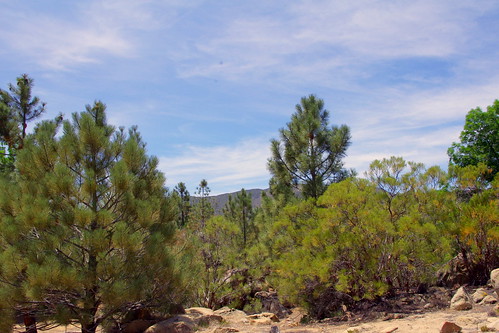
Photo: Mine
~~~~~~~~~~~~~~~~~~~~~~~~~~~~~~
Shifting Gears Here

Microbial breakdown of
rocks magnified
The article from the Oxford and Sheffield Universities was interesting, but it left out so many important details. It narrowly focused on large tree rooting ability to go deeply into subsoils and weather and/or degrade rocks, making more soils. Sure enough, a healthy determined root system can do just that. This is why I have no problem planting trees in what would otherwise be normally viewed as nothing more than horrible unproductive rocky soils. For me those are the best types of geological situations for forest and/or other native vegetation establishment which after maturity should be left entirely alone and untouched. Many things besides an extensively engineered complex root system assist in this mineral breakdown process. First, most notably, both endo & ecto mycorrhizae which are actually colonized on the actual plant root systems are the main players here, along with other beneficial soil bacteria. The roots also will supply water deep into the soil as they move downwards by means of hydraulic descent. Roots alone however will not do this rock breakdown into finer soils. For further information how sub-soils allow for life and breakdown of nutrients which are otherwise locked up and unavailable to plants, please read the information here on the link http://www.ncbi.nlm.nih.gov/pmc/articles/PMC3243026 . I'd post the Abstract and some pertinent bits, but it will be boring for most of you. 

The main message found at that site is that beneficial fungi, algae, bacteria and other microbes can actually unlock nutrients like Nitrogen and Phosphorus which are locked up in a structural form which makes them unavailable to all plants. By taking advantage of already existing cracks and other fractures, this actually leads the way for tree and shrub roots to actually intrude into deeper layers of sub-soils. This in turn allows plants with exceptional ability with regards a phenomena known as Hydraulic Descent to be able to pump water from the surface during the rainy season to these deeper layers to be utilized later during the hotter summer months. Any excess water will be added to deep underground aquifers which have suffered as a result of human misuse and abuse. Aquifers mean higher water tables for which even deserts may thrive with certain plants like Mesquite or Palo Verde designed to withstand those harsh environmental conditions. Below is a beautifully illustrated animation of what takes place all the time within rocky soil structures.


One thing is for sure, we truly don't know the extent to which hydraulic descent of moisture through deeper large old growth roots into much deeper layers of sub-soils actually works and which plants perform a better job at doing this. Still, knowing such valuable information would in of itself be invaluable to the re-forester when selecting just the right plant components for making a success of any ecosystem reestablishment. As stated at the beginning, most of the valuable old growth woodlands of most all ecosystems have only remnants of their former glory and it's a pity because observation is key to any understanding how such plant mechanisms function. We know what happens to geology when vegetation is severely removed. Rains come and wash away much of the valuable topsoil with it's healthy biological components. Soils develop into desertification in many areas and the soil pores close up so tightly that they just seem to fossilize into a type of rock. Any badlands are a prime example. In many cases rebuilding of such an area with re-vegetation in mind requires drastic measures. Perhaps it would be necessary to apply organic matter to the topsoil layers, but only after you perform a soil fracturing task otherwise utilized by those who drill deep holes for planting small explosives for percolation improvement through otherwise impermeable rock/soil layers. Rain alone is not going to percolate into deeper layers of Earth's sub-soil all by itself without the assistance of vegetation. References for last resort of soil impact fracturing: Here 


credit: Greenbelt

Hydraulic Descent during plant dormancy


Add caption
Once a healthy complex infrastructure of plant roots is in place, then other plants may be inserted into the landscape. Understanding these basic fundamentals will make any attempt at ecosystem reestablishment a much greater success. Mostly it is about showing respect for what already exists and following a strict guide line of natives within that particular system. For myself I am mostly familiar with drier climate systems, as opposed to where I find myself presently. If we once again take a journey into the past and view so-called great civilizations which collapsed as a result of drought, we find some amazing similarities as to what is happening today around the globe, but on a far grander scale. A week ago I wrote yet another post on the many romanticized myths about Native American conservation. Now there is no doubt that such peoples had a great deal of knowledge about living off the land, but also many of these cultures made terrible mistakes. One example of this is the mysterious disappearance of the pre-Inca Nazca Civilization of Peruvian deserts.  These are the same peoples many of the crackpot pseudo-scientists claim ancient aliens helped. Mostly they deforested this sensitive desert forested landscape of it's prized variety of Mesquite, the Huarango Trees (Prosopis pallida). This tree is considered a "Keystone Species" because of it's foundational structure within it's environment as the dominant tree. As the photo above reveals, this type of Prosopis had some huge rooting infrastructure capabilities as evidenced by the men who are dwarfed by this rare old growth specimen's immense size. If Arizona's Velvet Mesquite's taproot can bore deep into the earth at record depths between 150' and Africa's Acacia Tortilis on the Savanna even deeper to 200'+, then think what Huarango is capable of. One thing that does fascinate me is that this Nazca civilization along with those of Easter Island people, the Yucatan's Maya Empire, the Colorado Plateau Anasazi and the Cahokia Pyramid mound civilization of the Mississippi River in Illinois all seem to have disappeared much around the same time period. Now these peoples were said to be advanced, but even with their stone aged tools over several hundreds of years, they deforested and destroyed a complex weather creation mechanism which led to their downfall by means of prolonged drought. Now presently at an accelerated pace with an industrial steel mechanized human society, we have in a little over 100+ years brought almost a complete breakdown of an entire global weather mechanism and nobody can seem to agree on anything when it comes to making a correction. None of this is really rocket science here. The picture below taken by Geologist Wayne Ranne on a trip he made through Rajasthan outside Jodhpor India is an excellent example of how desertification could be reserved by even stabilizing drifting Sand Dunes with species of trees like Acacia or Prosopis.


Credit: Wayne Ranne - Jodhpor India, Acacia tree stabilized Sand Dune

Now you can go ahead and read the article from the link below on how Tree roots 'are natural thermostat' (which is a little vague) about how deep roots of trees are carbon sinks in sub-soils, or how Mushrooms are going to save the world, but none of the wishful speculation (though interesting) backed by patents and grandiose hopes of making a fortune with these schemes is going to replace REAL OUTDOORS education and Practical Application of what is observed. Below here is a further explanation of the actual heroes of bedrock breakdown and soil creation along with how they all work in conjunction with all other components within every ecosystem.
Climate News Network: Tree roots 'are natural thermostat'
~~~~~~~~~~~~~~~~~~~~~~~~~~~~
Of Further and Related Interesting Note:
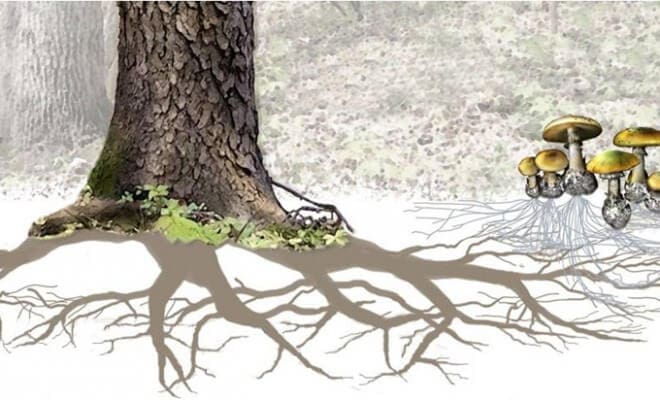
Credit: Greener Ideal (February 24, 2014)

Can Mushrooms Fight Climate Change ?
The link attached to the illustrative animation to the right here is an easier read for most folks. I like the illustration and the constructive mechanisms which are being conveyed in the picture. For most folks such animations along with simplistic paragraphs which speak in glittering generalities on a subject are enough to satisfy. But do such posts really get as much needed information to the public and wet their appetite for more deeper meat and potatoes material ? Does it actually motivate anyone to make personal application with what they read, or is the information considered nothing more than of mild interest and something other people like Scientists will take care of eventually ? There was a better piece published earlier on the same subject which came in January 8th 2014 which also had a similar title: Why Some Mushrooms May Be Magic for Climate Change . This comes from Time magazine's online journal and here are some important quotes from the author of the article, Bryan Walsh who summarizes a good explanation of the processes at work in our forest soils:
"Plants sequester carbon dioxide, but when they die, that carbon enters the soil—a lot of it. Globally, soil is the biggest single terrestrial reservoir of carbon, far more than the amount of carbon contained in living things and in the atmosphere combined. (On a planetary scale, the oceans hold by far the most carbon.) As the dead plant matter is broken down by microbes in the oil, that carbon is released back into the air. The rate at which that carbon leaves the soil can obviously have a major impact on the amount of carbon in the atmosphere, which in turn helps drive climate change."
Of course when you first read this, it seems like the blame for carbon release is by the decomposing of vegetation which causes the CO2 gases. But the real damage is man made synthesized unnatural aerosols into our atmosphere, not swamp gases from nature which have been going on for 10s of 1000s of years with no problem until now. Lately, I have seen some articles blaming trees for the release of their own VOCs (natural aerosols) which mix with industrial particles and cause hazy polluted skies. However, trees have been doing this with no problems until humans stepped up to the plate.
"One of the limits to the growth of those decomposing microbes is the availability of nitrogen in the soil. Living plants and soil microbes compete for nitrogen, and the less nitrogen is available to the microbes, the slower decomposition is—and the more carbon remains in the soil, instead of outgassing into the atmosphere. This is where the fungi come in. Most plants have a symbiotic relationship with mycorrhizal fungi: the fungi extract the nitrogen from the soil, and make it available to the plants through their roots. But according to a new study in Nature, one major type of the symbiotic fungi can extract nitrogen much more quickly than other types—and that in turn slows the growth of the competing microbes and leaves much more carbon locked away in the soil." 
Keep in mind also that even if fungi and bacteria are real heroes, they are also subject to the same deadly chemical pollution which kills other living things. Acid rain from industrial regions is also a killer of these organisms. As tough as we all would like to believe the microbial world is, they too have limits as to what they can withstand, often times it's the negative pathogenic microbial types which flourish as a result of the imbalance. This in turn creates the unfortunate and unfair bad reputation against all things microbial.

Researchers from the University of Texas, Boston University and the Smithsonian Tropical Research Institute ran computer models on data from more than 200 soil profiles from around the world. They found that soils dominated by ecto- and ericoid mycorrhizal (EEM) fungi contain as much as 70% more carbon than soils dominated by arbuscular mycorrhizal (AM) fungi. That’s because the EEM fungi produce more nitrogen-degrading enzymes, which allows them to extract more nitrogen from the soil. They essentially outcompete the soil microbes, which slows down their ability to decompose dead plant matter and return carbon from the soil to the atmosphere. “This analysis clearly establishes that the different types of symbiotic fungi that colonize plant roots exert major control on the global carbon cycle, which has not been fully appreciated or demonstrated until now,” said Colin Averill, a graduate student at the University of Texas and the lead author of the paper.
That relationship between the different types of fungi and plants is so important for the carbon cycle because it’s independent of temperature, precipitation, soil clay content and all the other variable factors that can influence plant growth and soil content. Perhaps unfortunately for us, though, AM fungi symbiosis is far more common, occurring in approximately 85% of plant families, while just a few plant families have a symbiotic relationship with EEM fungi. That could change as the composition of forests change, however, but we wouldn’t know the effects until scientists add the role of the different kinds of symbiotic fungi into global climate models, which they have yet to do."
“This study shows that trees and decomposers are really connected via these mycorrhizal fungi, and that you can’t accurately predict future carbon cycling without thinking about how these two groups interact,” said Averill. “We need to think of these systems holistically.” 
~~~~~~~~~~~~~~~~~~~~~~~~~~~~
Some Conclusions
"Planes, Trains and Automobiles"
Most of the articles coming out these days start out with a flashy sexy headlines to capture the imagination of an otherwise disinterested short attention spanned public with severe "Nature Deficit Disorder". Sensational phrases or words/terms like, "For the first time . . " or "Mushrooms can save the world" are meant to entice the reader into believing there actually are newly invented quick fix materialistic approaches which are so simple, as if they have just been under our noses all along. Most articles never really address or actually stress that the irresponsible stupid behavior of human beings has be STOPPED first, before any correction being implemented if there is to be any success at all. Much like the Doctors I interview who have patients who refuse to stop living a Chain Smoking or Boozing lifestyle, all the time believing and insisting there is just some magic pill the Doc's can prescribe to make the consequences go away. The photo above I have used before where John Candy and Steve Martin get stopped by the Police Officer and provide an otherwise humorous, but at the same time idiotic excuse as to why they should be allowed to be on their merry way. From an environmental point of view, the scripted conversational text between out of touch human beings with no clue and Researchers who see where the Natural World is headed could read like this: 
Humans: "Top of the morning to you Researcher, is there something we can help you with ?"
Researchers: "What the heck are you doing to your environmental surroundings ?"
Humans: "Well we've had a few disastrous industrial science mishaps happen recently ?"

Researchers: "Do you have any idea how accelerated you've pushed the natural world to the point of total breakdown ?"
Humans: "Well It's hard to say with any degree of accuracy just exactly how far we've run things into the ground."
Researchers: "Do you feel this planet is still safe enough to live on ? You've pushed things to the limit, are almost out of fuel and there are no foreseeable Services for the next 100 years"
Humans: "Well, yeah. we can buy that. Sure. You'd know better than us, especially since our weather mechanism thermostat's been melted down with global warming."
Researchers: "Do you feel this planet's life sustaining mechanisms are intact and still safe enough for sustaining life  ?"
Humans: "Yes, we do. The Earth's no longer as pretty as it once was, but it will get you where you want to go."

Researchers: "You've got no rainfall, no clear skies, failing economies and no properly functioning weather mechanisms, is that about correct ?"
Humans: "No not a one, However our Laptops, TV and iPads still work. Funny as that may seem, and also on that weather thing, we've been told that GMOs and Geoengineering are going to save everything. And you, anyone who doesn't believe those things will problem solve for us are, well, just anti-science" 
Okay, Okay, enough of the snarky superciliousness!  
Well, I'd post other references, but you know, it would be water off a Duck's back! 

Thursday, February 27, 2014

Wow, So Trees Cause Cloud Formation and Create Climate ?

Problem is, will anyone listen, let alone read the info ?


This is Finland's Hyytiälä Forest, where
researchers collected field measurements,
in early spring.
First off folks, this really is not News. I'm amazed at the amount of info coming out lately as to vegetation's actual role in cloud and weather creation along with overall climate moderation and long term and sustainable  maintenance. Yes, more and more research is available which explains the fascinating role with which various healthy forests and other types of plant communities contribute heavily to global atmospheric weather mechanisms. Weather & climate it appears is far more than just mere physics, it also has a biological component. Oh my, how did  that happen ? And yet, you can almost count on this all being ignored and shoved under the carpet in favour of more politically heated subject matter in the need to beat the right wing fundies and vice-versa from the other side. Meanwhile Nature and the rest of humanity take it in the backside while a handful of power obsessed ideologues argue over who's got the bigger pot-gut for brains. Below here I'll post several pertinent quotes about a forest's amazing ability at cloud formation. Added to the list of VOC aerosol producing cloud trees like Maples and Oaks are trees like Pines and other coniferous trees which comes from a study in Finland where forest trees of Boreal and Temperate ecosystems are now recognized as invaluable components as weather mechanism creators & drivers.
Pine forests are especially magical places for atmospheric chemists. Coniferous trees give off pine-scented vapors that form particles, very quickly and seemingly out of nowhere.  New research by German, Finnish and U.S. scientists elucidates the process by which gas wafting from coniferous trees creates particles that can reflect sunlight or promote cloud formation, both important climate feedbacks. The study is published Feb. 27 in Nature. 
“In many forested regions, you can go and observe particles apparently form from thin air. They’re not emitted from anything, they just appear,” said Joel Thornton, a University of Washington associate professor of atmospheric sciences and second author on the paper.
Scientists have known for decades that gases from pine trees can form particles that grow from just 1 nanometer in size to 100 nanometers in about a day. These airborne solid or liquid particles can reflect sunlight, and at 100 nanometers they are large enough to condense water vapor and prompt cloud formation.
University of Washington: "Pine forest particles appear out of thin air, influence climate"
Interestingly, this understanding has actually been known for many many years, but only recently becoming more and more republished from archived information and research being pulled out of the dungeons of libraries where historical work was shelved because it was an inconvenient exposure of the failure of Human leadership at  proper custodianship of the Earth. They are now forced to reckon with these incredible mechanisms of climate drive because those same powerful forces of nature are presently turning on mankind. There was one statement in that article which truly illustrates the purposeful ignorance of those in charge of climate correction and here it is below.

The study shows the chemistry behind these particles’ formation, and estimates they may be the dominant source of aerosols over boreal forests. The Intergovernmental Panel on Climate Change has named aerosols generally one of the biggest unknowns for climate change.
Seriously ? So they labeled aerosols generally one of the biggest unknowns for climate change ? The truth is they have actually known about this for decades. Irresponsibly clear cutting forests by unbridled unregulated profit making Corporate Venues around the globe has resulting in the desertification in many areas of the earth. Cut down any vegetation in a wholesale manner and clouds are less likely to form as well as historical seasonal rainfall totals becoming far less as well. And it doesn't take a scientist or genius to recognize this either. The average lowly developing world farmer (someone actually more connected to the land and it's subtle changes) has seen this coming for years and is mostly helpless against a growing powerful corporate entity blessed by most governments who bulldoze right in and take their land, often by force. But there were some other interesting things they found by means of experiment.

In the new paper, researchers took measurements in Finnish pine forests and then simulated the same particle formation in an air chamber at Germany’s Jülich Research Centre. A new type of chemical mass spectrometry let researchers pick out 1 in a trillion molecules and follow their evolution.


Felipe Lopez-Hilfiker, UW
Results showed that when a pine-scented molecule combines with ozone in the surrounding air, some of the resulting free radicals grab oxygen with unprecedented speed.  “The radical is so desperate to become a regular molecule again that it reacts with itself. The new oxygen breaks off a hydrogen from a neighboring carbon to keep for itself, and then more oxygen comes in to where the hydrogen was broken off,” Thornton said.
Current chemistry would predict that 3 to 5 oxygen molecules could be added per day during oxidation, Thornton said. But researchers observed the free radical adding 10 to 12 oxygen molecules in a single step. This new, bigger molecule wants to be in a solid or liquid state, rather than gas, and condenses onto small particles of just 3 nanometers. Researchers found so many of these molecules are produced that they can clump together and grow to a size big enough to influence climate. 
Boreal or pine forests give off the largest amount of these compounds, so the finding is especially relevant for the northern parts of North America, Europe and Russia. Other types of forests emit similar vapors, Thornton said, and he believes the rapid oxidation may apply to a broad range of atmospheric compounds. 
“I think a lot of missing puzzle pieces in atmospheric chemistry will start to fall into place once we incorporate this understanding,” Thornton said.
Yes, it is interesting Mr Thornton, but I wouldn't hold my breath on this having much meaning in these stupid climate debates at least from the scientific side. Why you ask ? Because nothing is actually being proposed that even remotely attempts to heal what has been lost. Discovery World's series called "Project Earth" is loaded with nothing but kooky far out bizarre inventions created from someone's  imagination steeped in Sci-Fi World with it's host, businessman billionaire Kevin O'Leary incessantly chanting after some researcher explains how the stupid thing works, "Yeah but can we make $$$ with it ?" Seriously, it's like being in a McGuyver episode where you've got mere minutes to survive a catastrophic situation and you start questioning Mac's idea before he implements his brilliant scheme into action to see if it's been patented or not first. But back to our reality, there's absolutely no more time here at this point, so  you do what you responsibly can to reverse the damage. But in order to truthfully make it a success requires that you employ biomimicry of Nature which has worked for countless thousands of years, not some tantalizing Geeky proposal suggested by someone who's left the reality of the Natural World and gone over to the Dork Side of the Farce . Now let me tell you something about this link I just published before here. Okay, so yes I used a snarky play on words, but the reality of what those Experts are proposing is simply stupid. I previously wrote about my work involving the pharmaceutical industry with regards research data collection. Most of the General Practice Doctors and Specialists told me the hardest thing they have is patient compliance and making lifestyle changes. Patients who chain smoke cigarettes refuse to give them up and demand the doctor do something about it by means of prescribing a drug. Drugs ONLY are an attempt at counteracting the negative side effects brought on by the person's irresponsible lifestyle. The proposals out there in the science-world that get so much attention in the media are asinine and absurd, but they have great Sci-Fi entertainment value which is great for ratings. In no way are there any viable options for actually tackling the causes of climate change. It's all about countering the negative side effects by an otherwise technologically Zombied public who are experiencing the debilitating effects of Nature Deficit Disorder.


Credit: © Pakhnyushchyy / Fotolia
Another related story to this University of Washington one was the actual account from the Jülich Forschungs Zentrum (Jülich Research Center) itself where the actual aerosol measurements and experiment actually took place. They found that the vapours can condense on small aerosol particles (starting from clusters of only a few nanometres in diameter) suspended in the air, causing them to grow to around 100 nanometres, at which size they can not ONLY reflect incoming sunlight, but also act as a condensation nuclei for cloud formation in the atmosphere. Again, keep in mind that despite the language in the article, this is not newly discovered. Maybe it is to these individuals, but others have known about this for perhaps decades, but it's simply been ignored until recent times. To be honest, there are time when I don't know how much of this stuff is the Scientist & Researcher, or some over zealous journalist embellishing the findings to create a News event sensation. 

The researchers' findings have bridged a major gap in knowledge in atmospheric and climate research. "Thanks to our much improved understanding of the role that naturally occurring substances in the atmosphere play in the formation of organic aerosol particles, we will in future be able to make more reliable assessments of their impact on cloud formation and sunlight scattering, and thus on climate," says Dr. Thomas F. Mentel from Jülich's Institute of Energy and Climate Research -- Troposphere (IEK-8). 
Experts consider a good understanding of the relationship between the increase in soil temperature, plant emissions, aerosol formation, and cloud formation to be essential for predicting future climate development correctly. "Our current research findings will help to improve computer models of the atmosphere and reduce existing uncertainties in climate prediction," says Prof. Andreas Wahner, director at IEK-8.
Source: Major Enigma Solved in Atmospheric Chemistry
~~~~~~~~~~~~~~~~~~~~~~~~~~~~
Some Final Thoughts:
You know the truly sad thing here ? There is not one viable option or proposal to rebuild the Earth's various  vegetative ecosystems as a means of reversing what mankind has done. They have the knowledge and understanding, know what exactly should be done, but not one makes sense deal on the table. The problem is the various world economies around the globe need to be built. That's why the Project Earth Fix-It-Pill approach is only being offered. Yes I know all about the various forestry pilot programs from grant monies being done around the globe, but we need more than a handful of pet projects back by token research grant monies provided by some charitable source given with the understanding that some plaque of dedication be created honoring them. The real problem is the human component, not some materialistic technological innovation. The problem is that Science while supposedly offering all these wonderful ideas, really cannot deal with changing human behavior which is the source of our problems in the first place. How do you get mankind to voluntarily and for the right reasons do the correct thing in the way they live ? You don't! There is no way humanly possible to do that. Do you think more laws and regulations, short of outright Marshall Law is the answer ? Here in Sweden they had a program of plain clothes undercover Eco-Gestapo forcing people to put the proper recycle waste in just the right receptacle container or be given a citation and that was a total monetary failure. This info is not posted to change world policy. Doing so would to be under the delusion that they will ever unite in the first place. That is never going to happen. It is however here for individuals who actually care, get a clue and will make personal and practical application in their own personal lives.

Also, keep in mind and be aware that there have been and will continue to be many attempts to use such information as a means of justifying and promoting the irresponsible practice of geoengineering. In other words another fix-it-pill approach to put the brakes on consequences and other side effects as opposed to nipping the cause in the bud. Lately their have been many articles that attempt to explain the slowdown of warming tread as coming from recent volcanoes. See Here . The problem is that even such findings and acknowledgement of what forests do as referenced in the articles above and others published on this site will be used as an excuse to dropping tonnes of chemicals in a last ditch effort emergency to curb climate change side effects. You can even read about this stupid proposal Here . Even NASA has long known about all the various known aerosols and their effects on climate and pollution Here . Healthy forested ecosystems and other plant communities are the solution. But even the scientists stress that the new understanding is not a panacea for climate change as forests can and will stop emitting VOCs or cloud forming aerosols if they become too stressed from heat or lack of water. So the ridiculous scheme of having a squadron of retrofitted Bombers with industrial sized spraying apparatus to spew tonnes of potentially harmful chemical aerosols into the atmosphere would not only cost massive amounts of money, but most likely do nothing as far as climate improvement. One possible consequence would be the increased chemical buildup over time on the ground in Nature killing many of the beneficial soil microbes and other organisms which actually create function within all plant ecosystems. On the positive note for some, a handful of special interests will make a killing of this, both figuratively and literally. 
~~~~~~~~~~~~~~~~~~~~~~~~~~~~
References of further interest: 
Previously I have written about the anomalous anti-bacterial properties of wood here with my post PLASTIC Vrs WOODEN CUTTING BOARDS . Now in a related note both with regards pine trees, water and filtering of bacteria we have this post released yesterday. MIT group shows xylem tissue in sapwood can filter bacteria from contaminated water.
Need a water filter? Peel a Pine tree branch

Image Courtesy of the MIT Researchers
A false-color electron microscope image showing E. coli bacteria (green) trapped over xylem pit membranes (red and blue) in the sapwood after filtration. If you’ve run out of drinking water during a lakeside camping trip, there’s a simple solution: Break off a branch from the nearest pine tree, peel away the bark, and slowly pour lake water through the stick. The improvised filter should trap any bacteria, producing fresh, uncontaminated water. Well actually it's not that simply, but there is some more potential with proper biomimicry. 
On another more ecosystem and climatology note there is a related website and research institute in Germany from the Technical University at München called Ecoclimatology Institute. Here is the link and research articles dealing with climate change effects in the Alps and weather effects on increased forest fires in Bavaria. Who knows, maybe they've coined a new expression here, something similar to Bioclimatology.

Chair of Ecoclimatology

Thursday, February 20, 2014

A Classic Picturesque Engelman Oak Scenery Gone Forever

The 2007 Poomacha Fire was the beginning of the end for the picturesque Engelman Oak woodland settings around those hairpin switchbacks of Hwy 76 on Palomar Mountain west of La Jolla Indian Reservation. And for that matter other associated plant communities.
NASA satellite photo (provided by NSPO, Taiwan National Space Organization)
 from October 23, 2007, showing the active fire zones and smoke plumes.


Hairpin switchback on Hwy 76 at Palomar
I almost want to start out making an apology for never once thinking of taking photographs for future historical reference of what once was. How often lately I have written about many things I know and have experienced, but like many other Natural World accounts, I too can only story tell what I've experienced. This particular specific location where 76 sharply spirals down hill had numerous picturesque and contorted Engelman Oak trees which were reminiscent was something you would see only along ridges in tropical rainforest mountaintops. 


Courtesy Scott Turner, Escondido CA
The often twisted but picturesque patterns of some trees are often much like the wildlife pruned Acacia tortilis of the African Savanna. California's Engelman Oak is actually interesting that way in that it seems to self-prune into itself into interesting more open patterns than the common dense forms of the various Live Oaks. You'll often see them in what could be considered Southern California's own form of Oak Savannas like those of Central California foothill regions. The best view in the past was driving past the Palomar Mountain junction turnoff and heading west from La Jolla Indian Reservation. It was from this high vantage point that one could see out towards the west the patterns clearly and distinctly. Sometimes I'd pull over on one of the viewpoint turnouts just to take it all in. And yet never once did I ever consider to photograph it for future reference. I always and mistakenly assumed it would always be there. In the times we are presently living in, nothing should be taken for granted as if it will always be there. But I did photograph this region this past Spring of 2013. Before I arrived, I truly wished this spot had escaped the horrible onslaught of the Poomacha Fire of 2007. No such luck. Below here is basically a gallery of what is left.


Photo: Mine
Before dropping down and spiraling into the back and forth switchbacks, you'll see the western edges of the Palomar Mountains which I believe is the Agua Tibia Wilderness. The area was blitz heavily by this fire. I watched it all late night over here in Sweden as both the Witch Creek and Poomacha Fires did as they pleased. I read through the pages of the online San Diego Union where a concerned wildlife enthusiast hiked up Pauma Creek where remnants of the native Southern California Stealhead Trout were located and they were still some in tiny pools alive but just barely. The danger of course was the coming winter rainy season which would have filled these pools with tonnes of silt and other sediment and debris. He alerted what he thought were the correct officials to send teams in to rescue the trout before the disaster which was sure to happen. As is usual, it was insisted that certain studies would need to be performed followed by discussion. However, it did appear some made it but many many areas didn't and some pools disappeared under tonnes of debris. It will of course take years of winter rains and normal high water flows to scour out those pools once again, but of course there is that present decades drought problem. The story can be followed here on the San Diego Trout's own website. Very interesting read with many photos of before and after in the referenced links
http://www.sandiegotrout.org/archive.html 


Photo: Mine
This is yet another photo taken which is actually further east near the San Luis Rey River Campground. The dead trees are those of the tough Big Cone Douglas Fir trees which I always associate more with Chaparral than I do other forest trees, although they do mix with other large trees. They have the ability to survive and actually thrive on hot steep southern slope where no other tree can succeed. Well, other than Engelman Oak which has a survival strategy of being drought stress deciduous and partially sheds half it's leaves in desperate times if need be. Big Cone Doug fir will actually sprout from the truck and branches again, something the other native conifers are not capable of doing. Mountain Center California has prime examples of this sprouting after fire along Hwy 243 if you know where to look for them.


Photo: Mine
This is the last open space of meadow just before you start dropping down into the steep switchback of the Pauma Grade on Hwy 76 where Pauma Valley and the Rincon Reservation / Casino which are are below. I wonder how many people have actually passed by here before and never truly appreciated the scenery before the fire took it away ?
Photo: Mine
Now finally coming around that first turn to the left on the Hwy 76 switch back where you start to grasp the more open view of the hilltop and ridge terrain scenery and of course one this shot is from the first turnout location you come to. This view shows some trees still intact and making a recovery of sorts, but looking nothing like their former glory. You also can see where many did not survive the fire to make the survival journey at all as the dead snags clearly indicate. Still there is enough holdover evidence of the areas once dominant ecosystem of Engelman Oak woodlands.


Photo: Mine
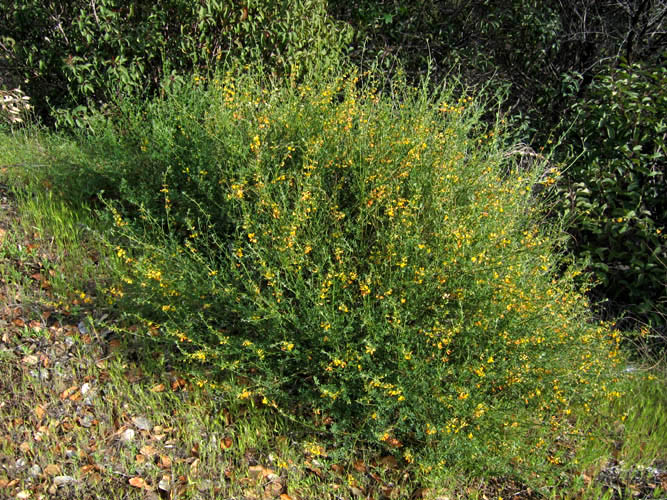
Same exact turnout as in the photo above this one, but the camera angle is further to the left looking directly across the other side of the road up the hill at the Engelman Oaks that survived. Notice the heavy cover of White Sage (Salvia apiana). This is common after fire. Fire to appear from my own observational view since the middle 1960s is that Deerweed (Lotus scoparius). Everyone should know that in many chaparral settings, especially nearer the inland valleys and coastal areas, these two shrubs are the first to comes back after fire wipes out the mature California Buckwheat / Sagebrush along with Laurel Sumac. In the old days after a fire tore through an area, the initial Springtime explosion of numerous varieties of wildflowers would be the first stage recovery component, followed by Deerweed which would blanket the hillsides for the first several years with White Sage moving in only to eventually overwhelm them. White Sage at the beginning will be huge, but will eventually yield to the California Buckwheat & Sagebrush. White Sage will always be present thereafter, but in a much smaller form. Laurel Sumac will sprout from the root crown immediately after the fire if moisture conditions are healthy in the sub-soils. It is these plant components which government agencies will almost always want to bypass, and clear the land by stripping it to the bare earth and immediately proceed to plant oak or other more desirable tree species if they were present in the location formerly. Especially is this true if the area were an officially designated Preserve or Park where the Public demands they do something quickly about restoration. Rather than actually educate the public as to the necessary role the early plants play in land revitalization as far as progression provides, they opt for a quick fix eye candy approach of replacing trees immediately with public approval. This is a shame because a healthier survival rate is produced and the earlier forage is better for the animal recovery. But always remember, these places are about pleasing people, not wildlife.

Photo: Mine
This is the second turnout looking back up back across the Hwy 76 road again to the east. The lower areas where most of the one time picturesque Engelman Oak trees once existed were much harder hit by the raging Poomacha Fire. Most were gone and those that were trying to come back were struggling. Only a few single seemingly untouched looking specimens appeared as lone comebacks. Ones like this next picture below here.

Photo: Mine
 Same second turnout location, but this photo faces north towards the western edge of the Palomar Mountains which are in the background to the north. Around this particular tree were numerous wonderfully lush green examples of California Holly or Toyon as can be seen just behind the guard railing. You'll notice all the brown on the lower part of the shrub ? All over San Diego County on my road trip almost all vegetation was dead and brown from the ground up to a meter in height. This is San Diego County and CalTrans way of road maintenance of their roadway easements by means of chemical pesticides.


Photo Courtesy of OneOakGrowers
I wish years ago more people had known about Engleman Oaks as far as landscape value. I wish I had done more with them. Tough little trees which need very little care if started off properly. Now there are desperate times with water becoming an even greater issue than at any other time in history. They are picturesque and seem to naturally self prune as I have already mentioned. They are not as dense as the heavier foliage Live Oak tree species. While Lives Oaks in nature require perhaps a deeper bottom land valley soil, the Engelman Oak can survive and actually thrive in some of the nastiest looking shallow rocky soils with often times a mix of adobe or red clay and on a southern exposure. Seriously, what other tree survives and thrives under those conditions ? 
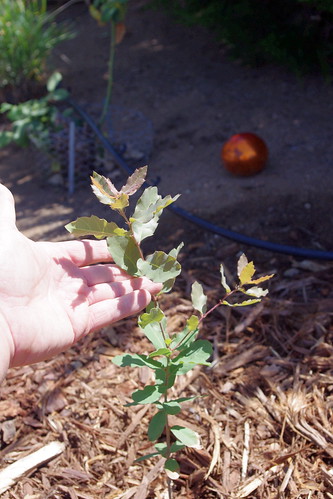
Before returning to Sweden, I actually planted some Engelman Oak tree seedlings at my mother's and brother's places. At my brother's place I also planted Foothill Pine (Pinus sabiniana)  in carefully selected locations near deeply rooted chaparral and Scrub Oak this past 2013 Spring before leaving to come back here. I simply planted in non-amended native decomposed granite soil and also inoculated the soil with a diverse mycorrhizal mix from Mycorrhizal Applications Inc. I kept tabs on their continual progress  from my mother and brother up in Ranchita and from what I was told, everything did exactly what I explained would happen. Hence I am excited to come back and find out just how well everything has progressed thus far. I have written a couple of other posts on the Engelman Oaks last year and will write another this coming June 2014 as I will again be out there. I'm also curious if any truffles will be found near by. I am also curious if the surrounding native Scrub Oaks have also improved in their leave cover and lusher vitality. This is also my experience after inoculating during the second year. Below I'll link again to my former posts. I'm sorry that most people reading this will never see what once was in their lifetime. Like the 2003 Cedar Fire before them, no one reading at present will ever experience the wonderful biodiverse old growth forest which once was Rancho Cuyamaca State Park. The real danger is that with so many more people and so much irresponsibility going on around the globe screwing up the climate, things will never be the same. More wildfires will mean less and less permanent recovery if they occur year after year. Below here is an example of a month and a half growth after planting before I came back to Sweden. It is said to be double that height now. The drip in the back ground is to the rose bushes, not the Oak sapling. Water was actually withheld after initial first week. 

Photo: Mine

Engelman Oak Sapling in El Cajon California
~~~~~~~~~~~~~~~~~~~~~~~~~~~~
Further reading References:
Engelmann Oak (Quercus engelmannii) an Often Ignored Native in the Landscape
What We Need Here is Wildfire to Propagate !!!
http://www.californiachaparral.org/

Thursday, January 16, 2014

Air Pollution harms Native Chaparral Plants and increases the Wildfire risk

Photo: National Park Service.
This was certainly no surprise to me. I have been wondering about this possible phenomena nitrogen enrichment actually degrading native vegetation for a couple of decades now by destroying the underground mycorrhizal network and creating a more favourable nutrient enriched soil which converts the healthy symbiotic mycorrhizal fungal grid system to a bacterial one that favours non-native weeds (Ruderals). Well low and behold there are finally others who've gotten a clue about this by actually researching this very real possibility. The study which was done in the Santa Monica Mountains did indeed show harm not only in the degenerative effects of Chaparral native plant seedling regeneration, but also a favourable system for various weeds and other non-native grasses which are labeled as flash fire plants. The photo above right shows Interns measuring plots of California Sagebrush that have been injected with various levels of nitrogen as part of a three-year study to learn how air pollution is impacting native plants and increasing the fire risk. Below is the actual article:
Date: January 14, 2014  
Contact: Kate Kuykendall, 805-370-2343 
THOUSAND OAKS, Calif. Initial results from experiments conducted in the Santa Monica Mountains indicate that high levels of nitrogen may adversely impact native plants and, by extension, increase the risk of wildfire.
"No one will be surprised to learn that our data shows increased air pollution on the eastern end of the mountains, closer to Los Angeles," said Dr. Irina Irvine, restoration ecologist for Santa Monica Mountains National Recreation Area. "What's more intriguing about this study is learning how high nitrogen levels affect native vegetation and what that might mean for fire risk in such a fire-prone region."
The preliminary results are from the first year of a three-year study undertaken by Irvine, UC Riverside's Dr. Edith B. Allen and the U.S. Forest Service's Dr. Andrzej Bytnerowicz and Dr. Mark Fenn.
Researchers measured atmospheric nitrogen deposition levels at 10 sites throughout the Santa Monica Mountains and found significantly higher pollution levels in the eastern end (See map) . At the two sites with the best air quality, they added various levels of nitrogen into experimental plots of coastal sage scrub to simulate pollution levels found throughout the mountains. 
Higher levels of nitrogen led to a decline in native shrub seedlings and an increase in nonnative grasses. Other studies in Australia and California have demonstrated a link between nonnative grasses, also known as "flashy fuels," and larger and more frequent wildfires.
Funded by the National Park Service's Air Resources Division, the $100,000 study will help scientists better determine the "critical load" when vegetation shifts, causing alterations to the structure and functionality of ecosystems. Coastal sage scrub once covered much of coastal California and is now an endangered habitat type, primarily due to development. 
Generally attributed to vehicle emissions in the Santa Monica Mountains, nitrogen deposition is the air pollution from industry, agriculture and transportation that settles out of the atmosphere and onto the earth's surface.
Santa Monica Mountains National Recreation Area (SMMNRA)is the largest urban national park in the country, encompassing more than 150,000 acres of mountains and coastline in Ventura and Los Angeles counties. It comprises a seamless network of local, state and federal parks interwoven with private lands and communities. As one of only five Mediterranean ecosystems in the world, SMMNRA preserves the rich biological diversity of more than 450 animal species and 26 distinct plant communities. 
Visit: http://www.nps.gov/samo/index.htm
UC Riverside's Plant and Botany Sciences Department conducts cutting-edge research in plant biology to advance fundamental scientific knowledge and solve critical issues for the state of California, and educates and trains graduate and undergraduate students to become science professionals and informed global citizens. 
Visit: http://plantbiology.ucr.edu 
USFS Pacific Southwest Research Station develops and communicates science needed to sustain forest ecosystems and other benefits to society. Headquartered in Albany, Calif., it has research facilities in California, Hawaii and the U.S.–affiliated Pacific Islands. For more information,  
(source)
Warning: You should know the California Chaparral Institute's owner, Richard Halsey, has dismissed this research as of little account & flawed. Whatever! 😒
Photo: Joe Decruyenaere

Adenostoma sparsifolium and Ceanothus megacarpus,
upper Stunt Canyon, Santa Monica Mountains
~~~~~~~~~~~~~~~~~~~~~~~~~~~~~~~~~~~~~~~~~~~~
(Update: Jan 17, 2014)
The above article is fascinating and certainly revealing of what is happening out there in the Natural World not only at present, but has actually been going on for the last several decades. It is popular today to blame everything wrong with the Earth as global warming. Global Warming has always been a lousy title for describing what is going wrong with the Earth, especially climate. But there are so many natural components to ecosystem breakdown that very few of the Experts seem capable of putting all the pieces together. Yes there are these CO2s exacerbating the problems with regard climate, but there is so very much more. Almost all of Earth's old growth vegetation systems are being depleted and if you have read much within these "Earth Internet" archives, you've come to realize from the references provided, along with my personal observation and practical application (without practical application, any knowledge or understanding is completely useless), that science for decades has known about the major role playing that healthy vegetation (& not just this love affair with Rainforests love, not that there is anything wrong with rainforests mind you) play in global cloud formation, seasonal rainfall and overall global climate moderation. But vegetation breakdown doesn't simply happen by means of climate change. From the above article, clearly it is a mechanisms issue. If there is a breakdown in the adjoining plant components like beneficial fungi or bacteria, then the bad health and eventual death of vegetation won't need to experience drought for total shutdown. 

There have been other articles in the past, some decades ago alluding to this potential problem in the future. But guess what ? The future has arrived and with a vengeance. For example this paper (here) by Duke University in 1993, which suggested that, "Increased nutrient availability reduces vesicular-arbuscular mycorrhizal (VAM) associations with plants". Of course complete understanding then was not what it is now, but at least they were giving this as a possible future issue. But then there was another paper in 2003 by the Ecological Society of America, who has a commitment to soil ecology and rebuilding ecosystems. They had a great piece on this same issue, which clearly had gotten worse since the studies since 1993, and there was a great illustration inside this piece which unfortunately I cannot link to anywhere, but I've substituted one below from another site for learning purposes only. 

Illustration - semanticscholar.org

The subject in the paper was, (nitrogen enrichment alters mycorrhizal allocation at five mesic to semiarid grasslands) and the illustration in that paper as you scroll down at page #1897 had an animation of two grassland plants, on the left with normal healthy microbial soil and on the right, soil with nutrient enrichment of nitrogen. The left side had far more roots and mycorrhizal networking associated with the plant, the one on the right dramatically less root and fungal colonization. Now look above left at the photos. This is a Pine seedling colonized on the right with ecto-mycorrhizae,  Pisolithus tintorius and the photo on the left has been digitally altered to remove the fungi in the picture and reveal the lack of enhanced mechanism which the the fungus offers the plant for vastly improved growth and survival. The nitrogen nutrient enriched soil will destroy this mycorrhizal colonization of the plant as represented by the picture on the left. This destruction is actually a removal of a major extensive network plumbing network which is extremely efficient at providing 200% more water and nutrients the plant would otherwise not receive on it's own. You can test this out yourself in your own healthy organically maintained landscape, if you even have one, by changing your maintenance regime to Scotts Miracle Gro or any other Industrial Science produced product sold at your local hardware. But rather than do this, take not only my word, but the studies done on this. Over decades this nitrogen(& other nutrients) has built up in our wildland soils to the point of where concentration levels have increase so much, we are now seeing the unhealthy effects of most all vegetation foliage. This is especially true in the western USA where dead or dying ecosystems are now not only a horrible habitat for wildlife, but even more of an increased wildfire hazard. It also offers clues as to why there would also naturally follow the present  breakdown in weather creation and maintenance mechanisms around the Earth.
(Further Update February 16, 2014)
University of Minnesota study finds, Fertilization destabilizes global grassland ecosystems
(earlier July 3, 2013) Study reports on declines in ecosystem productivity fueled by nitrogen-induced species loss
University of Nebraska - Lincoln "Worldwide study finds that fertilizer destabilizes grasslands"
 Nutrient Network: A Global Research Cooperative
Further research is also being conducted on the possible negative effects of Biocrustal degradation in deserts as a result of nitrogen nutrient enrichment. Here is an advert looking for research participants for a project running from Spring of 2014 to 2015 at the University of Las Vegas. This was originally posted at my attention from Mathew Bowker's site. Clearly, no living ecosystem is immune from the effects of nutrient enrichment where it doesn't belong.
Biological Soil Crusts: The Role of Trampling, Climate Change and Nitrogen Deposition in Affecting Community Species Composition
 ~~~~~~~~~~~~~~~~~~~~~~~~~~~~~~~~~~~~~~~~~~~~
(Further Update February 19, 2014)
Another interesting article on a little plant called Duck Weed in ponds or lakes. Often times demonized for taking over and becoming weedy. Over fertilization of waterways or otherwise known as Eutrophication, is actually what is responsible for this excessive growth of Duckweed. Much like the pea soup green of an algal infested pond, it's the human overuse of fertilizers or other nutrient enriched runoff from streets during rainstorms which fuels the population explosion other organisms. It is not the fault of the organisms, but rather once again human error. Needless to say, this was also an enlightening article. It reveals how duckweed has been  been used to clean up contaminated waters and as a source to produce pharmaceuticals. Now as a source to create biofuels. Still, it's human cause imbalances in nature which trigger the imbalances.
Pond-dwelling powerhouse's genome points to its biofuel potential
Now, continuing on with an even later article from the same Ecological Society of America recently in 2011 entitled: Using Air Pollution Thresholds To Protect And Restore Ecosystem Health  which deals with the same issues of air pollutants and their effects on the environment as a result of their prolonged accumulation over time in the soils. The USFS also did a reprint of it (here). It's this accumulation factor over time that I have also wondered about which may further make invasive weeds & other non-native grasses gradually more and more successful over the past decades. These were most always bottomland dwellers as a historic rule. They thrived where traditionally an accumulation of nutrients from much higher elevations over time build up in mountain meadows and/or lower elevation valley floodplains. They thrive in a nutrient higher bacterial setting, not a nutrient poor mycorrhizal setting on mountain tops. However nutrient poor such a setting is on mountains, it nevertheless suits the chaparral plant community perfectly. Clearly there is more we need to know about how this system works so successfully. When I was a kid growing up in El Cajon and if Rattlesnake Mountain or any other wild region did catch fire, the following Spring after Winter rains, it was mostly native wildflowers smothering the landscape, many of which are nitrogen fixers as part of Nature's soil rehabilitation mechanism which would appear in complete cover, only to gradually disappear or rather become smaller and more inconspicuous as chaparral took over in the gradual natural progression or plant succession. Take a look at the picture below posted on David Senesac's blog where he photos still pristine areas after fire in western Riverside County CA.

Photo by David Senesac

Spring 2008 Wildflower Trip Chronicles 
from Lake Elsinore to Coyote Canyon

Wikipedia (Deerweed)
The above picture of a mass flower scene with multiple species of wildflowers was typical of what I saw growing up as a kid in and around El Cajon. The following year after such beautiful displays however, these wildfire annuals would give way to more longer lived perennials like Deerweed (Lotus scoparius) and White Sage (Salvia apiana) which were always the two dominant plants to rule over the mountainous landscape prior to Cal-Buckwheat & Sagebrush asserting their dominance a decade later. Like the various species of native California wildflowers, the White Sage and Deerweed would always remain present, but in smaller forms in between the dominant Sagescrub plants. Still, decades after the 1960s, you could sense things changing if you lived in and around this area and hiked it's pathways yearly. Something more than human mechanical damage is allowing these plants to succeed on the slopes where they never historically could before.


Photo Mine (2013 Rattlesnake Mountain, El Cajon California)

Invasive non-native African bunch grasses normally used by Cal-Trans and seen along Interstate Freeways in Southern California for supposedly holding banks together and preventing erosion. This view is on Rattlesnake Mountain in El Cajon and was taken in Spring of 2013 prior to me being threatened by surrounding neighbourhood Sky  Ranch Housing Community residents for being on protected conservation land. These were the same neighbourhood community people that chained sawed the remaining 30 foot Torrey Pines behind this shot because they said the were an invasive species and were known to cause brushfires. The trees had their first crop of cones that previous year and the folks insisted they would spread. They did indeed reseed with some seedling under California Buckwheat with help of ScrubJays, but most of the ones I saw did not make it through these dry present drought years. Even still, what a success story. Yeah, what a crime that would have been to see such plants as Torrey Pines succeed. You should however take note in the scene above and on the other side of those non-native African Bunch Grasses at the top of the picture are several solid acres of invading Mediterranean Black Mustard and Yellow Star Starthistle which previously never existed up there before. Especially prior to Star Ranch Development. While these plants (with the exception of Starthistle) were in existence back in the 1960s on the El Cajon Valley floor, they were non-existent in the higher elevations above and never did make any headway, even after fire. Now the soil dynamics have clearly changed, becoming somehow enriched and which proves that something else is allowing them to be successful beyond the usual human soil disturbance. Clearly nutrient enrichment by means of pollution may well be the culprit, even if it comes in the form of rainfall with a nutrient content even if slight. Over decades, concentration buildup takes it's toll.

There was something else the article mentioned, that I had briefly noticed and thought about previously, but dismissed it as of little consequence. This is the increase in Mistletoe and such beneficial organisms such as Lichens on chaparral plants. As previously written about before in this blog citing studies, Mistletoe can be actually beneficial, despite it's being unfairly demonization by the so-called experts. The above referenced article at the top however, also mentioned this about Lichens:
“Fertility sounds like a good thing,” Driscoll said, “But over-fertilization can cause the sudden overgrowth of some plants, algae or bacteria at the expense of other species.” The characteristic algal blooms that follow sewage releases or agricultural runoff are caused by the influx of nutrients. Overgrowth of plant life in estuaries can push oxygen levels so low that fish die. 
Tree-inhabiting lichens and tiny, distinctive, single-celled algae species called diatoms are very sensitive to nitrogen compounds, and so changes in their relative abundance make good early warning signs for larger ecosystem changes, say the authors. Atmospheric ammonia is a particular problem because it is not regulated.
Image: Rick Halsey - Chaparral Institute
Now the term here being used is Tree-inhabiting Lichens. These Lichens have been present everywhere in chaparral and other plant communities since before Trees and Shrubs were in existence and they are actually foundational to ecosystem recovery and plant succession. There is an ignorant viewpoint of lichens as tree-inhibiting or destroying and this was parroted around the middle of last year after the 2013 Mountain Fire near Idyllwild California. The resident Biologist referring to chaparral with an abundance of Lichens and Mosses labeled the community as old and decadent, in other words in need of burning by fire. What interested me in the abundance of the presence of Lichens is not that they kill trees and shrubs, but that under stressful environmental or other unhealthful conditions they will be more abundant. Lichens are not tree or chaparral killers, but their increased presence may mean that there quite possibly may be a break down in the immune system health of these plants, whose natural defenses have allowed Lichens to increase. Perhaps drought or as is the case here, increased nitrogen increase. I have noticed increase in Lichens on Chaparral, but have paid it no mind in the past. Now I myself will rethink the observation the next time I'm out in the field. It may well be that these lichens could be viewed upon as bioindicators that the nitrogen cycle is cascading to the extent that the ecosystem is in collapse. Any research references or Foresters will tell you that lichens do not harm trees, and that typically, they grow so slowly as to be imperceptible. Here are some relevant quotes from that US Forest Service piece about increased presence of Lichen being an indicator of something else going wrong, aside from increased nitrogen's effect on invasive weeds:
US Forestry: "Setting Limits: Using Air Pollution Thresholds to Protect and Restore U.S. Ecosystems"
"Biodiversity of plant communities is sensitive to N added by air pollution. Nitrogen-loving species are often favored and increase in prominence as ecosystem nitrogen availability increases. Forests and woodlands in many regions of the world show large changes in epiphytic lichen communities in response to chronic atmospheric nitrogen deposition. These lichen community impacts occur at nitrogen pollution thresholds as low as 3-6 kg/ha/yr."
The photo below here is illustrative of massive amounts of excessive Lichen growth on Chaparral in the eastern Anza area and especially Burn Valley. This area also has one of the worst problems of over colonization of Mistletoe which also is strangling what life is left in these shrubs. But it is hardly the sole reason for the major decline in chaparral health. Drought in combination with nutrient enrichment no doubt favour such a decrease of plant health and increased growth activity of Lichens and Mistletoe. But for some years to the present, this region was also my best mycorrhizal truffle collection area, but as time went on, sharp declines in truffle formation and availability became apparent. Along with the sharp decline in truffle, I also saw massive die offs in Coulter & Jeffrey Pines at these same exact locations. It is interesting that lack of truffle presence was followed by sudden die offs of trees. This first happened in and around 1990, but was not limited to eastern Anza. Garner Valley was effected in mass die off as was the whole of eastern Palomar Mount and over in Arizona when we would visit Prescott National Forest in and around the city of Prescott. Literally 10s of 1000s of trees were dying or dead. It was a sad time, but certainly a memorable one as everyone was talking about it back then. Of course the Bark Beetle gets the blame, but as with Lichen increases there is clearly something else going on which is unseen to the naked eye.
photo by Vandekar

Chaparral being swallowed by excessive infection of Lichens
"Lichen community change from oligotrophic [Oligotrophs are characterized by slow growth, low rates of metabolism, and generally low population density] and to eutrophic species dominance" [fast-growing, nutrient enriched like this one, bigger than the branch it's on!]

From Table 1., Nitrogen Deposition: US Forest Service
"Adding nitrogen to forests whose growth is typically limited by its availability may appear desirable, possibly increasing forest growth and timber production, but it can also have adverse effects such as increased soil acidification, biodiversity impacts, predisposition to insect infestations, and effects on beneficial root fungi called mycorrhizae. As atmospheric nitrogen deposition onto forests and other ecosystems increases, the enhanced availability of nitrogen can lead to chemical and biological changes collectively called 'nitrogen saturation.' As nitrogen deposition from air pollution accumulates in an ecosystem, a progression of effects can occur as levels of biologically available nitrogen increase."
It would be interesting for those who are avid outdoors people and love hiking to take special note of areas with increased Lichen colonizations which were never observed before and take ongoing note of any increase and death of trees or shrubs. This of course would not be the fault or result of increased Lichen grows as it would indicate something unbalanced and going on terribly wrong within the soil itself which is actually creating the so-called decadence or branch die-off as many mistakenly describe Chaparral. It has been well known for some time that in the landscape and garden, the excessive use of high nitrogen fertilizers will actually harm beneficial soil organisms and actually attract pests to your plants. This may actually be the cause of so much ecosystem decline around the Earth, aside from the usual suspects, and may not have been noticed previously until present high levels of contaminants have reached this present critical concentration levels everywhere. There truly is far more than mere global warming and CO2s effecting our natural world. In any event, experimenting with various fertilizers in the landscape may just illustrate this point more rapidly. Again, pests get a bad rap, but only because hidden things are out of balance. 
~~~~~~~~~~~~~~~~~~~~~~~~~~~~~~~~~~~~~~~~~~~~
Update: April 8, 2015
"Nitrogen deposition reduces Swiss plant diversity"
"High human atmospheric nitrogen emissions lead to a reduction of plant diversity. Researchers at the University of Basel analyzed plots all over Switzerland and report that the plant diversity has decreased in landscapes with high nitrogen deposition. The journal Royal Society Open Science has published their results."
(Source: University of Basel)
"Nitrogen deposition poses a threat to the diversity of Europe's forest vegetation"
"Unless nitrogen emissions are curbed, the diversity of plant communities in Europe's forests will decrease. Atmospheric nitrogen deposition has already changed the number and richness of forest floor vegetation species in European forests over the last 20–30 years. In particular, the coverage of plant species adapted to nutrient-poor conditions has reduced. However, levels of nitrogen deposition in Finnish forests remain small compared to Southern and Central Europe."
(Source: Finnish Environment Institute SYKE)
Even seemingly isolated and pristine areas like Desert ecosystems which seem far removed from polluted environments are in trouble. Update 2018
Image: Saguaro National Park
"Healthy ecosystems can naturally buffer a certain amount of pollution, but as nitrogen and sulfur accumulate, a threshold is passed where the ecosystem is harmed. “Critical load” is a term used to describe the amount of pollution above which harmful changes in sensitive ecosystems occur (Porter 2005). Nitrogen deposition exceeds the critical load for one or more park ecosystems (NPS ARD 2018)." 
Park Air Profiles - Saguaro National Park


Anyone care to take a guess what the nitrogen and other contaminant concentrations levels are in and around the wild landscape we call Asia ??? What effect does this have on those native plants and their symbiotic companions ??? Oh wait, too late. A Japanese Scientist has already answered this here in the New York Times:
Scientist Says Pollution From China Is Killing a Japanese Island’s Trees 
~~~~~~~~~~~~~~~~~~~~~~~~~~~~~~~~~
Further Educational Reading References
http://www.fs.fed.us/psw/publications/fenn/psw_2011_fenn002.pdf