"Earth's Internet" attempts to document, reference as much of the natural world networking abilities and strategies as possible. Such Scientific findings are at odds with industrial scientific approaches maintaining our planet. Be warned. If your learning approach it based on Memes with short clever quips, you may be disappointed here.
Photo Image by Richard Halsey, Chaparral Institute
Last year I accompanied Chaparral Biologist Richard Halsey and his assistant Dylan Tweed to inspect the damage done by an un-necessary and costly Cal-Fire control burn which actually got out of control and extended the burn into an already burn recovery area of the 2002 Pines Fire which was started by government helicopter looking for drugs and accidentally hit a power pole. This fire as you may recalled burned all the way from Banner Canyon to the higher elevation community of Ranchita California and northward into the mountains beyond. At one point many thought it would burn all the way to Anza California. In the above picture, Richard has pointed out a location of the eastern most low elevation Engelmann Oak grew, but now are mostly skeleton snags. No doubt if lucky, they will sprout back from the trunk and possibly branches. We reached the point of a hill, but I couldn't go on any longer. The knee I had an operation on was hurting again [exacerbated by bushwhacking just a month earlier up near Idyllwild], so I stayed behind, viewed the entire valley to the south & east and reminisced about what this place use to look like decades before. At time of traveling this valley from the 1960s, 70s & 80s, I never thought to photograph what I always assumed would always be there. The view last year were of mountains on the east side of this San Felipe Valley which were bare and brown. In the old days they were bright rich green, even & especially during the Summertime. The plant community did have large chaparral plant species like Sugarbush and Hollyleaf Cherry, but was mostly dominated by the rich greenness common to Mesquite and Cat's Claw Acacia, with the later being the most dominant by at least 75% of the plant cover. Ocotillos were also on these eastern slopes of the valley. The valley was always a beautiful green until a fire in the late 1980s changed a portion of this. The Rancho Valle de San Felipe at that time was still a working Cattle ranch. San Felipe Road has several Hwy cattle guards which still exist today, but back there there were no fences as cattle were allowed to roam freely. There were attempts back in the late 1980s by the private ranch owner to eliminate all the Mesquite Bosques on not only the valley floor, but also the lower gradual slopes or steppes of those Vallecito Mountains which border on the east of San Felipe Rd. Some clearing was done by fire, and one of these burned on the east side of San Felipe Rd over the those mountains and on down into Sentenac Canyon where a split in the Vallecito Mountains allows San Felipe Creek to flow towards the Salton Sea. They later took bull dozers and scraped piles of dead Mesquite in separate mounds and burned them that way. What I do remember about that first fore was the large black scar in the middle of a sea of bright green. The erroneous idea was that such vegetation removal would allow grasses to grow in place of the Mesquite and Cat's Claw Acacia. Big mistake since cattle love mesquite pods which produce every years and are very high in nutritious proteins. Nevertheless, eventually the entire valley and surrounding mountains have since then been burned off to the point where the rich greenness of the border hillsides have never completely recovered ever again. Eventually the valley floor itself has died back to the point of where only a handful of riparian habitat pockets remain. The former 9,972-acre (40.36 km2) San Felipe Ranch is no longer private ownership, but rather purchased by the government some time back.
USGS Historical Topographic Map
Image University of Arizona (2004)
On an older Topo Map above are some symbols denoting marshlands otherwise known as Sentenac Cienega which was a rich surface spring region which began at the top of Sentenac Canyon where San Felipe Creek flows east down into the Borrego Desert on it's way to Ocotillo Wells and the Salton Sea. The University of Arizona photo to the right was taken in 2004, but even this picture does not tell the story of how rich green this spring fed wetland actually was. Never were there any brown straw in among pale green. It historically was always deep rich green with no variation in it's greenness. You should also be aware that even the green here above is no longer in existence, but rather brown and dry, with scrubby ragged Tamarisk moving in. This area is just east of Scissors Crossing. You should also take note that most all the large old growth Cottonwoods in Sentenac Canyon are gone as are the spectacular waterfalls which were numerous and ran all year long year after year. Okay, back to last years trip and the changes here since then.
Desert Viewpoint south of Julian on Hwy 79
So while playing around with some of the Google Earth features after I came back to Sweden last Spring 2013, I stumbled upon the ability to look back at the same picture historically over a period of years. Hence I looked at the same location at Scissors Crossing and the dramatic degradation of the riparian habitat loss along San Felipe Creek which had traditional always had been a permanent wealth of water flowing all along it's surface. From the Sheriff sub-station at the upper end of S-2 or San Felipe Road, all the way to Scissors Crossing, there was always a large permanent green ribbon of life. Since the early 1990s this area has gone rapidly down hill ecologically speaking. The photo to the right is looking down and east on the San Felipe Valley floor at Scissors Crossing. In the foreground are the skeleton remains of mostly Engelmann & Scrub Oak, Cuyamaca Cypress and Coulter pine which were made such by the 2003 Cedar Fire. I'll provide more on this Inspiration Desert Viewpoint much later in a separate post where I found a treasure trove of PT Mycorrhizae truffles. Below is a 2006 photo of the Scissors Crossing bridge and although there are some green vegetation of Cottonwoods present, the former old growth riparian forests which once flourished are gone as is the surface water stream. Presently today there is nothing but a dry sandy wash which is now converting into a true dry dusty desert floodplain.
image: San Diego Birding Pages (2006)
The photograph here taken in 2006 by the San Diego Birding Society is nothing compared to the majesty that was once this old growth forest where permanent crystal clear surface stream water could always be seen rushing under this bridge on it's way east towards the Salton Sea. While the surface water here in this picture was close to the surface which allowed these trees to exist, there was no surface running water here any longer in the form of it's once historical streambed teaming with lots of aquatic life which now no longer exists.
Google Earth (2012)
This photograph taken by the Google Camera Van was taken in 2012. Those same trees from the 2006 photograph are now completely dead in this photograph. In the photos after 2012, even these dead wood skeletons are gone as well. This was the photograph I used last year to verify in my article last summer in 2013: Anyone Really into Using Google Earth ?I hadn't actually gone down to Scissors Crossing last year, but little did I know it was worse than the photo above.
Updated Photo from Google Earth (2013)
This is the updated version from last year which reveals the dead wood from the trees which was consumed in a fire since then. Definitely in poorer shape, but it gets worse.
San Felipe Creek bridge on Hwy 78 looking north (June 30, 2014)
This photograph was taken two weeks ago on June 30th. The Cottonwood trees still standing in the distance are actually only partially leafed out. They are beginning to struggle. As a youth in the early 1970s who started driving, we would stop at this exact spot and go down to the water's edge. You couldn't see much beyond the railing and massive Cottonwoods & Sycamores. Down by the water the first thing you'd see with the masses of tiny fish darting everywhere. Oddly enough these were not the common Mosquito fish (Gambusia), with that characteristic flat topped head and body. Off hand from memory, I would relate what I saw and caught to something similar to the Arroyo Chub (Gila orcuttii) which I have seen in the San Jacinto South Fork River canyon, but perhaps more likely it was something more similar to the down stream Desert Pupfish (Cyprinodon macularius) which is indeed native to the lower San Felipe Creek, Fish Creek and drainage ditches all around Imperial Valley. I use to fish down there in the 1970s canal fishing and some drainage ditches. Young Mexican kids were always catching them back then and using them for bait for catch fish under road culverts. In any event, what were present didn't seem to be mosquitos fish.
Back in the middle 1960s, my friends and I who were on a Boy Scout camping trip at Ocotillo Wells further to the east from Scissors Crossing. But the Scout Master stopped all the vehicles at Scissors Crossing for us to walk around and explore. We indeed did see what were clearly larger fish which would dart here and there sending those smaller fish scurrying for cover, but we could never get a handle on exactly what they were. We had no idea whether someone had let go some bluegill or bass, but they seemed too slender for those fish and the habitat seemed two warm for trout of any type. Pondering back now, I'd love to believe they were historical holdovers from when Lake Cahuilla was at it's shoreline peak near Ocotillo Wells and San Felipe Creek flowed more perennially down to the lake's shore where perhaps some Humpback Suckers and Bonytail Chubs may have made their way upstream. Both of these were present in the Cahuilla Fish traps and hearths around Coachella Valley, but again who really knows for sure.
Humpback Chub (gila cypha)
Bonytail Chub (Gila elegans)
Photo by Diego Ortiz
Sonoran or Desert Mud Turtle
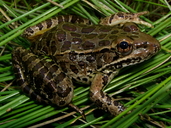
Another critter we use to see were turtles which would flop back into the water as we walked along San Felipe creek's banks. I have to assume that this could have been the Western Pond Turtle, but again way back in the 1970s. It could also have been the Desert or Sonoran Mud Turtle (Kinosternon sonoriense), since this region has more connection to deserts east, but again, who knows for sure. Not myself, nor friends ever gave it any thought way back when, other than we knew what we saw. The other creature which I don't remember seeing, but know of it's existence is the lowland leopard frog which is endangered and use to inhabit the upper San Felipe Creek all the way to San Sebastian Marsh near the present day Salton Sea.
image: Calphotos
Lowland Leopard Frog
Whatever the truth about the exact species of critters we saw, they never the less existed and the reason was water, which also now appears to be extinct as well. Recently about 3 or 4 weeks ago, I met Curtis and Linda Croulet up in Anza California at there home in Terwilliger. Curtis actually verified many of the things I saw there as he has worked at conservation in this specific area or region of the San Felipe Valley. If the world doesn't get a handle on this climate issue, many more things are bound to disappear.
~~~~~~~~~~~~~~~~~~~~~~~~~~~~~~~~~~~~~~~~
Hwy 78 bridge over San Felipe Creek looking south (June 30, 2014)
This view is looking towards the south side of San Felipe Creek bridge at Scissors Crossing. Straight ahead is community of Shelter Valley and the creek itself veers off to the left down Sentenac Canyon. Between here and the Canyon most of the majestic Cottonwoods are gone and even the Mesquite are struggling against the invasive Tamarisk which was never there previously in such massive population numbers. The lush reeds, rushes and sedges are all but gone now.
image: Charles Doersch (April 2012)
These are some hikers camping under San Felipe Creek bridge in April 2012, something that never would have been before possible just a few decades ago where permanent surface water flowed under here at a good pace.
~~~~~~~~~~~~~~~~~~~~~~~~~~~~~~~~~~~~~~~~
Conclusions
There are multiple complex components all throughout this San Felipe Valley riparian ecosystem & beyond which are only the tip of a vast iceberg here. For that matter, take any ecosystem around the globe and view as a body with various parts of necessary function: climate, geography, plants, animals, birds, reptiles, aquatic creatures, whatever – all of these components within their niche habitats can be subdivided into sub-ecosystems all within the entire system, and those can be further subdivided all the way down to microbiological level with it's underground organisms and right down to the very nutrient molecules they organize for life above, but all working together cooperating as a whole. Putting it all back together again requires recognizing the whole picture and not just some researcher working within their own specialty of personal training and practice. At every level, we see incredibly intricate tuning, synchronization, and functional complexity. Frankly for the sake of debate, it doesn't matter how it all came together as a finely tuned machine firing on all pistons with precision. It has always been that way from the beginning. True biomimicry in putting it all back together again is imperative, minus all the jealousies, envies, childish infighting among researchers, conjecture, assumptions and religious assertions. Find out how things really work and replicate.
In the old days when things weren't so globally effected, a civilization like those of Easter Island, Colorado Plateau or Empires of Central America or Europe could screw up locally or regionally and not effect an entire continent. Things are not that way now. Like global economies whose oil prices go through the roof every time some psychopath dictator hiccups, there are consequences now where all nations fail at taking care of business properly. If one Nation does something stupid ecologically, everyone else suffers. No amount of restoration techniques or politicking for stricter laws and regulations are going to succeed unless these weather mechanisms get back to proper function. I've seen to much disruption and outright wholesale failure out there on my last visit to California which has become increasingly worse since every other last visit. The biggest problem is never addressed and that is human behavior. How do you convince humans to do the right thing ? Persuasion seems to be a failure. Marshal Law ? Who wants to live in a Sci-Fi world ? Some major event around the globe is about to explode onto the scene, but how many are willing & ready to pay attention and keep awake ? When it does happen, that will not be the time to pay attention. It will be too late.
~~~~~~~~~~~~~~~~~~~~~~~~~~~~~~~~~~~~~~~~
UPDATE: March 19, 2022 Sadly many people are not taking this seriously. The Anza-Borrego Desert Wonders page on Facebook has several people laughing and criticing this video update.😥
This might be of interest to some reading here. The USGS has an Historical Topographic Map Explorer that allows you to view topographical maps at all scales that were ever produced by the agency, going back to the 1880s. You can pull up an 1887 map of the Prescott area like the one in the screen shot below. The sliding bar at the bottom of the search box lets you see what scale maps were generated in what year. This is where I brought up the older 1984 shot of Sentenac Canyon with it's graphics symbols. Maps are available for the entire country or regions of North America. You seriously may want to consider bookmarking this link below for future reference.
This post will be mostly short and sweet. Competition among Scientists for celebrity and notoriety in specific fields of research they are involved with is a huge motivator where their research is slanted and infected with their personal flavour or opposing stance they take on any subject related to ecology. Some are stubborn and ideologically driven when it comes to forest land management practices, while others may simply be out of touch with all the differing studies on the subject as a result of being so narrowly focused as opposed to utilizing important peripheral views on the matter which would give far deeper insight. In any event, it's no wonder the public is so confused on which side to believe. You'll often see this in the numerous ignorant comments from the public under almost any media frenzy inspired article where the subject is controversial with regards any type of land management subject. [especially with prescribed or controlled burns] All too often the average Joe/Jane Commenter will usually parrot the bad research expert which he views as having the least personal impact on his or her well being. Recently there was an article dealing with the ongoing problem of Deer destroying forests for no other reason than their higher than normal population numbers. Makes sense, since lack of predators makes for a great catastrophic imbalance. As we've learn from Yellowstone, the Wolves change Elk Feeding behavior which allowed for a balance to return in vegetation biodiversity.
Cornell University
This July 9th 2014 Purdue University forest ecology study came out agreeing with yet another study which supported those that came out in March 2014, which shed light on the problem of overpopulation by White-Tailed Deer gobbling up eastern forests. Here is a sample quote from that article:
"A research team led by Michael Jenkins, associate professor of forest ecology, found that a 17-year-long Indiana Department of Natural Resources policy of organizing hunts in state parks has successfully spurred the regrowth of native tree seedlings, herbs and wildflowers rendered scarce by browsing deer."
This piece above also agreed with another one published earlier this year back in March 2014 about White-Tailed Deer populations ruining forests through mere over abundance. The article there also spoke of the dangers to biodiversity. Excessive deer populations hurt native plant biodiversity . This also follows on the heels of the warning concerning invasive non-native earthworms for which I wrote this piece where not only were the worms being blamed for ruining forest floors, but also causing global warming. Apparently Earthworms are said to give off CO2 emissions. With science research articles like this, climate change remains a tough sell to many of those who still are bent on questioning the problem exists at all:
But now oddly enough, both of these issues involving Deer and Earthworms denuding forest floors of precious plant biodiversity are in direct conflict with the western forest ecologists who insist that a healthy forest must look like a clean manicured Park-like setting with nothing but a sterile understory.
"Conventional wildfire wisdom is generally the opposite. Many scientists say that dry Western forests were once open and park-like, with large, widely spaced trees and little undergrowth."
Often times the above mindset will justify the use of prescribed or controlled burns for providing grassland meadows for deer and other foraging wildlife or domestic livestock, but almost always leave out the part about deer often preferring saplings, young shrubs and other herbaceous plants in the forest understory. They also will cite the often repeated romanticized Native American usage of fire to grow greener pastures and increasing wild herds of game animals. What is also often left out is the countless other reasons these folks set fires which had zero to do with ecology. But why is it that when the Native Americans used fire to obliterate forest understory that equates to something natural by Fire Ecologists and Forestry officials ? How is it that when Deer, Elk or Bison obliterate understories, this is considered unnatural ?
Of course forest deer, elk & bison will graze meadows, but they also love plants in forest understory growth. But making sweeping generalizations are common when attempting to justify something under the guise of ecology, when alternatively, such studies are bought and paid for by the usual big commercial Timber and Livestock interests. Again, if you want to truly understand and interpret any scientific research work, first you must follow the money from those who backed and funded the study in the first place. In a sense what happened to the Deer without fear of predators, is that they became sort of domesticated much like Yellowstone's Elk. In other words that stayed in one place, mowed vegetation to the soil and only then moved onward. Lack of predators does that to wild herbivores.
image: Paul White
Last night I watch a European documentary about Wild Europe versus modern European agriculture. East European Farmers are hands on in their livestock management practices and more in tune with working with nature. Compare that to Western Europe Agriculture which prefers to kill off all predators, dump livestock in fields, check up occasionally and harvest when ready. Much of this mentality is what moved over into the North American's New World pioneers, and was especially disastrous out in the western states. East Europeans like those in Romania live with their animals, protect and move them along. This was the case where the film documentary showed them herding the sheep alongside wolves with no problems. The key is to mob up the herds or flocks and keep them moving, all the while, sheep graze and browse forest understories but with little damage to the actual forest floor. They also urinate and defecate as the move which further enhances the biological life within the forest. In this way they biomimic wild grazers who are always on the move. The Sheep in the above photo are on route through forest to grazing meadow near Cernat - Transylvania - Romania. There is a great page link here on just how the Romanians accomplish this coexistence with predators on the Wild Transylvania website:
Unfortunately many of these North American Researchers are not always on the same page as far as acting as colleagues working for the greater good and sharing information discovered. Many are so narrowly focused that they cannot see beyond their own little self-appointed niche of expertise on a subject. For example, there is far more to the deer culling then by means of hunting. There is also that "Fear of Predators", which influences deer behavour, habitat choice and distribution. In other words, lack of predators almost domesticates wild Deer and Elk which will also graze vegetation to the ground, but Wolves and Lynx give them their wild roaming instincts a kick start again. These things were never mentioned in the Purdue University hunting study [again follow the money], but again one wonders despite that funding was provided by the John S. Wright Endowment, if there were not others in the shadows with a vested interest in the research. Here is Constantine Alexander's blog article on east European Deer management:
Dogmatic Scientific Consensus gets blown out of the proverbial saddle once again!
Sorry, I couldn't resist. In most of the text books and science literature promoting the wonders of mycorrhizal fungi, both Ecto (EM) & Endo (AM) Mycorrhizae generally are categorized into lists that highlight the main types of trees, shrubs and other plants which both of these differing fungi will supposedly ONLY colonize. The lists are almost as a sort of etched in stone hallowed religious text that cannot be altered without facing some sort of backlash from the established Scientific Orthodoxy which establishes truth. Frankly, the Natural World couldn't care less what the Science Consensus gang may assume to be the prevailing worldview. Take for example the Chaparral Plant Community. The conventional thinking is that aside from Scrub Oak, Manzanita and a handful of other plants, most shrubs are Endomycorrhizal. But as a change of direction and surprisingly back in 2005, it was the US Forest Service who published a report entitled:
"Greasewood or Chamise( Adenostoma fasciculatum ) normally forms arbuscular mycorrhizae with all genera found in the region. However, during wet years (El Niño), we found EM associated with its roots and EM fungi in the stands (Allen and others 1999b). There was a high diversity of fungi ranging from Cenococcum and Balsamia spp. (ascomycetes ) to a variety of basidiomycetes such as Pisolithus sp., Cortinarius spp., and Hysterangium separabile. We also found a new species of Rhizopogon : R. mengei (Allen and others 1999a). This is an important finding , since all other known species of Rhizopog on are associated with conifers. In addition, we sequenced the dominant fungus found on the root tips of Chamise, and this fungus was an unknown species of ascomycete, most closely related to Sarcocypha emarginata (97 percent similarity in t h e sequence alignment of the 5.8S region, 63 percent similarity in I TS1, and 59 percent similarity in ITS2), a common fire-following fungus. There are clearly plant/ fungal symbiotic combinations that we do not understand and have yet to explore."
"Although we have focused on Coast Live Oak and Chamise, it must be noted that there are many other EM plants in southern California. These include all other species of oaks, all members of the Pinaceae, and Chinquapin ( Chrysolepus semper-virens ). In our region, these never have been surveyed comprehensively."
Maverick Example #1-Chamise (Adenostoma fasciculatum) &Pisolithus/Rhizopogon
The final quote in the very last sentence says it all, "In our region, these never have been surveyed comprehensively." No kidding ?The fact is, nothing is etched in stone when it comes to understanding Nature. If it was, our natural world wouldn't be in danger from global ruin as it is at present. The above admission and findings regarding ectomycorrhial colonization of many chaparral shrubs should takes us further in our understanding how to restore habitats and make practical application within the urban landscapes of Southern California. Why the very idea of Chamise or it's other not so flattering label Greasewood being ectomycorrhizal is almost unheard of. It's value to the natural world has been clouded by it's being demonized by many insisting that it alone is responsible for some of the worst wildfires in Southern California. Colonization by symbiotic various species of Ecto-Fungi, especially Pisolithus & Rhizopogon during wet rainy seasons (El Nino Events) is interesting and almost speaks volumes about the information encoded within the Chamise plant's DNA for assisting and facilitating Pine & Oak tree establishment during these wetter periods like El Nino events. It almost has the appearance of a cooperative strategy within an entire ecosystem to mutualistically help the entire plant community advance itself towards woodland re-establishment. This clearly exposes the ignorance and arrogance of many powerful Forest Managers who have conveniently and deliberately (no doubt for financial gain) ignored the beneficial roles chaparral plants play in forest establishment and lifetime health of the forest. It is clear that during drier periods, such lack of symbiosis would prevent tree seedlings from unsuccessful establishment due to lack of moisture, even within the subsoil and also at the same time taxing the survival mechanisms of the Chamise itself, who although being a tough fighter in hot drier regions, also has it's own limits. BTW, I originally alluded to Chamise ability of helping to advance forest trees and other oak woodlands over a year ago in May of 2013 last year. It's one of the best at further Parry Pinyon establishment. Given the new ectomycorrhizal connection revelations during extreme wet years, this along with it's incredible ability at hydraulic redistribution makes perfect explanatory sense for the successes in some areas regarding woodland increase.
Maverick Example #2 - Date Palm (Phoenix dactylifera) & Carob Tree (Ceratonia siliqua)- Pisolithus tinctorius
First, a word about Carob Trees and Pisolithus tinctorius. Without going much into this, I have created a later post (2016) and I am adding it here. Carob trees is another one of those interesting trees which the Dog Turd Truffle (Pisolithus tinctorius) will easily and readily colonize and remain for many years. I first discovered this not by reading any literature on the subject, but rather first hand observation back in the later 1990s when I did bank promorional work at California State Univerversity of San Bernardino in Southern California. Their ain parking lot was almost totally Carob Trees and truffles were everywhere in the street islands and parking area planters. It was only several years later I even found any literature and it was by researchers in the Middle east & North Africa.
Well we all know what a Carob Tree is, but it may surprise many to find that Pisolithus tinctorius will conolonize this tree. Not me, like I said, I have known of this since the middle 1990s. So here for the record California State University San Bernardino, is a free and accessible collecters hotspot with it's massive parking lot where Carob Trees can be found in the parking islands you will find many old dried Pisolithus truffles everywhere. I'm serious, go see this parking area for yourself. I'll be passing through there in two weeks on my way to Phelan, I'll take photos if I can. I know because this was one of my favourite collecting areas back then. But the real exciting shocker for me was the research literature of Date Palm (Phoenix dactylifera) being colonized by Pisolithus tinctorius. I mean all of the literature and text books insist this tropical or sub-tropical loving tree is strictly an endo-mycorrhizal plant ONLY. And yet once again research has proven otherwise. A 2012 study by Moroccan researchers who collected Psiolithus truffles from Eucaplytus woodlands in Morocco for acquiring spore source for Pisolithus inoculant for testing both Carob & Date Palm actually proven colonization does take place. Again this is contrary to what many of the approved conventional textbooks say with regards this subject. Clearly both trees are a major food source for Middle Eastern and North African peoples and cultures. The Arab researchers therefore had a strong motive for finding if such a possibility did exist when would greatly enhance their agricultural practices with these two trees.
"In this study ectomycorrhizal plants frequency after inoculation by Pisolithus tinctorius in this study was 6.66% for Date Palm and 10% for Ceratonia Siliqua . Thus , Phoenix dactylifera and Ceratonia siliqua were ecto-mycorrhized for the first time in our experience conditions."
Application of mycorrhizae in sustainable Date Palm cultivation
Images -(German BioMyc™ Vital, Germ 2009)
Date palm (Phoenix dactylifera) is a significant and developing crop especially in the Arabian Peninsula, the Middle East and North Africa regions. The area under cultivation of this tree is increasing annually. Date palms usually grown under harsh and unfavorable growing conditions with low rainfall and high rates of evaporation as well as in soils with low organic matter and nutrient deficiencies. Hence, date palm cultivation becomes dependent on application of high levels of fertilizers as well as on irrigation. This may lead to salinization of soil and leaching of nutrients to deep soils that might affect ground water. Therefore, it is important that date palm plantations are managed in a sustainable way to reduce the impact of date palm cultivation on ecosystems while maximizing dates yield through using such practices as mycorrhizal fungi technology. The application of mycorrhizal fungi technology is an option that can benefit both agronomic plant health and ecosystems. Mycorrhizae confer numerous benefits to host plants including improved plant growth and mineral nutrition, water uptake, tolerance to diseases and stresses such as drought, temperature fluctuation, metal toxicity and salinity. Mycorrhizae may also play a role in the formation of stable soil aggregates, building up a macro porous structure of soil that allows penetration of water and air and prevents erosion. All of these beneficial effects on plant health and soil fitness mean that mycorrhizae have the potential to increase agricultural productivity and are crucial for the sustainable functioning of agricultural ecosystems. This study provides an insight into the application of mycorrhizae in date palm cultivation."
Clearly, most western researchers, especially in the USA wouldn't have bothered with such an investigation considering such plants are not considered a pressing economic concern as they would to the Arab world researchers, opting instead to believe the prevailing doctrinal literature on the matter regarding Palms and other plants considered strictly to be endomycorrhizal. But this brings me to ponder about what other possible success stories are out there waiting to be discovered. For example, what about California Fan Palms (Washingtonia filifera) and other Palm Trees used in the urban landscape ??? I don't doubt they are strictly endomycorrhizal, but is there a possibility they could also become ecto-mycorrhizal colonized under the right conditions and with the correct species of Ecto, which would allow them to interconnect with other plants in the wild within a wild Oasis setting or an urban landscape scenario in association with other trees and/or shrubs ???
Further references on Date Palms and Ectomycorrhization
From Laboratory of plants and microorganisms Biology, De partment of Biology, Faculty of Sciences, Universit y Mohamed I, Oujda Morocco
Update 2021 on the 2000 year old date Palm seeds from Israel which germinated some years back.
~~~~~~~~~~~~~~~~~~~~~~~~~~~~~~~~~~~~~~~~~~~~
Maverick Example #3 -Alligator Juniper (Juniperus deppeana)&Pisolithus tinctorius
image: Mine
I have my own example which I experimented with back in the late 1990s. My Son and I went on a trip to the Huachuca Mountains above Sierra Vista Arizona while driving up Carr Canyon and along side the road I found a 6 inch high Alligator Juniper seedling I scooped up and took back to my property back in Anza. I planted the 6 inch Juniper seedling within a grouping of mature Redshank or Ribbonwood (Adenostoma sparsifolium). I did inoculate the seedling with a Pisolithus tinctorius mix I purchased from Plant Health Care Inc. Back then I was in continual communication with lead PHC Scientist, Dr Donald Marx and informed him that after a month from the time I inoculated this Juniper, a thumb sized truffle appeared at the base of the plant. This wasn't supposed to happen according to the literature. Of course lots of natural phenomena actually happen which is not in the conventional literature and textbooks. Dr Marx had me send him pictures of the tree with the truffle for documenting sake. Unfortunately I never received a reply and in all of the present literature out there, I still find no reference to colonization between the two species of organism. Not surprising since most religious orthodoxies resent being challenged as to what they consider TRUTH. This tree today hasn't grown to much, only close to a meter perhaps, but healthy enough to show promise. Given the fact that we are all shackled under the present climate change and extreme drought condition in SoCal, it's remarkable that this tree has survived at all. There are of course a number of things to also consider here. I have always had my greatest success in Southern California mountains establishing trees in remote areas and landscape by associating them with Adenostoma sparsifolium and Adenostoma fasciculatum. I had always thought that these extreme deeply rooted trees were potentially some of the best source for success as a Nurse Plant, but apparently there may be more to it than that. It makes sense to me that I have found in the past large Pisolithus truffles several meters away from target trees, like my Black Oak (Quercus kellogii) where I found numerous truffles which never existed on my property previously before suddenly appearing 10+ meters away from the Black Oak I later inoculated and within mature bases of Redshank or Ribbonwood. Same with Coutler and Jeffrey Pine that I have planted and have done so successfully and far far away from any irrigation source beyond the first year I might add. There is a wealth of information here and I hope more researchers follow this lead and actually do something with the information once it's published, instead of shelving it in some obscure place on the Net only to be stumbled upon by occasional accident from someone searching out of curiosity as I did. Sadly, the California Chaparral Institute has not spoken of this and they are the very ones who should be spearheading the lead in doing so. I'm becoming increasing disappointed with them as they are persuing more interest and direction in typical eco-activist lawsuits and radical protest movements. This world's powerful Elites in the Timber Industry and Forestry are also in terrible need of replacing things out in Nature are ever going to improve. The religious dogma known as "Survival of the Fittest" &Argument from Poor Design have both done far more damage than we can possibly know in our understanding of nature and developing management practices based on biomimicry. Why would anyone biomimic anything when you view the subject as flawed in the first place. Demonizing and eradicating chaparral as something invasive and overwhelmingly competitive in re-establishing a forest after wildfire is a flat out lie. The old archaic thinking of forest re-establishment techniques and innovation based on flawed worldview & false dogmas need to get a grip and change with the times. They desperately need replacing because the natural world cannot afford anymore mismanagement by either side of the issue. Both ideologies have been weighed in the balances and found deficient. We can't afford to have any of these individuals in charge anymore as time is running out. For the average person reading here who actually gets a clue and cares about their own property or habitat restoration project, this is invaluable information regarding ecto-mycorrhizal relationship with chaparral, added to the already deep rooted capability of their root infrastructure along with hydraulic redistribution phenomena. There is no guarantee officials will ever get this revelation unless of course there is some sort of career advancement promise or some other personal profit incentive attached to learning and accepting it. Below are further examples of my own success with community planting pines and oaks within Redshank & Chamise chaparral vegetation. Clearly more than hydraulic redistribution created the successes here. Inoculating with Pisolithus tinctorius also clearly created an interconnection pathway between all these plants. Let's create a new catch phrase, "Mutually Assured Survival"
image: Mine
This is my old place where I planted, inoculated and left to it's own devices a Coulter Pine the very year I left in 2001. It was planted in between those huge Redshank & smaller Chamise chaparral shrubs. Watered that first year ONLY and after that was left to it's own. The present owners cleared the land in front of this tree and put up the fence, but otherwise it was in a remote spot on the property. They did not move there until 3 years after I left and they have said they've never watered the tree. The height and spread are very large (taller than me @ 6.3) and pretty amazing considering the present long drought scenario in SoCal since then. It's also important to take special and specific note of how many years growth of needles are still clinging to each branch whorl. There were actually 4 years of needles still clinging onto the tree which is an amazing feat considering the drought that California is presently experiencing and predicted to get even worse and far reaching over a decade. Of course the credit goes to the way Nature is engineered here. Not only is the mycorrhizae imperative to the health and long term life of the tree, but a huge credit should also go to the two cousins of Chaparral you see here. Redshank & Chamise which facilitate hydraulic lift and redistribution of deeper under ground water resources which actually help hydrate and sustain the young Coulter Pine.
image: Mine
This Coulter Pine was a foot tall like the one in the above photo. It's location is in front of the one above where the Chaparral was cleared around it and a shed built which is in between both trees. However this was not done until 2004 almost 4 years after they were planted and they told me that they have never watered any of these trees. This seedling was actually slightly bigger than the one behind. Again, look at the height here which is much greater than the one above and notice the formation of cones already. This is unusual again given the drought circumstances which are presently hovering over this region and throughout California. What's exciting here as well is the formation of Coulter Pine cones already at this young stage. Clearly this less than one decade's worth of growth and survival can be attributed to the Chaparral which rather than compete, are aiding the tree's survival.
image: Mine
Once again this is the old Dawson homestead where we planted hundreds of Coulter & Jeffrey in 1983 which are now around between 20 and 30 feet high and bearing cones. We left the majority of Redshank, Chamise, Manzanita and Sugarbush. But clearly after inoculation with the PT Mycorrhizae, more happened than just hydraulic redistribution for mutual survival. I clearly have more picture examples of my old place and elsewhere, but the point has been made. Look forward to more research and discovery. In fact, biomimic it yourself and document what happens with photography. Share the results with others. BTW, for the landscapers, remember the importance of following establishment by replicating what happens during wetter years by watering with deep soaking frequently to first couple of years, then tapering off. Clearly this is also important in PT Mycorrhizal coolonization within the chaparral community which assures better tree seedling success.
For those particularly interested in Landscapes in the Southwest, you need to seriously pay attention
animation: Beatrice the Biologist
Whenever I am out anywhere in Nature, I am often intrigued with the natural underground networks which I believe make the beauty above ground all possible. Although usually unseen, I know there is something more going on with a luxuriant Chaparral shrub, especially when it first off appears to the eye to be in an impossible hot dry setting. In any event, it's always in the back of my mind and when I stumble upon a prime example while exploring, I record the scene straight away. I did recently stumble across these exact circumstances last week as my wife and I revisited Torrey Pines State Reserve between Del Mar and La Jolla California. While walking the Park road back to Visitor Lodge from the Guy Flemming Trail, I noticed along the road cut out where the bank was crumbling and fractured rock debris was falling down to the road, there were numerous chaparral plant roots exposed as a result. This sand stone here looks to be a fairly dense impenetrable material where even water would merely run off the surface rather than percolate. Yet there they were, the cracks and fractures underneath being exploited by the plant's root system. It brought back to mind something that was reported on in a recent article and which I wrote about (Here) with the importance of plant roots being able to open up not only the surface ground layers, but also the sub-soils which further allows water percolation and deeper earth penetration by means of hydraulic descent. If course they exploit the hidden cracks and crevices with the Earth through their spiral drilling mechanisms. Take a look at three interesting photographs I took at Torrey Pines State Reserve which illustrate the intense natural engineering lengths at which California Chaparral species will take in order to survive.
Image: Torrey Pines State Reserve Park Rd
image: Torrey Pines State Preserve Park Rd
image: Torrey Pines State Reserve Park Rd
I was also further amazed by something I found regarding California Fan Palms this past weekend west of Ocotillo California in a canyon between Dos Cabezas Springs and Mortero Palms Oasis. To be honest, I never really paid much attention when it came to Fan Palm root structure and viewed their network as something which never strayed far from the tree. I mean after all, they always seem to be located near springs or seeps which run close to the surface. But I again stumbled upon something interesting again and in a location most hikers normally avoid or pay little attention to. The parking area for setting out on the long strenuous hike to Mortero Palms Oasis is in a separate canyon from that of the Oasis, but up that canyon there 5 or 6 good medium sized California Fan Palms along with smaller ones. There does also exist an older fallen log of a grand daddy which I can tell you has been there for years. The dry hot desert air tends to mummify wooden things in a sort of preservation phenomena. But aside from the usual placement of the odd palm here and there, it was the root system with in the area's fractured granite rock strata which actually caught my eye. First off, there was this one interesting fan Palm which was the first palm you come to climbing up the wash. Everything looked pretty much normal until you squeezed around to the back behind it. This is where I started paying attention once again to the ground and the network of root systems. Take a look at the photo below here where all is not what it seems from a visual perspective
This California Fan Palm was intriguing for one particular reason. I actually had to squeeze by this granite boulder here where I saw an interesting growth anomaly which took place decades back history where flood waters had knocked this tree down flat on the wash bottom as a youth, but through gravitropism it was able thereafter to right itself back up where from a frontal view looks perfectly normal and opposite in the back door. Nothing out in the wild can be attributed to ideal conditions. Everything is a tough struggle with some slight ideal conditions which allow for the success and survival. Of course in the urban landscape, things can be ideal, but understanding the mechanisms by which things succeed out in the wild will enable you to establish a landscape which will be more likely to flourish on it's own, especially during times of water availability and uncertainty. This is the goal that should be sought after anyway under any conditions. A landscape developed and maintained on a life support scenario, otherwise known as welfare, will not survive such tough times. The degradation of 75% of Southern California yards is proof that something has to change.
For the moment, take a look at this Fan Palm to the right. This tree was at the top of a rocky outcropping higher in the wash with it's roots extending downwards and also broadly running in a side pattern horizontally almost 15 feet away from the base of the tree. As solid as the granite bedrock was, it had numerous fracture lines running vertically as well as horizontally. This is where these delicate, yet tough fan palm roots found a conduit channel for seeking out further water seepage. I never though the roots ever went that far away from the tree and actually they went further beyond down the wash, but these pictures are of what I could verify on the surface. I have no real idea of how deep a setting the Fan Palm roots will venture. It would seem however they may go some feet in deep sandy wash type soils where aeration is exceptional. Given their presence in washes with regular flash flooding and debris sediment movements, I have seen some which have been buried far above their normal root line. Also there is the fact that many in a sheltered landscape setting, as they age and mature do start showing the protrusion of roots growing down from the trunk a foot or two above the ground level higher up on the trunk base. So who knows what the possibilities of actual depth with which could be obtained by these trees as long as there is good healthy aeration.
image: Mine
PalmBob 2009
The photo above of the fan palm roots are about 12-15 foot at the bottom of the wash away from that tree above. The roots actually followed the cracks and fractures within the exposed granite bedrock and have been revealed by continual ongoing natural flooding within the wash. They actually proceed beyond this picture on the left to deep down inside the level sandy wash down stream to the right in the photo where the original large ancient palm trunk has fallen over. Although I didn't photograph them, there were also lateral roots which grew at great distance sideways across the wash to the other side, once again following the cracks in the bedrock. The other photo of a Mexican Fan Palm to the right is for illustrative purposes only. Older Palms develop roots a foot or two above the soil line where the bark splits and reveals root growth expansion which not only adds to it's water and nutrient uptake if it's successful in reaching the ground, but also adds a wider base for the strength of the larger tree as well. Under natural normal wild conditions, the palm frond skirting would hide these roots and protect them from the drying elements of the harsh sun, making it possible for them to expand all the way down into the soil. It's important in understanding how things actually work or have the potential to work out in Nature. Without practical application, for me none of this would be of any real value. This is important in understanding the physiology of any plant's growth, especially in later life and the geology of your own landscape and what can and cannot be planted and why or with what in a community planting. How does everything work and harmonize for the benefit of the other plants ? Which mycorrhizal applications should I use to further enhance the plant's ability to thrive in the landscape ? While I never thought it possible, recent research has uncovered that palms can be colonized by ecto-mycorrhizae and not just endo-mycorrhizae. This is an important find and one I'll share later in another post. It's incredible because one of my favourite fungi are mentioned as doing the colonization, Pisoliths tinctorius (Dog turd Fungus). Below here is one final photo. This is the bottom of the canyon where the wash opens up and fans out in the alluvial plan. This is a specimen of Holly Leaf Cherry (Prunus ilicifolia). Most of you won't believe this, but this particular old chaparral plant was present in the late 1960s when I first ventured here as a Boy scout. It is also a fascinating phenomena considering it's placement in the wild landscape. This area is extremely hot and dry, often well over 100 F or 40+ C. It's root infrastructure is clearly tapped into a permanent water source. It's the only Holly Leaf Cherry I have ever found near here and mostly likely was placed here by means of Coyote scat as opposed to being washed downstream. The placement above the wash may support this. The main point here is this chaparral species and the giant Sugarbush (Rhus ovata) in the next wash over can succeed in harsh climates given access to regular water. This is why natives should be used more often in the landscapes where as time pants on to the end, survival is becoming more and more of an issue than at any time previously.
image: Mine
I've benefited tremendously from observation and replication of various plant community scenarios observed in Nature. Despite recent climate change and drought in California, I have been successful in three landscape examples I installed last year (2013) in the interior valleys and mountains of San Diego County. I'll reveal the photos and report on them later. Of course everything is native plants and respect for underground root infrastructure and the interconnections between plants of the same community. Sadly, many of my techniques I fear will not work in remote wild places without human intervention, as the ongoing climate shifting and drought have changed the rules. In the landscape however, you have more control and success can be easily achieved by respect for some basic fundamentals and principles. If the climate were to ever change by way of improvement, then the native landscape will also respond in kind. The genetic information and detailed instruction are still in place, just waiting for this to happen. Sadly, I also fear that this year Torrey Pines State Reserve could and will be lost to wildfire if circumstances don't change. The chaparral and pines up there look terrible. The chaparral in many areas hasn't put on new growth and is struggling to maintain what's left by shedding well over half their leaves. The pic below says it all.
image: Mine
The chaparral everywhere here was suffering terribly and sadly it will be blamed when a disastrous wildfire strikes and it will, trust me. This should also be a wake-up call to home owners whose landscapes are in horrible condition and I say this from first hand on the ground observation. While the incredible amazing root infrastructure is all still there and in existence within all the plant communities, it means nothing without a normal rainfall pattern coming back again.
image: Mine
There were many stressed Torrey Pines, especially on the highest points where annual needle bundles located along the yearly growth whorls were from this years growth and that of last year. Most healthy pines in general should have as far back as six year's needle growth still present. The fact that these trees here exhibited only two or three years at best proves the stress they are under as they eliminate what they are incapable of maintaining. Armed with this knowledge, folks should inspect their own home landscape and be observant to the tell tale signs of a weakening system within their landscape. This is one of the main problems with the recent San Marcos Fire last month where News Helicopters revealed many neglected stressed or outright dead trees in their landscape which caused a greater firestorm. Although the State Park by it's very rules won't allow trimming of branches and dead material, in the interest of the park as a whole, something of a maintenance plan should be devised. There should be a rethinking of all Park and Wilderness rules where the conditions of climate and ecosystem health under which those rules originally formulated do not any longer exist. The conditions and rules by which Nature once operated no longer exist and humankind changed the rules.