Friday, June 24, 2016

Positive Interactions and Mutual Dependence between two Desert Plants

I caught this older 1978 black and white photograph by accident the other day while looking through some old archived literature on an unrelated subject. Mostly I was looking at mesquite dune references for building windbreaks or shelterbelts with native flora after removal of Tamarisk. I'm ever so thankful I made this find. It needs light shed on it.
Image is March 1978
"
Four-year old Prosopis tamarugo competing with native
 Atriplex atacamensis in the San Pedro de Atacama salt flat"

And so read the caption under the black and white photograph taken on March 1978 which was found down at the very bottom of this United Nations agriculture website. Can anyone appreciate the inaccurate misleading understanding back then regarding plant inter-relationships and mutualism ? Do I hear "Mother Tree" or "Nurse Plant" from anybody ? No of course not. Back then as today, we use hear people say that beautiful shrub or tree [depending on whether you champion the tree or shrub] in such a photograph seems to have the appearrance of being choked to death or strangled by the less desirable shrub. The times really haven't changed all that much with not only your average Gardener and commercial Landscaper, but also your average Professional Forester. Anyone else notice the word/term, "competing" being used in the description above of the two plants in that black and white photo ? Do either of those plants really look like they're suffering at the hands of the other ? There is an irresponsible blind faith religious concept called "Survival of the Fittest" which has done more harm than good and has set back positive scientific research more than anything else. Even today, Biomimicry leaves a foul taste in the mouths of some Ideologues who cherish an old inept Victorian Era worldview of our planet's natural world. I've seen such plant associations before, photographed them and written about them in this blog. Take a look below.

Photo Image - Kevin Franck (2013
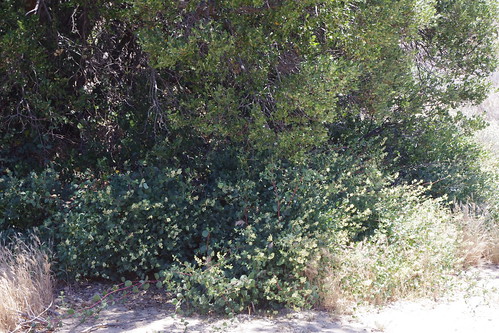
This is an Oak tree at the bottom of my brother's property in  Ranchita California. This region in many ways is very much an interior high desert ecosystem. Very dry, cold/hot and windy at times from  any direction. And yet, take a closer look underneath that Oak tree. On a much closer inspection, this is Chaparral Honeysuckle (Lonicera interupta) and may seem odd at first being way out on this dry flat, especially considering it is still recovering from the infamous Pines Fire of 2002. Most likely some bird stopped at this Oak tree weigh station rest area and took a  dump which may have contained some Honeysuckle berry seeds. Or perhaps a Coyote or some other animal literally dropped by after dining. Yet from the appearance of vigoriously growing foliage, do we see one plant outcompeting the other here ? No!
Photo Image - Kevin Franck (2013)
This group of riparian trees above, Cottonwood, Willow and Mexican Elderberry are also associated with not only Snow Pea, but also Wild Rose. The area is east of Lake Henshaw in San Diego county cloase to the Junction of Hwy 79 & 76. Do any of these plants look to be out competing or chocking out their neighbours in some blind faith concept known as "Survival of the Fittest" ??? Hardly. But strongly entrenched blind faith human dogma concepts are hard to weed out. And yes, many evolutionary concepts which originated from an ignorant Victorian Era have held on to the present. Their continued presence in the textbooks has held back good science and ruined many an ecosystem ever since they were conceived in response to justification of a new preferred  worldview. What is needed is some major deprogamming and re-education.
~~~~~~~~~~~~~~~~~~~~~~~~~~~~~~~~
 The plants in the black & white photograph. Prosopis tamarugo and Atriplex atacamensis

Image - creces.cl
Tamarugo Forest or Bosque
The Tamarugo (Prosopis tamarugo) is a deciduous legume tree growing up to 18 m high, with a crown ranging from 15 m to 20 m in diameter. Its root system consists of a deep taproot (down to 6 m) with lateral roots (down to 1.5 m). Leaves are bipinnate with 10-15 pairs of 5 mm long leaflets. Spike-like inflorescences bear golden yellow flowers. Fruits are peanut-shaped pods borne in clusters, 2 to 4 cm long. They contain an edible pulp and ovate seeds (3-4.3 mm long).
image - Nomad Desert
"The tamarugo is native to Chile (part of the Atacama desert is known as Pampa del Tamarugal). It is also found in Argentina and was introduced into India and other saline deserts of the world. It can grow up to an altitude of 1500 m. It thrives on salty sandy soils or clay loamy soils with a salt encrustation to a depth of 60 cm. It prefers the normal desert climate: high day temperatures, a large day-to-night temperature range, almost total lack of rainfall and intense sunlight. Tamarugo can withstand 10 to 12 months of drought."
Tamarugo mist watering  on leaves
"At the beginning of the 20th century, the tamarugo was almost extinct when a forest inspector noticed its ecological interest and created tamarugo plantations in the Pampa del Tamarugal. Since then, the tamarugo has been used to afforest saline deserts and has increased the overall productivity of the Tamarugal. The tree absorbs air moisture through its leaves and dispatches the collected water to its roots and to the surrounding soil, thus participating in the protection of soil water reserves. It is also a windbreaker and protects animals and people from the sun." 
(Source)
There are a number of amazing qualities about this species of Prosopis (Mesquite) and others. They can all be long lived. Often 100s, 500 to 1000 years old. One particular tree in South American country of Peru, a Hurango (Prosopis pallida), is in fact called the "Milenario de Hurango" because it has been found to be estimated at 1074 years of age. It was once part of a greater forest which has just about disappeared in the  Palpa region of Peru. As a land restoration tree, the Prosopis species in South America can access subterranean waters 60 meters (almost 200 feet) deep by means of a large tap root. It is one of the few trees/plants which can tolerate saline soils and transform such otherwise inhospitable landscapes into usable fertile soils. Part of the salty soil tolerance comes from it's association with micro-organisms on their root systems. 
Cachiyuyo (Atriplex atacamensis) 'Saltbush'
Taken on November 22, 2014 - Lucas Burchard Señoret

Planta del Desierto. Cachiyuyo (Atriplex atacamensis)
Chiu Chiu. Calama. Loa. Antofagasta. Chile

This plant in the photo above is what is commonly known by name as "Saltbrush" which where I come from is one of the few plants which will grow on saltflats of Coachella and Imperial Valleys. Atriplex is the plant referenced in that black and white photograph at the beginning of this post. It's not exactly an ornamental one we would chose for the urban landscape, nor even a specimen sought after by collectors of California Native Plants, but never the less it does have some amazing beneficial qualities. For example after stumbling upon the subject of Prosopis tamarugo from South America on the Food and Agriculture Organization of the United Nations website and the negative reference at the bottom of that page where gives the impression that the Atriplex was being demonized as the villan and Tamarugo as the victim. I realized that neither was true because from my own personal experience in researching on how nature utilizes sophisticated complex mechanisms for survival and success, the truth is clear that this has zero to do with "Survival of the Fittest" and more to do with survival of the mutually cooperative. Take a look at this one paragraph from the above book published in January 2007, titled:
"Positive Interactions and Interdependence in Plant Communities"
"Studies by Jose Facelli and Amada Temby (2002) in Southern Australia have also demonstrated a complex array of facilitative and competitive mechanisms working simultaneously in interactions between shrubs and the annual plants that grow around them. Shrubs altered soils, the seed bank, the effects of large vertebrates, and the subcanopy microclimate. But in a very interesting contrast to many other studies in similar systems, canopy effects were negative, reducing the effects of annuals, where as the roots of one shrub species, Atriplex vesicaria, facilitated annual species growing on the edges of it's canopy. Trenching around Atriplex shrubs decreased the abundance of annual plants. Facelli and Temby attributed the positive effects of Atriplex shrubs to hydraulic lift, and the decrease of nearby annuals after root severing to impeding the flow of water from the roots into shallow soils. Both positive and negative effects occurred in this system, but the typical of mechanisms in this system were reversed, with canopies inhibiting and root facilitating understories."
 (book source - short version)
 The mechanical benefits of hydraulic lift and redistribution of water to other plants within desert communities is fascinating and too the ability tolerate saline soils is also important when such soil degradation around the globe is increasing. Aside from being viewed as an important habitat creating tool, there are also some claimed health benefits to consumption of certain varieties. As always, thorough research and investigation on the part of those interested in such benefits and plant identification should be pursued. 
OrganicFacts: Potential health benefits of Saltbush (also known as saltbush or orache) for members of the Atriplex genus
Some concluding remarks on these plants and related ones & their landscape restoration value to people
Photo Image - BBC


The remarkable nitrogen-fixing Prosopis trees are an important source of food, forage timber and fuel for the local people of South America. But what is more important from a restoration self-sufficiency standpoint and something the average person knows very little about (if anything) and very few researchers are able press forward into the mainstream science education are the subjects - Hydraulic Lift & Redistribution - Hydraulic Descent. As referenced above with the plant Saltbush (Atriplex atacamensis) which can pull to the soil surface subterranean moisture to the benefit and well being of other plants around it. So too can the Prosopis species not only employ hydraulic lift and redistribution to entire plant ecosystems, but as other researchers have pointed out, they have the ability of removing vast amounts of surface waters during the rainy season and pumping this water deep underground, recharging aquifers and later utilizing these stores when the hot summer months appear. They also accomplish this task while still dormant in winter. The majority of these old growth Mesquite bosques are long gone. The evidence points to human stupidy and greed as the reason for their absence. The stupidity will be ongoing if they continue to ignore their value in hot dry arid saline soil desert regions which have also increased in temperature due to lack of vegetation cover. The companion planting of differing plant species is also another topic that should be shoved down people's throats until they're blue in the face. It's for their own and nature's good. Even now in one of the other links I've provided below, research is being done on experimenting with companion planting of Lavender & Arizona Cypress which have been observed to form healthier mycorrhizal associations and plant establishment. The old school science-based conventional ways of doing things is slowly killing this planet and biomimicry is going to come to the fore more and more. The bogus reforestation concept of stripping land bare of all competing shrubs so that more economically and aesthetically pleasing trees may flourish has done more harm than good and it continues. Most of this newer scientific understanding of plant mutualism will fall on deaf ears when it comes to human government and giant corporate business interests back by industrial science. However, it's hoped that such info will benefit small communities around the globe, habitat restoration groups, urban landscapers and home gardeners who more often have a passion for the natural world and a biomimetics approach which totally eliminates these destructive conventional science-based technologies. The pursuit of such conventional textbook mandates have over the past 100+ years degraded this planet to the point of serious climate disruption. At the bottom of this post below the references is one such interesting tool which could be of benefit to many. I'll post a link later.

Some interesting links and other references
Food & Agriculture Organization of U.N. - Prosopis Part I
FAO - PART TWO: PROSOPIS TAMARUGO, Phil.

The Huarango and Algarrobo forests of coastal Peru: rays of hope

BBC - Tree planting in the driest place on Earth

Science Direct: Lavandula species as accompanying plants in Cupressus replanting strategies: Effect on plant growth, mycorrhizal soil infectivity and soil microbial catabolic diversity
Hydraulic Lift and Redistribution of Water for the Benefit of other Plants in San Diego County
Adenostoma fasciculatum (chamise or greasewood): Worthless Brush or potential Nurse Plant ???

Photo Image: Groasis-Waterboxx
I have another post on this very subject of mutualism where an ingenius product by a company called Groasis-Waterboxx has experimented throughly [with the help of it's own customers] and successfully in hot dry desert regions around the globe. Even practicing planting with mycorrhizal inoculum and companion planting with two differing species of plants for successful establishment as you see in the photo above. Stay tuned.
Update June 27, 2016: 
Okay, here is the link I've created on companion planting using the Groasis-Waterboxx Cocoon. Their website also has vast amounts of tips, ideas and documented testimonials on the successes with this device. Enjoy:
How to Biomimic Nature's Companion Planting & the Reasons You Should

Image - Groasis-Waterboxx


Tuesday, June 21, 2016

A Pisolithus tinctorius truffle collecting hotspot @ CSUSB's parking lot Carob Trees

For three short years I visited California State University in San Bernardino, California on and off while I worked for Campus Dimensions. We promoted financial services and AT&T communications products to the students there. But every time I pulled into the public main Parking Lot, something amazing and incredible always captured my attention. Something was associated with the Parking Lot landscape island's Carob Trees.

Panoramic view of the CSUSB campus against the San Bernardino Mountains. (Amerique 2009)

image - CSUSB
That attention capturing phenomena was the association of Pisolithus tinctorius mycorrhizal truffle formation on the parking area's numerous Carob Trees (Ceratonia siliqua). An amazing tree in in that it is extremely resistence to dry heat and even extreme drought conditions. Also interesting since as a parking lot landscape choice the environmental conditions are increased greatly in the temperature department. All that asphalt baking under an already historically hot geographical location. But Carob Tree toughness alone is not enough. As with many hot and dry climate plants, there are those biological symbiotc associations which further increase survivability. The problem for me was, even though I saw it with my own eyes, I had never read about Ceratonia siliqua being a host specific associate of Pisolithus tinctorius mycorrhizal fungi on any of the official hosts lists inside any of the Scientific Literature. 

image - Marcus Wallenberg Prize
My only connection back then in the  middle 1990s as far as education and technical understanding regarding the mycorrhizal world [aside from years previous personal observation & practices] was Dr Donald Marx of Frogmore, South Carolina who eventually became chief scientist for Plant Health Care Inc. He won a Marcus Wallenberg Prize award for his groundbreaking development of a process for the selective mycorrhizal inoculation of tree nursery soils which greatly increases the growth and survival rates of conifer seedlings used in the reforestation of inhospitable soils like those of abandon mines sites. In particular he was an expert on Pisolithus tinctorius. Don was even skeptical when I informed him of Pisolithus tinctorius  colonization of an Alligator Juniper (Juniperus deppeana) I brought over from Arizona one summer and inoculated after planting. But getting back to the CSUSB Parking Lot. I once collected three medium sized plastic bags of the mature dried PT Truffles under these Carob trees for my own spore inoculum at home on my acreage in Anza California. I was however in the beginning puzzled and at that time attributed their existence to the Eucalypts also present in the parking landscape islands. But it wasn't until a study by researchers associated with the University Mohammed Premier in Oujda, Morocco that the host association I observed made any sense. There is often a feeling when you pour over many science research papers and journals today, that the only good and accurate science findings come only from the good'ol USA or perhaps Europe. It does however make sense that such findings come from researchers from the North African region of Morocco where Carob Trees are native and often farmed for various products. Here is what one reference describes as to tree distribution and uses.
"Ceratonia siliqua is native to the eastern Mediterranean and Middle East and is commonly cultivated in California. Spanish missionaries first introduced the carob tree into Mexico and southern California. In 1856, seedlings were distributed from Spain to the southern states of the US. In 1859, more seeds were brought from Israel. Many carobs were planted as ornamentals and street trees during this time in Texas, Arizona, California, and in Florida. The trees are also used for erosion control and the pods for stock feed, human consumption, commercial thickeners, pet foods, cosmetics, and pharmaceuticals."
So from that brief description we see how these Carob Trees  arrived via the Spanish colonists and the uses in it's own native range. So it is logical researchers from North Africa and the Middle East would have a close vested personal interest in the cultural and economic value of this tree and potential for improved farming methods in understanding many of the natural mechanical components which can be replicated on a commercial scale. But of course I never read any of this until 2012 when it was first published. I've written about this study before, but only from the perspective of Pisolithus tinctorius mycorrhizae colonizing Date Palm (Phoenix dactylifera). (HERE)

Image - CSUSB - Parking Lot

image - Global Journals Inc

The truffles I collected at the parking area above were identical to the ones referenced here from the research article done by the scientists at University Mohamed Permier. It's just a pity it took so long to understand the truth of Carob Tree P.T. Mycorrhizal associations. When I tried explaining what I found, it was always explained away by the so-called experts. I was delusional and they were correct. Still, I would imagine the area of the CSUSB parking lot is still a hotbed of truffle collecting for those who know what to look for. So I'm apparently giving up all my former secret Pisolithus tinctorius Ectomycorrhizal truffle collecting site locations >>>  (Like Here)

Image - PlantPoints.com

Cal Poly San Luis Obispo
The photograph above is of a typical Carob Tree (Ceratonia siliqua). When I went to El Cajon Valley High School in the early 1970s, they were everywhere lining the streets. They were never even watered as far as I could tell and still aren't by the Google Maps App. The CSUSB parking lot landscape trees had many of them along with Eucalyptus trees. Pisolithus tinctorius colonizes the root systems of both trees. But the majority of truffles I always found at CSUSB's parking lots were in the hard hot baked soil beneath the Carob Trees within the narrow parking lot landscape islands. I'm also fascinated by the fact that in some locations, even south of CSUSB at UC Riverside, the Carob Tree is in fact a weedy invasive. Fascinating read on underutilized uses and production of Carob trees in one of the links I've provided down below. Again, as the report brings out below, this Carob Tree and it's economic potential is little understood:
"Carob has been neglected with respect to both cultural practices and research and development. Apart from a few classic works written by interested scientists, references on this crop are scarce. We have tried to review most of the work published over the last 100 years and make useful information available to producers, processors, students, scientists and amateurs."
Images by Noureddine Elmtili

Note the Carob on the left colonized by Pisolithus
tinctorius. Note on the right no fungal inoculation.

Effects of ectomycorrhizal fungal inoculation on growth and rooting of carob tree (Ceratonia siliqua L.)

Quick References to this subject of Ectomycorrhizal Truffle formation on new found 'Host Plants'
Ectomycorrhization of Date Palm and Carob Plants
When Mycorrhizae debunks the Scientific Orthodoxy on what & who they'll colonize
Adenostoma fasciculatum (chamise or greasewood): Worthless Brush or potential Nurse Plant ???
DiscoverLife.org - Ceratonia siliqua
Carob tree. Ceratonia siliqua - Promoting the conservation and use of underutilized and neglected crops 
~~~~~~~~~~~~~~~~~~~~~~~~~~~~~~~~~~~~
Conclusions 
Of course in the historical past, neither the Date Palm nor the Carob Tree would have ever been found on any of the approved Host Plant lists for Pisolithus tinctorius or any other Ecto-Mycorrhizzas as provided by most American Mycology records. Much the same with P.T. ectomycorrhizal fungal colonization of (Adenostoma fasciculatum) otherwise known as Greasewood or Chamise or even it's cousin (Ademostoma sparsifolium) Redshank or Ribbonwood. Both generally being endo-mycorrhizal with the exception of heavy wet rainy years such as El Niño events. Neither shrubs are generally popular as landscape fare nor respected as far as a major foundational chaparral shrub as nurse maids to Forest trees which is probably why the Scientific Orthodoxy has ignored them for so long. And yet knowledge of the environmental cues which can trigger an epigenetic responses within Chamise to switch on the manufacture of chemical signaling messages to soil fungal partners plant's root exudates to inform nearby fungal spores or mycelium like PT ectomycorrhizae to form a mutualistic bonds during periods of heavier than normal wet rainy seasons (El Nino Events) could have been a sort of restoration alert to humans to get off their backsides and get busy with reforestation projects. The plethora of lost opportunities in furthering increases in forest ecosystem habitat spread by means of mutual cooperation between Chamise or Redshank and Pines/Oaks is now lost forever. Our present climate change and global extreme drought dilemma is a testament to the inept global scientific leadership we are all forced to be subjected under. Very little is written about these interactions and beneficial phenomena. The very nature of the average scientific animal is that the Lay Person is incapable of teaching them anything. Not all scientists conduct business as usual, but their numbers are very few. While there are some who are enthusiastic about mutualisms and practical applications on a potentially commercial scale, much of their work gets shelved away or appears on few websites where small groups take a real hands on interest. If this were not true, our planet Earth would look like a much different place than it is now. Fortunately many do recognize the value of what they call citizen scientists who are nothing more than folks with a heart felt passion for the natural world around them. They have no vested interest in corporate business profits. So their helpful input is often employed in some research works. Frankly, the present scientiific orthodoxy are beginning to remind me more and more of that fictional headmistress, Miss Agatha Trunchbull of the Trunchem Hall Primary School.

We really are living in the spooky End Times

Thursday, April 21, 2016

Mexican Researchers Observe Self-Governing Control of Scale Insects


Biologist Juan Manuel Vanegas-Rico
This will be a reprint of an article Entomology Today April 6 2016, which I bookmarked for later use. The fascinating subject is about that common white scale insect (Dactylopius opuntiae) which feeds on Prickly Pear Cactus. This insect turns blood red when you mess with it. I've really only ever found it on the common Cactus Plantation cultivators brought up from Mexico, (Opuntia megacantha) when I live in California, but often encountered it in the urban commercial landscapes I once maintained in and around San Diego, California. My way of control was using a high pressure washer with a water wand setting at a low volume, but high powered action. Even then those little buggers were tough to detach from the cacti pads.

Photo by J.A. Cruz-Rodríguez

 A prickly pear plantation in Axapusco,
Estado de México, México.
Entomology Today:
"Scale insects known as cochineals are major pests of prickly pear in Mexico, and pesticides are often used to control them. However, one prickly pear farmer has been controlling them without the use of insecticides since the year 2000."
"The farmer tipped off a team of scientists from the Universidad Autónoma Chapingo, and he told them that other insects were feeding on the scale insects. The researchers decided to investigate, and they found that the farmer was right. During the entirety of the research, the abundance of scale insects never reached pest status. Furthermore, when populations of scale insects increased, populations of predators increased at the same time, therefore regulating the growth of the scale insect populations. Their observations are described in an article in Environmental Entomology 
Did you take special note of a few key points in the article ? First the farmer of this plantation has been controlling the white scale insects without pesticides since the year 2000. He contacted researchers about predators doing the job for him. Now pay close attention to this single sentence from that second paragraph below here:
"During the entirety of the research, the abundance of scale insects never reached pest status."
The Scale insects never reached "pest" status ??? That would lead one to believe that the white scale is not all that evil when it is in balance. This is true of most all insects, even things we consider weeds in the plant world. Humans tend to judge things in Nature on human terms. Even Darwin did this when he wrote that letter to a minister named Asa Gray in 1860, where he referenced the example of a parasitic wasp which lays eggs on a caterpillar for the expressed purpose of it's young feeding on their host while going through a life stage development. To Darwin, this was absolute  proof that there could not be an omnipotent benevolent God. But exactly how did Darwin arrive at that conclusion ? He was a scientist right ? So what experiment or testing did he use to arrive at such a conclusion of what an intelligent entity which he said never existed, would or wouldn't do and can this experiment be repeatable for any one of us to arrive at the same conclusion ? Today Darwin's staunchest and most diehard defenders use these same fallacy arguments by using untestable metaphysical statesments for their scientific worldview. That's not to say that any of these questions are not legitimate ones, they definitely are. But they are religious questions, not scientific ones. Even the conventionally religious people cannot draw on any conclusions about why their God would do things in such and such a way through any experimentation. This doesn't mean they can't believe or have a faith in a certain way, but using science to test the whys and/or hows of creation by means of scientific research and writing a paper about it are near impossible. Take the origin of liffe experiements, both sides lose here. No one can prove by science how life emerged on Earth by experiment to create life. To be totally fair, this conclusion wasn't Darwin's fault either. Darwin like all of us was a human being on Earth who judged Nature on the basis of human concepts of good, bad, righteous, evil, etc. But still today, we all do this. Even myself at times. Hence when farming, landscaping, gardening or anything else, we all tend to judge any pests as an evil that needs to be obliterated from off the face of our own little world. Then we turn to industrial science for the poisons they manufacture to provide us relief. But it's not just the average person who reasons this was, highly education individuals with alphabet soup initials after their names on a business card follow this same flawed human reasoning as well, see the example here (Scientists Justify Mosquito Extermination from Earth)  Okay, let's continue:
"The farmer originally thought that ants were controlling the cochineals, but it turned out to be other insects. Six known predators of cochineals were found on the plantation, including different species of beetles, moths, lacewings, and flies — but no ants."
"This finding is important because the two most common ways to control scale insects in prickly pear in Mexico are 1) to use organophosphates, a class of insecticide that Mexican regulatory agencies do not recommend for this use, or 2) to knock the insects off of the plants using mechanical brooms. This study suggests there might be an alternative: natural control as a result of biodiversity, also known as autonomous self-governing control."

Photo by J.A. Cruz-Rodríguez

Colonies of scale insects (Dactylopius opuntiae)
 on fruits of a prickly pear (Opuntia megacantha)
"However, Dr. J. A. Cruz-Rodríguez, an author on the paper, warns that this method of control isn’t necessarily one that can be applied at will to other plantations or crops."
"Autonomous biological pest control cannot be considered a technology that is applied or not depending on the level of the pest,” he said. “It is a process that is established and maintained if the agroecosystem retains structural complexity and diversity of species."
"In other words, a lot of conditions must be met in order for autonomous self-governing control to be viable."
This is where people need to sit back and ponder, meditate and slow down and reason on any action to be taken with regards any possible biological controls and not automatically dismiss the idea that it cannot be done under every situation. While the researchers say the success the Mexican cacti plantation farmer had cannot be replicated for other crops, their next statement gives clues as to the error in their judgement on this:
"Autonomous control requires an ecological infrastructure that supports a network of interactions that limit the explosive growth of herbivores,” Cruz-Rodríguez said. “Intercropping, agroforestry systems, non-use of biocidal products (or its more rational application) — they all contribute to the formation of the biotic network that prevents the development of pests.This study shows that if the conditions are right, farmers can potentially use natural predators for autonomous control."
(Source)
This last paragraph really says it all and actually allows for the door for biocontrol for other crops to remain open. Not only scientists, but anyone should proceed and experiment on their own as a sort of what is being called a "citizen scientist" and share successful results with others. Believe it or not, professional researchers learn very much from people considered layman who have a natural passion for a specific phenomena found in Nature. Remember, even in healthy forested environments where all vegetation looks perfectly healthy, the insects and plants otherwise considered pests or weeds are still present, but their numbers are kept in check through a complex infrastructure of biological controls. Learning what those are can be fun and rewarding. Now let's look below at some information about this white scale insect you probably never knew. Did you know that in many places around the globe like Mexico and Iran, they are farmed for their red dye ingredients potential for the fabrics industry ? Below is a photo of an Iranian Cacti  plantation which has these little baskets attached to prickly pear pads. Click on the link below the photo of an Iranian website in English which goes into great deal on how this so-called pest is an income earner for some Iranian Farmers.
Farming Cochineals scale insects (Dactylopius opuntiae), for their raw material for the manufacture of Red dye

http://iranpazirik.com/htmls/cochincal.htm
"Cochineals are farmed in the traditional method by planting infected cactus pads or infecting existing cacti with cochineals and harvesting the insects by hand. The controlled method uses small baskets called Zapotec nests placed on host cacti. The baskets contain clean, fertile females which leave the nests and settle on the cactus to await insemination by the males. In both cases the cochineals have to be protected from predators, cold and rain. The complete cycle lasts 3 months during which the cacti are kept at a constant temperature of 27 °C. Once the cochineals have finished the cycle, the new cochineals are ready to begin the cycle again or to be dried for dye production."
"To produce dye from cochineals, the insects are collected when they are approximately ninety days old. Harvesting the insects is labor-intensive as they must be individually knocked, brushed or picked from the cacti and placed into bags. The insects are gathered by small groups of collectors who sell them to local processors or exporters."
Wasn't that a fantastic explanation on a subject most of us had no clue existed or could even imagine possible ? You'll find similar circumstances with many other plants and insects throughout the world. Believe it or not, most people in the industrial countries are often totally ignorant of the reality of the natural world around them and the potential for ecologically viable business possibilities. Finally one last look at that website and a quote about other nation economies who make a living with this, *cough-cough*,  Pest.


http://iranpazirik.com/htmls/cochincal.htm
"As of 2005, Peru produced 200 tonnes of cochineal dye per year and the Canary Islands produced 20 tonnes per year. Chile and Mexico have also recently begun to export cochineal. France is believed to be the world's largest importer of cochineal; Japan and Italy also import the insect. Much of these imports are processed and reexported to other developed economies."

Saturday, April 9, 2016

Synthetic Nitrogen's effects on the symbiosis between Legumes and their microbial partners

"Soil microbes known as rhizobia supply much-needed nitrogen to legumes such as clover (Trifolium species). In return, legumes shelter the rhizobia in nodules on their roots and provide them with carbon." - University of Illinois
 (Graphic by Julie McMahon)
Another excellent article by some researchers from the University of Illinois on the negative effects Synthetic [science-based] Fertilizers are actually found to hinder the epigenetic mechanisms for which instructions for signaling symbyosis are being switched off by the overwhelming concentration of synthetic nutrients. This has been going on for some time however, because there are now many cultivators of crop plants which are no longer mycorrhizal. Now you know why Monsanto blames failure of productivity for their seed if the farmer doesn't purchase the synthetics they were engineered to work with. They have either deliberately engineered this shutdown knowingly or it's happened by accident as a result of industrial practices influencing epigenetic changes within the DNA of the plant itself. So here below are the findings in the article published by the University of Illinois.

Plant biologists at the University of Illinois have pinpointed the area of genomes within nitrogen-fixing bacteria in roots, called rhizobia, that’s being altered when the plant they serve is exposed to nitrogen fertilizer.
The study, published in the Royal Society journal Proceedings of the Royal Society B, deepens the understanding of an Illinois study last year that indicated rhizobia—which are particularly beneficial to legumes such as clover, beans, peas, soybeans, lentils, and others—are less beneficial for plants when they are exposed to nitrogen fertilizer.
“This is one of the first times we’ve found at the genetic level the basis of an evolutionary change in mutualism,” said Katy Heath, professor of plant biology and one of the study’s authors, referring to the mutually beneficial relationship between rhizobia and plants that has evolved over millions of years. Rhizobia receive sugar from the plant and in turn provide the plant with nitrogen.
Again, I loved this article and the shedding of light on a subject close to my own heart, but there is a need here to clarify something stated in the above paragraph. Here it is below with one slight, but very important alteration or correction:
“This is one of the first times we’ve found at the genetic level the basis of an evolutionary change "epigenetic change" in mutualism”
Of course for some of you folks reading here, you might consider this to be an unacceptable major alteration of the text on my part. Hardly, it has more relevance than you realize. But there is a huge reason why I insist on this. Because it offers nothing in the way of value in actually trying to understand this incredible natural phenomena from an actual mechanisms viewpoint which the authors are describing to us here and I'll explain the why below in the footnote. Just follow the red single star (*) at the bottom of this page. Now back to the article's text.
Heath conducted the study with Christie Klinger, a researcher at the Beckman Institute for Advanced Science and Technology who was a graduate student in Heath’s laboratory for this work, and Jennifer Lau, a plant biologist at Michigan State University. The researchers also conducted last years’ study revealing that human-made nitrogen fertilizer altered the relationship between rhizobia and plants.

Images: Edalat Sowda Trading Company, Iran


Images: Edalat Sowda Trading Company, Iran

Whether applied using industrial technology or simply spreading it by field hand workers as traditional peasant farmers do in the world's poorer countries, both techniques and practices will kill the soil's microbiobome and shut down the symbiosis between host plants and micro-organisms. Why is this ? Epigenetic shut down of the switches for symbiosis signaling. The plant will stop signaling for cooperation and the fungi will detatch. Amazing how the natural plant world thrived long before the Green Revolution in what was nitrogen poor wild soils. This is because the micro-organisms were the work horses of acquiring nitrogen from the atmosphere and feeding it to their host plants. Back then soil was very aggregated, porus and breathing capability was at it's highest in allowing the atmosphere to infiltrate soils. But over time from the 1950s onward these epigentic switches for the instructions within crop plant DNA regarding symbiotic cooperation have been turned off. This has created a perpetual dependencey on crop plants for all Agro-Chemical company's manufactured synthetic inputs as a life-support system. So with modern GMO seeds, they fail unless otherwise fed a synthetic junk food diet.
“Humans are dumping fertilizer everywhere,” Heath said. “And so one thing we were interested in asking is whether long-term nitrogen additions would disrupt this long, many tens of millions years old symbiosis that is pretty important to the ability of legumes to compete in natural ecosystems.”
By studying legumes at the W.K. Kellogg Biological Station in Michigan, site of a long-term ecological research site created by the National Science Foundation in part to study the effects of nitrogen fertilizer on plants, the researchers determined last year that in fact fertilizer caused rhizobia to become less beneficial to the plants they served. The new study was launched to determine why that was so.
“This new study is extending that work with whole genome sequencing of the bacteria,” Heath said. “We sequenced our samples from our control group and from the nitrogen-fertilized group, and we located this key region on the genome that appears to be differentiated between those two groups.”
They found the difference in an area called the symbiosis plasmid, which is an area of extra chromosones in rhibozia that enables them to be mutually beneficial with the plants—it’s where the gene is located that actually breaks the bond between nitrogen molecules and the air to “fix” it into ammonium that the plant can use.
“We see that at that region of the genome there’s differentiation suggesting that the effects of the nitrogen fertilizer were to make these less beneficial rhizobia different than the controlled rhizobia at that location,” Heath said. “In the rest of the genome they’re interchangeable. But when you look at that one region they all start separating. That basically means that selection has changed something in that region.”
Heath said that they are continuing to study the topic. She believes that the findings have significant implications as societies deal with a changing environment. 

(Photo by L. Brian Stauffer.)

University of Illinois plant biology professor Katy Heath and her colleagues pinpointed the area of genomes within nitrogen-fixing bacteria in plant roots that’s being altered when the plant is exposed to nitrogen fertilizer. 
“Why does it matter if we can synthesize nitrogen and dump it on fields anyhow?” Heath said. “It matters because we’re looking for more sustainable solutions. I think we’re looking to not add tons of human-fixed nitrogen, which is a super energy-intensive process. Rhizobia are really special because they can do it themselves.”
(Source)
~~~~~~~~~~~~~~~~~~~~~~~~~~~~~~~~
Similar article from South Dakota State University on mycorrhizae's effect on plants and the potential for dumping all synthetic inputs (April 8, 2016)
South Dakota State University: "Microbiologists unravel relationship among plants, mycorrhizal fungi" 

If you've got the time, take a look at what the Food and Ariculture Organization of the United Nation (FAO) says about the need for increased synthetic inputs for feeding the world. They insist that synthetic fertilizer use will surpass 200 million tonnes in 2018. And yet this manufacture process for nitrogen is extremely energy intensive to produce. Phosphates are mined which also means intensive energy usage through strip mining which also destroys the landscape. Both of these together require major transportation for distribution points, then trucked to the farm and later heavy agricultural machiney is required for field application which requires even more fossil fuels. This all contributes to climate change, but the industry helped smoke screen all of this months before the last climate convention in Paris. (See "Get-Out-of-Jail-Free-Card")  Take note of some thought meditations that Darwin expressed to a minister named Asa Gray which I actually find to be a legitimate question by any intelligent human being, but it's just not a scientific one: 


(Darwin to Asa Gray, [a minister] May 22, 1860)
But again, such metaphysical reasonings question beg, where do these industrial scientists get their warped view of nature being flawed, inefficient and so badly designed that they feel they are in a better position to use all their collective intelligence and make shortcuts towards biological  perfection by means of biotechnology & synthetic chemicals ? This ongoing need to reference evolution in research papers and journals is key here to understanding what motivates and influences industrial scientists to push their view of the world into their less than ecologically responsible innovations. Because they are influenced by many of theory's well known proponents and ideologically driven philosophers who are constantly writing about some imagined proofs out there which reveal flaws in design everywhere in Nature and how some intelligent designer wouldn't have done it that way. Such metaphysical reasoning cannot be scientifically tested or experimented for and therefore should have nothing to do with science. But theoretical dogma are however used by profit driven industrial business models in rejecting other specific scientific findings on how nature actually works and mutualistic symbiotic functions within all ecosystems for balance and stability. Therefore these intelligent men and women reason and rationalize that they know better than Nature on how to improve upon Nature's flaws. You know the reality is, Nature has never been so flawed and out of balance since the past 100+ years of enlightenment took over running things.  

For me, it still just boggles the mind how these folks arrived at such conclusions and as I've stated previously, what science experiment did they use to conclude this ? Truthfully, None! We never hear of a single one, hence the need for promoting their own version of religious metaphysics which actually requires unquestioned blind faith. Take for example, this religiously driven ideologue below. Here is what evolutionary biologist Jerry Coyne thinks. It's illustrative of why Nature and then mankind take a hit when it comes to quality of life.

"Evolution is the greatest killer of belief that has ever happened on this planet because it showed that some of the best evidence for God, which was the design of animals and plants that so wonderfully matched their environment could be the result of this naturalistic, blind materialistic process of natural selection."
Okay, so all plants, animals, birds, fish, reptiles, amphibians, microbes etc and the ecosystems they create are basically flawed, badly designed and that is proof positive Jerry's worldview is true  ??? Problem is many agricultural researchers have either knowingly or unconsciously bought into this pathetic religious  dogma which has resulted in a globally ruined landscape all across our once beautiful planet which is now a mirror image of their degenerate worldview of things. But there is further evidence of their flawed thinking and it's effect on biotechnology today.    
" . . the universe and life are pointless....Pointless in the sense that there is no externally imposed purpose or point in the universe."
 Does anyone remember when the Biotechs came out with those stupid scientific studies about anti-gmo people being religious nutcases who took their anti-gmo stance because they believed the Earth actually had purpose ? Seriously, that's what they insisted and they told us the research was science-based. Remember the science paper that was published and reported on by Science Daily and other science journals ? Psychology of the appeal of being anti-GMO Not only did the researchers poke fun and accuse all anti-gmo people for believing in what they viewed as a stupid idea of the Earth having a purpose, but with their mocking and insults they also exposed the opposite view that pro-gmo, pro-biotech & pro-agro-chemical people mostly likely believe as Jerry Coyne does, that Earth doesn't have any purpose and that life is basically pointless. You'd think this would strike a nerve in many pro-gmo people, many of whom are heavily committed environmental activists. But guess what folks, you never hear a peep out of any them because they fear the peer-pressure from colleagues who may label them as being, *cough-cough*, " Anti-Science " and what an embarrassing shameful heretical thing that would be. Pathetic really. But wait, there is even more gems. Jerry says he and his kind are their own gods and make up their own rules on moral question of what is right and what is wrong.
"As atheists this is something that is manifestly true to us. We make our own meaning and purpose."
(Source)
Jerry Coyne actually believes that his modern day enlightened worldview and philosophical takes on life are based on modern day rational free thinking, but they are in fact nothing more than an old tired recycled belief system stated way back many many centuries ago recorded in some ancient manuscripts. Genesis 3:5 - Douay-Rheims 1899 American Edition  and there is this rendition from another version Genesis 3:5 - Amplified Bible   Okay let's move along here. Take a long look below at the infamous legacy that the more enlightened version of industrial science has thus far provided for mankind and our planet's natural environment with their version of how agriculture should be practiced. Now remember folks, this is science-based stuff here and if you dare criticize what you see below, you run the risk of being labeled an anti-science Luddite. Okay, I'll admit it. If this is really "THE" Science, than yeah sure, I am a Luddite.


Lynn Betts - U.S. Department of Agriculture, Natural Resources Conservation Service
View of runoff, also called nonpoint source pollution, from a farm field in Iowa during a rain storm. Topsoil as well as farm fertilizers and other potential pollutants run off unprotected farm fields when heavy rains occur. Synthetic fertilizers close up and tighten soil pores and kill most of it's microbiology which creates an aggregated sponge which would otherwsie soak up all rains. Even many flooding downpours vertically, instead of horizontal runoff
Image: F. lamiot (own work) - Own work
Eutrophication is caused by the enrichment of an ecosystem with chemical nutrients, typically compounds containing nitrogen or phosphorus, here in a pond, with many dead leaves., under tree, in Lille (North of France). This sort of eutrophication is not abnormal if just for some days or weeks. But this also is the end result of runoff and explains the deaths in lakes, lagoons, sloughs and oceans by means of mainly agricultural pollution. You will find massive algal bloom photos everywhere in the news now all across the planet.
Now look at something Nature actually inspires some scientists and responsible companies through the practical application of biomimetics. No imaginary improvement is require, just plain ol'replication from observation of how Nature does really work. This was actually posted this morning by Mycorrhizal Application Inc's Facebook page. They are one of the companies at the forefront of valuing the Natural World and showing people how to profit off biomimicry by saving 10s of 1000s of $$$ not having to purchase Synthetic Inputs and keeping nature hygenically healthy at the same time around their farms. Apparently there are other companies and their scientists who believe the Earth does have a purpose, irrespective of what they believe about the origins debates which are mostly time wasting anyway.

Image: Mycorrhizal Applications Inc.
Mycorrhizal Applications Inc just recently completed a trial on the effects of their MycoApply Ultrafine Endo inoculant on potato yields in India. With a population of 1.2 billion to feed, this OMRI-listed bio-rational solution can feed the masses using nature's ancient programmed software of storage mechanisms of knowledge and the age-old symbiotic relationships that industrial scientists say are flawed, inept, inefficient, and badly designed. Now I have no problem or issues with companies wanting to make money. But at least when technologies based on biomimetics like that of Mycorrhizal Applications Inc make money, they don't screw up the planet for everyone else.
~~~~~~~~~~~~~~~~~~~~~~~~~~~~~~~~
In a future article on Epigenetics which is really starting to explode now and revealing how change in all organisms actually takes place by means of genetic information control by sensors which trigger on and off switches in how such specific information is expressed. Understanding it is really not overly complicated and that is the beauty of this over the tired old fogma of random mutations being tinkered by natural selection, ot otherwise known as Stuff Happens. Now below here is my footnote explanation.
~~~~~~~~~~~~~~~~~~~~~~~~~~~~~~~~ 
Footnotes Explained & My Own Conclusions


From the Footnote*, the online journal, "The - Scientist" in August 2005, Philip S. Skell (1918 – 2010), an American chemist, emeritus Evan Pugh Professor at Pennsylvania State University, and from 1977 a member of the United States National Academy of Sciences wrote an article called, "Why do we invoke Darwin." Here are three great paragraphs from Philip Skell's article which sum up micely why Darwinian evolution is not helpful in experimental biology. Professor Skell explains the deep seated reasons that the name Darwin and/or words & terms natural selection evolution, etc are used in peer-reviewed papers and journals:

"In the peer-reviewed literature, the word "evolution" often occurs as a sort of coda to academic papers in experimental biology. Is the term integral or superfluous to the substance of these papers? To find out, I substituted for "evolution" some other word – "Buddhism," "Aztec cosmology," or even "creationism." I found that the substitution never touched the paper's core. This did not surprise me. From my conversations with leading researchers it had became clear that modern experimental biology gains its strength from the availability of new instruments and methodologies, not from an immersion in historical biology."

"In reality, however, this passage illustrates my point. The efforts mentioned there are not experimental biology; they are attempts to explain already authenticated phenomena in Darwinian terms, things like human nature. Further, Darwinian explanations for such things are often too supple: Natural selection makes humans self-centered and aggressive – except when it makes them altruistic and peaceable. Or natural selection produces virile men who eagerly spread their seed – except when it prefers men who are faithful protectors and providers. When an explanation is so supple that it can explain any behavior, it is difficult to test it experimentally, much less use it as a catalyst for scientific discovery."

"Darwinian evolution – whatever its other virtues – does not provide a fruitful heuristic in experimental biology. This becomes especially clear when we compare it with a heuristic framework such as the atomic model, which opens up structural chemistry and leads to advances in the synthesis of a multitude of new molecules of practical benefit. None of this demonstrates that Darwinism is false. It does, however, mean that the claim that it is the cornerstone of modern experimental biology will be met with quiet skepticism from a growing number of scientists in fields where theories actually do serve as cornerstones for tangible breakthroughs."
This is a very logical explanation for why no value is offered in understanding what is observed in experimental biology when faith-based terminology is inserted into any science paper or journalist's article on a subject matter. In fact, Katy Heath's and her team of colleagues conclusions on effects of nitrogen fertilizer on the symbiosis between plants and micro-organisms could be summed up in Philip Skell's last paragraph he wrote to a colleague who criticized his article.

"Evolution is not an observable characteristic of living organisms. What modern experimental biologists study are the mechanisms by which living organisms maintain their stability, without evolving. Organisms oscillate about a median state; and if they deviate significantly from that state, they die. It has been research on these mechanisms of stability, not research guided by Darwin's theory, which has produced the major fruits of modern biology and medicine. And so I ask again: Why do we invoke Darwin?"
This is why I inserted in above in the paragraph the term, "Epigentic Change" which is going to be so important in the future in explaining mechanisms with which influence the natural world into adaptive change to environment, as oppose to religious speculations demanded by the Scientific Orthodoxy which run Science and determines whose career receives life or figuratively burned at the stake. And if you think this dogma doesn't harm or influence industrial science, go back up and read my observations on the industrial agro-science industry.  Oddly enough, the same Evolutionary Biologist, Jerry Coyne, I referenced above admitted this in an article published in "Nature": 

"if truth be told, evolution hasn't yielded many practical or commercial benefits. Yes, bacteria evolve drug resistance, and yes, we must take countermeasures, but beyond that there is not much to say."
(Source)

You know what's really annoying for me when I read any scientific research paper or science journal article which inserts these blind faith metaphysical terminologies into their script ? Ever try and watch a Youtube video where someone has uploaded a video which contains those annoying Advertisement interruptions they try and force you to watch ? But then you get that button on the lower right side of the video with a message tells you that in 7 seconds you can click the Skip button and proceed with the viewing. So you wait through the longest 6 or 7 seconds of your life to click Skip Ad. That's what it's like when you have to skim over the gloss and fluff to get past the religiosity to appreciate the actual import of the information given on the article's subject. If there is too much insertion in the text, then like the Youtube videos, you just have to turn them off completely and move along elsewhere. So when I see science papers like the one in the recent Science Daily with the title, "The genetic evolution of Zika virus" , you find if you read the article, there was zero to do with evolution and everything to do with epigenetic change within DNA depending on which host the Zika virus was present. There was nothing that the word 'evolution' in the title that offered any value to help you understand the subject's main body of of information found in the text. It would be equally disappointing as Philip Skell explained, if other terms like God, Christ, Allah, Buddha, created, etc were inserted instead. They simply wouldn't help you to understand what was actually going on from a scientific observational mechanism standpoint. Sometimes folks, depending on who is doing the research, it's not advisable to follow the science where it leads based on the bias and motivation of the reseacher. In a worldview that claims to champion skepticism, amazing that so few actually practice skepicism. To summarize again, inoculate instead of fertilize with industrial science-based products.